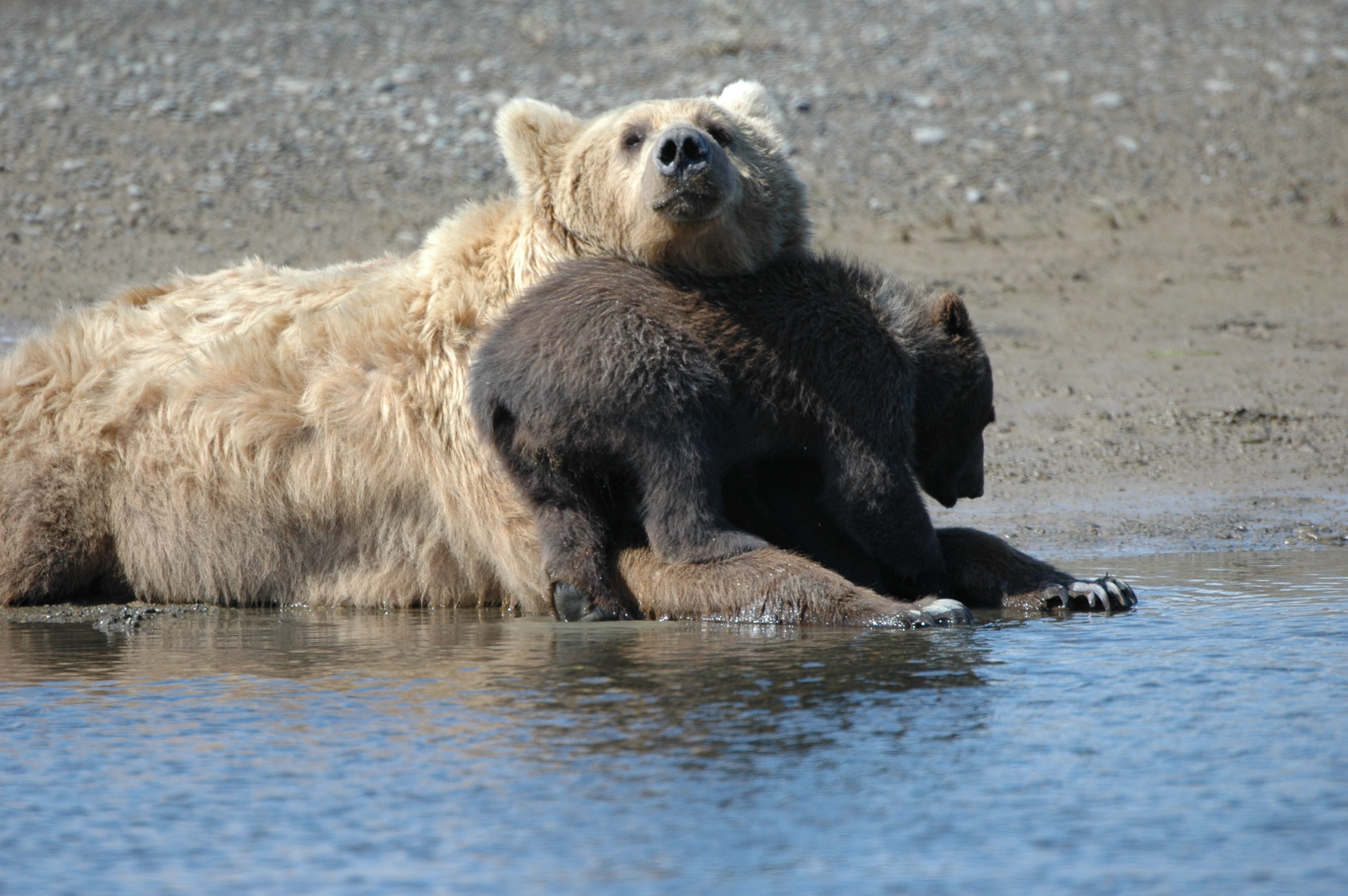
Banff bears use highway crossings to find mates


Photo copyright Jim Robertson

Photo copyright Jim Robertson


METRONEWS, By Staff The Canadian Press, February 18, 2014

BANFF, Alta. – Why did the bear cross the road?

A new study suggests that at least one reason bears in Banff National Park are crossing the Trans-Canada Highway is to find mates — vindication for a series of wildlife crossings installed by Parks Canada on the busy route to try to keep bears on either side of it genetically linked.

“It is clear that male and female individuals using crossings structures are successfully migrating, breeding and moving genes across the roadway,” says the paper published Tuesday in the Proceedings of the Royal Society, Britain’s national science academy.

The Trans-Canada Highway cuts through the heart of Banff National Park. For decades, scientists have been concerned that Canada’s busiest east-west road link was isolating grizzly and black bear populations on either side of it — especially after high wire fences were built along the road to reduce wildlife traffic deaths. So between 1982 and 1997, more than two dozen underground and overhead crossings were built to allow wildlife to move north-south.

In 2006, University of Montana ecologist Mike Sawaya began a three-year research project to see if the crossings were working. After analyzing DNA from nearly 10,000 hair samples collected from strategically placed strips of barbed wire, Sawaya has concluded that they are. Last summer, he published research proving that bears were using the crossings. His latest paper suggests they’re crossing for more than a patch of tasty berries. “We found enough movement and migration across the highway to infer that, yes, the crossing structures are allowing the transfer of genes.”

Sawaya said that grizzlies on either side of the road had been slowly becoming more genetically distinct from each other, although the effect wasn’t pronounced in black bears. DNA analysis of the hair samples shows that the two ursine neighbourhoods are gradually coming back together again. “The grizzly bear population was fragmented and we’re starting to see it be restored,” said Sawaya. “If the crossings continue to work the way they are, I think we’re going to see the dissolution of that genetic structure over time.”

The research team even documented how individual bears — both black and grizzly — were able to mate with a number of different females and wound up with offspring on both sides of the highway. Previous research conducted in California had suggested the only animals that use crossings are juveniles too young to breed. Sawaya found that wasn’t true. Almost half the black bears and more than one-quarter of the grizzlies that crossed were successful breeders. In fact, males who crossed most often seemed to be the ones with the most offspring.

And Sawaya said it’s probable that the crossings are being used by other animals such as wolves, lynx or cougars for the same purposes. “Certainly, you can draw more conclusions about other carnivores and other species that have similar characteristics. This is very indicative of how these crossing structures would perform for other large mammals.”

It’s good news for wildlife managers looking for ways to mitigate the effects of roads through wilderness.

Parks Canada now has a total of 44 Trans-Canada crossings in Banff, almost one every two kilometres. The solution was expensive — the overpasses cost about $1 million each — but Parks Canada carnivore specialist Jesse Whittington said they were worth it. “For the first couple years, they didn’t look like they worked very well,” he said. “Over time, grizzly bears have learned to use them on a regular basis.”

Whittington said the model has already been used in the U.S. for pronghorn antelope. “There are people looking to Banff from all over the globe to see how well these crossings are performing,” Sawaya said. “At the time, no one really knew they worked. They just assumed intuitively that they would … and it’s comforting to find that, yes, they are working as they were originally intended.”

— By Bob Weber in Edmonton

http://metronews.ca/news/canada/945896/banff-bears-use-highway-crossings-to-find-mates/

Ted Nugent pushes bear hunting in N.B.

Outspoken, gun-toting American rocker Ted Nugent is promoting the spring bear hunt in New Brunswick with his Sunrize Safaris.

The website tednugent.com offers hunters a chance to go to New Brunswick and shoot a trophy black bear

Nugent has hunted bear in New Brunswick before.

Ted Nugent

Ted Nugent has hunted black bear in New Brunswick in the past. (CBC)

He chronicles one such trip on the archerytalk.com blog in 2010 in a post titled: “Hi Spirit: New Brunswick Bruins. For a rockin’ good time, try for a far-North spring blackie.”

On that occasion, Nugent arranged for a bear hunting trip in New Brunswick after his band “rocked the house royal with Lynayrd Skynyrd (sic) in Barrie, Ontario, outside Toronto, Canada’s number one cosmopolitan megacity,” the blog post says,

Nugent was hunting with Slipp Brothers Ltd. Hunting and Outfitting in Hoyt, south of Fredericton. On the third day of hunting, with daylight running short, Nugent encountered a bear.

“Right then a big black blob appeared 60 yards out in the dense boreal scrub,” wrote Nugent. “My heart pounded like a double live gonzo big bass drum gone Motor city Mad Man full-tilt boogie. I love when that happens.”

Now Nugent is offering others the chance to experience that feeling with a Sunrize Safari to New Brunswick from June 1-7 for “the bear hunt of a lifetime,” with Toby Nugent — Ted’s son — and Paul Wilson of Sunrize Safaris in camp.

The cost of the outing in $3,550 per hunter plus $184.19 for a licence.

A similar outing for bear hunting in Quebec near Malartic is also offered by the company at a cost of $3,500.

Bear hunting has been on the decline in New Brunswick in recent years.

In 2004, more than 3,600 non-residents purchased bear licences. Last year, that number had fallen to below 2,000.

68439_10151399495155861_1116657731_n

Montana Bear Killings

Please note that the reward amount should be $7,600 instead of $6,600. Thanks!

FOR IMMEDIATE RELEASE November 26, 2013

Reward Increased for Tips on Grizzly Bear Shooting Northeast of Ovando

Photo of bears in the wild Copyright Jim Robertson

Photo of bears in the wild Copyright Jim Robertson

State wildlife officials continue to seek tips on the shooting death of a grizzly bear found November 3 northeast of Ovando in the Blackfoot Valley. Those that share information on the case may now receive up to $7,600 due to several private donations and a contribution from the US Fish & Wildlife Service.

Private donations, combined with $1,000 from the US Fish & Wildlife Service, bumped the reward amount from the original offering of $1,000 from Montana Fish, Wildlife & Park’s TIP-MONT program to $7,600 for tips that lead to a conviction in the case. Callers can remain anonymous and should phone 1-800-TIP-MONT ( 1-800-847-6668 ).

The female grizzly bear died of a gunshot wound and had three cubs of the year. FWP was able to trap two of the cubs and they will be transferred to the Bronx Zoo. Multiple attempts to capture the third cub were unsuccessful.

And speaking of Montana bears: http://missoulian.com/news/local/judge-fines-helena-couple-for-bucket-of-bear-paws-in/article_28dc6702-5633-11e3-a174-0019bb2963f4.html

Wisconsin on record pace for number of bear-hunting dogs killed this year

There’s a-near crisis situation going on in the cheese and crackers state, Wisconsin. It seems their hound hunters are losing dogs to wolves. Too bad for the dogs, but then again the only time they’re allowed out of their pen is to chase down and tree black bears so their “masters” can stumble up and shoot the terrified ursine.

Apparently the taxpayers are expected to foot the bill if a one of the hound hunters’ frantic dogs has a lethal run-in with a wolf. As the article below informs us, the Wisconsin Department of Natural “Resources” has a compensation program wherein hounders are paid $250.000 for their losses, if they choose to take up the barbaric sport. Of course, “it is possible, however, that because of the potential for compensation a hunter might be more likely to

photo Jim Robertson

photo Jim Robertson

put a dog at risk.”

According to Wisconsin newspapers:

This has been a deadly year for bear-hunting hounds.

According to the Wisconsin Department of Natural Resources’
<http://dnr.wi.gov/topic/wildlifehabitat/wolf/dogdeps.html#table&gt; dog
depredation report, 23 hounds have been killed by wolves while being used to
hunt bears or being trained to hunt bears since June 3, tying the record 23
killed in 2006, according to Brad Koele, DNR wildlife damage specialist.
Three pet dogs have also been killed.

Only six dogs were killed last year, but Koele says that was an aberration –
at least 20 were killed in each of the four years before that. Black bear
hunters in Wisconsin can use dogs until Oct. 1 and can hunt without dogs
until Oct. 8.

“It’s not that this year is abnormally high, it’s that last year was
abnormally low,” says Koele. “I don’t have an answer for why.”

The owners of the dogs can claim up to $2,500 from the state, though Koele
says not all of them receive or ask for the full amount.

“Not all claims are maximum payments,” he says.

Livestock, hunting dogs and pets are all eligible for compensation.

The death toll could be higher. Last year Republicans passed a bill
establishing a wolf hunt in the state, but a provision in the bill allowing
hunters to use dogs is tied up in court. However, dogs used to hunt wolves
would not be eligible for compensation.

According to a <http://www.ncbi.nlm.nih.gov/pubmed/23613910&gt; study earlier
this year from Michigan Tech, Wisconsin DNR data show that payouts for wolf
attacks on hounds “costs the state more than it has spent for wolf attacks
on any other category of domesticated animal, including calves, missing
calves or cattle.”

(Here’s a
<http://dnr.wi.gov/topic/wildlifehabitat/wolf/documents/wolfdamagepayments.p df> table showing the compensation paid out in Wisconsin since 1985, when
the program started.)

The Michigan Tech study found that the rate of wolf attacks on bear-hunting
hounds in Wisconsin is two to seven times higher than in Michigan.

Researchers at the college, who teamed up with Michigan DNR researchers for
the study, have a couple of ideas as to why.
<http://www.mtu.edu/news/stories/2013/april/story88261.html&gt; This bulletin
from Michigan Tech says the research team found that bear baiting season
starts earlier in Wisconsin and lasts longer.

“The longer you bait, the more opportunity you provide for wolves to
discover and potentially defend bear-bait sites,” said Joseph Bump, a
Michigan Tech wildlife ecologist, in the bulletin. “Most hunters release
their dogs at bait sites, and the longer the bait has been around, the more
likely hunting dogs are to encounter territorial wolves who have found and
are possibly defending the bait. So it appears that baiting is an important
factor.”

There’s another factor: Michigan doesn’t pay dog owners for their dead dogs.

“Compensation can have multiple effects,” Bump says. “It is a reporting
incentive, but it also creates an incentive for abuse. The net effect of
compensation is far from clear, and it is an important factor to study
further.”

Koele says providing an incentive for reporting attacks is important for
tracking efforts by the state. Wisconsin contracts with USDA Wildlife
Services to do a site investigation to verify that the depredation was
caused by wolves, he says.

“We don’t just pay based on what a hunter tells us,” he says. “There’s
actually an investigation to make sure we’re justly paying them.”

He says it is possible, however, that because of the potential for
compensation a hunter might be more likely to put a dog at risk.

“There could be that abuse occurring out there,” he says. “We really
wouldn’t know.”

Hunters Murder Two Bears, Then Whine About Injuries

Wildlife Photography ©Jim Robertson, 2013. All Rights Reserved

Wildlife Photography ©Jim Robertson, 2013. All Rights Reserved

Alright, I’ve had enough of this one-sided, narcissistic reporting!

Do I have to point out to the AP that their article completely missed the point here by making a hunter the victim of the story? They report that an hour after wounding the bear with an arrow… “The hunter located the wounded bear and shot it twice more with his bow. The bear then ran down the hill and encountered a man who had arrived to assist the hunter.”

WTF? How much suffering does a non-human animal have to go through before her plight is even considered by the media and she’s seen as the victim? Here’s how the AP titled the article:

Injured black bear injures hunter near Thompson Falls

Associated Press

KALISPELL — State wildlife officials say a 150-pound female black bear wounded by a bow hunter bit the arm of the hunter’s companion before succumbing to its injuries.

Fish, Wildlife and Parks spokesman John Fraley says a man was hunting near Thompson Falls on Tuesday when he shot a black bear with a bow and arrow.

The hunter waited for several hours to make sure the bear was dead before he started tracking it. The hunter located the wounded bear and shot it twice more with his bow. The bear then ran down the hill and encountered a man who had arrived to assist the hunter. The bear bit the second man’s arm before it died.

The injured man was treated at the hospital in Plains and released.

FWP says the hunter legally tagged the bear.

….and here’s another article with the same slant, which also ends with a dead bear. Note that the real victim was just out eating berries…

September 11, 2013 at 2:43 PM

Shots from other hunters halted grizzly attack in Alaska

Posted by

ANCHORAGE (AP) — An Alaska grizzly bear wounded by a Rhode Island hunter survived more than 90 minutes before attacking the man and slashing his head.

Alaska State Troopers say John Matson sustained injuries Monday to his head and body. The wounds were not considered life-threatening.

Troopers tell the Anchorage Daily News that Matson was hunting with another hunter and an assistant guide.

Matson shot a bear feeding on berries. The bear rolled into brush but popped out and ran.

The hunters waited about 90 minutes before going into thick cover after the bear.

Troopers say the assistant guide heard Matson scream as the bear attacked. The other men fired shots and the bear ran off.

The men walked about a mile to their camp. Matson was flown Tuesday to Anchorage

Maine’s bear hunting practices back in the crosshairs

Wildlife Photography ©Jim Robertson, 2013. All Rights Reserved

Wildlife Photography ©Jim Robertson, 2013. All Rights Reserved

Almost 10 years after failing to abolish baiting and other methods, animal-welfare activists want to revisit the debate: Are these cruel or are they viable wildlife management tools?

By  Deirdre Fleming dfleming@mainetoday.com Staff Writer

Bear hunters in Maine again find themselves in the sights of animal-welfare advocates who contend that some of their practices are inhumane.

Less than 10 years after Maine residents voted down a divisive referendum effort to abolish the use of bear hunting with bait, dogs and traps, the debate has re-emerged.

As hunters prepare for the first day of bear season Monday, sportsmen, politicians and animal-rights advocates are gearing up for a renewal of the referendum battle that spiked passions on both sides in 2004.

Bear-baiting involves placing food in the same location repeatedly for about a month before the season opens in hopes a bear will get in the habit of visiting the site regularly. Hunters also use dogs wearing radio collars to force a bear up a tree and keep it there until the hunter tracks it down electronically. Traps such as wire foothold snares are also used to hunt bears.

Supporters of banning the practices say they are cruel and give hunters an unfair advantage.

Opponents argue that the practices are vital to keeping the state’s bear population in check. If they are banned, the population will explode, and conflicts between bears and people will become commonplace, even in developed areas, they say.

Maine has one of the largest black bear populations in the lower 48 states, according to the Department of Inland Fisheries and Wildlife, and is the only state to allow all three controversial practices.

A coalition led by the Maine chapter of the Humane Society of the United States, called Mainers For Fair Bear Hunting, is behind the ballot initiative. It aims to collect as many as 80,000 signatures next month to get a referendum question on the 2014 ballot. The Secretary of State’s Office is still drafting language on the referendum question.

In 2004, voters rejected the referendum question seeking a ban on the three hunting practices by a margin of 53 percent to 47 percent. Each side spent more than $1 million on the campaign.

Those backing a ban on the practices said last week they think they’ll win this time.

“This is a last resort (after trying several times without success in the Legislature). But with the additional 10 years of experience, we’re confident we can win on the ballot,” said Katie Hansberry, director of the Maine chapter of the Humane Society.

Maine hunters expected the issue to resurface, and that it would involve another expensive ballot fight.

“I think we knew they’d be back,” said David Trahan, director of the Sportsman’s Alliance of Maine. “(The Humane Society is) a nationwide group. And (it) raises a lot of money.”

MAINE A FOCAL POINT

Proponents say the three controversial bear-hunting methods give hunters an unfair advantage and that trapping or shooting a bear over bait is inherently cruel.

Maine is a focal point in the debate over bear-hunting practices because it is the only state where all three are allowed.

Robert Fisk, director of the Maine Friends of Animals, which led the 2004 effort to ban the hunting practices, said the public is more familiar with the issues today, and that gives ban supporters an advantage.

“I believe we have an excellent chance of winning this time. The opposition’s alarmist strategies and scare tactics that were prevalent in 2004 can be exposed this time around. People are much more aware of animal protection issues than they were 10 years ago,” Fisk said.

Proponents say they have data and experiences from other states where the Humane Society successfully banned the use of these bear hunting methods, and that much of the Maine public was educated on the issue in 2004.

More: http://www.onlinesentinel.com/news/maines-bear-hunting-practices-back-in-the-crosshairs_2013-08-25.html


Animal Advocates Say New Mexico’s Bears are Under Siege

Wildlife Photography ©Jim Robertson, 2013. All Rights Reserved

Wildlife Photography ©Jim Robertson, 2013. All Rights Reserved

Renee Blake, Public News Service – NM
August 6, 2013 ALBUQUERQUE, N.M. –

What is being portrayed by some as an infrequent and humane response to hungry bears entering towns looking for food, is actually quite another matter, according to Jan Hayes founder of Sandia Mountain Bear Watch. Hayes is looking for the state to institute stopgap diversionary feeding to keep the bears alive at this difficult time, and keep them away from people.

She said what is happening to Sandia Mountain bears is an ecological disaster, that the drought and lack of food for the bears, along with the hunter-focused attitudes of New Mexico Game and Fish, add up to a decimated bear population. “They want the animals to be there for hunter opportunity,” she said. “Their only mode of management is to trap or kill. The Sandias is a wildlife preserve. So, it’s not a moneymaker for Game and Fish. Bears are a problem species that they would really prefer not be here.”

Stewart Liley, big-game program coordinator for N.M. Game and Fish, said feeding bears would cause them to become increasingly dependent upon artificial food sources. Hayes however said she believes the temporary measure would serve to get the bears “over the hump” and save their population in the Sandia Mountains. She is requesting a meeting with someone in Governor Martinez’ administration on the matter.

Hayes declared that the current style of bear management in the Sandia Mountains has caused an alarming rate of damage that cannot be overcome. “We’re looking at bears that are completely lost to this population. There’s no way they can keep up with reproduction,” she said. “And we also expect 100 percent attrition of first-year cubs this year. They’re very slow reproducing. Our bears don’t even have their first baby until they’re five or six.”

Mary Katherine Ray, Rio Grande Chapter wildlife chair of the Sierra Club, said New Mexico adheres to the North American Wildlife Conservation Model, which says that wildlife, from roadrunners to butterflies, belongs to everyone in the state. That includes the bears in the Sandia Mountains. “We all have a share in owning that wildlife, and it’s supposed to be democratically adjudicated,” Ray declared. “But when you look at the composition of the Game Commission, every last one of them is a hunter.” She said she believes that mindset is getting in the way of seeing the benefits of diversionary feeding.

Ray said that where it has been tried, bears that have been the beneficiaries of diversionary feeding have not become either dependent or dangerous.

See more at: http://www.publicnewsservice.org/index.php?/content/article/33828-1#sthash.l9IhArpU.dpuf

Today is Opening Day of “Bear Season” in Washington!

The first day of August: summer is at its peak, young birds have fledged and the wild berries are just now ripening up…

But on this very same day, demonic dimwits and narcissistic nimrods that enjoy making sport of murdering animals are out trying to end the life of a humble being whose only focus lately is filling up on fresh fruit.

That’s right; believe it or not, August 1st is the beginning of bear season across much of Washington! From today until November 15th, any loathsome scumbag with a bear tag and an unwholesome urge to kill can “bag” himself a bruin—just for the sport of it—in this presumably progressive state.

Sure, one or two people may be killed by bears in a given year, but over that same time period 50 will die from bee stings, 70 will be fatally struck by lightning and 300 will meet their maker due to hunting accidents. A person has about as good a chance of spontaneously combusting as being killed by a bear.

Meanwhile, tens of thousands of bears are killed by people each year, and no one is keeping track of how many are wounded, only to crawl off and die slowly without hospital care to pamper them back to health. 30,000 black bears are slain during legal hunting seasons in the US alone. Possibly another 30,000 fall prey each year to ethically impotent poachers seeking gall bladders to sell on the Chinese black market. Victims lost to that vile trade are eviscerated and left to rot, since bear meat is not considered a desirable taste treat. To make it palatable, backwoods chefs traditionally douse the flesh and offal with salt and grind the whole mess into sausage.

Why then, is it legal to kill bears when we have long since concocted a myriad of ways to turn high protein plant foods (such as soy, seitan or tempeh) into a perfectly scrumptious, spicy sausage, sans intestines? Unquestionably, the hunting of bears is nothing but a warped distraction motivated by a lecherous desire to make trophies of their heads and hides. But, dangerous and terrifying as they must seem to trophy hunters out to prove their manhood from behind the security blanket of a loaded weapon, they aren’t the “most dangerous game,” as the serial killer, Zodiac (an avid hunter who grew bored with “lesser” prey and progressed to hunting humans) divulged.

An irrational fear of bears dates back to the earliest days of American history and is customarily accompanied by obtuse thinking and quirky spelling. The most famous inscription (carved into a tree, naturally) attributable to Daniel Boone (that guy who went around with a dead raccoon on his head) bragged how he “…cilled a bar…in the year 1760.” The bears Boone killed (and there were many) in North Carolina and Tennessee were black bears, a uniquely American species that, like coyotes, evolved on the Western Hemisphere.

Every year a fresh crop of Elmers decides to play Daniel Boone and blast a poor little black bear with a musket ball (which, although extremely painful and traumatic, often isn’t enough to kill them outright). Others prefer the test of archery, savagely impaling innocent bears who are just out trying to find enough berries to get them through the winter.

Rachel Carson, whose 1962 book, Silent Spring, advanced the environmental movement, saw the brutality of hunting as a detriment to civilized society:

“Until we have the courage to recognize cruelty for what it is—whether its victim is human or animal—we cannot expect things to be much better in this world. We cannot have peace among men whose hearts delight in killing any living creature. By every act that glorifies or even tolerates such moronic delight in killing we set back the progress of humanity.”

The question is, how long will society continue to tolerate the moronic act of sport hunting?

————

This post contained excerpts from my book, Exposing the Big Game: Living Targets of a Dying Sport
http://www.earth-books.net/books/exposing-the-big-game

Text and Wildlife Photography ©Jim Robertson, 2013. All Rights Reserved

Text and Wildlife Photography ©Jim Robertson, 2013. All Rights Reserved

NC Groups offering $20,000 in dead bear case

Jun. 21, 2013   |
A black bear snacks on birdseed while visiting the home of Greg Perry in Black Mountain this spring.

A black bear snacks on birdseed while visiting the home of Greg Perry in Black Mountain this spring.  /  Special to the Citizen-Times
Written by
Romando Dixson


Anyone with information about a dead, painted bear dumped on a road in Buncombe County is asked to call the N.C. Wildlife Resources Commission at 800-662-7137. Callers may remain anonymous. It is a 24-hour hotline.

ASHEVILLE — As authorities Friday continued their investigation into who killed a bear, painted its head and claws, and dumped the carcass in Buncombe County, the N.C. Wildlife Federation added $17,000 in potential reward money in hopes anyone with information will speak up.

The conservation group’s addition raises the reward pool to $20,000 for the person or persons who provide information that directly leads to an arrest and criminal conviction, civil penalty assessment or forfeiture of property by the perpetrator. The U.S. Fish and Wildlife Service and U.S. Service Forest offered the initial $3,000 in reward money.

The $17,000 is the largest amount of reward money the state Wildlife Federation has offered in a poaching case, CEO Tim Gestwicki said Friday.

“This kind of ridiculous behavior necessitates a large reward to get folks to provide some tips,” he said.

“WHATS BRUIN” was written in white paint on the bear’s head, along with “w-h-a-t-s” across the claws on the right paw and “b-r-u-i-n” across the claws on the left paw, the N.C. Wildlife Resources Commission said Thursday. The carcass was found this week on a road in northwest Buncombe County.

Authorities believe the paint was referencing Operation Something Bruin, a collaborative undercover investigation focused on the illegal poaching of bears and other wildlife in North Carolina and Georgia.

Ten individuals were convicted this month in U.S. District Court of federal charges stemming from four years of undercover work during Operation Something Bruin [see: NC Bear Poachers Finally Getting Punished.] More cases are pending in Haywood County.

It is unclear how the bear was killed, said Lt. Tim Sisk of the N.C. Wildlife Resources Commission.

“We hope the investigation yields results and that the message is crystal clear: poaching, destroying wildlife in any ways, especially cowardly acts of wanton waste in North Carolina, will not be tolerated,” Gestwicki said. “We condemn in full any illegal wildlife violations and remain resolved to assisting state and federal agencies in upholding the regulations and guiding principles of fish and wildlife management.”

The nonprofit conservation group has a wildlife poaching reward fund. Private donors provide the money, Gestwicki said. In July 2012, the state Wildlife Federation offered $15,000 for information about a case in which three elk were shot and killed in May near Great Smoky Mountains National Park.

The group usually provides rewards between $1,000 and $5,000 in poaching cases. Gestwicki said can’t recall such an act and described it as atrocious and intolerable.

“We feel strongly that this malicious and cowardly act of illegal activity has no place in North Carolina,” Gestwicki said. “We are upping the ante to hopefully entice anyone with information to come forth. We are providing these resources to underscore the seriousness we place on the poaching and outright desecration of this animal.”

NC Bear Poachers Finally Getting Punished

Men get prison for poaching in WNC

Four-year probe uncovers illegal bear, deer hunting in WNC national forests

BRYSON CITY — A judge sentenced seven men to time in prison for poaching bears and deer and other illegal hunting activities on national forests in Western North Carolina after they were charged following a years-long law enforcement probe.

The arrests were the result of a four-year undercover investigation called Operation Something Bruin, in which officers infiltrated poaching circles to document violations, said Anne Tompkins, U.S. Attorney for the Western District of North Carolina.

Ten defendants pleaded guilty and were sentenced this week in U.S. District Court in Bryson City by Magistrate Judge Dennis Howell. Seven of the men received prison terms of up to 30 days.

“We anticipate that the success of Operation Something Bruin will send a strong message to poachers and would-be violators to think twice before they engage in illegal hunting activities,” Tompkins said. “Together with our federal and state law enforcement partners we will combine forces to combat illegal hunting, protect our wildlife and conserve our natural resources.”

Officials announced in February that the undercover operation netted 81 wildlife violators and some 980 violations in WNC and northern Georgia. About 100 wildlife officers began serving warrants at the time.

Posing as hunters and using social media to make contacts, officers with the N.C. Wildlife Resources Commission and the Georgia Department of Natural Resources infiltrated groups suspected of poaching.

Officials said the violations included:

• Bear baiting

• Illegal taking of bears, deer and other wildlife;

• Illegal use of dogs: and

• Operation of illegal bear enclosures and guiding hunts on national forest lands without the required permits.

“The continued success of Operation Something Bruin is a fine example of state and federal agencies coordinating efforts to protect the resources of our national forests,” said Steve Ruppert, special agent in charge with the U.S. Forest Service.

More: http://www.citizen-times.com/article/20130615/NEWS/306150024/Men-get-prison-poaching-WNC?nclick_check=1

Photo Copyright Jim Robertson

Photo Copyright Jim Robertson