The World I Long For

On the wall of my weight room is a poster-sized print of the painting below, depicting North America’s wildlife at the site of California’s La Brea Tar Pits, 20,000 years ago: It’s a heartening image, reminiscent of the kind of biodiversity found only on the plains of Africa.

Familiar species still around today included peccary, deer, elk, coyote, bobcat, cougar, wolf and brown bear (the last two surviving species were hunted and trapped to extinction in California during the nineteenth and twentieth centuries), golden eagle, ravens and heron.

But the list of species once common, now extinct, on this continent is much longer. It includes American camels, horses, the California tapir, American mastodon and Columbian mammoth (two former representatives of the elephant family sorely missed on this continent today); also, a couple of now nonexistent bison (the giant and the ancient bison), three species of ground sloths: the Harlan’s, Jefferson’s and the Shasta (the latter, a mere daisy of a ground sloth compared to the 3,500 pound “giant” ground sloth).

They, as well as the stilt-legged llama and the dwarf pronghorn, the American lion, cheetah and saber-toothed cats, the dire wolf and the short-faced bear all disappeared shortly after the arrival of our species—the one blessedly absent from the scene at La Brea.

To me, the most beautiful thing about the painting is that the human species hadn’t yet shown up and started doing the damage they’re infamous for. Just pencil in a few stick figures and well over half the other species disappear. Sure, the genus Homo did less damage with stone-tipped spears than they could have with drones or AK-47s, but to the non-humans of the world, we were mighty dangerous and destructive nonetheless.

While many people nowadays harken back to a time before the emergence of modern technology and prior to the dawn of civilization—convinced that a harmonious era must have existed somewhere in human pre-history—when I pine for the good old days, this is the world I think of…

00-intro

Wolves threatened: Ending federal protection is a mistake

http://www.mercurynews.com/opinion/ci_23578921/wolves-threatened-ending-federal-protection-is-mistake

By Winston Thomas

Special to the Mercury News

Posted: 07/02/2013 10:55:26 AM PDT

Updated: 07/02/2013 12:51:06 PM PDT

Until recently the restoration of the gray wolf to a portion of its natural habitat in the lower 48 was one of the success stories of the Endangered Species Act of 1973. However, the job is far from complete, and now the U.S. Department of the Interior wants to allow the states to return to many of the same methods of the late 1800s and early 1900s that led to the eradication of the wolf in California and elsewhere.

On June 7, the US Fish and Wildlife Service announced its plan to remove the gray wolf, Canis lupus, from the federal list of endangered wildlife in the remainder of the lower 48 states where it is not already delisted (except for the Mexican wolf in New Mexico and Arizona). The gray wolf will

Gray wolf at the Wildlife Science Center in Forest Lake, Minn. (DAWN VILLELLA / AP)
be dropped, not because it has recovered across most of its former range, but because the Department of the Interior appears to be responding to political pressure rather than peer reviewed science.

Elk hunting groups mistakenly see the wolf as competition for their sport. This represents a grave misunderstanding of the ecology of predator-prey relationships.

Many livestock producers have not begun to explore the non-lethal methods proven to reduce conflict between wolves and livestock. Even though livestock losses to wolves accounted for less than .01 percent of the total livestock in Idaho, Wyoming and Montana in 2012, many sheep and cattle ranchers want to see the wolf eradicated.

If the gray wolf is delisted, then


management of wolf populations reverts to each state. Wolves were delisted in 2011 in Idaho and Montana, and 2012 in Wyoming. Management in these states is a cruel euphemism for indiscriminate, aggressive hunting, trapping and snaring of wolves. Since delisting in Idaho, nearly 700 wolves have been killed by recreational hunting. In some areas of Idaho, wolves, including lactating females and pups, can be killed at any time. In 83 percent of Wyoming, wolves can be killed year round, in any number of ways, without a license. And Montana’s proposed management plan will allow up to five wolves to be killed per hunter/trapper. This is not scientific stewardship.


The now famous lone wolf OR-7 traveled from Oregon into California in December 2011 but wandered back into Oregon in March of this year. It defies logic to declare the gray wolf population recovered in California. The same is true in other states with excellent wolf habitat and abundant elk and deer such as Utah and Colorado. Like California, these states have no established wolf populations, yet there would be no federal protection for a wolf should it wander in. This action will end recovery in these states before it starts. Why delist the gray wolf in states where it does not yet exist, unless the goal is to keep the population at zero?

The bald eagle was delisted in 2007, but we have not allowed open hunting and trapping. Why should we do that with wolves? The stated goal of the Endangered Species Act is to save species from extinction and to fully recover the species by removing threats to its survival.

The 90-day public comment period for the proposed gray wolf delisting ends Sept. 11. Newly confirmed Secretary of the Interior Sally Jewell needs to hear from the public that wolf recovery has not even begun in California and other states. Wolves need our voices. Please howl your support for federal protection of the gray wolf until recovery is complete, and stop the wolf hunt.

Winston Thomas, a biologist and geneticist who has worked in the Bay Area biotech industry for 22 years, is Pacific Region representative and an advisory board member of Living with Wolves (www.livingwithwolves.org).

Murder Countless Coyotes, Win a Belt Buckle

“We must never let despair stop us in our mission. I have to believe there are more of us than them.”
~Linda Delano, Boulder, Colorado

From Project Coyote:

We have good news and not so good news about last weekend’s coyote killing contest in California.

The good news is that Project Coyote and allies -with your help- successfully exposed this brutal contest, shining the spotlight on a heartless practice. We generated national media on an event that, until now, had gone virtually unnoticed.

We also generated more than 20,000 letters and emails opposing the gratuitous slaughter bringing this issue to the attention of the California Fish and Game Commission and the Department of Fish and Wildlife. Our live testimony before the Commission in Sacramento was powerful and well-received.

Galvanizing a grassroots force of more than 25 wildlife conservation and animal protection organizations to oppose this hunt – representing more than 1 million Californians – comes on the heels of our success in helping stop a coyote contest hunt in New Mexico. Legislation has just been introduced there to ban contest hunts statewide. This is great news.

The sad news is that we weren’t able to stop this contest hunt in California because the law allows this wanton abuse of our wildlife. Nor do we know how many coyotes died at the hands of 250 eager contestants because the law doesn’t require them to report the body count. Sponsors boasted that the event was “enjoyable” and “successful.” A silver belt buckle was awared to the team with the biggest body count. We worked closely with a reporter documenting the event but it was tense going; he and his 13 year old granddaughter were met with open hostility and harrassment.

We promise this: on behalf of the coyotes who died needlessly that we will not stop working for a better way, a better day for coyotes. With your voice, your support and your heart, we will work to end the heartless persecution of our native Song Dogs.

On this Valentine’s Day, please consider giving a gift to Project Coyote to help us continue to expose these wildlife massacres and to seek reforms in the ways predators are “managed” in the U.S.

logohome

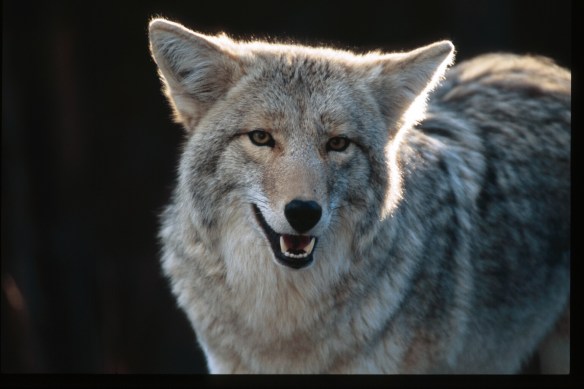
Coyote photo by Jim Robertson

California Lynch Mob Targeting Coyotes

In a scene all too reminiscent of something out of the movie, Mississippi Burning, a rural sheriff is urging his hate-filled, violence-prone constituents to defy federal law enforcement officers and continue their attacks on the objects of their redneck derision. This time, instead of the Deep South, the setting is extreme Northeastern California, and rather than the Civil Rights Amendment, the federal law being defied is the Endangered Species Act. The potential victim warranting protection is a wolf known as OR7, who could be caught in the crossfire of a depraved tradition know as a “contest hunt” targeting coyotes with the savage glee of an angry lynch mob.

The above analogy highlights how far we’ve come in terms of civil rights since the early ‘60s—and just how far we have to go before the country embraces the mere concept of animal rights. Try to suggest relegating any group of people to the back of the bus these days and see how many friends you make. But any asshole with an evil will (and maybe an extra shotgun or semi-automatic rifle or two to offer as grand prize for the highest body count) can legally propose a contest to kill as many intelligent, highly social—yet woefully unprotected—canines as state “game” laws allow. (And most western state game departments don’t even set a “bag limit” on coyotes.) Sadly, non-humans still have a ways to go before any but the most endangered are granted even the right to their very lives.

From Project Coyote:

For Immediate Release, February 8, 2013

Modoc County Sheriff Goes Rogue, Vows to Defy Federal Laws During Coyote Hunt

Hunt Continues Despite Public Opposition, Concerns over California’s Lone Wolf

SAN FRANCISCO — The Animal Welfare Institute, Project Coyote and Center for Biological Diversity are seeking an immediate investigation of Modoc County Sheriff Mike Poindexter for his decision to defy federal laws and advocate the violation of those laws during this weekend’s Coyote Drive 13, a coyote-killing contest in and near Modoc County.

A letter to the editor of the Modoc County Recorder on Feb. 7 by Sheriff Poindexter said he won’t “tolerate any restriction of legal hunting on our public lands” despite federal laws prohibiting or regulating coyote hunting on federal lands in and near Modoc County.  He also recommended that any hunt participant who is questioned or detained by federal enforcement officials for illegally hunting on federal lands to “cooperate but stand their ground and call the Sheriff’s Office” and that sheriff deputies “absolutely will not tolerate any infringement upon your liberties pertaining to accessing or legally hunting on your public lands.”

“Despite claiming to uphold the U.S. Constitution, Sheriff Poindexter has decided he will not enforce and is encouraging others to flout those federal laws which he opposes,” said D.J. Schubert, wildlife biologist with the Animal Welfare Institute. “This is a blatant breach of his duty as a law enforcement officer and a violation of the Law Enforcement Code of ethics.”

The groups have contacted the district attorney for Modoc County, the California Attorney General’s office, the U.S. Attorney for the Eastern District of California and a number of state and federal agencies advising them of Sheriff Poindexter’s comments and asking for urgent intervention.

“These laws are on the books to protect our public lands and the wildlife that live there. Not only does this coyote hunt put OR-7 and other wolves at risk, but now it’s also shaping up to be some kind of Wild West misadventure where the sheriff is thumbing his nose at federal laws,” said Amaroq Weiss, West Coast wolf organizer at the Center for Biological Diversity.

Poindexter’s statement comes in the wake of public outcry that generated more than 20,000 letters, emails, and petition signatures into the California Department of Fish and Wildlife and the California Fish and Game Commission calling for an end to Coyote Drive 2013 and a top-to-bottom evaluation of the state’s approach to managing predators in California.

“Given the serious potential for violations of state and federal laws barring predator hunting on public lands, the threat this hunt poses to OR-7 and any un-collared wolves in the area, and the public’s clear opposition to this killing contest, the state should take immediate action to call off Coyote Drive 2013 now,” said Camilla Fox, Project Coyote executive director and a wildlife consultant to the Animal Welfare Institute.

—-

Project Coyote promotes educated coexistence between people and coyotes by championing progressive management policies that reduce human-coyote conflict, supporting innovative scientific research, and by fostering respect for and understanding of America’s native wild “song dog.” http://www.projectcoyote.org/

The Animal Welfare Institute is dedicated to reducing animal suffering caused by people. AWI engages policymakers, scientists, industry and the public to achieve better treatment of animals everywhere — in the laboratory, on the farm, in commerce, at home, and in the wild. http://awionline.org

The Center for Biological Diversity is a national, nonprofit conservation organization with more than 450,000 members and online activists dedicated to the protection of endangered species and wild places. http://www.biologicaldiversity.org/

You can find the Stop the Coyote Contest Hunt Petition at Change.org:

http://www.change.org/petitions/ca-dept-of-fish-wildlife-f-g-commission-stop-coyote-killing-contest
Text and Wildlife Photography ©Jim Robertson, 2013. All Rights Reserved

Text and Wildlife Photography ©Jim Robertson, 2013. All Rights Reserved