People were appropriately appalled at recent news that Syrian rebel leader, Abu Sakkar, ate part of a government soldier’s innards in a primitive display of human evil possibly unrivaled on film (aside from those clandestine videos taken in slaughterhouses to expose animal cruelty, or the footage wolf hunters themselves spread around the internet to impress their buddies and sicken wolf-advocates).
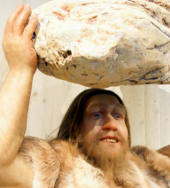
Cannibalism, an abhorrent, aberrant act practiced by carnivorous humans in one form or another the world over since the earliest of times (according to archaeological finds), has fallen out of fashion today for all but the most warped, serial killer-types.
In a new, almost apologetic article called Face-to-face with Abu Sakkar, Syria’s ‘heart-eating cannibal,’ BBC’s Paul Wood tells of his meeting with the Hannibal Lecter of the Mid-East (safely restrained in a straightjacket and hockey mask, one would hope)……
It sounded like the most far-fetched propaganda claim – a Syrian rebel commander who cut out the heart of a fallen enemy soldier, and ate it before a cheering crowd of his men. The story turned out to be true in its most important aspect – a ritual demonstration of cannibalism – though when I met the commander, Abu Sakkar, in Syria last week, he seemed hazy on the details.
“I really don’t remember,” he says, when I ask if it was the man’s heart, as reported at the time, or liver, or a piece of lung, as a doctor who saw the video said. He goes on: “I didn’t bite into it. I just held it for show.”
[A quasi-denial reminiscent of Bill Clinton’s bogus, “But I didn’t inhale” defense.]
The video says otherwise. It is one of the most gruesome to emerge from Syria’s civil war. In it, Abu Sakkar stands over an enemy corpse, slicing into the flesh.
“It looks like you’re carving him a Valentine’s heart,” says one of his men, raucously. Abu Sakkar picks up a bloody handful of something and declares: “We will eat your hearts and your livers you soldiers of Bashar the dog.”
Then he brings his hand up to his mouth and his lips close around whatever he is holding. At the time the video was released, in May, we rang him and he confirmed to us that he had indeed taken a ritual bite (of a piece of lung, he said).
Now, meeting him face-to-face, he seems a bit more circumspect, though his anger builds when I ask why he carried out this depraved act.
“I didn’t want to do this. I had to,” he tells me. “We have to terrify the enemy, humiliate them, just as they do to us…”
Before the uprising, he was working as a labourer in Baba Amr. He joined the demonstrations when they started in the spring of 2011. Then, he says, a woman and child were shot dead at a protest. His brother went to help. He, too, was shot and killed.
Abu Sakkar seems unsure how to respond to his notoriety. He is, by turns, sheepish, nervous, angry and bitter. He definitely has the look of a man who has seen too many bad things. At the end of our interview he says he is an “angel of death” coming to cash in the souls of the enemy.
It is possible that Abu Sakkar was mentally disturbed all along. Or perhaps the war made him this way. War damages men – and Syria is no different.
As the poet W H Auden wrote: “Those to whom evil is done, do evil in return.”
………………………….. 
Where will it all end? Eating human organs (whether heart, lung or liver) out of hatred, rage, to steal another’s life force or to terrify one’s enemies, definitely amounts to evil in my book.
With very few exceptions, most animal species don’t eat others of their own kind. (Some species of gulls will scavenge on the remains of another washed up on the beach; on the other hand, wolves may kill wolves from other packs, but will not eat them.) But cannibalism is not such a stretch for a species like Homo sapiens which eats or has eaten everything that creepeth, swimeth or otherwise moveth on the Earth—from snails to whales and everyone in between.
Indeed, if ancient humans had video cameras, Abu Sakkar’s stunt would seem like small potatoes.
As recently as the early 1800s, New Zealand’s Maori people practiced warfare-related cannibalism, such as the type Sakkar resurrected. New Zealand was blissfully human-free until only a thousand years ago. The Maori were the first settlers of the islands, arriving by canoe several centuries before Europeans. Known for practicing cannibalism in the heat of “battle rage,” the Maori made it onto the list of the Top Ten cases of human cannibalism:
In October 1809 a European convict ship was attacked by a large group of Maori warriors in revenge for the mistreatment of a chief’s son. The Maori killed most of the 66 people on board and carried dead and alive victims off the boat and back to shore to be eaten. A few lucky survivors who were able to find a hiding spot inside the mast of the boat were horrified as they watched the Maori devour their shipmates through the night until the next morning.
North of Australia, an anthropologist studying the Mianmin, a mountain-dwelling tribe in Papua New Guinea, witnessed them carrying off the dead of a neighboring tribe, the Atbalmins, after a successful lethal raid and asked them, “Why?” The Mianmins told the scientist they considered them “good meat.” The Atbalmins were outsiders, different from the Mianmins, who thought of them as “game.”
Also in New Guinea, during the 1950s and ’60s, How Stuff Works tells us: anthropologists studying the Fore people of Papua New Guinea documented an outbreak of kuru, a degenerative spongiform brain disease. The Fore contracted the disease by consuming the brain of their relatives as part of a funerary ritual. Kuru, which is the human version of mad cow disease, is highly contagious.
The only reason cows ever acquired “mad cow disease” is that “beef” producers began the capitalistic ritual of grinding up animal flesh and mixing it with their feed to produce a high protein gruel, thus creating unwitting cannibalistic cattle (possibly the only thing more bizarre than human cannibalism itself).
Ted Turner (the T.V mogul, oldies colorizer, big-time bison-flesh-peddler and former hubby to fellow activist Jane Fonda) predicted in 2008 that unless we drastically curb global warming, by 2040 “…none of the crops will grow. Most of the people will have died and the rest of us will be cannibals,”
Turner also said the population is another problem that must be handled. “We’ve got to stabilize the population,” he told PBS interviewer, Charlie Rose, “We’re too many people. That’s why we have global warming. We have global warming, because too many people are using too much stuff. If there were less people, they’d be using less stuff,” he said.
He also launched verbal offensives against the U.S. war on terror, describing war as senseless and suggesting a cutback in military budgets. “Right now the U.S. is spending $500 billion a year on the military, which is more than all [other] 190 countries in the world put together.
The timing of Turner’s prediction might be a bit off the mark as far as complete crop failure, mass starvation and rampant cannibalism, but one thing’s for certain: as long as people continue to feed their taste for the flesh of others—whether hunted venison, free-range bison, grass-fed beef or factory-farmed pig meat—the thought of moving laterally to include their fellow man in their bill of fare will be much easier to swallow.
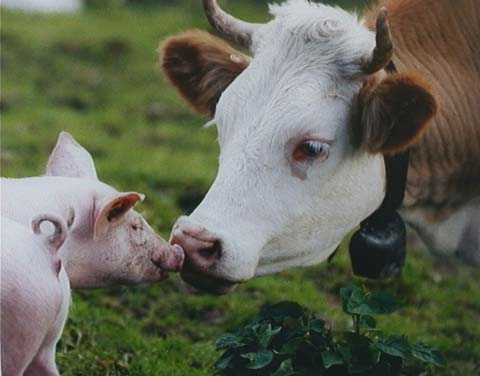
It certainly stands to reason that starving humans in future decades might eventually turn to the most numerous flesh foods available—other humans—for survival. But the vegan diet cuts out the middle man (so to speak), allowing for more plants and grains to go to feeding human beings themselves, rather than cows, pigs and chickens. The only solution to avoid a nightmarish future that includes the depravity of cannibalism and is to move beyond the evils of animal exploitation.








 Exposing the Big Game