Exposing the Big Game

Forget Hunters' Feeble Rationalizations and Trust Your Gut Feelings: Making Sport of Killing Is Not Healthy Human Behavior

Exposing the Big Game

The only thing more upsetting than Harambe the gorilla’s death was the reality of his life

http://www.independent.co.uk/voices/the-only-thing-more-upsetting-than-harambe-the-gorillas-death-was-the-reality-of-his-life-a7057981.html

Surely we can begin to agree that animals which share 98 per cent of our DNA should not be kept as entertainment for us to gawk at in a zoo

Yet again, captivity has taken an animal’s life. The latest victim: a 17-year-old gorilla named Harambe, who was gunned down after a young boy managed to crawl through a fence before falling into his enclosure at the Cincinnati Zoo.

The incident (which could have been prevented by surrounding the enclosure with a secondary barrier) has generated a great deal of debate online, some extreme – one tweet said, “[I]f you have to shoot – aim for the least endangered one,” while an Express columnist took the view that “zoo staff did what you might think all people would want: they put the human life first”. But arguing over whose life is more valuable misses the point. What we should be asking is why intelligent, self-aware animals are still being displayed as living exhibits for humans to gawk at.

Harambe and other animals serving life sentences in zoos are leading lives of quiet desperation. They are denied the most basic freedoms, including being able to choose where to roam, when and what to eat, and whom to socialise with. It’s no wonder that these magnificent animals frequently exhibit signs of extreme depression and related psychological conditions, such as pacing, rocking and eating their own vomit, which is unheard of in their wild counterparts, as they struggle with the confines of their captivity. They’re also prone to cardiac disease: in 2011, the Smithsonian Institution revealed that 30 of its gorillas were on heart medication.

Fullscreen
 

Cincinnati zoo gorilla shot dead as boy falls into enclosure

Zoos try to justify their existence in the name of “conservation”, but warehousing animals in these facilities does nothing to help protect endangered animals in the wild. In fact, some say doing so actually harms wild populations because it diverts much-needed funds away from the protection of animals in their natural habitats.

After all, capturing (yes, some zoos still snatch animals out of their natural habitats), transporting and maintaining non-human animals for the professed purpose of “conserving” them is enormously expensive. It costs about 50 times as much to keep one African elephant in a zoo as it would to safeguard sufficient natural habitat to sustain that elephant and countless others.

When, in 2007, the Zoological Society of London spent £5.3m on a new gorilla enclosure, Ian Redmond, the chief consultant to the UN Great Apes Survival Partnership, said: “£5m for three gorillas [seems a huge amount] when national parks are seeing [three gorillas] killed every day for want of some Land Rovers, trained men and anti-poaching patrols. It must be very frustrating for the warden of a national park to see”. Clearly, the same amount of money a zoo spends on buying expensive animals could benefit so many more of the same animals living in the wild. Our need for entertainment is expensive, unnecessary and without discernible benefit, then, to the animals involved.

While zoos spend millions on keeping animals in captivity, wild animals continue to experience habitat destruction and poaching. Virtually none of the captive-bred species that do face extinction in the wild – including gorillas, elephants, polar bears, gorillas, tigers, chimpanzees and pandas – will ever be released back into their natural environments to bolster dwindling populations. The truth is that most zoos have no contact of any kind with reintroduction programmes.

Perhaps the only thing more tragic than Harambe’s death was his life. While the debate about whether Cincinnati Zoo should have killed him or not rages on, surely we can all agree that animals deserve better than a life sentence in a zoo.


If Gorilla’s Death Moves You, Consider Other Animals’ Plights

http://www.npr.org/2016/06/04/480671964/if-gorillas-death-moves-you-consider-other-animals-plights

Zoo visitors look at protesters and mourners from a walk bridge during a vigil for the gorilla Harambe outside the Cincinnati Zoo & Botanical Garden. John Minchillo/AP hide caption

toggle caption John Minchillo/AP

Zoo visitors look at protesters and mourners from a walk bridge during a vigil for the gorilla Harambe outside the Cincinnati Zoo & Botanical Garden.

Zoo visitors look at protesters and mourners from a walk bridge during a vigil for the gorilla Harambe outside the Cincinnati Zoo & Botanical Garden.

John Minchillo/AP

The shooting death of Harambe, the 17-year-old western lowland gorilla, after a 3-year-old boy fell into his cage at the Cincinnati Zoo, is a tragedy in all ways.

Harambe delighted zoogoers, and may have meant the boy no harm.

The little boy’s parents say they are grateful their son survived and is doing well. But many people on social media platforms have attacked the mother as neglectful.

Wayne Pacelle, president of the Humane Society, said on his blog that the debate over how Harambe died reminds him of old dorm room discussions where people would pose imaginary questions that weighed the life of an animal against a human being’s.

But if some of the people who snarl at the boy’s parents on social media want to do something more for animals, they may need to look no further than their own dinner.

We have heard a lot in recent years about the 8.5 billion chickens that are slaughtered for food in the United States every year. The ones that live on factory farms are kept in cages about as large as a sheet of copy paper. Their feet never touch the ground. They never see the sun or sky. They never play or mate. Their beaks are often snipped or burned off to keep them from pecking each other to death in those cramped, congested cages.

Harambe’s death might also remind us how more than 100 million pigs are raised for food in the United States. The ASPCA points out that pigs, who are known to be as intelligent as dogs, are one of the few animals Americans both keep as pets and raise for food.

Most pigs are kept in windowless sheds on factory farms, in cages so small they cannot turn around; so they will grow fat. They live in their own manure, and the air is so heavy with ammonia that many pigs develop lesions on their lungs.

Female breeding pigs are put into what are called gestation crates, where they are artificially inseminated. They give birth, then are inseminated time and time again; and when they can longer get pregnant, they’re slaughtered.

We could go on. But it is not necessary to become a vegetarian to change what we eat to consume fewer animals, which is probably healthier anyway.

What happened to Harambe was a catastrophe, but one so rare as to be almost unprecedented. The treatment of so many millions of animals raised for food can be just business as usual.

L.A. Times Op/Ed: Harambe the gorilla dies, meat-eaters grieve

Harambe the gorilla
Peter Singer and Karen Dawn

Last weekend at the Cincinnati Zoo, a child got curious and a gorilla got shot. The 4-year-old boy crawled past a barricade and fell into a moat surrounding the enclosure housing Harambe, whose 17th birthday had been celebrated the day before. In the 10 minutes the two spent together, Harambe showed no intention of harming the boy…

Zoo officials chose to shoot Harambe as the only way to guarantee the child’s safety.

Full Story: http://www.latimes.com/opinion/op-ed/la-oe-singer-dawn-harambe-death-zoo-20160605-snap-story.html


Why Was Harambe the Gorilla in a Zoo in the First Place?

http://blogs.scientificamerican.com/guest-blog/why-was-harambe-the-gorilla-in-a-zoo-in-the-first-place/

Amid the debate over who was at fault in the death of a beloved animal, we need to step back and ask a different question

Unidentified male western lowland gorilla, Cincinnati Zoo Credit: By Mark Dumont via Wikimedia Commons under Creative Commons license
Advertisement

Harambe, a 17-year-old male western lowland gorilla, was killed at the Cincinnati Zoo to save the life of a four-year-old child who fell into his cage. Opinions vary as to whether the boy was really in danger and who was to blame, the zoo (why was the boy able to get into the enclosure and why wasn’t Harambe tranquilized?) his mother, or both? Playing the blame game will not bring Harambe back and for me the real question, while also considering why Harambe was killed, is “Why was Harambe in the zoo in the first place?”

As I watched footage of the event I was reminded of an incident that happened in 1996 at Chicago’s Brookfield Zoo in which a female western lowland gorilla named Binta Jua rescued a three-year-old boy who fell into her enclosure. She became a worldwide celebrity. I also thought about the movie King Kong.

People worldwide are outraged by Harambe’s death. This global interest is all part of a heightened awareness about the nature of human-animal relationships, the focus of a rapidly growing field called anthrozoology. People are keenly interested in how and why nonhuman animals – animals – are used by humans in a wide variety of venues, in this case “in the name of human entertainment.”

Harambe was in the zoo because he was captive born, and breeding animals who are going to live out the rest of their lives in cages raises numerous issues. However, that is precisely why Harambe was living in the Cincinnati Zoo. Being a zoo-ed animal, Harmabe lost all of his freedoms – the freedoms to make choices about how he was to live, what he would eat, when he would sleep and go to the bathroom, where he would roam, and if he were to become a father. While some might say Harmabe had a “good life” in the zoo, it doesn’t come close to the life he would have had as a wild gorilla, with all its attendant risks. Indeed, one might argue that the animal people were seeing was not really a true western lowland gorilla, surely not an ambassador for his species.

Harambe’s cage also was his home where he felt safe. When the boy fell into his home it was a trespass of sorts, and it’s most likely Harambe was startled, perhaps feeling vulnerable and unprotected, and wondering what was going on. Let’s not forget that gorillas and many other animals are highly intelligent and emotional beings and they deeply care about what happens to themselves, their families and their friends. In this case Harambe did what was expected, he picked up the boy, but he didn’t harm him. Of course Harambe could have killed the boy in a heartbeat, but he didn’t.

An analysis of Harmabe’s behavior published in another essay I wrote indicates that he was doing what one would expect a western lowland gorilla to do with a youngster. Harmabe’s hold on the child and his sheltering of the youngster are indicators of protection. He didn’t seem to be afraid. He examined the boy but also was attentive to the reaction of the crowd who saw what happened and the communication between the child’s mother and her son.

Along these lines, it’s essential that the people who work with zoo-ed animals know their behavior in detail, and those people who know individuals the best—the caretakers who interact with certain individuals daily—be called in in emergency situations. Each animal has a unique personality and this knowledge could be put to use to avoid what happened to Harambe.

For people who want to know more about what was going on in Harmabe’s head and heart, think about your companion dog, for example. How do they respond when someone trespasses into where they feel safe? I like to ask people to use their companion animals to close the empathy gap because people get incredibly upset when a dog is harmed because they see dogs as sentient, feeling beings. So too, was Harambe.

So, would you allow your dog to be put in a zoo? If not, then why Harambe and millions of other individuals who languish behind bars?

It’s not happening at the zoo

Captive breeding by zoos to produce individuals who are going to live out their lives in cages, in the name of entertainment and possibly in the name of education and conservation, raises many challenging questions. Did people who saw Harambe learn anything about what the life of a male western lowland gorilla is really like? No, they didn’t. Did they learn something about these fascinating animals that would help Harambe or his wild relatives? Clearly, nothing learned would help Harambe as he was forced to live in his cage; a large enclosure is still a cage. Harambe was not going to be put out in the wild and introduced to other gorillas.

Did people learn something about these gorillas that would help wild relatives? Once again, likely not. While some might argue that learning about Harambe is good for conserving his species, and while many of us know someone who went to a zoo and said they learned something new about a given species, there’s no hard evidence that these people then go on to do something for the good of the species.  Indeed, a recent study conducted by zoos themselves, showed that what people learn is very limited in scope in terms of what the new knowledge means in any practical sense. While a very small percentage of people learn that maintaining biodiversity is important, they don’t learn about the need for biodiversity conservation.

Where do we go from here?

Harambe is dead and the boy is alive. I’m very sad, and also very happy. A gorilla’s life was traded off because a human child was in danger. What needs to be done in the future to be sure that events like this never happen again? First, zoos need to stop breeding animals who are going to live in zoos for the rest of their lives. Zoos also should be turned into sanctuaries for the animals themselves. Over time there will be fewer and fewer captive animals and zoos as we know them can be phased out. And, the money that is saved as time goes on can be used to preserve populations of wild animals and their homes. These sorts of changes will take time and we need to be very patient, but we need to move in this direction.

As we move on, the choices we make should emphasize preservation of wild animals and critical habitats, and we need to move away from captive breeding and the zoo mentality of keeping animals locked in cages for our entertainment—and supposedly for their own and their species’ good.

We humans are constantly making decisions about who lives and who dies, and we need to focus our attention on the animals themselves, and put their lives first and foremost. The rapidly growing international field called compassionate conservation comes into play here. The guiding principles of compassionate conservation are “First do no harm” and “the lives of all individuals matter.”

Turning a moment into a movement

I hope Harambe did not die in vain, and that this moment can be turned into a movement that is concerned with the plight of captive animals. Judging by what is sailing into my email inbox each minute and by worldwide media coverage, it already is. The publicity generated by killing Harambe can and must be used to save the lives of numerous other captive animals. We must face the difficult questions that arise because animals are “in” and the questions are not going to disappear.

Criminal charges possible in killing of Cincinnati gorilla

http://www.msn.com/en-us/news/us/criminal-charges-possible-in-killing-of-cincinnati-gorilla/ar-BBtH9Uc?ocid=spartandhp

Reuters
By Ginny McCabe2 hrs ago

  • USA TODAY

    Free

CINCINNATI, May 31 (Reuters) – Police may bring criminal charges over a Cincinnati Zoo incident in which a gorilla was killed to rescue a 4-year-old boy who had fallen into its enclosure, a prosecutor said on Tuesday.

The death of Harambe, a 450-pound (200-kg) gorilla, also prompted the animal rights group Stop Animal Exploitation Now to file a negligence complaint on Tuesday against the zoo with the U.S. Department of Agriculture. The group is seeking the maximum penalty of $10,000.

The group said in its complaint letter that the child’s ability to get past the barrier was proof the zoo was negligent and should be fined for a “clear and fatal violation of the Animal Welfare Act.”

Mounting outrage over Saturday’s killing of the Western lowland silverback, an endangered species, sparked criticism of both the zoo and the child’s parents. Online petitions at change.org drew more than 500,000 signatures demanding “Justice for Harambe.”

Cleveland Police are taking a second look at possible criminal charges in the incident after initially saying no one was charged. There was no indication of whether the investigation would focus on the zoo or the child’s parents.

“Once their investigation is concluded, they will confer with our office on possible criminal charges,” Hamilton County Prosecutor Joseph Deters said in a statement.

Witnesses said the child had expressed a desire to get into the enclosure and climbed over a 3-foot (1-meter) barrier, falling 15 feet (4.6 m) into a moat. Zookeepers took down the 17-year-old ape after he violently dragged and tossed the child, officials said.

A child touches the head of a gorilla statue where flowers have been placed outside the Gorilla World exhibit at the Cincinnati Zoo & Botanical Garden, Sunday, May 29, 2016, in Cincinnati. On Saturday, a special zoo response team shot and killed Harambe, a 17-year-old gorilla, that grabbed and dragged a 4-year-old boy who fell into the gorilla exhibit moat. Authorities said the boy is expected to recover. He was taken to Cincinnati Children's Hospital Medical Center. (AP Photo/John Minchillo)© The Associated Press A child touches the head of a gorilla statue where flowers have been placed outside the Gorilla World exhibit at the Cincinnati Zoo & Botanical Garden, Sunday, May 29, 2016, in… The boy’s mother said on Facebook that the boy suffered a concussion and scrapes but was otherwise fine.

Thane Maynard, director of the Cincinnati Zoo & Botanical Gardens, on Monday stood by the decision to shoot Harambe, saying he was not simply endangering the child but actually hurting him.

Zoo officials were not immediately available for comment on either the negligence complaint or the police investigation but said on Monday the exhibit was safe and exceeded required protocols.

The Gorilla World exhibit has been closed since the incident and will reopen on Saturday.

Looking at the incident through Harambe’s eyes, his former caretaker, Jerry Stones, said in a CNN interview that the breach of his habitat was likely confusing.

“Here is this animal that has this strange thing in his house,” Stones said on CNN. “He knew what adult people were but he’d never been around children. It smells similar, it looks similar but ‘What is it? Do I play with it? Am I supposed to be afraid of it? What do I do?'”

Even Republican presidential candidate Donald Trump jumped into the fray at a news conference, saying, “The way he held that child, it was almost like a mother holding a baby … It was so beautiful to watch that powerful, almost 500-pound gorilla, the way he dealt with that little boy. But it just takes one second … one little flick of his finger.”

In the wild, adult male silverbacks such as Harambe are leaders of groups of gorillas known as troops. They develop the silver patch on their coats as they mature. (Additional reporting by Barbara Goldberg and Gina Cherelus; Editing by Bill Trott)

Lions, Tigers and Bears Attract State Scrutiny

http://www.pewtrusts.org/en/research-and-analysis/blogs/stateline/2015/09/25/lions-tigers-and-bears-attract-state-scrutiny?utm_campaign=2015-09-25%20Stateline%20Daily%20%20&utm_medium=email&utm_source=Eloqua

Snake© The Associated Press

Mack Ralbovsky, left, of the Rainforest Reptile Shows, gets assistance from state game wardens Timothy Carey, center, and Wesley Butler as they remove a python from a Vermont home. Many states ban the private ownership of exotic animals or require that owners get licenses or permits.

This summer, Milwaukee residents were captivated by reports of what appeared to be a lion-like creature roaming city neighborhoods. Authorities set up a dragnet and traps, but the big cat was never located.

Wisconsin state Sen. Van Wanggaard, a Republican, wasn’t surprised to hear of a wandering wild feline. He already was so concerned about the threat posed by dangerous exotic pets that he’d been crafting a bill to limit private ownership of them.

Wanggaard wants his state to join dozens of others that have passed laws banning or regulating big cats, bears, apes and other exotic pets, which animal welfare advocates say can threaten public safety when they escape and are at risk of being poorly cared for by private owners.

Although it’s difficult to determine exactly how many exotic creatures are privately owned, the Humane Society of the United States says they are part of a multibillion-dollar industry. Born Free USA, a wildlife conservation and animal welfare group opposed to private ownership, estimates that between 10,000 and 20,000 big cats alone are in private hands in the U.S. And because the federal government largely leaves it to the states to regulate exotic animals, legislatures have been grappling with the issue.

Since 2013, legislation that deals with exotic pet ownership has been proposed in more than a dozen states, including Wisconsin, according to Born Free. Of the 22 measures filed, 18 have failed and two have passed, including one that created an exemption allowing the owner of a Louisiana truck stop to keep his tiger, Tony, as a roadside attraction. Two remaining measures are pending, including Wanggaard’s in Wisconsin and another in Pennsylvania.

Opponents say many owners are ill-equipped to house and care for exotic pets, putting them in cages and enclosures that don’t meet the creatures’ basic needs.

“Wildlife belongs in the wild. It’s risky for everyone involved,” said Kate Dylewsky of Born Free. “It’s cruel to the animals to keep them in confinement, often isolated from members of their own species. And most people don’t have knowledge or the resources to care for these animals properly.”

Many exotic pet owners, breeders, private zoos and sanctuaries disagree. They say that state bans can hurt efforts to protect animals. And, some argue, the states shouldn’t meddle with an individual’s decision about what kinds of pets to keep.

Good regulations could help protect these animals, said Lynn Culver, executive director of the Feline Conservation Federation, which represents owners, breeders, private zoos and sanctuaries that keep wild cats. “But these [ban] laws are designed to stop future generations and clamp down on current populations.”

Culver said exotic animals need to be kept in captivity so they can breed. “They are the offspring of animals that were taken out of the wild. We’re morally obligated to manage them responsibly for future generations.”

States React

Federal laws restrict the sale and transportation of some exotic and wild animals, but don’t generally address private ownership. That falls to the states, which take a variety of approaches.

Some state laws specify which species are banned or regulated. The Wisconsin proposal lists several types of exotic animals that would be considered dangerous—including non-native big cats and bears, gorillas, chimpanzees, alligators and crocodiles. Others are more general, said David Favre, a professor at the Michigan State University College of Law and director of the Animal Legal & Historical Center, a website devoted to animals and the law.

“It usually takes some horrible event in a state, where people say, ‘How did you let this happen?’ for the legislature to act,” Favre said.

That’s what occurred in Zanesville, Ohio, after a suicidal man released more than 50 big cats, bears, primates and wolves in 2011. Police and animal control officers tried to use tranquilizers, but couldn’t control the situation and were forced to kill most of the animals.

At the time, Ohio had no law dealing with dangerous exotic pets. After the Zanesville incident, the Legislature in 2012 banned their possession or acquisition. Those who already owned such pets were allowed to keep them, but they had to apply for permits and comply with safety and care standards.

In Connecticut, the Legislature amended its law in 2009 to ban the private ownership of some primates after an incident that year in which a woman was blinded, lost both hands and had much of her face ripped off by her friend’s 200-pound pet chimp.

Wisconsin is one of five states without a law regulating the private ownership of dangerous exotic animals, according to Born Free. Fourteen states require licenses or permits. Twelve allow ownership of some exotic animals but prohibit others. And 19 have bans on a number of species.

Last year, West Virginia, which had not had a law, passed a measure that prohibited private possession of lions, tigers, bears, elephants and most primates. Owners were grandfathered in, provided they are registered. The rules went into effect earlier this year.

“When you don’t have any checks and balances in place, it was wide open for people bringing these exotic animals into our little state,” said former Democratic Del. Randy Swartzmiller, who introduced the bill. “The majority of the Legislature saw this as a bill that was not only going to protect people but also the well-being of these animals.”

But bills restricting or regulating exotic animal ownership often die in state legislatures. This year, six measures failed—in Indiana, Kansas, North Carolina, Oklahoma, Virginia and Wyoming—according to Born Free.

“In some of these states, it’s very hard to have a conversation about it,” said Born Free’s Dylewsky.

To pass laws, legislators and the public often must be educated about the potential threats to public safety and the animals’ well-being, said Nicole Paquette, vice president of wildlife for the Humane Society. Also, debates about which animals should be covered by new laws are usually heated.

Zuzana Kukol, co-founder of REXANO, or Responsible Exotic Animal Ownership, a nonprofit that advocates for exotic pet owners’ rights, opposes bans, saying they don’t really work. “Do bans on drugs or prostitution work? If people want it, they’re going to get it.”

Kukol, who with her fiance lives in rural Nevada and owns lions, tigers, bobcats, cougars and other exotic animals, dismisses the public safety argument. “The regular population isn’t getting killed by tigers and lions on the way to the store,” she said. “They’re much more likely to be killed by a drunk driver.”

Kukol said that many counties and cities already have regulations governing exotic animal ownership. In her area, she said, the county does an inspection every year and requires her to get an annual permit.

“I don’t think states should micromanage,” Kukol said. “They should take care of the roads, not worry about exotics. They are not telling me how many dogs or horses I can have.”

Strain on Resources

Wanggaard, who introduced the Wisconsin measure last month, points to a case in Kenosha two years ago. Police were called to a house where they found five rattlesnakes, a crocodile, two alligators and a poisonous Gila monster, and, dead in the backyard, an alligator and a snake. While these types of incidents have cropped up over the years, Wanggaard said, the recent Milwaukee lion scare might be the impetus needed to pass legislation.

Under his proposal, private possession of many dangerous exotic animals would be prohibited. Those who already own them would be able to keep them—but not to acquire any others—if their municipality allows it and they are registered. The proposal would exempt accredited zoos, wildlife sanctuaries and circuses.

A police officer for 30 years, Wanggaard said that he recalls times when police would respond to domestic violence calls and, arriving at a home, find a bear or an 8-foot alligator. “Not only is it dangerous for the officer, but these animals often aren’t being maintained in a humane way.”

Wanggaard said that exotic pets also put a strain on emergency services, noting that in Milwaukee this summer, 30 or 40 officers were busy trying to corral the lion.

Wanggaard, who is vice chairman of the Senate majority caucus, said that if his bill becomes law, authorities will have a better handle on where exotic animals are located and whether they’re legally allowed.

“We have hours of discussion in our towns and villages about somebody raising five chickens in their backyard,” he said. “We’re regulating that, but we won’t regulate it if you have a lion or a baboon in your basement.”

Captive Killer Whales Die Much Younger than Wild Orcas

Captive Killer Whales Die Much Younger than Wild Orcas
By Marc Bekoff Ph.D. on April 29, 2015 in Animal Emotions
A new study shows captive killer whales don’t live as long as wild relatives. The researchers show that “62 to 81 percent of wild female killer whales live at least 15 years. In contrast, only 27 percent of the now-dead females in the captive study survived that long. Roughly half of the still-living captive female whales are at least 15 years old.”

Why Not Become a Sea Lion Advocate?

According to an MSN news article entitled, Golden Gate Bridge jumper says sea lion saved him, “A man who jumped off San Francisco’s Golden Gate Bridge to try to take his own life and was kept afloat by a sea lion said Wednesday suicide prevention was now his life’s work.”

Witnesses who saw the incident said a sea lion kept him afloat until the Coast Guard sent a rescue boat. Kevin Hines told MSN news, “I really thought it was a shark and I thought it was going to take off a leg and I was panicking. And then it just didn’t, it just kept circling beneath me. I remember floating atop the water and this thing just bumping me, bumping me up.”

One of the witnesses told Hines, “I was less than two feet away from you when you jumped. It haunted me until this day; it was no shark, it was a sea lion and people above looking down believed it to be keeping you afloat until the Coast Guard brought a ride behind you.”

Hines stated, “[Witnesses] saw me laying atop the water and being bumped.” He added, “This thing beneath me didn’t stop or didn’t go away until I heard the boat behind me.”

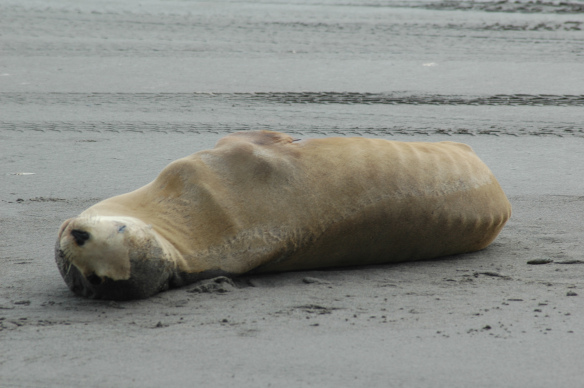
After all our species has done and continues to do to sea lions—hunted them by the thousands for their fur and oil while feeding their flesh to dogs or captive minks; vilifying and putting a bounty on their heads forDSC_0129 competing with commercial fishermen; and forcing them to perform as trained “seals” in the circus, etc.—it’s incredible that one of these “lesser” mammals would go out of his or her way to save a human.

If not for the sea lion keeping him afloat, Hines would very likely have gone under and drowned before the rescue boat arrived.  While it’s noble that he is now devoting his life to suicide prevention, if he really wants to be altruistic, why not advocate for the one who went out of their way to prevent his suicide. It seems to me that if anyone has a good reason to become a marine mammal advocate, he does—he owes them his life.

While the human population grows by 350,000 per day, Steller sea lions, dsc_0224whose total pre-persecution numbers were never more than 300,000, have been driven below 100,000 and are still in decline. In Alaska, the Western segment of Stellars is down to a mere 18% of their historic numbers. Meanwhile, starved California sea lion pups are washing up dead on the beaches.

Sea lions are still being scapegoated, branded and shot, all for eating fish—the only food they have.

Text and Wildlife Photography ©Jim Robertson

Text and Wildlife Photography ©Jim Robertson

Chris Christie turns his back on his fellow pigs by veto-ing controversial cage bill

As an FB friend so eloquently put it:

“How I hate that gross, gluttonous, obese fuck! Someone put his lard ass in a gestation crate, the ugly, greedy, heartless bastard!!!”

New Jersey governor Chris Christie vetoes controversial pig cage bill

Chris Christie has vetoed a bill that called for restrictive pig cages to be banned in the state, a move seen by many as a gauge of his presidential ambitions

pig cages chris christie
Animal rights advocates demonstrating in favor of legislation that would see certain pig cages banned in New Jersey. Governor Chris Christie has vetoed the bill. Photograph: Mel Evans/AP

New Jersey Republican governor Chris Christie has vetoed a politically-charged bill that would have banned the use of certain pig cages in the state.

The potential 2016 presidential contender called the bill a “solution in search of a problem” on Friday.

The bill would have banned pig farmers from using gestation crates, which are so small that they prevent pregnant pigs from turning around.

While the contraptions are rarely used on New Jersey’s 300 pig farms, they are widespread in states like Iowa.

Many farmers are opposed to the idea of the government telling them how to raise their livestock.

Animal rights advocates say the practice is cruel.

Christie’s response to the bill is seen as a gauge of his presidential ambitions.

http://www.theguardian.com/us-news/2014/nov/28/new-jersey-chris-christie-pig-bill

Also:  Jon Stewart rips Chris Christie on ‘The Daily Show’ over controversial pig crate bill (VIDEO)http://www.nj.com/politics/index.ssf/2014/11/chris_christie_puts_nj_first_with_obvious_exceptions_of_bridges_and_pigs_stewart_says.htmlttp://www.nj.com/politics/index.ssf/2014/11/chris_christie_puts_nj_first_with_obvious_exceptions_of_bridges_and_pigs_stewart_says.html