Exposing the Big Game

Forget Hunters' Feeble Rationalizations and Trust Your Gut Feelings: Making Sport of Killing Is Not Healthy Human Behavior

Exposing the Big Game

House members reintroduce bill to ban cub petting, keeping big cats as pets

By Kitty Block and Sara Amundson

January 11, 2021 0 Comments
House members reintroduce bill to ban cub petting, keeping big cats as pets

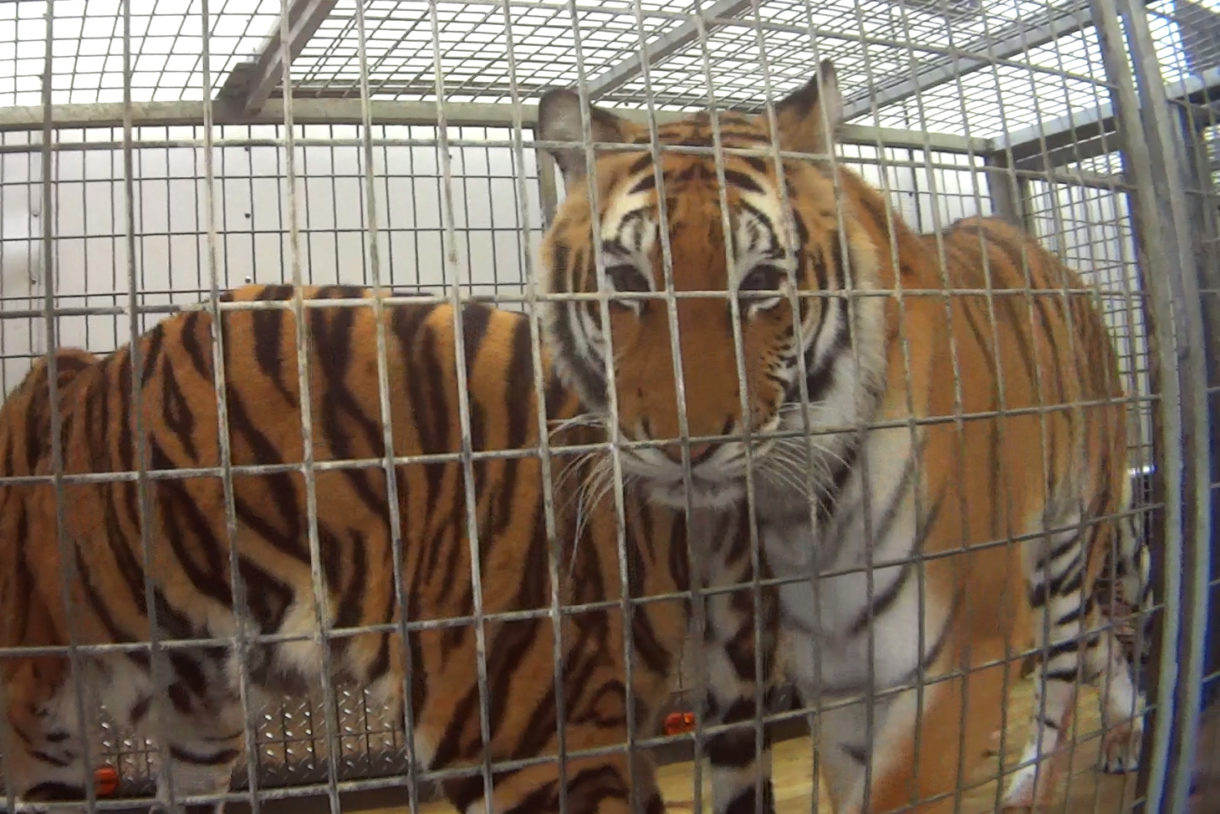
Americans today are more aware than ever before about the horrors that big cats endure in captivity at the hands of exhibitors and roadside zoo owners. Photo by the HSUS236SHARES

A bill that would prohibit public contact with big cats like tigers, lions and leopards and ban the possession of these animals as pets was swiftly reintroduced in the U.S. House today, suggesting that the measure is poised for early action in Congress.

The Big Cat Public Safety Act had already passed the House in the last Congress with nearly two-thirds of members supporting it but the session ended before it could be taken up by the Senate. It was reintroduced today by Reps. Michael Quigley, D-Ill., and Brian Fitzpatrick, R-Penn, the original sponsors of the bill, and we will be working with all of our might to ensure it becomes law.

Americans today are more aware than ever before about the horrors that big cats endure in captivity at the hands of exhibitors and roadside zoo owners like Joe ExoticTim StarkKevin “Doc” Antle and Jeff Lowe. Cub-petting activities offered by these ramshackle operations provide baby tigers, lions and other big cats for the public to pet, feed, play with and be photographed with. Some exhibitors haul big cat cubs to fairs, festivals, shopping malls and other random venues and charge people to interact with the babies.

As Humane Society of the United States undercover investigations have revealed, these practices inflict cruelty and suffering on so many levels. Tigers are bred continually in order to provide a steady supply of infants. The cubs are torn from their mothers at birth. They are fed irregularly, constantly woken from their sleep, and physically abused when they resist being endlessly handled. When the cubs reach three to four months of age and are too big for public contact, they are typically warehoused at roadside zoos or pseudo sanctuaries, or sold as pets to make way for more infant cubs. This constant cycle of breeding and dumping big cats is why we have such a large surplus of captive big cats in the United States.

Conservationists have also long feared that tigers discarded from the cub petting industry may be feeding the illegal market for animal parts used in traditional Asian medicine.

The pandemic has provided yet another reason to ban cub petting. The coronavirus has been found in tigers, lions and snow leopards in captivity, leading the U.S. Department of Agriculture to issue a rare advisory to big cat exhibitors to discontinue hands-on encounters with wild cats in the interests of public safety and animal welfare.

There is neither doubt nor debate among a majority of Americans that we need the Big Cat Public Safety Act to become law. This is commonsense legislation and it is long overdue. No one needs a pet tiger or lion in their backyard or garage, and no one needs to take a selfie with one, especially at such tremendous cost to the animals and at such risk to human and animal safety. Please join us in urging your U.S. Representative to cosponsor and push for the passage of this bill without delay.

Sara Amundson is president of the Humane Society Legislative Fund.
North Denmark in lockdown over mutated virus in mink farms

https://apnews.com/article/mutated-virus-mink-farm-denmark-lockdown-98ede7f921eb6ef3b312e53743fc3edb

By JAN M. OLSENtoday

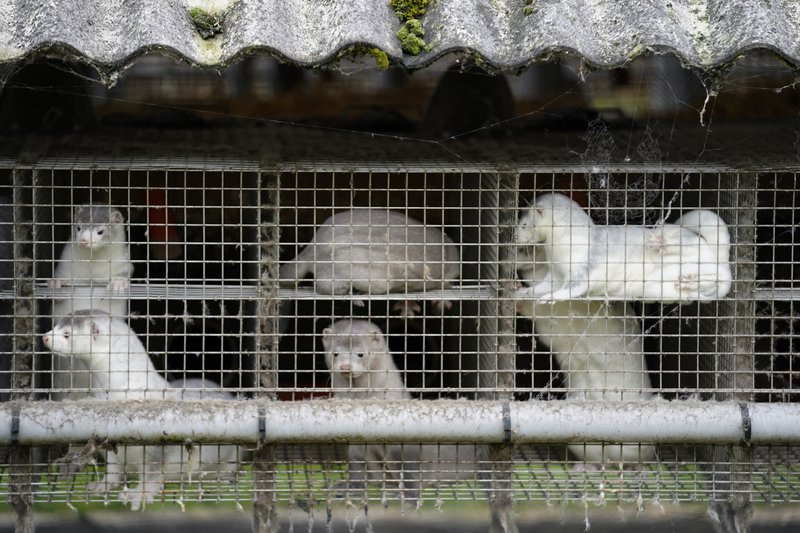
1 of 5FILE – In this Friday, Oct. 9, 2020 file photo, minks in a farm in Gjoel in North Jutland, Denmark. Denmark’s prime minister says the government wants to cull all minks in Danish farms, to minimize the risk of them re-transmitting the new coronavirus to humans. She said Wednesday, Nov. 4, 2020, a report from a government agency that maps the coronavirus in Denmark has shown a mutation in the virus found in 12 people in the northern part of the country who got infected by minks. (Mads Claus Rasmussen/Ritzau Scanpix via AP, File)

COPENHAGEN, Denmark (AP) — More than a quarter million Danes went into lockdown Friday in a northern region of the country where a mutated variation of the coronavirus has infected minks being farmed for their fur, leading to an order to kill millions of the animals.

Prime Minister Mette Frederiksen said the move was meant to contain the virus, and it came two days after the government ordered the cull of all 15 million minks bred at Denmark’s 1,139 mink farms.

The coronavirus evolves constantly and, to date, there is no evidence that any of the mutations pose an increased danger to people. But Danish authorities were not taking any chances.

“Instead of waiting for evidence, it is better to act quickly,” said Tyra Grove Krause, head department at Statens Serum Institut, a government agency that maps the spread of the coronavirus in Denmark.

In seven northern Danish municipalities with some 280,000 residents sport and cultural activities have been suspended, public transportation has been stopped and regional borders have been closed. Only people with so-called “critical functions” such as police and health officials and different authorities are being permitted to cross municipal boundaries.ADVERTISEMENThttps://598824f24255f8188d3ac7c9665c3618.safeframe.googlesyndication.com/safeframe/1-0-37/html/container.html

People in the region have been urged to to be tested. As of Saturday, restaurants must close and school students from fifth grade and up will switch to remote learning Monday.

“We must knock down completely this virus variant,” Health Minister Magnus Heunicke said Thursday, adding that the mutated virus had been found in 12 people.

Last month, Denmark started culling millions of minks in the north of the country after COVID-19 infections were reported among the stock there. Nationwide, at least 216 out of the 1,139 fur farms in Denmark have now been infected.

Kaare Moelbak of Statens Serum Institut said the virus variant was registered in August and September, and no mutations have been found since, so it was not known if it still exists. The mutated virus was found in five mink farms, according to the government body.

WHO officials said each case needs to be evaluated to determine if any of the changes mean the virus behaves differently.

“We are a long, long way from making any determination of that kind,” said Mike Ryan, the WHO emergencies chief. He said that such mutations happen all the time in viruses.

“Right now the evidence that we have doesn’t suggest that this variant is in any way different in the way it behaves,” he said in Geneva.

Peter Ben Embarek, a WHO expert on food safety, said that initial studies on pigs, chickens and cattle “show that these species are not at all susceptible in the same way that mink are, for example. So even if these animals were infected, they would not be able to sustain and spread the disease in the same way.”

Britain on Friday said that people coming from Denmark must self-isolate for 14 days, adding the country to a list of countries it deems risky.

The Danish government said a mutation of the virus had been found in 12 people infected by minks, which farmers have been ordered to cull en masse, but experts said the significance of any variant strain and its effect on humans was unclear because it was yet to be studied.

Denmark, the world’s largest mink fur exporter, produces an estimated 17 million furs per year. Kopenhagen Fur, a cooperative of 1,500 Danish breeders, accounts for 40% of the global mink production. Most of its exports go to China and Hong Kong.

The pelts of the mink will be destroyed and Danish fur farmers have said the cull, which is estimated to cost up to 5 billion kroner ($785 million), may spell the end of the industry in the country.

Overall, Denmark has reported 53,180 cases of coronavirus and 738 deaths.

___

Jamey Keaten in Geneva contributed to this report.

Denmark plans to cull its mink population after coronavirus mutation spreads to humans

NOVEMBER 4, 20206:41 AMUPDATED A DAY AGO

By Reuters Staff

3 MIN READ

https://www.reuters.com/article/health-coronavirus-denmark-mink/denmark-plans-to-cull-its-mink-population-after-coronavirus-mutation-spreads-to-humans-idINKBN27K1YV

COPENHAGEN (Reuters) – Denmark will cull its mink population of up to 17 million after a mutation of the coronavirus found in the animals spread to humans, the prime minister said on Wednesday.Slideshow ( 2 images )

Health authorities found virus strains in humans and in mink which showed decreased sensitivity against antibodies, potentially lowering the efficacy of future vaccines, Prime Minister Mette Frederiksen said.

“We have a great responsibility towards our own population, but with the mutation that has now been found, we have an even greater responsibility for the rest of the world as well,” Frederiksen told a news conference.

The findings, which have been shared with the World Health Organization and the European Centre for Disease Prevention and Control, were based on laboratory tests by the State Serum Institute, the Danish authority dealing with infectious diseases.

The head of the WHO’s emergencies programme, Mike Ryan, called on Friday for full-scale scientific investigations of the complex issue of humans – outside China – infecting mink which in turn transmitted the virus back to humans.

“We have been informed by Denmark of a number of persons infected with coronavirus from mink, with some genetic changes in the virus,” WHO said in a statement emailed to Reuters in Geneva. “The Danish authorities are investigating the epidemiological and virological significance of these findings.”

Authorities in Denmark said five cases of the new virus strain had been recorded on mink farms and 12 cases in humans, and that there were between 15 million and 17 million mink in the country.

Outbreaks at mink farms have persisted in the Nordic country, the world’s largest producer of mink furs, despite repeated efforts to cull infected animals since June.

Denmark’s police, army and home guard will be deployed to speed up the culling process, Frederiksen said.

ADVERTISEMENThttps://27bc285b2c4179caeb5be46668c9cd9a.safeframe.googlesyndication.com/safeframe/1-0-37/html/container.html

Christian Sonne, professor of Veterinary and Wildlife Medicine at Aarhus University, said in an email he believed culling the herd now as a precautionary measure was a sound decision and could prevent a future outbreak that would be more difficult to control. Sonne co-authored a letter published in the journal Science last week calling for the cull.

“China, Denmark, and Poland should support and extend the immediate and complete ban of mink production,” Sonne and his co-authors wrote last week.

Tougher lockdown restrictions and intensified tracing efforts will be implemented to contain the virus in some areas of Northern Denmark, home to a large number of mink farms, authorities said.

“The worst case scenario is a new pandemic, starting all over again out of Denmark,” said Kare Molbak, director at the State Serum Institute.

Minks have also been culled in the Netherlands and Spain after infections were discovered.

Denmark plans to cull its mink population after coronavirus mutation spreads to humans

NOVEMBER 4, 20206:41 AMUPDATED A DAY AGO

By Reuters Staff

3 MIN READ

https://www.reuters.com/article/health-coronavirus-denmark-mink/denmark-plans-to-cull-its-mink-population-after-coronavirus-mutation-spreads-to-humans-idINKBN27K1YV

COPENHAGEN (Reuters) – Denmark will cull its mink population of up to 17 million after a mutation of the coronavirus found in the animals spread to humans, the prime minister said on Wednesday.Slideshow ( 2 images )

Health authorities found virus strains in humans and in mink which showed decreased sensitivity against antibodies, potentially lowering the efficacy of future vaccines, Prime Minister Mette Frederiksen said.

“We have a great responsibility towards our own population, but with the mutation that has now been found, we have an even greater responsibility for the rest of the world as well,” Frederiksen told a news conference.

The findings, which have been shared with the World Health Organization and the European Centre for Disease Prevention and Control, were based on laboratory tests by the State Serum Institute, the Danish authority dealing with infectious diseases.

The head of the WHO’s emergencies programme, Mike Ryan, called on Friday for full-scale scientific investigations of the complex issue of humans – outside China – infecting mink which in turn transmitted the virus back to humans.

ADVERTISEMENT

“We have been informed by Denmark of a number of persons infected with coronavirus from mink, with some genetic changes in the virus,” WHO said in a statement emailed to Reuters in Geneva. “The Danish authorities are investigating the epidemiological and virological significance of these findings.”

Authorities in Denmark said five cases of the new virus strain had been recorded on mink farms and 12 cases in humans, and that there were between 15 million and 17 million mink in the country.

Outbreaks at mink farms have persisted in the Nordic country, the world’s largest producer of mink furs, despite repeated efforts to cull infected animals since June.

Denmark’s police, army and home guard will be deployed to speed up the culling process, Frederiksen said.

ADVERTISEMENThttps://c612c2d872644b35b33113b0e4803fb2.safeframe.googlesyndication.com/safeframe/1-0-37/html/container.html

Christian Sonne, professor of Veterinary and Wildlife Medicine at Aarhus University, said in an email he believed culling the herd now as a precautionary measure was a sound decision and could prevent a future outbreak that would be more difficult to control. Sonne co-authored a letter published in the journal Science last week calling for the cull.

“China, Denmark, and Poland should support and extend the immediate and complete ban of mink production,” Sonne and his co-authors wrote last week.

Tougher lockdown restrictions and intensified tracing efforts will be implemented to contain the virus in some areas of Northern Denmark, home to a large number of mink farms, authorities said.

“The worst case scenario is a new pandemic, starting all over again out of Denmark,” said Kare Molbak, director at the State Serum Institute.

Minks have also been culled in the Netherlands and Spain after infections were discovered.

Reporting by Nikolaj Skydsgaard and Jacob Gronholt-Pedersen; additional reporting by Stephanie Nebehay in Geneva and Michael Erman in Maplewood, N.J. Editing by Jon Boyle, Nick Macfie, Timothy Heritage and Tom Brown

Our Standards: The Thomson Reuters Trust Principles.

MORE FROM REUTERSv

Man charged in leopard mauling incident is a notorious backyard breeder of primates

By Kitty Block and Sara Amundson

November 3, 2020 0 Comments

Man charged in leopard mauling incident is a notorious backyard breeder of primates

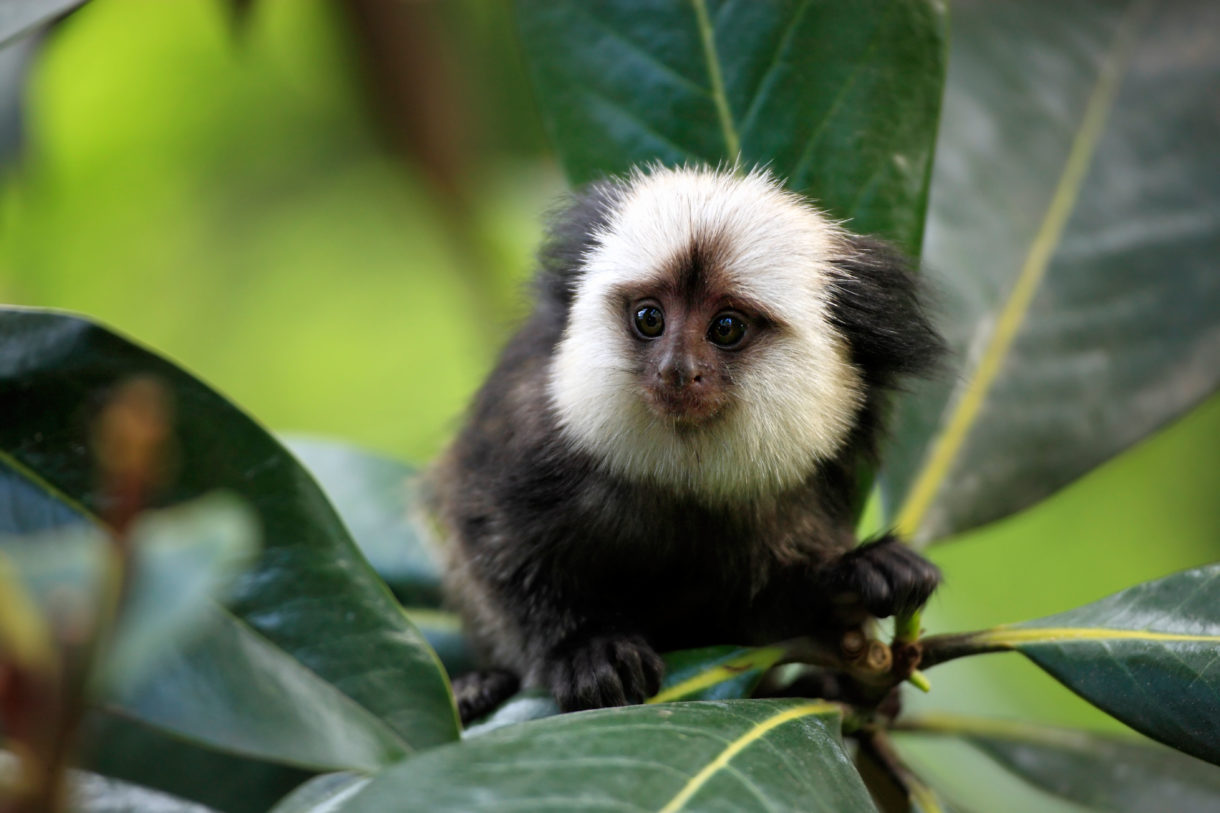
In order to be sold as pets, infant monkeys are pulled from their mothers for sale to the pet trade. Photo by Picture Press/Alamy Stock Photo

A backyard breeder of primates who has been on our radar for years was in the news this week for an incident that defies all common sense. Michael Poggi, who runs his operation from his home in Florida, charged a man $150 in August for a “full contact experience” with an adult leopard in his possession. According to an investigative report by Florida officials, Poggi agreed to let the victim, Dwight Turner, go inside the leopard’s cage to “play with it, rub its belly and take pictures.” The leopard attacked Turner, biting him on the head and the ear.

Turner underwent multiple surgeries for his critical injuries. Poggi was charged by the state of Florida with a misdemeanor for keeping wildlife in an unsafe condition and for allowing full contact with an extremely dangerous animal.

Our wildlife team began tracking Poggi years ago because of his backyard primate breeding business. While this aspect escaped the attention of the media reporting on the leopard incident, it is just as concerning because of the public safety and animal welfare problems involved.

In order to be sold as pets, infant monkeys are pulled from their mothers for sale to the pet trade. Poggi advertises baby marmosets on the internet for prices as high as $5,900, with “financing available”. Records show that in 2014, Poggi sold a six-week-old marmoset monkey to a Massachusetts couple for $3,500. A year later, the monkey was confiscated by the Massachusetts Department of Fish and Game because keeping a pet monkey in the state is illegal.

Poggi also offers close encounters with wild animals as well as takes animals off-site to birthday parties and other events.

As cute as they are, primates like marmosets and capuchin monkeys are not pets. Even the smallest primates are incredibly strong and can inflict serious injuries with their teeth and nails, including puncture wounds, severe lacerations and infections. Experts also agree that keeping primates can be extremely traumatic to the animals. Marmosets, for instance, like all primates, are intelligent and emotionally complex animals who need to be with their mothers for an appropriate amount of time and around their own kind to develop normally.

As veterinarian Kevin Wright, director of conservation, science and sanctuary at the Phoenix Zoo in Arizona points out, when kept in homes, primates are almost certain to become mentally disturbed. “The animal will never be able to fit in any other home. Never learn how to get along with other monkeys. And, more often than not, will end up with a lot of behavioral traits that are self-destructive.”

We have seen first-hand the suffering primates endure in captivity. Many of the primates at our Cleveland Amory Black Beauty Ranch have been rescued from the exotic pet trade, including Willie, a pig tailed macaque, and Jackie, a capuchin monkey. Jackie had been a pet for 20 years and was living in a large bird cage in someone’s home for much of her life when she was seized by Louisiana authorities. Willie came to us 20 years ago after he bit his owner.

There have been 540 documented safety incidents involving captive primates in the United States since 1990, and more than half have been attributed to primates kept as pets. Zoonotic diseases – caused by germs that spread between people and animals – are also a concern. Human cold sores, according to Wright, can kill smaller monkeys like marmosets and tamarins. Macaques can carry herpes B, a potentially fatal virus to humans, infecting them through bites or scratches.

Approximately 25 states now prohibit keeping some or all primate species as pets, but these laws have limitations. Primates continue to be easily available from backyard breeders like Poggi and on the internet, so anyone who wants to keep a monkey as a pet can easily buy one.

The Humane Society of the United States and the Humane Society Legislative Fund are supporting bills in Congress that would stop the exploitation of primates and big cats. The Captive Primate Safety Act, S. 2562/H.R. 1776, would make it difficult for individuals not qualified to handle primates to buy and keep them as pets. The bill, introduced by Sen. Richard Blumenthal, D-Conn., and Reps. Earl Blumenauer, D-Ore., and Brian Fitzpatrick, R-Pa., would prohibit the interstate and foreign commerce of these animals for the exotic pet trade. It would not impact zoos, universities or wildlife sanctuaries. The Big Cat Public Safety Act, S. 2561/H.R. 1380, introduced by Sen. Blumenthal and Reps. Mike Quigley, D-Ill., and Rep. Brian Fitzpatrick, R-Pa., would ban the possession of big cat species like tigers, lions and leopards by unqualified individuals, and it would prohibit poorly run animal exhibitions from allowing public contact with big cats.

Please contact your members of Congress and urge them to pass these bills, ending the suffering of thousands of primates and big cats across the United States who are now in the hands of people who should never be allowed to have them.

Sara Amundson is president of the Humane Society Legislative Fund.
Wildlife watchdog told to take action after report finds Zimbabwe’s baby elephants sale violated rules Young captured elephants held in pen in Zimbabwe prior to being exported to China

(See:
https://cites.org/sites/default/files/eng/com/ac/31/Docs/E-AC31-18-02.pdf)


Tracy Keeling
4th August 2020
 
Zimbabwe loaded 32 baby elephants onto a China-bound plane in October 2019. It had sold off the young animals, who it had separated from their wild families a year earlier, to an unnatural and torturous life in zoos. Zimbabwe authorities went ahead with the baby elephants’ export in the face of legal action. It also did so just before the global wildlife watchdog, the Convention on International Trade in Endangered Species of Wild Fauna and Flora (CITES), implemented a landmark rule change that would have made the export impossible.
 
Zimbabwe, however, isn’t guaranteed to get off scot-free with its much criticised move. A recent CITES report accuses the country of not only contravening the “will” of CITES members, but the “good faith” and “spirit” of the Convention overall. It also asserts that, regardless of the landmark rule change that was about to come into force, Zimbabwe contravened prior provisions of CITES.
 
The report’s authors call on CITES’ Animals Committee to take “appropriate steps” after considering its findings. Such a step would be removing the elephants from the distressing situation they now find themselves in, and giving them the chance to live out the rest of their lives in relative comfort.
 
Rule change
 
Zimbabwe and a number of other nations that African elephants call home have been easily able to sell them on to non-African countries for display in zoos until very recently. But parties to CITES – which are nation states – voted to change the rules at the 2019 conference. The definition of what constitutes an ‘appropriate and acceptable destination’ for export of elephants was limited to “in situ”
conservation programmes. Simply put, the change means that African elephants should stay in Africa.
 
The rule change came into force on 26 November 2019, 90 days after the vote. This grace period between parties approving resolutions and them coming into force is to allow countries time to adjust their national laws and policies to fit the incoming CITES’ requirements.
 
 
But Zimbabwe used the time to export the young elephants it had captured in 2018 to China. At the time, elephant biologist and wildlife director at Humane Society International/Africa, Audrey Delsink, said:
 
We are left feeling outraged and heartbroken at this news today that the Zimbabwe authorities have shipped these poor baby elephants out of the country. Zimbabwe is showing total disregard for the spirit of the CITES ruling as well as ignoring local and global criticism. Condemning these elephants to a life of captivity in Chinese zoos is a tragedy.
 
Inhumane
 
Now two parties to CITES, Burkina Faso and Niger, have submitted a report to the authority’s Animals Committee. The report looks at exports of live elephants from African nations since 2010 in the context of CITES’ various rules, such as countries having to find ‘appropriate and acceptable destinations’ for them.
 
Zimbabwe has outstrippped all others in sheer numbers of exports. The report found it has exported 144 young elephants, mostly to China, since 2010. Namibia came second, with 24 elephants. The report spotlights Zimbabwe’s 2019 export in great detail. The report states that, at the time of writing in May, the elephants were in Longemont Animal Park close to Hangzhou. It continues:
 
Undercover video footage shows the elephants separated from each other in barren, indoor cells. Many appear to be very young (2-3 years).
Recent photographic evidence from China indicates that the elephants have undergone inhumane training by mahouts, presumably to prepare them for entertainment use. There are unconfirmed reports that some of the elephants are going to Yongyuan Biotech Company. The reason remains unknown.
 
Against the rules, by any measure
 
The report further assesses whether the export complied with CITES provisions. It notes that Zimbabwe can only export an elephant to ‘appropriate and acceptable destinations’ that are “suitably equipped to house and care for it”, due to a resolution that came into force in 2000. Parties have added further provisions over time. As a result, the scientific authorities for both the importing and exporting country also have to be “satisfied” that the export ‘promotes in situ conservation’, i.e. conservation in the place the elephant comes from. Furthermore, the
2019 landmark rule change, as already mentioned, limits what constitutes an ‘appropriate and acceptable destination’ to those that are ‘in situ’.
 
Burkina Faso and Niger argue, however, that, by any measure, Zimbabwe’s hurried export of the young elephants didn’t abide by CITES’ provisions.
The report says:
 
there is no publicly available evidence suggesting that the safari park in Shanghai which received the 32 young elephants from Zimbabwe in October 2019 –or any of the likely further destinations –can be considered as “suitably equipped to house and care for” live elephants, and thus meet the recommendations in the non-binding guidance, or that this particular import would promote in situ conservation. …
 
By any reasonable metric, the conditions of the transfer and housing are demonstrably inhumane.
 
Highlighting the 2019 rule change and the fact that, as part of that change, parties explicitly recognised elephants are “highly social animals” and removing them from their social groups has “detrimental effects” on their “physical and social well-being”, the report said the
export:
 
not only contravened the will of the CITES Parties, it undermined the good faith and the spirit of the Convention.
 
Mighty and toothless
 
In short, the CITES report by two of its member countries is scathing about Zimbabwe’s actions. It asserts that, no matter how you look at it, or what resolution you test it by, the country’s choice to fly out the young elephants was flawed.
 
The parties recommend that the Animals Committee considers the report’s findings on the Zimbabwe 2019 export, in relation to the ‘appropriate and acceptable destinations’ condition, and takes “appropriate steps”.
The report doesn’t clarify what those steps should be.
 
CITES essentially plays god as an authority. It’s immensely powerful, deciding the fate of countless earthly beings, by controlling the trade in them – alive and dead. But it’s fairly ineffective when it comes to cracking down on wildlife trade offenders. The illegal trade in wildlife, for example, is booming (as is the legal trade). And what action CITES is empowered to take against Zimbabwe, and indeed China, for their apparent transgressions is unclear. South African journalist Adam Cruise told The Canary:
 
The appropriate steps would be haul Zimbabwe over the coals but just how CITES does that is the question. They are pretty toothless in that regard as they cannot really ‘do’ anything after the fact but simply an acknowledgement that Zimbabwe and by extension CITES were wrong and this sort of export will never happen again may be enough. Sadly, the elephants cant go back in the wild, that’s for sure.
 
Amid a global pandemic likely to have been caused by the wildlife trade, and a biodiversity crisis, the global wildlife watchdog increasingly appears unfit for purpose. A functional authority would reverse this trade and force the return of these young elephants to Africa, for rehabilitation and care in a wildlife sanctuary. If CITES is unable, or unwilling, to do that then really, what is the point of it?
 
https://www.thecanary.co/discovery/analysis-discovery/2020/08/04/wildlife-watchdog-told-to-take-action-after-report-finds-zimbabwes-baby-elephants-sale-violated-rules/
 

Marineland changes gears, won’t reopen this weekend

Jul 13 10:45PM -0400


<https://images.thestar.com/viQBQWw4VNrUwzrpmPKG16qBydw=/100×100/smart/https
:/www.niagarafallsreview.ca/content/dam/niagaradailies/uploads/Law_John.JPG>


By <https://www.niagarafallsreview.ca/authors.law_john.html> John LawReview
Reporter

Mon., July 13, 2020timer1 min. read

Marineland is putting the brakes on plans to reopen this weekend.

After announcing last week it would open for its 59th season July 17, the
park issued a statement late Monday that it “decided to push back” its
opening date to July 24.

“The decision comes after the park’s efforts to make sure some, if not all,
of the most popular attractions can open with the park,” the statement
reads.

Marineland says the delay is meant to offer guests a “better experience in
the coming days,” and is in accordance with “recent updates” from the
Ontario government.

On Monday, Premier Doug Ford announced much of the province will move to
Phase 3 of its reopening Friday, but Niagara will remain in Phase 2.

According to the Reopening Ontario
<https://www.ontario.ca/page/reopening-ontario> website, waterparks and
amusement parks are to be closed in Phase 2, and they will remain closed
during Phase 3.

In its statement, Marineland says it is “working closely with health and
government officials to ensure that all health and safety protocols are in
place before the park opens to make sure the public can have a safe and
enjoyable experience.”

In its reopening press release, the park said its Polar Splash water park
would be open, with staff monitoring the number of guests allowed in.

It also said staff would be provided with face masks.

When asked about opening in light of the provincial guidelines, a parks
spokesperson said Marineland is allowed to operate under Stage 2 as a
“zoo/aquarium.”

In Monday’s statement, Marineland owner Marie Holer – wife of late owner
John Holer – said “we are lucky we are an outdoor facility with lots of room
for people to social distance while still enjoying the attractions.”

https://www.niagarafallsreview.ca/news/niagara-region/2020/07/13/marineland
changes-gears-wont-reopen-this-weekend.html

<https://www.niagarafallsreview.ca/news/niagara-region/2020/07/13/marineland
-changes-gears-wont-reopen-this-weekend.html>

<https://www.niagarafallsreview.ca/news/niagara-region/2020/07/13/marineland
-changes-gears-wont-reopen-this-weekend.html> Marineland changes gears,
won’t reopen this weekend | NiagaraFallsReview.ca

Marineland is putting the brakes on plans to reopen this weekend. After
announcing last week it would open for its 59th season July 17, the park
issued a statement late Monday that it “decided to push back” its opening
date to July 24. “The decision comes after the park’s efforts to make …

http://www.niagarafallsreview.ca <http://www.niagarafallsreview.ca

“PSYCHOLOGICALLY DISTRESSED” TIGER IN BEIJING ZOO WALKS IN ENDLESS CIRCLES IN SMALL ENCLOSURE

Posted on 2020/05/7
TAGS: ANIMALSNEWS

By John Vibes / Truth Theory

Footage captured at a zoo in Beijing, China shows a captive tiger walking in endless circles in his enclosure. A staff member told reporters that this type of behavior is actually common for animals who have been staying at the zoo for a long time.

Representatives with the zoo say that the Bengal tiger was later given “psychological counseling” after zookeepers noticed the strange behavior. However, the so-called “psychological counseling” that the animal was given did not seem very professional.

“We have taken the animal to receive behavior training. We also brought more food and toys for the tiger. It’s like “psychological counseling”,’ a zookeeper told reporters.

When tigers are in the wild, they usually cover a lot of ground and do a lot of exploring in their day to day activities, and that is what their instincts tell them to do.

The enclosure that the animal was kept in was just a giant cage or fence, with no semblance of a tiger’s natural habitat. This is why many zoos at least make an attempt to recreate an animal’s natural habitat in their enclosures. Unfortunately, the zoo where this tiger was held did not implement these types of natural landscapes in the animal’s enclosure, leading to severe psychological stress.https://googleads.g.doubleclick.net/pagead/ads?client=ca-pub-3352039084549762&output=html&h=280&slotname=3150226346&adk=2975939105&adf=4151858944&w=560&fwrn=4&fwrnh=100&lmt=1594312452&rafmt=1&psa=1&guci=2.2.0.0.2.2.0.0&us_privacy=1—&format=560×280&url=https%3A%2F%2Ftruththeory.com%2F2020%2F05%2F07%2Fpsychologically-distressed-tiger-in-beijing-zoo-walks-in-endless-circles-in-small-enclosure%2F%3Ffbclid%3DIwAR2wbrakKEwYO4494G1kQWeANRdixFa310X7fn8iY3KjYz7ApT7BkJsuENY&flash=0&fwr=0&fwrattr=true&rpe=1&resp_fmts=3&wgl=1&adsid=ChEI8ICb-AUQ3euZmYfC3ObdARJMALqdR0Ithprx9XP4a0v6wwQ9bdIVQMLERQERFS6Yd0lqLOg9AaPHyFPZ2pXOgJJbnKpMVYYt-Mrco_V6_8zYJsdudNNBgrtilcGqRA&dt=1594312450112&bpp=55&bdt=3819&idt=2029&shv=r20200706&cbv=r20190131&ptt=9&saldr=aa&abxe=1&cookie=ID%3D979f73b8979b71d2%3AT%3D1594309830%3AS%3DALNI_MbHGUIj4OFoXku-exRl_Rokjhdr6A&prev_fmts=0x0&nras=1&correlator=7951419361940&frm=20&pv=1&ga_vid=358418846.1594309840&ga_sid=1594312451&ga_hid=1852987212&ga_fc=1&iag=0&icsg=3000292152959520&dssz=89&mdo=0&mso=0&u_tz=-420&u_his=1&u_java=0&u_h=768&u_w=1366&u_ah=728&u_aw=1366&u_cd=24&u_nplug=3&u_nmime=4&adx=213&ady=1733&biw=1349&bih=657&scr_x=0&scr_y=0&eid=21060548&oid=3&pvsid=3207325954121030&pem=600&rx=0&eae=0&fc=1920&brdim=0%2C0%2C0%2C0%2C1366%2C0%2C1366%2C728%2C1366%2C657&vis=1&rsz=%7C%7CeEbr%7C&abl=CS&pfx=0&fu=8336&bc=31&jar=2020-7-8-19&ifi=1&uci=a!1&btvi=1&fsb=1&xpc=pEd1boSLxz&p=https%3A//truththeory.com&dtd=2284

Sun Quanhui, a senior scientific adviser at a non-profit organization called World Animal Protection China told the South China Morning Post that this is a common problem in Chinese zoos.

“Let’s just give the example of how beasts of prey are kept. In almost every Chinese zoo, we see them in cement cages or behind steel bars, which to some extent is considered maltreatment. Some are species that naturally live in groups, but they’re often isolated, which also causes them huge psychological distress.” Quanhui said.

Tigers are listed as Endangered on the IUCN Red List since 1986. As of 2015, the global wild tiger population was estimated to number between 3,062 and 3,948, but the number in captivity is far higher.

Image Credit: Asia Newswire

Albanian restaurant serves bear meat in illegal wildlife trade that’s ‘out of control’

Stop the Wildlife Trade exclusive: Bears, monkeys, wolves and birds of prey sold for hundreds of euros on popular Albanian websites, investigation finds

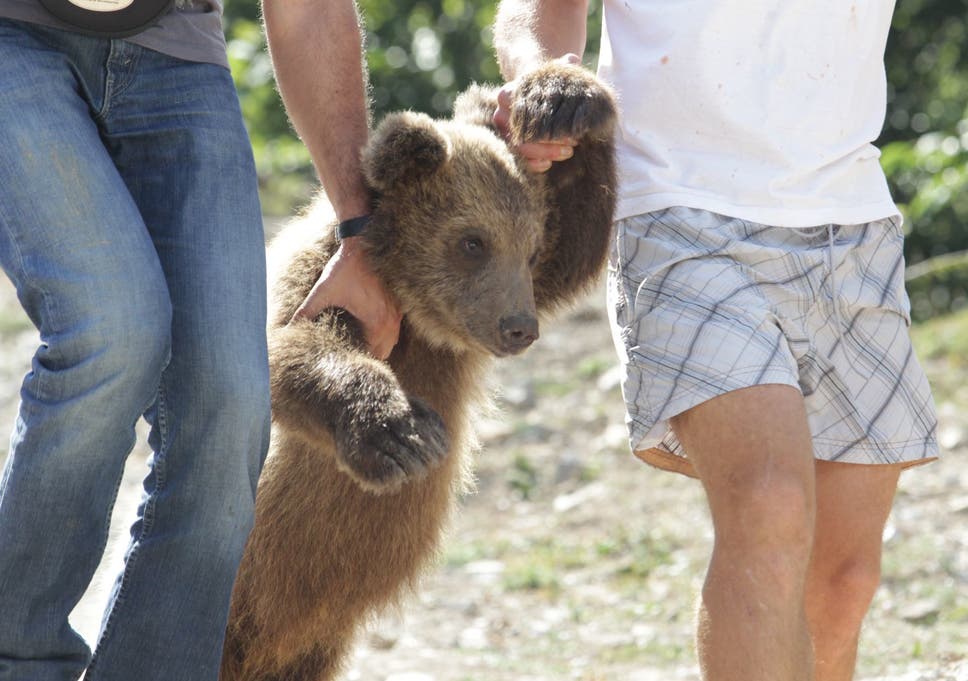
A cub kept by a hotel owner to attract tourists - a common practice in Albania

A cub kept by a hotel owner to attract tourists – a common practice in Albania ( Four Paws )

A restaurant in Albania is offering diners meat from illegally hunted bears – part of an illicit trade in wildlife that is “out of control” in the country, investigators claim.

Researchers said it was the first time they had seen bear meat cooked in Europe, and experts warned that the crude butchering of animals may lead to outbreaks of zoonotic diseases such as coronavirus.

Bears, monkeys and birds of prey are among live animals being sold on popular Albanian online marketplaces, the investigation found, raising fears for the survival of some species in the country.

Animal-protection charity Four Paws discovered that two of Albania’s leading online sites were carrying dozens of adverts selling brown bears and other species that are legally protected.

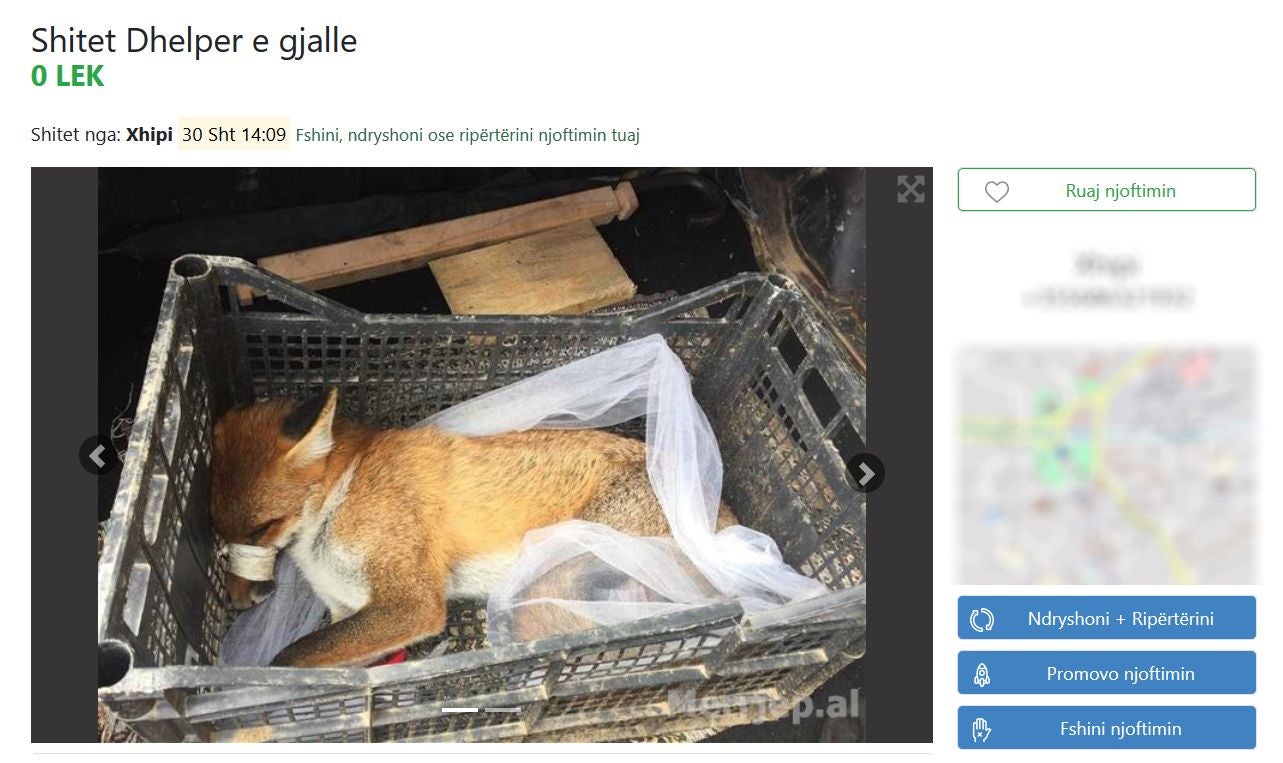
Many photographs of the animals – along with foxes, barn owls and wolves – showed them with their mouths taped up or their claws chained.

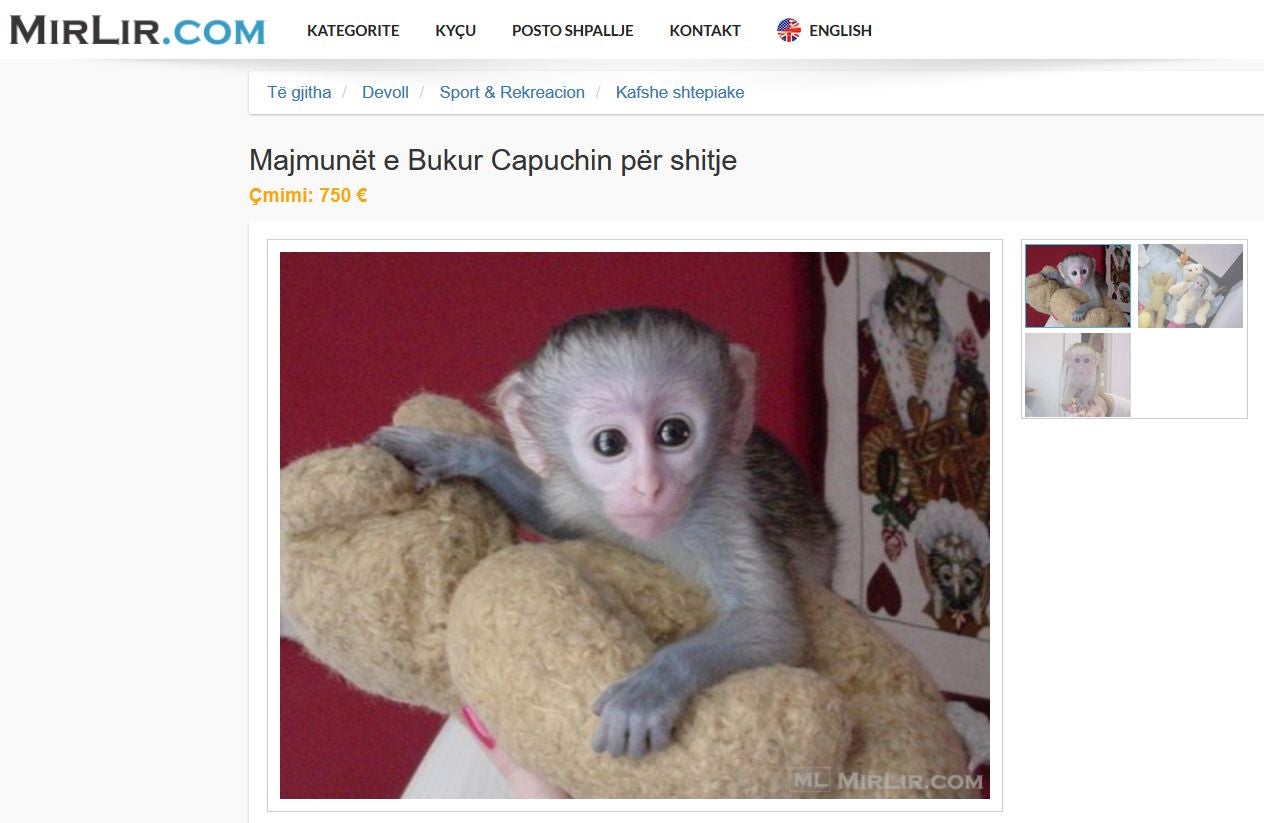
It’s a profitable business: a tiny capuchin monkey was offered for €750 (£675), and a barn owl, a bear cub and a wolf for €500 each.

The buyers are mostly restaurant and hotel owners who keep the animals to attract tourists, or individuals who want the animals as pets and status symbols, charity workers said.

Eagles, the national symbol of Albania, are especially popular with buyers and are often found stuffed as trophies in public places.

The menu featuring mish ariu – bear meat (PPNEA)

But hunting protected species, keeping them captive and selling them is banned in Albania, following a huge decline of native wildlife in the country.

Offenders may be jailed under the law, which was tightened in October, but enforcement of it is lax.

Four Paws said that after its team reported some of the illegal adverts, they were deleted but new ones reappeared.

“A large majority of the photographs displayed severe animal cruelty, such as foxes with sealed muzzles in plastic boxes, bear cubs in chains and birds with their feet tied,” said Barbara van Genne, of the chaity.

A tiny capuchin monkey on sale for €750 (Four Paws)

Monkeys and birds of prey are often kept in bars and restaurants in Albania as a tourist attraction, while foxes are sold for their fur, according to the investigators.

Wolves are bought to be cross-bred with dogs for the puppies to be sold as guard dogs, commonly used in the mountains against wolves. But other animals are killed, stuffed and put on display.

Animals’ mouths are often taped to prevent them biting and their feet chained to stop them running away.

A restaurant in the town of Drilon has also been found advertising bear meat on its menu on Facebook. The listing, for “mish ariu” – Albanian for bear meat – added “ne sezone”, meaning “according to season”.

A live fox with its mouth taped up advertised for sale (Four Paws)

An online restaurant portal, updated earlier this month, confirms the restaurant offering.

A spokesperson for Protection and Preservation of Natural Environment in Albania (PPNEA) said: “What is especially alarming about this is not only the fact that bear meat is being sold, it is also the addition in brackets of “ne sezone”, which gives the impression that there’s a hunting season for bears.

“In fact there’s no hunting season for any wild animals in Albania, there’s a hunting moratorium and hunting ban for years throughout the whole country – passed in 2014 and extended in 2016 until March 2021.

“The massive decline of wildlife in Albania triggered this.”

Bear meat dishes have previously been seen in Asian countries. The meat can trigger disease caused by parasites, with symptoms including diarrhoea, cramps, fever and hallucinations.

Prof James Wood, head of department of veterinary medicine and an infection expert at the University of Cambridge, said Covid-19 and other zoonotic viruses can be carried by contaminated meat from any species.

“However, the risks are far greater from butchering and hunting than they are from simple consumption,” he said.

“Bears are no more likely to act as a source of a zoonotic virus than any other species group.” He added that cooking was a highly effective means of destroying the Covid-19 virus and other infections, but that “eating bears is, of course, highly undesirable for many reasons, including conservation and animal welfare, if they have been kept in captivity before being killed”.

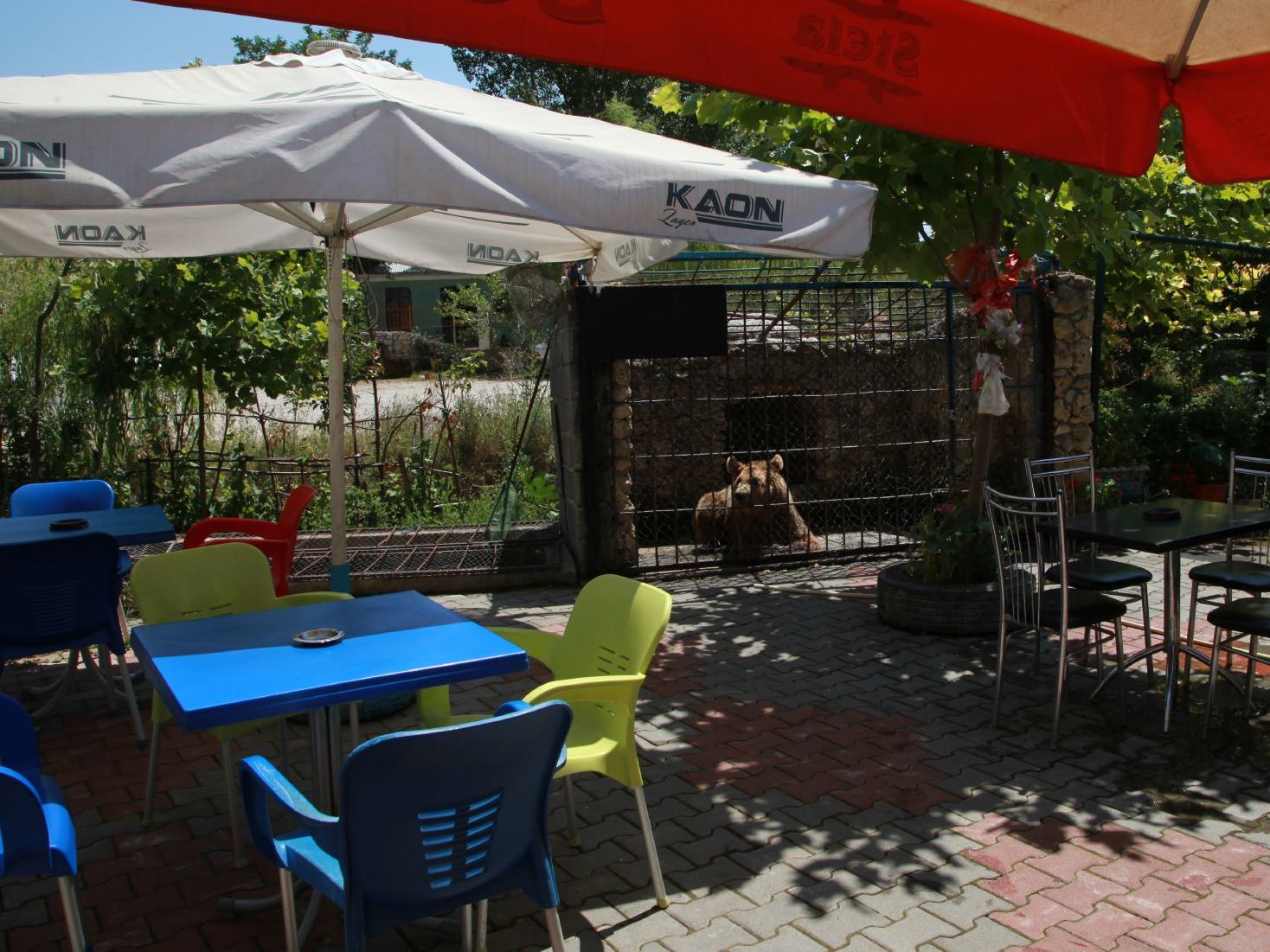
A bear kept in a cage at a restaurant (Four Paws)

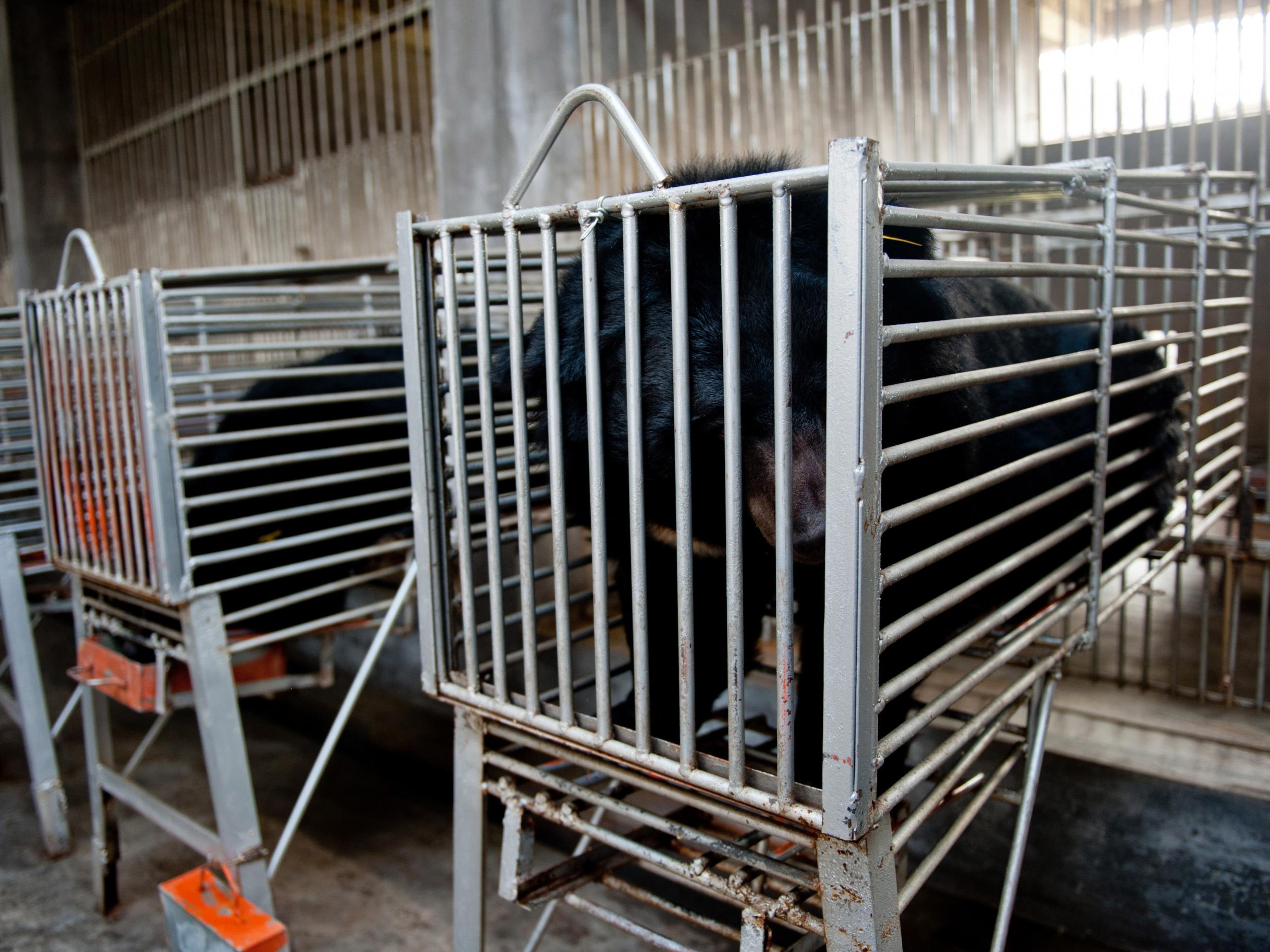
Ms van Genne said: “Four Paws has been active in Albania since 2015 but we have never seen such atrocities before. Until now we have mainly focused on restaurants that keep bears in small cages for entertainment of guests.

“This bizarre new discovery is a further indication that the commercial wildlife trade in Albania is out of control.”

She warned that if the government did not intervene soon, “the few native wild animals left will be history”.

“The platforms need to introduce preventive measures such as seller identification to stop these ads. However, the main problem for the illegal trade remains – the lack of control and enforcement by the authorities,” she claimed.

In the 1990s, there were still about 200 pairs of eagles in Albania, but today the number has halved.

A wildlife sanctuary that can carry out criminal prosecutions, take in rescues and educate people in species protection was urgently needed in Albania, Ms van Genne said.

Dutch fur farms have killed 575,000 mink, mostly pups, following coronavirus outbreak

June 11, 2020 1 Comment

The Netherlands is expected to kill more than 350,000 mink by gassing, in a massive cull following an outbreak of coronavirus on fur farms in the country. It is estimated that most of these—about 300,000—are pups just days or weeks old.

The killing of animals on fur farms is heartbreaking under any circumstances, because of how utterly needless and preventable it is. But this tragic cull, and the scale of it, is a stark reminder of the many problems that surround fur factory farming, impacting both animal welfare and human health, and why all production of this unnecessary commodity needs to end immediately.

The problem came to light in April, when two fur farm workers in the Netherlands were found to have contracted the coronavirus from mink, which is the only known animal-to-human transmission following the initial outbreak. In following weeks, 13 of the Netherlands’ roughly 130 fur farms reported mink infected with the virus. And the number of infected farms keeps on growing. The farms said more mink were dying than usual, and some had nasal discharge or difficulty breathing.

This month, the government ordered all mink on infected Dutch fur farms be killed to prevent the further spread of the coronavirus to humans. The cull, which began last week, has farm workers in protective clothing using gas to kill mink mothers and their pups. The animals’ bodies are then transported to a disposal center in a sealed shipping container and the farms disinfected.

It is now clear that these fur farms, where animals are crowded in close contact with each other, are reservoirs for the spread of pandemics. Organizations like ours have been sounding the alarm bell over fur farms—and the high risk for disease they pose—for years, and as tragic as this development is, it is not surprising to us.

Fur farms also pose an extraordinary animal welfare problem. Much like factory farms and wildlife markets, the animals in these operations live short, miserable lives in small, barren and filthy cages, usually without any veterinary care. A Humane Society International investigation of Finland’s fur farms last year showed many animals had eye infections and gaping wounds, including a mink with a large, bloody hole in the head. Some animals lay dead in the cages and others ate them or walked over them.

Such fur farms exist around the globe, including in the United States, where the top 10 states for mink pelt production (in order of most to least) are Wisconsin, Utah, Idaho, Oregon, Minnesota, Iowa, Illinois, Pennsylvania, Michigan and Washington. As part of our 11-point policy plan to reduce animal suffering and help prevent future national and global pandemics, the Humane Society family of organizations is calling for an end to all fur farming everywhere it exists around the world.

We have already made tremendous progress in fighting fur, with dozens of fashion designers and retailers turning away from this cruel product in recent years. In the United States, California has banned the production of fur and all sales of new fur products. Globally, Britain became the first country in the world to ban fur production, and it has been followed by a dozen European countries, including Austria, the Czech Republic and Norway.

The Netherlands, once the third largest fur farming country in the world, banned fur production in 2013 with an 11-year phaseout. But the tragedy now playing out in the country is an opportunity for the government there, and for governments in all fur-producing nations, to take note of the serious public health and animal welfare problems associated with fur farms and close them down without delay. With the pandemic still ravaging the globe, it simply doesn’t make sense for anyone to reinvest in an enterprise that’s fallen out of fashion and favor the world over.