Exposing the Big Game

Forget Hunters' Feeble Rationalizations and Trust Your Gut Feelings: Making Sport of Killing Is Not Healthy Human Behavior

Exposing the Big Game

Dutch govt orders culling of 10,000 mink to prevent spread of coronavirus

https://theprint.in/world/dutch-govt-orders-culling-of-10000-mink-to-prevent-spread-of-coronavirus/437466/

In May, WHO had identified possible animal-to-human transmission of Covid-19 from the Dutch mink to their farmers. This was the first instance of such a transmission.

 7 June, 2020 7:56 pm IST
A mink | Photo: Jens Schlueter| DDP/AFP/Getty Images via Bloomberg
Text Size: A- A+

New Delhi: Mink farms in the Netherlands have commenced a government-ordered culling of around 10,000 mink across the country over concerns that the animals infected with coronavirus could transmit the infection to humans, reports The Guardian.

According to the Netherlands Food & Wares Authority, mink infected with Covid-19 have been found on 10 Dutch farms. The authority’s spokesperson Frederique Hermie said, “All mink breeding farms where there is an infection will be cleared, and farms, where there are no infections, won’t be.”

The initial infection was reported in two farms near the city of Eindhoven, where the disease was discovered in April among mink that are bred for their valuable fur.

Dutch Agriculture Minister Carola Schouten said two workers likely contracted Covid-19 on a mink farm while stressing that the risk of further spread of the coronavirus from the mink to humans remains low.

Advertisement: 0:18

The culling of mink involves farmworkers in protective gear using gas on mink. The bodies of the mink will be sent to the disposal plant after which the farms will be disinfected.


Rights groups call for end to mink fur trade

Animal rights groups opposed to mink fur trade said the outbreak is another reason to close all farms.

“We are calling for the 24 countries around the world that still allow mink farming to very rapidly evaluate the situation and evidence coming out of the Netherlands,” said Claire Bass, executive director of the Humane Society International.

China, Denmark and Poland are the largest mink fur producers across the world. According to the Dutch Federation of Pelt Farmers, there are 140 mink farms in the Netherlands, exporting $146 million worth of fur every year.

In 2013, the Dutch Parliament had ordered the closure of all mink farms by 2024. Slovenia and Serbia have also passed legislation to ban all fur farming in the country. Countries like Norway and the UK have already banned mink farming for fur. The state of California in the US has banned the sale and manufacture of all fur products.


Also read: How coronavirus, bird flu and rumours to stay off non-veg hit poultry industry hard in India


Other animals culled due to Covid fears

The Dutch mink are not the only animals to have been eliminated due to the coronavirus pandemic. Meat processing plants and hatcheries, across the world, have been forced to kill birds due to shut down and lack of business.

ThePrint had earlier reported that Covid-related rumours had led to a huge loss to poultry businesses, which forced farmers to kill their birds or abandon them.

Due to the dip in business, poultry farmers have been finding it difficult to sustain their existing stock with the rising fodder and other maintenance-related costs.

Several other animals have also been reportedly infected by Covid-19. On 4 June, a dog was reportedly infected with coronavirus in the US. The disease has also been spotted in tigers, lions and cats. Also, early reports of animal-to-human transmission in China in February had led to cats and dogs being abandoned in Wuhan.

Viewpoint: It’s time for state to close live animal markets

As world leaders continue to debate the closure of wild animal wet markets across the globe, New York can act right now to stem the spread of zoonotic diseases caused by the exploitation of animals by closing such markets in the state.

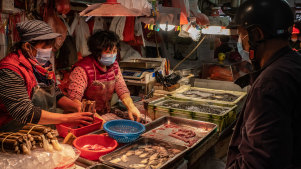
Live animal markets have for too long cruelly consumed millions of wild animals and endangered the planet’s health. Experts have said the COVID-19 pandemic likely arose from a wet market in China.

COVID-19 is not the only deadly disease to emerge from such markets across the globe. SARS, MERS, Ebola, Nipah virus and many others have jumped from animals to humans because of the wildlife trade.

In fact, three out of every four new or emerging infectious diseases in people come from animals and more than 34 million people worldwide have died from zoonotic diseases, according to the Centers for Disease Control and Prevention and World Health Organization.

New York state is home to more than 80 live animal markets, including in Schenectady, Buffalo and New York City, the latter of which hosts the majority of them and where more than 21,600 people so far have died from COVID-19. Smuggled illegal bush meat from imported exotics such as monkeys, pythons and civets can make their way into such markets to be sold to consumers.

Many of these markets operate next door to schools and homes despite health laws prohibiting slaughterhouses near residential buildings, according to Assemblymember Linda B. Rosenthal and state Sen. Luis Sepulveda, who have introduced a bill (A.10399) to shut them. The markets are not regulated by the USDA, but by state agencies, which have weaker oversight rules and a small staff of inspectors who struggle to keep up with the quarterly inspections mandated by state law.

It would be shameful if state lawmakers failed to act on a bill at the center of the crisis, one that will save lives, end exploitation and suffering of humans and animals and help prevent future pandemics.

Priscilla Feral is president of Friends of Animals.

Joe Exotic says Carole Baskin getting his zoo is a ‘treachery’ that ‘must not go unchecked’

(CNN)In response to the lawsuit that awarded Carole Baskin the zoo once owned by Joe Exotic, the “Tiger King’s” management team released a statement that said Baskin’s “treachery” has to be challenged.

This month, a judge ruled in favor of Baskin’s Big Cat Rescue in her suit against the Greater Wynnewood Development Group, LLC, the company Joe Exotic once owned, giving her control of the G.W. Zoo in Oklahoma.
Exotic, whose legal name is Joe Maldonado-Passage, is still in prison serving a 22-year sentence for a murder for hire plot against Baskin and animal abuse, among other charges. The allegations against him were documented in the smash Netflix docuseries “Tiger King,” released after he was sent to prison.
So his team spoke for him from Twitter.
“While we again acknowledge it is truly time to pray for justice for George Floyd’s family as well as an end to systemic racism in America, we must address Carol [sic] Baskin’s treachery before it goes unchecked,” a tweet from an account run by Maldonado-Passage’s management team read.
His team released a longer statement on the website “Help Free Joe,” in which the “Joe Exotic Team” said it “prays for justice for George Floyd’s family as well as an end to systemic racism in America.”
A few lines later, the statement said Maldonado-Passage’s legal team is filing appeals while his media team drums up public support.
CNN has reached out to Maldonado-Passage’s attorney for comment and is waiting to hear back.
The court order that awarded Baskin control of the G.W. Zoo gives her 16 acres of land in Garvin County, Oklahoma, as well as several cabins and vehicles, court records show.
The zoo’s current owner, “Tiger King” supporting player Jeff Lowe, must vacate the premises within 120 days of the order and remove all the animals, too.
Lowe’s attorney told CNN that the judgment wasn’t unexpected, and Lowe’s currently focused on opening a new “Tiger King” park within the next 120 days.

(CNN)In response to the lawsuit that awarded Carole Baskin the zoo once owned by Joe Exotic, the “Tiger King’s” management team released a statement that said Baskin’s “treachery” has to be challenged.

This month, a judge ruled in favor of Baskin’s Big Cat Rescue in her suit against the Greater Wynnewood Development Group, LLC, the company Joe Exotic once owned, giving her control of the G.W. Zoo in Oklahoma.
Exotic, whose legal name is Joe Maldonado-Passage, is still in prison serving a 22-year sentence for a murder for hire plot against Baskin and animal abuse, among other charges. The allegations against him were documented in the smash Netflix docuseries “Tiger King,” released after he was sent to prison.
So his team spoke for him from Twitter.
“While we again acknowledge it is truly time to pray for justice for George Floyd’s family as well as an end to systemic racism in America, we must address Carol [sic] Baskin’s treachery before it goes unchecked,” a tweet from an account run by Maldonado-Passage’s management team read.
His team released a longer statement on the website “Help Free Joe,” in which the “Joe Exotic Team” said it “prays for justice for George Floyd’s family as well as an end to systemic racism in America.”
A few lines later, the statement said Maldonado-Passage’s legal team is filing appeals while his media team drums up public support.
CNN has reached out to Maldonado-Passage’s attorney for comment and is waiting to hear back.
The court order that awarded Baskin control of the G.W. Zoo gives her 16 acres of land in Garvin County, Oklahoma, as well as several cabins and vehicles, court records show.
The zoo’s current owner, “Tiger King” supporting player Jeff Lowe, must vacate the premises within 120 days of the order and remove all the animals, too.
Lowe’s attorney told CNN that the judgment wasn’t unexpected, and Lowe’s currently focused on opening a new “Tiger King” park within the next 120 days.

Wildlife markets are the tip of the iceberg and not just in China

For our free coronavirus pandemic coverage, learn more here.

In the heart of central Jakarta, about 20 minutes from Joko Widodo’s Presidential Palace, the Pramuka Bird Market is open for business.

The aisles throng with people, few wearing masks, and hum with the din of humans, birds, reptiles and mammals all mixed together. It stinks too.

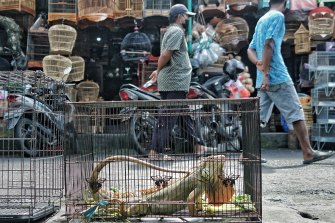
A live lizard is displayed for sale in a cage at the Satria market in Bali, Indonesia.
A live lizard is displayed for sale in a cage at the Satria market in Bali, Indonesia.CREDIT:AMILIA ROSA

Today, Vonis, a local trader who uses just the one name, is holding forth about the origins of the coronavirus that has infected nearly 6 million people, killed more than 360,000, up-ended the global economy and more. It is thought to have passed from bats, via an unidentified animal, to humans at a wet market in Wuhan, China.

“It’s hoax. It is not true that bats caused COVID-19. I’ve been selling this [bats] for many years, nobody gets sick here. No one. Also, many Indonesians eat bat meat and nobody is sick. I myself healed my asthma after consuming bat. It happened when I was around 25 years old. I’m a bit over 40, I am healthy now,” he says.

Vonis sells birds, mostly, as pets, but he also has bats (about $25), civets (about $40) and squirrels. It’s for traditional medicine, he hastens to add. He sells about 30 bats a week and is happy to offer cooking tips.

“Just fry it, don’t put too many spices in like the Manado dish. Just a little salt. For chronic asthma you have to consume it twice a week. If it is only for keeping you healthy, eat it once a month.”

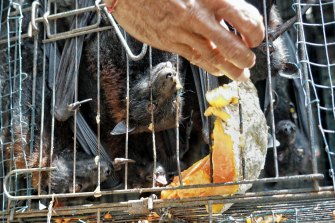
A man feeds bats for sale at the Satria market in Bali.
A man feeds bats for sale at the Satria market in Bali.CREDIT:AMILIA ROSA

If you want a pangolin – thought to be the potential “bridge animal” between bats and humans in Wuhan – he can get you one of those, too.

“Nobody has it here [at the market]. But if you want, we can look for it. I have someone who can do it.”

The small, scaly mammal cost between $250 and $300 to source, and you have to pay half in advance.

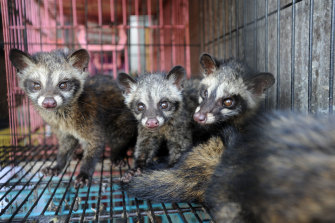
Civet cats for sale at a market in Bali.
Civet cats for sale at a market in Bali.CREDIT:AMILIA ROSA

Vonis is far from the only person in the Pramuka market selling exotic animals for consumption. Indonesia is home to some large wildlife wet markets, such as the Beriman Tomohon in North Sulawesi, the Satria in Bali, Hewan Pasty in Yogyakarta, Depok in Solo and Jatinegara, also in Jakarta. There also smaller markets – up to 1000, according to the Jakarta Animal Aid Network.

At the Satria, pet shop owner Nengah Wita sells bats, rabbit, chickens, song birds and geckos. He’s at pains to stress he sells very few bats (they retail for about $120 each) and says they are only sold to help with asthma in traditional medicine.

He says people have “exaggerated” the part played by bats in the origin of the coronavirus.

“I would’ve fallen sick weeks ago if it was true. But I am fine, I sleep in the shop, I care for them every day, I even got bitten last week but you can see, I am not sick. Just like the last time, the bird flu, I sell birds too, but I was fine then too.”

These market traders are just the tip of the iceberg. Civets are widely available for sale on Tokopedia, Indonesia’s answer to eBay (some listings describe them as pets, others note they are very tasty). It isn’t hard to find pangolin scales for sale, either.

While experts such as Professor Wiku Adisasmito, who is part of the Indonesian government’s national COVID-19 taskforce, have warned that wild animal markets are an “animal cafeteria for pathogens” that could lead to the next coronavirus, the national government has shown little appetite for tackling the problem. Instead, it has suggested that it the responsibility of provincial governments.

It’s a similar story throughout the region where bats, pangolins, civets, rats, rare birds, dogs, and parts of rhinos, elephants and tigers are regularly traded.

China has, since the emergence SARS-CoV-2, flagged plans to ban the trade of live animals for food – but left exceptions for traditional medicine and fur. That’s more than most countries. A Vietnamese plan to ban the trade and consumption of wild animals seems to have stalled.

The illegal trade in wild animals for food, medicine, fur and as pets is big business worth an estimated $7 billion to $23 billion annually. The legal trade – loosely regulated by the Convention on International Trade in Endangered Species [CITES] of Wild Fauna and Flora – is worth perhaps 10 times as much and, until the new coronavirus was unleashed, it was booming.

Play Video

What is a wet market?

What is a wet market?

Protests sweep across the US

What is a wet market?

Play video

3:25

What is a wet market?

The reopening of China’s wet markets has sparked global debate and prompted calls to close them entirely. But with confusion around the definition of the term ‘wet market’, we take a look at exactly what it means, and how their permanent c…

Scott Roberton, the Bangkok-based director for Counter-Wildlife trafficking for the Wildlife Conservation Society, praises China for its post-COVID-19 plans to curtail the wildlife trade, though he admits it could go further.

“It’s a much bigger problem than a single market in Wuhan. We really need to break this idea that it’s only about markets. They are an important location, but huge volumes of the trade in wild animals in the region takes place outside of markets and poses similar risks of virus emergence,” he says.

“Wildlife is moved over provincial and international boundaries, stored in houses, warehouses, refrigerated storerooms, restaurants, shops and farms.”

Roberton, who was based in Vietnam for more than a decade, describes China as less of a “source” country now and as more of a destination for wildlife consumption, as well as a transit country for animals coming from places such as Cambodia and Laos. Indonesia, too, “is a source, destination and transit country”.

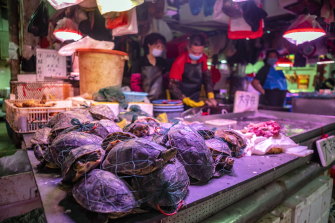
Live turtles for sale at the Xihua Farmers' Market in Guangzhou, China.
Live turtles for sale at the Xihua Farmers’ Market in Guangzhou, China.CREDIT:EPA/AP

Laos and Cambodia, some of the poorest countries in south-east Asia, operate as a source for both farmed and illegally caught wildlife. There is a domestic market, too, for consumption by tourists, as is the case with Thailand.

“This is one of the most valuable illicit trades, up there with drugs, weapons, human trafficking and counterfeit goods; it’s worth billions of dollars annually,” Roberton says.

“One reaction from some governments is that they don’t have the trade of wildlife for meat like in China, yet they do have trade for wildlife as pets and traditional medicine. The fact is that the conditions that lead to the emergence of zoonotic pathogens like COVID-19 and SARS occur in the wild animal trade whether they are being sold for meat, fur or medicine, so policies focused on only wildlife meat won’t significantly reduce the future threat of pathogen emergence.”

Australia has backed an international review of wildlife markets in the wake of the virus, which it has labelled a “big risk” to human health and food production.

Leanne Wicker, a senior vet at Healesville Sanctuary who worked in Vietnam for years and is an expert on species threatened by the wildlife trade, says such infectious organisms are “no risk to people when wild animals are left in the wild”.

The problem is that human behaviour, such as habitat destruction, ecotourism, hunting, the trade and consumption of wild animals and the farming of wild animals brings “people and wildlife into unnaturally proximity enabling the spillover of disease between species”.

Aside from COVID-19, she reels off rabies, Ebola, Hendra virus, henipavirus, the first SARS coronavirus, monkey pox, HIV, leptospirosis and rat lung worm, salmonella and toxoplasmosis as examples.

“The SARS-CoV-2 virus is not the first significant pathogen to arise from the wildlife trade and it most certainly won’t be the last.”

She’s also frustrated by the focus on wildlife or wet markets, arguing that restaurants, for example, can also pose a significant risk in spreading new and exotic viruses.

Australia’s Agriculture Minister David Littleproud said markets that exist across Africa and north and south-east Asia and sell animals for traditional medicine and food consumption are a “particular concern”.

“Even before COVID-19, we knew these sorts of markets posed a serious potential risk to human health and, if we obtain the scientific backing, we would like to see these markets phased out to ensure public health,” he says.

As Wicker says, the impact of the global wildlife trade is “devastating”.

“While I am acutely aware that the public health risks are significant, it is very hard to ignore the fact that this is a problem caused entirely by human greed. For me, the real tragedy lies in considering the fear, pain and discomfort felt by every single one of the many millions of individual animals who find themselves unlucky participants in this human atrocity.”

– with Amilia Rosa

COVID-19 kills Roy Horn, 75, of Siegfried & Roy, role model for “Joe Exotic”

https://www.animals24-7.org/2020/05/09/covid-19-kills-roy-horn-75-of-siegfried-roy-role-model-for-joe-exotic/?fbclid=IwAR1Eok8KbDUwI2AlUyoLj_2POsfhyEx0RQ8JpQUT3cZVjpErQALTaqZuLYc

Roy Horn & white tiger Mantecore.
(Beth Clifton collage)

Manicured image as “positive reinforcement” trainer & conservationist was,  like the Siegfried & Roy show,  largely illusory

            LAS VEGAS––Entertainer Roy Horn,  75,  whose illusion acts with longtime partner Siegfried Fischbacher famously featured white tigers,  pythons,  and elephants,  died on May 8,  2020 in Las Vegas,  his home for nearly 50 years,  from complications of COVID-19.

Siegfried & Roy show publicist Dave Kirvin told media that Horn died at the Mountain View Hospital in Las Vegas about a week after testing positive for COVID-19 infection.

Performing together since 1959,  Siegfried & Roy were the evident inspirations for a generation of white tiger breeders,  exhibitors,  and would-be media stars,  including “Joe Exotic” and “Doc” Antle,  featured in the six-part March/April 2020 Netflix “reality” series Tiger King:  Murder,  Mayhem,  & Madness,  directed by Eric Goode and Rebecca Chaiklin.

Roy Horn and Siegfried Fischbacher

Tiger act bought $10 million home in Las Vegas

Siegfried & Roy “toured Europe,  Japan and other venues,”  recalled New York Times obituarist Robert D. McFadden,  “ and were featured in a 1999 3D Imax movie, a 1994 television special,  and at Radio City Music Hall in New York.  They broke records for the longest-running act in Las Vegas,  and were among the most popular and highest paid performers on the Strip. They also wrote a book,  Siegfried & Roy: Mastering the Impossible (1992).

“Horn and Fischbacher,”  McFadden wrote,  “who were domestic as well as professional partners,  kept their menageries,  including dozens of exotic cats,  at a glass-enclosed tropically forested habitat at the Mirage [hotel and casino];  at Jungle Paradise,  their 88-acre estate outside of town;  and at Jungle Palace,  their $10 million Spanish-style home in Las Vegas.”

McFadden recalled that Horn and Fischbacher,  “acknowledging that their acts depended on some endangered species,  were prominent in various animal conservation efforts,  particularly for the white tiger,  native to Asia,  and the white lion of Timbavati,  in South Africa.  They raised many of their show animals from birth,  and said they were not exploited and were never tranquilized.”

Exhibit A for banning white tiger & lion breeding

But animal advocates,  while conceding that Horn and Fischbacher may have treated their animals much more kindly than most animal-using entertainers,  tend to have viewed those “conservation efforts” as mostly eyewash,  meant to burnish the Siegfried & Roy show image.

A nine-member coalition,  headed by People for the Ethical Treatment of Animals,  on May 19,  2017 formally petitioned the USDA Animal & Plant Health Inspection Service to initiate the federal rulemaking process to make breeding either white tigers or lion/tiger hybrids,  as Siegfried & Roy did to maintain their menagerie,  a violation of the Animal Health Protection Act of 2002 and the Animal Welfare Act of 1966.

Charged the petitioners to the USDA,  which has yet to act in response,  “Despite the known risks and lack of conservation value associated with breeding to create white tigers,  exhibitors like Siegfried & Roy continue to mislead the public into believing that they are a rare subspecies rather than a genetic anomaly.  Siegfried & Roy have had as many as 58 white tigers in their inventory at one time.  The pair continue to breed to create white tigers for exhibition at Siegfried & Roy’s Secret Garden at the Mirage in Las Vegas.”

(Beth Clifton collage)

Petition spotlighted “Joe Exotic” years before Netflix

The PETA-led petition to the USDA also described the activities of many other white tiger and lion/tiger hybrid breeders.

“In Oklahoma,  exhibitor Joe Schreibvogel,”  also known as Joseph Maldonado and now as Tiger King star ‘Joe Exotic,’  “sells white tigers,  ligers,  liligers,  and tiligers to private owners and exhibitors all over the country,”  the petition to the USDA alleged.

U.S. District Court Judge Scott Palk on January 23,  2020 sentenced “Joe Exotic” to serve 22 years in prison for having solicited the murder of Big Cat Rescue founder Carole Baskin in 2018.

Convicted of the murder plot in April 2019,  “Joe Exotic” was convicted at the same time of nine counts of violating the Endangered Species Act,  by shotgunning five tigers in October 2017 and by illegally offering tiger cubs for sale between November 2016 and March 2018.

The PETA-led petition also spotlighted “Bhagavan ‘Doc’ Antle,  also featured in The Tiger King,  whose South Carolina roadside zoo,  like the facilities formerly owned by “Joe Exotic,”  has a long history of Animal Welfare Act violations.

“Antle takes his experiments to a whole new level,”  the petitioners charged,  “by breeding to create hybrid white ligers.”

Roy Horn & his mother, circa 1950.

Siegfried & Roy act originated in post-World War II Germany

Horn and Fischbacher,  by contrast,  have been widely credited with helping to popularize “positive reinforcement” animal training,  but may also have done more to popularize and promote traffic in white tigers,  developing the market served by “Joe Exotic,”  Antle,  and others,  than all previous white tiger breeders combined.

Wrote McFadden,  “Roy Uwe Ludwig Horn was born on October 3,  1944,  in  Nordenham,  Germany,  near Bremen.  Like Fischbacher,  who was five years older and raised in Rosenheim,  a village in Bavaria,  Horn grew up in the turmoil of wartime and postwar Germany. While Fischbacher was drawn to magic,  Horn was taken with animals,  including his wolf-dog Hexe, and a cheetah,  Chico,  at a zoo in Bremen where the boy took an after-school job feeding animals and cleaning cages.”

Horn,  at age 13,  in 1957 became a cabin boy on a German cruise ship.

Roy Horn (left) with Chico the cheetah and Siegfried Fischbacher, 1966.

Cheetah named Chico

Continued McFadden,  “Fischbacher,  a steward,  was entertaining passengers with magic tricks,  and Horn caught his act.”

Recalled Horn to interviewers many years later,  “I told Siegfried if he could make rabbits come out of a hat,  why couldn’t he make cheetahs appear?”

Horn eventually smuggled the cheetah Chico aboard the ship in a laundry bag.  Siegfried developed an illusion routine featuring Chico,  performed at a variety of venues in Germany and Switzerland before mostly small crowds until in 1966 Princess Grace of Monaco saw them at a charity performance in Monte Carlo “and gave them a rave notice,”  recounted McFadden.

“A rush of publicity ensued.  Adding animals and tricks,  they were soon playing nightclubs in Paris and other European cities.  They made their Las Vegas debut at the Tropicana in 1967,”  McFadden continued,  “and by the early 1970s,  having made Las Vegas their base,  they were under contract at the MGM Grand.”

Money made the tigers go around

Moving to the Frontier Hotel in 1981, Siegfried & Roy during the next seven years performed before three million people there.

“In 1987,”  McFadden summarized,  “they signed a five-year $57.5 million contract with Steve Wynn,  owner of the planned $640 million Mirage casino-hotel,  a deal Variety called the largest in show business history.  It included $40 million more for a new theater for the show,”  plus the $18 million Secret Garden animal habitat.

Headliners at the Mirage from 1990 to 2003,  adding white tigers to the act in 1995 after purchasing a pair from the Cincinnati Zoo,  Siegfried & Roy at peak performed before 400,000 people a year,  generating $44 million in revenue.

Former Siegfried & Roy trainer Chris Lawrence was onstage with Roy Horn during 2003 attack.  (NBC News photo)

Birthday attack stopped the show

That ended abruptly on Horn’s 59th birthday in 2003.  Midway through a solo show with a seven-year-old white tiger named Mantecore,  the tiger refused to lie down on command.  Horn rapped Mantecore on the nose with his microphone.  Mantecore swiped at Horn’s arm.  Horn stumbled.  Mantecore seized Horn by the neck,  crushing his windpipe,  and dragged Horn off stage as Horn tried to beat him away with the microphone.

Forced to suspend the Siegfried & Roy shows,  the Mirage laid off 267 workers,  but continued to house the Siegfried & Roy animals,  including Mantecore,  at the Secret Garden.

Horn and Fischbacher contended that Mantecore “had been unhinged by a woman in the front row with a beehive hairdo,”  McFadden recalled,  and after Horn tripped,  “picked him up by the neck,  as a tigress might a cub,  attempting to carry him to safety.”

The USDA Animal & Plant Health Inspection Service,  however,  “discounted all such theories and called it a simple attack by the tiger,”  McFadden noted.

A white tiger at Big Cat Rescue.  (Beth Clifton photo)

“Treating the cats like props”

Former Siegfried & Roy trainer Chris Lawrence,  46,  in March 2019 gave a different explanation to The Hollywood Reporter.

“Many of the handlers thought that Roy was treating the cats more like props than he was respecting them for who they were,”  Lawrence told The Hollywood Reporter.

Lawrence claimed that he himself “actually talked Roy into using the tiger that would ultimately maul him and end the most successful stage show in the history of Las Vegas.”

Said Lawrence,  “What Roy did was,  instead of walking Mantecore in a circle,  as was usually done,  he just used his arm to steer him right back into his body,  in a pirouette motion.  Mantecore’s face was right in (Horn’s) midsection.  Roy not following the correct procedure fed into confusion and rebellion.”

Lawrence tried unsuccessfully to lure Mantecore away from Roy with raw meat,  but was knocked down,  along with Roy.

Bengali the tiger keeps on coming, with a red rubber ball rising like the morning sun behind him.  (Carole Baskin photo)

Oldest Siegfried & Roy tiger died at Big Cat Rescue

Siegfried & Roy,  with Mantecore,  performed only once more together,  for a cancer charity benefit in 2009.

Wrote Las Vegas Review-Journal reporter Mike Weatherford then,  “Siegfried Fischbacher and Horn were trying to figure out when and how to bow out gracefully even before the accident that put an abrupt end to their show.  The Mirage hit had been running for thirteen and a half years and 5,750 performances.  Horn had just celebrated his 59th birthday. Fischbacher had already passed 60.”

Mantecore died on March 19,  2014,  at age 17––old for a tiger,  but not nearly the oldest of the tigers Siegfried & Roy bred.

That tiger,  21 or 22 years of age,  either way one of the half dozen oldest tigers on record,  and one of two tigers within that elite half dozen to share the name Bengali,  died on May 31,  2016 at Big Cat Rescue on the outskirts of Tampa,  Florida.  Siegfried & Roy had sold him to a circus.  The circus retired him to Big Cat Rescue in 2000.  

(Beth Clifton collage)

Another former Siegfried & Roy tiger,  Sarmoti,  acquired at the same time,  died at Big Cat Rescue at age 20 in 2013.

Sarmoti,  Big Cat Rescue founder Carole Baskin told ANIMALS 24-7,  “is an acronym for Siegfried And Roy, Masters Of The Impossible.”

         (See A tale of two of the world’s oldest tigers, both named Bengali.)

Please help us continue our work for animals: 

http://www.animals24-7.org/donate/

Healthy pigs being killed as meatpacking backlog hits farms

Updated 

DES MOINES, Iowa (AP) — After spending two decades raising pigs to send to slaughterhouses, Dean Meyer now faces the mentally draining, physically difficult task of killing them even before they leave his northwest Iowa farm.

Meyer said he and other farmers across the Midwest have been devastated by the prospect of euthanizing hundreds of thousands of hogs after the temporary closure of giant pork production plants due to the coronavirus.

The unprecedented dilemma for the U.S. pork industry has forced farmers to figure out how to kill healthy hogs and dispose of carcasses weighing up to 300 pounds (136 kilograms) in landfills, or by composting them on farms for fertilizer.

Meyer, who has already killed baby pigs to reduce his herd size, said it’s awful but necessary.

“Believe me, we’re double-stocking barns. We’re putting pigs in pens that we never had pigs in before just trying to hold them. We’re feeding them diets that have low energy just to try to stall their growth and just to maintain,” said Meyer, who also grows corn and soybeans on his family’s farm near Rock Rapids.

It’s all a result of colliding forces as plants that normally process up to 20,000 hogs a day are closing because of ill workers, leaving few options for farmers raising millions of hogs. Experts describe the pork industry as similar to an escalator that efficiently supplies the nation with food only as long as it never stops.

More than 60,000 farmers normally send about 115 million pigs a year to slaughter in the U.S. A little less than a quarter of those hogs are raised in Iowa, by far the biggest pork-producing state.

Officials estimate that about 700,000 pigs across the nation can’t be processed each week and must be euthanized. Most of the hogs are being killed at farms, but up to 13,000 a day also may be euthanized at the JBS pork plant in Worthington, Minnesota.

U.S. Rep. Collin Peterson, a Minnesota Democrat who chairs the House Agriculture Committee, went to the plant Wednesday, in part to thank JBS officials for agreeing to kill the hogs at his request.

“The only thing they wanted out of me was for me to come down here and say I’m the one who asked for this, not them. … Blame me if you don’t like it,” he said.

It all means that meat can’t be delivered to grocery stores, restaurants that now are beginning to reopen or food banks that are seeing record demand from people suddenly out of work. Some of that demand is being met by high levels of meat in cold storage, but analysts say that supply will quickly dwindle, likely causing people to soon see higher prices and less selection.

To help farmers, the USDA already has set up a center that can supply the tools needed to euthanize hogs. That includes captive bolt guns and cartridges that can be shot into the heads of larger animals as well as chutes, trailers and personal protective equipment.

Iowa officials have asked that federal aid include funding for mental health services available to farmers and the veterinarians who help them.

Meyer said euthanizing healthy animals is a difficult decision for a farmer.

“It is a tough one,” he said. “We got keep our heads up and try to be resourceful and if we can make it through this cloud, I think there will be good opportunities if we’re left standing yet.”

The USDA has a program designed to connect farmers with local meat lockers and small processors that can slaughter some hogs and donate the meat to food banks. However, that effort has been hindered by the fact that small processors already were overwhelmed with customers who have turned away from mass-produced meat and instead bought a hog or cow to be processed locally.

Chuck Ryherd, owner of State Center Locker in State Center, Iowa, said he’s almost completely booked through the end of the year and has been turning away customers.

Chris Young, the executive director for the American Association of Meat Processors, a trade group for about 1,500 smaller meat lockers, said that while some local processors in Indiana, Illinois and Wisconsin have been able to take a few extra hogs, the shortage is being felt nationwide.

“When the pandemic started, all across the country, a lot of these small processing plants with a retail store in the front were just overrun,” he said. “They’re still crazy busy. It hasn’t really backed off.”

On Wednesday, President Donald Trump used the Defense Production Act to order that large meat processors remain open, giving hog farmers hope the situation could improve.

However, Howard Roth, a Wisconsin farmer and president of the National Pork Producers Council, said farmers will need to keep euthanizing pigs as the slaughterhouses struggle to resume their full production. Farmers will definitely need federal help to keep them afloat.

“We are going to need indemnity money for these farmers,” he said. “This situation is unprecedented.”

Peterson also said he’ll seek a change in the law so that the USDA can retroactively compensate farmers for euthanizing healthy animals in such emergencies. He said the USDA told him it doesn’t have the authority at the moment to do that for healthy animals, just diseased animals, as it did during for chickens and turkeys in the bird flu outbreak.

“It’s going to be in there, I’ll guarantee you,” he said.

Coronavirus ground zero food market was selling KOALAS, snakes and wolf pups before deadly virus outbreak

A FOOD market at the centre of the deadly coronavirus outbreak has claimed they sold live koalas, snakes, rats and wolf pup to locals to eat.

The Huanan Seafood market in WuhanChina is under investigation after officials believe the coronavirus originated from a wild animal that was sold at the venue.

 Officials believe the coronavirus originated from a wild animal that was sold at the food market

5
Officials believe the coronavirus originated from a wild animal that was sold at the food marketCredit: Muyi Xiao/Reuters
 Their advertising board showed their wide-ranging menu of live animals on offer

5
Their advertising board showed their wide-ranging menu of live animals on offerCredit: Muyi Xiao/Reuters

In a desperate attempt to contain the killer virus, the market — labelled “ground zero” by local authorities — has since been shut down.

So far, the highly-contagious virus has killed 26 people and infected hundreds around Asia.

A translation of the markets’ advertising board revealed how they sold live foxes, crocodiles, wolf puppies, salamanders, snakes, rats, peacocks, porcupines and even koalas.

Amidst the global health threat, stunned locals took to Chinese social media site Weibo to show their surprise.

One user, clearly shocked at the sale of live animals, wrote: “Just take a closer look at the viral wild animal menu — they even eat koalas.

“There’s nothing Chinese people won’t eat.”

Just take a closer look at the viral wild animal menu — they even eat koalas

Weibo User

According to the list, there were 112 live animals and animal products readily available to purchase.

Coronavirus represents a wide variety of viruses present in animals that can, in certain circumstances, jump to humans.

Amid fears it could become a global pandemic, the Chinese government has put the city into lockdown and plans to shut down the airport and public transport.

More than 500 people have been infected, but there are fears that figure could now be as high as 10,000.

Experts now fear that the new strain is “as deadly as Spanish flu”, which killed 50 million people in 1918.

Professor Neil Ferguson, an expert in mathematical biology at Imperial College London, said the death rate was “roughly the same as for the Spanish flu epidemic, at around one in 50”.

Several countries increased border health checks to guard against the disease’s spread, including Australia, the US, the UK and Russia.

In worrying circumstances, people are being treated for suspected coronavirus in Britain after flying in from China.

Recent footage also emerged today showing a suspected coronavirus victim being wheeled out of an airport in a quarantine box.

 Even live koalas, a local delicacy, were up for grabs at the 'ground zero' market

5
Even live koalas, a local delicacy, were up for grabs at the ‘ground zero’ marketCredit: Miami Zoo via Ron Magill
 Countries have increased border health checks to guard against the disease's spread, including Australia, the US, the UK and Russia

5
Countries have increased border health checks to guard against the disease’s spread, including Australia, the US, the UK and RussiaCredit: SWNS:South West News Service
 But people are being treated for suspected coronavirus in Britain after flying in from China today

5
But people are being treated for suspected coronavirus in Britain after flying in from China todayCredit: SWNS:South West News Service

‘Tiger King’ star Joe Exotic had sex fetishes, ordered burial of protesters at zoo, Jeff Lowe claims

aldonado-Passage, also known as “Joe Exotic,” had kinky sex fetishes and once ordered employees to bury the bodies of two protesters at his former zoo, current owner Jeff Lowe claims in a new interview.

Lowe assumed ownership of the Greater Wynnewood Exotic Animal Park in Oklahoma following Maldonado-Passage’s run in 2019. The Netflix series’ boisterous star is now serving 22 years behind bars for a failed murder-for-hire plot on his rival, Big Cat Rescue CEO Carole Baskin.

Lowe, who also appeared in the Netflix documentary, now claims in an interview with the Daily Mail that the series only showed a very small fraction of Maldonado-Passage’s questionable behavior. He alleged the cat enthusiast is guilty of burying his protesters on the zoo’s grounds in addition to indulging in a number of eyebrow-raising sex fetishes.

‘TIGER KING’ SPECIAL TO AIR ON FOX, FEATURE NEVER-BEFORE-SEEN FOOTAGE

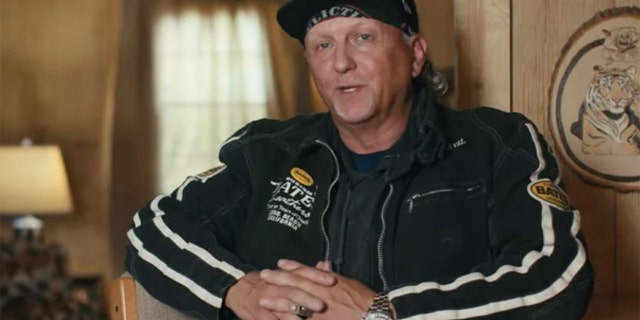
Jeff Lowe of 'Tiger King: Murder, Mayhem and Madness'

Jeff Lowe of ‘Tiger King: Murder, Mayhem and Madness’ (Netflix)

Lowe claimed he stumbled upon “packages and packages of these whips and chains and bondage devices” belonging to Joe Exotic in his attic.

“We also found pictures of stuffed animals where the mouths and ends of the animals had holes cut out in them where they would use them as their own sex toy,” Lowe claimed.

The zoo owner provided the Daily Mail with photos of the stuffed animals, as well as online documentation of Maldonado-Passage soliciting sex in exchange for money with strangers online.

‘TIGER KING’ CAPTURED 34 MILLION US VIEWERS IN FIRST 10 DAYS: REPORT

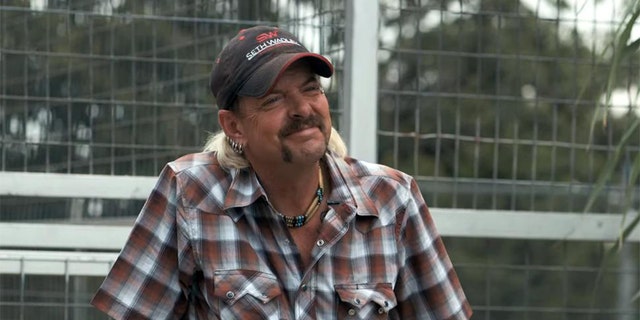
Joseph Maldonado-Passage, also known as "Joe Exotic," from the hit Netflix series 'Tiger King.'

Joseph Maldonado-Passage, also known as “Joe Exotic,” from the hit Netflix series ‘Tiger King.’ (Netflix)

“Joe was embezzling money from the zoo in order to pay all of these men to come have sex with him, he was only making $150 a week at the time. He was using the zoo as his own personal piggy bank,” Lowe alleged.

An attorney for Maldonado-Passage did not immediately respond to Fox News’ request for comment.

Furthermore, Lowe said he’s heard claims from other employees that Maldonado-Passage engaged in bestiality around the zoo.

The owner also claimed he’s learned there is a possibility of dead bodies buried on the zoo property.

‘TIGER KING’ STARS: WHERE ARE THEY NOW?

Joe Exotic is the main subject of Netflix's hit docuseries 'Tiger King.'

Joe Exotic is the main subject of Netflix’s hit docuseries ‘Tiger King.’ (Netflix)

“After Joe was arrested, four locals who didn’t know each other told me that there could be dead bodies buried on my property,” he said.

He claimed he was told by one employee that a co-worker once shot two protesters who attempted to climb the zoo’s fence. He claimed Joe allegedly instructed the employee to place the bodies inside of large tires and then burn them.

Lowe claimed the feds agreed to see how long Joe Exotic would be sentenced for before spending “the estimated $1 million to excavate and process the entire area” of the zoo.

Jeff Lowe now owns the Greater Wynnewood Exotic Animal Park.

Jeff Lowe now owns the Greater Wynnewood Exotic Animal Park. (Netflix)

CLICK HERE TO GET THE FOX NEWS APP

Since landing in prison, Maldonado-Passage has filed a civil lawsuit against Lowe and a number of government agencies seeking $94 million for false arrest, false imprisonment, selective enforcement and the death of his mother, among other claims.

Tiger Queen

To think I almost watched an episode of the “Tiger King” at one time. I had added it to my Netflix list back when I’d heard only that it was a true crime documentay and guessed that it would reveal much about the way animals are abused when forced to perform. But I have long- since removed it from the list, after I started to get an idea that the rampant tiger abuse was not even the focus of the stupid show…

I was reminded of a time years ago when I took the chance to get near tigers by visiting a hollywood animal “trainer” or “wrangler” or whatever the heck they call them now at her property in rural Washington. She “owned” tigers, lions and I don’t remember what else–all kept in small, muddy outdoor enclosures, totally devoid of trees, bushes or any living vegetation. I’m guessing now, that she didn’t want to give the animals anything to hide behind.

When we went out to meet the tigers, one had knocked over its water bowl or for some reason she had to go into the pen with the tigers. One of them (playfully?) took a swipe at her and she responded by picking up a section of 2×4 and hitting the cat as hard as she could over the head, before hastily scrambling out of the fenced enclosure!

At that point it was clear that the animals weren’t at all happy there and wouldn’t hesitate to escape their confines if they had half a chance and freedom would not just end in them being shot like so many “big game” animals humans so proudly display on the walls of their dens or in their “trophy” rooms …

The Most-Watched Show in America Is a Moral Failure

NETFLIX
This article contains spoilers through all seven episodes of Tiger King.

At this particular moment, the most-watched show in America is a seven-part documentary series about a gay, polygamous zoo owner in Oklahoma who breeds tigers, commissions and stars in his own country-music videos, presides over what he describes as “my little cult” of drifters and much younger men, and ran for governor of Oklahoma in 2018 on a libertarian platform. He’s also currently serving a 22-year prison sentence for, among other charges, trying to arrange the assassination of his nemesis, an animal-sanctuary owner in Florida. And his business allies include another big-cat breeder—a yoga-loving guru in Myrtle Beach who runs what appears to be a tiger-themed sex sect.

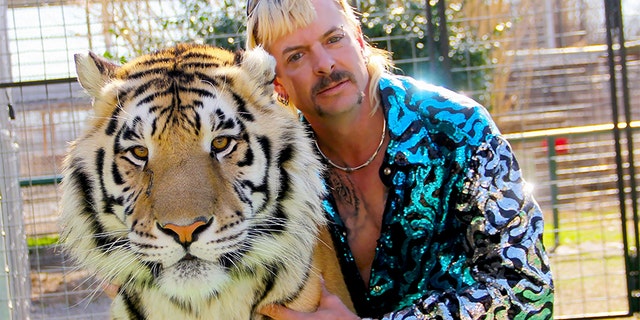
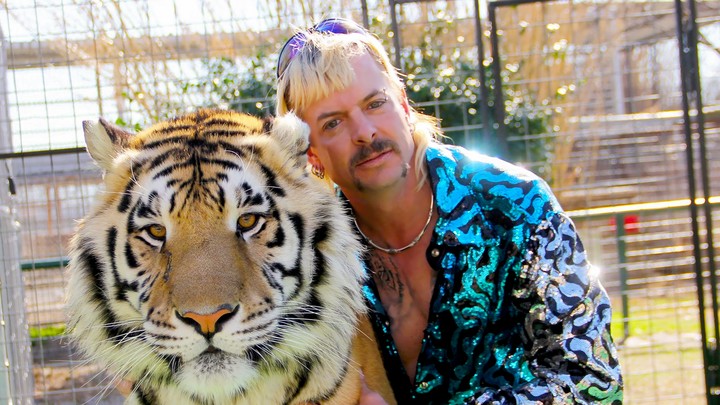
There are no heroes in Tiger King. Not Joseph “Joe Exotic” Maldonado-Passage, whose stripy mullet you’ve surely seen on social media, accompanied by a teal sequined jacket so ostentatious that the adult tiger he’s posing with looks like an afterthought. Not Bhagavan “Doc” Antle, who, one former employee alleges, coerces teenage girls working 100-hour weeks at his ranch to reach “his level of enlightenment” by sleeping with him. Not Carole Baskin, the owner of a Florida sanctuary for big cats, who Tiger King insinuates—in a strikingly unjournalistic way—might have killed her husband. And definitely not Eric Goode, the New York hotelier and animal-rights activist who co-directed the series, whose elevator pitch for it seems to have been “What if Christopher Guest, but real?” and whose disdain for the dentally challenged and leopard-print-festooned characters he captures is Tiger King’s most discernible emotion.

And yet, for the past two-plus weeks, Tiger King has consumed the pop-cultural imagination. It’s the stuff memes are made of, heavy on visual absurdity and light on meaning. The series is a carnival sideshow not unlike Joe Exotic’s central-Oklahoma park: You see the sign on the side of the road and you stop, not because you want to, necessarily, but because it’s there.

In that sense, Tiger King is also the latest and most acute iteration of a Netflix trend toward extreme storytelling; the more unfathomable and ethically dubious, the better. The point is virality—content so outlandish that people can’t help but talk about it. In 2018, the docuseries Wild Wild Country set the model, with its jaw-dropping chronicles of an alternative Oregon faith community whose antics allegedly included spiritual orgies, gun hoarding, electoral fraud, and mass poisonings. Last year’s Abducted in Plain Sight captured the appalling story of a teenage girl who was abused and kidnapped by a family friend, seemingly in full view of her parents. With its reality programming, too, Netflix has been courting eyeballs with simple insanity, via the hit dating series Love Is Blind and the upcoming Too Hot to Handle, a show in which ridiculously good-looking people are sequestered on an island to compete for a cash prize that diminishes every time they hook up, or even masturbate. The more scurrilous or degrading the concept, the more we watch.

This truism wasn’t news for P. T. Barnum, and it isn’t news now. But there’s still something wretched to me about the way Tiger King has managed to define a cultural moment in which empathy and communitarianism are so crucial. America right now, in the midst of a pandemic, is reliant on collective behavior, adhering to rules, and taking sensible precautions to avoid danger. Tiger King is the TV equivalent of licking the subway pole. Its characters have managed to construct whole worlds around themselves rather than curtail their worst impulses in any way. These characters are so colorful that they obliterate everything else around them. They’re any documentarian’s dream, and yet you can’t help but wonder what the directors hope to get out of giving showmen the mass exposure that they want. Who, in the end, benefits?

On its face, Tiger King is about a remarkable subculture in the U.S.: people who collect and (illegally) breed big cats. There are, the show reveals early on, more privately owned tigers living in America than there are existing in the wild, kept in independent “zoos” and parks across the country. (In 2003, authorities discovered that a man in Harlem was cohabiting with a 400-pound tiger named Ming, in the same apartment that his mother was using to babysit children.) If the people drawn to tigers have a shared quality, Tiger King emphasizes, it’s extroversion, which it illustrates in one scene with footage of Doc Antle riding an elephant into town while opining in voice-over about the “primordial calligraphy” of exotic animals.

Joe Exotic, for better or worse, is the show’s central character, and Tiger King sketches out a sparse biography that hints at, rather than elucidates, the forces that shaped him. The challenge seems to be that anything he says is stated in the service of inflating his own mystique, and the directors decline to press him or any of the other characters on the worst charges against them. There are some undeniable facts, such as how hard it must have been for Exotic to be a gay man in rural Oklahoma during the ’80s and ’90s. There’s also his history of releasing country songs he only lip-synchs to; his run for president in 2016 and for governor two years later; and his habit of filming virtually everything he does. There are a few private moments, too, including how he reacts after one of his employees is mauled by a tiger while at work. “I’m never gonna financially recover from this,” Maldonado-Passage sighs, while the rest of his employees try to tend to the victim’s severed arm. Hardest to endure is how he behaves at the funeral for his youngest husband, Travis, who accidentally shoots himself in the head. Dressed up in a dog collar, Exotic seizes the spotlight, singing, cracking jokes, and reminiscing fondly about his late partner’s testicles while Travis’s mother sobs.

Mostly, though, Exotic communes with tigers. He cuddles them while they’re riding shotgun in the front seat of his truck; he wrestles with them; he uses a steel hook to wrest newborn cubs from their mothers and then complains that the screaming babies are making too much noise. The visual impact of seeing humans and tigers so intimately connected is one of the defining qualities of Tiger King, and is also, the series suggests, why some people find tigers so appealing. There’s a taboo quality to the breach of natural laws separating humans and big cats that implies strength, virility, and power. No wonder, the show notes, so many male Tinder users have tiger selfies as avatars.

NETFLIX

Tiger King’s unified theory of tiger obsession falls short, however, when it reaches Carole Baskin, the owner of a Florida animal sanctuary devoted to big cats. This shortcoming might explain why the show takes such pains to portray her as a kook, and possibly even a murderer. Baskin is Exotic’s bête noire, a woman who has dedicated her career to trying to outlaw the breeding and personal ownership of exotic cats in the U.S. The show’s treatment of Baskin is where it indulges in its most egregious displays of false equivalence, as it tries to elevate her eccentricities to stand alongside those of Exotic and Antle. Baskin, Tiger King painstakingly lays out, is obsessed with animal print. The horror! Sometimes she wears flower crowns! She has an uncanny gift for search-engine optimization! She rides a bicycle! Her sanctuary relies heavily on unpaid volunteers! The show underscores all these facts, while making the most of the mysterious disappearance of Carole’s husband in 1997 and interviewing family members who seem convinced that she killed him. “There is absolutely no physical evidence at this time” implicating any one individual as a suspect, a police detective firmly and rather crushingly points out. Tiger King doesn’t care. It would much rather imply several times that she could have fed her husband’s corpse to tigers, had she been so inclined.

Baskin is interesting, too, because she’s a woman operating in a world characterized by gleeful misogyny. Exotic makes effigies of Baskin; he fills her mailbox with snakes (a strangely phallic gesture); he makes memes about her crotch, and videos in which he fantasizes about torturing her with a horse penis. He calls her a bitch so many times that the word loses all meaning. Jeff Lowe, one of Exotic’s business associates, who enters the series midway through, is a more limited character, but his treatment of women is still horrible enough to be noteworthy. (As his wife tells the camera about how she’s preparing for the upcoming birth of their child, Lowe remarks that she’ll immediately have to go back to the gym, and shows the directors glamour shots of the women he’s considering as nannies. Lowe, according to the show, also has a felony criminal record and a history of charges that include throttling his first wife.)

NETFLIX

The degradation in Tiger King starts to feel contagious after a while. Goode and his co-director, Rebecca Chaiklin, filmed the series over five years, and the longer they spend with their subjects, the more obviously things fall apart. One of Exotic’s ex-husbands, John Finlay, gives shirtless interviews that show off his abundant tribal tattoos—including a crotch adornment that reads privately owned joe exotic—and his undeniable lack of teeth. (Only in Episode 5 does Tiger King stop to note that meth has been a prevalent factor in Exotic’s world the whole time.) The interviews become more and more invasive. Travis’s mother is asked about her son’s death while she’s seemingly intoxicated. In Episode 7, one of Exotic’s zoo employees is so incapacitated that he passes out mid-interview. Exotic’s campaign manager is interviewed early on as a fresh-faced former Walmart manager enthusiastically crafting Exotic’s libertarian platform; a year or so later, he too has lost teeth, and appears considerably more disheveled than during his clean-cut canvassing days.

Exotic is the only one who appears unchanged, even as the plot makes its way toward his 22-year jail sentence for conspiring to have Baskin assassinated. The persona he’s crafted, you sense, is strong enough to survive anything, even prison. In that sense, there’s something undeniably Trumpian about him. No misfortune can shake his sense of self. No humiliation can shame a man who refuses to be shamed. The chaotic reactions that Exotic has sparked are irrevocable, and even now, he’s fast approaching cultural-legend status, as Hollywood stars spar on Twitter over who gets to play him in the already-approved miniseries. “Fuck yeah, roll the cameras,” is how the reality-TV producer Rick Kirkham described watching Exotic at his most idiosyncratic and badly behaved. Netflix obviously agreed. Why can’t the rest of us look away?