Exposing the Big Game

Forget Hunters' Feeble Rationalizations and Trust Your Gut Feelings: Making Sport of Killing Is Not Healthy Human Behavior

Exposing the Big Game

Lion cubs found dead in freezer at South African ‘hunting’ farm while others tremble and twitch inside tiny cages ‘due to inbreeding’

THIS is the horrifying moment inspectors found two fatally ill lion cubs locked inside a metal crate on a farm – seconds before discovering the bodies of 20 others stuffed inside a freezer.

Officers dropped in on Pienika Farm in South Africa as part of a surprise inspection arranged after they found other animals in dire conditions just four months ago.

 The cubs were found suffering from neurological conditions and vets were forced to put them to sleep

7
The cubs were found suffering from neurological conditions and vets were forced to put them to sleepCredit: NSPCA

 Officers dropped in on Pienika Farm in South Africa as part of a surprise inspection

7
Officers dropped in on Pienika Farm in South Africa as part of a surprise inspectionCredit: NSPCA

The cubs, who ranged in different ages, were found suffering from neurological conditions and had to be euthanised at the scene.

Their bodies were later taken away from the farm, which was slammed in April after inspectors found animals in filthy and parasitic conditions, for post mortem examinations.

The discoveries sparked a further search, leading to inspectors finding approximately 20 carcasses of lions and tigers in a chest freezer.

According to Eduardo Goncalves, founder of the Campaign to Ban Trophy Hunting, the animals were being bred in captivity to be petted by tourists, bottle fed and then eventually shot for trophies.

The NSPCA removed five carcasses for post mortem examinations to determine the cause of death.

They stated that they will be laying further charges in terms of the Animals Protection Act No 71 of 1962, on the owners of the farm, who were initially charged in April.

Speaking to The Sun, Mr Goncalves, said: “Inspectors from the NSPCA previously found 27 tigers, lions, leopards and caracals in terrible condition at the same farm during an unannounced visit in April this year.

‘PET, BOTTLE FED, THEN SHOOT FOR TROPHY’

“They were kept in overcrowded conditions, had no water, were filthy and suffering from parasites. Two lion cubs were suffering from neurological conditions, likely to be the result of in-breeding.

“The farm is in Lichtenburg in South Africa’s North West Province. There are around 60 such facilities in South Africa breeding big cats for people to pet, bottle feed, and then shoot for a trophy.

“The bones are often sold off to dodgy dealers in Asia who make fake medicines out of them. This is the reality of big cat factory farming in South Africa.

“It’s simply obscene. The animals are kept in appalling conditions and their owners make a fortune out of their misery.”

Senior Inspector Douglas Wolhuter, manager of the NSPCA’s Wildlife Protection Unit, said: “With the release of The Lion King and the tribute to lions during World Lion Day, the rest of the world is celebrating these majestic creatures.

“Here in South Africa, where lions are indigenous and a massive part of our heritage, we are condemning thousands of lions to a life of captivity, where their basic needs are not being catered for, and we are subjecting what is globally known as the king of the animal kingdom to a pathetic life in a cage, waiting for death.”

 The discoveries sparked a further search, leading to inspectors finding approximately 20 carcasses of lions and tigers in a chest freezer

7
The discoveries sparked a further search, leading to inspectors finding approximately 20 carcasses of lions and tigers in a chest freezerCredit: NSPCA

 Cubs were found shaking uncontrollably in cages on the farm

7
Cubs were found shaking uncontrollably in cages on the farmCredit: NSPCA

 THIS is the horrifying moment inspectors found two fatally ill lion cubs locked inside a metal crate on a farm - seconds before discovering the bodies of 20 others stuffed inside a freezer.

7
THIS is the horrifying moment inspectors found two fatally ill lion cubs locked inside a metal crate on a farm – seconds before discovering the bodies of 20 others stuffed inside a freezer.Credit: NSPCA

In April, NSPCA investigators attended to a complaint at the same farm in Lichtenburg, where they found lions being kept in small, overcrowded enclosures and inadequate shelters with no provision of water.

The farm contained suffering lions, caracals, tigers, and leopards. In total, 27 of the lions had mange and the caracal were obese and unable to properly groom themselves.

An NSPCA spokesperson said: “The Inspectors were horrified to find two lion cubs that were unable to walk and appeared to be showing signs that they were suffering from a neurological condition.

“The NSPCA removed the two cubs for assessment and veterinary treatment by a veterinarian with a special interest in carnivores.”

The two cubs have since improved ‘with leaps and bounds’ and are now able to stand unaided.

The spokesperson added: “Two cubs that were unable to stand, and were paddling on the ground to try and move away from their own faecal matter, are [now] able to stand and even take steps.

Cows, carbon and climate change

Cows, carbon and climate change
© Getty

With record heat waves, costly fire seasons, rising sea levels, and superstorms wracking our planet, it is clear that human-caused climate disruption is causing major problems for all of Earth’s inhabitants. Fossil fuels have long (and correctly) been identified as the biggest culprits, with the majority of humanity’s atmospheric carbon contribution coming from burning fossil fuels — oil, coal, and natural gas — and reversing hundreds of millions of years of natural carbon sequestration on the part of swamps and forests. However, there is an increasing global awareness that animal agriculture also plays a major role in accelerating climate change.

Cattle and other domestic ruminants have a four-chambered stomach, including a fermentation vat (called a rumen) that enables the animal to use microbes to break down cellulose — the main component of wood, paper and cardboard — into sugar. This fermentation process creates methane, which increases atmospheric temperatures  25 to 84 times as much as carbon dioxide. Thus, cattle, sheep and other livestock boost the carbon dioxide absorbed by plants into a far more climate-potent gas.

Livestock belching, farting and manure emissions of this and other gases has been estimated to account for 14 to 18 percent of the total human-induced greenhouse gases that are responsible for climate change. The remaining 82 to 86 percent of carbon emissions into the atmosphere comes from taking carbon out of the ground and pumping it into the atmosphere, whether through equally-potent methane leaks from natural gas wellfields and pipelines or through burning fuels to produce carbon dioxide. Thanks to the combined effect of greenhouse gases from livestock production and fossil fuel combustion on the world’s climate, the survival of the planet’s life forms, humanity included, is now at risk.

But the livestock also convert and degrade lands, radically reducing carbon sequestration — the natural ability of the biosphere to soak up atmospheric carbon — creating an even greater climate problem than methane emissions themselves. This effect is most obvious in tropical rainforest areas, which are being deforested at an accelerating pace to create pasture lands for livestock. This upsets natural nutrient cycling, as soil nutrients present in rainforest settings quickly leach out of the soil. Following deforestation, the massive carbon banks tied up in rainforest trees, vines and shrubs are gone for the long term. This bankrupting of carbon reserves in the tropics is paired with a catastrophic loss of biodiversity, an environmental crisis co-equal to climate disruption in its severity and significance.

Less visibly but perhaps more importantly, livestock grazing on the world’s grasslands, shrubsteppes and deserts can cause even greater withdrawals from a carbon banking standpoint than cutting down the forests. Livestock grazing eliminates deep-rooted native grasses and wildflowers, replacing them with shallow-rooted annual weeds that thrive in disturbed environments and die every year, releasing their carbon back to the atmosphere. Annual weeds therefore have little ability to store carbon in the soil.

In addition, once rangelands become degraded through overgrazing, shrubs sometimes increase, but clearing these shrubs to stimulate forage production for livestock further cripples the land’s ability to store carbon.

Throughout the Intermountain West, heavy grazing by livestock flips the ecological switch that converts healthy native habitats to an annual weed called cheatgrass, by suppressing the native perennial grasses and destroying the soil crusts that otherwise prevent cheatgrass invasion. Cheatgrass is highly flammable, and the resulting high-frequency range fires can eliminate deep-rooted shrubs, accelerating carbon loss from the soil.

Restoring the 25 million acres of livestock-degraded and cheatgrass-infested rangelands in the western United States back to native shrubs and grasses could offset some 23 percent of all U.S. carbon emissions. Stopping the livestock-induced damage would allow the land to heal over time and regain its carbon-storing capacity.

Natural areas are the lungs of the planet, breathing in carbon dioxide and exhaling oxygen. Personal choices by consumers (adding rooftop solar panels, eating less meat) can help, but they’re not enough to stem the tide. Returning half the Earth to nature would restore carbon reserves while also addressing the biodiversity crisis.

We need major policy initiatives like the Green New Deal to force decisive action, stabilize and slash carbon emissions, and restore healthy levels of carbon sequestration through the natural processes of photosynthesis. Major livestock reforms on America’s western public lands would be a key step forward in this effort.

Bear attacks worker during wildlife tour at Pennsylvania resort

The resort said that it has “ensured the enclosure is completely secure” and is arranging counseling for guests and staff who witnessed the attack.

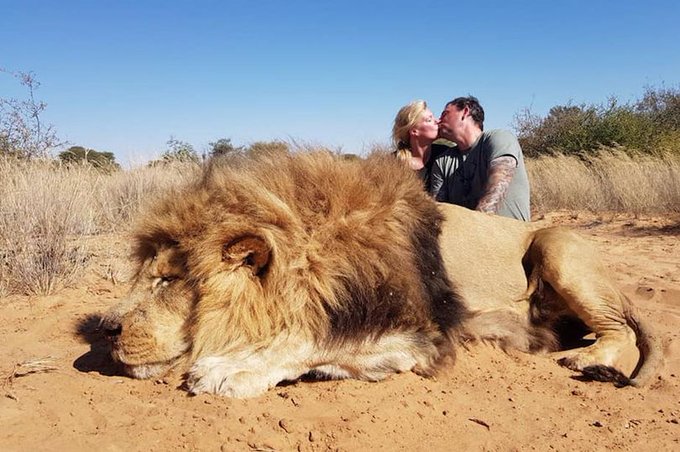
Makes Me Sick’: Daughter Disowns Trophy-Hunting Dad Who Kissed Partner Beside Slain Lion

The Carters from Edmonton, Alberta, were part of a tour organised by Legelela Safaris when they shot and killed the lion.

'Makes Me Sick': Daughter Disowns Trophy-Hunting Dad Who Kissed Partner Beside Slain Lion

Image credit: Twitter/YouTube

A Canadian trophy-hunter, who was slammed for kissing his partner beside a lion they had just shot and killed in Africa, has now been disowned by his own daughter.

“Hard work in the hot Kalahari sun… well done. A monster lion,” Darren and Carolyn Carter of Edmonton, Alberta, had captioned their photo on Facebook, drawing flak from animal rights activists and social media users.

The couple from Edmonton, Alberta, was part of a tour organised by Legelela Safaris when they shot and killed the magnificent animal.

“The tour operator regularly shares snaps of dead animals alongside proud hunters, often grinning as they hold up their guns, on their Facebook page,” reports Daily Mail.

Other photos showing Darren and Carolyn Carter posing in front of another dead lion were captioned: “There is nothing like hunting the king of the jungle in the sands of the Kalahari. Well done to the happy huntress and the team…”

As the pictures went viral on social media, the Carters were called “murderers”, “disgusting” and “cowardly.”

Daily Mirror

@DailyMirror

Sick couple kiss to celebrate killing magnificent lion in horrifying picture https://www.mirror.co.uk/news/world-news/sick-couple-kiss-celebrate-killing-18210999 

View image on Twitter

Oilergirl@Sherwoodparkuke

I am thoroughly disgusted and appalled at these people. This is all for sport and it is absolutely disgusting. This has to stop now!

56 people are talking about this

Oilergirl@Sherwoodparkuke

I am thoroughly disgusted and appalled at these people. This is all for sport and it is absolutely disgusting. This has to stop now!

chrissys@chrissylso

Beyond disgusting! This is how they get their kicks. So disturbing.

See chrissys’s other Tweets

Dr Lauren Gavaghan

@DancingTheMind

Canadian couple kiss and pose for photo by dead lion they killed.

Not brave. Not cool. Cowardly to the extreme. What sad sad souls to kill such a majestic & beautiful animal.

Ban now. https://www.mirror.co.uk/news/world-news/sick-couple-kiss-celebrate-killing-18210999 

View image on Twitter
248 people are talking about this

The pictures along with the Facebook page of Legelela Safaris have since been deleted. On July 16, Darren’s daughter took to YouTube to express her disgust.

“That just make me sick,” she said. “Like, I refuse to call him my dad anymore. Who does that? I’ll never understand people like that, that take pride in shooting a beautiful animal like a lion. … [K]nowing you trophy hunt beautiful animals like lions who are slowly getting endangered is just, it’s too much. I’m someone who loves animals and I never want anyone to hurt them. To know that my own father does that, I don’t even consider you my dad anymore,” she said in a 10-minute long video.

The Carters, who run a taxidermy business, have described themselves as “passionate conservationists” despite their trophy-hunting expeditions, reports Daily Mirror. “We aren’t interested in commenting on that at all. It’s too political,” Darren was quoted as saying.

Eduardo Goncalves, the founder of the Campaign to Ban Trophy Hunting, believes the lions were captive and bred for the sole purpose of being killed by hunters.

“It looks as though this lion was a tame animal killed in an enclosure, bred for the sole purpose of being the subject of a smug selfie,” he was quoted as saying by the Daily Mail.

“This couple should be utterly ashamed of themselves, not showing off and snogging for the cameras.”

Also see: https://canoe.com/news/world/disgusted-daughter-of-lion-killing-canadian-couple-speaks-out

Bear Flees Over 3 Electric Fences, Drawing Mockery for His Captors

Rangers search woods in northern Italy
18 comments Comments

Shrink
A European brown bear roams a forest.   (Getty/ErikMandre)

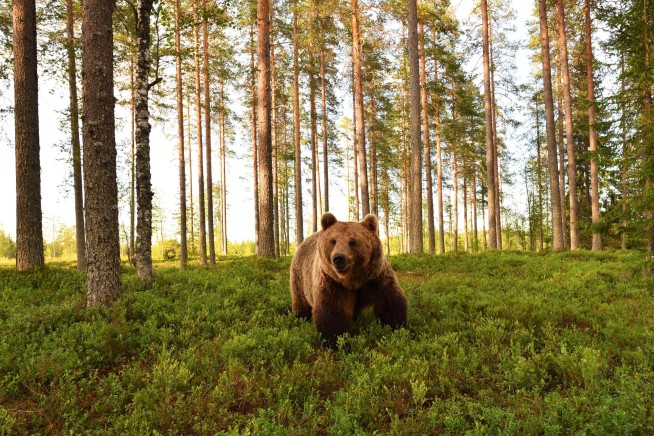
(NEWSER) – Forest rangers are searching the woods for a bear that climbed over three electric fences and a 13-foot barrier to escape a wildlife enclosure in Northern Italy. The bear had been captured only hours before, the Guardian reports. “Run and save yourself,” the president of an animal rights group implored. “We are on the side of the bear and of freedom.” The president of the province of Trentino had ordered the capture of the European brown bear after it was spotted near residential areas. After the escape, he authorized rangers to shoot the bear, labeled M49, if it went near people, per MSN. Italy’s environment minister overruled that order, saying, “M49’s escape from the enclosure cannot justify an action that would cause its death.” He sent a team to Trentino to help catch the bear without harming it, and to investigate the escape.

Animal rights advocates mocked the bear’s captors. One cheered the bear on, and another said: “A solid electrified fence with adequate power is an insurmountable barrier even for the most astute bears. Obviously the structure was not working properly, since bears do not fly.” An anti-hunting organization said that “evidently, M49 is an escape genius … gifted with superpowers akin to a hero of Marvel Comics.” The group suggested the bear was allowed to escape Sunday so it could be decreed dangerous and killed. Italy’s constitution court, per ANSA, on Tuesday upheld provincial laws allowing the capture and killing of bears and wolves that pose a threat. The bear was spotted by a camera on Tuesday. Rangers think it’s somewhere in the Marzoil woods near Trento. (Read more escaped animal stories.)

Trophy-hunting firms banned from gun show after protests (UK)

Trophy-hunting businesses targeting big-game hunters in Britain have been banned from a shooting show after public objections. The NEC in Birmingham said that it would no longer be welcoming safari operators selling hunting trips for sport at the Great British Shooting Show in February.

Campaigners had gathered 30,000 signatures demanding that the venue revoke admission for ten safari operators that wanted to market their tours to shoot lions, elephants and other big game in Africa. The announcement by the NEC yesterday came after organisers had earlier defended the safari operators’ appearance at the show as “controversial”.

The venue, which also hosts Crufts, said in a tweet yesterday that it had listened to its customers’ concerns “and have acted”.

“Taking these concerns and the safety of staff and visitors into consideration, we will be removing exhibitors that practise safari hunting from the show,” it said.

Among the exhibitors that had bought stands at the show were Umlilo Safaris, from South Africa, which offers packages including lion trophy hunts “in fenced areas” — a practice known as canned hunting because there is no way the trapped animals can avoid their fate. Another operator, Legelela Safaris, offers giraffe hunts for £2,400 and baboons for £160.

The safari firms had been expected to capitalise on an increase in interest from British big-game hunters, documented in a report by the Campaign to Ban Trophy Hunting. The report, based on data from Cites, the global wildlife trade regulator, tracks a sharp rise in souvenir animal trophies imported into Britain in recent years.

Last night the veteran explorer Sir Ranulph Fiennes welcomed the NEC’s decision as “a small but positive first step”.

“The idea that animals may be killed, not in self-defence or for food but purely for entertainment, must surely be challenged,” he told The Times. Last week Sir Ranulph appeared at a reception in parliament calling for a ban on the import of trophies from endangered animals to Britain.

From 2004 to 2014 about 2,500 such trophies were brought home by British hunters. The UK is among the top 12 nations taking part in such hunting trips, along with the United States, Russia and Germany, according to Cites data.

Many of the lions being imported into Britain come from hunting farms in South Africa, which Sir Ranulph described as a “hideous trade”. The country has 3,000 lions in the wild, compared with up to 8,000 born in captivity for commercial purposes. Canned hunting is legal in South Africa. Supporters argue that it helps conservation efforts by giving greater value to preserving animals in the wild, as well as bringing revenue to rural areas.

Scientists consider captive-bred lions to have little to no conservation value.

https://www.thetimes.co.uk/article/trophy-hunting-firms-banned-from-gun-show-after-protests-zbvm9689v

CIRCUS TIGERS TURN ON TRAINER, MAUL HIM TO DEATH DESPITE FRANTIC ATTEMPTS TO INTERVENE

Italian police are investigating after one of the country’s most famous tamers was killed by four tigers he was training.

Ettore Weber died Thursday evening during a rehearsal at Marina Orfei Circus in Triggiano, Bari, Italian newspaper Repubblica reported.

Police said they think one tiger bit Weber, prompting the other three to attack. The animals mauled the tamer for some 20 minutes, according to Notizie.it.

Some 118 people tried to rescue Weber, but he died from his injuries. He was in his early sixties.

Weber’s show was part of the circus’s “Animal Park” event, which featured live animals from five continents. It was due to run from June 15 to July 14. The circus did not immediately respond to Newsweek‘s request for comment.

Tiger, Killed, Trainer
File photo: A tiger jumps through a flaming hoop at a circus. An exotic animal tamer has been killed by four tigers he was training.GETTY

Weber’s death provoked fierce criticism on social media of circuses that feature wild animals. One Twitter user wrote: “Animals have to stay where nature puts them, stop. You can’t torture them for your own profit and delight.”

Sofia Marinelli@TopaM79

Procura di Bari apre inchiesta per ricostruire l’incidente a Ettore Weber, domatore del circo Orfei, ucciso da una tigre durante le prove a Triggiano. Che vuoi ricostrui’? Un animale selvatico, per quanto addestrato, resta selvatico. Se lo tratti da giocattolo ci scappa il morto.

Gianluca #IoBalloConLaura@Gianluc54410558

Gli animali devono stare dove la natura li mette, stop. Non puoi torturarli per il tuo profitto e diletto.

See Gianluca #IoBalloConLaura’s other Tweets

User Lello Pinto called those who run circuses with wild animals “beasts.” “A decent parent doesn’t take their children to see animals behind bars,” Pinto added.

User Katerina Medici said she was not “at all” sorry about the tragedy. “This is not their natural habitat,” she wrote. “Let these animals go free.”

“Karma is a b****,” tweeted another user. “Another reason not to use animals in circuses.”

Taltos 🇨🇦🇮🇹🇪🇺🏳️‍🌈@taltos_mxp_yyz

Karma is a bitch. Altro motivo per non usare animali nei circhi. , sbrana famoso addestratore al e lo uccide: Ettore Weber https://www.fanpage.it/attualita/bari-tigre-sbrana-addestratore-al-circo-orfei-e-lo-uccide-tragedia-durante-le-prove/  via @fanpage

Bari, tigre sbrana addestratore al Circo Orfei e lo uccide: tragedia durante le prove

Tragedia al Circo Orfei allestito nelle campagne di Triggiano, vicino al centro commerciale Bariblu. Secondo quanto appreso una tigre, durante le prove dello spettacolo, ha azzannato il suo addestr…

fanpage.it

See Taltos 🇨🇦🇮🇹🇪🇺🏳️‍🌈‘s other Tweets

User Paola Massari said she was “dismayed, of course,” but added: “This could also be an opportunity to stop exploiting, segregating and mistreating exotic animals.”

But some Twitter users hit back at critics. One said those “rejoicing” over Weber’s death wouldn’t do the same if he was their own friend or relative. The user added: “If you are so opposed to the mistreatment of animals in the circus, why don’t you actually take action?”

G I O@mccharmlypaul

Siete di una piccolezza infinita, voi che esultate per la morte di un uomo sbranato da quattro tigri. Immagino che avreste fatto la stessa cosa se al suo posto ci fosse stato vostro padre, vostro figlio, un vostro parente o un vostro amico.

G I O@mccharmlypaul

Se siete così contrari al maltrattamento degli animali nel circo, perché non vi attivate concretamente? Al posto di scrivere “godo”, “se lo è meritato”, “finalmente”.

See G I O’s other Tweets

Italy’s parliament voted to phase out animal circus acts in November 2017, with a requirement that new legislation be outlined within a year. Campaign group Animal Defenders International hailed the move as “a major breakthrough” for animal rights.

In the U.S., some states have banned the use of exotic wild animals in circuses. When New Jersey governor Phil Murphy signed such a bill into law last December he said he was proud his state would no longer allow animals to be “exploited and cruelly treated.” He added: “These animals belong in their natural habitats or in wildlife sanctuaries, not in performances where their safety and the safety of others is at risk

Russia to release whales from ‘jail’ in far east after outcry

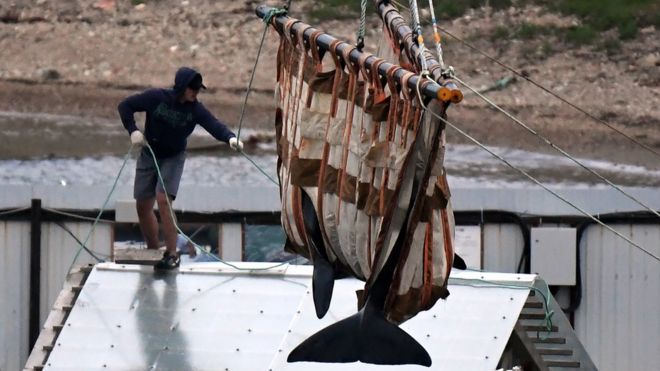
Experts of the Russian Research Institute of Fisheries and Oceanography (VNIRO) begin an operation to release the first two orcasImage copyrightGETTY IMAGES
Image captionExperts released two orcas from the so-called “whale jail” on Thursday

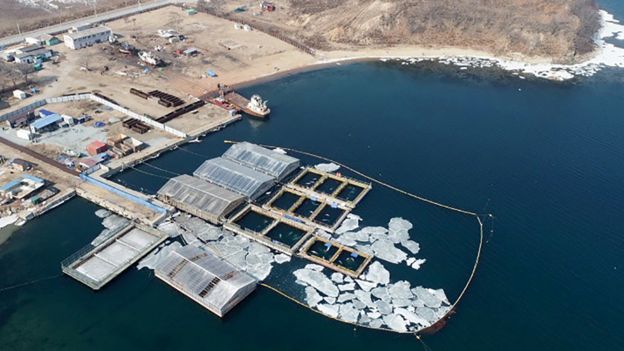
Russia has started to release a group of nearly 100 captive whales which have been kept in small pens in the far east of the country.

It comes after the so-called “whale jail” provoked an international outcry, with marine scientists and celebrities calling for the mammals to be released.

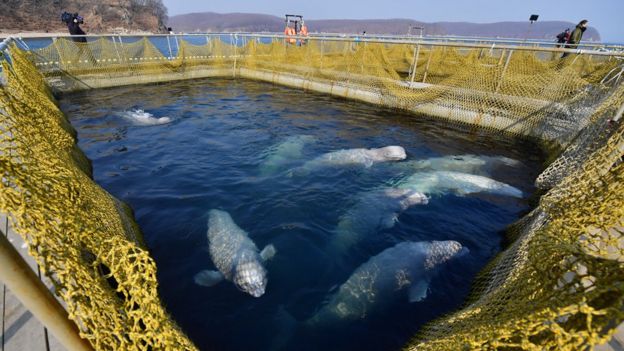
In total, 11 killer whales (orcas) and 87 belugas are being kept in cramped enclosures on the Sea of Japan.

They will be released in stages and the process will take several months.

“We have taken the only sensible decision at the recommendation of scientists to release the animals to their natural habitat where they were caught,” Deputy Prime Minister Alexei Gordeyev told reporters on Thursday.

“This operation will take about four months,” he added. Eight whales will reportedly be freed in the first stage of the process.

President Vladimir Putin praised the decision during his annual televised phone-in in which he fields questions from members of the public.

“The killer whales alone – as far as I know – are worth around 100 million dollars,” he said. “When it’s big money, problems are always hard to solve. Thank God things have started moving.”

What was the “whale jail”?

The juvenile whales were caught last year in the Sea of Okhotsk. They were then transported more than 1,300km (800 miles) south and kept in cramped pens near the port town of Nakhodka.

Although Russia allows the capture of whales for scientific purposes, experts feared the animals were bound for theme parks or aquariums in China.

Individual orcas, often caught illegally, can fetch millions of dollars. Belugas are sold for tens of thousands of dollars.

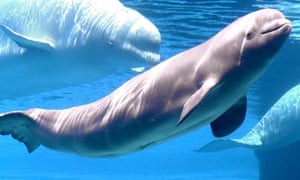
Belugas at Srednyaya Bay, 1 Mar 19Image copyrightGETTY IMAGES
Image captionThe belugas are in cramped pens which are taking a toll on their health

Greenpeace Russia, an environmental group, raised the alarm about the animals last October. They believe at least four of the whales died while in captivity.

Many are known to be in poor health and some have shown signs of hypothermia. In the wild whales swim tens of kilometres every day – and that keeps them warm – but in small pens they get cold.

In January, Greenpeace also reported that some of the whales were showing skin lesions and flipper deterioration. Some of those injuries may have been caused by bumping into the sea ice.

Who campaigned for their release?

The confined whales scandalised scientists, politicians and activists around the world.

Environmental groups demanded the release of the mammals and celebrities have also campaigned to rescue them.

Whale pens, 1 Mar 19Image copyrightGETTY IMAGES
Image captionThe whale pens are at a remote site by the Sea of Japan

Hollywood star Leonardo DiCaprio urged his social media followers to sign a petition – and more than 1.5m people have done so.

Pamela Anderson, the former model and Baywatch TV star, wrote to President Vladimir Putin, urging action to release the whales. She is active in the International Fund for Animal Welfare (IFAW).

Earlier this month, the companies that caught the whales were fined for breaking fishing rules. One company – White Whale – was fined 28.1 million rubles ($433,000; £430,000).

Charles Vinick, executive director of the Whale Sanctuary Project, said the release should be conducted “as humanely as possible”.

“We have provided extensive recommendations [about how to do this],” he told the BBC. “While they are not able to follow all of our recommendations, we hope they can follow as many as possible.”

“It’s all about the welfare of the animals,” he added.

No ‘Free Willy’ moment: captive whales, dolphins exempted under Canada ban

WATCH: The Vancouver Aquarium started planning for a future without whales and dolphins in early 2018.

– A A +

Canada’s ban on captive whales and dolphins will not affect those already in captivity, meaning nearly 60 animals will likely live out their natural lives at Marineland and the Vancouver Aquarium.

The so-called ‘Free Willy’ bill passed in the Senate Monday will make it illegal to possess whales or dolphins — collectively known as cetaceans — for anything other than research or rehabilitation purposes. Offenders can be fined up to $200,000 under the Criminal Code of Canada, although whales and dolphins currently held in captivity are exempt. The bill also outlaws breeding cetaceans in captivity.

READ MORE: Whale and dolphin captivity banned by law in Canada

The bill’s grandfather clause will allow Marineland in Niagara Falls, Ont., to keep its nearly five dozen cetaceans until they all die. Among those cetaceans are five young beluga whales that could live up to 50 years — the expected lifespan of a beluga in the wild.

WATCH: Feds introduce measures to save endangered orcas

Marineland owns the vast majority of living whales and dolphins in Canada, according to the whale-tracking site Cetabase. The park has an estimated 51 beluga whales, five bottlenose dolphins and a 40-year-old killer whale at its facility in Niagara Falls, according to Cetabase data and media reports. The park has not confirmed those exact numbers.

Marineland says it remains confident that it complies with all aspects of the new bill, which is awaiting royal assent. The park claims the exemption for its whales “acknowledged Marineland’s role as a custodian for the cetacean populations that call Marineland home, and specifically acknowledged that Marineland Canada’s actions are not inherently animal cruelty.”

The bill passed by the Senate does not explicitly mention Marineland or animal cruelty.

WATCH: Crown drops animal cruelty charges against Marineland in 2017

“Marineland Canada continues to be a facility where children can learn about and be inspired by cetaceans without invading their natural habitats or disturbing cetacean populations that live in the ocean,” the park said in a statement on Monday. Marineland says it started evolving its operations “some time ago,” and it’s confident that evolution will keep it compliant with all aspects of the new bill.

Marineland did not provide Global News with the exact number of whales and dolphins in its care, nor did it say whether it will release any into the wild.

“Marineland will continue to provide world-class care to all marine mammals that call Marineland home,” the park said in a statement to Global News.

“With our current mammal population, we will be able to operate decades into the future uninterrupted.”

READ MORE: Ships must keep 400 metres away as part of new rules to protect killer whales on B.C. coast

Many aquariums around the world have faced intense criticism for housing cetaceans since 2013, when the documentary film Blackfish depicted the allegedly poor treatment of killer whales in captivity at SeaWorld in Florida. SeaWorld has described the film as inaccurate, misleading and exploitative.

Activists have been pushing for aquariums to divest themselves of their whales and dolphins ever since the film’s release.

The federal Green Party and its leader, MP Elizabeth May, applauded the ban as a ‘Free Willy’ law on Monday.

“These intelligent, social mammals will now get to live where they belong — in the ocean,” the party wrote on Twitter.

May sponsored the bill in the House of Commons, while Sen. Murray Sinclair sponsored it in the Senate.

The bill also leaves room for the Vancouver Aquarium to hold onto its only cetacean, a Pacific white-sided dolphin named Helen.

The Vancouver Aquarium started phasing out its whale and dolphin displays last year following public pressure over the deaths of two belugas. It sent another pair of its belugas to Spain in May, one month before the bill was passed. Those belugas had been living at Marineland Canada.

WATCH: Vancouver Aquarium says ‘toxin’ killed belugas in 2017

“The decision to move them was made in their best interest, not because of politics,” the Vancouver Aquarium said in a statement at the time.

Activists celebrated the law on Monday under the hashtag #EmptytheTanks.

The bill will come into effect once it receives royal assent.

Calls for Canadian zoo to be shut down after deer die in stampede

Marineland in Ontario partly closes after a walrus and two deer die in recent weeks

Protesters in front of Marineland theme park.
 Protesters in front of Marineland theme park. Photograph: Tara Walton/Toronto Star via Getty

A controversial theme park in Canada is facing renewed criticism following the deaths of three animals in recent weeks, triggering fresh calls from activists for the attraction to be shut down.

Officials at Marineland, which sits on the Canadian side of Niagara Falls in Ontario, said two deer were killed in a stampede allegedly caused by a father and son taunting the animals. The incident, which occurred last weekend when the attraction opened for the season, has prompted staff to temporarily close the deer park area.

Days after the stampede, the park also announced the results of a postmortem on one of its walruses which died in April, citing a heart attack as the cause of death for the 18-year-old animal named Apollo. Apollo is the fourth walrus to die in the park over the last two years, leaving it with only one remaining animal – a female called Smooshi.

Speaking of the deer deaths, Marineland said: “We are all upset by this terrible act against innocent animals. In order to protect our animals, we are closing the deer park to make modifications to prevent this type of incident from ever happening again.” It added that this was the first time such an incident had occurred.

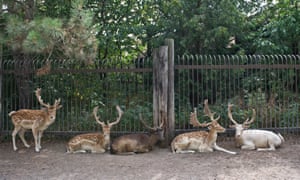
Deer sit around the perimeter of Marineland’s deer park.
Pinterest
 Deer sit around the perimeter of Marineland’s deer park. Photograph: Tara Walton/Toronto Star via Getty Images

But Phil Demers, a former animal trainer at the park who has become Marineland’s most vocal critic, rejected the park’s explanation, claiming that a move to reopen the deer park to visitors after years of closure could cause panic among the animals.

“There’s been countless incidences of patrons stressing out the animals. [Marineland] took a gamble. They opened it for the first time in years,” he said.

Marineland has increasingly become a target for activists, who argue the park has a moral responsibility to release the animals it keeps in captivity. The park dismissed protests outside its gates over the opening weekend as a “small group of annual demonstrators [who] continue to seek to damage Marineland at all costs”.

The park was the focus of a 2012 investigation by the Toronto Star, which interviewed a number of employees alleging incidences of animal neglect. The park is contesting the claims.

“Marineland is in what can only be described as a significantly worse condition than when I spoke out in 2012. There has been exactly no investment in improvement to the animal life support systems whatsoever,” said Demers.

Marineland has vigorously denied the claims and has been in a legal battle with Demers over the last seven years, alleging he attempted to steal a walrus – an allegation he calls “absurd”.

Despite pressure from critics, the park continues to house an estimated 51 beluga whales. It also has five bottle-nosed dolphins and a single orca named Kiska.

A male beluga whale at Marineland.
Pinterest
 A male beluga whale at Marineland. Photograph: Denis Cahill/AP

Proposed legislation in the Canadian parliament – dubbed the “Free Willy bill”– is likely to receive royal assent in the coming weeks and would ban the captivity of cetaceans, including orcas, dolphins and beluga whales across the country. The province of Ontario previously passed similar legislation, which banned the acquisition of large marine mammals, but allowed Marineland to keep its whales.

Ever since the park’s owner, John Holer, died last year, the company – Holer Family Amusements – has been at a “crossroads”, the Niagara Falls mayor, Jim Diodati, told the Toronto Star, as it explores a possible expansion of the park, or sale of its land to developers.