BLM Illegally Sells Protected Wild Horses for Slaughter


Ranchers who sell beef to Whole Foods Market are behind the largest mustang roundup of 2015-2016 is now underway in southern Oregon.

Ranchers who sell beef to Whole Foods Market are behind the largest mustang roundup of 2015-2016 is now underway in southern Oregon. Whole Foods has reacted to this news, by telling us to talk to the ranchers. (Read more about our correspondence with Whole Foods and its supplier Country Natural Beef here.)

Right now, wild horses are being brutally rounded up, removed from their families and their homes on the range, all so that ranchers can profit by selling beef to Whole Foods. Whole Foods then markets this beef as “grass-fed” to its customers and sells it at a premium.

Don’t let Whole Foods pass the buck. The natural foods giant must incorporate mustang safe standards into its animal welfare policies.

http://act.wildhorsepreservation.org/p/dia/action3/common/public/?action_KEY=21689

Washington Ranchers want compensation for reduced weight gain, low pregnancy rates caused by wolves.

http://www.capitalpress.com/Washington/20151016/wdfw-seeks-panel-to-review-wolf-caused-losses

by Don Jenkins

Capital Press

Published:October 16, 2015 9:11AM

Washington Department of Fish and Wildlife
A Washington Department of Fish and Wildlife file photo shows a member of the Teanaway wolf pack. Washington wildlife officials are recruiting livestock experts and conservationists to advise the state

<!–

–>

The Washington Department of Fish and Wildlife will form a board to review claims for indirect losses caused by wolves.

Washington wildlife officials are recruiting livestock experts and conservationists to advise the state on compensating ranchers for lost production caused by wolves.

The Department of Fish and Wildlife plans to appoint up to five volunteers to serve on the new committee.

The panel will review WDFW’s approval or denial of claims for reduced weight gain, low pregnancy rates and higher-than-normal losses.

The department will make the final call on payments, but the panel will bring additional expertise and transparency to the process, WDFW wolf policy coordinator Donny Martorello said.

He said WDFW wants a variety of viewpoints represented. “Diversity is important. If it were all like-minded people, we’d need only one person,” he said.

WDFW pays ranchers the market value for livestock killed by wolves. The state’s wolf recovery plan also calls for WDFW to develop a system to compensate ranchers for livestock losses where there is no direct evidence wolves caused the damage.

Martorello said WDFW has not made any payments for indirect losses, but two ranchers have filed claims.

Volunteers will serve staggered one- or two-year terms. The committee may start meeting as early as mid-November and will likely meet about four times a year, according to WDFW.

Committee members will be reimbursed for travel expenses.

Applications and nominations must be submitted in writing and include a description of “experience in collaborating with people who have different values.”

Applications also must include the candidate’s name, telephone number, email address and organization affiliations.

Candidates should explain why they would be an effective board member and report their experience with livestock, natural resource management or wildlife conservation.

People or groups nominating members must include their names and contact information.

Applications and nominations must be postmarked by Oct. 31 and mailed to WDFW Game Division Manager Mick Cope, 600 Capitol Way N., Olympia, WA 98501-1091 or by email to Mick.Cope@dfw.wa.gov.

NM “Game” Commission caters to hunters, ranchers

Letters to the editor

Published: Tuesday, September 8th, 2015 at 12:02am
Commission caters to hunters, ranchers
AT THE N.M. Game Commission hearing on Aug. 27, opponents of increased mountain lion and bear killing outnumbered the hunters, trappers and ranchers at least 4 to 1. Yet, while some of the environmental/animal groups were allowed to speak, many of us individual citizens were not.
It was obvious to many that the commission was changing the rules to fit its biased needs. Not only are numerous ranchers and hunters on this commission, but there are two Safari Club International members as well.
Anyone surprised that the “vote” was unanimous in favor of more killing?
We cannot help wildlife by changing these game (commission’s) names, or funding structure, or by continuing to accept their barbaric “game management policies” as something worthy of support.
Game agencies were started in the early 1900s. Aldo Leopold – a longtime wolf killer – literally wrote the textbook on game management. Yes, he was “sorry” for killing one wolf too many, but he was responsible for the atrocious model of today’s “modern game management,” which views wild animals as “commodities and resources.”
Terms such as “harvest” and “game quotas” are designed to artificially maintain wild species for trophy/trapping – keeping just enough of them for human exploitation/killing.
The N.M. Game (and Fish) Department comes up with pseudo-statistics to rationalize its use of wildlife. Some so-called wildlife groups are collaborating with the enemies of wildlife – the hunting, trapping and livestock industries – to establish a so-called sustainable level of wildlife killing. The wildlife of New Mexico has enough to contend with without wildlife organizations joining the killing machine.
The World Wildlife Living Planet Report states that populations of fish, birds, mammals, amphibians and reptiles measured for the report have declined by 52 percent since 1970; and freshwater species have suffered a 76 percent decline – an average loss almost double that of land and marine species.
We are developing a campaign against trophy hunting, and the state game departments that support it, on our EARTH for Animals website.
ROSEMARY LOWE
Santa Fe
Protect our wildlife from trophy hunters
I FIND IT despicable that the N.M. Game Commission could be dominated by the lobbying of hunters. Bears, cougars and other native species are magnificent wildlife creatures that have no voice, no vote, no money and no guns with which to fight back.
Shame on the commission for considering any killing, let alone killing by traps. Anyone with a degree in biology knows that predator/prey populations enter population equilibrium if humans do not interfere by hunting. It is unnecessary to kill them.
I will work to defeat those on the commission with my time, effort and money if they refuse to protect our wildlife from trophy hunters.
Hunting is not motivated by a need for food but by a need for power and satisfaction of personal ego. Allowing these kills satisfies the self interest of the few over the common interest of the many, the greater public.
Listen to the people who support the common interest, people who want these creatures to live, not die.
LORNA DYER
Santa Fe
Game Commission OKs exterminations
SHAME ON THE New Mexico Game Commission for its continued assault on our wildlife. It is tragically pathetic that even though the taxpaying public has loudly voiced opposition to the commission’s plans to exterminate all forms of wildlife from our lands (commissioners) continue their quest to do so and get away with it.
How sad for the rest of us.
RUTH CONNERY
Albuquerque
All commissioners ignored will of people
A PERVERSION OF democracy in order to kill cougars. Just one fact makes that statement sadly accurate.
Seventy-five percent of voters (polled) don’t want trapping of cougars, and furthermore, 75 percent of voters (polled) don’t want trapping of cougars, even considering it would bring in revenue. And yet, the N.M. Game Commission voted, unanimously, to allow trapping of cougars.
Let that sink in. Seventy-five percent of voters polled don’t want trapping of cougars in New Mexico, and yet, the N.M. Game Commission voted unanimously to allow it anyway. Unanimously.
All of the game commissioners ignored the will of the people.
And while maybe the Game Commission doesn’t have to adhere strictly to democratic principles, the fact that all commissioners ignored the will of the people shows that absolutely none of them give democracy any consideration.
It seems like that would be impossible. Impossible that none of the commissioners would vote according to the will of the people. This, folks, is a sad commentary on the arrogance of these officials. Ignoring democratic principles. Surely one would think that at least one commissioner would acquiesce to the will of the people, but no. Not one considered democracy when voting.
Add to that the petition results opposing trapping of cougars and the questionable handling of public comments, it is accurate and fair to say that the decision to allow trapping of cougars in N.M. is a perversion of democracy here in New Mexico. Just so a few people can torture and kill.
How sad.
DAVID J. FORJAN
Tularosa
Time to get some new commissioners
THE NEW MEXICO Game Commission is charged with managing wildlife for all of us. Recent decisions show there is no representation for those of us who think wildlife, including the top predators, should be protected from slaughter. We are the majority yet completely unrepresented on the commission.
The terms of three of the commissioners expire on Dec. 31. All New Mexicans who believe wildlife has a right to more than a brutal death should implore Gov. Susana Martinez to appoint at least one commissioner to represent the majority.
MARK JUSTICE HINTON
Albuquerque
JOURNAL

BLM Fails to Protect Our Public Lands Against Lawless Welfare Ranchers

http://www.wildhorsepreservation.org/media/blm-fails-protect-our-public-lands-against-lawless-welfare-ranchers#

Public lands ranchers, many of whom decry the federal government while happily accepting federal grazing subsidies, continue to defy Bureau of Land Management (BLM) restrictions on livestock grazing. Emboldened by Cliven Bundy, who owes the federal government millions of dollars in grazing fees and whose trespass cattle are still illegally grazing on BLM land in southern Nevada, ranchers continue to thumb their nose at federal authority. As in the Bundy situation, the BLM continues to back down. While the agency has threatened to arrest wild horse advocates for the simple act of videotaping, it takes no action against lawless ranchers who flaunt grazing restrictions and offer up threats of violence in the form of armed militias. The BLM”s lack of action against these violators is an affront to law abiding citizens and American taxpayers whose drought-stricken, western public lands are rapidly being turned into a dust bowl, courtesy of welfare ranching. Please read on for the latest examples.

BLM allows grazing on closed allotment to avoid confrontation

During the first week of June, 2015, two Elko County Commissioners joined welfare ranchers Dan and Eddyann Fillippini in breaking federal law by turning out cattle in a drought stricken area of public lands where livestock grazing has been prohibited by the BLM. In response, the BLM did nothing. Instead the agency “negotiated” with these ranchers, who feel entitled to graze their livestock on our public lands and receive taxpayer-subsidized grazing rates that are a fraction of market rate. In a settlement dated June 5, 2015, the BLM agreed to allow the Fillippinis to leave their trespass cattle on the public lands that have been closed to livestock grazing because of the drought. In exchange, the Filippinis admitted to “willful” grazing trespass and will have to pay less than a week’s worth of “enhanced” grazing fees, which are still a fraction of market rate, thanks to our taxpayer subsidies  Since the settlement, the grazing fee has reverted to $1.65 per Animal Unit Month, which is at least 1/12th of the fee they would pay to graze their livestock on private lands and far cheaper for the Filippinis than keeping their cattle on their own private lands and feeding them hay. So, once again, the BLM rewarded welfare ranchers for illegal behavior and the destruction of our public lands.

Media Coverage of California Water Shortage Omits Biggest Culprit — Animal Agriculture

http://theirturn.net/2015/04/07/animal-agriculture-water-shortage

April 7, 2015 by

In its extensive coverage of the California drought, the New York Times has consistently focused on the cultivation of crops without so much as mentioning animal agriculture, which is far more water intensive.

The glaring omission has sent readers the message that fruits, vegetables and nuts  – not beef and dairy – are responsible for the state’s grave water shortage. Following are excerpts from the NY Times over the past three days.

April 6th: “Even as the worst drought in decades ravages California, . . . millions of pounds of thirsty crops like oranges, tomatoes and almonds continue to stream out of the state and onto the nation’s grocery shelves.”

April 5th: “The expansion of almonds, walnuts and other water-guzzling tree and vine crops has come under sharp criticism from some urban Californians.”

April 4th: ”There is likely to be increased pressure on the farms to move away from certain water-intensive crops — like almonds.”

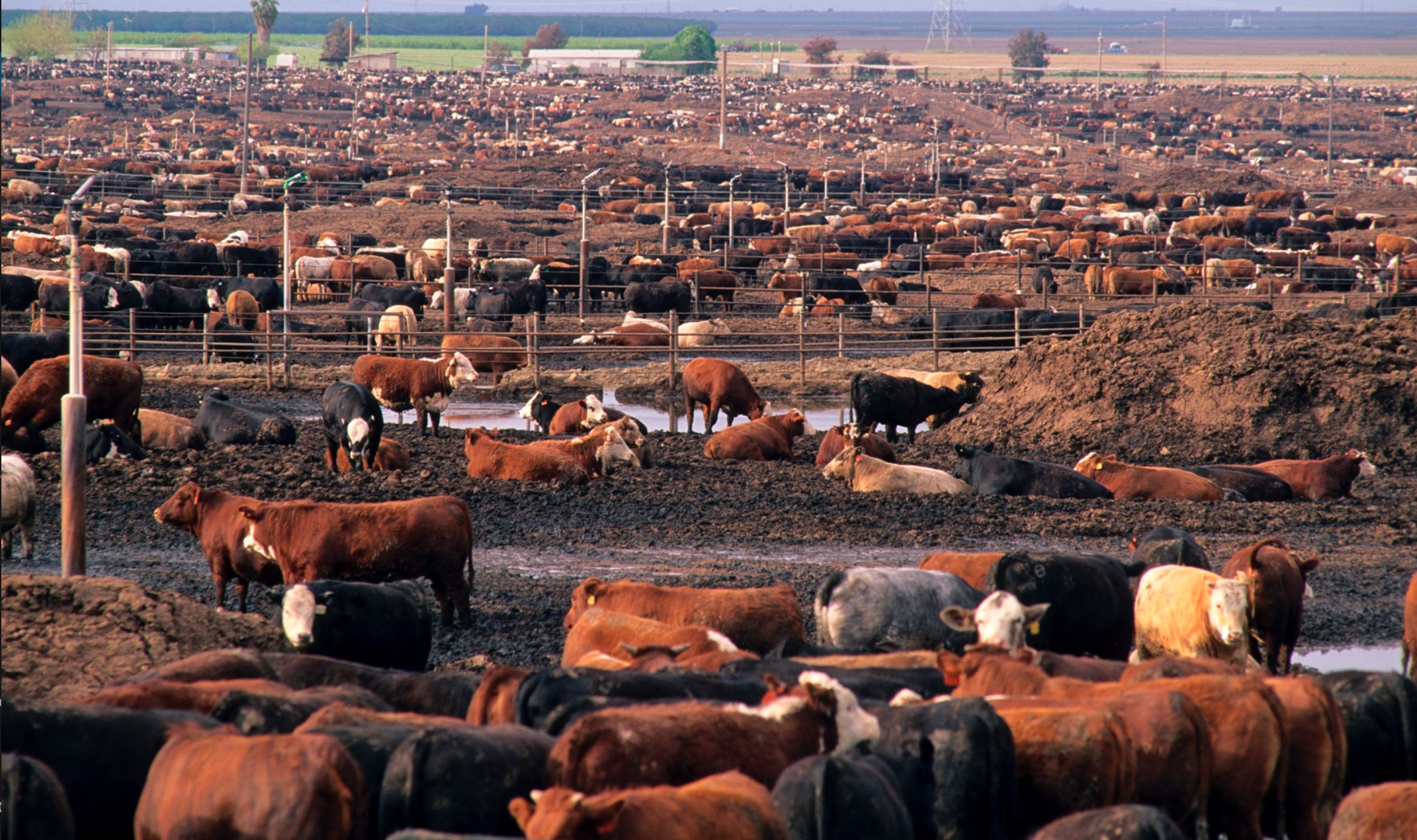
Cultivating crops might be be water intensive, but it uses a fraction of the water consumed in animal agriculture. On California’s factory farms, which house tens of millions of chickens, pigs and cows, water is used not only to hydrate these animals but also to grow their feed and clean the facilities and slaughterhouses where they are raised and killed.

Cows in a California feedlot

Eliminating animal agriculture, which inefficiently uses of a scarce resource and is altogether unnecessary, would undoubtedly help to curb California’s water shortage.

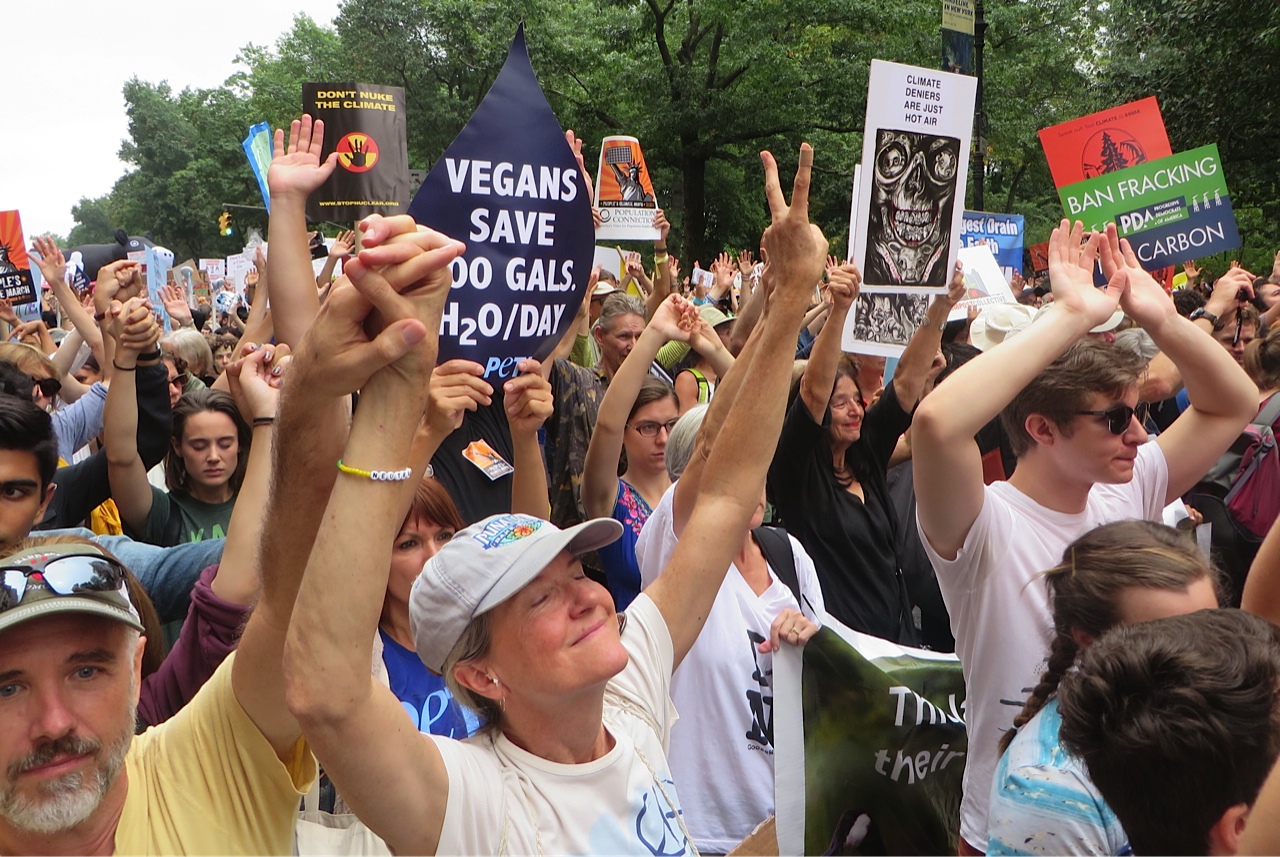
2014 Climate March participants highlighted impact of animal agriculture on water supply

Following are just a few statistics that demonstrate the impact of animal agriculture on the water supply:

  • 2,500 gallons of water are used to produce one pound of beef compared to 100 gallons for a pound of wheat.
  • Vegetables use about 11,300 gallons of blue* water per ton. Pork, beef and butter use 121,000, 145,000 and 122,800 gallons per ton respectively. (*Blue water is water stored in lakes, rivers and aquifers.)
  • Each day, cows consume 23 gallons of water; humans drink less than one.
  • The amount of water needed to produce a gallon of milk is equivalent to one month of showers.
  • 132 gallons of water are used every time an animal is slaughtered.

One year ago (March, 2014), the NY Times published an op-ed, Meat Makes the Planet Thirsty, that included statistics comparing the amount of water used for crops and animals. So why is it omitting this vital information in its current coverage of the drought? Could it be a mere oversight? Or is it something more sinister?

2014 Climate March participants highlighted the the amount of water used in animal agriculture.

Buffalo Escape Farm Only to Be Shot and Killed

The Boston Globe reports that after a herd of buffalo escaped from a farm in upstate New York, they were intentionally shot and killed:
Three men hired by the farm opened fire on the animals Friday afternoon in woods in the town of Coeymans, about 10 miles south of the capital. …
… They escaped Thursday from a farm across the Hudson River in the Rensselaer County town of Schodack. The owner believes they swam across the river to the town of Bethlehem, where they wandered across a busy stretch of Interstate 87 and into neighboring Coeymans.
This heartbreaking incident reminds us that farmed animals, like all sentient beings, have a strong desire to live; in fact, Mercy For Animals has reported on countless animals who have escaped from slaughterhouses or jumped from transport trucks.
Love buffalo and other farmed animals? Don’t eat them! Click here to order your FREE Vegetarian Starter Guide.
Photos: Mike Groll / Associated Press 

Public Overwhelmingly Supports Free-ranging Tule Elk Herd

—Wildlife Photography ©Jim Robertson

—Wildlife Photography ©Jim Robertson

http://www.biologicaldiversity.org/news/press_releases/2014/tule-elk-09-18-2014.html

Public Overwhelmingly Supports Free-ranging Tule Elk Herd at Point Reyes National Seashore

Ranchers Lobbying Park Service to Remove or Fence Out Native Elk

POINT REYES, Calif.— The vast majority of 3,000 public comments on a ranch-management plan for Point Reyes National Seashore support allowing a free-roaming tule elk herd to stay at Outer Point Reyes rather than being fenced in or removed. The comments were released today by the National Park Service as part of a planning process initiated for 28,000 acres of dairy and beef cattle ranches within the national park.

“Point Reyes tule elk are highly beloved by visitors, photographers, naturalists and locals alike. The public doesn’t want these elk relocated, fenced into an exhibit, shot, sterilized or any of the other absurd proposals from ranchers who enjoy subsidized grazing privileges in our national seashore,” said Jeff Miller with the Center for Biological Diversity. “This is the only national park with native tule elk — it’s not a ‘national ranch’ or a zoo exhibit, and it shouldn’t be managed that way. If the park takes any steps toward fencing or relocating elk, it will create a legal and public-relations fight that it will lose.”

The Park Service is considering extending existing ranching leases for up to 20 years. The management plan will address concerns about alleged conflicts between tule elk and ranch operations. The Point Reyes Seashore Ranchers Association, Marin Supervisor Steve Kinsey and Congressman Jared Huffman are demanding that the Park Service remove free-ranging tule elk from the “pastoral zone” or build an extraordinarily large, environmentally damaging elk-proof fence to keep elk out of ranching areas. Many ranchers claim that elk cause economic impacts by eating grass they believe belongs solely to their cattle.

“Tule elk are an ecologically important part of the landscape of Point Reyes National Seashore, while cattle grazing permits are a privilege and certainly not a free pass to try to dictate Park Service policy that harms park wildlife,” said Todd Steiner, biologist and executive director of Turtle Island Restoration Network. “Ranching and wild elk herds can coexist at the seashore, but if ranchers want to manufacture a fight over cattle versus elk, they are likely to quickly learn that the vast majority of Americans rightly choose wildlife over cows in our parks.”

The ranchers in the national seashore enjoy heavily subsidized cattle grazing lease rates on public lands within the park. They bizarrely characterize native tule elk as “invasive” because they were extirpated in the 1800s when ranchers and market hunters eliminated them from the Point Reyes peninsula and most of California. Tule elk were reintroduced to Point Reyes in 1978, and a free-ranging elk herd was established in the park in 1998.

Background
Tule elk have been grazing the Point Reyes peninsula for about 10,000 years, except during from the late 1800s, when they were eliminated from most of California. They returned in 1978 when the National Park Service reintroduced elk to Tomales Point. Tule elk have taken well to reintroduction, and the Tomales Point herd is one of the largest of the 22 herds in California, with a stable population of 450 elk, which are fenced in on the remote point.

The Park Service last prepared an elk management plan in 1998, with an environmental assessment considering alternatives for managing elk on Tomales Point, and decided on a plan to establish a free-ranging herd within the park. The Park Service reintroduced 28 tule elk to the Limantour wilderness area in 1998. The Limantour herd has grown to 65 elk, and a sub-herd established itself near Drakes Beach, now numbering 55 elk, nowhere near the park’s stated management limit of 250-350 elk. The 1998 reintroduction plan allowed capture and relocation of wayward elk, contraception of elk in the event of the herd surpassing 250-350 elk, and even killing aggressive elk that had conflicts with cattle ranches, which has only happened once.

The Park Service is required to manage Point Reyes National Seashore “without impairment of its natural values” and for “maximum protection, restoration, and preservation of the natural environment.” The reintroduction of elk to the Point Reyes peninsula is a success story for conservation of native species and restoring ecosystem processes, one of the primary missions of the National Park Service. Free‐ranging elk, as browsers, play an important role in reducing fire danger by reducing brush that is unpalatable to cattle, and without negative impacts to water quality.

Some of the ranchers at the national seashore routinely violate their lease conditions by stocking excess cattle, allowing cattle to trespass out of the pastoral zone (where they are eating forage needed by wildlife) and raising animals not allowed in their leases — with no consequences. Public-lands ranchers at the seashore pay less than half of the grazing rent they would pay outside the park on private lands ($7 to $9 per animal unit month inside the park compared with $15 to $20 outside), which already more than compensates these livestock operators for any wildlife impacts.

The Beef Burden: How Cows Greatly Hurt the Environment

[Listen to this Crap (in bold text)]

by Brian Stallard

http://www.natureworldnews.com/articles/8180/20140722/beef-burden-cows-greatly-hurt-environment.htm

According to a recent study published in the Proceedings of the National Academy of Sciences, beef cattle require 28 times more land and 11 times more irrigation water than pork, eggs, poultry or even diary.

“We have a sharp view of the comparative impact that beef, pork, poultry, dairy and eggs have in terms of land and water use, reactive nitrogen discharge, and greenhouse gas emissions,” lead author Gidon Eshel, from Bard College in New York, told BBC News.

To reach their findings, Eshel and his team collected and analyzed data on five edible livestock industries from 2000 to 2010, as provided by the US Department of Agriculture. Based on consumption models, they then calculated what kind of burden each of these industries placed on the environment.

Being exceptionally inefficient energy converters and a hugely popular source of food, cattle have long been known to have a greater environmental impact compared to other livestock. However, this is the first time that their impact has been quantified.

According to the report, land and irrigation burden aside, the emissions from cattle alone nearly make up the ten-fold impact seen, compared to other livestock.

Methane gas (CH4) has increased in average world volume by an estimated 50 percent compared to pre-industrial levels, according to the US Environmental Protection Agency (EPA). Alarmingly, this gas is far more potent than carbon dioxide (CO2).

“Pound for pound, the comparative impact of CH4 on climate change is over 20 times greater than CO2 over a 100-year period,” the EPA reports.

“The result is that the researchers estimate that over 60 percent of the environmental burden of livestock in the US results from beef,” commenting expert Mark Sutton, from the UK’s Centre for Ecology and Hydrology, told BBC. “Although the exact numbers will be different for Europe, the overall message will be similar: Cattle dominate the livestock footprint of both Europe and US.”

10405311_308608659330466_3235603653435958062_nBut don’t go thinking about veganism just yet. A past Nature World News report detailed a new proposed solution for the environmental burden of sheep in Europe – genetically tweaking the animals to reduce their methane footprint. If a similar technique could be used in cattle populations, we all can keep munching on hamburgers even as the “beef burden” is lightened.

Also see: http://www.natureworldnews.com/articles/14060/20150414/methane-and-climate-change-scientists-struggle-to-solve-four-corners-mystery.htm

Other Evils of the Livestock Industry

1011767_10152168496128769_1859093580_n
The following is by Rosemary Lowe:

Thinking Beyond the Animal Factories to Save This Planet

 
 Those out there who are concerned about this planet, the wildlife, the wild places, really need to understand how very destructive the Livestock Industry is, and not just for the factory farming aspects (as horrendous as they are).
Even many Vegans, who rightly abhor  what goes on in animal factories,  ignore, (or are unaware of), the plight of billions of native wild species in the U.S. and around the world. Wild species’ populations are in severe decline , some near extinction, due to livestock grazing on the last open, wild places.
Since the 1880’s the western livestock industry in the U.S., has been responsible for the slaughter of Billions (not millions) of coyotes, bears, wolves, prairie dogs, birds of prey, mountain lions, bobcats, beavers, ferrets, and other wild fauna and flora. This industry is also killing our rivers, streams,  forests, not to mention increasing the volatile gas, methane, that is a by-product of grazing, &  increasing global climate change.
So, while most people are now at least aware of the evil animal factories,  the horror of what goes on “out there” on the range– the vast expanses of our public lands– is hardly mentioned or thought about. It is crucial to also understand that western public lands–wilderness areas, BLM, National Forests, National Grasslands,  National Wildlife Refuges, and state lands–are becoming Domesticated Feed Lots because of the ranching industry. These public lands are the last refuge for wildness, in this Climate Change world!
 No matter how livestock grazing is packaged, it is an industry which is  removing what is wild and replacing it with  Domestication. Every so-called “wildlife problem” west of the Mississippi is really about The Livestock Industry, whether it be actual  grazing, or the raising of crops used for grazing domestic sheep and cattle. The western livestock interests are powerful, vocal, and determined to keep wolves, coyotes, mountain lions, wild horses, & thousands of other species “controlled/managed” with emphasis on aerial shooting, roundups, poisoning, trapping, hunts,  subsidized by taxpayers.
Now, some misguided animal groups, like IDA, and HSUS are falling for the PZP “birth control” method for horses, deer and other wild ungulates–which means more “taming” of the wild west.
What does this trend mean for the future of The Wild, when even so-called “animal people” start Sleeping with The Enemy?
 The great naturalist, professor, author, John A. Livingston, wrote, in Rogue Primate that: “to domesticate…is to amputate its wildness, to tame it; to train or otherwise coerce it into living with, and being of use, to us; to make it a part of our (human) infrastructure.”

We who care, still have a chance to save what is left of wildness, but we don’t have much time. Worse yet, the other living beings–wild non-humans-are fast running out of time.
      __________________________________________________
And John A. Livingston also wrote (and ahimsaforever commented), One of my favorite quotes of Livingston catalogs why he and other people (including me) who care about animals can be misanthropic:

“In the alchemist’s dungeon that is almost any well-appointed shopping center in the “developed” world, you can buy cosmetics, transmission fluid, and pet food made from whales; you can buy the hide of lynx in the form of a hat, or gloves made from the skin of an unborn lamb; you can buy a coat made from seal whelps; you can buy a tropical finch in a metal cage and a Siamese fighting fish in a plastic bag; you can buy firearms and whammo ammunition and multiple hooks with barbs on them; you can buy sharkskin shoes and the unspawned eggs of a sturgeon; you can buy the pulverized enlarged liver of a force-fed goose and the testicles of a bull and the brain of a calf . . . . You can buy the sterile eggs of an untrod chicken and the tongue of a feed-lot steer that spent its last weeks hock-deep in its own manure; you can buy medicines made from the blood and viscera of living laboratory animals . . . . You can also buy the Holy Bible and the Declaration of Human Rights.” The John Livingston Reader (2007), p. 149.

WA legislation proposes relocating wolves

http://www.spokesman.com/outdoors/stories/2015/feb/05/kretz-legislation-proposes-relocating-wolves/

THURSDAY, FEB. 5, 2015, MIDNIGHT

Kretz legislation proposes relocating wolves

Washington’s best wolf habitat is in the southern Cascade Mountains, where vast federal lands support more than 20,000 elk in the state’s two largest herds.

State biologists expect wolves to discover this prime territory and thrive there by 2022, after gradually dispersing south along the Cascade range.

But seven years is too long a wait for state Rep. Joel Kretz, R-Wauconda, whose Northeast Washington legislative district is currently home to 11 of the state’s 14 wolf packs, as well as cattle ranchers and sheep herders.

He’s again sponsoring what he calls a “share the love” bill that would require the Department of Fish and Wildlife to try relocating wolves to other parts of Washington.

“Most of the support in the state for wolves … comes from areas where there are no wolves,” said Kretz, who last year sponsored a bill to capture Eastern Washington wolves and transplant them to the districts of West Side legislators opposed to any controls on the predators.

But the current bill, HB 1224, isn’t a jab at Western Washington, Kretz said. Instead, it’s intended to speed up wolves’ colonization of the state, which would hasten the removal of federal and state protections for wolves and allow for more active management.

The legislation is among several wolf-related bills scheduled for hearings today in the House Committee on Agriculture and Natural Resources.

Relocating wolves would face steep political hurdles, but some livestock producers and environmental groups think the idea has merit.

The Washington Cattlemen’s Association wants ranchers to have more options for dealing with wolves that attack livestock, said Jack Field, the association’s executive vice president. That won’t happen until wolf populations recover to the point that federal protections are lifted throughout the state, and relocating wolves would make that happen faster, he said.

According to Washington’s wolf recovery plan, wolves will remain a protected species until at least 15 breeding pairs are documented across the state for three years. The pairs must be geographically dispersed so there are breeding pairs in Eastern Washington, north-central Washington and a zone that includes the south Cascades and Western Washington.

Environmental groups also support faster colonization.

“The South Cascades has the best wolf habitat in the state because of the prey base,” said Mitch Friedman, Conservation Northwest’s executive director. In addition to the Yakima elk herd, with about 10,000 animals, the area contains the St. Helens herd, which is infected with a bacterial hoof disease.

“The state is hiring gunners to mercy-kill some of those elk. Wolves would do a better job,” Friedman said.

But the southern Cascades and the Olympic Peninsula, which also has good wolf habitat, are rural and conservative, much like Northeast Washington. Politically, it would be difficult to get the support to relocate wolves, Friedman said.

“There’s a big difference between wolves coming there on their own paws versus in a state pickup truck,” he said.

That’s one of the state Department of Fish and Wildlife’s concerns, said Dave Ware, the agency’s policy lead on wolves. In the Northern Rockies, anti-wolf advocates have never forgotten the federal government transplanted Canadian wolves into Yellowstone and Central Idaho.

“There’s that stigma that you brought them here, versus them moving in naturally,” Ware said.

The endeavor also would be costly and time consuming, he added. State biologists figure they would need to trap and transplant about 30 wolves – preferably in packs – to end up with several breeding pairs that would stick around in their new location.

Such an action would require thorough state and federal environmental analysis, which would take two to three years to complete. A wolf relocation pilot project, as outlined in Kretz’s bill, would cost about $1 million, according to state estimates.

In a few years, wolves will be establishing packs in the South Cascades on their own, Ware predicted. Wolf tracks have been documented northwest of Yakima, in the foothills of the Cascades, where credible sightings of multiple wolves also have occurred. Last spring, a photo of a wolf was taken in Klickitat County.

“They are bounding around. They’re looking,” Ware said. “It’s just a matter of time before a male and female find each other and decide to start a pack.”

But Kretz said livestock producers in Northeast Washington need faster action to protect their animals from wolf attacks. He and Rep. Shelly Short, R-Addy, also are sponsoring or co-sponsoring several other wolf bills.

Also on the agenda for today’s hearing are bills that would order the Fish and Wildlife Department to manage wolf problems with “lethal means” under certain circumstances and give the Fish and Wildlife Commission more leeway in changing a state endangered species classification.

Sen. Brian Dansel, R-Republic, is sponsoring a companion bill in the Senate, allowing state endangered species to be declassified by region. If adopted, it would allow the state to manage wolves differently in the eastern one-third of Washington than in other parts of the state.

“We’re putting out a number of ideas,” Short said. “We’re saying we just need some relief.”

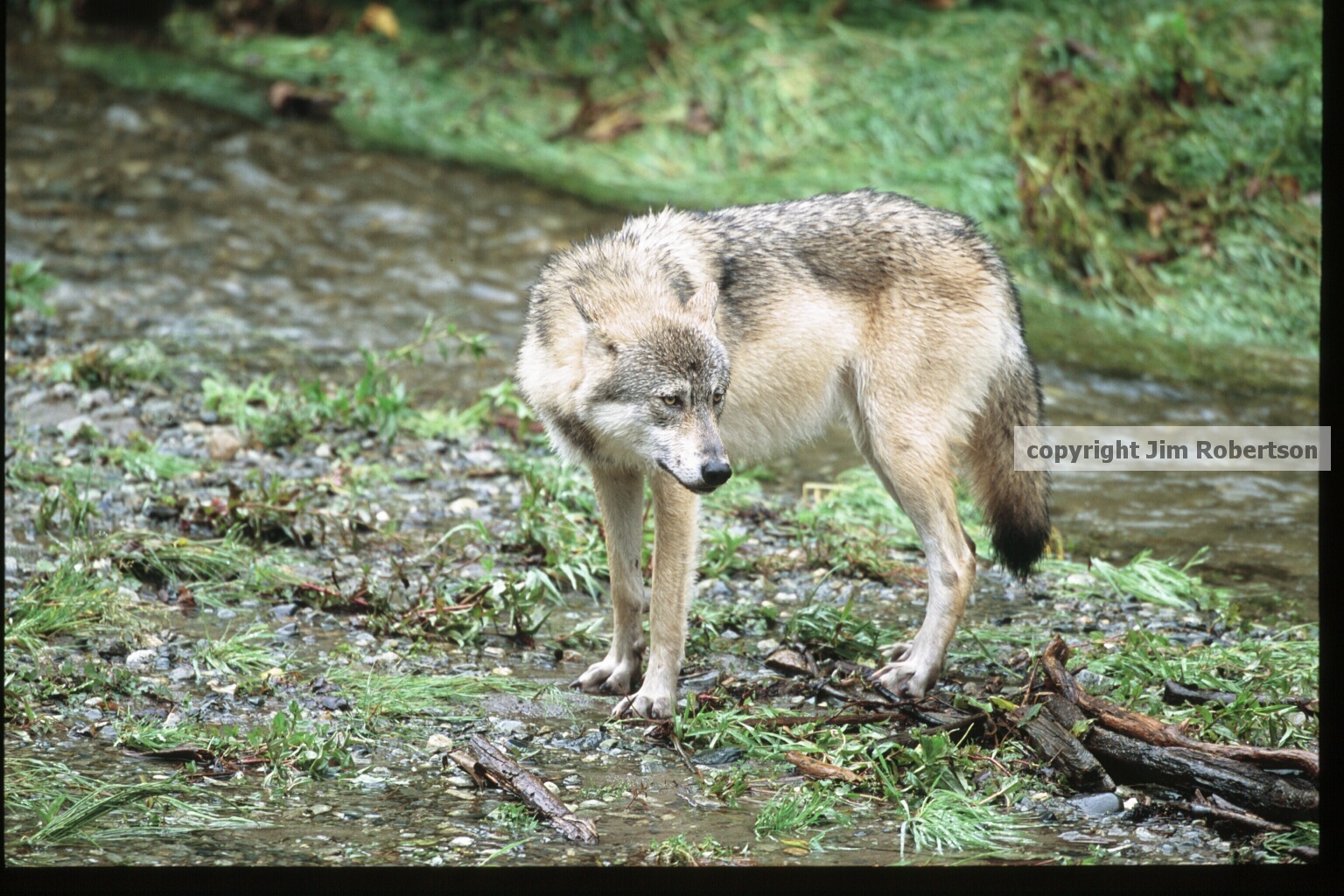
copyrighted wolf in river