Beloved pets also lost, displaced by mudslide

[Only now, after the human death toll has been tallied up, do we hear about the no-human casualties of the Oso slide.]

imagesCALYDLG2

http://www.komonews.com/news/local/Beloved-pets-also-lost-displaced-by-mudslide-253195501.html

By MANUEL VALDES, Associated Press Published: Mar 31, 2014
DARRINGTON, Wash. (AP) – After a rescue worker called her animal clinic saying dogs had been extracted from the destruction left behind by a massive mudslide, veterinary assistant Cassna Wemple and her colleagues raced to this small Washington town near the debris field.

They found one of the dogs at the fire station among a flurry of rescue workers and townspeople. Bonnie, an Australian shepherd, was wrapped in a comforter. She was muddy and had a broken leg in a splint. One of Bonnie’s owners had just died in the slide. The other had been pulled out.

“She was just very much in shock,” Wemple said.

In this rural community north of Seattle, Wemple said it’s common for residents to have plenty of animals, including pigs, horses, rabbits, chickens, dogs and cats. When the deadly slide struck March 22, beloved pets and livestock also perished.

The full number of pets and livestock killed may never be known. Authorities also don’t have a clear number of how many pets are missing or displaced by the slide, incident spokespeople have said. There are at least 37 horses displaced and at least 10 dogs that were missing, according to different animal services helping the recovery efforts.

“To know that their animals are lost and may or may not be found. It’s heartbreaking. It’s heartbreaking for the people and the animals,” said Dee Cordell of the Everett Animal Services.

Wemple said rescue workers could hear horses crying from the debris hours after the slide, but because of the unsafe conditions, rescuers couldn’t go in.

For those animals that survived, the community and outsiders have rallied in support with donations. Bag after bag of food for dogs, cats and chickens have filled up the rodeo grounds outside Darrington, which are serving as a makeshift shelter. At last count, it totaled nearly 45,000 pounds. On Saturday alone, 27 tons of donated food from Purina arrived.

Lilianna Andrews’s seven horses are now at the rodeo grounds. Their house wasn’t buried in the mud, but the displaced earth formed a dam, backing up the Stillaguamish River into a lake that rose waist-high in the house and as high as 10 feet in the barn.

“We got them out before they got any water on them,” the 13-year-old said after helping unload hay at the rodeo grounds on Saturday. “But they would have drowned. So we just had to evacuate them from the water, and they’ve been staying here ever since.”

The Andrews were in Seattle when a friend called to check on their whereabouts. When they realized it wasn’t just a small mudslide blocking the road, they hurried home. Their dog, cats and chickens are fine too, Andrews said, although they haven’t been able to get in to feed the chickens.

Volunteers are also tending to 20 horses that belonged to Summer Raffo, a farrier who died in the slide.

Wemple’s clinic, Chuckanut Valley Veterinary, treated three dogs hurt from the slide. One of those dogs, named Blue, had to have one of his legs amputated last week. His owner is still hospitalized. The owner’s daughter has visited the dog daily.

“He’ll be happier in the long run. No more pain in that leg,” Wemple said.

Bonnie’s owner was Linda McPherson, a retired librarian. She was in her living room reading newspapers with her husband, Gary “Mac” McPherson, when the slide hit. She died. He lived. Bonnie has been kept at the clinic for rehabilitation. At night, one of the staffers takes her home.

A memorial is planned for next week for Linda McPherson. Wemple said the staffer will bring the Australian shepherd to the memorial for a reunion with her surviving owner.

___

Associated Press writer Jonathan J. Cooper contributed to this report.

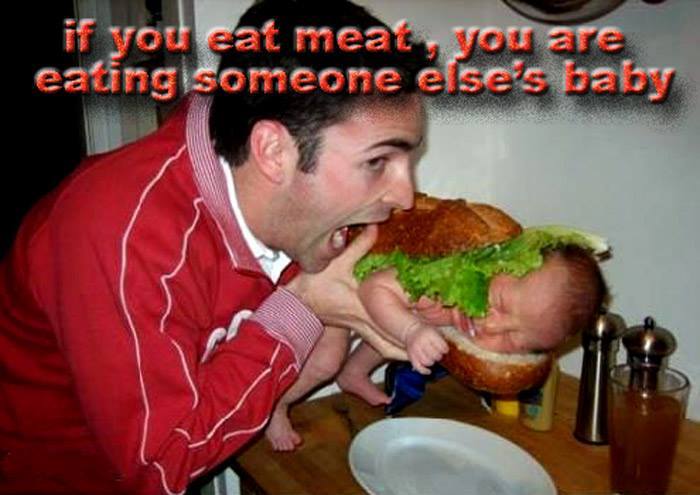
If You Eat Meat

1782018_10152293762567498_482181499_n

If you eat chicken or pork, you’re supporting extreme animal abuse on factory farms;

If you eat beef, you’re supporting the livestock industry that kills bison, elk and wolves;

If you eat fish, you’re supporting the demise of our living oceans;

If you hunt, your selfish food choice robs a life and cheats a natural predator;

If you eat meat, you’re part of the problem instead of the solution;

1797410_10201246274383855_1764880622_n

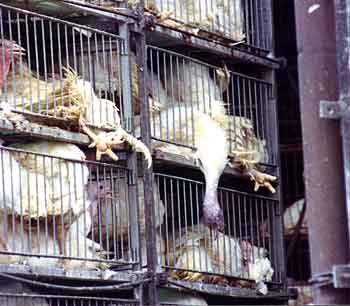
Deadly bird flu surges in China as millions travel

http://www.usatoday.com/story/news/health/2014/01/22/china-bird-flu-deadly-h7n9-chinese-new-year-travel/4779149/

Four more cases of deadly bird flu were reported in China on Wednesday, bringing the season’s total in that country to 221. Fifty-seven people have died.

The surge in cases has health officials worldwide watching closely as hundreds of millions of Chinese begin to travel for Chinese New Year.

The H7N9 strain of influenza jumped from birds to humans only last year. It is extremely dangerous, causing severe illness in more than three quarters of people infected and death in more than one quarter, according to Chinese researchers.

It is called bird flu because the virus originated in birds and so far is transmitted to humans only by live poultry. Cooked meat is no risk.

All of this year’s cases have been in China.

The surge in cases comes as China gets ready for what is called Spring Festival in Chinese. Known as Chinese New Year in the West, it begins Jan 31. People customarily travel to spend the holiday with family.

China estimates that 3.6 billion trips will be taken during the two-week holiday — and many of those traveling will be taking or buying live chickens and ducks as gifts.

Humans can be infected by being in close contact with “infected live poultry, mostly in live bird markets or when slaughtering birds at home,” the United Nations Food and Agriculture Organization said in a warning issued Tuesday.

So far, no sustained human-to-human transmission has occurred, according to the World Health Organization.

“Nothing can be predicted with certainty, but on present evidence, none of these viruses shows a potential to spread widely or cause an explosive outbreak,” Margaret Chen, director-general of the World Health Organization, said Tuesday in Geneva.

Flu viruses are notorious for quickly mutating into new forms, but so far genetic analysis by the FAO shows that the H7N9 virus has not changed significantly since its emergence last year.

“We are watching closely the increasing number of confirmed cases that are being reported from China during the past few weeks,” said Joseph Breese, an influenza expert with the Centers for Disease Control and Prevention in Atlanta. “Fortunately, Chinese health officials have not reported changes in the epidemiology of the virus that would lead us to believe it can easily spread between humans.”

The fear is that it could all too easily do so, said Mike Osterholm, director of the Centers of Excellence for Influenza Research and Surveillance at the University of Minnesota in St. Paul. “The clock is ticking but we just don’t know what time it is.”

Several things about H7N9 worry health officials. A major concern is that unlike other flu strains, it doesn’t make infected birds sick, so farmers don’t know their flocks are infected.

Humans are the proverbial canary in the coal mine in this outbreak. “The way we know that we have H7N9 in poultry is that humans start to get sick,” Osterholm said.

When testing shows a flock is ill, farmers have been reluctant to cull their birds because the animals seem healthy.

The birds breathe out the virus. That’s different from other flu strains, which are excreted in feces.

“We don’t know yet if there’s an infectious cloud that comes off the bird markets that can infect nearby humans,” Osterholm said. There have been cases in which people who lived close to a live bird market but didn’t go in still got infected, he said.

The concern is that with so many cases appearing in eastern and southern China, and hundreds of millions of people traveling long distances to get home for the holidays, the virus could find a way to mutate into something that can easily pass between humans.

“We’re in a ‘stay tuned’ moment right now,” Osterholm said. “If that happens, then bets are off. It’s potential pandemic time.”

cage_1

A Bit of Animal Trivia

Everyone likes a bit of trivia. Well, maybe not everyone; you may be the one person who doesn’t. Come to think of it, I don’t really enjoy trivia all that much myself. But anyway, like it or not, here’s some trivia for you…

1) What is the fastest growing bone tissue on Earth?
Answer:  Deer antlers

2) Which wild animal carries a dominant gene affecting their appearance that was acquired from their domesticated cousins?
Answer: Wolves. The wolf got their gene for black fur (found nearly exclusively in North American wolves) from dogs brought over with the earliest people to inhabit this continent.

3) What animal can detect odors up to 5 miles away; can hear both low and high frequency sounds beyond human capabilities and has 360 degree panoramic vision?
Answer: Cows. They also form friendships and are devoted mothers and will walk upwards of five miles in search of their calves.

4) A few centuries ago, this animals’ droppings were considered the best available fertilizer and therefore were protected by armed guards?
Answer: Pigeons

5) Which marine animal can live up to 100 years, uses complicated signals to establish social relationships, and sometimes travels hand in hand, the old leading the young?
Answer: Lobsters

6) When this animal gets injured or sick, his or her mate, and sometimes a comrade or two, will stay by their side until they are able to recover or pass on.
Answer: Canada goose

7) Which animal has the ability to learn the precise details of an area of over 1000 acres?
Answer: The turkey

8) Which dog breed was an American favorite in the early 20th century, featured as a child’s best friend and constant companion on TV and in movies, and can now be found in hospitals and nursing homes as a registered therapy animal?
Answer: The Pit Bull Terrier

9) What creature has some so paranoid that they’ve had protective enclosures—modeled after shark cages—built at school bus stops?
Answer: The Mexican Wolf in Catron County, New Mexico

10) Which animal species secretly communicates with one another through their flatulence?
Answer: Herring. Many species of fish have devised creative forms of communication and recent research has shown fish have a more complex nervous system than was previously accepted.

Bonus Question) While so many others dwindle, which group of animals has been steadily on the increase over  the years, now surpassing 150 billion?
Answer: Those consumed by humans each year.

turkey-factory-farming

Relative Radicalism

All things are relative, and that includes radicalism. Do I go too far, or not far enough? That depends on who you ask. Ask a hunter, and I’m an extremist “anti”; in the eyes of the everyday meat-eater, I’m a vegan food Nazi.

But to an actual radical—one of the die-hard few who won’t be happy until every cage is empty, every cattle ranch is bankrupt, every mink is freed and every fur farm burned to the ground—well, I’m probably considered too fuckin’ nice. It’s not that I don’t want to see every hog farm abandoned, every layingcage_1 hen liberated, every trap melted back into pot metal, every trophy hunter prosecuted and every meat-eater veganized.

I guess I just don’t have that much faith in humanity.

I can’t get past the feeling that the only way all this human evil’s gonna end is when the species goes completely under, due to, say, a pandemic, major drought, storms or food shortage—the kind of things we’re likely to see as the climate keeps changing for the worse.

I’m not saying we shouldn’t try to do everything humanly possible (within reason) to stop the coming global train wreck, but meanwhile, I’m going to continue to secretly hope Mother Nature will hurry up and get her shit together to make right her biggest mistake. She’s been an overly permissive parent to the spoiled species Homo sapiens thus far, letting them get away with uncontrolled, selfish misbehavior.

It’s about time for her to rein in the over-intelligent, under-compassionate, over teched, under-ethical killer ape, even if she has to throw out the baby with the bath water.


Factory Farm Legacy: Animal Torture, Water and Air Pollution and Antibiotic-Resistant Superbugs

From: Organic Consumers Association, September 18, 2013

For related articles and more information, please visit OCA’s Factory Farming page and our Food Safety page.

The days of the small farmer raising his cattle, hogs and hens on green pastures are long gone. Today America’s farming landscape resembles a windowless, animal gulag system filled with metal sheds, wire cages, gestation crates and confinement systems.

Factory farms aren’t about feeding the hungry or harvesting healthy food. They’re about maximizing profits for a handful of the world’s largest agribusiness corporations, and the biotech and pesticide companies that fuel their factories and feed their animals.

Today, nearly 65 billion animals worldwide, including cows, chickens and pigs, are crammed into CAFOs and slaughtered annually. These animals are literally imprisoned and tortured in unhealthy, unsanitary and unconscionably cruel conditions.

Factory farms produce unhealthy animals. And unhealthy people. About 80 percent of all antibiotics used in the U.S. are used on factory farms, either to prevent disease or stimulate growth. Meanwhile, about 70,000 Americans die each year from “superbugs” that have developed a resistance to antibiotics.

Animal Torture Chambers

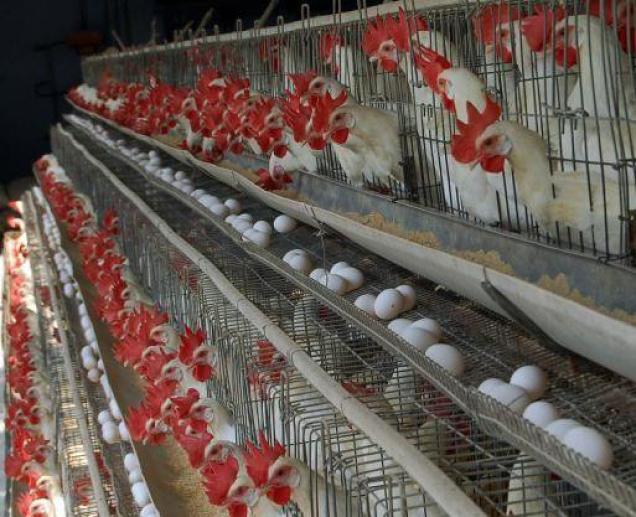
Over 300 million: The number of laying hens in the United States; of these, some 95 percent are kept in wire battery cages.

67: The average number of square inches of space allowed in each hen’s wire battery cage – less than the size of a standard sheet of paper.

72: The number of square inches of space a hen needs to be able to stand up straight.

303: The number of square inches a hen needs to be able to spread and flap her wings.

2 ft: The width of a factory farm sow cage – too small for them even to turn around or lie down comfortably.

2 ft.: The width of a factory farm cage for calves who are raised for veal.

None: The time provided to chickens and hogs raised in factory farms to spend outdoors, breathe fresh air or experience natural light.

None: The time provided to dairy and beef cattle to graze in a pasture where they could express their natural behavior (and ideal diet).

80: The percentage of antibiotics used in the United States that are given to farm animals, as a preventative measure or to stimulate growth. Growth stimulants are prohibited in Europe, but not here.

23 million: The number of pounds of antibiotics added to animal feed every year, to make the animals grow faster.

875 million: The number of U.S. animals, or 8.6%, who died lingering deaths from disease, injury, starvation, suffocation, maceration, or other atrocities of animal farming and transport.

Endangering Human Health

220 billion: The number of gallons of animal waste dumped by factory farms onto farmland and into our waterways every year.

73,000: The number of E. coli and salmonella outbreaks in 2007.

70,000: The number of Americans that die every year because of force-feeding animals antibiotics that helps breed antibiotic-resistant “superbugs.”

5,000: The number of deaths per year from food borne illnesses in the U.S.

4.5 million: The approximate number of Americans exposed to dangerously high nitrate levels in their drinking water. Agricultural Waste is the number-one form of well-water contaminants in the U.S.

14: The percentage of factory farm chickens that tested positive for
salmonella.
68: The percentage of chickens with salmonella that showed resistance to one or more antibiotics.

40: The percentage of cows in industrial dairies that are injected with genetically engineered recombinant bovine growth hormone (rBGH) to increase their milk yields.

70: The percentage of chicken producers that used the toxin roxarsone in their feed additives between 1995 and 2000.

3: The number of cases of mad cow disease identified in cattle in the U.S. — in December 2003, June 2005, and March 2006.

Over 90: The percentage the U.S. Department of Agriculture (USDA) scaled back testing for mad cow disease starting in the fall 2006, claiming that testing was expensive and detection of infected cows was rare.

Nearly 43: The percentage of large-scale dairies (over 500 head) that used rBGH on their cows in 2007, compared to 30 percent of mid-sized dairies, and nine percent of small dairies.

Sources:
Antibiotics are widely used by U.S. meat industry, Consumer Reports
Report: Bacteria in chicken too high, Consumer Reports
10 Reasons to Fear Your Food Supply, Takepart.com
Factory-Farmed Chickens: Their Difficult Lives and Deaths, Britannica Advocacy for Animals
CAFO’s Uncovered, Union of Concerned Scientists

Zack Kaldveer, Assistant Media Director for the Organic Consumers Association, compiled these statistics.

_________________

And From the UK Guardian:

Mad cow, bird flu, pink slime? The bigger threat is antibiotics in our meat

23,000 people die each year in the US from overuse of antibiotics. We should regulate antibiotic use in agriculture


  •  Wednesday 18 September 2013
                                          Beef carcasses at a wholesale meat market in Paris
Beef carcasses at a wholesale meat market. Photograph: Francois Mori/AP

Remember pink slime – that Dayglo-bright mash of ground up meat scraps and cow connective tissues larded with industrial strength ammonia that was being served up in school lunch programs in the United States last year?

More ominously, there was mad cow disease, which has killed scores of people in Britain and elsewhere. Bird-flue outbreaks originating in poultry farms  in China and Southeast Asia have also led to periodic scares. And did I mention salmonella?

But these food-related scourges pale in comparison with another threat, which was the subject of a report released Monday by the US Centers for Disease Control: the spread of antibiotic resistant bacteria. In its first estimate of the scope of the problem, the CDC says that 23,000 people – and possibly many more than that – die in the US each year from infection by microorganisms that can no longer be controlled by our current array of antibiotics.

We’ve known for a long time that our chronic overuse of antibiotics is helping to create these dangerous new strains of bacteria. Public health officials worry that doctors are routinely overprescribing powerful broad-spectrum antibiotics for everything from stomach aches to common colds. The CDC report says that 50% of all the antibiotics prescribed for people are not actually necessary.

But antibiotics are not just overused in medical care; we’re also feeding them indiscriminately to cows, pigs and chickens. Fully 80% of the antibiotics sold in the US are administered to farm animals in their water and feed. The use of these drugs in agriculture is virtually unregulated, according to Keeve Nachman, the director of the Center for a Livable Future at Johns Hopkins University.

Nachman told me that we don’t know exactly what antibiotics are being used in meat production, or how large the doses that are administered are. Even more critically, we don’t know how much of these antibiotics remains in the meat that we eat. There is no requirement to routinely test for this. Eating meat, even with low doses of antibiotics, he warns, may lead to the spread of antibiotic resistant bacteria in our own guts, if the meat is mishandled or undercooked.

There is also ample evidence that the overuse of antibiotics has created resistant bacteria in the external environment. Studies have shown them in water downstream from livestock farms, as well as in the air and soil near facilities where antibiotics are used. Nachman himself published a study yesterday in the journal JAMA Internal Medicine that shows that people living near swine production sites are more likely to be infected with the superbug MRSA (Methicillin-Resistant Staphylococcus aureus).

In light of these risks, the CDC report says pointblank:

The use of antibiotics for growth is not necessary, and the practice should be phased out.

Most antibiotics currently used on farms are not for the treatment of sick animals, or even the prevention of disease, but to promote the growth and weight of livestock. Until recently scientists didn’t know how antibiotics stimulated growth. However, a study published in the journal Nature last year helped to clear up this mystery.

New York University researchers found that antibiotics have a big impact on what is called the microbiome, the teeming ecosystem of billions of diverse bacteria that live within the gut. Not only do they kill off many valuable microorganisms, but they also apparently alter the ability of some gut bacteria to metabolize carbohydrates. With the result that mice that the scientists fed antibiotics fattened up, just as as livestock do.

So if animals typically put on weight when they take antibiotics, what about humans? A study published in the Journal of Obesity found a strong correlation between exposure to antibiotics in childhood and later obesity. But that may not be the worst of it. Evidence is also mounting that low microbial diversity in the gut is associated with a whole range of inflammatory illnesses including heart disease, type 2 diabetes and cancer.

With all of these dangers deriving from our overuse of antibiotics, Keeve Nachman argues that the time has come to get serious about regulating them. He says:

The FDA has proposed a voluntary program in which the pharmaceutical companies are asked to give up their drug approvals for purposes of growth promotion and to relist them for purposes of disease prevention.

But Nachman calls this “essentially a shell game” which will change how the drugs are labelled, but not the way they are actually used in animals.

To solve the problem, he says, we’ll have to ban antibiotics except in actual cases of illness. Farmers should be required to get a prescription from a veterinarian, much as you and I need a prescription from their physician before we can use the drugs.

There are already several European countries that have banned the indiscriminate use of antibiotics in meat production. But so far neither Congress nor regulators in the US have been willing to stand up to the livestock lobby and protect the public’s health.

In Relation to Animals, All People Are Narcissists

The protagonist in Nobel Peace Prize laureate and author Isaac Bashevis Singer’s book, The Letter Writer, stated, “In relation to animals, all people are Nazis.”

Ah, the Nazis; who can forget them? They were those goose-stepping narcissists who had the arrogant audacity to think themselves superior to all other races. Hell, “Nazi” even sounds like a derivative of the word “narcissism.” Thank God that kind of grandiosity is a thing of the past.

Or is it…

Not if you, like Isaac Singer, consider the attitudes human beings have toward their fellow animals. When you allow yourself even for a moment to ponder the plight of non-humans at the hands of man and connect the dots, you’re sure to come to the logical conclusion that: in relation to animals, all people are Narcissists.

Although Galileo and Copernicus have long since put to rest the notion of Earth as the center of the universe, so engrained is the belief that humans themselves are the center of all things that they even imagine their omnipotent creator in the image of man. (When the Good Lord was handing out personality disorders, he must have decided to make humankind the narcissists of the animal kingdom—in His image, perhaps.)

So what’s the problem with people having this perception of prowess, self-importance and excessive sense of entitlement (undeserved as they may be)? As those who study aberrant behavior have found, like the Nazis, the vast majority of serial killers have overblown narcissistic tendencies. While the serial killer objectifies his human victims, the human species is comfortable exploiting other Earthlings for their own selfish gains—no other life forms seem to matter much in the human scheme of things. The human race as a whole considers only the treatment of their own kind worthy of consideration.

Instantaneous creation and miraculous wand waving aside, how did Homo sapiens become so narcissistic as a species? It has been well established that hunters share many of the behaviors and rationalizations of serial killers. Although most people don’t live by hunting any more these days, a long, long history of proving oneself the baddest spear-throwing, fire-wielding, big game hunter on the planet doesn’t fade from the collective psyche overnight. No wonder the species has been so quick throughout history to take advantage of every other animal with such indifference to their needs or feelings. All others are just background—props on their stage.

Never before in the history of mammals have seven billion large, terrestrial, meat-eating members of one species single-handedly laid waste to so much of the Earth’s biodiversity. Human carnivorousness is killing the planet one species at a time, one ecosystem after another. Yet meat has never been so readily available worldwide. That’s because living conditions for farmed animals has taken a backseat on the bus of human hedonism. For all the recent advances made in regards to human rights, the treatment of non-humans has never been more deplorable and demonic.

Like the ordinary German civilian who chose to look the other way during the Holocaust, the everyday meat-eater chooses to remain willfully ignorant of today’s ongoing atrocities. But some who choose a vegetarian or vegan diet purely for their health can be about as narcissistic as a meat-eater.

Even the severely deformed and consequently down-trodden title character in David Lynch’s classic film, The Elephant Man, voiced his perceived human superiority when he told a gawking crowd, “I am not an animal! I’m a human being!” Of course he was an animal, and so are you, and so am I. I’m proud to be an animal. I’m sure if John Merrick, “the elephant man,” had had a chance to get to know many non-human animals, he would have realized that most animals are far more accepting and less judgmental than the average human.

Edgar Kupfer-Koberwitz, a conscientious objector and Holocaust victim who was sent to a concentration camp for “being a strong autonomously thinking personality” wrote in his Dachau Diaries, “I have suffered so much myself that I can feel other creatures’ suffering by virtue of my own…I believe as long as man tortures and kills animals, he will torture and kill humans as well—and wars will be waged—for killing must be practiced and learned on a small scale.”

Human beings are unique only in the extent of cruelty and destruction they inflict. While each and every human being does not suffer from narcissistic personality disorder, the species Homo sapiens is a lot more like a narcissist than a Galileo or Copernicus.

Isaac Bashevis Singer was one of those who was able to shed his deep-rooted human narcissism, a fact made clear by his statement in Judaism and Vegetarianism, “I am a vegetarian for health reasons – the health of the chicken.”

poultry_845904f_jp_1463316f

And We Call Ourselves Civilized?

In agreeing with President Obama’s plan to strike Syria, Representative Nancy Pelosi was quoted as saying we must respond to actions “outside the circle of civilized human behavior.” Nice to hear that the U.S. Government thinks it has the moral authority to respond to such actions. While they’re at it, I can think of a whole lot of other actions which should be considered “outside the circle of civilized human behavior” that are desperately in need of responding to.

I’m referring, of course, to the innumerable abuses of non-human animals by humans—many that go on every day right here in the U.S. of A. I’m afraid if I were to try to list all the instances of human mistreatment of other animals which should fall outside the “circle of civilized human behavior,” the pages would fill the halls of justice, spill out onto the streets and overflow the banks of Potomac River in an unending tsunami of savagery.

So here’s just a partial list…

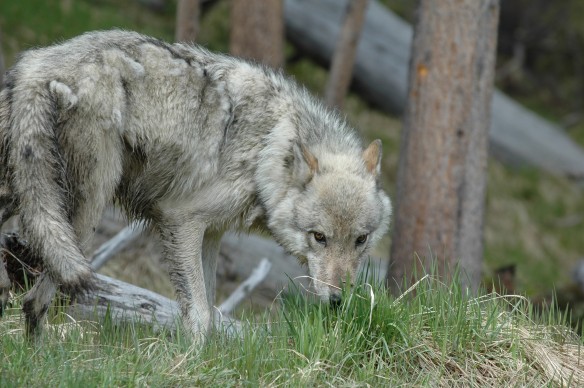
Wolf Hunting—No sooner did grey wolves begin to make a comeback in the Lower 48 than did the feds jerk the rug out from under them by lifting their endangered species protections and casting their fate into the clutches of hostile states. Now, hunters in Wyoming have a year-round season on them while anti-wolf fanatics in Montana have quadrupled their per person yearly kill quota.

Trapping—Only the creepiest arachnid would leave a victim suffering and struggling for days until it suits them to come along for the “harvest.” Yet “law abiding trappers” routinely leave highly sentient, social animals clamped by the foot and chained to a log to endlessly await their fate.

Hound-Hunting—“Sportsmen” not content to shoot unsuspecting prey from a distance of a hundred yards or more sometimes use hounds to make their blood-sport even more outrageously one-sided.

Bowhunting—Those who want to add a bit of challenge to their unnecessary kill-fest like to try their luck at archery. Though they often go home empty-handed, they can always boast about the “ones that got away”… with arrows painfully stuck in them.

Contest Hunts—Prairie dogs, coyotes, and in Canada, wolves, are among the noble, intelligent animals that ignoble dimwits are allowed to massacre during bloody tournaments reminiscent of the bestial Roman Games.

Horse Slaughter—After all that our equine friends have done for us over the centuries, the administration sees fit to send them in cattle trucks to those nightmarish death-camps where so many other forcibly domesticated herbivores meet their tragic ends.

Factory farming—Whether cows, sheep, pigs, chickens or turkeys, the conditions animals are forced to withstand on modern day factory farms fall well outside even the narrowest circle of civilized human compassion. To call their situations overcrowded, inhumane or unnatural does not do justice to the fiendish cruelty that farmed animals endure each and every day of their lives.

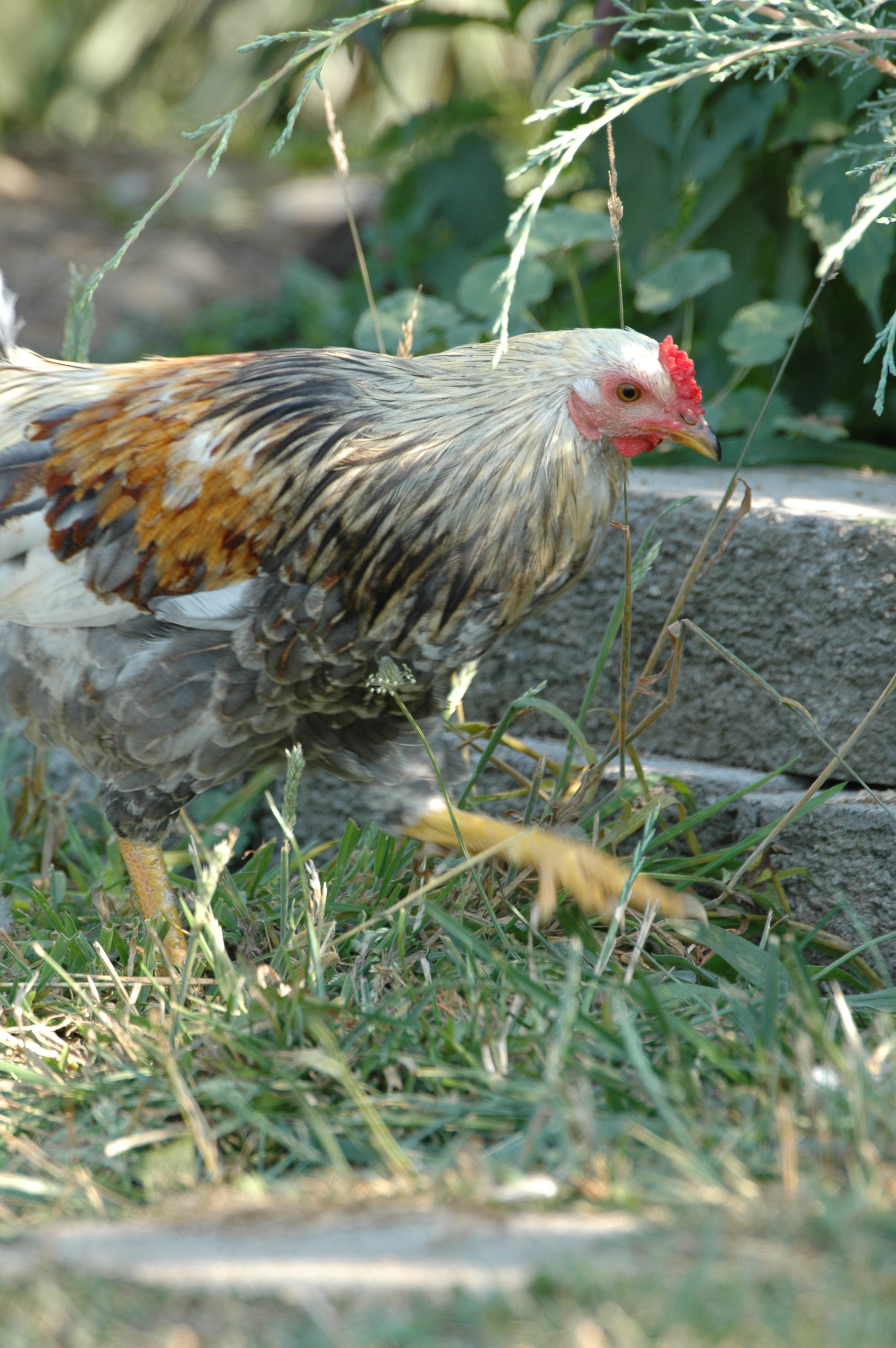
Atrocious conditions are not confined to this continent. Chickens in China (the ancestral home of some new strain of bird flu just about every other week) are treated worse than inanimate objects. Bears, rhinoceros and any other animal whose body parts are said to have properties that will harden the wieners of hard-hearted humans are hunted like there’s no tomorrow. And let’s not forget the South Korean dog and cat slaughter, or Japan’s annual dolphin round up…

Far be it from me to belittle the use of chemical weapons—my Grandfather received a purple heart after the Germans dropped mustard gas on his foxhole during World War One. I just feel that if we’re considering responding to actions “outside the circle of civilized human behavior,” we might want to strike a few targets closer to home as well. Or better yet, reign in some of our own ill-behaviors so we can justifiably call ourselves “civilized.”

Text and Wildlife Photography ©Jim Robertson, 2013. All Rights Reserved

Text and Wildlife Photography ©Jim Robertson, 2013. All Rights Reserved

Newsflash: Chickens Are Sentient Beings, Not Future Nuggets

Was Your Chicken Nugget Made In China? It’ll Soon Be Hard To Know

September 5, 2013

Here’s a bit of news that might make you drop that chicken nugget midbite.

Just before the start of the long holiday weekend last Friday, the U.S. Department of Agriculture quietly announced that it was ending a ban on processed chicken imports from China. The kicker: These products can now be sold in the U.S. without a country-of-origin label.

For starters, just four Chinese processing plants will be allowed to export cooked chicken products to the U.S., as first reported by Politico. The plants in question passed USDA inspection in March. Initially, these processors will only be allowed to export chicken products made from birds that were raised in the U.S. and Canada. Because of that, the poultry processors won’t be required to have a USDA inspector on site, as The New York Times notes, adding:

“And because the poultry will be processed, it will not require country-of-origin labeling. Nor will consumers eating chicken noodle soup from a can or chicken nuggets in a fast-food restaurant know if the chicken came from Chinese processing plants.”

That’s a pretty disturbing thought for anyone who’s followed the slew of stories regarding food safety failures in China in recent years. As we’ve previously reported on The Salt, this year alone, thousands of dead pigs turned up in the waters of Shanghai, rat meat was passed off as mutton and — perhaps most disconcerting for U.S. consumers — there was an outbreak of the H7N9 bird flu virus among live fowl in fresh meat markets.

What’s more, critics fear that the changes could eventually open the floodgates for a whole slew of chicken products from China. As the industry publication World Poultry notes:

“It is thought … that the government would eventually expand the rules, so that chickens and turkeys bred in China could end up in the American market. Experts suggest that this could be the first step towards allowing China to export its own domestic chickens to the U.S.”

The USDA’s decision comes with a backdrop of long-running trade disputes over meat between the U.S. and China. In a nutshell: China banned U.S. beef exports in 2003 after a case of mad cow disease turned up in a Washington state cow. Then, when the bird flu virus broke out widely among Asian bird flocks in 2004, the U.S. blocked imports of Chinese poultry. China challenged that decision in front of the World Trade Organization, which ruled in China’s favor in 2010.

And, chicken lovers, brace yourselves: There’s more. A report suggests chicken inspections here in the U.S. might be poised to take a turn for the worse. The Government Accountability Office said this week it has serious “questions about the validity” of the new procedures for inspecting poultry across the country.

Basically, these changes would replace many USDA inspectors on chicken processing lines with employees from the poultry companies themselves. The USDA has been piloting the new procedures, which will save money and significantly speed up processing lines, in 29 chicken plants. As The Washington Post reports, the plan is to roll out the new procedures eventually to “most of the country’s 239 chicken and 96 turkey plants.”

The problem? According to the GAO, the USDA did a poor job of evaluating the effectiveness of the pilot programs it has in place.

As a result, the report concludes, it’s hard to justify the USDA’s conclusions that the new procedures will do a better job than current approaches at cutting down on the number of dangerous bacteria like salmonella that pop up on the birds that will later end up on our dinner tables.

Still, the USDA maintains that the changes will, in fact, boost food safety. In a commentary published on Food Safety News, USDA food safety and inspections administrator Alfred Almanza writes, “If finalized and implemented broadly, this new inspection system would enable [USDA inspectors] to better fulfill our food safety mission. Nothing in the GAO’s report contradicts this basic fact.”

Copyright 2013 NPR. To see more, visit http://www.npr.org/.

DSC_0140