UPC President Karen Davis’s Letter to the Editor appears Jan. 15, 2021, in Voices of Monterey Bay, a nonprofit online news source serving California’s Central Coast. The letter is a response to “Quieting the rooster chorus,” by Royal Calkins, Jan. 10, 2021 regarding the response of Monterey County officials to the campaign by SHARK & HFA to crush illegal cockfighting in the county.
To the Editor:
Thank you for covering this important milestone in the effort to eliminate illegal cockfighting in Monterey County (and elsewhere). Contrary to the claims of cockfighters, roosters bred for cockfighting are not born surrogates for their trainers. Roosters rescued from cockfighters can usually be rehabilitated to live like normal chickens with their hens in a place where they lose their fear of abuse and enjoy foraging in the soil, sunbathing, dustbathing, perching in trees, and socializing as Nature intended. We currently have four roosters rescued from cockfighting operations in our predator-proof outdoor aviary in Virginia. Over the years we’ve adopted roosters from raids in Mississippi, Alabama, and Virginia.
I hope this new task force will effectively curb staged cockfights in Monterey County. Studies of feral chickens, such as the McBride study of flocks off the coast of Queensland, Australia in the 1960s, report that roosters are busy foraging, raising their families, and keeping an eye out for predators: “No serious fights were observed,” the McBride researchers wrote. (McBride, G., et al. 1969. “The Social Organization and Behaviour of the Feral Domestic Fowl,” Animal Behaviour Monograph, pp. 127-181.)
https://v.kr.kollus.com/py5JO1bo?player_version=html5+ Text Size Large / – SmallTo stop the spread of highly pathogenic avian influenza(AI), the South Korean government has temporarily banned the movement of people connected to poultry farms around the country this weekend. A task force at the ministry of agriculture says that over 10 cases of the disease have occurred at poultry farms in five cities and provinces. Highly pathogenic bird flu is contagious, can cause severe illness, and kill poultry. Animals, farm owners, and vehicles from poultry farms and related facilities like feed factories and slaughterhouses have been banned from traveling. The task force will be checking locations and can punish farm owners if they violate the law. In the meantime, poultry farms, related facilities, and vehicles will be disinfected.
Chickens have a reputation for being profoundly dumb, but in fact they are remarkably intelligent and may even be empathic
By Colin Barras
11 January 2017
Reputation: Chickens are dumber than your average bird – little more than walking meat factories with a talent for laying tasty eggs
Reality: The world’s most common bird is actually intelligent, and perhaps even sensitive to the welfare of its peers – which might raise some uncomfortable ethical questions for the farming industry
How much brain does pecking at seeds even take? (Credit: Klein & Hubert/naturepl.com)
There is something odd about chickens. Globally they number more than 19 billion, making them one of the most abundant vertebrate species on the planet. Yet many people have little or no contact with the birds – at least, not while they are alive.
Chickens can count, show some level of self-awareness, and even manipulate one another
That has led to some strange assumptions about chickens. According to some studies, people can struggle even to see them as typical birds. They are, in fact, reasonably representative of the galliformes, a bird group that also includes turkeys, partridges and pheasants.
It is also common for people to view chickens as unintelligent animals that lack the complex psychological characteristics of “higher” animals like monkeys and apes. This is a view reinforced by some depictions of chickens in popular culture, and one that might help people feel better about eating eggs or chicken meat produced by intensive farming practices.
But chickens are, in fact, anything but dumb.
Heihei, from Moana, is unbelievably stupid (Credit: Entertainment Pictures/Alamy)
They can count, show some level of self-awareness, and even manipulate one another by Machiavellian means. In fact, chickens are so smart that even a limited amount of exposure to the living birds can crush longstanding preconceptions.
I never thought that chickens would be intelligent enough and learn quite so quickly
For a study published in 2015, Lisel O’Dwyer and Susan Hazel ran a class for undergraduates at the University of Adelaide, Australia. As a way to learn about psychology and cognition, the students performed experiments that involved training chickens.
Before the class began, the students completed a questionnaire. Most said they had previously spent little time with chickens. They viewed them as simple creatures, unlikely to feel boredom, frustration or happiness.
“Chickens are a lot smarter than I originally thought,” commented one student on a follow-up questionnaire. Another said: “I never thought that chickens would be intelligent enough and learn quite so quickly.”
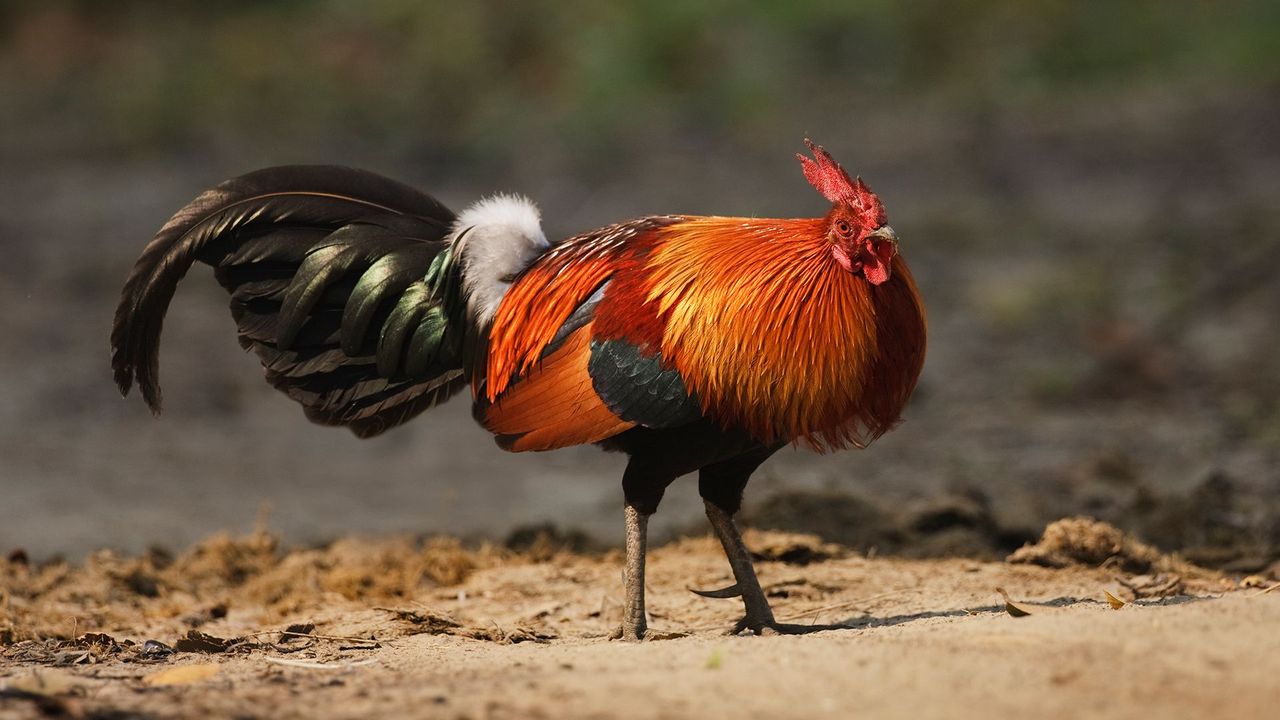
A male junglefowl (Gallus gallus), domestic chickens’s closest wild relative (Credit: Tony Heald/naturepl.com)
In as-yet-unpublished research, O’Dwyer has replicated this study with workers in the poultry industry, and found the same results. “Basically we had two quite different social groups and found the same [initial] attitudes and the same attitude change in both,” she says.
The researchers have shown that chickens can count and perform basic arithmetic
She now plans to study whether these experiences have any impact on people’s eating habits – for instance, whether they shift to eating chicken reared in ways that they believe to be more ethically acceptable.
“The paper is part of a joint venture between Farm Sanctuary and The Kimmela Center, called The Someone Project,” says Marino. “The aim of the Project is to educate the public about who farmed animals are from the scientific data.”
Marino says the scientific evidence shows clearly that chickens are not as unaware and unintelligent as many people assume.
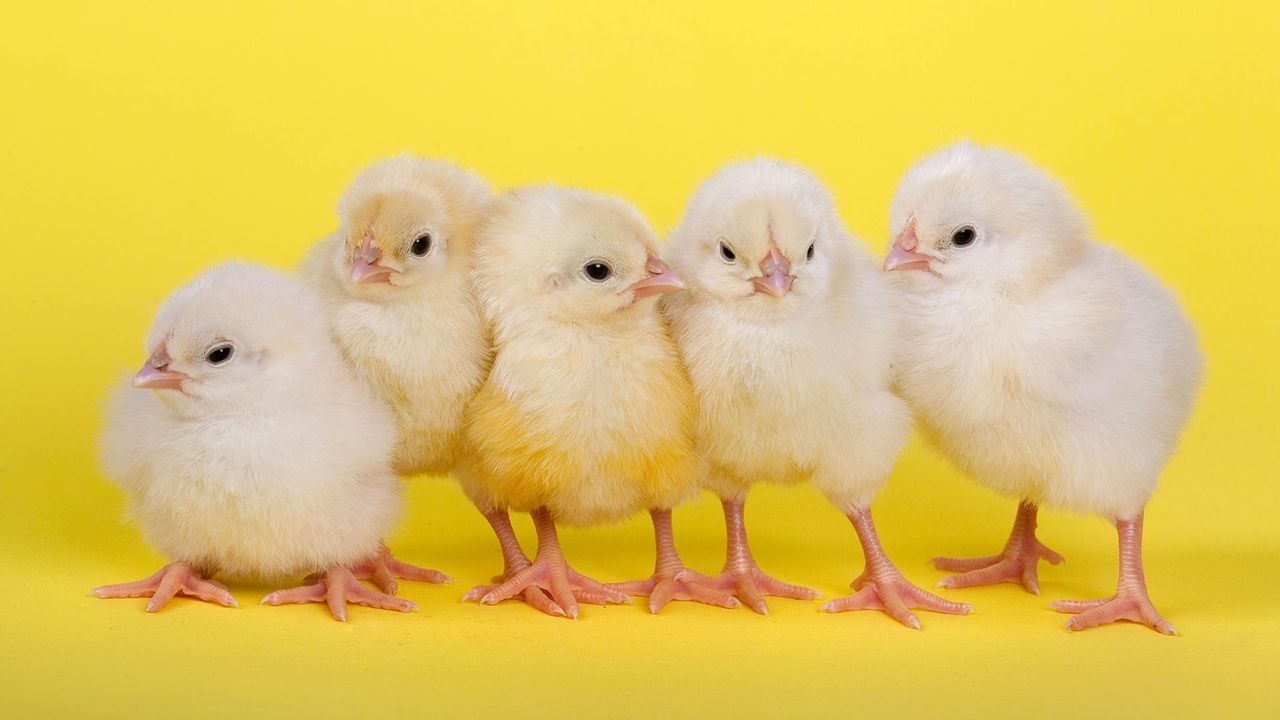
Newly-hatched chicks have remarkable skills (Credit: Ernie Janes/naturepl.com)
Take, for instance, a suite of papers published over the last decade by Rosa Rugani at the University of Padova, Italy, and her colleagues. Working with newly-hatched chicks, the researchers have shown that chickens can count and perform basic arithmetic.
Chickens may also have some ability to perform “mental time travel”
The chicks were raised from hatching with five objects – the plastic containers from Kinder Surprise eggs. After a few days, the scientists took the five objects and, in full view of the chicks, hid three behind one screen and two behind a second screen. The chicks were more likely to approach the screen hiding more of the objects.
A follow-up experiment tested the chicks’ memory and ability to add and subtract. After the objects had been hidden behind the two screens, the scientists began transferring objects between the two screens, in view of the chicks. The chicks seemed to keep track of how many objects were behind each screen, and were still more likely to approach the screen that hid the larger number of objects.
Chickens have a strong grasp of numerical tasks from a young age, even if they have limited experience, says Rugani.
This chicken has a first-rate mind (Credit: Pete Cairns/naturepl.com)
She thinks that might be true of higher animals in general, rather than chickens in particular. “These abilities would help animals in their natural environment, for example to reach a larger amount of food, or to find a larger group for social companionship,” she says.
If a male chicken foraging for food finds a particularly tasty morsel, he will often try to impress nearby females by performing a dance
Chickens may also have some ability to perform “mental time travel” – that is, to imagine what will happen in the future – to secure a larger amount of food, according to a 2005 study led by Siobhan Abeyesinghe, then at the University of Bristol, UK.
Abeyesinghe gave chickens the option of pecking one key, which would give brief access to food after a two-second delay, or pecking a second key that gave prolonged access to food after a six-second delay.
Chickens have intricate social lives (Credit: Ernie Janes/naturepl.com)
Some studies suggest the birds can appreciate how the world must appear to their peers, and that they can use this information for personal advantage.
Females quickly wise up to males who perform this sort of deception too often
If a male chicken foraging for food finds a particularly tasty morsel, he will often try to impress nearby females by performing a dance while making a characteristic food call.
However, subordinate males that perform this song-and-dance routine risk being noticed and attacked by the dominant male. So if the dominant male is nearby, the subordinate often performs his special dance in silence, in a bid to impress females without the dominant male noticing.
Meanwhile, some males may try to trick females into approaching by making the characteristic food calls even when they have not found anything worth crowing about. Unsurprisingly, females quickly wise up to males who perform this sort of deception too often.
There are even some hints that chickens may show a rudimentary form of empathy for each other.
Chickens can be very communicative (Credit: Klein & Hubert/naturepl.com)
In a series of studies over the last six years, Joanne Edgar at the University of Bristol, UK and her colleagues have studied how hens react when they see their chicks having air puffed at them – something the hens have learned, from personal experience, is mildly unpleasant.
Hens can respond to their personal knowledge of the potential for chick discomfort
In a study published in 2013, the hens learned to associate one coloured box with the uncomfortable air puff and a second coloured box with safety – no air puff. The hens again showed signs of concern when chicks were placed in the “dangerous” box, even if the chicks never actually experienced an air puff and remained oblivious to the peril.
Chickens are farmed in many countries (Credit: Ernie Janes/naturepl.com)
The research is ongoing, says Edgar. “We have not yet established whether the behavioural and physiological responses in hens observing their chicks in mild distress are indicative of an emotional response, or are simply akin to arousal or interest.”
When the chicks were puffed, the hens’ hearts began to race and they called more frequently to the chicks
If it does turn out that chickens can show empathy when other birds are in distress, that could raise serious questions about the way farmed chickens are reared.
“There are numerous situations where all farm animals are exposed to the sights, sounds and smells of other individuals showing signs of pain and distress,” says Edgar. “It is important to determine whether their welfare might be reduced at these times.”
Marino also thinks it may be time to discuss these questions. “The perception of chickens [as unaware and unintelligent] is driven in part by the motivation to dismiss their intelligence and sensibilities because people eat them,” she says.
The uncomfortable truth about chickens is that they are far more cognitively advanced than many people might appreciate. But it remains to be seen whether consumers who are armed with this knowledge change their shopping habits at the meat counter.
(Adds comment from officials, detail on record cullings)
By Yuka Obayashi and Aaron Sheldrick
TOKYO, Dec 10 (Reuters) – A bird flu outbreak in Japan worsened on Thursday with farms in two more prefectures slaughtering chicken in a record cull of poultry as the government ordered the disinfection of all chicken farms.
Highly pathogenic bird flu, a H5 subtype most likely brought by migrating birds from the Asian/European continent, has spread to eight of Japan’s 47 prefectures.
While officials say it is not possible for people to catch avian influenza from eggs or meat of infected chickens, they are concerned about the virus making a “species jump” to humans and causing a pandemic like the novel coronavirus.
All farms in Japan have been ordered to carry out disinfection and check hygiene regimes as well as ensure that nets to keep out wild birds are installed properly, agriculture ministry officials told Reuters.
The number of birds culled, at 2.36 million before the latest two outbreaks, exceeded the previous record of 1.83 million slaughtered in the year beginning in April 2010.
The government is calling for extra vigilance due to the growing number of infections at home and in Europe, which is in the grip of an outbreak.
Japan’s worst outbreak since at least 2016 started last month in Kagawa prefecture on Shikoku island.
In the latest cases, the virus was confirmed at an egg-laying farm in Kinokawa city in Wakayama prefecture, the agriculture ministry said on its website.
Three broiler farms in Oita prefecture on Kyushu island also reported outbreaks, it said.
More than 130,000 chickens at the farms in Oita and Wakayama will be slaughtered and buried.
The latest cullings mean nearly 2.5 million chickens will have been slaughtered since the outbreak began. Japan has suspended poultry imports from seven countries including Germany.
Japan had a broiler chicken population amounting to 138 million head last year, according to the U.S. Department of Agriculture.
(Reporting by Aaron Sheldrick Editing by Grant McCool, Robert Birsel)
AT&T Business & Barbara Corcoran have teamed up on a webinar series to help small businesses navigate times that are anything but “business as usual”. We dive into the details & discuss why leaning on insights from experts is key for entrepreneurs. Presented by AT&T Business.VISIT SITE
The COVID-19 pandemic has been devastating for America’s food workers, and nowhere is that more apparent than in the meatpacking industry.
USA Today reported last month that executives at the Triumph Foods meatpacking plant in St. Joseph, Missouri, lobbied government officials to keep the plant open at the height of the Spring coronavirus outbreak, a delay that led to hundreds of workers getting sick and at least two deaths.
In Iowa, not only did Tyson Food executives keep their factory open, but they also allegedly made bets on how many of their workers would contract the virus.
These are the latest examples of callous worker treatment by meatpackers – and of a failure of public agencies tasked with overseeing them. While this may be shocking to the general public, it isn’t surprising for those of us in the industry. I was a contract farmer for one of the biggest poultry companies in the US for 24 years. To me, this looks like standard operating procedure.
What will it take for businesses to implement and manage their augmented and virtual reality efforts? We explore why companies might leverage third-party consultants who are experts in the space to advance A.R. & V.R. tech offerings. Presented by AT&T Business.VISIT SITE
Par for the course
Nationally, more than 49,000 meatpacking plant workers have tested positive for COVID-19 and 253 have died.
Along with nursing homes and prisons, meat and poultry plants were the leading source of virus outbreaks in the spring. Workers on the processing line reported no way to social distance, no PPE, and no time to even cover a cough. But rather than quickly close the plants to control the outbreaks and establish safety measures, meatpacking companies dragged their feet.
Shortly after the largest plants did finally close, an executive order from President Donald Trump deemed them “essential” and allowed them to re-open, but with no mandate for worker protections.
This year, I’ve heard meatpacking workers, many of them immigrants and refugees, describe being afraid of the virus but even more afraid of speaking up. Speaking up could cost their job, and then how would they feed their family?
Take out my $500,000 mortgage on now-empty chicken houses, and we’ve got the same story.
Corporate Control
I wanted to raise chickens and raise a family, that was all. I signed a contract with a major poultry company in 1992 and built those houses. The company hooked me by promising that after ten years, my mortgage would be satisfied and I could really make money raising birds. As it turned out, getting the barns paid off in ten years was a pipe dream. Every year, there was some new technology they wanted me to invest in, and the understanding was that if I didn’t do it, I wouldn’t get more birds.
In 2014, I finally did speak up about how the contract required me to treat the birds. The company tried to intimidate and discredit me, showing up on my farm for audits at all hours. I finally quit in 2016, but clearly this was bigger than me.
I got involved with Rural Advancement Fund International-USA (RAFI-USA) and other groups advocating for common sense regulations for the meat and poultry industry so the power wasn’t 100% in the hands of the companies. However, the meatpackers fought tooth and nail against any little thing to change the status quo, and they kept winning. Under the Trump Administration, the federal Grain Inspectors, Packers, and Stockyards Administration, the agency tasked with protecting contract farmers, was essentially eliminated when it was merged with another department in 2017.
I have seen again and again that when it comes to the big meatpacking companies, both federal and state oversight bodies act like customer service agencies instead of regulatory agencies. Customer service to the meatpackers, that is, not to the farmers or workers.
And here we are again. In October, a memo came out showing that meat industry lobby groups wrote parts of Trump’s executive order to re-open the plants. North Carolina Governor Roy Cooper backed off a pledge to release guidance for meatpacking plants due to industry pressure. Groups in Iowa have sued the state’s Occupational Health and Safety Administration (OSHA) saying the agency has not protected workers in several industries including meatpacking. The list goes on.
Meatpacking plant workers and farmers are both deemed “essential” in the pandemic. Why do we keep being treated instead as expendable, not only by the companies we work for, but by the very government agencies that are supposed to protect us?
Craig Watts is a former contract poultry farmer, who works part time as a farmer advocate at Rural Advancement Foundation International – USA (RAFI-USA).
This is an opinion column. The thoughts expressed are those of the author(s).
A November 2020 article, published by *HoneySuckle Magazine*, promotes a particular “humane” animal farm, while sharing alternative perspectives by Karen Davis of United Poultry Concerns and Alex Hershaft of Farm Animal Rights Movement:
“Even high standards for animal care do not meet the demands of many animal rights groups. For example, Dr. Karen Davis from United Poultry Concerns (UPC) preaches a vegan and cruelty-free lifestyle. When asked about safe farming practice, such as that of Seven Sons, she finds that ‘when you get into the details of animal farming, the word humane and ethics just don’t apply, not compared to how you would want your dog, or your cat, or yourself to be treated.'”
“‘I should caution you that we are abolitionists, in the sense that we are less concerned with how animals are treated on factory farms than that they are raised for food altogether. We oppose all oppression of all sentient beings, however gentle,’ was the warning I received by email before interviewing Alex Hershaft, co-founder and president of Farm Animal Rights Movement (FARM), a vegan blogger <https://theveganblog.org/> and holocaust survivor.”
Today, I was a guest on the Louie B. Free Show: Brainfood from the Heartland out of Ohio. Louie and I discussed the emotional life of turkeys and chickens and what turkeys suffer in being raised and slaughtered for food. We then turned our attention to all the wonderful animal-free “meat and dairy” products that are now readily available so that no animal needs to suffer and die for the dinner plate. Thank you, as always Louie, for a great interview! – Karen Davis, United Poultry Concerns
As a filmmaker for We Animals Media (WAM), Kelly Guerin has traveled to farms and slaughterhouses around the world to document the life and death of the farmed animals confined inside.
Most poultry farms look the same, says Guerin, easily recognized by their long barns with fluorescent lighting and the noise of whirring fans. But this chicken farm is the first she’s gained access to in the United States—where chickens account for 95 percent of the land animals killed for food each year—and, as she puts it, is “the first with a company name I recognized, who sends chickens to very familiar restaurants.”
This time, a farmer invited her in, wanting to talk openly about being caught up in the supply chain of Perdue Farms.
The farm, owned by Rudy Howell, contracts exclusively with Perdue which slaughters 700 million chickens each year making it the country’s fourth-largest poultry producer.
“[Perdue] calls themselves a family farm, but they’re a corporate farm. They have control over everything out here,” he said.
On the farm, Guerin witnessed what rapid growth in chickens actually looks like and why animal protection groups are pushing to end the practice.
Along with confined environments and overweight birds, culling is a daily reality inside factory farms that, before COVID-19, often went unseen. Perdue is no exception.
As Guerin toured Howell’s farm, she was shown how sick and dying young birds are killed. Farmers often use a method called cervical dislocation, in which a chicken’s head is stretched away from the body, as the bird is decapitated by hand. According to Perdue and the rest of the poultry industry, this is considered an acceptable way for farmed chickens to be killed.
In fact, a reminder to cull animals daily was listed on signs provided by Perdue and posted on the doors of the barn during Guerin’s tour.
The Rise of Factory Farmed Chicken In the late 1920s, chickens became the first large-scale farmed animals, bred and raised indoors for egg production. The 1948 Chicken of Tomorrow Contest, marked the start of significant investment in the world of poultry production. What was then a 3 billion dollar industry with chickens bred for “plumper thighs” has now grown into a $48.3 billion dollar industry, where chickens are bred for rapid growth leading to the conditions we see today: CHICKENS ARE THE MOST FACTORY-FARMED LAND ANIMAL ON EARTH. But they didn’t use to be. According to PEW Trusts, in 1950, more than 1.6 million farms grew chickens for American consumers. By 2007, 98 percent of those farms were gone, and Americans were eating even more chicken. Broiler sales jumped by 8 billion birds (1,400%), meaning nearly all of them were raised on a factory farm.
The U.S. chicken market is now largely controlled by four companies—Tyson Foods, Pilgrim’s (JBS), Sanderson Farms, and Perdue Foods—all of which own and operate large-scale chicken farms. In 2019, Tyson Foods slaughtered 45 million chickens per week within 183 facilities. Being one of the top meat producers in the United States means that production cycles must be fast, animals must be bred in large quantities, and the slaughtering process must be continuous, leading to the increased potential for severe animal suffering and workplace injuries.
Organizations including Animal Outlook and PETA have conducted investigations at Tyson suppliers and processors unveiling severe abuse, neglect, and physiological issues as a result of selective breeding. One worker told an undercover investigator for PETA that, “Yesterday, I ain’t gonna lie, man, I straight up broke one’s back…I hurt an innocent chicken because the other chickens made me mad.” U.S. CHICKEN PRODUCTION IS BOOMING. For lack of more elegant phrasing, people want cheap chicken and they want a lot of it. Producers know this, and they’ve shaped their supply chains to accompany the booming demand. Fifty years ago, chickens became the first animals to be farmed at a large-scale. At the time, scientists believed there would be no way to continue feeding animal products to a rapidly growing human population without farming animals more efficiently. So they stuck animals in barns, crammed them in cages, and turned the farm into a well-oiled machine.
Today, roughly 25 million chickens are killed for food each day in the U.S. alone. To document the undisputed cruelty within modern chicken farms, Jo-Anne McArthur of We Animals produced Undercover: Stories from a Former Investigator. This short film documents former undercover investigator, Geoff Regier, and his time handling chickens on more than 50 farms and one processing plant for Maple Lodge Farms in Ontario, Canada.
“You stop seeing suffering. You stop seeing individuals. Animal dying alone on the floor becomes just a mess to be cleaned up. Otherwise good people, people with families and senses of humor are doing terrible things to animals because that’s how the system is set up,” Regier states. CHICKEN PRODUCERS IN THE U.S. SET GLOBAL STANDARDS FOR ANIMAL WELFARE. Over the past 10 years, large-scale farming practices honed in the U.S. have spilled over into Europe. And in an attempt to meet the steadily rising global demand for chicken, Europe’s poultry production centers have become overrun with factory farms. Although European farms with more than 5,000 broilers barely represent 1 percent of the total number of broiler farms in the EU, they account for more than nine in 10 broiler chickens.
Every year, more than 60 billion chickens live and die on factory farms around the world. They spend their lives crowded into industrial feeding operations where they barely have enough room to flap their wings. Many suffocate and die due to overcrowding. Then, over the course of just 40 days, they reach full size.
After the birds’ accelerated growing period—which can cause heart disease, lethargy, and lameness—they are sent to slaughter. Factory farmed chickens live their lives confined, without access to sunlight, for less than six weeks before they are killed, sent to be processed, and sold by the world’s largest fast-food companies.
Guerin saw some young chicks who had just arrived from the hatchery and already “could only take a few steps and then plop down. They had their legs splayed out beneath them.” Some tried and were unable to walk away as she got closer. “They would be laying there, breathing heavily, eyes closed,” she says.
“These animals have been bred to grow so fast that their hearts and legs can hardly keep up with the pressure from their bulking bodies,” says WAM founder Jo-Anne McArthur. “To some, death comes quickly. Others wither slowly away.”
If factory farming has become the new normal for chickens, and even the highest animal welfare standards aren’t enough, should companies like Perdue be able to claim that they are committed to animal care?
Our next session will leave you with the tools you need to develop your personal brand and develop your social profile.
New York Times bestselling author and top web influencer Neil Patel, vegan influencer and producer of The Invisible Vegan Jasmine Leyva, and social media influencer John Oberg will teach you how to harness the power of social media.
Covering COVID-19 With the worst global pandemic we’ve seen in over a century, it’s more important than ever to make sure the truth is reported in its entirety, not just what’s convenient.
Help us share the facts during these uncertain times and make sure the world knows our species cannot survive if we continue our exploitation of the planet and nonhuman animals.
As a filmmaker for We Animals Media (WAM), Kelly Guerin has traveled to farms and slaughterhouses around the world to document the life and death of the farmed animals confined inside.
Most poultry farms look the same, says Guerin, easily recognized by their long barns with fluorescent lighting and the noise of whirring fans. But this chicken farm is the first she’s gained access to in the United States—where chickens account for 95 percent of the land animals killed for food each year—and, as she puts it, is “the first with a company name I recognized, who sends chickens to very familiar restaurants.”
This time, a farmer invited her in, wanting to talk openly about being caught up in the supply chain of Perdue Farms.
The farm, owned by Rudy Howell, contracts exclusively with Perdue which slaughters 700 million chickens each year making it the country’s fourth-largest poultry producer.
“[Perdue] calls themselves a family farm, but they’re a corporate farm. They have control over everything out here,” he said.
On the farm, Guerin witnessed what rapid growth in chickens actually looks like and why animal protection groups are pushing to end the practice.
Along with confined environments and overweight birds, culling is a daily reality inside factory farms that, before COVID-19, often went unseen. Perdue is no exception.
As Guerin toured Howell’s farm, she was shown how sick and dying young birds are killed. Farmers often use a method called cervical dislocation, in which a chicken’s head is stretched away from the body, as the bird is decapitated by hand. According to Perdue and the rest of the poultry industry, this is considered an acceptable way for farmed chickens to be killed.
In fact, a reminder to cull animals daily was listed on signs provided by Perdue and posted on the doors of the barn during Guerin’s tour. The Rise of Factory Farmed Chicken In the late 1920s, chickens became the first large-scale farmed animals, bred and raised indoors for egg production. The 1948 Chicken of Tomorrow Contest, marked the start of significant investment in the world of poultry production. What was then a 3 billion dollar industry with chickens bred for “plumper thighs” has now grown into a $48.3 billion dollar industry, where chickens are bred for rapid growth leading to the conditions we see today: CHICKENS ARE THE MOST FACTORY-FARMED LAND ANIMAL ON EARTH. But they didn’t use to be. According to PEW Trusts, in 1950, more than 1.6 million farms grew chickens for American consumers. By 2007, 98 percent of those farms were gone, and Americans were eating even more chicken. Broiler sales jumped by 8 billion birds (1,400%), meaning nearly all of them were raised on a factory farm.
The U.S. chicken market is now largely controlled by four companies—Tyson Foods, Pilgrim’s (JBS), Sanderson Farms, and Perdue Foods—all of which own and operate large-scale chicken farms. In 2019, Tyson Foods slaughtered 45 million chickens per week within 183 facilities. Being one of the top meat producers in the United States means that production cycles must be fast, animals must be bred in large quantities, and the slaughtering process must be continuous, leading to the increased potential for severe animal suffering and workplace injuries.
Organizations including Animal Outlook and PETA have conducted investigations at Tyson suppliers and processors unveiling severe abuse, neglect, and physiological issues as a result of selective breeding. One worker told an undercover investigator for PETA that, “Yesterday, I ain’t gonna lie, man, I straight up broke one’s back…I hurt an innocent chicken because the other chickens made me mad.”
U.S. CHICKEN PRODUCTION IS BOOMING. For lack of more elegant phrasing, people want cheap chicken and they want a lot of it. Producers know this, and they’ve shaped their supply chains to accompany the booming demand. Fifty years ago, chickens became the first animals to be farmed at a large-scale. At the time, scientists believed there would be no way to continue feeding animal products to a rapidly growing human population without farming animals more efficiently. So they stuck animals in barns, crammed them in cages, and turned the farm into a well-oiled machine.
Today, roughly 25 million chickens are killed for food each day in the U.S. alone. To document the undisputed cruelty within modern chicken farms, Jo-Anne McArthur of We Animals produced Undercover: Stories from a Former Investigator. This short film documents former undercover investigator, Geoff Regier, and his time handling chickens on more than 50 farms and one processing plant for Maple Lodge Farms in Ontario, Canada.
“You stop seeing suffering. You stop seeing individuals. Animal dying alone on the floor becomes just a mess to be cleaned up. Otherwise good people, people with families and senses of humor are doing terrible things to animals because that’s how the system is set up,” Regier states.
CHICKEN PRODUCERS IN THE U.S. SET GLOBAL STANDARDS FOR ANIMAL WELFARE. Over the past 10 years, large-scale farming practices honed in the U.S. have spilled over into Europe. And in an attempt to meet the steadily rising global demand for chicken, Europe’s poultry production centers have become overrun with factory farms. Although European farms with more than 5,000 broilers barely represent 1 percent of the total number of broiler farms in the EU, they account for more than nine in 10 broiler chickens.
Every year, more than 60 billion chickens live and die on factory farms around the world. They spend their lives crowded into industrial feeding operations where they barely have enough room to flap their wings. Many suffocate and die due to overcrowding. Then, over the course of just 40 days, they reach full size.
After the birds’ accelerated growing period—which can cause heart disease, lethargy, and lameness—they are sent to slaughter. Factory farmed chickens live their lives confined, without access to sunlight, for less than six weeks before they are killed, sent to be processed, and sold by the world’s largest fast-food companies. Guerin saw some young chicks who had just arrived from the hatchery and already “could only take a few steps and then plop down. They had their legs splayed out beneath them.” Some tried and were unable to walk away as she got closer. “They would be laying there, breathing heavily, eyes closed,” she says.
“These animals have been bred to grow so fast that their hearts and legs can hardly keep up with the pressure from their bulking bodies,” says WAM founder Jo-Anne McArthur. “To some, death comes quickly. Others wither slowly away.”
If factory farming has become the new normal for chickens, and even the highest animal welfare standards aren’t enough, should companies like Perdue be able to claim that they are committed to animal care?
Read the full story here Our next session will leave you with the tools you need to develop your personal brand and develop your social profile.
New York Times bestselling author and top web influencer Neil Patel, vegan influencer and producer of The Invisible Vegan Jasmine Leyva, and social media influencer John Oberg will teach you how to harness the power of social media.
Limited tickets available—secure your spot now. Covering COVID-19 With the worst global pandemic we’ve seen in over a century, it’s more important than ever to make sure the truth is reported in its entirety, not just what’s convenient.
Help us share the facts during these uncertain times and make sure the world knows our species cannot survive if we continue our exploitation of the planet and nonhuman animals.
Wahkiakum County Engineer Paul Lacy and his wife, Daria were scheduled to be in Wahkiakum District Court on Wednesday morning for a preliminary hearing. The pair have been charged with 11 counts of animal cruelty in the second degree and two counts of transporting or confining a domestic animal in an unsafe manner in a case that brought Wahkiakum County Sheriff’s Office to their Skamokawa property multiple times over the course of several months in 2019.
A brief overview, according to reports from the Wahkiakum County Sheriff’s Office:
On May 2, 2019, WCSO received a complaint that several horses were loose in Skamokawa. When deputies responded, they found a small pig standing atop a larger decomposing pig carcass in a pig pen that was several inches deep in mud and feces. Nearby in a garage, they found several dogs standing shoulder to shoulder, unable to lay down in a kennel, along with a smaller cage containing more dogs. The dogs were without food and water. Two calves were found without water, and a dozen or more chicks were found without food or water.
On June 8, 2019, the WCSO received a report of possible animal cruelty at a property in Skamokawa.
A deputy found one horse up to its knees in mud and feces. There was an overturned water bucket nearby, and no feed. The horse had swollen knees and had lost patches of hair. Nearby in a horse area, he found four horses with untrimmed hooves and swollen knees. Several of the horses had ribs showing.
Paul Lacy said he had sold about 20 horses and still had about 18 remaining. He said it was not uncommon for horses to not get their hooves trimmed, stating that the Department of Natural Resources does not trim wild horses’ feet.
A witness provided photos of neglect, including a horse with visible ribs standing in a stall in mud up to its knees. A second photo showed a horse with overgrown hooves and visible ribs, and a third photo showed two horses with visible ribs.
On June 15, 2019, deputies and an animal control officer from Cowlitz County visited the Lacy home to inspect the animals. The animal control officer “found them to be in such bad conditions and health, according to her training and experience, that probable cause existed for Animal Cruelty.”
On June 18, 2019, deputies were told about an injured horse. A caller said she had witnessed people loading most of the horses onto a truck, but found a horse with a broken leg in a stall, bleeding out. Deputies responded. They found two horses in a muddy pen, one of which had clearly defined ribs, hips, and shoulder bones. Several pigs were in a large stall, laying in and wandering around in mud, feces, and bones. A horse with a leg injury was found deceased nearby, with what appeared to be a gunshot wound to the head.
On June 21, 2019, deputies returned to the farm. They found a horse with open wounds on its muzzle and face. Photographs were taken.
Paul Lacy said that the horse that had been euthanized had been buried in his back field, and that he had gotten rid of several dogs. He said that he did not want to get rid of any more, as he and his wife, Daria, planned to breed them to sell. He was advised that they would need a license.
Lacy was advised at that time that if he did not continue to improve the care of his current animals, he would be subject to criminal charges.
On June 24, 2019, Lacy said in a missive that he had reduced the number of horses from 18 to two, the number of dogs by five, the number of chickens by two, and the number of pigs by one, with a plan to auction three and harvest two.
On July 3, 2019, a neighbor reported that some of Lacy’s animals were on their property. The Lacys were given a warning. Deputies noted that the two remaining horses appeared to be in better condition, and that pigs were in a newly constructed pen with food and water available.
On December 15, 2019, a search warrant was served by the sheriff’s office in conjunction with the Cowlitz County Humane Society, which seized four pigs, one sow, five piglets, 15 sheep/goats, four ducks, four ducklings, one turkey, seven dogs, and 32 bird eggs in an incubator. Two dogs were found in a room, with evidence that they had attempted to gnaw and scratch their way out. The floor was smeared with feces, and there was no food or water. In the same room, they found a cage containing a duck and ducklings, the bottom of the cage full of liquid feces, resulting in a fetid odor. The animal control officer was heard to say that day that “this was one of the worst cases she has worked on.”
On December 19, they returned to collect the remaining animals, including 10 turkeys, 11 geese, 61 ducks, 42 chickens, one pack rat, and two pigeons. Every bird had a lice infestation, according to the report.
The family role of the rooster is nowadays less well known to most people than the motherhood of the hen. The charm of seeing a rooster with his hens appears in Chaucer’s portrait of Chanticleer in The Canterbury Tales:
This cock had in his princely sway and measure
Seven hens to satisfy his every pleasure,
Who were his sisters and his sweethearts true,
Each wonderfully like him in her hue,
Of whom the fairest-feathered throat to see
Was fair Dame Partlet. Courteous was she,
Discreet, and always acted debonairly.
Rooster as a Symbol of Divine Fertility and Life Force
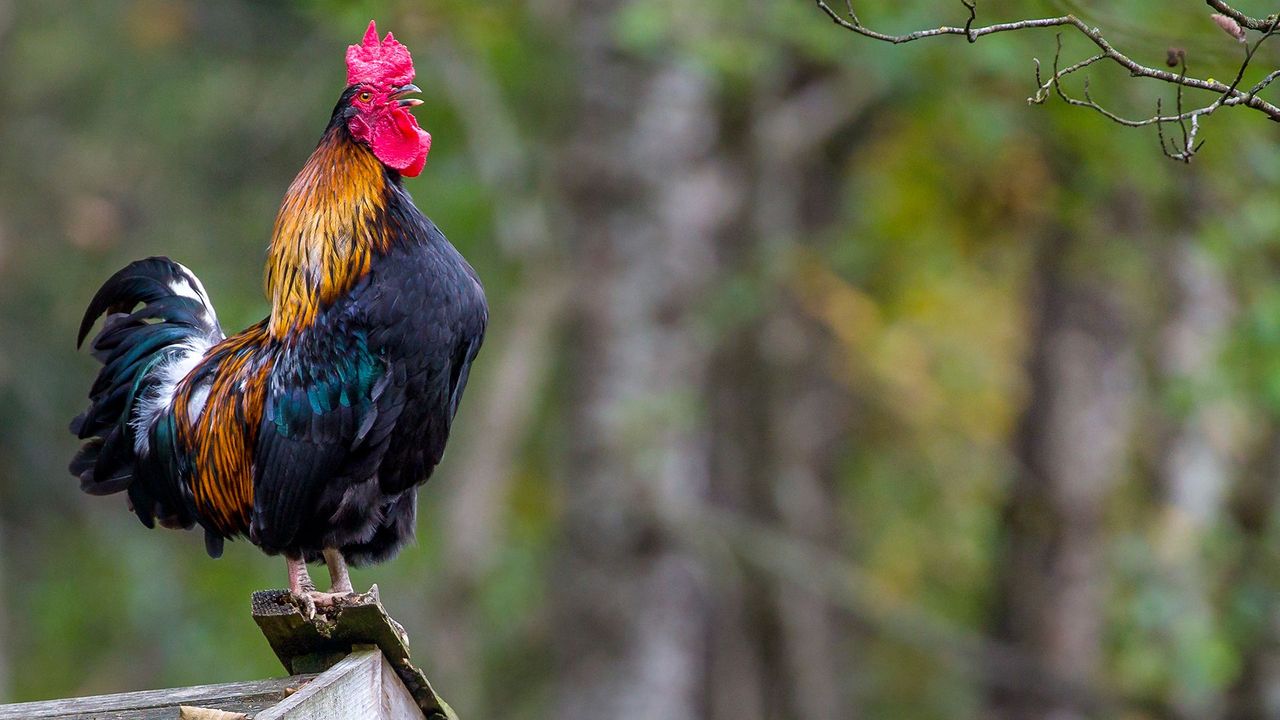
In ancient times, the rooster was esteemed for his sexual vigor; it is said that a healthy young rooster may mate as often as thirty or more times a day. The rooster thus figures in religious history as a symbol of divine fertility and the life force. In his own world of chickendom, the rooster – the cock – is a father, a lover, a brother, a food-finder, a guardian, and a sentinel.
Aldrovandi extolled the rooster’s domestic virtues:
He is for us the example of the best and truest father of a family. For he not only presents himself as a vigilant guardian of his little ones, and in the morning, at the proper time, invites us to our daily labor; but he sallies forth as the first, not only with his crowing, by which he shows what must be done, but he sweeps everything, explores and spies out everything.
Role of the Rooster – A Father and a Guardian
Finding food, “he calls both hens and chicks together to eat it while he stands like a father and host at a banquet . . . inviting them to the feast, exercised by a single care, that they should have something to eat. Meanwhile he scurries about to find something nearby, and when he has found it, he calls his family again in a loud voice. They run to the spot. He stretches himself up, looks around for any danger that may be near, runs about the entire poultry yard, here and there plucking up a grain or two for himself without ceasing to invite the others to follow him.”
A nineteenth-century poultry keeper wrote to his friend that his Shanghai cock was “very attentive to his Hens, and exercises a most fatherly care over the Chicks in his yard. . . . He frequently would allow them to perch on his back, and in this manner carry them into the house, and then up the chicken ladder.”
Roosters, Nathanial (left), Nicholas (right) with Karen Davis.
Dr Davis: “They (Nathanial & Nicholas) were found walking together on a road in Greenbelt Maryland, a residential area outside Washington, DC. They apparently had been abandoned and may have been actual brothers. People who keep chickens constantly abandon roosters. They only want hens for eggs, and in suburban areas, local laws do not allow roosters to be kept. It is so sad and infuriating. Fortunately, Nathanial and Nicholas were saved.”
My Relationship with the Roosters in Our Sanctuary
A less happy ambivalence appeared in a soft-colored gray and white rooster I named Ruby when he was brought to our sanctuary as a young bird by a girl who swore he was a hen. Following me about the house on his brisk little legs, even sleeping beside me on my pillow at night, Ruby grew up to be a rooster. In spite of our close relationship during his first months of life, once he became sexually mature, Ruby’s attitude toward me changed.
In the yard with the other chickens, he showed no disposition to fight. He didn’t attack other birds or provoke antagonisms. He fit in with the existing flock of hens and roosters, but toward me and other people he became compulsively aggressive. As soon as I (or anyone) appeared in the yard, Ruby ran from wherever he was and physically attacked us. Having to work in the yard under his vigilant eye, I took to carrying a bottomless birdcage and placing it over him while I worked. When finished I would lift it off him and walk backward toward the gate with the birdcage in front of me as a shield.
There is Always an Underlying Cause for Temperament Change
What I saw taking place in Ruby was a conflict he couldn’t control, and from which he suffered emotionally, between an autonomous genetic impulse on the one hand, and his personal desire on the other to be friendly with me. He got to where when he saw me coming with the birdcage, he would walk right up and let me place it over him as if grateful for my protection against a behavior he didn’t want to carry out. Even more tellingly, he developed a syndrome of coughs and sneezes whenever I approached, symptomatic, I believed, of his inner turmoil. He didn’t have a respiratory infection, and despite his antagonism toward me, I never felt that he hated me but rather that he suffered from his dilemma, including his inability to manage it.
Combat is Unnatural for Roosters
My personal experience with our sanctuary roosters confirms the literature I’ve read about wild and feral chickens documenting that the majority of roosters do not physically and compulsively attack one another. Chickens maintain a social order in which every member of the flock has a place and finds a place. During the day our roosters and hens break up into small, fluctuating groups that are somewhat, but by no means, rigidly territorial. Antagonisms between roosters are resolved with bloodless showdowns and face-offs. The most notable exception is when a new rooster is introduced into an existing flock, which may provoke a temporary flare up, but even then, there is no predicting.
Roosters are Playful
Pola & Karen Davis I Courtesy of UPC
Last year I placed newcomer Benjamin in a yard already occupied by two other roosters, Rhubarb and Oliver and their twenty or so hens, and he fit in right away. Ruby won immediate acceptance when I put him outside in the chickenyard after living in the house with me for almost six months. In dealing with Ruby I found an unexpected ally in our large red rooster Pola, who was so attentive to me, all I had to do was call him, and he bolted over from his hens and let me pick him up and hold him. I have a greeting card photograph of Pola and me “crowing” together, my one hand clasped over his swelled-out chest, my other hand holding his claw, in a duet I captioned “With Heart and Voice.”
Playfully, I got into the habit of yelling “Pola, Help!” whenever Ruby acted like he was ready to come after me, which worked as well as the birdcage. Hearing my call, Pola would perk up, race over to where Ruby was about to charge, and run him off with such cheerful alacrity it was as if he knew this was our little game together. I’d always say, “Thank you, Pola, thank you!” and he acted very pleased with his performance and the praise I lavished on him for “saving” me. He stuck out his chest, stretched up his neck, flapped his wings vigorously, and crowed triumphantly a few times.
Roosters are Full of Energy and Enthusiasm
Roosters crow to announce their accomplishments. Even after losing a skirmish, a rooster will often crow as if to compensate for his loss or deny its importance or call it a draw. Last summer as I sat reading outside with the chickens, I was diverted by our two head roosters, Rhubarb and Sir Valery Valentine, crowing back and forth at each other in their respective yards just a few feet apart. It looked like Sir Valery was intentionally crossing a little too far into Rhubarb’s territory, and Rhubarb kept dashing at him to reinforce the boundary.
There was not a hint of hostility between them; rather the contest, I decided as I watched them go at it, was being carried out as a kind of spirited mock ritual, in which each rooster rushed at the other, only to halt abruptly on his own side of the invisible buffer zone they apparently had agreed upon. At that point, each rooster paced up and down on his own side, steadily eyeing the other bird and crowing at him across the divide. After ten minutes or so, they each backed off and were soon engrossed in other activities.
Roosters, Hens, and their Social Life Together
Rooster Lincoln, hen Sno-Pea and chick Luv-Bug I Courtesy of UPC
Roosters are so energetic and solicitous toward their hens, so intensely focused on every aspect of their social life together that one of the saddest things to see is a rooster in a state of decline due to age, illness or both. An aging or ailing rooster who can no longer hold his own in the flock suffers severely. He droops, and I have even heard a rooster cry over his loss of place and prestige within his flock. This is what happened to our rooster Jules – “Gentleman Jules,” as my husband fondly named him – who came to our sanctuary in the following way.
One day I received a phone call from the resident of an apartment building outside Washington, DC, saying that a rooster was loose in the complex and was being chased by children who were throwing stones at him. After two weeks of trying, she managed to lure the rooster into the laundry room and called me to come get him. Expecting to find a cowering and emaciated creature needing to be carefully lifted out of a corner, I discovered instead a bright-eyed perky, chatty little fellow with glossy black feathers.
I drove him to our sanctuary and set him outside with the flock, which at the time included our large white broiler rooster Henry, and our feisty bantam rooster, Bantu, who loved nothing better than sitting in the breeze under the trees with his two favorite large brown hens, Nadia and Nadine.
Do Hens Love Sweet-Natured Roosters…
Jules was a sweet-natured rooster, warm and affectionate to the core. He was a natural leader, and the hens loved him. Our dusky brown hen Petal, whom we’d adopted from another sanctuary, was especially devoted to Jules. Petal had curled gnarly toes, which didn’t stop her from whisking away from anyone she didn’t want to come near her; otherwise she sat still watching everything, especially Jules. Petal never made a sound; she didn’t cluck like most hens – except when Jules left her side a little too long. Then all of a sudden, the silent and immobile hen with the watchful eye let out a raucous SQUAWK, SQUAWK, SQUAWK, that didn’t stop until Jules had lifted his head up from whatever he was doing, and muttering to himself, ran over to comfort his friend.
Roosters Leave a Lasting Impression
Gentleman Jules the Rooster I Courtesy of UPC
Two years after coming to live with us, Jules developed a respiratory infection that with treatment seemed to go away, but left him weak and vulnerable. He returned to the chickenyard only to find himself supplanted by Glippie, with whom he had used to be cordial, but was now dueling, and he didn’t have the heart or strength for it. His exuberance ebbed out of him and he became sad; there is no other word for the total condition of mournfulness he showed. His voice, which had always been cheerful, changed to moaning tones of woe. He banished himself to the outer edges of the chickenyard where he paced up and down, bawling so loudly I could hear him crying from inside the house.
I brought him in with me and sought to comfort my beloved bird, who showed by his whole demeanor that knew he was dying and was hurt through and through by what he had become. Jules developed an abdominal tumor. One morning our veterinarian placed him gently on the floor of his office after a final and futile overnight stay. Jules looked up at me from the floor and let out a low groan of “ooooohh” so broken that it pierced me through. I am pierced by it now, remembering the sorrow expressed by this dear sweet creature, “Gentleman Jules,” who had loved his life and his hens and was leaving it all behind.
Epilogue: Male Chicks of the Egg Industry who Never Grow Up to become Roosters
The journey from birth to death in the life of chickens follows a rhythm ordained by Nature, just like any other animals’ journey. In the case of male chickens, male chicks grow up to become roosters within 4 to 6 months’ time.
In Nature, a rooster lives up to 8, sometimes even 15 years of age. However, the egg industry, disregarding natural laws, justice, and ethics, systematically kills male chicks immediately after they are born.
Why? Because male chicks do not lay eggs. Basically, they are of no *use* in commercial egg production, apart from a certain number required for breeding flocks. In India, eggs are deemed “vegetarian,” but actually, every egg has two victims – the hen and the little male chick deliberately crushed inside a grinder because he cannot profit the industry. The breeding flocks of hens and roosters are also victims since they, too, are slaughtered within two years of life.
“Over the years, we’ve had several egg-industry roosters in our sanctuary. In the U.S., they are almost always the White Leghorns, representing the type of hens most used for commercial egg production. They are very nice, friendly birds. This is Luce, who was rescued by UPC member Laurie Melichar. Every year in the United States, a quarter of a billion of these beautiful male chickens are buried alive or ground up alive by the egg industry as soon as they are born. These birds represent 250 million more reasons each year to go – and stay – vegan.”
The company will also eliminate any pork produced through locking mother pigs in gestation crates from its supply chain. Photo by iStock.com
Ahold Delhaize, the company that owns some of the largest grocery chains in the United States, including Food Lion, Giant Food, the GIANT Company, Hannaford and Stop & Shop, has announced it will only sell eggs from cage-free chickens across all its stores by 2025 or sooner. The company will also eliminate any pork produced through locking mother pigs in gestation crates from its supply chain.
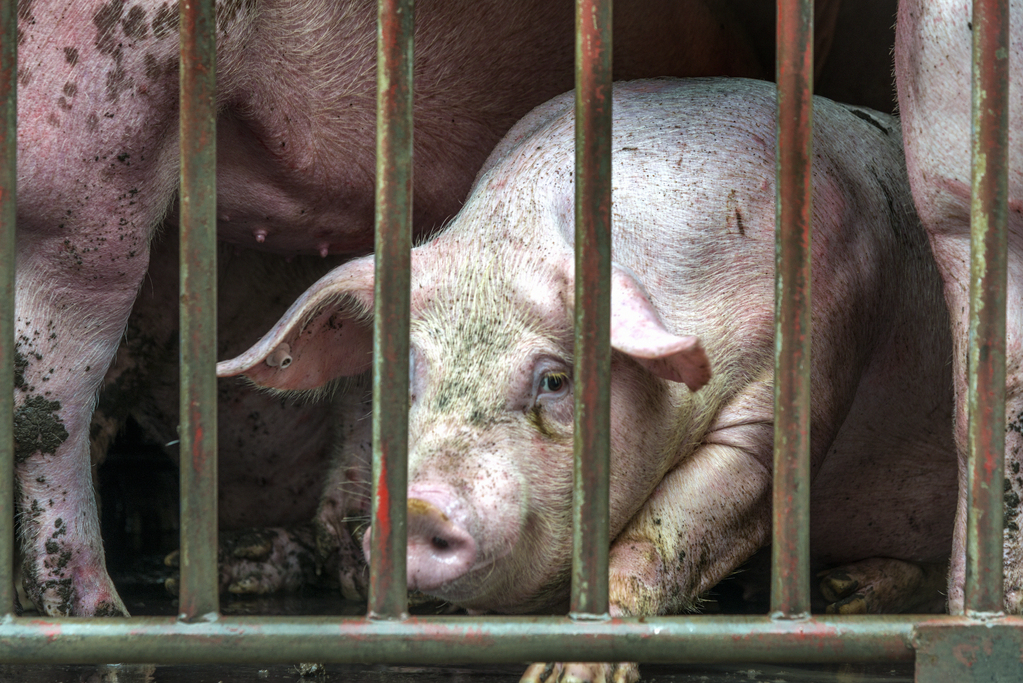
This is incredible news, coming as it does from what is the nation’s fourth-largest grocery retailer, with more than 2,000 locations. The company’s new animal welfare policy, which comes after dialogue with the Humane Society of the United States, eliminates two of the most heinous forms of intensive animal confinement in cages and crates. Cages used to confine egg-laying chickens are so small that the animals cannot express natural behaviors like running, exploring or even extending their wings. Each chicken is given less space than a sheet of paper on which to live. Gestation crates, used to confine mother pigs, are about the same width and length of the animal’s body, leaving them with no room to even turn around.
The announcement from Ahold Delhaize is the latest in a series of similar pledges that the HSUS, Humane Society International, and other animal protection organizations have secured from hundreds of major food companies over the last decade, including Kroger, Nestle and Unilever. With our Food Industry Scorecard, we are keeping track of the progress these companies are making toward achieving their cage-free goals.
In addition, we have helped secure the passage of a dozen state laws to end the cruel cage confinement of farm animals, including in Massachusetts where Ahold Delhaize is based.
While cage-free doesn’t equate to cruelty-free, thanks to the headway we’re making, tens of millions of animals will never know the misery of being locked in tiny cages for their entire lives. Let’s take a moment today to celebrate this incredible win for egg-laying hens and mother pigs even as we continue our work to dismantle the cruelty of cage confinement in the United States and abroad.





 Exposing the Big Game