NY Times Editorial: There’s a grim reality behind your Thanksgiving turkey

Observing an annual pre-Thanksgiving rite, President Trump pardoned two big white fluffy turkeys Tuesday in a photo op at the White House. (Named Drumstick and Wishbone, the birds will end up at an enclosure on the campus of Virginia Tech.) That leaves 46 million other turkeys that won’t get pardoned. Instead, they’ll wind up on someone’s dinner table during this holiday season, a fate that is expected to befall about 245 million gobblers all told this year. And none of them will make the journey from farm to table via the Willard InterContinental Hotel, where Drumstick and Wishbone hung out before Drumstick was ceremoniously presented to Trump.

No animals raised on factory farms are kept and killed under worse conditions than turkeys and chickens, which make up most of the animals raised for food in the U.S. Nearly 9 billion chickens are slaughtered each year for food. And because poultry is exempt from the federal Humane Methods of Slaughter Act, which the U.S. Department of Agriculture enforces, there are not even minimum federal standards governing how they live or die.

Turkeys and so-called broiler chickens are genetically bred to grow fast (to satisfy our love for breast meat) and, typically, grow so big that they can barely walk by the time they are killed. As a result, they can suffer from painful skeletal disorders and leg deformities. The vast majority spend their short lives (about 47 days for chickens) in artificially lit, windowless, barren warehouse barns. So that turkeys won’t peck one another in these crowded barns, their beaks are painfully trimmed.

When it’s time to slaughter them, the live birds are shackled upside down on a conveyor belt, paralyzed by electrified water and then dragged over mechanical throat-cutting blades. The birds are supposed to be stunned unconscious by the electrified water, but that doesn’t always happen. Sometimes the birds miss the blades and end up tumbling into the tanks of scalding water, where they drown. These methods are so cruel that they would be prohibited by federal welfare laws — if the animals in question were cows or pigs.

These are the grim realities behind Americans’ traditional Thanksgiving meal. But there are ways to make life and death somewhat better for the turkeys that wind up on your table. Of course, we could all just eat less turkey and chicken, which would reduce the demand for these animals. But to make a bigger impact, the major buyers of chicken and turkey meat need to push their suppliers to adopt less grisly practices.

The Humane Society of the U.S. has launched a campaign to get producers to pledge to raise healthier, less bloated birds, to provide them with better living conditions — more space, more stimulating environments and more sunlight — and, perhaps most important, to render the birds unconscious before they are shackled and slaughtered. The campaign also seeks to persuade buyers to obtain meat only from producers that honor this pledge. Meanwhile, Temple Grandin, the animal science professor known for designing more humane procedures for slaughtering beef cattle, has called for “controlled atmosphere stunning,” a process of using gas to make the birds unconscious before they get shackled for slaughter.

Installing new procedures takes time and money. All the buyers and producers that have signed on to the Humane Society campaign have agreed to fully convert to a new system by 2024. Companies should be held to that time frame, and more should be encouraged to take that pledge. If enough consumers demand it, companies will do it. That’s not too much to ask for the sake of the bird you’ll be carving up on Thanksgiving.

Not In My Backyard: The Day My Quiet Cul-De-Sac Turned Into a Bloodbath

By Hope Bohanec, Projects Manager for United Poultry Concerns

I live in a rural area of Sonoma County, California in the small town of
Penngrove. It’s farm country and there isn’t much more in the tiny downtown
block than a burger joint and bars. But it’s a beautiful, peaceful area. The
golden hills glimmer in the distance, and mature, majestic oak trees shade
the
wild turkeys and deer in our neighborhood. My husband and I have been in
this
area for over a decade, and while a miniature horse or a goat in a field is
a
common sight, chickens were not, up until a few years ago. The popularity of
having chickens at home has grown, and now we see flocks of chickens
everywhere.
Across the street, there is a chicken “tractor” (a mobile chicken coop) in a
sprawling field. We often see a colorful collection of chickens here and
there,
wandering and scratching around front yards as we take our evening walk.

So when our new neighbors built a chicken coop in their backyard, I wasn’t
surprised, but I was concerned. Our four duplexes share a laundry, and I
walk
directly in front of this neighbor’s house on a regular basis. He is often
outside in a cloud of cigarette smoke. When the chickens first came, I
braved
inhaling a haze of second-hand smoke to inquire about the birds. He said he
got
them for eggs. I said, “You’re not going to kill them, are you?” He said no,
that he had them just for the eggs. I reminded him that coops need to be
cleaned
daily and that he should adopt chickens if he was going to get any more, but
doubted that he would care one way or the other about something like this
as he
blew smoke away from my direction.

A few months later, I was walking some laundry out to the machines. As I
glanced
in this neighbor’s front yard, he and two other men were standing around a
tall,
green, plastic garbage can. There was a scuffle and I couldn’t quite figure
out
what was happening at first, until I saw his arms spotted in blood and a big
black bird flapping her wings furiously as she was being held upside down by
both men in the garbage can. Her large ebony wings beat desperately against
his
arms. The third man was skinning the sandy colored feathers off another
chicken
and there was a third little body, colorless, headless, featherless, with
her
feet cut off, balanced on the top of the garbage can. I dropped my laundry
basket and screamed, “What are you doing!?!?!” The neighbor was immediately
uncomfortable. He said, “Oh, sorry Hope.” One of the other men looked at me
and
said, “We’re gonna BBQ!”

I ran back to my apartment and grabbed my cell phone and then back to the
scene
of the horror and with trembling hands started taking pictures while I
pleaded
with him to stop. There wasn’t another bird out there, just the three now
still
and silent. The neighbor said these three were the “old ass chickens.” I
assume
he meant they were not laying eggs as frequently as the others in his
backyard.

Through my tears, I reminded him that he had promised he wasn’t going to
kill
the chickens. He didn’t say much, just apologized again. He knows my
feelings as
he sees my vegan bumper stickers every day, and we have talked on a couple
of
occasions about veganism and not killing animals. It seemed to me like he
felt
“caught in the act.” I can only hope that he does feel a degree of guilt
and not
just embarrassment about doing something his neighbor disapproves of.

I was so upset I forgot my laundry basket which sat out in the driveway for
hours and I cried my eyes out. It was sickening to witness. My neighbor
literally had blood on his hands from taking a precious life not fifty feet
from
my front door, and there was nothing I could do about it. The fact that
these
men were executing this repulsive act in a garbage can felt terribly
symbolic of
how they seemed to feel about these birds. They treated them like garbage
and
left their heads, feet, feathers, and other parts of their little bodies to
be
thrown away with the trash.

I called our mutual landlord to complain. He sympathized with me but said
only
that he would tell the murdering neighbor that he should do his killing in a
more private and secluded area of his backyard in the future. I know that
it is
legal to kill animals who are your “property” as long as you do it
“humanely.”
But what can be humane about taking a sentient being’s life? And although
throat
cutting and beheading are considered “humane” methods of killing, they
certainly
are not. Throat slashing is a painful, traumatic way to die, and it can take
agonizing, frightening minutes for someone to bleed out. Killing an animal
who
wants to live can never be humane. This idea that we can “humanely” take the
life of another animal is an outrage. And I am outraged that it is
happening in
my backyard . . . in anyone’s backyard.

The idea that it is somehow better to “kill your own” baffles me. One
argument
my neighbor might use is that his bird had a good life and this was her
“one bad
day.” But what about all the other days of life you are depriving her of?
What
about all the days of sunshine, eating, dustbathing, playing with friends,
and
loving being alive? It’s not just one bad day; it’s denying someone a
lifetime
of experience, robbing them of the full knowledge of life. If we don’t want
our
human life cut short, how can we justify taking the life of another sentient
being who wants to live when it is completely unnecessary and we live
healthier
as vegans?

Another position that people who kill animals themselves take is that the
person
is now aware of the process and “knows where their food comes from.” But
this is
useful only to that person. The animal receives no benefit from this
concept. If
they took care of the animal, fed and cleaned and provided for this animal,
then
a bond of trust was formed between the caregiver and the dependent. To turn
on
someone you care for, and then mercilessly kill them, is a terrible
betrayal of
trust. In fact, it’s the ultimate betrayal. This phrase is the title of my
book
on the subject of small scale animal agriculture, *The Ultimate Betrayal*.
For a
broader, in depth analysis of this issue, I encourage you to read my book
<https://www.amazon.com/Ultimate-Betrayal-There-Happy-Meat/dp/1475990936/ref=tmm_pap_swatch_0?_encoding=UTF8&qid=1372963043&sr=8-1>
.

I haven’t seen my neighbor since that horrible day, which is unusual as he
is
typically out in his haze of smoke several times a day. I think he has
moved his
habit to the backyard so he doesn’t have to look me in the eye. I hope that
my
reaction made him think deeply about what he did. There is a different
energy
now when I walk past his place and out to the laundry. It feels somber and
sad
knowing what occurred there. It’s horrible to live with but only
strengthens my
resolve to fight for these beautiful birds and help bring about the day when
they no longer suffer at the hands of our neighbors.

__________

Hope Bohanec is the Projects Manager for United Poultry Concerns and author
of
*The Ultimate Betrayal: Is There Happy Meat?*
<http://www.the-ultimate-betrayal.com>


United Poultry Concerns is a nonprofit organization that promotes
the compassionate and respectful treatment of domestic fowl.
Don’t just switch from beef to chicken. Go Vegan.
http://www.UPC-online.org/ http://www.twitter.com/upcnews
http://www.facebook.com/UnitedPoultryConcerns

View this article online
<http://upc-online.org/alerts/170901_not_in_my_backyard.html

Chicken vendors turn to selling pork amid bird flu outbreak in Pampanga

http://www.gmanetwork.com/news/news/regions/621736/chicken-vendors-turn-to-selling-pork-amid-bird-flu-outbreak-in-pampanga/story/

Published August 14, 2017 8:31am


Poultry vendors at a public market in San Luis, Pampanga have temporarily stopped selling chicken amid the bird flu outbreak.

According to a report by Victoria Tulad on Unang Balita on Monday, vendors said they canceled deliveries of chicken in anticipation of low market demand.

Instead, vendors have increased their orders for pork and fish.

Pork prices have been stable at the market—P190 per kilo for laman (innards), P200 per kilo for liempo, P160 to P165 per kilo of buto-buto (soup bones), P165 per kilo for ribs, P190 per kilo for pork chop, and P140 per kilo of pata.

One of the vendors, Brenda Maglaqui, said she tried selling chicken on Saturday but no one bought any. Most market-goers chose to buy fish and other seafood instead.

Fish vendors Victoria spoke to said some fish varities sold higher due to the high demand.

A kilo of dalagang bukid, for instance, which used to sell for P120 per kilo, now sells for P160. Hasa-hasa, which was at P160 per kilo before, is now being selling for P180. Squid sells for P200 per kilo, while yellowfin tuna is now pegged at P180 per kilo from the previous P160.

Pork sellers worry that the prices of choice cuts may have to be increased in the coming days due to the lack of supply.

Agriculture Secretary Emmanuel Piñol on Friday disclosed a bird flu outbreak at a poultry farm in Barangay San Agustin, San Luis, Pampanga.

The mass slaughter or culling of thousands of chickens believed infected with avian flu in at least eleven poultry farms in San Luis, Pampanga followed starting Sunday, an official of the Bureau of Animal Industry said. —KG/KVD, GMA News

PROTECT CALIFORNIA’S ANIMALS

https://secure.humanesociety.org/site/Advocacy?cmd=display&page=UserAction&id=7404


Photo by David Stephenson/iStock.com

California leads the country in laws that require the humane treatment of animals. Nearly 10 years ago, California voters overwhelmingly approved Prop 2 so that California’s egg-laying hens can spread their wings and breeding pigs and veal calves have enough room to turn around. A new bill threatens gains like these and future progress for farm animals and wildlife.

AB 243 proposes the creation of a new state beef commission that would engage in legislative, regulatory and ballot measure advocacy funded by a new tax on all of California’s beef and dairy producers, including small family farmers.

Backed by California’s large beef and dairy industries, AB 243 would exempt all activity of the new commission from the state’s antitrust, unfair practices and public records laws.

Your voice is needed to speak out against Big Ag’s power grab.

TAKE ACTION
Please take a moment to call your state senator now. Look up your legislators’ phone numbers. You can say, “As your constituent, I urge you to vote ‘no’ on AB 243, the California Beef Commission Law, in order to protect consumers, animals and the environment.”

After your call, use the form below to send a follow-up message. Editing your message will help it stand out.

Bears, chickens a lethal mix, conservation officer says

by Lori Garrison Friday May 26, 2017

This bear was killed by conservation officers in Hidden Valley May 19 after entering a pen and killing a goat. Another bear was shot by a property owner after it raided chicken coops.

Six bears have been killed in the Whitehorse area in recent weeks after coming into conflict with humans.

Two of the most recent kills — one on May 19 in Hidden Valley and one in Mount Lorne on May 22 — involved bears attracted to livestock, said conservation officer Ken Knutson.

The Hidden Valley bear entered a pen containing two goats, one of which was killed, before the bear was “destroyed for safety reasons” by conservation officers, said Knutson.

The Mount Lorne bear was lawfully shot by a property owner after it raided three other chicken coops in the area, said Knutson. The property owner lost 15 chickens.

Chickens are particularly tempting to bears, Knutson said, because they are high in fat and calories. Once a bear gets a taste for chicken it is very hard to deter them in the future which can be a death sentence for the animal, he said.

“I often say, ‘chickens kill bears,’” Knutson said. “We’ve destroyed many bears over the last five years over chickens. We have yet to see an instance of a bear that has gotten into chickens and doesn’t come back.”

The best way to protect chickens and other livestock from bears — and bears from being shot for eating chickens and livestock — is to use electric fencing, said Knutson.

“A shock from a fence is a deterrent, it’s not a very comfortable feeling … you don’t want to do it again,” he said.

It’s the responsibility of people to try to deter animals from entering their property in search of food, said Knutson. Livestock should be secure and people should take steps to manage bear attractants such as garbage or unlocked outdoor freezers.

“Just because you haven’t had a problem doesn’t mean you won’t,” he said. “No one is immune to bears.”

The number of bear interactions and bear kills from previous years in the Whitehorse area were not readily available for comparison.

Bear-human conflicts can occur at anytime outside of the animal’s hibernation period, Knutson said.

Bear sightings were reported earlier in the month along the Riverdale trail, a popular hiking area within city limits, although those bears — a sow and cubs — haven’t been seen recently Knutson said.

“We haven’t had any calls about that sow in a while — she’s being a good mama and keeping her cubs away from people,” he said.

People can report bear sightings or problem animals to Environment Yukon at 1-800-661-0525.

The department is also currently running a survey on grizzly bear management and conservation. The online survey closes May 27.

“We’re hoping a lot of Yukoners will contribute to it,” Knutson said.

Contact Lori Garrison at lori.garrison@yukon-news.com

Chinese Chicken Is Headed To America, But It’s Really All About The Beef

Listen·3:18

Chicken meat for sale at a market in Anhui province, China.

VCG via Getty Images

Cooked chicken from birds grown and raised in China soon will be headed to America — in a trade deal that’s really about beef.

Commerce Secretary Wilbur Ross announced Thursday night that the U.S. was greenlighting Chinese chicken imports and getting U.S. beef producers access to China’s nearly 1.4 billion consumers. But the deal is raising concerns among critics who point to China’s long history of food-safety scandals.

The Chinese appetite for beef is huge and growing, but American beef producers have been locked out of that market since a case of mad cow disease cropped up in the U.S. in 2003. In response, many countries, including South Korea, Japan, Mexico and China, banned imports of U.S. beef.

China was the only one of those nations to not eventually lift its ban — and that’s a big deal.

“It’s a very big market; it’s at least a $2.5 billion market that’s being opened up for U.S. beef,” Ross said in announcing the trade deal.

Many people long had seen China’s refusal to lift its ban on U.S. beef imports as a negotiating tactic, a tit for tat aimed at allowing Chinese chicken imports into the United States. The negotiations that led to the new trade deal have been going back and forth for more than a decade, stalled at one point by worries in Congress over China’s food-safety practices.

American beef producers are rejoicing that the process has finally resulted in allowing them to send beef to China.

“After being locked out of the world’s largest market for 13 years, we strongly welcome the announcement that an agreement has been made to restore U.S. beef exports to China,” Craig Uden, president of the National Cattlemen’s Beef Association, said in a statement. “It’s impossible to overstate how beneficial this will be for America’s cattle producers, and the Trump administration deserves a lot of credit for getting this achieved.”

The U.S. should be cleared to export beef to China by mid-July. That’s also the deadline for the U.S. to finalize rules for the importation of cooked chicken products from China. Why cooked chicken instead of raw?

“For a country to be able to ship meat and poultry products into the U.S., they have to demonstrate that their food-safety inspection system is equivalent to the system here in the U.S.,” explains Brian Ronholm, who served as deputy undersecretary for food safety at the U.S. Department of Agriculture under the Obama administration.

“The equivalency determination process for China as it relates to processed [cooked] chicken products had been underway, and this deal expedites this process,” he says. “China also is seeking equivalency for their inspection system for slaughter facilities, but that will be a longer process.”

Given the many outbreaks of avian flu China has experienced, there are also worries that if raw Chinese poultry were processed in the U.S., it could potentially contaminate American plants or somehow spread to birds here in the States.

Tony Corbo, a senior lobbyist for the food campaign at Food & Water Watch, an environmental advocacy group, has been raising concerns about efforts to open the U.S. market to Chinese chicken imports for years. He questions the Chinese government’s ability to enforce food-safety standards, given its poor track record.

That record includes rat meat being sold as lamb, oil recovered from drainage ditches in gutters being sold as cooking oil, and baby formula contaminated with melamine that sickened hundreds of thousands of babies and killed six. In 2014, a Shanghai food-processing factory that supplied international restaurant brands including McDonald’s and KFC was caught selling stale meat, repackaged with new expiration dates.

Corbo points out that last December, China’s own Food and Drug Administration reported it had uncovered as many as a half-million cases of food-safety violations just in the first three quarters of 2016.

That said, the USDA has gone to China to inspect plants that would process the chicken to be shipped to America. But Corbo finds little comfort in that. “You don’t know from moment to moment how China is enforcing food-safety standards,” Corbo says.

In recent months, a team from the USDA’s Food Safety and Inspection Service has traveled to China to train Chinese officials in meat safety.

One thing Thursday’s trade deal did not address: U.S. poultry exports to China. The U.S. used to send a lot of chicken feet over to China, where they are a delicacy. But China banned U.S. chicken imports in 2015, after an outbreak of avian flu in the Midwest.

China “was a $750 million market just a few years ago, and now it’s essentially zero. It was one of our most important markets,” says Jim Sumner, president of the USA Poultry and Egg Export Council.

But Sumner isn’t worried about the new competition from Chinese chicken in the U.S. In fact, he welcomes it as an important step in reopening the Chinese market to U.S. poultry producers.

“Trade is a two-way street,” he says.

It’s not clear how soon after mid-July we can expect to see cooked chicken products from China in U.S. supermarkets. Sumner says he doesn’t expect the product to overwhelm store shelves, because the economics of raising chickens in China and then shipping them to America still favors U.S. producers.

Maria Godoy is a senior editor with NPR News and host of The Salt. She’s on Twitter: @mgodoyh

Wonkblog Trump, China reach preliminary trade agreements on beef, poultry

https://www.washingtonpost.com/news/wonk/wp/2017/05/11/trump-china-reach-preliminary-trade-agreements-on-beef-poultry/?utm_term=.3e6d4a4c5835

May 12 at 7:48 AM

The Trump administration has reached new deals with China to ease market access for a variety of industries, including beef and financial services, as the White House makes progress on trying to soften economic barriers between the two sides.

The 10-part agreement, announced by Secretary of Commerce Wilbur Ross, comes as part of an ongoing negotiation between the two countries following a meeting between President Trump and Chinese President Xi Jinping last month.

“We have some very big news,” Ross told reporters Thursday. “U.S.-China relationships are now hitting a new high, especially in trade. We’re announcing, jointly with the Chinese, the initial results of the 100-day action plan of the U.S.-China Comprehensive Economic Dialogue.”

But experts were less impressed.

“China has made a few modest concessions that cost it very little, in areas strategically picked to maximize the political benefit to Trump,” said Arthur Kroeber, managing director of Gavekal Dragonomics, an economic research firm in Beijing. “But the substantive impact on US-China trade and investment flows is pretty minimal.”

Still, in a week of chaotic news from the Trump administration, White House officials pitched the agreement as a major breakthrough.

China just agreed that the U.S. will be allowed to sell beef, and other major products, into China once again. This is REAL news!

The new arrangements include an agreement from China to allow imports of U.S. beef, on certain conditions, by July 16. The United States has pressured China for years to allow beef imports, but the process has been constantly delayed.

“It’s at least a $2.5 billion market that’s being opened up for U.S. beef,” Ross said.

The beef industry praised the agreement.

“It’s impossible to overstate how beneficial this will be for America’s cattle producers, and the Trump Administration deserves a lot of credit for getting this achieved,” National Cattlemen’s Beef Association President Craig Uden said.

Similarly, Washington has agreed to advance a new rule that would allow China to export cooked poultry to the United States. The impact of this change on the U.S. poultry industry is uncertain, but Ross said it would not be severe.

CONTENT FROM THE NATIONAL ASSOCIATION OF REALTORS®
Millennials are about to shake up the suburbs
Today’s first-time homebuyers want urban conveniences at affordable prices. What does that mean for the housing market?


And there were numerous other parts of the preliminary agreement. This included language that appears to pave the way for U.S. firms to export liquid natural gas to China, the expediting of Chinese safety reviews for U.S. biotechnology applications, and cooperation between Chinese and U.S. regulators over financial transactions.

Other parts of the arrangement would direct China to issue bond underwriting and settlement licenses to “two qualified U.S. financial institutions” by July 17, a date that is significant because it comes 100 days after Trump and Xi met in Florida. And the United States has agreed to allow Chinese entrepreneurs to a Washington summit in June.

Trump spent months on the campaign trail berating China for its trade practices, but he has softened his approach since winning office. He has initiated reviews of China’s support of its steel and aluminum industries and its impact on U.S. trade, but the outcome of those reviews is unclear. He has shown a willingness to back away from trade-related threats after consulting with aides and foreign leaders, and he has recently heaped praise on Xi and what he perceives as China’s willingness to negotiate.

Christopher Balding, an associate professor at the HSBC Business School in Shenzhen in China, said Trump had created leverage with his “undiplomatic statements” on the campaign trail.

“However, the importance of this deals shouldn’t be overstated,” he added. “These are largely long standing issues that China was either legally obligated to address or had every reason in its own incentives to address.

Nevertheless, Balding said the agreement could provide the basis for further cooperation and market opening agreements for American firms in China.

At a news conference in Beijing, China’s Vice Commerce Minister Yu Jianhua said the trade deficit between the two countries had been “overestimated” and was not a priority during this round of talks.

But he added China was open-minded about discussing it in further rounds, calling the U.S. government’s attitude “positive and pragmatic.”

“The wisdom and ability of the two countries to control differences and properly handle bilateral relations is beyond the imagination of many people,” Yu said.

In Washington, Ross said this announcement covered 10 items, but was a step in the right direction.

“As you can appreciate, this addresses 10 items,” Ross said of the initial agreements. “There are probably 500 items that you could potentially discuss; maybe more than 500.” Ross said they would continue working and then “see if we can reach agreement” on other matters.

International Respect for Chickens Day One Month from Today – May 4, 2017!

Chickens Ruby and Ivy.
For merchandise, posters and brochures, please visit our online store.

Please join us at the White House for UPC’s International Respect for Chickens Day/Month of May Public Outreach Event! We provide brochures, posters & banners – all we need is YOU!

When: Sunday May 7 Noon – 3:00pm
Where: Lafayette Park across from the White House at Pennsylvania Avenue
Why: Stick Up For Chickens!

For more information visit:
International Respect for Chickens Day

Karen and Liqin holding a 'International Respect for Chickens Month' banner by the White House.

MAY 7, 2017

Leafleting at the White House for International Respect for Chickens Day

Hosted by United Poultry Concerns


Thank you for taking action!

Super-size problem

http://www.humanesociety.org/news/magazines/2017/03-04/super-size-problem-broiler-chickens.html?referrer=https://outlook.live.com/

Americans’ demand for cheap meat has forced factory-farm broiler chickens to grow faster and larger than ever before

All Animals magazine, March/April 2017

by Karen Lange

  • Click or tap the image to enlarge.

Fresh from the trauma of World War II, mid-century Americans imagined a peaceful, prosperous future. They dreamed of moon rockets and flying cars. They envisioned house-cleaning robots. And, after years of rationing, they hoped for bountiful meals. Most particularly, they hungered for chicken. But not the scrawny, spent laying hens, exhausted from their lives producing eggs, that Americans ate when beef and pork were scarce. Instead, they looked forward to the bird of the future—bigger, better.

The A&P grocery chain invited poultry producers to enter a nationwide contest. Farmers sent eggs from their plumpest birds to a U.S. Department of Agriculture station on Maryland’s eastern shore. Researchers selected and bred birds who were larger and faster- growing to create a new type of chicken, “a broad-breasted bird with bigger drumsticks, plumper thighs and layers of white meat,” according to writer and broadcaster Lowell Thomas, who narrated a documentary sponsored by Texaco. It would be, proclaimed the film’s title, “The Chicken of Tomorrow.”

Over decades, America got all that and more.

As the winning chicks, hatched in 1948, were used to breed the strains now used by large-scale commercial farms, the time needed to raise a “broiler”—a chicken raised for meat—dropped from 12 weeks to six or less, the feed required fell by half and the growth rate multiplied by four. The amount of breast meat on an individual bird rose by nearly 70 percent. By 1978, a pound of chicken, which in 1922 had cost around $5.50 in today’s dollars, cost just $2.46. Per capita, chicken consumption grew four-fold, and a whole new industry emerged, dominated by factory farms controlled by corporations such as Tyson and Pilgrim’s Pride.

  • At 56 days old, when chickens are typically sent to slaughter, today’s broilers are much larger than broilers of the past. Photo by Poultry Science Association.

A recent paper shows the consequences: Scientists at a research farm in Alberta that has continued to breed earlier strains of chickens took pictures of a 1956 type broiler, a 1978 broiler and a 2005 broiler, all 8 weeks old, and placed the photos side by side. The result is unsettling: On the left, a comparatively fit bird (1956), in the center a plump chicken (1978) who appears “normal” (if you don’t know how chickens used to look), and on the right, the “chicken of tomorrow,” a morbidly obese bird (2005) who appears monstrous next to the others. By modern standards, she’s a week or two past the date when she would be slaughtered for meat, and she’s at high risk for heart failure. She’s a juvenile, but the size of her body has outgrown the capacity of her bones and joints, muscles and organs to support it, says John Webster, professor emeritus of animal husbandry at the University of Bristol.

“If [broilers] weren’t killed at 42 days, they wouldn’t survive another two weeks,” he says.

During the last days of their lives, about a third of broiler chickens suffer leg problems so severe they struggle to walk. Factory-farm workers move through buildings to collect dead birds and break the necks of lame ones. Survivors huddle on the floor, trapped by their own bodies. Unable to escape the pain, they lie in litter strewn with their own waste. Ammonia burns their breasts and often blisters their skin and feet.

In 2016, The HSUS launched a campaign to end these kind of conditions. In June, Perdue became the first major producer to commit to reform. Major buyers followed.

The initiative comes after years of research have documented the suffering produced by the birds’ genetics. Before joining HSUS-affiliate Humane Society International, Sara Shields studied whether farmers could encourage broilers to dustbathe and improve their welfare through increased exercise. But she found that because of their size, dustbathing was not enough, and by the time the birds approached the market weight they did not engage in much behavior beyond sitting and eating.

What has taken place is the opposite of Darwinian selection, Webster says. “They’ve destroyed the fitness of the bird in order to produce the most meat.”

With approximately 9 billion broilers raised and slaughtered each year in the U.S. alone (60 billion worldwide), Webster calls the broiler industry the single greatest example of human inhumanity toward another animal. It’s why Shields chose chickens as the subject of her doctoral dissertation.

“If an animal only has six weeks to live, it’s really important that they have a positive experience,” she says, “because that’s all they’ve got—six weeks.”

Chickens raised for meat spend their days in dark barns where they often sit on the floor in their own waste. Photo by Mercy for Animals.

But to improve quality of life, breeders must change broiler genetics so birds grow more slowly and can live longer, Webster, Shields and other experts say. Fortunately, breeders still have small supplies of slower- growing chicks that can be used to reform the industry. In the United Kingdom, grocery stores competing for customers are already selling birds that take 10 weeks to reach market weight. In the United States, at the urging of The HSUS and other animal welfare groups, producers and buyers are beginning to shift toward this. There is also hope that researchers can eventually breed a faster-growing bird that is healthy and walks without pain.

The HSUS has worked with Perdue, one of the country’s largest producers, to develop a reform plan that includes changing the type of broilers farmers raise and offering birds more room. Late in 2016, the five largest food service companies in the country, which together buy more than 115 million chickens a year—Compass Group, Sodexo, Aramark, Delaware North and Centerplate—announced with The HSUS that by 2024 they will adopt a new Global Animal Partnership standard for healthier breeds of chickens, better living conditions and increased space per bird.

Starbucks and Panera Bread have announced a similar policy. Aside from ensuring better lives for the chickens, the companies are also mandating a slaughter method that avoids excessively inhumane practices and instead uses a multistep controlled-atmosphere processing system that renders chickens unconscious so they suffer less.

Josh Balk, HSUS vice president of farm animal protection, says the organization is meeting with other major companies. “It will take years to make these changes happen,” he says. “We have to start now.”

Modern broilers are raised in starkly different ways: Factory farms stock the fastest- growing birds, while some smaller farms let slower-growing birds roam outside. As The HSUS transforms the industry, bigger farms will switch to healthier birds able to lead better lives, even if they are still indoors.

  • Due to their unnatural size, many chickens suffer painful injuries and are unable to walk. Photo by Compassion Over Killing.

Suffering silently

Walk into one of the windowless, dimly lit factory farms where most U.S. broilers are raised, and you’re likely to see tens of thousands of obese birds, barely stirring, sitting on the floor in their own waste. They have been selected for massive appetites, bred to eat and sit. Many of the birds have painful leg and joint problems that make walking difficult. They’re confined so close together that they jostle one another. This, plus the absence of a natural light-dark cycle, prevents sleep, which is critical for young, growing animals. It’s a scene of quiet misery. There’s a stench of ammonia. The birds’ bodies are on the brink of giving out. So extreme is the stress that in order for breeder broilers to survive long enough to lay eggs (about 20 weeks), producers must restrict their feed intake, sometimes feeding them only every other day. Broilers raised to be eaten usually die at 6 weeks, says Shields. “They still peep like baby chicks when they’re slaughtered.”

Ranging freely

The chickens at White Oaks Pastures, owned by HSUS state agriculture advisory council member Will Harris in Bluffton, Georgia, are very different because of their genetics, behavior and environment. Place a factory farm broiler outside to forage for food and move with a flock, and that chicken probably would not survive, Harris says. Using chicks who genetically resemble birds from the 1950s, Harris puts his birds out on pasture to do what chickens evolved to: search out insects and other edible morsels by scratching the soil, all the while fertilizing dirt with their manure. They walk miles each day before they roost in mobile houses that are towed to different spots. At 12 weeks, they reach 3 to 4 pounds and are slaughtered on the farm. The price consumers pay, via the White Oak Pastures website, is around $4 per pound—more than three times what conventional chicken meat costs. It’s a struggle to find people to spend that, says Harris, who has turned a profit with pasture-raised cows and pigs but not so far with chickens: “Consumers will either support humane production, and it will thrive, or they will not, and it will perish.”

On Will Harris’ farm in Georgia, broiler chickens grow at a healthier rate and have room to roam. Photo by Julie Busch Branaman/For The HSUS.

A more humane future

The HSUS is encouraging producers to breed healthier broilers who live free from pain and engage in typical chicken behaviors— in other words, to be like chickens were until the push for maximum efficiency altered their genetic makeup. Given a modest increase in space (at least 1 square foot per six pounds of animal) along with more natural light, better litter quality and hay bales, their lives will be substantially altered. They will walk around, dust bathe, peck and perch. For the birds, a lifetime of misery will be turned into an existence that allows for a little bit of pleasure. Webster, the professor in the U.K., has seen it happen. Chickens there live in conditions that allow them to demonstrate their intelligence and engaging personalities. When a human visitor arrives, they rush forward to great him. “The big movement is to get a better bird,” he says. “Once you’ve got a better bird, you can give it a better life.”

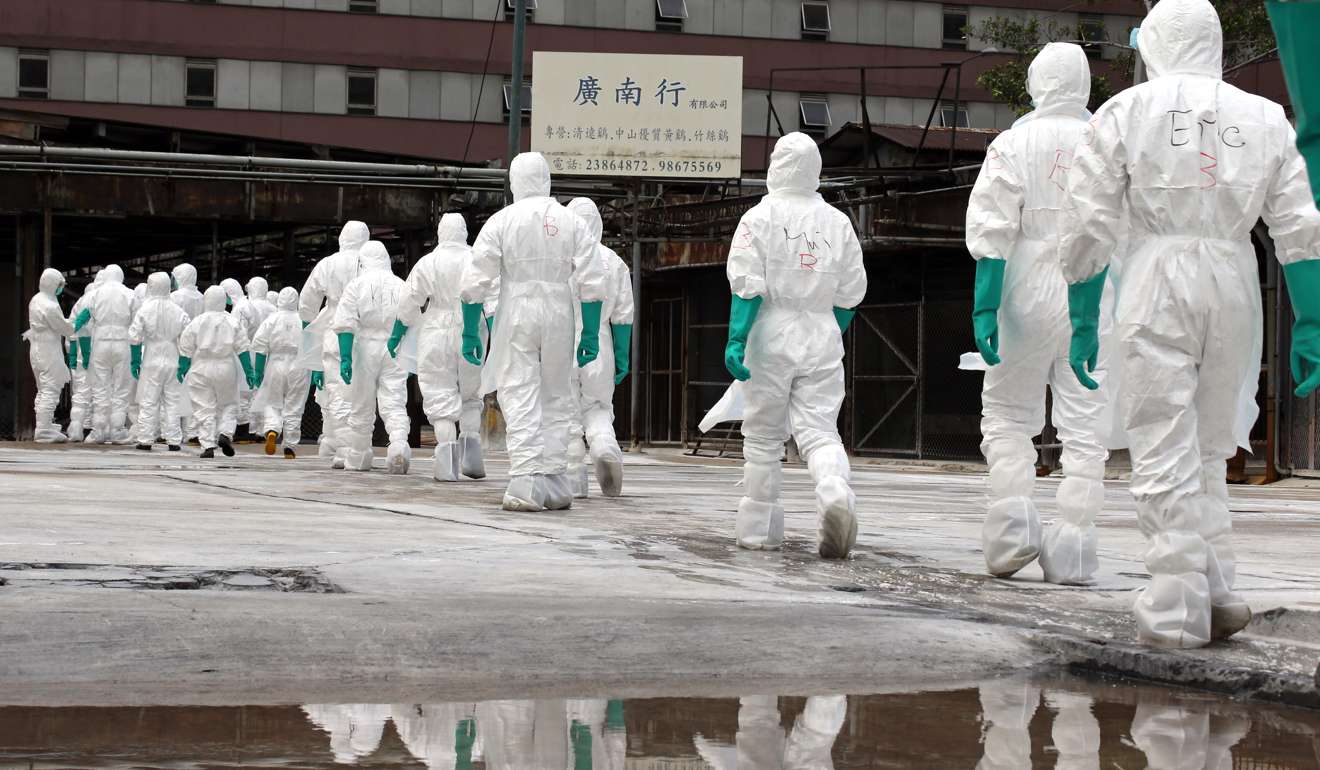
As bird flu outbreaks become more common in China and elsewhere, scientists debate the underlying cause

 http://www.scmp.com/news/china/policies-politics/article/2074048/bird-flu-outbreaks-become-more-common-china-and

Experts argue whether blame for spread of virus lies with factory farming or live poultry markets

PUBLISHED : Sunday, 26 February, 2017, 8:01am

The answer to whether industrial-scale poultry farming is responsible for bird flu differs depending on who you ask – a virologist or a geographer.

In a book published last month, Stephen Hinchliffe, a professor of human geography at the University of Exeter in Britain, argues that mass livestock production is driving molecular changes in diseases that could lead to human pandemics.

According to the United Nations Food and Agriculture Organisation (FAO), the world raised more than 21 billion chickens in 2014, up from 19 billion in 2011, or about three fowls for every person on the planet. The bulk of that production came from the United States, China and Europe.

Rapidly rising global poultry numbers, along with selective breeding and production techniques that have dramatically altered the physiology of chickens and other poultry, have made the planet more “infectable”, Hinchliffe and three co-authors argue in their book, Pathological Lives: Disease, Space and Biopolitics.

 A combination of factors ranging from virus evolution to economics places humans and animals at risk, they say.

But other researchers say poultry farms are just victims. The biggest culprits in the spread of bird flu viruses, they say, were the live poultry markets in China and Southeast Asia, which should be reformed if not eliminated.

More than 90 people on the mainland have died in the latest seasonal outbreak of H7N9 bird flu. Taiwan has also began culling hundreds of thousands of domestic birds to contain the spread.

Hinchliffe argues that the bird flu crisis stems from “our economies and modes of organising life”.

“We question the sustainability and security of the kinds of intensive protein production that are being rolled out across the planet,” Hinchliffe said.

Some current forms of bird flu can infect people. Some scientists warn that the current “swarm” of flu viruses in circulation are cause for heightened concern.

“Avian flu has been around for a long time, circulating in wild birds without being too much of an issue. But as inexpensively produced protein-rich diets become a worldwide norm, poultry populations, growth rates and metabolisms have changed accordingly,” Hinchliffe said.

Economic considerations were driving selective breeding, feed and dietary supplements, and sometimes the inappropriate use of pharmacueticals, especially antibiotics.

“Raising a bird to market weight takes a third of the time it did 30 or so years ago, with the result that disease tolerance is often compromised,” he said.

“Between that and sheer numbers, flock densities and global connectivity, humans have created a new set of conditions for viral selection and evolution.

“As any epidemiologist will tell you, a microbe can only become deadly or pathogenic if there are the right environmental and host conditions.

“Bird numbers and altered bodies have, in short, made the planet more ‘infectable’,” Hinchliffe said.

Dr Chen Quanjiao, associate researcher of bird flu epidemiology at the Wuhan Institute of Virology, under the Chinese Academy of Sciences, disagreed.

The detection rate of bird flu at poultry farms was usually “very low”, she said. Farmers regularly jabbed birds with vaccines and erected nets to fence out wild species.

The outbreak of bird flu happened in live poultry markets where birds from different places were kept in the same cages, sometimes for days, which gave the virus a chance to mutate and spread to humans.

“Hong Kong has implemented a very effective method to regulate its live poultry market. If other places in China and Asia can follow Hong Kong’s practice, we can significantly reduce the risk,” Chen said.