Philippine Cockfighters, Gamefowl Breeders Warned About Bird Flu

http://www.visayandailystar.com/2014/January/25/topstory7.htm

Gamefowl breeders warned vs. bird flu
BY CARLA GOMEZ

Provincial Veterinarian Renante Decena yesterday advised gamefowl breeders and cockfighting aficionados to take extra precautions against bird flu contamination that would gravely affect the province’s multi-billion industry.

Those engaged in the gamefowl industry should avoid bird flu positive areas, such as China, he said, pointing out that Avian influenza, commonly called bird flu, is a highly infectious viral disease of birds.

Gamefowl breeders and cockfighting aficionados and members of their families who travel to bird flu positive areas, should not visit their fighting cock farms immediately upon their return to the country, he said.

They should stay away from their gamefowls for about three days, he said, to prevent the transmission of any virus they may have picked up in their travels.

Bird flu virus particles may be transferred through clothing, shoes and other belongings, Decena warned.

He also said visitors should also be kept at a distance from game fowls as a precaution.

The gamefowl population in Negros Occidental is valued at about P4 billion while materials such as feeds for their upkeep are estimated at P2 billion, he added.

Negros Occidental annually exports about 200,000 fighting cocks and if valued at an average of only P5,000 each would be P1 billion in sales, he said.

That is on top of the fighting cocks used for cockfights in Negros, he added.

Decena said his office is also keeping a close watch on areas that migratory birds visit in Negros Occidental, such as San Enrique and Himamaylan, for possible contamination of the local poultry industry.

He added that they conduct serum sampling every six months as a precaution.*CPG

Photo ©Jim Robertson

Photo ©Jim Robertson

Deadly bird flu surges in China as millions travel

http://www.usatoday.com/story/news/health/2014/01/22/china-bird-flu-deadly-h7n9-chinese-new-year-travel/4779149/

Four more cases of deadly bird flu were reported in China on Wednesday, bringing the season’s total in that country to 221. Fifty-seven people have died.

The surge in cases has health officials worldwide watching closely as hundreds of millions of Chinese begin to travel for Chinese New Year.

The H7N9 strain of influenza jumped from birds to humans only last year. It is extremely dangerous, causing severe illness in more than three quarters of people infected and death in more than one quarter, according to Chinese researchers.

It is called bird flu because the virus originated in birds and so far is transmitted to humans only by live poultry. Cooked meat is no risk.

All of this year’s cases have been in China.

The surge in cases comes as China gets ready for what is called Spring Festival in Chinese. Known as Chinese New Year in the West, it begins Jan 31. People customarily travel to spend the holiday with family.

China estimates that 3.6 billion trips will be taken during the two-week holiday — and many of those traveling will be taking or buying live chickens and ducks as gifts.

Humans can be infected by being in close contact with “infected live poultry, mostly in live bird markets or when slaughtering birds at home,” the United Nations Food and Agriculture Organization said in a warning issued Tuesday.

So far, no sustained human-to-human transmission has occurred, according to the World Health Organization.

“Nothing can be predicted with certainty, but on present evidence, none of these viruses shows a potential to spread widely or cause an explosive outbreak,” Margaret Chen, director-general of the World Health Organization, said Tuesday in Geneva.

Flu viruses are notorious for quickly mutating into new forms, but so far genetic analysis by the FAO shows that the H7N9 virus has not changed significantly since its emergence last year.

“We are watching closely the increasing number of confirmed cases that are being reported from China during the past few weeks,” said Joseph Breese, an influenza expert with the Centers for Disease Control and Prevention in Atlanta. “Fortunately, Chinese health officials have not reported changes in the epidemiology of the virus that would lead us to believe it can easily spread between humans.”

The fear is that it could all too easily do so, said Mike Osterholm, director of the Centers of Excellence for Influenza Research and Surveillance at the University of Minnesota in St. Paul. “The clock is ticking but we just don’t know what time it is.”

Several things about H7N9 worry health officials. A major concern is that unlike other flu strains, it doesn’t make infected birds sick, so farmers don’t know their flocks are infected.

Humans are the proverbial canary in the coal mine in this outbreak. “The way we know that we have H7N9 in poultry is that humans start to get sick,” Osterholm said.

When testing shows a flock is ill, farmers have been reluctant to cull their birds because the animals seem healthy.

The birds breathe out the virus. That’s different from other flu strains, which are excreted in feces.

“We don’t know yet if there’s an infectious cloud that comes off the bird markets that can infect nearby humans,” Osterholm said. There have been cases in which people who lived close to a live bird market but didn’t go in still got infected, he said.

The concern is that with so many cases appearing in eastern and southern China, and hundreds of millions of people traveling long distances to get home for the holidays, the virus could find a way to mutate into something that can easily pass between humans.

“We’re in a ‘stay tuned’ moment right now,” Osterholm said. “If that happens, then bets are off. It’s potential pandemic time.”

cage_1

Bird flu cloud looms over Chinese New Year celebrations

Live chickens at the Baixing Sanniao Wholesale Market in Guangzhou’s Baiyun district, Dec. 20, 2013. (Photo/CNS)

As millions of Chinese prepare to return to their hometowns for Spring Festival, the challenges of containing the latest H7N9 bird flu epidemic have come sharply into focus.

Health authorities are deeply concerned by the resurgent epidemic, with about twenty new cases reported in the first two weeks of 2014, mostly in the eastern costal regions. About 150 cases of H7N9 bird flu have been confirmed in China since the first case in March last year.

Li Lanjuan of the Chinese Academy of Engineering said the virus is more active in winter and spring, and that high density transportation in coaches, trains and aircraft could create favorable circumstances for the epidemic to spread.

Li is China’s leading researcher on bird flu and a member of the H7N9 prevention and control group. She warns that the virus might be spread by migrants returning to their, mainly rural, homes from developed eastern regions.

During the world’s biggest annual human migration in the 40 days around Spring Festival, about 3.62 billion trips will be made this year, according to Tuesday’s National Development and Reform Commission press release.

This year, the highlight of Spring Festival, Chinese Lunar New Year, falls on Jan. 31, which Chinese people traditionally celebrate as a family.

“We are worried about the risk brought by massive numbers of people gathering together in confined spaces,” said Dr Liang Weifeng of the medical college at Zhejiang University.

In Zhejiang, new H7N9 cases have been reported for six consecutive days. As of Tuesday, the eastern province had reported a total of 11, including some fatalities. Zhejiang was also the site of China’s first confirmed human-to-human transmission last November, when a man was infected while caring for his father-in-law.

More alarming still, Guizhou province in the remote southwest of the country confirmed its first H7N9 fatality on Saturday, that of a migrant worker who returned home from Zhejiang on Jan. 4.

Results of research by a Chinese team published in the Lancet, have established that the variation of an amino acid on the H7 gene has made the H7N9 strain more infectious to mammals.

“On the PB2 gene, we have found another variation in a key amino acid. One more variation of a specified amino acid, and human-to-human transmission will become much more likely,” said Liang, indicating his extremely high concern over the possibility.

The team recently identified a new partial variation in the virus, demonstrating its capacity to adapt to its environment.

“It has increased the risk of human-to-human transmission and brought more difficulty in treatment,” Liang added.

“In spite of this, there is no reason to panic. We can confirm that the H7N9 flu virus has not shown scaled variation and human-to-human transmission,” said Gao Hainyu, a member of the team drafting a thesis on the new results.

Another problem facing health authorities is that Spring Festival is also the peak season for poultry sales and consumption.

The Chinese have a long tradition of eating fresh food especially at important feasts and family reunions. Chinese people, especially those in eastern regions, like to buy live chicken and duck and slaughter them at home to serve fresh. Despite a government ban, live poultry markets are reemerging in some regions.

At an open-air market in Zhejiang, Cai, a local senior citizen, and his wife pick several live birds in preparation for cooking the city’s speciality, Hangzhou Roast Duck for the new year. “Dishes of chicken and duck are a must on New Year’s Eve. We can hardly change tradition,” said Cai.

“There is no problem after cooking, and the duck and chicken sold here have been quarantined,” said Zhu Linying, a housewife at Xianlinyuan market in Hangzhou.

Zhejiang and other provinces are cranking up H7N9 control with more inspections and tougher quarantine measures wherever live birds are sold.

Poultry are easily infected by H7N9, and the risk cannot be contained simply by closing live poultry markets, said Li Lanjuan.

“Some deaths were caused by delays in seeking medical advice, as the virus quickly attacks the lungs,” said Li, alerting people to mind their health during the holiday and go to hospital if they have fever or a cough.

2013: The Year of the Big Backslide?

The year of our lord, 2013, could be known as the year of the big backslide, at least in terms of attitudes toward animals and the environment, as well as the general acceptance of scientific fact.

For example, CBS News reports that the number of Republicans who believe in evolution today has plummeted compared to what it was in 2009, according to new analysis from the Pew Research Center. A poll out Monday shows that less than half – 43 percent – of those who identify with the Republican Party say they believe humans have evolved over time, plunging from 54 percent four years ago. Forty-eight percent say they believe “humans and other living things have existed in their present form since the beginning of time,” up from 39 percent in 2009.

I can’t help but think this is because many people still aren’t comfortable admitting they’re animals. And this supremacist attitude is reflected in everything they do in regard to our fellow species.

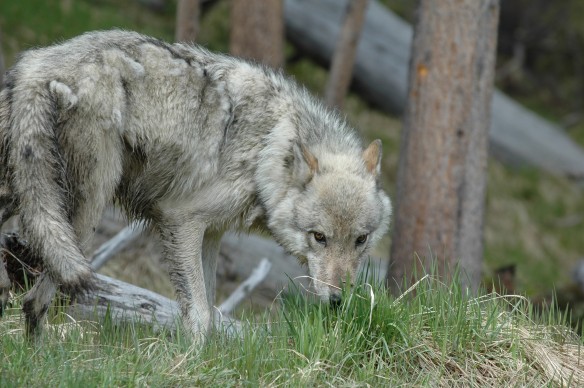
Anyone who has been following the wolf issue since gray wolves were removed from the Endangered Species List in a handful of backward states has certainly noticed a rapid backslide pertaining to how wolves are perceived, treated and “managed” by those bent on dragging us back to the dark ages for animals—the Nineteenth Century—when concepts like bounties, culls and contest hunts were commonplace. Hunters and ranchers in the tri-state area surrounding Yellowstone National Park, as well as in the Great Lakes region, are doing everything they can to resurrect the gory glory days of the 1800s, and wolves are paying the ultimate price.

Meanwhile, in spite of great efforts to educate people about the myriad of problems associated with factory farming and the dependence on meat consumption in an ever more crowded human world, the number of ruminants raised for food on the planet today is at an all-time high of 3.6 billion, double what is was 50 years ago. Regardless of or our burgeoning human population, not only do we have a chicken in every pot in this country, we now have cow and sheep parts in every freezer and pig parts in practically every poke. This, of course, is all thanks to ever-worsening living conditions for farmed animals.

Professor William Ripple and co-authors of a research paper, “Ruminants, Climate Change, and Climate Policy,” prepared in Scotland, Austria, Australia and the United States, noted that about 25 percent of the earth’s land area is dedicated to grazing, and a third of all arable land is used to grow food for livestock, according to the report. Reducing the number of cattle and sheep on the planet, and thereby reducing the methane gas emissions they produce, is a faster way to impact climate change than reducing carbon dioxide alone, the report concluded. The researchers concluded that greenhouse gas emissions from cattle and sheep are 19 to 48 times higher per pounds of food produced than the gas emitted in the production of plant protein foods such as beans, grains or soy.

To get an idea of how unnatural and unsustainable 3.6 billion large ruminants is, think back to when vast bison herds blackened the plains. At that time there were only 50 million bison in all of North America. There are over 300 million human beef-eaters in the United States, every one of them expecting to see a fully stocked steak house, Subway or McDonald’s on every street corner.

Meanwhile, the media’s busily cooking up a spin to answer to meat’s culpability in this planet’s climate crisis. Articles on how methane from grass-eaters is a primary greenhouse gas are often accompanied by the suggestion that pigs and chickens don’t produce as much. In other words, don’t worry your little meat-addicted heads if this beef-cow-causing-global-warming thing becomes a recognized issue, you can just switch over to other non-ruminants’ carcasses—no one really expects you to become a vegetarian, after all.

One of the most outrageous spins ever concocted aired on a “Ted Talk” just last March. Allan Savory, a former Rhodesian provincial Game Officer, has been spreading the counterintuitive notion that to control desertification and stop global warming we need to turn even more cattle out onto arid land. This notion comes from a man who, as late as 1969 advocated for the culling of large populations of elephants and hippos because he felt they were destroying their habitat. Savory participated in the culling of 40,000 elephants in the 1950s, but he later concluded it did not reverse the degradation of the land and called the culling project “the saddest and greatest blunder of my life.” Now he’s trying to sell us on another blunder with even more destructive consequences. What will this guy do for an encore? Never mind, I don’t want to know.

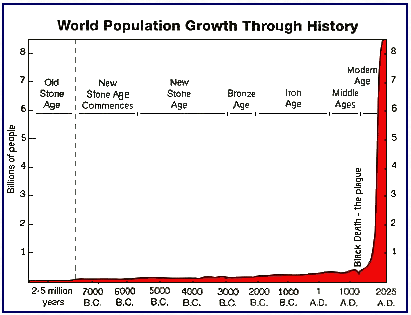
Speaking of Africa, 2013 saw the fastest growing and second most populous continent on its way to adding another billion people to the planet. By the end of this century, 3/4 of the world’s growth is expected to come from Africa, and projections put its population at four billion—one billion in Nigeria alone. Most African countries will at least triple in population, as there are very high fertility rates and very little family planning in most regions. No one is quite sure how the continent will provide for that many hungry humans; only time will tell.

And even though China’s overwhelming population is already well past a billion, in 2013 they abandoned their one child policy and affectively doubled it by implementing a two child policy at the stroke of a pen.

Sorry, but this shit is scary, at least if you care about the plight of non-human species on this planet. Sure, cultural diversity is important—to people. But it sure as hell doesn’t trump biological diversity in the scheme of things. Regardless of what you may or may not believe about whether we were created in the image of a god, life on Earth as we know it will not go on if we humans are one of the only species left around.

The coming decades are going to test just what Homo sapiens are made of. Are we progressive and adaptable enough to learn to share the planet with others and become plant eaters, as some people have? Or is our incessant breeding and meat consumption going to put us into an all new classification—planet eater?
1535443_10151792030721493_1254752217_n

Guilty plea in major rhino horn smuggling case

Kevin Johnson, USA TODAY

December 19, 2013 A Chinese antique dealer, described as one of the most prolific wildlife traffickers in the world, pleaded guilty Thursday as the director of conspiracy to smuggle $4.5 million in rhinoceros horn and elephant ivory from the U.S. to China.

Zhifei Li, 29, faces a maximum punishment of 10 years in prison on each of 11 criminal counts when he is sentenced April 1.

New Jersey U.S. Attorney Paul Fishman, whose office prosecuted the case, said the trafficking of such things as rhino horn, which can fetch up to $17,500 per pound on the illegal market, has swelled to “unprecedented levels.”

“The brutality of animal poaching, wherever it occurs, feeds the demand of a multibillion-dollar illegal international market,” Fishman said.

A HUGE Positive Step: China to Finally Criminalize Poaching

http://www.onegreenplanet.org/news/a-huge-positive-step-china-to-finally-criminalize-poaching/?utm_source=Green+Monster+Mailing+List&utm_campaign=fdb7346a41-GM_RSS_EMAIL_CAMPAIGN&utm_medium=email&utm_term=0_bbf62ddf34-fdb7346a41-102169273

Kristina Pepelko                       
December 5, 2013

Many never thought they’d see the day come, but it finally has – China, one of the world’s largest importers of ivory, has announced, that it, along with 29 other nations, will help protect the world’s elephants by criminalizing poaching.

Now, that’s something to celebrate.

For the past year, it seemed that poaching was reaching a whole new level, with poachers resorting to tactics like cyanide poisoning to hack off precious elephant tusks and a death toll skyrocketing to 22,000 dead elephants across Africa in 2012 – a number that a new report by the Convention on International Trade in Endangered Species (CITES) recently revealed.

The same report estimates that if poaching continues at around the same rate it is now for the next 10 years, 20 percent of Africa’s elephants will be wiped out, further devastating the ecosystem and an already vulnerable population.

These numbers are almost as hard to hear as this recording of an elephant slaughter and the heartbreaking fact that elephants are still affected by mass killings years later.

Plenty of tactics have been proposed to combat this crime and the grim future

 facing Africa’s wildlife including shooting poachers on the spot and hiring more park rangers. But what has sorely been missing from the conversation is a collective crack-down on the crime by the international community.

Thankfully, nations have finally been shaken into action. At a summit this week in Bostswana’s capital Gaborone, 30 nations, including China, Germany, Zambia, Nigeria, Zimbabwe, Botswana, Thailand, Vietnam, the Philippines, and the United States, signed an agreement to adopt 14 measures to protect wildlife crime victims.

According to Bloomberg, the steps “include classifying poaching as a serious crime, strengthening cross-border law-enforcement and reining in demand for ivory in Asia with information campaigns.”

“The conference resulted in concrete improvements for elephants in Africa,” German Environment Minister Peter Altmaier said via Bloomberg. “I hope that we can now break the dangerous

 trend toward more poaching.”

Ultimately, what this new agreement does is “render the trade of ivory … a serious crime, enforceable under international law, with stricter prison sentences,” reports International Business Times.

Now, isn’t that something? It’s always said that good things happen when you least expect it, and turns out, it’s true. Many thought poaching was getting beyond control, and that there was little hope left for major steps to be taken against it. But perhaps we threw down our hats too soon.

While time will tell how well this new agreement will be upheld, for now, let’s take the good news and celebrate properly (cake, anyone?).

Image source: Voices in the Wilderness / Flickr

ele-with-tusks-feature

China Encourages More Breeding

http://www.usatoday.com/story/news/world/2013/11/15/china-one-child-policy/3570593/

BEIJING — China made its first major change to its “one-child policy” in nearly 30 years to grapple with a massive shift in its population toward the elderly, who cannot work and need support, say experts.

Introduced by the Communist Party in 1979, the policy was meant to help the impoverished country feed its people. China credits the policy with keeping family expenses down so parents could more easily raise their standards of living.

But China demographer He Yafu says that the policy threatens to harm stability because the segment of the Chinese population that is elderly is growing at a faster rate than previous years….

[This sounds a lot like the story of the Little Old Lady Who Swallowed a Fly]

world-population-through-history-to-2025

And We Call Ourselves Civilized?

In agreeing with President Obama’s plan to strike Syria, Representative Nancy Pelosi was quoted as saying we must respond to actions “outside the circle of civilized human behavior.” Nice to hear that the U.S. Government thinks it has the moral authority to respond to such actions. While they’re at it, I can think of a whole lot of other actions which should be considered “outside the circle of civilized human behavior” that are desperately in need of responding to.

I’m referring, of course, to the innumerable abuses of non-human animals by humans—many that go on every day right here in the U.S. of A. I’m afraid if I were to try to list all the instances of human mistreatment of other animals which should fall outside the “circle of civilized human behavior,” the pages would fill the halls of justice, spill out onto the streets and overflow the banks of Potomac River in an unending tsunami of savagery.

So here’s just a partial list…

Wolf Hunting—No sooner did grey wolves begin to make a comeback in the Lower 48 than did the feds jerk the rug out from under them by lifting their endangered species protections and casting their fate into the clutches of hostile states. Now, hunters in Wyoming have a year-round season on them while anti-wolf fanatics in Montana have quadrupled their per person yearly kill quota.

Trapping—Only the creepiest arachnid would leave a victim suffering and struggling for days until it suits them to come along for the “harvest.” Yet “law abiding trappers” routinely leave highly sentient, social animals clamped by the foot and chained to a log to endlessly await their fate.

Hound-Hunting—“Sportsmen” not content to shoot unsuspecting prey from a distance of a hundred yards or more sometimes use hounds to make their blood-sport even more outrageously one-sided.

Bowhunting—Those who want to add a bit of challenge to their unnecessary kill-fest like to try their luck at archery. Though they often go home empty-handed, they can always boast about the “ones that got away”… with arrows painfully stuck in them.

Contest Hunts—Prairie dogs, coyotes, and in Canada, wolves, are among the noble, intelligent animals that ignoble dimwits are allowed to massacre during bloody tournaments reminiscent of the bestial Roman Games.

Horse Slaughter—After all that our equine friends have done for us over the centuries, the administration sees fit to send them in cattle trucks to those nightmarish death-camps where so many other forcibly domesticated herbivores meet their tragic ends.

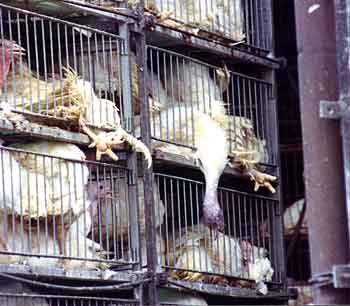
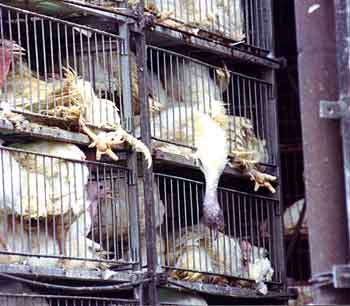
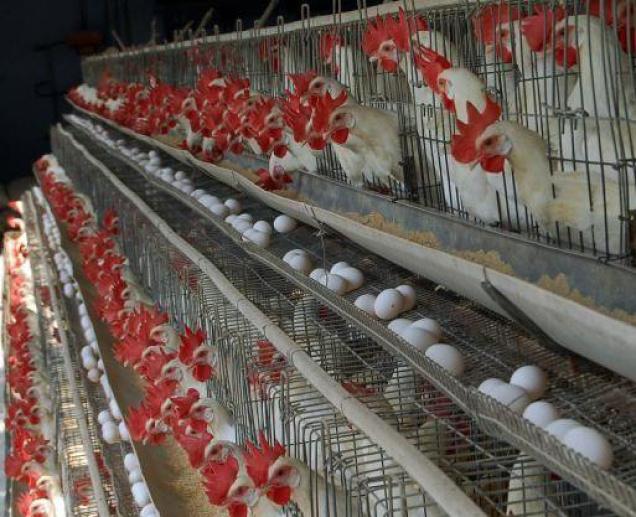
Factory farming—Whether cows, sheep, pigs, chickens or turkeys, the conditions animals are forced to withstand on modern day factory farms fall well outside even the narrowest circle of civilized human compassion. To call their situations overcrowded, inhumane or unnatural does not do justice to the fiendish cruelty that farmed animals endure each and every day of their lives.

Atrocious conditions are not confined to this continent. Chickens in China (the ancestral home of some new strain of bird flu just about every other week) are treated worse than inanimate objects. Bears, rhinoceros and any other animal whose body parts are said to have properties that will harden the wieners of hard-hearted humans are hunted like there’s no tomorrow. And let’s not forget the South Korean dog and cat slaughter, or Japan’s annual dolphin round up…

Far be it from me to belittle the use of chemical weapons—my Grandfather received a purple heart after the Germans dropped mustard gas on his foxhole during World War One. I just feel that if we’re considering responding to actions “outside the circle of civilized human behavior,” we might want to strike a few targets closer to home as well. Or better yet, reign in some of our own ill-behaviors so we can justifiably call ourselves “civilized.”

Text and Wildlife Photography ©Jim Robertson, 2013. All Rights Reserved

Text and Wildlife Photography ©Jim Robertson, 2013. All Rights Reserved

China’s Poultry Industy is Losing One Billion Yuan PER DAY

While an article in the Hindu Business Line tells us that China’s poultry industry has  lost 65 BILLION Yuan since the end of March, what I found shocking is that the industry has been losing an average of one billion Yuan a day for the past two months! What I want to know is, how many millions of birds does it take to raise one billion Yuan and what kind of horrendous living conditions must that many birds be forced to endure? How miserably confined, overcrowded and devoid of any semblance to natural bird life must it be like (for the short time their allowed to live).

The article (inadvertently) points out some shocking facts, which I’ve highlighted incage_1 bold

Bird flu costs China’s poultry industry $65 bn: State media

Beijing, May 21:

China’s human H7N9 bird flu outbreak has cost the country’s poultry industry more than $65 billion as consumers shun chicken, government officials said according to state media yesterday.

The sector has been losing an average of one billion yuan a day since the end of March, the Beijing Times said, citing Li Xirong, head of the National Animal Husbandry Service.

H7N9 avian influenza has infected 130 people in China, killing 35, since it was found in humans for the first time, according to latest official data.

Poultry sales have tumbled and prices plunged, Li said, causing major financial problems and job losses as a result.

Another agriculture ministry official, Wang Zongli, said government agencies should set a good example for the public by treating “poultry products in a correct way”, the report added.

In a stunt to boost confidence, officials and poultry business leaders in the eastern province of Shandong held a widely reported all-chicken lunch last week, according to Chinese media.

China has seen several food safety scares in recent years, including one in which the industrial chemical melamine was added to dairy products in 2008, killing at least six babies and making 300,000 ill.

poultry_845904f_jp_1463316f

Chronicling the End, Part 2

Today’s installment of Chronicling the End is also centers on the new strain of bird flu, which could play a major role in the bringing on an early demise for the species since, as Jim Pipas, virologist at the University of Pittsburgh, said: “…H7N9 is so different from influenza viruses currently circulating in the human population, humans are likely to lack an effective immune response to the virus…”

But this crisis actually has a solution—if only people are willing to forgo one of their longest-held vices—eating birds.

As CNN reports: Anne Kelso, the director of a WHO-collaborating research center, said researchers had seen a “dramatic slowdown” in human cases in Shanghai after the city’s live poultry market was shut on April 6. Describing the finding as “very encouraging,” she said evidence suggests the closure of live poultry markets is an effective way to stop the spread of the virus.

The joint inspection team from China’s National Health and Family Planning Commission and the World Health Organization also found that, so far, no migratory birds have tested positive for the virus. It said the H7N9 virus is only being found in chickens, ducks and pigeons at live poultry markets. So far there is no evidence of sustained human-to-human transmission, the authorities say.

This doesn’t have to become a pandemic, people. Let’s think outside the bucket here. The simple solution is, close the poultry markets, give up meat, and stop confining birds by the billions.

On a related not, CNN Money reports: Bird flu eats up Yum profits in China…

130423215630-yum-china-620xa