The whales appear emaciated but whether from decline of food supply or overpopulation is unclear
Clare Hennig · CBC News ·
Every spring, the grey whales migrate from Mexico to the North Pacific. (Craig Hayslip/Oregon State University Marine Mammal Institute)
41
comments
An unusually high number of grey whales are washing up dead on West Coast shorelines on their annual migration north and B.C. is the next stop, warns a U.S.-based marine biologist.
More than 20 grey whales were stranded ashore in California this spring, and, further north along the coast in Oregon, several more have washed up recently.
Eleven whales were recently stranded in Washington state. Only one survived.
“We’re already beyond what we would typically consider high numbers and this is still early in our stranding season,” said Jessie Huggins, stranding co-ordinator for the Cascadia Research Collective.
in one of the longest migrations of any mammal, grey whales migrate from their wintering areas near Mexico to their summer feeding grounds in the North Pacific every year.
“They’re heading towards Canada,” Huggins told CBC’s On The Island.The whales are expected to pass by Vancouver Island.
Young grey whale pictured washed up on Ucluelet beach on Vancouver Island in 2016. (Les Doiron)
Food shortage
From necropsies on the animals, Huggins said it appears that food shortage is an underlying cause of the deaths.
“We’ve been seeing a lot of emaciated animals,” she said.
Grey whales feed on sediment along the ocean floor, which brings them closer to shore than other types of whales. Their proximity to land means they are more likely to wash ashore and for their deaths to be noted.
“Many other whales, when they die further off-shore, we never see them,” Huggins said.
“Especially skinny ones because they tend to sink first.”
Thanks to wildlife protection measures like the Marine Mammal Protection Act, grey whales became a “success story” and their numbers increased over the last decades.
The research hasn’t concluded whether the recent deaths are due to a decline in food sources or an overpopulation of grey whales or some combination of both.
“It’s difficult for us to tell at the moment, but we do know that, for the last year or two, there have been a number of very skinny whales,” Huggins said.
“They didn’t get enough food last summer and, along their normal migration patterns, are just not able to make it all the way to Alaska.”
On The Island
Dozens of grey whales washing up dead along migration route – and B.C. is their next stop
LISTEN
00:0006:53
An unusually high number of grey whales are washing up dead on West Coast shorelines on their annual migration north and B.C. is the next stop, warns a U.S.-based marine biologist. 6:53
Beyond Meat, the plant-based meat company, is going public next week.
The company sells burgers that contain no meat, but taste like they do. Its stated goal is to fix our food system. Its initial public offering (IPO) is the latest sign that alt-meat is going mainstream — and that’s a big deal.
It’s been a good few years for Beyond Meat. National chains including Del Taco, Carl’s Jr., and T.G.I. Friday’s have started carrying their products. They’ve also found their way onto grocery store shelves at Whole Foods, Kroger, and Target. In total, Beyond Meat says its products are available in more than 35,000 outlets, from hotels and college campuses to grocery stores and sports stadiums. Sales have been growing fast — last year the company reported revenues of $87.9 million, up from $32.6 million in 2017.
Now, the company has filed with the Securities and Exchange Commission for an IPO, scheduled for next week. They’ll sell shares in the company for between $19 and $21 per share, allowing them to raise $183 million for additional manufacturing facilities, research and development, and sales. If their stock sells at the high end of that, the company would be valued at $1.2 billion. They’ll be listed on NASDAQ as BYND.
Founded in 2009 by CEO Ethan Brown, the Los Angeles-based company’s products first hit supermarket shelves in 2013. Its rapid rise — food is not an easy industry to break into — reflects intense consumer demand and investor interest in meat alternatives. The company has never been profitable, and lost $29 million in 2018, but its rapidly growing revenues made it a good bet to many investors — as did its positioning on the frontier of a transformation of our food system.
“Beyond Meat was the first company to really set its sights on creating meat from plants that could compete on the basis of the things that meat eaters like about meat,” Bruce Friedrich of the Good Food Institute, which works on policy and investment surrounding meat alternatives, told me. “Before Beyond Meat and Impossible Foods, there was really this sense that plant-based foods was for vegetarians. People like Ethan Brown said, ‘No, we can make plant-based foods that meat eaters like just as much.’”
Brown will soon have a billion-dollar company to prove it. And while it’s the first plant-based meat company to go public, it looks likely that it won’t be the last. The trend that brought Beyond Meat racing to its billion-dollar valuation and IPO are just getting started — and that has the potential to be game-changing, not just for the industry, but for the world.
Plant-based meat alternatives are getting big
There’s a lot wrong with our food system. Producing meat by raising animals on factory farms produces tons of greenhouse gases, and many analysts think we can’t tackle climate change without tackling the enormous emissions that go into agriculture. Animals in close quarters are fed low-dose antibiotics constantly so they don’t make one another sick, which contributes to antibiotic resistance, a huge threat on the horizon for public health. And animals on factory farms are routinely subjected to intense cruelty and conditions that disgust the average American consumer.
That’s what inspired people to start working on meat alternatives — and it may be what’s inspiring the consumer enthusiasm that has buoyed them in recent years. Products like veggie burgers, fake chicken, and soy and almond milk are growing in popularity and market share — and even better, they’re getting tastier and harder to distinguish from animal products.
New breakthroughs in food science have made it easier to imitate the flavor and texture of real meat. While early veggie burgers were almost exclusively purchased by vegetarians, Brown says that 93 percent of Beyond Meat customers buy regular meat too — suggesting the company has succeeded at making something that appeals to meat eaters.
Beyond Meat was among the pioneers of this new generation of plant-based meat, which aimed to replace bean-based veggie burgers marketed mostly to vegans. Now, they’ll be the first plant-based meat company to have an IPO. It’s a remarkable success for the company. It’s also remarkable because food companies rarely go public, Friedrich told me: “The food industry is highly centralized, and most exits are mergers or acquisitions by large food conglomerates.”
Last year, there were rumors that industry giant (and Beyond Meat investor) Tyson Foods was considering buying the company. Beyond Meat stayed independent, though. A few months later, the company added the chief financial officers of Coca-Cola and of Twitter to their board, signaling that it was getting the expertise on-board that it needed to become a huge public company.
The rest of the plant-based meat industry has been thriving too. Qdoba announced last week that it would be serving Beyond Meat competitor Impossible Foods. Earlier in April, Burger King launched the Impossible Whopper. Industry giants Tyson and Purdue are pursuing their own plant-based product lines. A few years ago, the Impossible Burger was available in a handful of restaurants — now it can be found in more than 5,000.
“There’s a sense that there’s a movement going on that’s much bigger than any one company,” Brown told Vox two weeks ago.
The interesting thing about that movement is that plant-based meats don’t have to displace all animal meats in order to make a big difference. Every burger replaced with a Beyond Burger has an impact on CO2 emissions, demand for factory farming, and demand for antibiotics. The more the plant-based meat industry grows, the more those impacts will be visible — and that might, in turn, itself fuel more interest in plant-based meats. Beyond Burger’s team doesn’t just believe they’ve found a niche — they say they’ve figured out the “Future of Protein.” Here’s hoping they’re right.
A growing group of women concerned about climate change agree with AOC. And they’re wielding a new weapon in the war against“business as usual.” They’re choosing not to reproduce.
These women, called BirthStrikers, all agree to not bear children “due to the severity of the ecological crisis and the current inaction of governing forces in the face of this existential threat.”
Blythe Pepino grew up walking with her parents on blustery, cold English beaches and in the Welsh mountains.
She remembers fondly sitting in the freezing cold with hot chocolate, aware of her environment and its fragility. As she grew older, the singer-songwriter watched a lot of news, and read books like Naomi Klein’s “This Changes Everything: Capitalism vs. The Climate,” with growing dismay.
While she wanted to hold politicians and governments accountable for their inaction on climate change, she found herself “anxious to the point where I had to switch off,” she told Business Insider.
Then she went to an Extinction Rebellion lecture last year — which was “very blunt about how nightmarish this could get and how quickly” — and realized she had to do something.
Extinction Rebellion is a group of activists that seek to stop climate breakdown, halt biodiversity loss, and minimize the risk of human extinction and ecological collapse by means of education and nonviolent protest. Their lecture changed Pepino’s outlook on the climate change crisis.
“I knew I couldn’t go back,” she said. “I knew stuff I couldn’t un-know.”
The Extinction Rebellion activist group protested on November 23, 2018 in Tower Hill, London.David Holt/Wikimedia Commons
That was the genesis for Pepino’s controversial and growing BirthStrike movement, created for people who have decided not to have children in response to the threat of a warming planet. While the movement is small, it’s part of a growing group of activists, politicians, and scientists attempting to communicate that our warming planet has passed multiple irreversible tipping points.
BirthStrike began with a modest membership of 60 men and women. Now, global membership is around 200, according to the Guardian.
‘We’re too afraid to bring children into world with the future that’s forecast’
Congresswoman Alexandria Ocasio-Cortez made headlines in February when she brought up the idea that having children was no longer a given in today’s environment. “It is basically a scientific consensus that the lives of our children are going to be very difficult, and it does lead young people to have a legitimate question: is it OK to still have children?” she said on Instagram Live.
This vocalization of a core BirthStriker message may have helped pave the way for the media attention that Pepino’s new movement is getting. She publicly announced the BirthStrike movement two weeks ago.
“We’re too afraid to bring children into the world with future that’s forecast,” Pepino, age 33, said. “This is a really powerful way of communicating the severity of what’s going on.”
The UK-based Birthstriker movement started with Pepino — freshly grieving from her decision to not have children — reaching out on Facebook to friends and others who she thought might feel the same way.
Pepino’s movement quickly attracted notice, and the founder recently appeared on Fox News to talk about her project and the growing threat of a warming planet.
“I know that sounds calculated, but I made this decision [to not have children] personally first and then realized it was a great way to get more people, especially the right wing media, on board with the climate change crisis,” she said.
While BirthStrike is new, the idea of not having children because of climate change has been percolating for years.
‘Maybe we should protect our kids by not having them’
“I think it’s seen as such a massive decision to make, especially for the younger women like myself,” Lydia Dibben, a BirthStriker from West Sussex, told Business Insider. “Children are seen to be the ultimate goal in life, something that everyone wants, and so promising never to have them seems extreme to a lot of people.”
Travis Rieder, a bioethics professor at Johns Hopkins University, lectured about the morality of continuing to have children some three years ago.
“Here’s a provocative thought: Maybe we should protect our kids by not having them,” Rieder told NPR.
Another organization, a non-profit called Conceivable Future, was started on the notion that “the climate crisis is a reproductive crisis.” The US-based group, founded in 2015, demands an end to US fossil fuel subsidies by “telling the stories of climate change’s impact on our reproductive lives.”
In 2018, the New York Times reported on more than a dozen people ages 18 to 43 — most of them American women — voicing concerns over bringing a child into a world saddled with increasing climate-change driven natural disasters.
Conduit doesn’t own a car, walks to work, and eats vegetarian. Pepino said she doesn’t fly anymore. But a 2017 study found that having even one less child is a more effective way of cutting down a person’s carbon footprint than recycling, driving an electric car, being vegetarian, or using renewable energy.
That said, the BirthStrikers — and many scientists— argue the scale of the climate change problem has become so severe that collective action is more important than individual actions.
The movement is not about population control
One of those suggested collective actions is controlling how fast the number of humans living on Earth grows. Though the world population currently hovers around 7.7 billion, the United Nations expects that number to grow to 9.8 billion in just 30 years, and reach 11.2 billion by 2100.
Each additional person uses up more of already-scant resources, and contributes to even more greenhouse gas emissions that serve to further warm the planet.
But the BirthStrike movement isn’t founded on notions of a “child ban” or population control. In fact, Pepino’s biggest concern is that the BirthStrike movement “will continue to be re-edited as a population argument.”
Hannah Conduit, a 27-year-old Birthstriker from Bristol, UK, pointed out that “nothing in the movement demonizes having children.”
“The idea of a sort of mass movement against having children is damaging to society,” Conduit told Business Insider. “But BirthStrike highlights that some women see [having children] as a choice that they might not be able to make in good conscience.”
Conduit said she decided before college that having children wasn’t something she could do. Now, her entire life is focused on making the world better for her future nieces and nephews. One of three sisters, Conduit supports her siblings in their desire to have children.
She doesn’t have a significant other in her life right now. Pepino does.
“We still talk about how we want kids, and it’s hard to come to terms that this is the end,” Pepino said of her and her partner’s conversations about starting a family.
Alice Brown, a 24-year-old from Bristol who works on the BirthStrike movement with Pepino, said on the BirthStrike website that “instead of dreaming about my career and family, I’m burdened with the disease we’ve created.”
Alice Brown, age 24, is “gutted” not to be able to start her family. Thomas Jacob
“My decision not to have a child I truly feel is a necessity not a choice,”Brown said. “I cannot imagine how scared our kids are going to be.”
For Dibben, who worked with the Extinction Rebellion movement before joining BirthStrike, there’s no price too high in the fight for system change and climate justice.
“People doing extreme things for what they believe in always gets attention. It’s worked in past social movements, like the suffragettes chaining themselves to railings, and it really needs to work if we have any hope of surviving the years that are coming,” 22-year-old Dibben said.
‘It would break my heart to bring children into the world and have it collapse around them’
The BirthStrike movement has dealt with plenty of conservative backlash and social media vitriol in the two weeks since the organization’s formal announcement. But that doesn’t deter BirthStrike followers.
To these women, their power of reproduction is the hammer with which they strike at a world that seems indifferent to its impending demise. “We’re going to have to take a hit on our arrogance as a species,” Pepino said. “We are becoming less than we are as our babies, our future, and our natural world are disappearing.”
And while the loss of the opportunity to give birth may seem like too much pain for some, for women like Conduit, the tragedy of conceiving a child and raising it on a planet with an uncertain future is perhaps worse.
“It would break my heart to bring children into the world and have it collapse around them,” Conduit said.
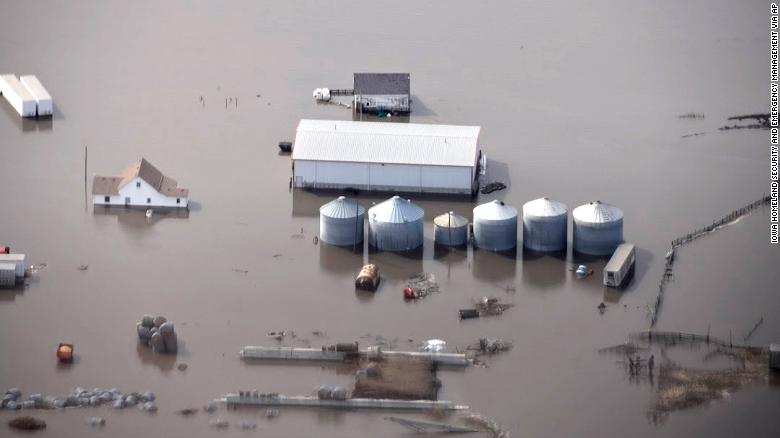
This photo taken by the South Dakota Civil Air Patrol shows flooding in western Iowa, along the Missouri River, on Monday.
(CNN)Farmers in parts of Nebraska and Iowa had precious little time to move themselves from the floodwaters that rushed over their lands last week, so many left their livestock and last year’s harvest behind.
Now as they watch the new lakes that overtook their property slowly recede, some have a painfully long time to reflect: They lost so much, staying in business will be a mighty struggle.
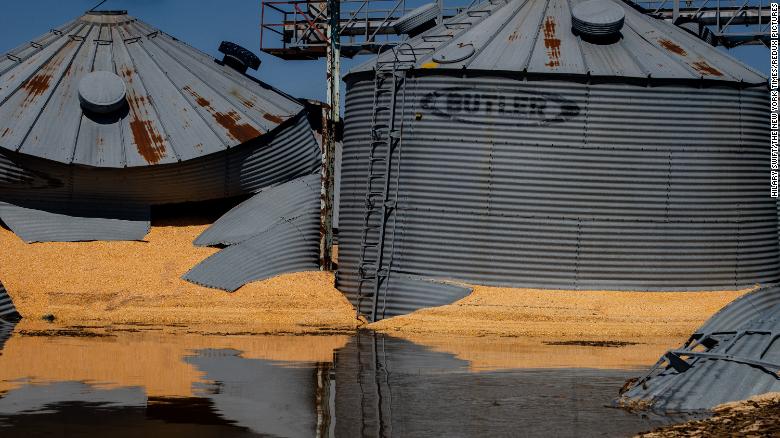
Across parts of the Midwest, hundreds of livestock are drowned or stranded; valuable unsold, stored grain is ruined in submerged storage bins; and fields are like lakes, casting doubt on whether they can be planted this year.
These are especially cruel times for Nebraska and Iowa farmers who had to scrape money to keep going just eight years ago, when floods overtook their lands in 2011.
“I would say 50% of the farmers in our area will not recover from this,” Dustin Sheldon, a farmer in southwestern Iowa’s flood-devastated Fremont County near the swollen Missouri River, said this week.
Grain silos destroyed by the flooding in Hamburg, Iowa, on Wednesday.
700 hogs drowned at one farm
Floodwaters washed over the Plains and Upper Midwest as a bomb cyclone dropped heavy rain and snow last week, and as previous snow and ice melted.
Nebraska Gov. Pete Ricketts called this the “most widespread disaster we have had in our state’s history.” Officials expect their initial farm damage estimates — $400 million in damages to crops, and $400 million in lost livestock, will be exceeded, Nebraska Department of Agriculture spokeswoman Christin Kamm said.
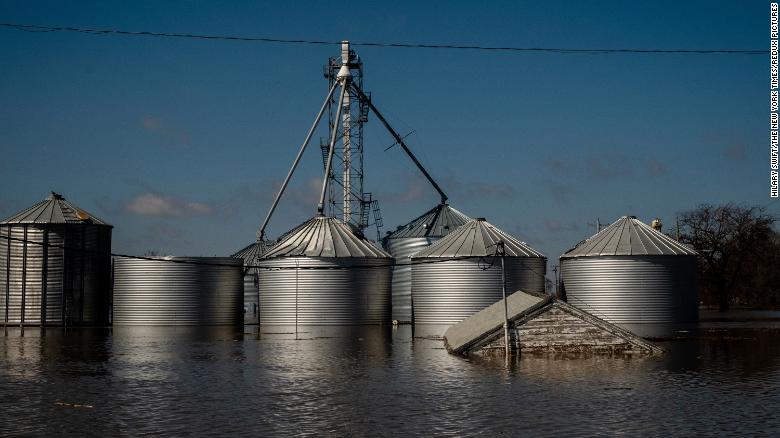
In Iowa, after Gov. Kim Reynolds flew over flooded farms in a helicopter, she said she could see only the tops of grain bins sticking out of what looked like an ocean.
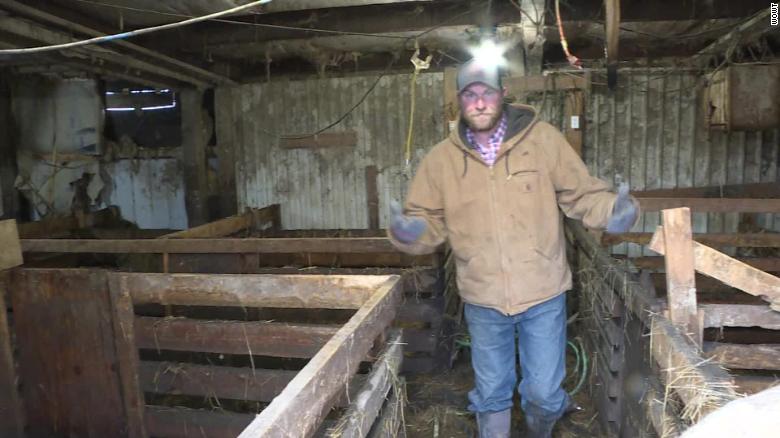
Farmers and ranchers have been especially hard hit. In rural eastern Nebraska outside of Omaha, farmer Eric Alberts told CNN affiliate WOWT that about 700 of his hogs drowned, many in his barn.
He was trying to move his animals when the waters started rising last week.
“Within 30 minutes, we had over 2 feet of water come through the front barn, and just swells were coming, and we barely made it out of here,” leaving most of the animals behind, he told WOWT.
Eric Alberts said many hogs drowned in this barn.
The fate of other animals is a mystery. Sheldon, the Iowa farmer, said Wednesday he knows of six facilities holding about 3,000 pigs each — and no one was immediately able to reach the flooded buildings to see how the livestock fared.
Rescue groups have tried to help in some cases.
Over the weekend, Iowan Scott Shehan crossed state lines to help ferry donkeys and ponies to dry land. In one of his Facebook videos, rescuers used a makeshift floating platform — pushed by an airboat — to get a pony out of a stranded portion of Sycamore Farms in Waterloo, Nebraska, on Sunday.
At least one donkey was found dead there, he said.
“Nobody could plan for this,” Shehan, co-owner of Lusco Farms Rescue, told CNN. “It’s flooded in places it’s never flooded before.”
A farmer says he lost hundreds of thousands of dollars in ruined harvest
Beyond livestock, crop loss — both harvested and not yet planted — will weigh heavily on farmers.
In Iowa’s Fremont County, Sheldon’s farm supports three families. Floodwaters got into their bins, ruining about 75% to 80% of their stored crop.
He estimates that’s hundreds of thousands of dollars of revenue lost — money that now can’t support the families or pay the farm’s expenses.
Farmers commonly store the harvest and sell portions throughout the year, sometimes to wait for better prices in the spring. Losing it is devastating.
“In 2011, we thought we had the 500-year flood — the Noah’s Ark of all floods,” Sheldon, who also is the Fremont County supervisor, told CNN. “We didn’t file bankruptcy, but we went though some really tough times on the money side.
“It took every dime of money our family had to put the land back into production at the level it was. Here, eight years later, we are right back to square one.”
Grain silos destroyed by the flooding in Hamburg, Iowa, on Wednesday.
The apocalypse has a new date: 2048.That’s when the world’s oceans will be empty of fish, predicts an international team of ecologists and economists. The cause: the disappearance of species due to overfishing, pollution, habitat loss, and climate change.
The study by Boris Worm, PhD, of Dalhousie University in Halifax, Nova Scotia, — with colleagues in the U.K., U.S., Sweden, and Panama — was an effort to understand what this loss of ocean species might mean to the world.
The researchers analyzed several different kinds of data. Even to these ecology-minded scientists, the results were an unpleasant surprise.
“I was shocked and disturbed by how consistent these trends are — beyond anything we suspected,” Worm says in a news release.
“This isn’t predicted to happen. This is happening now,” study researcher Nicola Beaumont, PhD, of the Plymouth Marine Laboratory, U.K., says in a news release.
“If biodiversity continues to decline, the marine environment will not be able to sustain our way of life. Indeed, it may not be able to sustain our lives at all,” Beaumont adds.
Already, 29% of edible fish and seafood species have declined by 90% — a drop that means the collapse of these fisheries.
But the issue isn’t just having seafood on our plates. Ocean species filter toxins from the water. They protect shorelines. And they reduce the risks of algae blooms such as the red tide.
“A large and increasing proportion of our population lives close to the coast; thus the loss of services such as flood control and waste detoxification can have disastrous consequences,” Worm and colleagues say.
The researchers analyzed data from 32 experiments on different marine environments.
They then analyzed the 1,000-year history of 12 coastal regions around the world, including San Francisco and Chesapeake bays in the U.S., and the Adriatic, Baltic, and North seas in Europe.
Next, they analyzed fishery data from 64 large marine ecosystems.
And finally, they looked at the recovery of 48 protected ocean areas.
Their bottom line: Everything that lives in the ocean is important. The diversity of ocean life is the key to its survival. The areas of the ocean with the most different kinds of life are the healthiest.
But the loss of species isn’t gradual. It’s happening fast — and getting faster, the researchers say.
Worm and colleagues call for sustainable fisheries management, pollution control, habitat maintenance, and the creation of more ocean reserves.
This, they say, isn’t a cost; it’s an investment that will pay off in lower insurance costs, a sustainable fish industry, fewer natural disasters, human health, and more.
“It’s not too late. We can turn this around,” Worm says. “But less than 1% of the global ocean is effectively protected right now.”
Worm and colleagues report their findings in the Nov. 3 issue of Science.
SOURCES: Worm, B. Science, Nov. 3, 2006; vol 314: pp 787-790. News release, SeaWeb. News release, American Association for the Advancement of Science.
A hamburger a week, but no more — that’s about as much red meat people should eat to do what’s best for their health and the planet, according to a report seeking to overhaul the world’s diet.
Eggs should be limited to fewer than about four a week, the report says. Dairy foods should be about a serving a day, or less.
The report from a panel of nutrition, agriculture and environmental experts recommends a plant-based diet, based on previously published studies that have linked red meat to increased risk of health problems. It also comes amid recent studies of how eating habits affect the environment. Producing red meat takes up land and feed to raise cattle, which also emit the greenhouse gas methane.
John Ioannidis, chair of disease prevention at Stanford University, said he welcomed the growing attention to how diets affect the environment, but that the report’s recommendations do not reflect the level of scientific uncertainties around nutrition and health.
“The evidence is not as strong as it seems to be,” Ioannidis said.
The report was organized by EAT, a Stockholm-based non-profit seeking to improve the food system, and published Wednesday by the medical journal Lancet. The panel of experts who wrote it says a “Great Food Transformation” is urgently needed by 2050, and that the optimal diet they outline is flexible enough to accommodate food cultures around the world.
Overall, the diet encourages whole grains, beans, fruits and most vegetables, and says to limit added sugars, refined grains such as white rice and starches like potatoes and cassava. It says red meat consumption on average needs to be slashed by half globally, though the necessary changes vary by region and reductions would need to be more dramatic in richer countries like the United States.
Convincing people to limit meat, cheese and eggs won’t be easy, however, particularly in places where those foods are a notable part of culture.
Think of it [meat] like lobster — something that I really like, but have a few times a year.– Walter Willett
In Sao Paulo, Brazil, systems analyst Cleberson Bernardes said as he was leaving a barbecue restaurant that letting himself eat just one serving of red meat a week would be “ridiculous.”
In Berlin, Germany, craftsman Erik Langguth said there are better ways to reduce greenhouse gas emissions, and dismissed the suggestion that the world needs to cut back on meat.
“If it hasn’t got meat, it’s not a proper meal,” said Langguth, who is from a region known for its bratwurst sausages.
Before even factoring in the environmental implications, the report sought to sketch out what the healthiest diet for people would look like, said Walter Willett, one of its authors and a nutrition researcher at Harvard University. While eggs are no longer thought to increase risk of heart disease, Willett said the report recommends limiting them because studies indicate a breakfast of whole grains, nuts and fruit would be healthier.
He said everybody doesn’t need to become a vegan, and that many are already limiting how much meat they eat.
“Think of it like lobster — something that I really like, but have a few times a year,” Willett said.
Advice to limit red meat is not new, and is tied to its saturated fat content, which is also found in cheese, milk, nuts and packaged foods with coconut and palm kernel oils. The report notes most evidence on diet and health is from Europe and the United States. In Asian countries, a large analysis found eating poultry and red meat (mostly pork) was associated with improved lifespans. That might be in part because people might eat smaller amounts of meat in those
countries, the report says.
Reduce red meat for optimal health
Ioannidis of Stanford noted nutrition research is often based on observational links between diet and health, and that some past associations have not been validated. Dietary cholesterol, for example, is no longer believed to be strongly linked to blood cholesterol.
Under the new recommendations, consumption of fruits and vegetables would need to more than double compared with current diets. (Ted Dillon/CBC)
The meat and dairy industries also dispute the report’s recommendations, saying their products deliver important nutrients and can be part of healthy diets.
Andrew Mente, a nutrition epidemiology researcher at McMaster University, urged caution before making widespread dietary recommendations, which he said could have unintended consequences.
Still, the EAT-Lancet report’s authors say the overall body of evidence strongly supports reducing red meat for optimal health and shifting toward plant-based diets. They note the recommendations are compatible with the U.S. dietary guidelines, which say to limit saturated fat to 10 per cent of calories.
While people in some poorer counties may benefit from getting more of the nutrients in meat and dairy products, the report says they shouldn’t follow the path of richer countries in how much of those foods they eat in coming years.
Environmental benefits
Though estimates vary, a report by the United Nations said livestock is responsible for about 15 per cent of the world’s gas emissions that warm the climate.
Robbie Andrew, a senior researcher at CICERO Center for International Climate Research in Norway, said farming practices that make animals grow faster and bigger may help limit emissions.
But he said cows and other ruminant animals nevertheless produce a lot of methane, a powerful greenhouse gas.
“It’s very difficult to get down these natural emissions that are part of their biology,” Andrew said.
The environmental benefits of giving up red meat depend on what people eat in its place. Chicken and pork produce far fewer emissions than beef, Andrew said, adding that plants in general have among the smallest carbon footprints.
Brent Loken, an author of the EAT-Lancet report, said the report lays out the parameters of an optimal diet, but acknowledged the challenge in figuring out how to work with policy makers, food companies and others in tailoring and implementing it in different regions.
Warning: This story may be upsetting to children who believe in Santa Claus.
Reindeer are perhaps best recognized by their magnificent antlers, the largest of any deer species in proportion to their bodies. They’re also notable for their epic thousand-mile journeys every year in search of food, in herds of 100,000 or more.
And they’re supremely important to the Arctic ecosystem as a source of food and livelihood for local people, and because of their power to reshape vegetation by grazing.
But the populations of reindeer, a.k.a. caribou, near the North Pole have been declining dramatically in recent years. Since the mid-1990s, the size of reindeer and caribou herds has declined by 56 percent.
That’s a drop from an estimated 4.7 million animals to 2.1 million, a loss of 2.6 million.
“Five herds,” out of 22 monitored “in the Alaska-Canada region, have declined more than 90 percent and show no sign of recovery,” according to the latest Arctic Report Card from the National Oceanic and Atmospheric Administration, out Tuesday. “Some herds have all-time record low populations since reliable record keeping began.”
Herds have lost hundreds of thousands of individuals, as measured by aerial photography of herds and counts in areas where caribou give birth. And their declines affect not just the landscape but the people who depend on it. The report explains that the declining number of animals are “a threat to the food security and culture of indigenous people who have depended on the herds.“
Arctic Report Card/NOAA
Big swings in population size aren’t a shock
Reindeer and caribou are the same animal. They are members of the species Rangifer tarandus. The Rangifer tarandusthat live in North America are called caribou, and the ones in Europe and Siberia are called reindeer. Mostly they are wild creatures, but sometimes they are domesticated to pull sleds and carriages.
Ecologist Don Russell, the lead author of the report subsection on caribou, says it’s normal for herd sizes to fluctuate greatly. It’s part of a natural cycle: Herds can go from numbers in the hundreds of thousands to the tens of thousands in just a few decades, and then rebound.
“The fact that these herds are declining shouldn’t be a shock — they do it all the time,” Russell said by phone from the Yukon territory in Canada. “But they’re at such low levels, you start to be concerned. … If we return in 10 years and [their numbers] have gone down further, that would be unprecedented.”
The question now, he says, is “are their numbers so low they can’t recover?”
Climate change means the future of caribou, like that of so many other creatures, is uncertain
The herds have been declining in recent decades due to a complicated mix of factors including hunting, disease, diminished food availability, and climate change, the report explains.
On one hand, you’d think that with climate change, the Arctic would become a more favorable environment for these grazing animals. Longer, warmer summers mean more vegetation for them to nosh on. And according to the Arctic Report Card, the Arctic did grow greener between 1982 and 2017.
But it seems the warmer Arctic summers are also taking a toll on the reindeer. “Warmer summers also have adverse effects through increased drought, flies and parasites, and perhaps heat stress leading to increased susceptibility to pathogens and other stressors,” the report notes. Higher summer temperatures and wintertime freezing rain (as opposed to snow) seem to be correlated with adult caribou mortality.
Warmer summers have also meant that diseases, long locked in the Arctic permafrost, may thaw and spread among herds, though scientists aren’t completely sure how much of an impact this is having.
And warmer winters can hurt them too. When it rains in the Arctic, as opposed to snow, it can freeze over into ice. That makes it harder for the caribou to walk, and to eat. In 2013, 61,000 (61,000!) reindeer died of starvation in Russia due to excess ice. Currently, a lack of snow in Sweden is impeding reindeer migrations there.
As the climate warms, and as freezing rain replaces snow in the far north, this threat may increase.
Animal populations are shrinking worldwide
The change in caribou numbers also looks concerning when you factor in what’s happening to wildlife around the world.
In October, WWF, the international wildlife conservation nonprofit, released its biennial Living Planet Report, a global assessment of the health of animal populations all over the world. The topline finding: The average vertebrate (birds, fish, mammals, amphibians) population has declined 60 percent since 1970.
That eye-popping figure — a 60 percent decline in average populations — is not the same as saying the world has lost 60 percent of its animals. But most populations of animals, like particular herds, or schools of fish, have seen declining numbers.
There’s a bigger global story here that we must reckon with: Humans are a small part of the living world, yet we have an outsize impact on it. The WWF report stresses that wildlife faces multiple threats — climate change, habitat loss, pollution, hunting, and invasive species — which all trace back to us and our insatiable consumption patterns.
What we lose if we lose the caribou
Caribou don’t have the ability to fly. (Sorry, kids. Though, if you’re reading a science news article, you probably know this by now.) But they’re hugely important to the Arctic ecosystem as a source of food for predators like wolves and biting flies. “A lot of the ecosystem components are riding on their backs,” Russell says.
Moreover, they’re central to the traditions of indigenous people in the Arctic, like the Sami, as a source of food and clothing. “If you look at the [top] Northern resources, that shape the culture of northern communities and aboriginal people, what they have in common is caribou and or wild reindeer, no matter where they are in the circumpolar North,” he says.
The takeaway is that the Arctic landscape is changing — and it’s changing more dramatically than anywhere on the Earth. The temperature increase in the Arctic just since 2014, the report card also finds, “is unlike any other period on record.” And it’s not yet clear if the caribou can change and adapt with it.
The largest single threat to the ecology and biodiversity of the planet in the decades to come will be global climate disruption due to the buildup of human-generated greenhouse gases in the atmosphere. People around the world are beginning to address the problem by reducing their carbon footprint through less consumption and better technology. But unsustainable human population growth can overwhelm those efforts, leading us to conclude that we not only need smaller footprints, but fewer feet.
Portland, Oregon, for example, decreased its combined per-capita residential energy and car driving carbon footprint by 5 percent between 2000 and 2005. During this same period, however, its population grew by 8 percent.
A 2009 study of the relationship between population growth and global warming determined that the “carbon legacy” of just one child can produce 20 times more greenhouse gas than a person will save by driving a high-mileage car, recycling, using energy-efficient appliances and light bulbs, etc. Each child born in the United States will add about 9,441 metric tons of carbon dioxide to the carbon legacy of an average parent. The study concludes, “Clearly, the potential savings from reduced reproduction are huge compared to the savings that can be achieved by changes in lifestyle.”
One of the study’s authors, Paul Murtaugh, warned that: “In discussions about climate change, we tend to focus on the carbon emissions of an individual over his or her lifetime. Those are important issues and it’s essential that they should be considered. But an added challenge facing us is continuing population growth and increasing global consumption of resources. . . . Future growth amplifies the consequences of people’s reproductive choices today, the same way that compound interest amplifies a bank balance.”
The size of the carbon legacy is closely tied to consumption patterns. Under current conditions, a child born in the United States will be responsible for almost seven times the carbon emissions of a child born in China and 168 times the impact of a child born in Bangladesh.
The globalization of the world economy, moreover, can mask the true carbon footprint of individual nations. China, for example, recently surpassed the United States to become the world’s leading greenhouse gas emitter. But a large portion of those gases is emitted in the production of consumer goods for the United States and Europe. Thus a large share of “China’s” greenhouse gas footprint is actually the displaced footprint of high-consumption western nations.
The United States has the largest population in the developed world, and is the only developed nation experiencing significant population growth: Its population may double before the end of the century. Its 300 million inhabitants produce greenhouse gases at a per-capita rate that is more than double that of Europe, five times the global average, and more than 10 times the average of developing nations. The U.S. greenhouse gas contribution is driven by a disastrous combination of high population, significant growth, and massive (and rising) consumption levels, and thus far, lack of political will to end our fossil-fuel addiction.
More than half of the U.S. population now lives in car-dependent suburbs. Cumulatively, we drive 3 trillion miles each year. The average miles traveled per capita is increasing rapidly, and the transportation sector now accounts for one-third of all U.S. carbon emissions.
Another one-fifth of U.S. carbon emissions comes from the residential sector. Average home sizes have increased dramatically in recent decades, as has the accompanying footprint of each home. Suburban sprawl contributes significantly to deforestation, reducing the capacity of the planet to absorb the increased CO2 we emit. Due to a dramatic decrease in household size, from 3.1 persons per home in 1970 to 2.6 in 2000, homebuilding is outpacing the population growth that is driving it. More Americans are driving farther to reach bigger homes with higher heating and cooling demands and fewer people per household than ever before. All of these trends exacerbate the carbon footprint inherent in the basic energy needs of a burgeoning U.S. population.
Globally, recent research indicates that assumptions regarding declining fertility rates used by the Intergovernmental Panel on Climate Change to develop future emissions scenarios may be overly optimistic. While fertility rates have generally declined over the past few decades, progress has slowed in recent years, especially in developing nations, largely due to cutbacks in family planning assistance and political interference from the United States. And even if fertility rates are reduced to below replacement levels, population levels will continue to climb steeply for some time as people live longer and billions of young people mature and proceed through their reproductive years. Per-capita greenhouse gas emissions may drop, but the population bulge will continue to contribute to a dangerous increase in greenhouse gases in the atmosphere.
Time is short, but it not too late to stop runaway global warming. Economy-wide reduction of greenhouse gas emissions to a level that brings atmospheric CO2 back from 386 parts per million to 350 or less, scaling back first-world consumption patterns, and long-term population reduction to ecologically sustainable levels will solve the global warming crisis and move us to toward a healthier, more stable, post-fossil fuel, post-growth addicted society.


/cdn.vox-cdn.com/uploads/chorus_image/image/63672679/Beyond_Breakfast_Sausage_hero.0.jpg)






/cdn.vox-cdn.com/uploads/chorus_image/image/62662006/GettyImages_120817449.1544538470.jpg)
:no_upscale()/cdn.vox-cdn.com/uploads/chorus_asset/file/13616060/Screen_Shot_2018_12_10_at_12.04.11_PM.png)

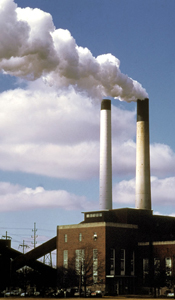 More than half of the U.S. population now lives in car-dependent suburbs. Cumulatively, we drive 3 trillion miles each year. The average miles traveled per capita is increasing rapidly, and the transportation sector now accounts for one-third of all U.S. carbon emissions.
 Exposing the Big Game
_Extinction_Rebellion_Protest_Tower_Hill.jpg)