
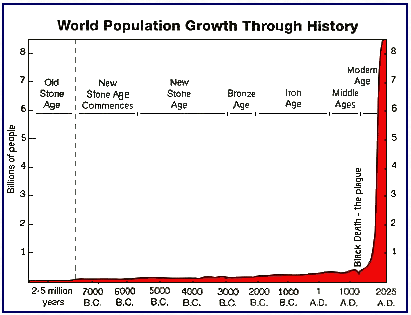
Looking back through some old copies of the National Wildlife Magazine, I came across an article from April/May, 1990, by John Nielsen entitled, “Whatever Happened to the Population Bomb? Two decades after Paul Ehrlich’s doomsday predictions, the biologist answers his critics with a new book.” The article came out at the time of Ehrlich’s then new book, Population Explosion, 22 years after his best-selling book (more than 20 million copies), Population Bomb. Ehrlich told National Wildlife, “What we were seeing on a global scale, was the rise to total dominance of a single species, man. This phenomenon was absolutely new and it threatened to wreck the planet.”
The article states, What about the population bomb? What happened to the notion that exponential population growth is the cause of almost all environmental woes? If to Ehrlich his 1968 message was clear, to his more extreme critics it has proved inaccurate and wrong-headed.
Like other ‘doomsayers,’ economist Julian Simon says, ‘Ehrlich underestimates the human ability to respond to change.’
But what about the rest of nature’s ability to respond to change wrought by humans?
Other critics point to Ehrlich’s erroneous predictions of traffic riots in Los Angeles, cataclysmic famines and dead oceans…
We may not be hearing a lot about traffic riots in LA—aside from road rage and regular drive-by shootings, but over-exploited fisheries and massive dead zones are cropping up in oceans across the globe.
Meanwhile, Right- to-Life activists attack him for favoring abortion. His notions of coercive population control in countries such as India and China have been called inhuman.
The problem with these charges, he says, is that they miss the point. Ehrlich admits that some of the scenarios that he made did not unfold [yet]. But he maintains, scenarios are not predictions and being out of date is not the same as being wrong.
Though a new environmental awareness is sweeping the United States [again, this was 1990], population control doesn’t seem to be generating as much concern in the press…The very notion, charges Ehrlich, is becoming ‘taboo’. “Politically, the pressure has been on to stay away from this issue,” he says.
“Each hour,” Ehrlich writes, “there are 11,000 more mouths to feed.”
Nowadays that number is roughly 16,000 per hour. (But of course that’s not taking into account people’s ability to respond to change.)
About his then new book, The Population Explosion, Ehrlich concedes that readers might ignore him this time around. They do so, he says, at the peril of their children’s world. Either way, this will be the last written warning.
“About the only thing I can guarantee is that this will be the last book on population by Paul Ehrlich,” he says. “You can only spend so much time alerting people to a problem. After that, they do their own thing.”



%20of%20IMG_3385_cropped.jpg)

 Exposing the Big Game