Global heating pace risks ‘unstoppable’ sea level rise as Antarctic ice sheet melts

https://www.theguardian.com/environment/2021/may/05/antarctica-ice-sheet-melting-global-heating-sea-level-rise-study

World faces ‘abrupt jump’ in pace of ice loss around 2060 unless emissions reduced to meet Paris agreement goals, study warns
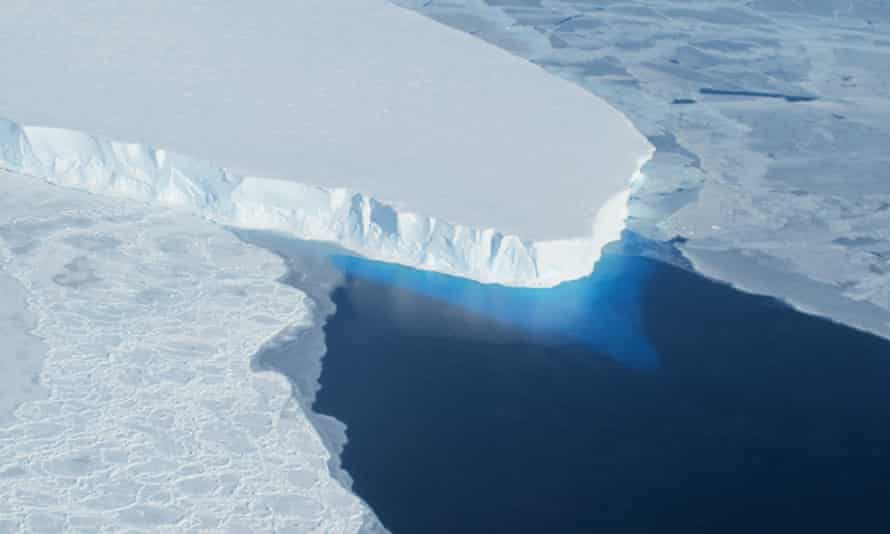
An undated photo courtesy of Nasa showing the Thwaites glacier in western Antarctica. This tipping point for Antarctica could be triggered by a global temperature rise of 3C above the preindustrial era.
An undated photo courtesy of Nasa showing the Thwaites glacier in western Antarctica. This tipping point for Antarctica could be triggered by a global temperature rise of 3C above the preindustrial era. Photograph: AFP/Getty Images

Oliver Milman@olliemilmanWed 5 May 2021 11.00 EDT

99

The current pace of global heating risks unleashing “rapid and unstoppable” sea level rise from the melting of Antarctica’s vast ice sheet, a new research paper has warned.

Unless planet-heating emissions are swiftly reduced to meet the goals of the Paris climate agreement, the world faces a situation where there is an “abrupt jump” in the pace of Antarctic ice loss around 2060, the study states, fueling sea level rise and placing coastal cities in greater peril.
“If the world warms up at a rate dictated by current policies we will see the Antarctic system start to get away from us around 2060,” said Robert DeConto, an expert in polar climate change at the University of Massachusetts and lead author of the study. “Once you put enough heat into the climate system, you are going to lose those ice shelves, and once that is set in motion you can’t reverse it.”AdvertisementTrump criticizes Facebook ruling and says social media companies ‘must pay a political price’ – liveJudge orders release of memo on Trump obstruction decisionExplosives and weaponry found at US far-right protests, documents revealRome court to rule on two Americans accused of fatally stabbing police officerSteven Soderbergh: Oscars ending changed in case Chadwick Boseman wonTrump criticizes Facebook ruling and says socialmedia companies ‘must pay a political price’ – livehttps://imasdk.googleapis.com/js/core/bridge3.453.0_en.html#goog_50591582https://imasdk.googleapis.com/js/core/bridge3.453.0_en.html#goog_856866834https://imasdk.googleapis.com/js/core/bridge3.453.0_en.html#goog_1219580895javascript:false00:16/00:30SKIP ADTrump criticizes Facebook ruling and says social media companies ‘must pay a political price’ – live

DeConto added: “The oceans would have to cool back down before the ice sheet could heal, which would take a very long time. On a societal timescale it would essentially be a permanent change.”

This tipping point for Antarctica could be triggered by a global temperature rise of 3C (5.4F) above the preindustrial era, which many researchers say is feasible by 2100 under governments’ current policies. The new research, published in Nature, finds that ice loss from Antarctica would be “irreversible on multi-century timescales” should this happen, helping raise the world’s oceans by 17cm to 21cm (6.69in to 8.27in) by the end of the century.

If the world was able to meet commitments made in the Paris deal, however, the research found Antarctica would contribute 6cm to 11cm of sea level rise by the end of the century, on a par with the current rate of ice loss. Under the Paris agreement, governments have vowed to limit dangerous global heating below 2C hotter than preindustrial times, with efforts to keep the increase to 1.5C.

“It’s really the next few decades that will determine the sea level rise from Antarctica,” De Conto said. “These ice shelves won’t be able to just grow back.”

Scientists have increasingly issued warnings over the fate of the huge amount of ice stored in Antarctica which, if it all melted, would raise global sea levels by 57 metres, completely submerging the world’s coasts.

While this won’t happen in any sort of foreseeable timescale, even a small increase in ice loss would be felt in global sea levels. Of particular concern is the western section of the Antarctic ice sheet, with scientists currently exploring the rate of decline experienced by the Thwaites glacier, also known as the doomsday glacier. In a worst-case scenario, the loss of the glacier, which is about the size of Britain and 1km deep, would raise sea levels by 65cm.

Antarctica is being winnowed away by a warming atmosphere as well as the heating oceans, with warming seawater entering crevasses and gnawing away at “pinning points” that hold enormous bodies of ice to submerged bedrock. A rapid acceleration of melting could cause a cascading effect where huge amounts of ice and water flow uninterrupted into the Southern Ocean.

Once in motion, the impacts from such dramatic ice loss would unfurl over centuries. “In the century after 2100 it’s potentially catastrophic,” said DeConto. “If we did nothing at all to reduce emissions we could get 5 metres of sea level rise just from Antarctica by 2200, at which point you’d have to remap the world from space. It would be unimaginable.”

DeConto’s paper uses a mode that incorporates temperature increase and ice loss, as well as the dynamic processes at play in Antarctica that present challenges in predicting exactly what will happen as the world continues to heat up.

Another study published in Nature on Wednesday, by scientists at King’s College in London, finds the sea level will rise by 0.5cm every year by 2100 if the global temperature rise hits 3C. DeConto said the other paper is an “impressive piece of work” but differed from his paper, which factored in compounding impacts from the loss of ice shelves.

“Neither of these papers are the last word, this is ongoing work,” he said. “Basically we are going to have to cope with continued sea level rise. The real question is whether it will be at a manageable or unmanageable rate for us.”

Orrin Pilkey, a sea level rise expert at Duke University who was not involved in the research, said the paper is an “important attempt to relate the Paris agreement to reality”.

He added: “I would consider this a thoughtful and even frightening but credible contribution which should provide a very strong basis to get on with implementation of the Paris agreement.”

Andrea Dutton, an expert in sea level rise at University of Wisconsin–Madison, who was a co-author, said the paper “addresses an important and pressing question” of what the Paris climate targets will mean for future sea level rise.

“We are already struggling with the amount of sea level rise that has occurred over the past century,” said Dutton, who added that a major acceleration in Antarctic melting will “bring about coastal retreat and migration on a scale that we have never before witnessed”.

“We will not be able to just adapt because it is impossible to just engineer our way out of this,” she said. “The conclusion is a stark reminder of the urgency in making deep and sustained cuts in our greenhouse gas emissions.”
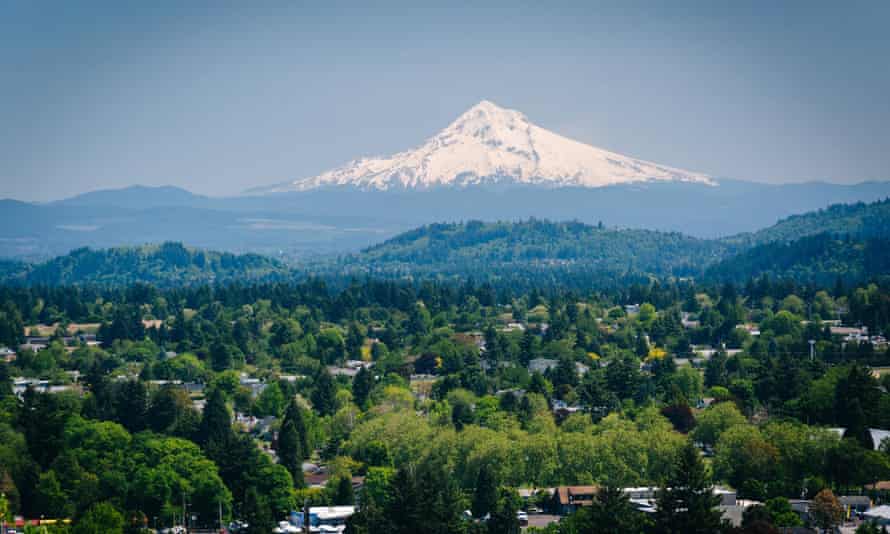

‘It’s like a rotting carcass of its former self’: funeral for an Oregon glacier

https://www.theguardian.com/environment/2021/may/02/its-like-a-rotting-carcass-of-its-former-self-funeral-for-an-oregon-glacier

Worried researchers hold ceremony for Clark glacier to illustrate how climate crisis is eroding icepacks

Mount Hood
Mount Hood pictured from Mount Tabor, in Portland, Oregon. The glacier provides water for drinking and growing crops. Photograph: Jon Bilous/Alamy

Oliver Milman@olliemilmanSun 2 May 2021 09.00 EDT

150

The funeral was a suitably solemn affair. The small casket was placed on a table covered in a black drape, a maudlin yet defiant speech quoted a Dylan Thomas poem, a moment’s silence was held.

Inside the casket, however, was not a body, but a vial of meltwater from Clark glacier in Oregon, once an imposing body of ice but now a shrivelled remnant.

The funeral, a stunt held by worried glacier researchers on the steps of the state capitol in Salem, illustrated how the climate crisis is rapidly gnawing away at the majestic icepacks that used to throng the mountains of the northwestern US, potentially posing a threat to the region’s water supplies.

“There is just this immense sadness because we all knew it was going to be bad, but didn’t think it would be this bad,” said Anders Carlson, president of the Oregon Glacier Institute, who read the eulogy for Clark glacier at the “funeral” in October.

Clark glacier is, or was, found if you took a moderately strenuous hike amid the Cascade mountains, a range that stretches from British Columbia in Canada down to the northern reaches of California.

Once spanning about 46 football pitches in size, the Clark glacier is now about three football pitches in area, or what Carlson calls a “stagnant scrap of ice”.

Mount Rainier
Mount Rainier Photograph: Elaine Thompson/AP

“It’s like a rotting carcass of its former self,” said Carlson. Glaciers move via gravity under their own vast weight, but once they have lost a certain amount of volume, they become dormant patches of ice. Other nearby glaciers found on the three sisters, a chain of volcanic peaks, and Mount Hood have similarly “died” in this way.Advertisementhttps://2d5c5e053b62f319ca53502bafa5e824.safeframe.googlesyndication.com/safeframe/1-0-38/html/container.html

“You go back through old photographs and glaciers have disappeared just in the last 20 years – it’s really dramatic,” said Carlson, who has calculated that at least a third of the state’s glaciers named by the US government in the 1950s are now gone.

Among their other benefits, the meltwater from glaciers each spring feeds streams and rivers that supply a water source for apple and pear orchards, vineyards and even some drinking water for towns situated in the shadows of the mountains.

Researchers have estimated that river volumes in the late summer could drop by 80% by the end of the century due to decreases in glacier and snow melt. These huge losses raise tough questions over how to replace the water.

“These glaciers are not just nice to look at – they are our water towers, where we store our water,” said Carlson.

“Places like Hood River and Eugene are drinking and growing crops with water from glaciers. If you like Oregon wine, the chances are it was grown with glacier water. If you lose that, it’s not going to be a pretty picture. You either try to get groundwater or build new dams, which is not popular with anyone.”

The decline of glaciers is part of a broader trend that has seen vast bodies of ice wither away from the Himalayas to Switzerland as global temperatures climb. The glaciers of America’s Pacific north-west aren’t as well known as those overseas, but they play an important role in the local environment and are suffering stunning losses.

Since the mock funeral, researchers have found that the Cascades are particularly vulnerable to the melting of glaciers, which can cause maladies ranging from increased wildfire risk to the loss of species such as steelhead trout that rely on the frigid cold of glacier-fed streams. In the longer term, the glaciers of the American west face almost complete obliteration.

“The glaciers in the western US continue to shrink and will largely disappear by the end of the century,” said Andrew Fountain, a geologist at Portland State University who has submitted new research that found the glaciers of the Olympic Mountains, in the state of Washington, will probably vanish by 2070.

“You might get icy remnants on the peaks of tall mountains like Mount Rainier or Mount Baker, but they will be pretty small. Rising temperatures are doing this, without a doubt.”

Beyond drastically cutting planet-warming emissions, there is little that can be done to salvage the glaciers, a sobering reality for those who have long hiked and climbed the peaks of the US north-west.

“It’s really hard to stop the decline,” said Carlson. “People don’t realise we are a glacierised country – we rely upon them, like the Swiss and Norwegians do. They are important and we need them.”

The math isn’t adding up on forests and CO2 reductions

https://www.theverge.com/2021/4/29/22410367/forest-offsets-trees-carbon-dioxide-accounting

Big polluters can hide behind forest offsetsBy Justine Calma@justcalma  Apr 29, 2021, 5:12pm EDT

Share this story

Upward view of giant sequoias in Sequoia National Park,...
SEQUOIA NATIONAL PARK, CALIFORNIA, UNITED STATES – 2018/09/01: Upward view of giant sequoias in Sequoia National Park, California, USA.

More evidence surfaced this week that shows that forests are struggling to do humans’ dirty work when it comes to climate change. Although companies and countries are increasingly relying on forests to draw down their planet-heating carbon dioxide emissions, the math isn’t adding up to show big benefits.

California might have oversold the success of carbon offsets used in its cap-and-trade system, which is often billed as one of the world’s most successful market-based mechanisms to tackle climate change. The system appears to be failing because California is actually overcounting how much carbon dioxide forests keep out of the atmosphere, according to a new study by nonprofit CarbonPlan, that’s still under peer review, and reporting by ProPublica and MIT Technology Review. (One of the authors, James Temple, was previously a senior director at The Verge.)

That finding follows research published earlier this week in the journal Nature Climate Change that found a giant discrepancy between how much climate pollution countries officially reported and how much pollution independent models calculated for them. In this case, forests mucked up the numbers because countries are attributing more carbon reductions to their forests than independent models do.THAT LETS THOSE POLLUTERS OFF THE HOOK

Trees do provide a crucial service for people and the planet by “breathing in” and storing carbon dioxide. So protecting forests is important for their health and ours. But schemes devised to sell forests’ carbon storage to polluters as a way to cancel out their emissions haven’t always resulted in the CO2 reductions they’re supposed to achieve. Ultimately, that lets those polluters off the hook instead of pushing them to do more in the race to prevent a deeper climate crisis.

In the US, forest owners can sell their land’s ability to store carbon as “credits” to polluters. Since California sets a cap for how much CO2 pollution industries generate, companies can purchase those credits to cancel out some of their emissions and stay below the cap (with each credit representing one metric ton of CO2). But up to 39 million credits, nearly a third in the state’s program, didn’t actually provide the climate benefits they were supposed to, according to the new analysis by CarbonPlan.

That’s because the state was using averages to estimate how much CO2 each parcel of forest could hold. In reality, some pieces of forest can store more than others based on what kinds of trees are there and how dense the forest is. Forest managers also “gamed the system” by selling credits from parcels that inflated how much carbon they stored, ProPublica and MIT Technology Review reported.FOREST MANAGERS ALSO “GAMED THE SYSTEM”

The California Air Resources Board disputes the study’s findings, which are still undergoing peer review. “We were not given sufficient time to fully analyze an unpublished study and are not commenting further on the authors’ alternative methodology,” a spokesperson for the Air Resources Board wrote to ProPublica and MIT Technology Review. (This isn’t the first time California’s cap-and-trade system has come under scrutiny. Previous research found that some “economically disadvantaged neighborhoods” near regulated facilities experienced higher rates of pollution after the carbon trading system began.)

Discrepancies in carbon accounting due to forests show up globally, too, according to the Nature Climate Change study. There was a 5.5 billion ton difference between the amount of carbon dioxide emissions nations report each year and what independent models calculated. That’s a big gap, nearly as much as the US’s net emissions in 2019. It boils down to the way the US and other countries count up carbon caught by their forests, which doesn’t match up with the methods other researchers use. The lack of standardized reporting across the board for countries and scientists could throw a wrench in global efforts to curb greenhouse gas emissions. It’s hard to make progress if everyone’s taking different measurements.

What’s more, countries that are big polluters and that have a lot of forests, like the US, can lean on that asset more than countries without as much forest cover, The Washington Post writes. Countries like the US use forests to subtract emissions, and they end up reporting a smaller “net” footprint as a result. That can make it look like they’ve made bigger environmental gains even if they’re still polluting a lot.“A FREEBIE FROM NATURE”

If the US didn’t count on forests and other land ecosystems to offset some 12 percent of its emissions, its carbon footprint would actually be much higher. “We are lucky to have those natural carbon sinks,” Christopher Williams, a professor at Clark University, told The Washington Post. “However, that carbon uptake is a freebie from nature for which we do not really get to take credit in our battle against climate change.”

Despite the risks that come with relying on those freebies, it’s getting trendier than ever to invest in forest-based climate solutions. YouTubers and the World Economic Forum have launched feel-good tree-planting initiatives. Tech companies like Microsoft that have made commitments to become carbon “neutral” or carbon “negative” say that they’ll draw down at least as many emissions as they release — and are relying heavily on trees to do that. But trees can only do so much — and, if the results of these studies hold up, perhaps much less than people previously thought they could.

HOW CARBON LABELS ARE GETTING PEOPLE TO EAT LESS MEAT

 By: Karen Asp    |    Reading time: 7 minutes
It’s no secret that the Western world needs a dietary intervention. Animal agriculture continues to be among the leading causes of greenhouse gas emissions, and without a major shift to a plant-based diet globally as well as at an individual level, the future looks bleak.
The question is, though, how do you make consumers aware of the carbon footprint of their food? Enter climate labels. Just as nutritional labels help consumers make the right purchase for their health, these labels, which are being added to restaurant menus and food products, are designed to help consumers make healthier choices for the planet. 

In 2020, the World Resources Institute launched the Cool Foods Meals badge to make it easier for consumers to choose climate-friendly meals when dining out. The launch was timely, as it followed on the tails of a survey conducted by the Yale Program on Climate Change Communication and Earth Day Network which found that 64 percent of individuals said they were either purchasing or eating plant-based foods to help reduce global warming.

Science, of course, shows that the best foods for planetary health are also the same ones that support human health: plants. So, could these climate labels inadvertently end up encouraging people to eat less meat? There is hope.
THE ENVIRONMENTAL COST OF ANIMAL AGRICULTURE

Every year, around 70 billion animals are raised and slaughtered for food. Our industrial, profit-driven food system benefits some while exploiting and harming animals, marginalized communities, public health, and the planet we all call home. If we are to fight climate change, we must act to change the food system now
 Animal Agriculture’s Negative Impact on Climate ChangeReporting on our large-scale industrial farming of animals, Laura Bridgeman writes, “Called humanity’s greatest mistake by some due to the resulting hard labor, diminished nutrition, and social inequality brought by agriculture, this system of food production now presents the world with a new quandary: environmental destruction on scales that can no longer be ignored.”

The environmental impacts of concentrated animal feeding operations [CAFOs], more widely known as factory farms, are many and devastating. “CAFOs produce enormous amounts of waste, which collect in vast open-air lagoons that can be breached by extreme weather events or gradually seep into groundwater. Water pollution from CAFOs can cause algal blooms which can devastate entire marine ecosystems. Air pollution is generated from CAFOs as manure is vaporized, sending toxic wafts through the air to surrounding communities,” writes Bridgeman.

Farmed animals generate well over 14 percent of all anthropogenic emissions. The bulk of these emissions are due to the raising of cattle for meat and dairy, which contribute 60 percent of total livestock emissions.
 Cattle Farming Is One of the Most Destructive Industries on the Planet: Animal agriculture is a leading cause of environmental degradation, and cattle farming is among the worst offenders.

“Farming is one of the largest contributors to greenhouse gases, thus being a major cause of climate change,” writes Nimisha Agarwal. “Cattle farming has also often displaced local communities who have ensured more regenerative and balanced uses of land in their environments. It causes air and water pollution.” Agarwal adds that cattle farming, which “also treats living beings as commodities and shows no consideration for their welfare,” is an industry that “depends on clearing the land of forests, which is the habitat of many animals, thus threatening biodiversity.” 

While grass-fed beef has been offered up as a more sustainable option, Jessica Scott-Reid writes that consumers are being duped. “Grass-fed beef production is often marketed as small-scale with wholesome images of family farms and small herds. But in most North American supermarkets, grass-fed beef is sold by some of the largest, most environmentally destructive meat producers on the planet, including PerdueHormel, and JBS.”
 Is Regenerative Agriculture Really a Climate Solution?: “Regenerative agriculture is an attempt to reconcile agriculture with a healthy environment, and therefore address the destructive nature of farming as it currently exists,” writes Matthew Chalmers. 

But as farmers are embracing regenerative grazing and other forms of regenerative agriculture, experts remain skeptical of the positive impacts of these methods. Chalmers writes that while regenerative agriculture could be a “vital component” in fighting climate change, it alone is not enough: “If corporate agriculture and opportunistic farmers adopt sustainable farming practices without introducing a comprehensive plan to overhaul the farming system, animal agriculture’s contribution to the climate crisis will continue to accelerate.”
 9 Boundaries We Must Respect to Keep the Planet Habitable: Our food system is one of many threats the planet faces, and experts are warning that we must take action to change it.

“Scientists note nine planetary boundaries beyond which we can’t push Earth Systems without putting our societies at risk: climate change, biodiversity loss, ocean acidification, ozone depletion, atmospheric aerosol pollution, freshwater use, biogeochemical flows of nitrogen and phosphorus, land-system change, and release of novel chemicals,” writes Claire Asher. “The best way to prevent overshoot, researchers say, is to revamp our energy and food systems.”
 POLITICO: White House Dances Around A Big Contributor to Climate Change: Agriculture: While President Biden announced this month his plans to reduce U.S. greenhouse gas emissions by 2030, Ryan McCrimmon writes that the administration is not taking enough action when it comes to the agriculture industry.

“President Joe Biden needs the help of the powerful farm industry to reach his sky-high climate goals. But his plans for cutting agricultural emissions might not have enough teeth to take a big bite out of global warming,” writes McCrimmon. “The White House hasn’t set any specific targets yet for agriculture.” Read more from Sentient Media.We are exposing the truth about Big Ag. Donate now.
The Cool Foods badge, which identifies dishes with a lower carbon footprint, was first embraced by Panera Bread, which became the first company to receive the Cool Food Meals certification. Today, when you look on Panera’s menu, you’ll see climate-friendly foods denoted with a bright green badge. As of October 2020, 55 percent of its menu was labeled as low-carbon Cool Food Meals. 

In 2020, Chipotle launched its Real Foodprint tracker, giving customers detailed information about five metrics behind the chain’s ingredients, including how much water an order saves, how many antibiotics it avoided, how much organic land it supported, how much less carbon it put into the atmosphere, and how much it improved soil health.

A new survey from Michigan State University indicates a disconnect between climate change and food. Only 44 percent of participants knew that eating more plant-based foods could have a significant impact on greenhouse gas emissions.  

Researchers in Sweden asked 803 individuals to answer questions online about their food-related habits and choices, finding that the majority of study participants either wanted the knowledge of the climate impact of food products, or at least weren’t against it—and after individuals who wanted the information digested it, their willingness to pay for meat substitutes increased.

While climate labels are still so new that long-term data doesn’t yet exist to understand their full impact, early data from some restaurants shows positive changes. For instance, after Just Salad introduced its Climatarian menu, sales of those items increased significantly.

Read the full story here.
Featured Image: Push Doctor/Flickr

Salmon Have Shrunk So Much That Whole Foods Redid Its Guidelines

https://www.bloomberg.com/news/articles/2021-04-27/salmon-have-shrunk-so-much-that-whole-foods-redid-its-guidelines?fbclid=IwAR0M_Vsl3auoFdrIBFyc4v6QDbBgTWiAgGG9skFS3giheS34NC953fybT40

By Kim ChipmanApril 27, 2021, 4:00 AM PDT

  •  Climate change seen as threat to Pacific Rim’s ‘keystone’ fish
  •  Wild salmon woes pose threats to Alaska’s $2 billion industry
A fisherman washes freshly caught salmon in Newtok, Alaska.
A fisherman washes freshly caught salmon in Newtok, Alaska. Photographer: Andrew Burton/Getty Images

LISTEN TO ARTICLE

5:57

SHARE THIS ARTICLE

ShareTweetPostEmail

In this article

0597575DUNIVERSITY OF ALASKA FAIRBANPrivate Company0179553DUNIVERSITY OF CALIFORNIA SANPrivate Company

At OBI Seafoods, a sprawling operation with outposts throughout Alaska, there’s all sorts of extra machinery for workers to master. At Whole Foods Market, there are new guidelines for purchasing salmon from wholesalers. And at Ivar’s, a fixture on Seattle’s waterfront for eight decades, the chef is sending back more and more salmon delivered to his kitchen.

Behind all these changes is an alarming trend that’s been building for years: The giant schools of wild Pacific salmon that can turn southeast Alaska’s ice-cold waters into a brilliant orange blur are thinning out, and those that do survive are shrinking in size.

It’s the shrinking part that’s causing the biggest logistical snarl right now. Many salmon are so small they’ve thrown off OBI’s fish-sorting process and no longer meet the purchasing specifications at Whole Foods and culinary demands at Ivar’s. There, head chef Craig Breeden snaps photos of the fish next to his knife to illustrate their diminutive size before shipping them back.

“It’s very irritating when the supplier sends it to me and I see the size of these fillets,” he said. “In the last eight to 10 years, the salmon sizes have started to get smaller and smaller.”

‘Critical Moment’

More fromDeep-Sea Mining Robot Lost on Cobalt-Rich Floor of PacificCalifornia’s $4 Gasoline May Mean a Price Shock Across U.S.Glaciers Are Melting More Rapidly, Risking Floods and DroughtsChina Wants More Steel at Home as Industry Faces Overhaul

These disruptions are, for now, more a nuisance than serious problem. But they almost certainly presage more costly changes to come and, much more importantly, raise alarm bells about the growing crisis in some key salmon populations that is being driven, according to many scientists, by climate change and more competition for food. Decades after the Atlantic cod fisheries collapsed, concern is now mounting among experts that wild Pacific salmon could face a similar fate.

“The whole thing is out of whack,” said Laurie Weitkamp, a U.S. fisheries biologist at the National Oceanic and Atmospheric Administration. “Salmon managers are realizing that climate change is impacting their stocks and it is generally not favorable and it’s only going to get worse.”

Salmon are so vital that scientists call them a “keystone” species, since animals such as bears and eagles depend on them, and the fish indirectly spread nutrients into ecosystems including forests. A salmon’s life journey from freshwater streams to the ocean and back again to reproduce and die makes them especially vulnerable to warming temperatures and a shifting environment.

PA Salmon
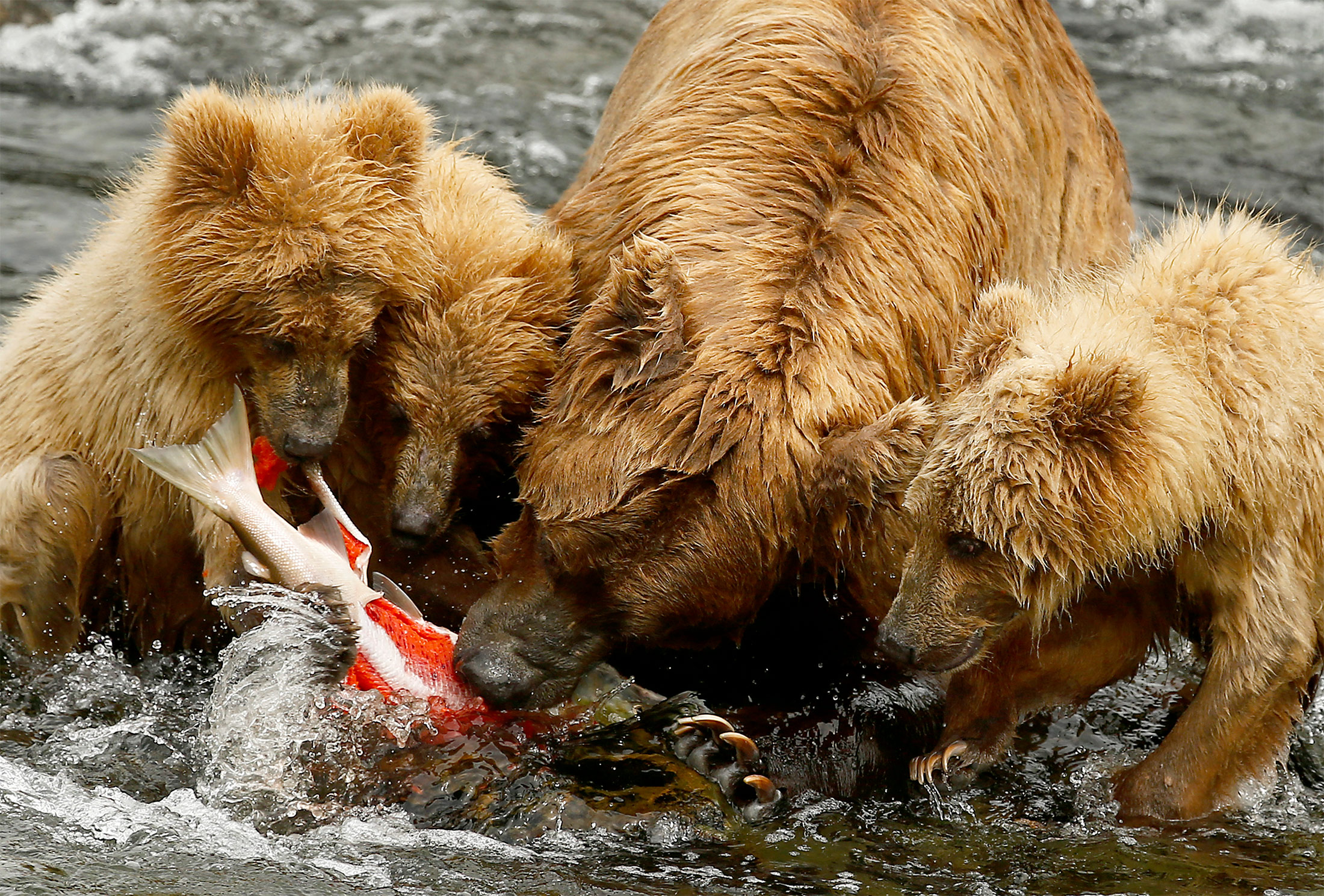
A bear and her cubs eat a sockeye salmon in Alaska’s Katmai National Park.Photographer: Luis Sinco/Los Angeles Times/Getty Images

Alaskan salmon are getting smaller partly because they’re returning from the ocean at a younger age, though scientists don’t really know why. The trend is also playing out across the Pacific Rim, from the U.S. mainland and Canada to Russia and Japan.

“When the size and the numbers go down that’s a harbinger of change that is taken as a red flag among many scientists,” said Peter Westley of the University of Alaska Fairbanks, co-author of a study on salmon size published last year with the University of California Santa Cruz.

The scientists examined four of the five Pacific salmon species in Alaska. Chinook — pursued by anglers and valued by restaurants — had the biggest average decline, at 8%, compared with pre-1990 fish. All other species shrunk, with sockeye showing the smallest decline at 2.1%. The most rapid changes were in the past decade.

Dwindling sizes in other species signaled a fishery’s collapse, including Canada’s Atlantic cod three decades ago.

In Europe and New England, the memory of rivers teeming with wild Atlantic salmon is all but forgotten due to overfishing, habitat loss and dam construction that blocked spawning grounds, said David Montgomery, whose 2003 book “King of Fish: The Thousand Year Run of Salmon” warns that the Pacific species could face the same fate. “Sadly, the book is still current.”

Agriculture, mining and other man-made interactions have sent Pacific salmon numbers plummeting in places including the Pacific Northwest’s Columbia-Snake River Basin. In some parts of Canada and the U.S., they’re endangered. Key runs in Alaska and Canada’s British Columbia province are seeing some of the worst years.

B.C.’s Fraser River had record low sockeye run sizes in three of the last five years, with last season setting a new low, said the Pacific Salmon Commission, which oversees management of the fish in the U.S. and Canada.

Collapsing Fisheries

“We are seeing a march north on the declines and collapses of salmon fisheries,” said Guido Rahr, head of Portland, Oregon-based Wild Salmon Center. “Japan has almost no wild fish left. In parts of Russia, once massive salmon runs are collapsing due to overfishing.”

Russia and the U.S. make up 85% of the world’s remaining Pacific salmon.

PA Salmon
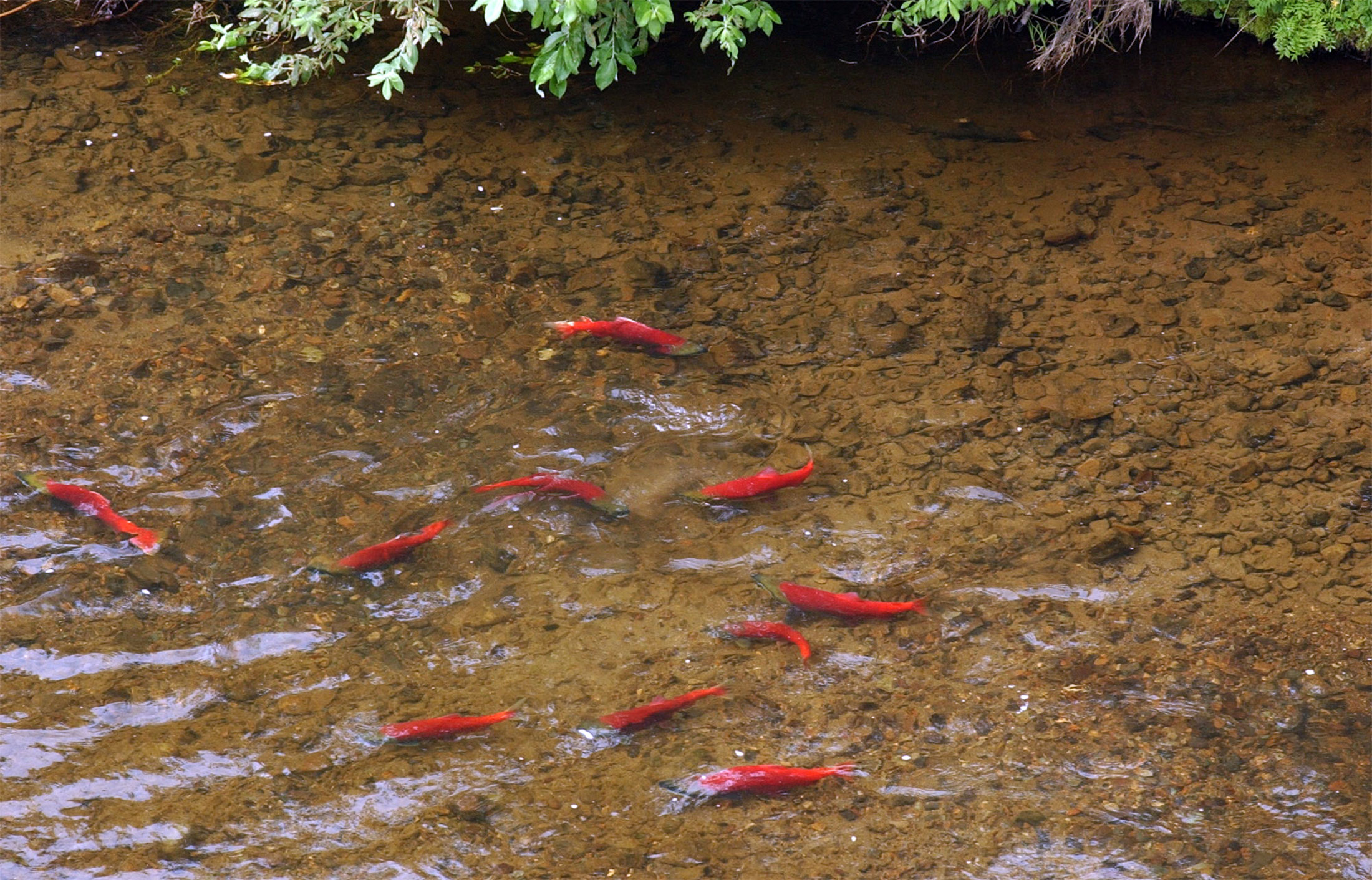
Sockeye salmon school up in the Upper Talarik River in the Alaska Peninsula.Photographer: Bob Hallinen/Anchorage Daily News/Tribune News Service/Getty Images

Less weighty catches mean fewer dollars for the $2 billion industry. Last year’s haul garnered $295.2 million, down 56% from 2019, Alaska estimates show.

“Salmon is such a nuanced and interconnected species — one little tweak when they are young can make a big change,” said Arron Kallenberg, founder and chief executive officer of seafood retailer Wild Alaskan Co. “From an industry standpoint it certainty makes an impact.”

While salmon runs in some areas saw steep population declines, Bristol Bay — supplier of about half the world’s sockeye — has had booming harvests. Even so, signs of smaller fish abound, OBI Seafoods CEO Mark Palmer said.What on Earth?The Bloomberg Green newsletter is your guide to the latest in climate news, zero-emission tech and green finance.EmailSign UpBy submitting my information, I agree to the Privacy Policy and Terms of Service and to receive offers and promotions from Bloomberg.

Historically, 4-pound sockeye and larger — key for commercial fisheries — comprise as much as 70% of each season’s Bristol Bay catch, Palmer said. Today, those larger salmon are no more than half the catch.

“Your yields go down a little bit with smaller fish,” he said.

At southeast Alaska’s Klukwan village, 115 miles north of Juneau, fishing nets have told the tale of shrinking salmon for years.

“Something is out of whack in the ocean and we wish we knew a way to fix it,” said Jones Hotch Jr., a tribal council member of this community of 40 families along a river whose indigenous name means “winter container for salmon.”

They depend on annual salmon return, which is why Hotch Jr. is pushing for stronger environmental protections against mining and other threats to the Chilkat River.

“My drive for saving our river for salmon runs to the very marrow of my being,” the 70-year-old said. “I believe that when we save our salmon, we save and preserve our culture.”

No, Biden’s Not Banning Burgers — But Meat Is a Real Climate Problem

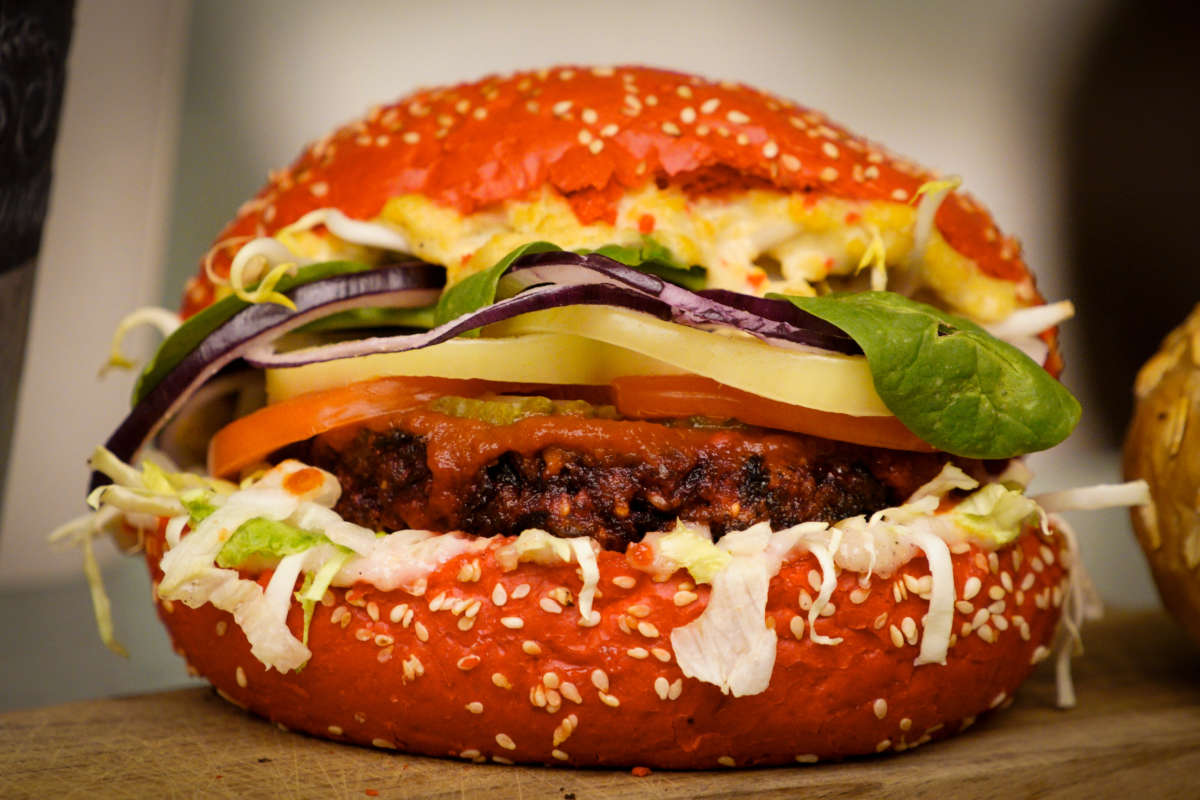
A meatless hamburger is seen on display at the Vegan Food Festival in Warsaw, Poland on October 6, 2019.
A meatless hamburger is seen on display at the Vegan Food Festival in Warsaw, Poland, on October 6, 2019.

BYMike LudwigTruthoutPUBLISHEDApril 27, 2021SHAREShare via FacebookShare via TwitterShare via Email

A white lower-case t on a black background

READING LISTPOLITICS & ELECTIONSTrump-Disrupted Census Hurts Marginalized Communities and Hands New Power to GOPENVIRONMENT & HEALTHNo, Biden’s Not Banning Burgers — But Meat Is a Real Climate ProblemENVIRONMENT & HEALTHThe More Biden Expands ACA, the Harder It Will Be for the Right to Cut ItPOLITICS & ELECTIONSOver 80 House Democrats Urge Biden to Lower Medicare Eligibility AgeECONOMY & LABORBiden to Sign Executive Order Raising Federal Workers’ Wages to $15 an HourWAR & PEACEBiden Is Reviewing US Policy in North Korea. The Brutal Sanctions Must End.

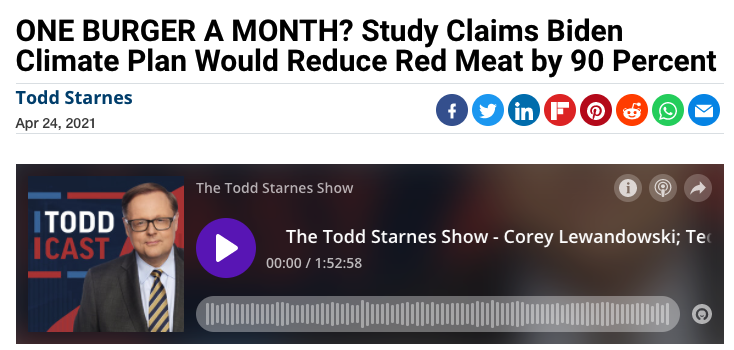
Fact-checkers are slamming Republicans and the right-wing media for repeating false claims that President Joe Biden’s climate plan would require Americans to drastically reduce consumption of red meat. While the rumors about Biden have been thoroughly debunked, these claims were sparked by a real, thought-provoking University of Michigan study that models how a shift toward plant-based diets would reduce greenhouse gas emissions that are driving the climate crisis.

The right-wing claims originated from baseless speculation by The Daily Mail, a conservative British tabloid that thrives on viral posts, which was then taken out of context by right-wing politicians and personalities who jumped at the chance to throw red meat (excuse the pun) to the Trumpian base.

“Speaking of stupid, there’s a study coming out of the University of Michigan which says that to meet the Biden Green New Deal targets, America has to, get this, America has to stop eating meat, stop eating poultry and fish, seafood, eggs, dairy, and animal-based fats,” Fox News host Larry Kudlow said over the weekend. “Ok, got that? No burger on July 4. No steaks on the barbecue.”

Don’t miss a beat

Get the latest news and thought-provoking analysis from Truthout.

  • Email

Of course, there are considerable gaps between Biden’s climate vision and the latest Green New Deal proposals put forth by progressives like Sen. Bernie Sanders and Rep. Alexandria Ocasio-Cortez. The University of Michigan study is not part of the Green New Deal, but Kudlow baselessly threatened “middle America” with somehow being forced to grill “Brussels sprouts”instead of beef on the Fourth of July.

Multiple far right Republicans and commentators ran with it, sending out viral tweets and media stories falsely suggesting that Biden wants to control what people eat and would even limit Americans to “one burger a month.” (Donald Trump Jr., forever riding his father’s presidential coattails, bragged on Twitter about eating four pounds of red meat in a single day. Warning: Eating that much red meat at once can cause constipation and other health problems.)

These right-wing claims are ridiculous on their face, but the University of Michigan study that Kudlow and others took out of context is real climate science. After all, scientists say the global food supply chain is responsible for 26 percent of climate-warming emissions. While not connected White House climate policy, the study adds to a large body of research showing that reducing meat consumption — and, perhaps more importantly, reducing factory farming and mass beef production that destroys lush ecosystems in places like the Amazon — is essential for addressing the climate emergency. The study also models how a shift toward plant-based diets would drastically reduce climate-warming emissions in the United States.

According to federal data cited by in the study, the average person in the U.S. consumed about 133 pounds of red meat and poultry in 2016. If the average hamburger contains between one-third and half a pound of beef, that’s roughly equivalent to 300-plus burgers. While red meat (beef, pork and lamb) provides only 9 percent of calories in the average American diet, red meat produces about 47 percent of the food system’s greenhouse gas emissions. Consumption of all animal products combined, including eggs, dairy and fish, represents 82 percent of the nation’s dietary carbon footprint.Red meat produces about 47 percent of the food system’s greenhouse gas emissions.

Using this data as a baseline, the study considers four dietary scenarios in the U.S over the next decade. In the first scenario, the average amount of animal-based food products remains unchanged by 2030. In the second scenario, consumption increases slightly based on federal projections. In the third scenario, animal product consumption is reduced by 50 percent and replaced with plant-based foods. The fourth (and incredibly optimistic) scenario is the same as the third, except beef consumption is further reduced by 90 percent, a completely theoretical figure that conservatives took out of context.

If diets in the U.S. remain unchanged under the first scenario, the food supply would generate greenhouse gas emissions equivalent to about 646 million metric tons of carbon dioxide in 2030. However, if animal product consumption dropped by 50 percent and was replaced by plant-based foods, the food supply would produce 224 million metric tons less — the equivalent of taking 47.5 million gas and diesel vehicles off the road. That represents about a quarter of the emission reductions necessary to meet U.S. climate goals, although the Biden administration is now pushing for even greater reductions.

Cumulative emissions would drop by 1.6 billion metric tons from 2016 levels by 2030 if the U.S. reduced animal product consumption by 50 percent. Under the fourth scenario, where the U.S. hits the 50 percent reduction target while also reducing beef consumption by 90 percent, the projected reduction in emissions would be equivalent to about 2.4 billion metric tons of carbon dioxide.

Again, these scenarios are completely theoretical; they are models of what the future could look like if we eat less meat and animal products. Of course, what the actual future will look like is completely dependent on the decisions that we humans make. To achieve a 50 percent reduction in animal product consumption, or to replace 90 percent of the beef we currently consume with plant-based alternatives such as soy protein and vegan meat alternatives, would require substantial changes to agriculture and the food delivery system.

Since there is clearly no government plan to mandate Impossible Burgers, changing the food system will require changes in consumer demand. In short, a large chunk of the population would have to choose to eat less meat.

Hints of this shift are already happening. Americans are eating more meatless meat and plant-based dairy alternatives than ever before, but nowhere near the scale modeled in the University of Michigan study.

After looking at the climate data, grilling Brussels sprouts or asparagus instead of ground beef and hotdogs might sound pretty tasty. You’ll need some protein as well, and while there’s plenty of meatless burgers to choose from nowadays, there’s nothing quite like marinating some old-fashioned grilled barbecue tofu. Who knows, your insides and the Earth might thank you.

How a false claim about beef and Biden’s climate plan spread

https://news.yahoo.com/how-a-false-claim-about-beef-and-bidens-climate-plan-spread-155102973.html

Yahoo News

Christopher Wilson·Senior WriterMon, April 26, 2021, 8:51 AM·5 min read

  • More content below
  • More content below

On Sunday afternoon, Texas Gov. Greg Abbott tweeted out a Fox News graphic about President Biden proposing a reduction in red meat consumption. “Not gonna happen in Texas!” proclaimed the Republican, who serves nearly 30 million constituents.https://platform.twitter.com/embed/Tweet.html?creatorScreenName=realchriswilson&dnt=true&embedId=twitter-widget-0&features=eyJ0ZndfZXhwZXJpbWVudHNfY29va2llX2V4cGlyYXRpb24iOnsiYnVja2V0IjoxMjA5NjAwLCJ2ZXJzaW9uIjpudWxsfSwidGZ3X2hvcml6b25fdHdlZXRfZW1iZWRfOTU1NSI6eyJidWNrZXQiOiJodGUiLCJ2ZXJzaW9uIjpudWxsfX0%3D&frame=false&hideCard=false&hideThread=false&id=1386433630747070468&lang=en&origin=https%3A%2F%2Fnews.yahoo.com%2Fhow-a-false-claim-about-beef-and-bidens-climate-plan-spread-155102973.html&sessionId=7f247ad66814665724d5898bfff6d51b9e287866&siteScreenName=YahooNews&theme=light&widgetsVersion=ff2e7cf%3A1618526400629&width=550px

Abbott was retweeted by fellow Republican Gov. Brad Little, who said, “Idahoans also have beef with this agenda and for dinner!” The two governors followed in a line of conservative politicians, pundits and news outlets who spent days proudly stating their opposition to a provision of Biden’s climate plan that doesn’t exist.

The false narrative stems from coverage of Biden announcing his new climate goals last week in honor of Earth Day, including cutting U.S. carbon emissions by at least 50 percent by 2030 over 2005 levels. The plan drew immediate Republican condemnation, but the beef-specific narrative stems from a Thursday article in the Daily Mail, a conservative British tabloid. The lengthy headline reads, “How Biden’s climate plan could limit you to eat just one burger a MONTH, cost $3.5K a year per person in taxes, force you to spend $55K on an electric car and ‘crush’ American jobs.”

The piece cites a University of Michigan study that analyzes what different changes in the U.S. diet could mean for greenhouse gas emissions. This was translated into the Fox News graphic shared by Abbott and others, which stated that the Biden proposal would cut 90 percent of red meat from Americans’ diet, allowing them a maximum of 4 pounds per year and one burger a month.

A primary issue in using the paper to condemn the Biden climate plan is that it was published in January 2020, when Biden was involved in a tight Democratic primary and a year away from being sworn in as president. His climate plan does not have any provisions regulating citizens’ ability to consume meat.

US President Joe Biden speaks during climate change virtual summit from the East Room of the White House campus April 22, 2021, in Washington, DC. (Brendan Smialowski/AFP via Getty Images)
President Biden during the virtual summit on climate change on April 22. (Brendan Smialowski/AFP via Getty Images)

Gregory A. Keoleian and Martin Heller, two of the study’s authors, told Yahoo News that “to our knowledge, there is no connection between our study and Joe Biden’s Climate plan.”

“This appears to be an association made erroneously by the Daily Mail that has been picked up widely,” they continued. “Our study merely identifies opportunities for emissions reductions that are possible from changes in our diet. By no means does it suggest that these changes in diet would be required to meet climate goals.”

The Daily Mail’s detachment from reality did not stop the false narrative from spreading. On Friday, former Trump adviser Larry Kudlow elevated the claims on his Fox Business show.

“Speaking of stupid, there’s a study coming out of the University of Michigan which says that to meet the Biden Green New Deal targets, America has to, get this, America has to stop eating meat, stop eating poultry and fish, seafood, eggs, dairy and animal-based fats,” Kudlow said, “OK, got that? No burger on July 4. No steaks on the barbecue. I’m sure Middle America is just going to love that.”

“Can you grill those brussels sprouts? So get ready. You can throw back a plant-based beer with your grilled brussels sprouts and wave your American flag,” Kudlow continued, seemingly unclear about the fact that beer already comes from plants. Senate Majority Leader Chuck Schumer took a shot at the narrative Sunday evening, tweeting, “Excited to be watching the Oscars with an ice cold plant-based beer. Thanks Joe Biden.”

It was full steam ahead at that point. Rep. Lauren Boebert, R-Colo., tweeted Friday morning, “Joe Biden’s climate plan includes cutting 90% of red meat from our diets by 2030. They want to limit us to about four pounds a year. Why doesn’t Joe stay out of my kitchen?”

On Saturday, Donald Trump. Jr., the oldest son of the former president, retweeted the Fox News graphic and said, “I’m pretty sure I ate 4 pounds of red meat yesterday. That’s going to be a hard NO from me.”

Rep. Marjorie Taylor Greene, the Georgia congresswoman who has promoted conspiracies and has repeatedly used racist and xenophobic language, attempted to knock Biden by referring to him as the McDonald’s character the Hamburglar and tweeting an image of him eating a burger with the caption “No burgers for thee, but just for me.”

Rep. Marjorie Taylor Greene, R-Ga., is seen on the House steps during the vote on the $1.9 trillion covid-19 relief package, the American Rescue Plan Act, on Wednesday, March 10, 2021. (Tom Williams/CQ Roll Call via Getty Images)
Rep. Marjorie Taylor Greene, R-Ga. (Tom Williams/CQ Roll Call via Getty Images)

This is not the first time that conservatives have ginned up a false narrative about meat consumption to negatively portray Democratic climate policies. In 2019, after Rep. Alexandria Ocasio-Cortez, D-N.Y., rolled out her Green New Deal proposal, she was accused of wanting to take away Americans’ burgers. At a press conference opposing the Green New Deal, Republican legislators ate burgers and drank milkshakes.

Sebastian Gorka, a former Trump White House official, addressed the concern at that year’s Conservative Political Action Conference, saying, “They want to rebuild your home, they want to take away your hamburgers. This is what Stalin dreamt about but never achieved.”

Cover thumbnail photo illustration: Yahoo News; photos: AP, Image Bank/Getty Images

Climate Change Has Now Invisibly Shifted Earth’s Axis, New Data Reveal

https://www.sciencealert.com/earth-s-axis-has-already-been-shifted-by-climate-change-scientists-say

(den-belitsky/Getty Images)ENVIRONMENT

PETER DOCKRILL26 APRIL 2021

Humanity’s impacts on our planet’s climate are so profound, we have for decades been unwittingly shifting the very axis upon which Earth spins around, scientists say.

In a new study, researchers examined the phenomenon of polar wandering, in which Earth’s magnetic north and south poles drift around the surface of the planet, restlessly roaming from the anchored positions of their geographic counterparts.

This mysterious phenomenon is thought to be driven by many factors, including the existence of vast anomalies of molten iron under Earth’s surface. But other elements also contribute, scientists say – including, amazingly enough, the effects of anthropogenic (human-caused) climate change.

“Faster ice melting under global warming was the most likely cause of the directional change of the polar drift in the 1990s,” explains lead researcher Shanshan Deng from the Institute of Geographic Sciences and Natural Resources Research in China.

In the new study, Deng and fellow researchers examined the extent to which changes in terrestrial water storage (TWS) in recent decades contributed to the amount of magnetic polar wander recorded in the same timeframe.

Basically, TWS includes changes in water levels on Earth resulting from glaciers melting as the world gets warmer, in addition to changes also produced by the pumping of groundwater from underground reservoirs.

The reason these changes are important is because they affect the distribution of mass on Earth, and when you’re dealing with a spinning object – whether a spinning top, a yo-yo, or an entire planet revolving in space – the way its mass is distributed in turn affects the way it spins.https://1e0f390c5e99aa9b210823e4926c72d3.safeframe.googlesyndication.com/safeframe/1-0-38/html/container.html

“It brings an interesting piece of evidence to this question,” explains climate scientist Vincent Humphrey from the University of Zurich in Switzerland, who wasn’t involved with the study.

“It tells you how strong this mass change is – it’s so big that it can change the axis of the Earth.”

While polar drift is a natural phenomenon that has been observed by scientists for over a century, the wandering has rapidly picked up speed in more recent times, along with a directional change from westwards to eastwards in the magnetic north pole first seen in the 1990s.

Over time, the drifting adds up, with the poles traveling hundreds of kilometers, meaning adjustments have to be made to the World Magnetic Model, which underpins navigation systems such as GPS.

According to the team’s calculations – based on satellite data from NASA’s Gravity Recovery and Climate Experiment (GRACE) mission and estimates of glacier loss and groundwater pumping going back to the 1980s – the primary driver of polar drift change seen in the 1990s was ice melt due to climate change.

“The faster ice melting under global warming was the most likely cause of the directional change of the polar drift in the 1990s,” the researchers explain in their study.

“The other possible causes are TWS change in non‐glacial regions due to climate change and unsustainable consumption of groundwater for irrigation and other anthropogenic activities.”

While the degree of axis shift experienced so far is estimated to be so slight that humans wouldn’t be able to perceive it in daily life, the results nonetheless suggest another alarming side effect of humanity’s unsustainable usage of Earth’s resources: planetary-scale mass rearrangements significant enough to measurably affect the revolutions of the world we live upon.

Another question is how much ongoing, locked-in ice melting – and continued plundering of groundwater resources – might impact future axis shifting, and what ramifications could result from that. We’ll have to wait and see.

The findings are reported in Geophysical Research Letters.

Going vegan: can switching to a plant-based diet really save the planet?

https://www.theguardian.com/lifeandstyle/2021/apr/25/going-vegan-can-switching-to-a-plant-based-diet-really-save-the-planet

If politicians are serious about change, they need to incentivise it, say scientists and writers

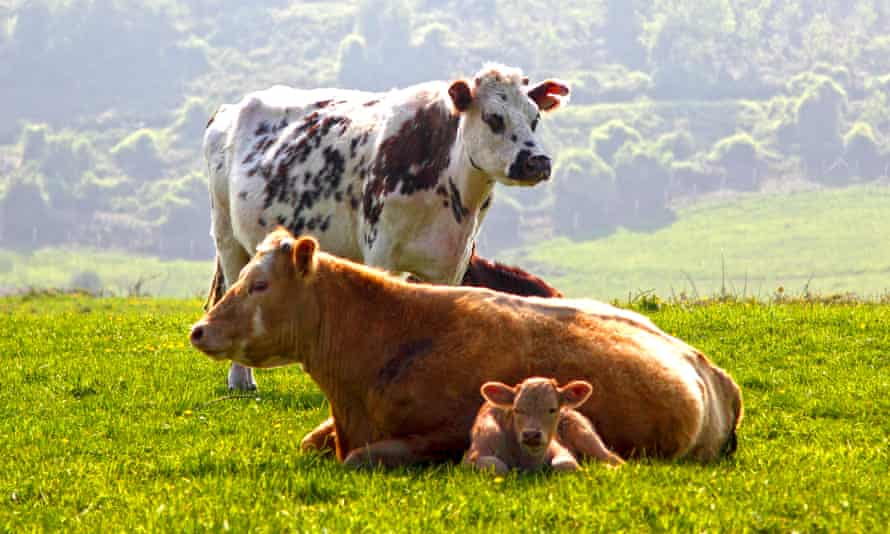
Cows in Normandy, France
Research in 2018 showed that without meat and dairy consumption, global farmland use could be reduced by more than 75% – an area equivalent to the US, China, the EU and Australia combined – and still feed the world. Photograph: DBPITT/Getty Images/iStockphoto

Sarah Marsh@sloumarshSun 25 Apr 2021 04.30 EDT

438

The UK business secretary, Kwasi Kwarteng, is considering a “full vegan diet” to help tackle climate change, saying people will need to make lifestyle changes if the government is to meet its new emissions target of a 78% reduction on 1990 levels by 2035.

But how much difference would it make if everyone turned to a plant-based diet? Experts say changing the way we eat is necessary for the future of the planet but that government policy is needed alongside this. If politicians are serious about wanting dietary changes, they also need to incentivise it, scientists and writers add.

The literature on the impact of going vegan varies. Some studies show that choosing vegetarian options would only reduce greenhouse gas emissions per person by 3%. Others show a reduction in emissions per person of 20-30%.AdvertisementPaths less trodden are best kept secret  | Brief lettersTalking to yourself: a good antidote to loneliness – or the sign of a real problem?Readers reply: why can’t people tickle themselves?How will my three-year-old cope with family weddings?Our baby is a year old. And what a strange 12 months it’s beenPaths less trodden are best kept secret |Brief lettershttps://imasdk.googleapis.com/js/core/bridge3.453.0_en.html#goog_1775637949https://imasdk.googleapis.com/js/core/bridge3.453.0_en.html#goog_232372636https://imasdk.googleapis.com/js/core/bridge3.453.0_en.html#goog_1214206122SKIP ADPaths less trodden are best kept secret  | Brief letters

“Probably the most important thing to point out is that emissions are often viewed as the only metric of sustainability: they are not. Impacts of farming systems on carbon sequestration, soil acidification, water quality, and broader ecosystem services also need to be well considered,” said Matthew Harrison, systems modelling team leader at the Tasmanian Institute of Agriculture.

“There is also a need to account for farming systems that may replace livestock,” he said.

The writer and environmental campaigner George Monbiot says the numbers on the impact of going vegan are different because of what scientists measure. “There are two completely different ways look at the carbon impact of diet: one is carbon released by producing this or that food – that is ‘carbon current account’. But another one is ‘carbon capital account’, which is the carbon opportunity cost of producing this food rather than another one,” he said.

“If you are producing meat, for example, what might land be used for if you took meat away? If you are growing forests there instead or peat bog there.”

Monbiot says what we eat is a “huge issue”, alongside our transport habits. “Most of what you can do at an individual level is weak by comparison to what governments need to do … but changing diet does not. That has a major impact,” he said.

“It is easier done if the government acts to change the food system but in the absence of that, we should still try and change our diets.”

In 2018, scientists behind the most comprehensive analysis to date of the damage of farming to the planet found avoiding meat and dairy products was the single biggest way to reduce your environmental impact on the planet. The research show0ed that without meat and dairy consumption, global farmland use could be reduced by more than 75% – an area equivalent to the US, China, European Union and Australia combined – and still feed the world.

“There are lots of different sectors that have an impact on emissions and the food system is surely one of the most important ones as it is globally responsible for about a third of all greenhouse gas emissions,” said Dr Marco Springmann, senior researcher on environmental sustainability and public health at the University of Oxford.

He added that the overwhelming majority of emissions were due to foods such as beef and dairy, which “means that without changing emissions associated with those products it is hard to make progress”. He said there were no good technical solutions for the fact that “cows emit methane emissions”.

“You can change feed composition but that does not change the animal and the need to feed the animal a lot of feed product,” he said. He believes the government needs to offer price incentives for sustainable products, making beef and dairy more expensive.

Frank Mitloehner, professor and air quality extension specialist at the University of California and Davis, said putting the onus on the individual was a distraction from policy changes that are needed. He said literature suggests “going vegan for two years has the same saving impact as one flight Europe to the US would generate.”

“If we really want to make a difference in carbon emissions we need to change policy. We need to have a cost for carbon that is appropriate. We need to incentivise those who can reduce greenhouse gas emissions to do so,” he said.

He believes the most important individual choice someone can make is to “go and vote … That is number one.”

Martin Heller, a research specialist at the University of Michigan, said: “There are no silver bullets for climate change. Nothing in isolation will be ‘enough’.”

He added that studies showed that even with gracious assumptions in improvements in agricultural production, feeding an anticipated population at anticipated growing demand for animal-based foods by 2050 would occupy “all of the allowable emissions if we are to stay below a 2C temperature rise”.

“We have to change the way we eat,” he said. “That certainly isn’t saying that diet change – or even becoming vegan – will ‘save the planet’. It’s more of a necessary but not sufficient kind of thing.” He added that “these diet shifts need to come with government, corporate and every other kind of action”.

“It’s also probably naive to assume that people will just change these behaviours because it’s good for the planet. It will require directed policy, changes in the restaurant and foodservice industries,” he said.