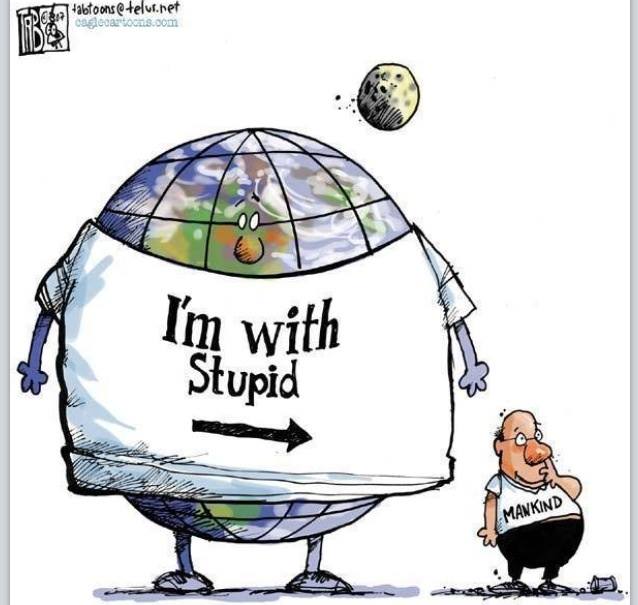
Earth’s Favorite T-Shirt
Image
5

“If you want to make a conservation biologist squirm, try this question: “How do you think the animal feels?” Scientists usually think in terms of populations and species.”
http://conservationmagazine.org/2014/10/killing-for-conservation/
October 24, 2014
The pressure to reach for a gun to help save one animal from another is stronger than ever. And it has triggered a conservation problem from hell.
By Warren Cornwall
We usually think conservation means saving animals. But its history is tinged with blood. John Audubon, a patron saint of the American conservation movement, killed hundreds of birds, partly for sport and partly for specimens to pose for his paintings. Aldo Leopold, a father of ecological science, endorsed killing wolves to increase deer populations.
Today, as climate change pushes animals into each other’s overlapping territories and humans drive ever more species to the brink of extinction, the pressure to reach for a gun to help save one animal from another is stronger than ever. In recent years, the federal government has shot Arctic foxes to guard the nests of rare Steller’s eider ducks. In Texas and Oklahoma, hunters blast cowbirds that take over the nests of endangered black-capped vireos. Sea lions have been put to death for the sake of salmon on the Northwest’s Columbia River. The U.S. Army Corps of Engineers plans to kill 16,000 double-crested cormorants in 2015 to help those same salmon. But the most controversial case may prove to be the northern spotted owl.
The spotted owl, an icon of the environmental movement, is a shy bird that favors ancient forests. Its declining numbers led to its listing under the Endangered Species Act, bringing a halt to most old-growth logging in Northwest federal forests in the early 1990s. Today, the migration of the barred owl from its original East Coast home poses a potentially fatal threat. Bigger and more aggressive than its smaller cousin, the barred owl has gradually pushed south in a seemingly inexorable wave since arriving in western Canada in the mid-twentieth century. Wherever it turns up in large numbers, spotted owls start to disappear. Biologists suspect spotted owls abandon their nests when they are driven off by the barred owl. In at least one case, a barred owl appeared to have killed and eaten a spotted owl.
Alarmed by the rapid decline of the remaining spotted owls, desperate biologists, federal bureaucrats, and environmentalists have hit upon a last-ditch, bloody scheme: shoot enough barred owls to create breathing room for spotted owls. Last winter, after years of studying the pros and cons of various approaches, the U.S. Fish and Wildlife Service embarked on a six-year experiment in four small parts of the Northwest (the initial four-year plan stretched to six, due to budget problems). Trained marksmen killed 71 barred owls in the first season, a number that could grow to as many as 3,600 owls over the span of the entire experiment. The tests are designed to show what it would take to really make a difference for the spotted owls. If the experiment is deemed a success, it could pave the way for death warrants for thousands of owls every year for decades, if not forever. It would be the largest known mass killing of raptors.
For bird lovers or for anyone with a soft spot for wild animals, this is a problem from hell. Nobody is happy with the options. Bob Sallinger, conservation director of the Audubon Society of Portland, summed it up neatly: “On the one hand, killing thousands of owls is completely unacceptable. On the other hand, the extinction of the spotted owl is completely unacceptable.”
The shootings have prompted an unusual amount of soul-searching. For the first time ever, the Fish and Wildlife Service—an agency with plenty of blood on its hands—convened people to grapple with the ethics of killing one animal for the sake of another. How should humans get involved in a fight between species? Step into the boots of people on the front lines of the owl wars. Would you open fire?
••
The first time Lowell Diller shot a barred owl, he almost couldn’t pull the trigger. He was standing in a grove of Douglas firs and redwoods outside the tiny northern California mill town of Korbel on a damp February afternoon in 2009.

He had lured the bird with a speaker perched on a stump, programmed to send out the barred owl’s haunting eight-note call: who-who, who-whooo . . . who-who, who-whooo. Now the female was perched just 30 meters away, an easy shot with his 20-gauge shotgun. Even in the fading light, he could see the distinctive white and brown stripes down its breast.
Diller had partly hoped no owl would answer his call. He raised the shotgun to his shoulder and tried to take aim. But he was shaking so badly, he feared he would miss. He lowered the gun, taking deep breaths and whispering to himself to calm down, to relax. He braced himself against a tree to steady the gun, told himself it was for the sake of science, and fired.
“It just fundamentally seemed so wrong to be shooting one of these birds,” said Diller, who recently retired from his job as a wildlife biologist with the Seattle-based Green Diamond Resource company. “You just don’t shoot raptors.”
Diller’s queasiness embodies the profound unease people are feeling in the Northwest. In the end, Diller weighed the options and chose what he felt was the lesser of two evils. Doing nothing, he feared, meant accepting the demise of the spotted owl. And that, for him, meant that the killing experiment was worthwhile. If someone needed to do the dirty work, Diller felt he shouldn’t ask someone else to take that job. Since that first day, he has shot 96 barred owls. It hasn’t gotten much easier.
This past spring, he and a handful of marksmen finished the first season of the experiment. They called it quits around the time eggs hatched, because they didn’t want to orphan chicks. The Fish and Wildlife Service draws the line at leaving young birds to slowly starve. This underscores the odd ways ethics can pop up in wildlife management. The shooters will be back in the fall, trying to kill those same owls.
••
How many barred owls would you kill to save a spotted owl? One? A hundred? A thousand? The calculus is straightforward for Dave Werntz: as many as it takes. Werntz is the science and conservation director for the environmental group Conservation Northwest, based in Bellingham, Washington. He sees the spotted owl as a rare, native species threatened by a new arrival that will likely survive quite well even if thousands are killed every year. So he supports an even more ambitious killing program than the one that the U.S. Fish and Wildlife Service is considering. He likens owl removal to pulling a weed. “I don’t see the barred owl as much different [from] addressing Himalayan blackberry or other domineering species that are impacting our landscape,” he said.
 His life has been intertwined with northern spotted owls for more than a quarter-century. In the late 1980s, he wandered the forests of southwest Washington, hooting like an owl. He was working for the U.S. Forest Service, counting spotted owls and tracking where they nested. It was the peak of the Northwest’s legendary timber wars, a time when protesters chained themselves to logging equipment to save vestiges of old-growth forest, loggers burned spotted owls in effigy, and federal courts took control of much of the region’s public timberlands—in part to protect the owl.
Repelled by clearcuts, and fascinated with the owls and old-growth forests, Werntz went back to school. He studied under University of Washington ecologist Jerry Franklin, a pioneer of a new understanding of the richness of old-growth forests. Werntz has been on the front lines of the fight over the owls ever since. In the 1990s, Werntz worked with environmental groups to push for stronger owl protections. Later he toiled to stop the timber industry from rolling back logging restrictions.
The politically charged history of owls and old growth makes the case of the barred owl even more fraught with controversy. Since humans destroyed spotted owl habitat and brought the species to this dire moment, Werntz believes people have an obligation to save the last remaining ones.
Nevertheless, Werntz frames the killing of barred owls as primarily a scientific matter, not a political or ethical one. This is a view commonly espoused by conservation scientists trained to think in terms of the fate of entire species rather than individual animals. While he doesn’t relish killing barred owls, Werntz sees it as necessary to protect a native species integral to the forests he loves. Biodiversity trumps squeamishness about bloodletting.
••
If you want to make a conservation biologist squirm, try this question: “How do you think the animal feels?” Scientists usually think in terms of populations and species. Individuals form the raw materials for the grand Darwinian drama of survival and evolution. Feelings are, by and large, beside the point.
But for some, the barred owl is a majestic creature endowed with animal intelligence—not a pest. Fish and Wildlife Service officials learned that at public meetings about the owl removal plan. They came to talk science. Many in the crowd spoke of how they felt about the owls as individuals.

Now a growing number of researchers are trying to bridge those two perspectives. They argue that the conventional approach to conservation risks ignoring the lives and experiences of wildlife—making for poor science and shaky ethics. Their new field, “compassionate conservation,” draws on a body of research documenting the cognitive and emotional lives of animals. Injured chickens self-medicate. Crustaceans learn to avoid pain, and they respond to stress in a way similar to that of vertebrates. And rats and dogs—even bees—are capable of pessimism. The more we learn about how animals think and feel, the more we empathize with them and the less we can ignore the suffering we inflict.
“The guiding principle of compassionate conservation is ‘First, do no harm,’ which means the life of each and every individual animal is valued,” writes Marc Bekoff in his “Animal Emotions” column at Psychology Today. Bekoff, a University of Colorado professor emeritus and animal behavior researcher, is a leading voice in the compassionate conservation field. “Trading off individuals of one species for the good of individuals of another species isn’t acceptable,” he says. That means no killing of barred owls.
Yet for many people, the owl dilemma falls into a gray area in which there is tension between the fate of the individual and the survival of a species.
Bill Lynn started out suspicious of the idea of shooting owls. An ethicist at Loyola Marymount University and Clark University in Massachusetts, he was hired by the Fish and Wildlife Service to run stakeholder meetings about the ethics of the lethal experiment. At first, he suspected the government’s killing program was a knee-jerk response that showed little regard for the animals. But the spotted owl’s dire situation changed his mind. He concluded that the experiments, if done as humanely as possible, would be a “sad good”—something unfortunate yet worth doing to help save a species. But he won’t endorse a region-wide war on barred owls until he sees how high the death toll would be.
••
Even if we manage to negotiate the moral thicket of killing one owl to save another—and emerge at the other end with gun at the ready—we run headlong into a practical question: What’s the exit strategy? Can we kill 10,000 barred owls every year forever?
That’s the figure some experts in the field use when they talk about what it will take to truly help spotted owls recover in the Northwest. On the optimistic side, some (such as Diller and Werntz) believe that as Pacific Northwest forests continue to recover from logging and more owl habitat opens up, the killing could slow down or stop after a few decades. Others worry that new habitat will just fill up with even more barred owls, creating a never-ending killing operation.
“I think in the long run we simply can’t control barred owl populations on a large scale,” said Eric Forsman, a U.S. Forest Service wildlife biologist and pre-eminent spotted owl researcher. “It would be incredibly expensive and essentially you’d have to do it forever.”
To date, studies on the effectiveness of lethal barred owl removal have been limited in scope and scale. In small tests on private forestland in northern California, spotted owls returned to nearly all their former nest sites after people shot barred owls that had taken over, according to Diller, who took part in the experiment. Where barred owls were left alone, he said, spotted owl numbers continued to fall. Those results have yet to be published.
The U.S. Fish and Wildlife Service, for its part, hasn’t offered a long-term plan of attack. They’re awaiting the results of their six-year experiment. That experiment is expected to cost $4 million—more than $1,000 per dead bird. And it will cover only two percent of spotted owl habitat in Washington, Oregon, and northern California. The other 98 percent is the worrisome part.
The logistics alone are daunting. First, there’s the problem of finding enough qualified shooters. It’s tricky to tell the difference between a barred owl and a spotted owl. For the experiment, the government is relying on trained gunmen. But declaring open season on barred owls could be a recipe for unacceptable collateral damage.
Then there’s the politics. Even if it is technically feasible, will the public get behind an open-ended mass owl killing with no clear exit strategy? Kent Livezey, a retired Fish and Wildlife biologist, has his doubts. “Even if you got the public to agree the first year, you just need some photographer to go out with them and show a bunch of dead owls,” he said.
Livezey worked for years to save spotted owls, helping to craft the plan for their recovery. But he’s personally repelled by the shooting plan, and he bowed out of the owl work when it came time to devise the experiment. For him, there were just too many dead raptors, and the plan set a bad precedent for other clashes between wildlife. He would rather see people pick a fight that can be won. He imagines using guns to halt the advance of barred owls south into the territory of the California spotted owl, a species that’s not rare yet. But it also means leaving the northern spotted owl without armed bodyguards. “Personally, I would just let nature run its course,” he said.
——-
Warren Cornwall is an environmental and science journalist living in Bellingham, Washington

Rising carbon dioxide levels in oceans adversely change the behavior of fish through generations, raising the possibility that marine species may never fully adapt to their changed environment, research has found.
The study, published in Nature Climate Change, found that elevated CO2 levels affected fish regardless of whether their parents had also experienced the same environment.
Spiny damselfish were kept in water with different CO2 levels for several months. One level was consistent with the world taking rapid action to cut carbon emissions, while the other was a “business as usual” scenario, in which the current trend in rising emissions would equate to a 3C warming of the oceans by the end of the century.
The offspring of the damselfish were then also kept in these differing conditions, with researchers finding that juveniles of fish from the high CO2 water were no better than their parents in adapting to the conditions.
This suggests that fish will take at least several generations to cope with the changed environment, with no guarantee they will ever do so, meaning several species could be at risk of collapsing due to climate change.
The research was conducted by the ARC center of excellence for coral reef studies, based at James Cook University in Queensland.
Previous studies by the center have found that rising CO2 levels in the oceans directly alters neuron transmitters in fish brains, modifying their behavior. Their sense of smell is hindered, as well as their wariness, meaning more are picked off by predators.
More than 90% of the excess CO2 in the atmosphere, primarily caused by the burning of fossil fuels, is soaked up by the oceans.
When CO2 is dissolved in water it causes ocean acidification, which slightly lowers the pH of the water and changes its chemistry. Crustaceans can find it hard to form shells in highly acidic water, while corals are more prone to bleaching.
Professor Philip Munday, a co-author of the study, told Guardian Australia the research suggested fish would not be able to adapt to climate change in the short term.
October 2, 2014 Nicky Phillips Science Editor
If you consider the consequences of global warming, it’s always the major effects that receive the most attention – glaciers melting, sea levels rising, more frequent and more intense bushfires, floods and cyclones.
But climate change is affecting plants and animals in ways that are far less spectacular and harder to detect. And yet these subtle changes have the same potential to decimate populations.
This month scientists will publish research that links a decline in the nutritional quality of leaves eaten by colobus monkeys in Uganda to changes in climate over the past 30 years.
Specifically, the team found that in a range of plant species in Kibale National Park the amount of fibre had increased by up to 15 per cent, while the proportion of protein had decreased by about 6 per cent.
David Raubenheimer, a professor of nutritional ecology and co-author of the study, said this shift was significant because many variety of monkey selected their food based on its nutritional quality, in particular the amount of protein to fibre in plant leaves.
“We know if we go out and measure leaves and find patches that have a lot of protein to fibre, that’s good territory for monkeys,” said Professor Raubenheimer, from the Charles Perkins Centre at the University of Sydney.
But over the past three decades the climate in Kibale National Park has become hotter and wetter, which in turn has altered the composition of plant foliage.
The team, led by primatologist Jessica Rothman from the City University of New York, found nine out of 10 species had increased their fibre concentration and reduced in protein. Only one plant showed the opposite trend, where its protein level increased.
“There are a number of experiments on plants showing that an increase in temperature and moisture has an impact on the fibre concentration,” Professor Raubenheimer said.
A rise in carbon dioxide in the atmosphere has also been linked to a drop in the amount of protein in leaves.
While colobus populations remain stable, the study, published in the Ecology journal, propose that this shift in plant nutrients will have a significant effect on future populations.
Professor Raubenheimer said monkeys cannot digest a lot of fibre. So as fibre increases in their diet, he predicts their other nutrients needs, from protein and sugars, will not be met.
Females deprived of a balanced diet are less fertile and give birth to smaller young.
“The population birth rate is slowed, so you get a decline in population,” he said.
Because humans had destroyed so much plant and animal habitat for urbanisation and agriculture, many species were confined to isolated pockets of bushland or nature reserves.
“If climate change is causing these [reserves] to change biologically, then there is nowhere for them to go,” Professor Raubenheimer said.
“They can’t migrate to follow climates that are better suited to them like they could have a few hundred years ago.”
Unusually high water temperatures throughout the North Pacific Ocean have brought concerns from researchers about how it could affect native species of fish as well as sightings of uncommon species.
The three areas of the North Pacific with the most notable warming trend include the Gulf of Alaska, the Bering Sea and an area off the coast of Southern California down to Baja California, Mexico, with temperatures as high as 5 degrees above average.
These sea surface temperature anomalies have remained this way for more than a year, one of the longest stretches on record, according to researchers with the National Oceanic and Atmospheric Administration (NOAA).
 This is a sea surface temperature anomaly map in the North Pacific Ocean. The darker the red, the farther above average the sea surface temperature, according to NOAA. (Photo/NOAA)
A big concern for native species of fish, such as salmon, is that the primary food items they eat may no longer be available, Weitkamp said.
Potentially adding further stress to the situation, warm water also increases the metabolic rate of the fish so they have to eat more in warmer water, but there may not be enough to eat because the conditions are not suitable for their food items, Weitkamp said.
RELATED:
Great White Shark Populations Increase in Both Pacific, Atlantic Waters
PHOTOS: Rare Blue Lobster Caught in Maine
Northwest Regional Weather Radar
Nate Mantua, leader of the landscape ecology team at the NOAA Southwest Fisheries Science Center, attributes these conditions in the Gulf of Alaska to the same ridge of high pressure that’s believed to have contributed to California’s extreme drought. Storms and winds that commonly cool and stir the sea surface have been quelled by the ridge.
“If the warming persists for the whole summer and fall, some of the critters that do well in a colder, more productive ocean could suffer reduced growth, poor reproductive success and population declines,” Mantua said in a NOAA Fisheries article.
“This has happened to marine mammals, sea birds and Pacific salmon in the past. At the same time, species that do well in warmer conditions may experience increased growth, survival and abundance,” Mantua said.
Another effect likely brought about by the noticeably warmer waters is observations of different species of fish that are not known for frequenting this part of the ocean.
Earlier this past summer, a research vessel found a thresher shark in the Gulf of Alaska, which was the northernmost documented catch of the species, according to Michael Milstein, a spokesman for NOAA Fisheries.
“Thresher sharks are know for preferring warm waters,” Milstein said.
More: http://www.accuweather.com/en/weather-news/warm-north-pacific-waters-threaten-fish/34699318
This is the opening scene—ground zero—in the 1995 film Outbreak, in which an Ebola-like virus ultimately lands on U.S. soil and becomes an unstoppable killer. In the film, the virus is connected directly to the deforestation of the land enacted by western military: a local health care worker tells a U.S. army virologist, played by Dustin Hoffman, that the local “juju man” believes “the gods were awoken by their sleep by the man cutting down the trees where no man should be, and the gods got angry; this is their punishment.”
In 2011, Steven Soderbergh’s Contagion looked anew at the same issues of global infection, and here too, the filmmakers came to the same conclusion: the source of the killer virus is (spoiler alert) also industrial deforestation. In the 21st century edition, a multinational bulldozes a grove of palm trees in China for some unnamed purpose, destroying the nest of some local bats. Those bats end up flying over a pig farm, dropping a piece of infected fruit into the pen. The pig eats the fruit, the humans eat the pig, and the next thing you know, the contagion is spreading.
These, and other, pop culture characterization of Ebola-like viruses place the blame for the spread of the disease squarely on the shoulders of globalization and man’s careless despoiling of the environment. It’s not just Hollywood that believe that we are the cause of our own potential demise.
“Humans are the major driver of emerging diseases,” says Jonathan Epstein, an epidemiologist at the non-profit EcoHealth Alliance who studies Ebola and other infectious disease. “Things like agricultural expansion and deforestation…and certainly travel and trade — these are things that manipulate our environment and allow pathogens to get from animal hosts to people and then travel around the world.”
In a study published in 2012, researchers asked national infectious disease experts in 30 different countries whether or not they thought climate change would affect infectious disease patterns in their countries. The majority agreed.
Nevertheless, it’s unclear whether these beliefs are driven by good science, or, as Malcolm Gladwell argued way back in 1995, a guilt-driven “idea of disease as a punishment for wickedness.”
It’s true that West Africa, where the latest and most catastrophic Ebola outbreak is currently raging, has faced unequivocal environmental changes in recent years. The International Food Policy Research Institute published a report in 2013, finding that in Sierra Leone (the epicenter of the outbreak), climate change has resulted in “seasonal droughts, strong winds, thunderstorms, landslides, heat waves, floods, and changed rainfall patterns.”
And there is, according to the World Health Organization, a recent global increase in infectious diseases that seems to correspond with rising global temperatures. But determining whether there is a direct causative relation between the two is a hazy business.
One issue at play is food scarcity. The Ebola virus is known to spread into human populations through contact with an infected animal. The virus can live for years in animal populations (such as bats and monkeys) without harming the animals, becoming dangerous to humans only when humans prepare and eat infected bush meat. Poorer populations, living in resource-strapped areas, are the most likely to become stricken with the virus—because they’re the ones most likely to rely on bush meat to feed their families. And according to the 2013 IFPRI report, “poor communities suffer the most from climate change impacts.” It’s not hard to extrapolate from there and estimate that as these communities become more and more needy, they will encroach further into the wild in search of food. These changes in human behavior will likely impact the natural environment.
“We we see more incursion into the forest, we might see more exposure to Ebola,” says Stephen Morse, an infectious disease and epidemiology expert at Columbia University. “But it’s unclear whether there would be a net positive or net negative.”
Morse believes that the only way to make an educated guess at how climate change will impact future Ebola outbreaks is to undertake nuanced microclimate analyses of the specific African regions that have been affected in the past. And even that might not say all that much, given that Ebola and other emerging diseases seem to pop up in new parts of the continent every few years.
On the other hand, research does suggest strongly that warming global temperatures will make vector-borne diseases like malaria more common, mostly because the vectors that carry those diseases — like mosquitoes — thrive in warmer climates.
In the past few century, the temperatures of the oceans have risen significantly, at an average of 0.13 degrees Fahrenheit per decade. And it turns out cholera thrives in warm water; research has shown that rising sea temperature seem to be connected to rising incidences of cholera. Further, as temperatures rise, the polar ice caps will continue to melt, leading to rising sea levels. The most dire prognosticators warn that low-elevation coastal zones
This is particularly problematic in developing countries. Globalization has led to significant change in the demographics in these parts of the world; in Africa, more and more people are moving out of the rural areas and into the growing cities. That, in turn, has had some serious public health consequences that look to worsen in coming years.
“As you move towards these megacities and mega populations on coastal areas, you wind up with huge vulnerability to infectious outbreaks because of inadequate sanitation and water,” says Stephen Morrison, the director of the Center for Strategic & International Studies’ Global Health Policy Center. “And then if you have flooding, those coastal environments will be more at risk because of climate change. You’ll be at a higher risk of the kind of infectious outbreaks like cholera.”
And the reality is that both malaria and cholera have had — and are expected to continue to have — a much bigger impact on public health than Ebola (unless the current outbreak becomes a truly once-in-a-lifetime, Hollywood-style pandemic). The WHO estimates about 110,000 deaths due to cholera every year; malaria killed an estimated 627,000 in 2012 alone. Meanwhile, since the first Ebola case was identified in 1976 there have been only 1,600 Ebola-related deaths.
That, though, is not exactly good news for human populations. Because though modern society’s impact on the Earth’s environment may not result in an explosion in Ebola, it seems that it will almost certainly drive up rates of these other, far more dread diseases.
Predators play crucial roles in ecosystems. They weed out prey that are sick or old, and they can even push species to move in order to stay in their climatic comfort zones. Now, scientists have taken a look at how climate change might impact predators which could, in turn, affect entire ecosystems…
A historical example of this particular phenomenon is the sea otter. These mammals were once decimated by the fur trade that spanned the late 1700s to the early 1900s. This important predator species regulated prey in areas spanning from Alaska to Baja California, Mexico.
“The near extinction of sea otters is one of the most dramatic examples of human-induced impacts to the structure and functioning of temperate nearshore marine ecosystems,” said Rebecca G. Martone, one of the researchers, in a news release.
Without sea otters, which live on abalone, clams, crabs, mussels, shrimp and sea urchins, kelp forests suffer. Without the otters, undersea urchins prey on kelp forests, causing dense areas to become barren and essentially disrupting entire ecosystems. In fact, scientists found that this may even have an effect on climate change.
Kelp forests grow rapidly and store large amounts of carbon. This means that if otters are absent and urchins are destroying these forests, more carbon is released. Not only that, but kelp provides a three-dimensional habitat for species such as rockfish, seals, sea lions, whales, gulls, terns, snowy egrets and some short birds. Without otters, though, these communities rapidly decline.
The analysis of the effect of sea otters shows that predators play huge roles in ecosystems. This means that climate change that affects predators negatively can also greatly impact ecosystems. A symposium focusing on climate’s effects on predators will occur during the Ecological Society of America’s 99th Annual Meeting in Sacramento, California.
From Ocean Conservancy.org:
Breaking: The U.S. government is beginning to make plans for future offshore oil and gas operations—and those plans could open Arctic waters to risky drilling.
This follows Shell Oil’s decision to abandon Arctic drilling this summer, after an accident-plagued 2012.
If a disaster like BP Deepwater Horizon happened in the Arctic, spill response would be even more challenging. The Arctic’s sea ice, freezing temperatures, gale force winds, and lack of visibility could make cleanup next to impossible.
The government’s public comment period ends on July 31, so we only have 10 days to respond. We need you to tell the Bureau of Ocean Energy Management (BOEM) to say no to risky Arctic drilling now.
The Arctic Ocean and all those who depend on it are already under stress. The rapidly changing climate, including extreme deterioration of the summer sea ice, is putting Arctic marine animals at risk. Many people who live in coastal communities in the Arctic depend on a clean and healthy ocean to support their subsistence way of life. Offshore drilling for oil and gas would expose this already fragile ecosystem to significant noise, pollution and traffic.
Answer: Well, nothing really, yet. They just happen to be three of the more popular keywords, and I hoped that if I used them in a title I’d tempt more of you to read some of the recent posts that have been overlooked according to this blog’s stats.
Why, for instance, did an article about Kendall Jones’ trophy hunting pictures receive over 22,000 reads here, whereas posts about climate change, elk or mute swans have only been looked at by a few dozen?
I’m trying to figure out what makes people tick.
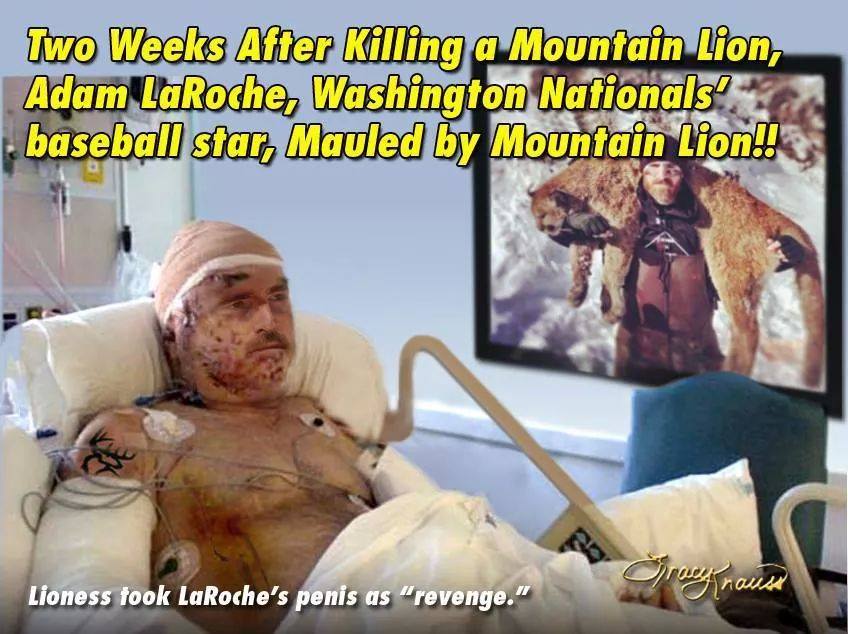
Maybe there just aren’t enough hunting accidents involving trophy hunters to keep people reading, so here’s one that someone made up:

 Exposing the Big Game