On a planet wracked by rising seas, expanding deserts, withering biodiversity, and hotter temperatures, that’s a fraught question to answer. Food production accounts for roughly a quarter of the world’s greenhouse-gas emissions, and scientists have found that limiting global warming will be impossible without significant changes to how the world eats. At the same time, climate change is threatening the world’s food supply, with land and water being exploited at an “unprecedented” pace.
A new guide to living through climate change
The Weekly Planet brings you big ideas and vital information to help you flourish on a changing planet.Join the Newsletter
Reforming the food system to save the planet is going to require new corporate practices, and new laws and regulations at the national and international levels. But individual consumer behaviors matter as well—more than you might think. Your diet is likely one of your biggest sources of climate emissions. But what should you do? Eat locally? Get your food from small-scale farmers? Choose organics and fair trade? Avoid processed foods? Eat seasonally?
The choices are many; the stakes are high. But experts on land use, climate change, and sustainable agriculture told me that two habits tower above all others in terms of environmental impact. To help save the planet, quit wasting food and eat less meat.
The conservation nonprofit Rare analyzed a sweeping set of climate-change mitigation strategies in 2019. It found that getting households to recycle, switch to LED lighting and hybrid vehicles, and add rooftop solar systems would save less than half the carbon emissions combined than would reducing food waste and adopting a plant-based diet.
Let’s begin with the role of food waste. Americans waste a lot of food. Nearly one-third of it, in fact. More than 130 billion pounds a year, worth roughly $160 billion. We throw away enough food to close our own “meal gap” eight times over. Food is the single biggest component of our country’s landfills, and the average American sends more than 200 pounds of food there every year. More than 1,250 calories per person a day, or more than 140 trillion calories a year, get tossed in the garbage.
Households, not restaurants or schools or corporate cafeterias, are the dominant wasters. The problem is worse in the United States than in most other countries, and it has worsened over time. When you toss a spoiled chicken breast or moldy tomato into the trash, you’re wasting a greenhouse-gas-intensive product. You’re also sending it to a landfill, where it will emit methane.
Addressing food waste would be low-hanging fruit: The country could save money, emit less carbon into the atmosphere, alleviate the burden on landfills, reduce the number of animals subjected to life on a factory farm, and address its hunger crisis just by eating all the food it makes. Households consuming more of what they buy, and thus buying less, would have a major effect on the whole food system. Food suppliers would produce less to meet the country’s more efficient demand. Supermarkets would stock less food. Fewer trucks would need to run from plant to store. Fewer refrigerators would be needed in stores and industrial facilities to keep groceries cold. Fewer cows would fill up feedlots. Fewer acres of corn and soy would be grown to feed them.
How to do it? For one, get wise about expiration labels and quit throwing out perfectly good food. Research shows that nearly all Americans misinterpret date labels and toss their groceries out prematurely, for fear of food poisoning, and understandably so. Retailers and production companies use 50 different use by–type labels, and none is federally regulated, except for those on infant formula. sell by stamps tend to be for inventory management, and have nothing to do with food safety; best if used by and use by stamps tend to be about freshness and food quality, not whether you are about to enjoy a serving of mycotoxins. As a general point, most food is safe to eat as long as there is no evident spoilage, such as visible mold or an off smell. “Use your senses,” says Yvette Cabrera of the Natural Resources Defense Council, the conservation nonprofit, noting that those senses were refined through millennia of natural selection in no small part to help us figure out whether food is safe to eat.
Experts also point to a series of simple, old-fashioned techniques households can use to ensure that they eat more of the food they buy. They amount to thinking like your Depression-era forebears, pretty much. Figure out appropriate portion sizes; eat your leftovers; store food in appropriate containers and at the right temperature; prepare and freeze perishables instead of letting them linger and go bad; and shop in your refrigerator and cabinet before you hit the store.
And when you’re at the store, there is one dietary change to consider that beats all others in terms of its climate impact. It is not eating locally or seasonally. It is not eating organic or fair-trade. It is not eating unprocessed foods or avoiding big-box and fast-food retailers. It is eating less meat. Roughly three-quarters of the world’s farmland is used to pasture livestock or raise crops to feed that livestock. That contributes to deforestation, destroys the planet’s natural carbon sinks, erodes the planet’s biodiversity, and uses up fresh water.
The main, mooing offender is beef. Cattle are responsible for roughly two-thirds of the livestock sector’s greenhouse-gas emissions, while beef and dairy products are responsible for about one-tenth of global emissions overall. Gram for gram, beef produces roughly eight times more greenhouse-gas emissions than farmed fish or poultry, 12 times more than eggs, 25 times more than tofu, and even more compared with pulses, nuts, root vegetables, bananas, potatoes, bread, or maize.
Beef is so bad for two reasons, Michael Clark, a scholar of food systems and health at the University of Oxford, explained to me. The first is that it takes a lot of inputs to produce beef as an output: about 20 kilograms of corn and soy protein to produce one kilogram of beef, he said. The second is that cows produce methane as they digest their food. “Other types of animals don’t do that,” he said. “And methane is a more potent greenhouse gas than carbon dioxide.”
Trading your rib eyes and cheesesteaks for lentils and tofu is one of the best things you can do as a consumer for the environment; if all Americans did, the country would be roughly halfway to hitting its Paris Agreement targets. Still, the all-or-nothing way the choice is often presented is a mistake. There is enormous acreage between the Atkins diet, or even the meat-heavy diet of the average American, and full-on veganism, which remains a niche lifestyle choice that few follow for long. Better all Americans cut meat consumption by 40 percent than 3 percent of Americans cut it out completely. Experts encourage taking small, meaningful steps to reduce your meat consumption, and trying to find some joy in doing it. Participate in Meatless Monday; try learning to cook dishes from a plant-heavy cuisine you like; offer a vegetarian option at work events; opt for dishes where meat plays a supporting, rather than leading, role.https://d858d25b90763dc6b2a9f8f70ad934b6.safeframe.googlesyndication.com/safeframe/1-0-38/html/container.html
After wasting less food and eating less meat, all other changes a person might make are marginal, experts said, among them eating locally, organically, and seasonally. Moreover, the climate impact of those food choices is in many cases contradictory. “I work in food, and it’s confusing for me,” Cabrera, of the NRDC, told me. “Is this lettuce better than this lettuce? Consumers are faced with so many choices, and it is really hard to know.”
Humanely raised, local meat, for instance, can produce more emissions than meat coming from a concentrated industrial operation, Clark told me. Cows in concentrated animal-feeding operations are generally slaughtered at 12 to 18 months of age, while cows raised exclusively on pastures typically live twice as long. “The cow that lives for longer is going to emit more methane over the course of its lifespan,” he said, though he added that there were still compelling reasons to opt for the local beef.
Similarly, growing a given amount of organic produce usually requires more emissions and acres of land than growing the same amount using conventional farming methods. One study conducted in Sweden, for instance, showed that organic peas and wheat have a bigger climate impact than their conventionally farmed cousins.
That said, when it comes to the emissions related to shipping food around the world, experts argue that—surprisingly—local is not always better. There’s a certain uncanny decadence to eating Peruvian avocados and Chinese grapes in the dead of winter, or opening a bottle of French Beaujolais or a package of Scottish smoked salmon at will. But transporting food around the world tends to make up only a small share of a given product’s total greenhouse-gas emissions. What you are eating and how it was farmed is far more important than how it got to you, and imported food typically has a low carbon impact.
For all that, experts said there are good reasons to opt for organic, locally produced, seasonal food, even if it might not be as efficient to produce, or might not have the lowest greenhouse-gas emissions. Many smaller-scale operations outside Big Ag produce food without pesticides, without monoculture, with manure instead of chemical fertilizers, and with respect for biodiversity and soil health. Those are all important facets of environmental preservation too.
Complicating things, what’s good for the environment isn’t always what’s good for animal welfare. When it comes to eating animals, “unfortunately, the cruelty scale is the flip of the emissions scale,” Leah Garcés, the president of Mercy for Animals, a nonprofit that advocates for better conditions for animals raised in industrial environments, told me. A family can easily eat a chicken in a single night, but might struggle to eat a whole cow over the course of a year. Moreover, transportation and processing is much rougher on birds, which have delicate bodies. (Each year, more than 1 million chickens die en route to slaughter, and half a million are not actually dead when they hit the scalding tank.) For these reasons, a chicken breast represents much more suffering than a steak, even though the steak is worse for the planet. But the fact remains: The fewer animals you eat, the fewer die, and the better off the planet is.https://d858d25b90763dc6b2a9f8f70ad934b6.safeframe.googlesyndication.com/safeframe/1-0-38/html/container.html
Diets that are good for the planet tend to be good for people too. Research by Clark and his colleagues has shown that foods associated with good health generally have low environmental impacts, “indicating that the same dietary transitions that would lower incidences of noncommunicable diseases would also help meet environmental sustainability targets.”
Our diets are cooking the planet, and changing them, even in small ways, might help avert catastrophe. A burger for lunch, a bag of wilted greens in the trash—these may not be as obviously destructive to the environment as a private jet or a gas-guzzling car. But they are choices we make daily, and they matter.
According to research published yesterday in Nature Climate Change, by the end of this century, lightning will be about twice as likely in the Arctic if greenhouse gas emissions continue as usual.
“We’ve been trying to find out in the Arctic region, where there’s little fire in the region previously, how that will change in the future,” says Yang Chen, who researches climate and wildfire at UC Irvine, and was the lead researcher on the study. “And the only ignition source is lightning strikes.”
Lightning requires two ingredients: warm air that rises quickly from the ground, and moisture. “When you get warm air … it kind of bubbles up through the atmosphere,” says Peter Bieniek, a climatologist at the University of Alaska who was not involved in the research. “It actually condenses, just like you would condense humid air on a cool window.” When that water freezes into ice, it can create lightning.
Those turbulent, wet conditions are becoming more common across the United States. A 2014 study in the journal Science predicted that by the end of the century, the country would experience 50 percent more lightning. What’s surprising, Chen says, is the magnitude of the changes in the Arctic: “It’s really big. It’s much bigger than in other regions of the world.”
The Nature research is actually the second recent study to find this result in the Arctic: a team of researchers in Alaska predicted last year that lightning strikes would double in the state over the next century. Alison York, a fire ecologist at the University of Alaska Fairbanks who co-authored that study, says that the findings in this most recent research are consistent with other work. “The physics of climate change would say, yes, we would have increased lightning, just from increased air temperatures.”
Those changes have implications not only for the Arctic landscape, but for the entire planet.
Right now, fire isn’t a major component of the tundra. “If you think of a tundra ecosystem, you think of these little tiny plants: little tiny blueberries, dwarf mosses, birch, lots of mosses,” says York. That’s because only a few inches to a foot of ground thaw out every summer, and larger plants can’t survive in the shallow conditions. That also means that fires normally don’t spread widely. “The fires are kind of like peat burning, along the surface,” says Chen, or into the carbon stored in the ground itself.
[Related: Beavers might be making the Arctic melt even faster]
The “dirt” on a tundra is mostly layers of older, dead plants, says Troy, “forming this blanket of moss, and litter” called duff.
More lightning would mean more fire, and that could tip the environment into something entirely different. Spring melts could reach deeper into the ground, and trees could take root in the bare soil. That process is likely to speed warming, and maybe spur even more lightning.
At stake is the permafrost, the rock-hard layer of soil that hasn’t thawed in tens of thousands of years, and which locks in a sleeping giant of methane, half-decayed plants, and carbon-rich dirt. In some places, that material has piled up thousands of feet deep. When it escapes—through burning, rotting, or simply burping out into the air—it contributes to greenhouse gas emissions, speeding up climate change.
With the insulating mosses and grasses burned away, it’s likely that the permafrost will melt even faster. “That blanket keeps the permafrost cold. And as the fire burns into that blanket of duff, the underlying ground is exposed and warmed,” says Troy.
If the fire goes deep enough, there’s more ground to grow in, allowing trees and shrubs to move in, which in turn speeds up the warming process. Because trees are darker than the surrounding snow, they absorb heat rather than reflecting it. “You can actually deliver energy directly from the sun to the soil surface, so you can actually accelerate permafrost thaw,” says James Randerson, an author on the recent paper who studies climate change’s impact on Arctic ecosystems at UC Irvine.
Forests also have their own effects on fire and lightning; there’s some evidence that, because they create warm, wet conditions, they can actually promote lightning storms overhead. And when a fire is sparked in the boreal forest, it tends to jump from tree to tree, resulting in much larger blazes. Lightning will probably become more common in forests too, but won’t create the same kinds of landscape changes.
“We have not seen documentation of treeline migration on a large scale, but that might just be a process that takes a long time to observe,” Troy says. And, she notes, some of the trends can be seen in localized areas already, as in the site of a giant 2007 tundra fire that’s now growing back as willows and other brush.
The transition might take decades, Randerson agrees. “There’s a time delay between when climate conditions are suitable, and the migration rates of these trees’ lifetimes. It takes them a while to catch up.”
On January 13, one week before the inauguration of Joe Biden as the forty-sixth president of the United States and seven long days after the storming of the Capitol by an armed right-wing mob, it was easy enough to miss an article published in the journal Frontiers in Conservation Science, despite its eye-catching title: “Underestimating the Challenges of Avoiding a Ghastly Future.” The headline was itself a train wreck: six dully innocuous words piling up in front of a modifier more suitable to a 1950s horror comic than a sober, academic journal. But there it was: The 17 scientists who co-wrote the article, the experts who peer-reviewed it, and the journal’s editors did not consider the word “ghastly” too sensational, subjective, or value-laden to describe the future toward which our society is advancing with all the prudence and caution of a runaway locomotive. The article’s message was simple: Everything must change.
On its current track, the authors wrote, “humanity is causing a rapid loss of biodiversity and, with it, Earth’s ability to support complex life.” As many as a million animal species—and 20 percent of all species—are facing near-term extinction. Humans have altered 70 percent of the planet’s land surface and “compromised” or otherwise despoiled two-thirds of its oceans, and the climate has only begun to warm. Humanity—or some of us, anyway—“is running an ecological Ponzi scheme in which society”—or some sectors of it—“robs nature and future generations to pay for boosting incomes in the short term.” Only a radical transformation of the systems that govern our relations to one another and to the myriad forms of life with which we share the planet, the authors concurred, could deliver any hope of a “less-ravaged future.”
One week later, Joe Biden took the oath of office and quickly signed sweeping executiveorders declaring it the explicit policy of his administration “to listen to the science.” He didn’t use the word “ghastly,” but he did mention “a cry for survival … from the planet itself,” one that “can’t be any more desperate or any more clear.” This was strangely comforting to hear. He rejoined the Paris accord, revoked a slew of Trump-era executive orders, and restored, albeit temporarily, the moratorium on drilling in the Arctic that President Barack Obama had issued on his way out the door. However slow Biden had been to catch on to the true magnitude of the climate crisis during the primaries, he had, after months of sustained movement pressure, apparently begun to come around.Get independent, fact-based journalism: 3 months for $5Subscribe
To his credit, in his first week in office, Biden went further than any of his predecessors ever had. He ordered a “pause” on all new permits and leases for oil and gas drilling offshore and on federal land and shut down the Keystone XL oil pipeline, which activists had been fighting for more than a decade. He ordered federal agencies to pursue a “carbon pollution–free electricity sector no later than 2035,” and the full conversion of all government fleets to zero-emissions vehicles.
Perhaps most significantly, Biden’s actions aimed to institutionalize the mitigation of climate change as a priority in the daily workings of the federal bureaucracy. He ordered the creation of an Office of Domestic Climate Policy, a national climate adviser, a special presidential envoy for climate, and, in an explicit echo of the New Deal program—though green only with a lowercase g—a Civilian Climate Corps. He directed federal agencies to “implement a Government-wide approach that reduces climate pollution in every sector of the economy,” to center climate in foreign policy decisions, to eliminate fossil fuel subsidies, and to “promote ending international financing” of fossil fuels. There was even, in the very first section of his first climate order, a mandate for environmental justice and the protection of communities of color that had been disproportionately harmed by polluters. Whether that would mean any real inclusion—“If you’re not at the table, you’re on the menu,” as one South Carolina environmental justice activist put it to me—remains an open question. But as a signal of his administration’s priorities and its sense of urgency, it was, all the climate activists I spoke to agreed, an extremely solid start.https://3e2ce429ad8218c24d438728d948328a.safeframe.googlesyndication.com/safeframe/1-0-37/html/container.html
There was of course also a good deal of typical Democratic half-stepping. Why a “pause” on drilling and not an outright ban? (And why had the administration quietly gone ahead and approved 31 new drilling permits anyway?) Why no mention of fracking? Why not just shut down all the oil and gas pipelines that “[disserve] the U.S. national interest,” as the executive order put it, in exactly the same ways that Keystone XL did? And why not immediately declare a climate emergency, which would have opened up executive powers that would enable him to evade many of the roadblocks erected by the 50 Republicans in the Senate? Even Senate Majority Leader Chuck Schumer, no one’s idea of a radical, was urging Biden to do so. “If there ever was an emergency,” Schumer said, “the climate crisis is one.”
Still, with these and more caveats and endless sound reasons for mistrust, after four long years of Trump’s out-and-out denialist, kleptocratic mayhem, the sheer momentum of Biden’s actions did feel pretty good. At least it allowed us to contemplate the prospect ahead with something other than pure dread. But a couple of months into the Biden era, enough time has passed for it no longer to seem impolite to point out that we should not be reassured. The “ghastly future” that those 17 scientists were warning of will still arrive, right on schedule or perhaps a little early, so long as Biden stays within the frame of what now counts as pragmatic climate policy—which, it turns out, is not very pragmatic at all.
Those 17 scientists did not want you to despair. “Ours is not a call to surrender,” they wrote. It was meant as a kick in the ass—a reminder that our only chance is a thoroughgoing transformation. Specifically: “fundamental changes to global capitalism, education, and equality, which include inter alia the abolition of perpetual economic growth.” Radical as this call may seem, it was hardly an outlier demand from a few oddball pinko Ph.Ds. In 2019, 11,258 scientists from 153 countries signed a “Warning of a Climate Emergency” that called for “bold and drastic” changes to the economy, including a shift away “from GDP growth and the pursuit of affluence toward sustaining ecosystems and improving human well-being.” Two years before that, the Alliance of World Scientists made a similar call in a “Warning to Humanity” that garnered 15,364 signatures. We are supposed to listen to science now. This is what the scientists are saying: Everything must change.Get independent, fact-based journalism: 3 months for $5Subscribe
A strange sort of faith lies at the core of mainstream climate advocacy—a largely unexamined belief that the very system that got us into this mess is the one that will get us out of it. For a community putatively committed to scientific empiricism, this is an extraordinary conviction. Despite reams of increasingly apocalyptic research, and despite 25 years of largely fruitless international climate negotiations, carbon emissions have continued to rise, and temperatures along with them. We are at nearly 1.2 degrees Celsius of warming already—more than 2 degrees Fahrenheit over preindustrial averages—and three-tenths of a degree away from blowing the Paris accord’s aspiration to limit warming to a still-calamitous 1.5 degrees Celsius. Scientists now expect us to hit that threshold in about 10 years, and large swaths of the Arctic have been in actual flames for two summers running, but most governments with the option to do so are still feeding the beast that got us here.https://3e2ce429ad8218c24d438728d948328a.safeframe.googlesyndication.com/safeframe/1-0-37/html/container.html
Even with the grim opportunity presented by the Covid-19 pandemic, which slowed the economy so much that growth in fossil fuel production dropped an almost unprecedented 7 percent last year, governments—ours very much included—have so far dumped much more stimulus spending into high-carbon industries than into renewable energy. It’s as if our economic system, and the politics it breeds, will not allow us to diverge from the straight path to self-obliteration.
The faith nonetheless persists: The market will provide. It has not done so yet, but renewables are perhaps finally cheap enough—cheaper at last than conventional energy sources—that the transition is now inevitable. So the credo goes. The change that is coming will be largely technological: a bold new era of “green growth.” Modern societies erected on dirty coal and oil can be jacked up and shifted to cleaner forms of energy like an old house in need of a new foundation. Government may have a larger role in this transition than neoliberal dogma has recently allowed, but its primary task will still be to encourage innovation and feed the markets by shepherding the resulting growth.
It is no coincidence that some version of this faith, so all-pervasive now that it does not register as a piety, has been reshaping the planet for almost precisely as long as fossil energy—first coal, then oil—has been altering the atmosphere. Capitalism is guided by a carbon creed, an ecstatic vision of a market that chugs along eternally, needing only new inputs—the earth itself, commodified as minerals, or water, housing, health care, or almost any living thing—to spew out wealth that can be shoveled back into the machine, converting more and more of the biosphere into zeros in a digital account: more fleshless, magical money that can be invested once again. If appetites are bottomless, and apparently they are, shouldn’t growth be endless too?
The market’s grip on the political imagination so effectively blinds us to alternatives that we are unable fully to grasp that this is the basic script that the new administration is following. Even the Green New Deal does not substantively diverge from it. The climate crisis, an existential threat to planetary life, must be sold to Wall Street and the public at large as a growth opportunity. On January 31, John Kerry, acting as Biden’s new climate envoy, enthused to CNN’s Fareed Zakaria about “literally millions of jobs” that would soon be created, about all the “new products coming online,” and about oil companies’ newfound passion for “carbon capture and storage and so forth.” The private sector, he said, “has already made the decision that there is money to be made here, that’s capitalism, and they are investing in that future.” If that makes you nervous, it shouldn’t, Kerry insisted. The changes ahead would be like the analog-to-digital shift of the 1990s, only better: “the important point, Fareed, for people to really focus on is it’s a very exciting economic transition.”
If Kerry struck a cheerier tone than that of the doomsaying consensus in the scientific community, it wasn’t just a question of polishing a turd. “Green growth” is mainstream climate discourse. A “green transition” that does not significantly alter existing economic structures—or their vast inequities—is still, for most climate advocates, the only imaginable way forward. Kerry was speaking a made-for-TV version of the sole language available to him—one that in its most basic assumptions excludes the possibility of fundamental social transformation, and of any heresy that casts doubt on the Great God Growth. The one thing all those thousands of scientists agree on is our only hope—that the economic structures that mediate our relation to the planet must be profoundly altered—is the one thing that Kerry and Biden are quite careful not to consider at all.
In climate policy jargon, the crucial concept is “decoupling.” The notion lies deep in the hidden heart of the “sustainable development goals” held dear by international bodies such as the United Nations and the World Bank: Economic growth can be safely divorced from the ecological damage that it has heretofore almost universally wreaked. If the train of capital appears to be hurtling us toward the abyss, we can cut the engine loose and cruise someplace more comfortable: same train, same speed, different destination. Like millions of clean-tech jobs and a crisis-induced transition magically unlocking unimaginable wealth, it is an attractive and reassuring idea. The only problem is that there is next to no evidence that anything analogous has ever occurred, or that it is likely to occur in the future.
Examples of successful decoupling tend to involve shifts in the location rather than the nature of industrial production: Rich countries green their economies by offshoring the manufacture of the goods they consume to China and countries in the global south, which they can then chastise for their lax emissions standards. But Earth’s atmosphere is not divided by national boundaries. Greenhouse gases cause the same degree of global warming no matter where they are produced, and to the extent that this kind of decoupling is a meaningful measure of anything, it is only of the colonial relations that still set the terms for the shell game of global capital.
What policy wonks call “absolute decoupling”—the only kind that would do the climate any good—turns out to be a fantasy akin to a perpetual motion machine, a chimera of growth unhindered by material constraints. One recent analysis of 835 peer-reviewed articles on the subject found that the kind of massive and speedy reductions in emissions that would be necessary to halt global warming “cannot be achieved through observed decoupling rates.” The mechanism on which mainstream climate policy is betting the future of the species, and on which the possibility of green growth rests, appears to be a fiction.https://3e2ce429ad8218c24d438728d948328a.safeframe.googlesyndication.com/safeframe/1-0-37/html/container.html
This fiction is nonetheless fundamental to the very math used by international climate institutions. In 2018, the Intergovernmental Panel on Climate Change’s benchmark Special Report on Global Warming of 1.5oC—which announced in no uncertain terms that global emissions must be decreased by nearly half by 2030 and reach net zero by 2050 to avoid cataclysm at an almost unthinkable scale—set out a number of possible scenarios for policymakers to consider. It relied on algorithmic models linking greenhouse gas emissions and their climate impacts to various socioeconomic “pathways.” Whatever other variables they accounted for, though, all of the scenarios envisioned by the IPCC assumed the continuation of economic growth comparable to the past half-century’s. Even as they acknowledged levels of atmospheric carbon unseen in the last three million years, they were unable to conceive of an economy that does not perpetually expand. Fredric Jameson’s oft-cited dictum that it is easier to imagine the end of the world than the end of capitalism was baked into the actual modeling.
At the same time, all but one of the IPCC’s scenarios that envision us successfully limiting warming to 1.5 degrees Celsius rely on the use of technology to remove carbon from the atmosphere after the fact. (The one exception involves converting an area more than half the size of the United States to forest. None of the scenarios imagines that we can reach the 1.5 degrees Celsius target by cutting emissions alone.) But the technology in question is at this point largely speculative. “No proposed technology is close to deployment at scale,” the report’s authors concede, and “there is substantial uncertainty” about possible “adverse effects” on the environment. The international body, in other words, is more willing to gamble on potentially destructive technologies that do not currently exist than to even run the math on a more substantive economic transformation.
A version of this same wager animates the Biden climate plan, which, as Canada, the European Union, the U.K., and South Korea all have, commits to “net-zero emissions no later than 2050.” (China plans to reach the same goal by 2060.) This sounds like great news, and is without doubt worlds better than the status quo ante of no ambitions at all. But “net zero” is a slippery notion. It does not mean zero at all. To avoid exceeding 1.5 degrees Celsius of warming, emissions need to fall 7.6 percent every year for the next 10 years. Even with the pandemic-induced slowdown, global emissions shrank only 6.4 percent in 2020. Since, as Biden reassured a nervous oil industry during the campaign, “We’re not getting rid of fossil fuels for a long time,” net-zero calculations assume some degree of “overshoot”—i.e., they stipulate that we’re not going to be able to cut emissions fast enough, and that we’ll therefore have to rely on those same untested carbon removal technologies to eventually bring us to zero.
But a planet is not a balance sheet. The climate has tipping points—the collapse of the Antarctic and Greenland ice sheets and the Himalayan glaciers, the deterioration of Atlantic Ocean currents, the melting of the permafrost, the transition of the Amazon from rain forest to savannah. We are perilously close to hitting some of them already: In February, 31 people were killed and 165 went missing when a chunk of a Himalayan glacier broke off, releasing an explosive burst of meltwater and debris. In the most nightmarish scenario, which could be tripped with less than 2 degrees Celsius (3.6 degrees Fahrenheit) of warming, those tipping points could begin to trigger one another and cascade, locking us in, as one widely cited study put it, to “conditions that would be inhospitable to current human societies and to many other contemporary species.” Without major emissions cuts, we may reach 2 degrees Celsius of warming before 2050.https://3e2ce429ad8218c24d438728d948328a.safeframe.googlesyndication.com/safeframe/1-0-37/html/container.html
That’s a heavy risk to bet against, but there it is, pulsing away inside the net-zero promises that not only politicians but corporate boards have been proudly rolling out. Over the last two years, more and more corporations in fossil fuel–intensive industries—BP, Shell, Maersk, GM, Ford, Volkswagen, at least a dozen major airlines—have made similar pledges. Shell’s plan alone would require tree planting over an area nearly the size of Brazil. By the estimate of the NGO ActionAid, “there is simply not enough available land on the planet to accommodate all of the combined corporate and government ‘net zero’ plans” for offsets and carbon-sinking tree plantations. To save this planet, it appears we’ll need another one. This is what currently counts as pragmatism.
“If there is any one thing that global warming has made perfectly clear,” Amitav Ghosh wrote in 2016, “it is that to think about the world as it is amounts to a formula for collective suicide.” Five years later, the pandemic has drilled the point painfully home. The societies most geared toward individual profit, and most worshipful of economic expansion, have proved least capable of saving themselves. Decades of almost unbroken GDP growth have piled up riches in a few gated compounds while leaving the vast majority of Americans poorer and more vulnerable to illness, imprisonment, homelessness, and the ghastly futures that we know all too well await us. That vulnerability is far from uniform. Covid has charted a precise map of its variegated terrain, of who gets to live and who gets pushed out to die. The same map applies to the climate crisis, too.
It is at this point a truism that the responsibility for global warming is not the common property of humanity but lies overwhelmingly with the few wealthy countries, the United States above all others, that profited most from early industrialization. The corollary truism is that the poor countries that disproportionately suffer the impacts of climate change contributed next to nothing to the problem. We have since learned that what is true in global macrocosm applies at the societal level as well. The wealthy consume far more resources and emit far more carbon than the rest of us. According to a recent Oxfam report, the richest one percent produce 100 times more emissions than the poorest half of the planet’s population, and the richest 5 percent were responsible for more than a third of all emissions growth between 1990 and 2015. Leveling this gross inequity is a question of survival.
As transcendent as the notion is made to sound, the “economy” is not a god or a temple. It is the order that maintains these inequalities: a highly contingent network of relations among human beings and between humans and the rest of the planet. Like everything we might ever hope to make, it is transitory and eminently changeable. Homo sapiens have walked the earth for at least 300,000 years, but coal-fueled industrial capitalism is less than 200 years old. Its latest, fully globalized stage has been around for just a few decades, even if its roots lie in colonial dynamics that date back a few centuries. Our specific modern exaltation of “growth” dates only to the years that followed World War II. It is younger than Joe Biden, Mitch McConnell, Nancy Pelosi, and Donald Trump. Like them, it cannot survive much longer.https://3e2ce429ad8218c24d438728d948328a.safeframe.googlesyndication.com/safeframe/1-0-37/html/container.html
Last year, GDP growth in the United States fell 3.5 percent. Emissions tumbled, too. The only other time in the last three decades that they have dropped significantly was, not coincidentally, also the last time the economy contracted. But if it’s guided with intent, the cessation of endless growth does not have to mean impoverishment. The most recent “Emissions Gap Report” from the United Nations Environment Program (UNEP) projects that warming could be successfully limited to 1.5 degrees Celsius if the richest one percent reduced “their current emissions by at least a factor of 30,” which would allow the poorest 50 percent of the planet’s population to increase their per capita emissions “by around three times their current levels.” For the latter, a threefold jump in consumption is the difference between constant want and a life of basic dignity. Billionaires who drop to 1/30th of their fortunes are still multimillionaires.
As innocuous as it may sound, “growth” should be understood to describe the frenzied ruination of nearly every ecosystem on the planet so that its richest human inhabitants can hold on to their privileges for another generation or two. Rejecting the idolatry of growth means tilting the organization of our societies toward other social goods—health, for instance, and the freedom to exist on a planet that is not on fire. This should not be unimaginable. There are infinite other ways to organize a society, and the fact that we are not widely and urgently discussing them is at this point nothing short of criminal. There are voluminous literatures on degrowth, on circular economies, on mutual aid, and, yes, on socialism, too. There is the 99.999 percent of human history during which we managed to not significantly alter the atmosphere or wipe out such an enormous portion of the species with whom we share the planet. There is the living experience of every indigenous community in the United States, and of others around the globe that have been forced to invent ways to resist and survive a system determined to erase them.
Everything must change. The energy system that is heating the atmosphere was poisoning Black and brown communities in America long before climate change emerged as an issue. The industrial food chain that produces roughly half of all global greenhouse gas emissions is also leaving more than a quarter of U.S. families with children without secure access to food and millions more with a uniquely American combination of obesity and undernourishment. The globalized supply chains that fuel international shipping and aviation—which, per the UNEP, “are projected to consume between 60 and 220 percent of allowable CO2 emissions by 2050”—were deadly to local economies as well as to breathing individuals long before the pandemic revealed their extraordinary fragility.
Transportation, health care, housing, education, everything that the Covid-19 outbreak has revealed to be so murderously broken, every aspect of our lives currently controlled by shareholder profits—does that even leave anything out?—must be rethought and rebuilt in the context of terrestrial survival. The white supremacy that threatens to tear the country down while strangling the rest of the globe has proved inseparable from an ecocidal urge to dominate all forms of planetary life. (W.E.B. Du Bois saw it clearly 100 years ago: “whiteness is the ownership of the earth forever and ever.”) It must be confronted head on. A foreign policy constructed to at all costs preserve a hegemony that for most of the last century has hinged on control of the planet’s oil reserves must be radically reconfigured.https://3e2ce429ad8218c24d438728d948328a.safeframe.googlesyndication.com/safeframe/1-0-37/html/container.html
It is of course foolish to the point of derangement to imagine that Joe Biden would consent to any such transformation, much less lead the country toward one. Given the current political geography, it would be equally whimsical to suppose that any American politician or movement could ride to power on the message that this planet does not belong to us, that we share it with the dead and the still-to-be-born and with species we have not bothered to notice, and that we must learn to live among them with generosity, humility, and the sort of wisdom that does not come to human beings cheaply. However, it would be just as naïve to believe that current political configurations are any more stable or permanent than the climate, or any less vulnerable to concerted human action. If we do actually listen to the science, then we understand what ghastly futures await us and we know how bold we must be to avoid them. Any politics that presumes to be anything other than suicidal must take that knowledge as its starting point.Ben Ehrenreich @BenEhrenreich
Ben Ehrenreich is the author of Desert Notebooks: A Roadmap for the End of Time, which was published by Counterpoint Press.
This story was originally published by The Revelator.
Ahailstorm in South Texas. Tornadoes in Tennessee. Wildfires across the West. A barrage of Gulf Coast hurricanes. Those are among the record 22 weather and climate disasters that each topped $1 billion in damages last year in the United States.
In all, the price tag for 2020 hit a whopping $95 billion — and that’s just in the United States. Reinsurance firm Swiss Re put global economic losses at $175 billion last year, including $32 billion for floods in China and $13 billion in damages from Cyclone Amphan across India and Bangladesh.
The worst news? Our profligate burning of fossil fuels means we’re in store for more.
Studies show that climate change is supercharging some weather and climate events and will lead to more severe and longer-lasting heat waves, stronger hurricanes, an increased wildfire risk and a longer wildfire season. We can also expect more heavy rain events and severe droughts, not to mention other extreme events like February’s polar vortex.
“You can’t attribute any particular storm to climate change, but what we do know is that climate change tips the odds of making many of these events more severe,” says Bruce Stein, chief scientist and associate vice president at the National Wildlife Federation.
While experts tabulate the economic losses — homes destroyed, crops ruined, businesses shuttered — ecosystems and wildlife can also sustain damage that’s harder to quantify.
Many plants and wildlife evolved with and have adapted to dealing with large-scale disturbances, but we’re beginning to see “megadisturbances” at levels beyond what we saw in the past, says Stein.
And that can take a toll. Extreme weather can kill animals directly — or indirectly, like by destroying food sources, contaminating water or altering habitat, forcing a species to move into areas where there may be more competition, fewer resources or a greater risk of predation.
“What we begin to find when you get some of these mega disturbances is that it’s beyond the ability of a species — or their adaptive capacity — to bounce back,” says Stein.
The Research
The effects of climate change on the natural world are being felt at two speeds. One is more gradual, referred to by scientists as “ramping” — shrinking glaciers, rising sea levels. The second is quick, like extreme weather events.
Both are problematic, says Sean Maxwell, a postdoctoral research fellow at the University of Queensland’s Centre for Biodiversity and Conservation Science. But, he adds, “I think the changes to acute events have the greatest potential to devastate local populations or ecosystems, and the impacts of these events are often more difficult to plan for or avoid.”
Maxwell was the lead author of a 2018 study published in the journal Diversity and Distributions that examined how changes in the frequency and intensity of extreme weather and climate events affected wildlife. The researchers looked at 519 studies of ecological responses to extreme events — including cyclones, droughts, floods, and heat and cold waves — that took place from 1941 to 2015. They found that the response was negative 57% of the time. (And in those instances where species benefited, they were mostly invasive species.)
“Some of the negative responses we found were quite concerning, including more than 100 cases of dramatic population declines and 31 cases of local population extinction following an extreme event,” says Maxwell. “Populations of critically endangered bird species in Hawai’i, such as the palia, have been annihilated due to drought, and populations of lizard species have been wiped out due to cyclones in the Bahamas.”
Plant species, the researchers found, had the highest number of negative responses to extreme events, followed by reptiles and amphibians.
“Collectively, the studies in our review suggest that extreme weather and climate events have profound implications for species and ecosystem management,” the researchers concluded.
The Most Vulnerable
Species that are already threatened or endangered are of course especially at risk.
Take the Attwater prairie chicken. A million of these birds once ranged across the prairies of Texas and Louisiana.
Today fewer than 100 remain in the wild and scientists have sought to bolster their populations with captive breeding programs. But when Hurricane Harvey walloped Texas with 130-mile-per-hour winds and record rainfall in 2017, the birds were right in harm’s way.
“The Attwater Prairie Chicken National Wildlife Refuge tracked 29 individual birds, mostly hens. Post-hurricane, staff confirmed only five of them still alive,” Texas Climate News reported. “The hurricane also killed roughly 80% of a prairie chicken population on private property in Goliad County.”
Other species with limited ranges, like those on islands, also face big threats.
“If a species is well distributed, then if one part of its range gets hit, there’s the ability for it to recover,” says Stein. “But if essentially all its eggs are in one basket, and that particular place gets hit by one of these big disturbances, that’s when you have a real concern.”
In 2017 Hurricane Maria cut the population of just 200 Puerto Rican parrots in half. The year before, Hurricane Matthew was believed to have wiped out the last Bahama nuthatches (Sitta insularis). It took two years before a few of the birds were found — and then Hurricane Dorian struck in 2019, making their survival unlikely, according to Diana Bell, a professor of conservation biology at the University of East Anglia.
“In fact, Dorian may have not only sealed the fate of the nuthatch but also severely impacted other birds endemic to these islands, particularly the Bahama warbler and the Abaco parrot,” Bell wrote in an essay for The Conversation. “Also known as the Bahama Amazon parrot, this subspecies uniquely nests in limestone cavities on the ground which are likely to have been flooded by the storm surge.”
Compounding Crises
The risk to wildlife from extreme storms can be compounded by the ramping effects of climate change, too.
“If you have increasingly severe hurricanes where you’ve also got sea-level rise essentially providing a higher lodge point for the storm surge, then you start seeing impacts beyond the historical record,” says Stein.
In other places, extreme weather is an extra blow to species already struggling with other environmental pressures, like habitat loss, invasive species or pollution.
Last year the world watched in horror as land-use management, climate change and drought helped push Australia’s bushfires to a terrifying new level, killing 34 people and burning 37,500 square miles.
A study published in Nature Ecology and Evolution found that the fire impacted the critical habitat of 832 native species, with 70 species losing more than 30% of their natural range. Twenty-one of those were already at risk of extinction.
Those that survived could find themselves hard-pressed in future climate disasters. “Multiple extreme events are likely to act in synergistic ways to exacerbate risk of species’ extinction,” wrote Maxwell and the other researchers of the 2018 study.
Australia already has one of the highest extinction rates, and the wildfires could limit the capacity of some species to recover — like the endangered Kangaroo Island dunnart and the long-footed potoroo — and threaten others. Australia’s record blazes last year could push the number of endangered species in the country up by 19%, the study in Nature Ecology and Evolution found.
Solutions
When Hurricane Irma sacked the Florida Keys in 2017, the storm tossed boats ashore, destroyed more than 1,000 homes and left a trail of debris across the islands.
It also endangered one of the region’s beloved endemic species, the tiny Key deer, which today primarily live on Big Pine Key. Some deer were killed in the storm, and surviving animals faced threats to their already limited freshwater supply as the storm surge dumped saline ocean water into freshwater pools.
Island residents responded the way folks often do after a disaster — they offered help to their neighbors.
“What you saw during and shortly after Irma is that these Key deer were coming up to houses looking for fresh water,” says Stein. “And people were putting out kiddie pools of water for them.”
Following Australia’s bushfires last year, the country’s government jumped to the aid of wildlife by dropping 4,000 pounds of carrots and sweet potatoes to starving brush-tailed rock-wallabies who lost their food source in the blazes.
“There’s a lot of things that we can do to help human communities as well as wildlife after these acute disturbances,” says Stein.
But beyond immediate food and water relief, there’s a much bigger task ahead: reducing greenhouse gas emissions to address the ongoing dangers of climate change and the ability of ecosystems to adapt. Key deer, for example, also face a long-term threat to their drinking water supply from rising seas, something no number of kiddie pools can repair. And more severe hurricanes are likely in their future, too.
“As climate change continues to ensure extreme climate and weather events are more and more common, we now need to act to ensure species have the best chance to survive,” says Maxwell. “Wherever possible, high-quality and intact habitat areas should be retained, as these are the places where species are most resilient to increasing exposure to extreme events.”
If such intact habitat doesn’t exist, ecological restoration efforts can be used to help species adapt, his study found.
And the more we know, the better.
“Incorporating extreme events into climate change vulnerability assessments and adaptation plans will be challenging,” the researchers of the 2018 paper concluded. “But by doing so we have a greater chance of arriving at conservation interventions that truly address the full range of climate change impacts.”
And that could give more species a fighting chance in a changing climate.
Michael E Mann: ‘It’s no longer credible to deny climate change because people can see it playing out in real time.’ Photograph: Jessica Hromas/The Guardian
The author and eminent climate scientist on the deniers’ new tactics and why positive change feels closer than it has done in 20 years@jonathanwattsSat 27 Feb 2021 11.00 EST
Michael E Mann is one of the world’s most influential climate scientists. He rose to prominence in 1999 as the co-author of the “hockey-stick graph”, which showed the sharp rise in global temperatures since the industrial age. This was the clearest evidence anyone had provided of the link between human emissions and global warming. This made him a target. He and other scientists have been subject to “climategate” email hacking, personal abuse and online trolling. In his new book, The New Climate War, he argues the tide may finally be turning in a hopeful direction.Advertisementhttps://f1b04e536d1427e725fce8377eb78bbf.safeframe.googlesyndication.com/safeframe/1-0-37/html/container.html
You are a battle-scarred veteran of many climate campaigns. What’s new about the climate war? For more than two decades I was in the crosshairs of climate change deniers, fossil fuel industry groups and those advocating for them – conservative politicians and media outlets. This was part of a larger effort to discredit the science of climate change that is arguably the most well-funded, most organised PR campaign in history. Now we finally have reached the point where it is not credible to deny climate change because people can see it playing out in real time in front of their eyes.
But the “inactivists”, as I call them, haven’t given up; they have simply shifted from hard denial to a new array of tactics that I describe in the book as the new climate war.
Who is the enemy in the new climate war? It is fossil fuel interests, climate change deniers, conservative media tycoons, working together with petrostate actors like Saudi Arabia and Russia. I call this the coalition of the unwilling.
If you had to find a single face that represents both the old and new climate war it would be Rupert Murdoch. Climate change is an issue the Murdoch press has disassembled on for years. The disinformation was obvious last year, when they blamed arsonists for the devastating Australian bushfires. This was a horrible attempt to divert attention from the real cause, which was climate change. Murdoch was taken to task by his own son because of the immorality of his practices.Advertisementhttps://f1b04e536d1427e725fce8377eb78bbf.safeframe.googlesyndication.com/safeframe/1-0-37/html/container.html
We also have to recognise the increasing roles of petrostate actors. Saudi Arabia has played an obstructionist role. Russia has perfected cyber warfare and used it to interfere in other countries and disrupt action on climate change. MSNBC’s Rachel Maddow has made a credible case about Russia’s efforts to hijack the 2016 presidential election and get Trump elected. Russia wanted to end US sanctions that stood in the way of a half-trillion-dollar deal between Rosneft and ExxonMobil. It worked. Who did Trump appoint as his first secretary of state? Rex Tillerson, the former CEO of ExxonMobil.
Today Russia uses cyberware – bot armies and trolls – to get climate activists to fight one another and to seed arguments on social media. Russian trolls have attempted to undermine carbon pricing in Canada and Australia, and Russian fingerprints have been detected in the yellow-vest protests in France.
And WikiLeaks? Your book suggests they were involved? I’m not an expert but there has been a lot of investigative journalism about the role they played in the 2016 election. Julian Assange and WikiLeaks helped Donald Trump get elected, and in doing that they did the bidding of Putin. Their fingerprints are also all over the climategate affair 10 years ago. UK investigators have evidence of Russian involvement in that too.
It’s an unlikely alliance. Yes, it’s a remarkable irony. Who would think you would see a US republican president, a Russian president and Rupert Murdoch working together as part of the coalition of the unwilling, doing everything in their power to prevent action on the defining crisis of our time: climate change.
What is in it for Murdoch? The Saudi royal family has been the second-highest shareholder in News Corporation [Murdoch’s company]. And apparently Murdoch and the Saudi family are close friends, so that is a potential motive.
It’s frustrating to see scientists being blamed. We’ve been fighting the most well-funded PR campaign in human history
You say the deniers are on the back foot and there are reasons to be hopeful. But we have seen false dawns in the past. Why is it different now? Without doubt, this is the best chance in the 20 years since I have been in the climate arena. We have seen false complacency in the past. In 2007, after the IPCC shared the Nobel peace prize with Al Gore, there seemed to be this awakening in the media. that felt to many like a tipping point, though at the time I was very apprehensive. I knew the enemy wouldn’t give up and I expected a resurgence of the climate war. That’s exactly what we saw with the climategate campaign [the leaking of emails to try to tarnish scientists]. This is different. It feels different, it looks different, it smells different.Advertisementhttps://f1b04e536d1427e725fce8377eb78bbf.safeframe.googlesyndication.com/safeframe/1-0-37/html/container.html
I am optimistic about a favourable shift in the political wind. The youth climate movement has galvanised attention and re-centred the debate on intergenerational ethics. We are seeing a tipping point in public consciousness. That bodes well. There is still a viable way forward to avoid climate catastrophe.
You can see from the talking points of inactivists that they are really in retreat. Republican pollsters like Frank Luntz have advised clients in the fossil fuel industry and the politicians who carry water for them that you can’t get away with denying climate change any more. It doesn’t pass the sniff test with the public. Instead they are looking at other things they can do.
Let’s dig into deniers’ tactics. One that you mention is deflection. What are the telltale signs? Any time you are told a problem is your fault because you are not behaving responsibly, there is a good chance that you are being deflected from systemic solutions and policies. Blaming the individual is a tried and trusted playbook that we have seen in the past with other industries. In the 1970s, Coca Cola and the beverage industry did this very effectively to convince us we don’t need regulations on waste disposal. Because of that we now have a global plastic crisis. The same tactics are evident in the gun lobby’s motto, “guns don’t kill people, people kill people”, which is classic deflection. For a UK example look at BP, which gave us the world’s first individual carbon footprint calculator. Why did they do that? Because BP wanted us looking at our carbon footprint not theirs.
This leads to the second tactic – division. You argue people need to focus strategically on system change, but online bots are stirring up arguments over individual lifestyle choices. That said, you suggest there is too much emphasis on reducing meat, which is a relatively minor source of emissions compared with fossil fuels. Isn’t that likely to be divisive among vegetarians and vegans? Of course lifestyle changes are necessary but they alone won’t get us where we need to be. They make us more healthy, save money and set a good example for others. But we can’t allow the forces of inaction to convince us these actions alone are the solution and that we don’t need systemic changes. If they can get us arguing with one another, and finger pointing and carbon shaming about lifestyle choices, that is extremely divisive and the community will no longer be effective in challenging vested interest and polluters.
I don’t eat meat. We get power from renewable energy. I have a plug-in hybrid vehicle. I do those things and encourage others to do them. but I don’t think it is helpful to shame people who are not as far along as you. Instead, let’s help everybody to move in that direction. That is what policy and system change is about: creating incentives so even those who don’t think about their environmental footprint are still led in that direction.
Another new front in the new climate war is what you call “doomism”. What do you mean by that? Doom-mongering has overtaken denial as a threat and as a tactic. Inactivists know that if people believe there is nothing you can do, they are led down a path of disengagement. They unwittingly do the bidding of fossil fuel interests by giving up.
What is so pernicious about this is that it seeks to weaponise environmental progressives who would otherwise be on the frontline demanding change. These are folk of good intentions and good will, but they become disillusioned or depressed and they fall into despair. But “too late” narratives are invariably based on a misunderstanding of science. Many of the prominent doomist narratives – [Jonathan] Franzen, David Wallace-Wells, the Deep Adaptation movement – can be traced back to a false notion that an Arctic methane bomb will cause runaway warming and extinguish all life on earth within 10 years. This is completely wrong. There is no science to support that.
Even without Arctic methane, there are plenty of solid reasons to be worried about the climate. Can’t a sense of doom also radicalise people and act as an antidote to complacency? Isn’t it a stage in understanding? True. It is a natural emotional reaction. Good people fall victim to doomism. I do too sometimes. It can be enabling and empowering as long as you don’t get stuck there. It is up to others to help ensure that experience can be cathartic.
You also suggest that Greta Thunberg has sometimes been led astray. I am very supportive of Greta. At one point in the book, I point out that even she has at times been a victim of some of this bad framing. But in terms of what she does, I am hugely supportive. Those I call out really are those who should know better. In particular, I tried to document mis-statements about the science. If the science objectively demonstrated it was too late to limit warming below catastrophic levels, that would be one thing and we scientists would be faithful to that. But science doesn’t say that.Advertisement
Ten years ago, you and other climate scientists were accused of exaggerating the risks and now you are accused of underplaying the dangers. Sometimes it must seem that you cannot win. It is frustrating to see scientists blamed. We also are told that we didn’t do a good enough job communicating the risks. People forget we were fighting the most well-funded, well-organised PR campaign in the history of human civilisation.
Another development in the “climate war” is the entry of new participants. Bill Gates is perhaps the most prominent. His new book, How to Prevent a Climate Disaster, offers a systems analyst approach to the problem, a kind of operating system upgrade for the planet. What do you make of his take? I want to thank him for using his platform to raise awareness of the climate crisis. That said, I disagree with him quite sharply on the prescription. His view is overly technocratic and premised on an underestimate of the role that renewable energy can play in decarbonising our civilisation. If you understate that potential, you are forced to make other risky choices, such as geoengineering and carbon capture and sequestration. Investment in those unproven options would crowd out investment in better solutions.
Gates writes that he doesn’t know the political solution to climate change. But the politics are the problem buddy. If you don’t have a prescription of how to solve that, then you don’t have a solution and perhaps your solution might be taking us down the wrong path.
What are the prospects for political change with Joe Biden in the White House? Breathtaking. Biden has surprised even the most ardent climate hawks in the boldness of his first 100 day agenda, which goes well beyond any previous president, including Obama when it comes to use of executive actions. He has incorporated climate policy into every single government agency and we have seen massive investments in renewable energy infrastructure, cuts in subsidies for fossil fuels, and the cancellation of the Keystone XL pipeline. On the international front, the appointment of John Kerry, who helped negotiate the Paris Accord, has telegraphed to the rest of the world that the US is back and ready to lead again. That is huge and puts pressure on intransigent state actors like [Australian prime minister] Scott Morrison, who has been a friend of the fossil fuel industry in Australia. Morrison has changed his rhetoric dramatically since Biden became president. I think that creates an opportunity like no other.How to Avoid a Climate Disaster by Bill Gates; The New Climate War by Michael E Mann – reviewRead moreAdvertisement
The book provides a long list of other reasons to be hopeful – rapid take-up of renewable energy, technology advances, financial sector action and more. Even so, the US, like other countries, is still far short of the second world war-level of mobilisation that you and others say is necessary to keep global heating to 1.5C. Have the prospects for that been helped or hindered by Covid? I see a perfect storm of climate opportunity. Terrible as the pandemic has been, this tragedy can also provide lessons, particularly on the importance of listening to the word of science when facing risks. That could be from medical scientists advising us on the need for social distancing to reduce the chances of contagion, or it could be from climate scientists recommending we cut carbon emissions to reduce the risk of climate catastrophe. There is also awareness of the deadliness of anti-science, which can be measured in hundreds of thousands of lives in the US that were unnecessarily lost because a president refused to implement policies based on what health scientists were saying. Out of this crisis can come a collective reconsideration of our priorities. How to live sustainably on a finite planet with finite space, food and water. A year from now, memories and impacts of coronavirus will still feel painful, but the crisis itself will be in the rear-view mirror thanks to vaccines. What will loom larger will be the greater crisis we face – the climate crisis.
• The New Climate War by Michael E Mann is published by Scribe (£16.99). To order a copy go to guardianbookshop.com. Delivery charges may apply
Outlawing ecocide would hold governments and corporations accountable for environmental negligence. We can’t wait
Smoke rises from an illegally lit fire in an Amazon rainforest reserve in Pará State, Brazil. Photograph: Carl de Souza/AFP/Getty Images
Wed 24 Feb 2021 02.16 EST
1,074
The Paris agreement is failing. Yet there is new hope for preserving a livable planet: the growing global campaign to criminalize ecocide can address the root causes of the climate crisis and safeguard our planet – the common home of all humanity and, indeed, all life on Earth.
The science is clear: without drastic action to limit temperature rise below 1.5C, the Earth, and all life on it, including all human beings, will suffer devastating consequences.Advertisement
Yet only two countries – Morocco and the Gambia – are on track to meet the 1.5C target. The largest emitters, including the United States, China, Russia and Saudi Arabia, are putting the world on course for 4C. At that rate, the polar ice caps will melt, causing dramatic sea level rise that will – in combination with other devastating effects like strengthening storms and droughts – cause mass famine, displacement and extinction.
Currently, much of humanity feels hopeless, but the establishment of ecocide as a crime offers something for people to get behind. Enacting laws against ecocide, as is under consideration in a growing number of jurisdictions, offers a way to correct the shortcomings of the Paris agreement. Whereas Paris lacks sufficient ambition, transparency and accountability, the criminalization of ecocide would be an enforceable deterrent. Outlawing ecocide would also address a key root cause of global climate change: the widespread destruction of nature, which, in addition to increasing greenhouse gas emissions, has devastating impacts on global health, food and water security, and sustainable development – to name a few.
Ecocide shares its roots with other landmark concepts in international law, including genocide. Indeed, ecocide and genocide often go hand in hand. Around the globe, ecological destruction is also decimating indigenous communities.To give just a few cases: Brazil’s Yanomami are facing mercury poisoning generated by the 20,000 illegal miners in their territories. 87% of Native Alaskan villages are experiencing climate-related erosion, even as they face growing calls to drill on their lands.
Conviction for ecocide would require demonstrating willful disregard for the consequences of actions such as deforestation, reckless drilling and mining. This threshold implicates a number of global and corporate leaders through their complicity in deforesting the Amazon and Congo basins, drilling recklessly in the Arctic and the Niger delta, or permitting unsustainable palm oil plantations in south-east Asia, among other destructive practices.
As a term, “ecocide” dates to 1970, when Arthur Galston, an American botanist, used it to describe the appalling effects of Agent Orange on the vast forests of Vietnam and Cambodia. On the 50th anniversary of the concept, we can take heart in the growing civic will to officially make ecocide an international crime.
Already, citizens, scientists and youth activists including Greta Thunberg are calling on global leaders to introduce ecocide at the international criminal court (ICC). Following the lead of climate-vulnerable ocean states Vanuatu and the Maldives in December 2019, President Emmanuel Macron of France vowed to champion it on the international stage last June and has proposed a version of it in French law. Finland and Belgium both expressed interest during the ICC’s annual assembly, and Spain’s parliamentary foreign affairs committee has issued recommendations to consider it. The EU has also voted to encourage its recognition by member states. And Pope Francis was ahead of the game in November 2019 when he called for ecocide to become an international crime against peace. The Stop Ecocide Foundation has recently convened a panel of heavyweight international lawyers to draft a robust legal definition of ecocide which this growing list of states can seriously consider proposing as an amendment to the ICC’s Rome Statute.
Criminalizing ecocide gives us the unprecedented chance to create a protective measure with legal teeth that could deter reckless leaders from damaging, short-sighted policies creating accountability in a way that Paris does not.
Just as important, we could motivate corporations to make dramatic shifts away from an unacceptable status quo that too often favors the destruction of nature for short-term profits. As ecocide becomes an impending legal reality, corporate leaders would be forced to adapt, and quickly, re-examining the way they do business and make decisions with our planet in mind.
But ecocide would not just be a punitive measure for corporate leaders. It would also offer considerable opportunities for new sustainable ventures. The pristine areas that ecocide targets – virgin forests, wetlands and our oceans – are precisely the places that have value far beyond mere extractive industries, including in sustainably developing new pharmaceuticals that may help in the current Covid-19 pandemic and in future pandemics. True leaders in the public and private sector would much prefer ethical, sustainable and long-term value creation that does not exploit nature or humanity. By outlawing bad actors, we will empower many more good ones.
As a global community, we cannot wait for more warning signs or the “right moment”. Last year alone has seen devastating examples of ecocide: fires ravaging the Amazon, the Congo basin, Australia, Alaska and Siberia all at unprecedented rates; a large oil spill in Ecuador; and unending, accelerating plastic pollution, which could weigh up to 1.3bn tons by 2040. Unfortunately, under cover of Covid-19, ecocide has accelerated. Deforestation in the Amazon basin increased by 50% in the first quarter of 2020, with rampant fires reaching a 13-year high in June.
In the midst of a global pandemic that demonstrates humanity’s shared vulnerability – and our need to work together collectively in the face of crisis – we must begin to understand that what we do to our ecosystems, we do to ourselves.
Indeed, the meaning of ecocide is fully encapsulated by its etymology. It comes from the Greek oikos (home) and the Latin cadere (to kill). Ecocide is literally “killing our home”.
During glacial periods, the sea level falls, because vast quantities of water are stored in the massive inland glaciers. To date, however, computer models have been unable to reconcile sea-level height with the thickness of the glaciers. Using innovative new calculations, a team of climate researchers led by the Alfred Wegener Institute has now managed to explain this discrepancy. The study, which was recently published in the journal Nature Communications, could significantly advance research into our planet’s climate history.https://24c9ab203f42b4736dbd7ca7659f2f08.safeframe.googlesyndication.com/safeframe/1-0-37/html/container.html
During transitions from glacials to interglacials, the glaciers on Greenland and in North America and Europe wax and wane over tens of thousands of years. The more water that is stored in the mighty glaciers, the less there is in the oceans—and the lower the sea level is. Climate researchers are now investigating to what extent the glaciers could melt in the coming centuries due to anthropogenic climate change, and how much the sea level would rise as a result. To do so, they’re look back into the past. If they can understand the ice growth and melting during past glacials and interglacials, they’ll be able to draw valuable conclusions about the future.
The ‘missing ice problem’
However, reconstructing the distant past is no mean feat, because the glaciers’ thickness and sea level can’t be measured directly. Accordingly, climate researchers have to painstakingly gather evidence that they can then use to form a picture of the past. The problem: different pictures emerge, depending on the types of evidence collected. We can’t say with absolute certainty what the situation was actually like ten thousand years ago. This ‘missing ice problem’ remained unsolved for many years. It describes the incongruity of two different scientific approaches that sought to reconcile sea-level height and glacier thickness at the peak of the last glacial, ca. 20,000 years ago. A team of climate experts led by Evan Gowan from the Alfred Wegener Institute, Helmholtz Centre for Polar and Marine Research (AWI) in Bremerhaven has now solved the problem using a new method. “It looks like we’ve found a new way to reconstruct the past as far back as 80,000 years,” says Dr. Gowan, who has been investigating the problem for roughly a decade. These findings have now been published in the journal Nature Communications.
With his new method, Gowan has now reconciled sea level and glacier mass: according to his calculations, the sea level at the time was ca. 116 meters lower than it is today. Based on his approach, there is no discrepancy in terms of glacier mass. Unlike the previous global model, Gowan closely examined the geological conditions in the glaciated regions: how steep was the ice surface? Where did glaciers flow? How much did the rocks and sediment at the base of the ice resist ice flow? His model considers all of these aspects. It also takes into account to what extent the ice sheet pressed down on the Earth’s crust in the respective areas. “That depends on how viscous the underlying mantle was,” Gowan explains. “We base our calculations on different mantle viscosities, and therefore arrive at different ice masses.” The resulting ice masses can now be reconciled with the sea level without any discrepancy.
The established model is flawed
The recent article by Gowan and his team critically re-examines the long-established scientific method used to estimate glacier masses: the oxygen isotope method. Isotopes are atoms of the same element that have different numbers of neutrons and therefore different masses. Oxygen, for example, has a lighter 16O isotope, and a heavier 18O isotope. According to conventional theory, the lighter 16O evaporates from the oceans, while the heavier 18O remains in the water. Accordingly, during glacials, when large inland glaciers form and the volume of water in the oceans decreases, the 18O concentration in the oceans should increase. However, as has been shown, this established model produces discrepancies when it comes to reconciling sea-level height and glacier masses for the period 20,000 years ago and earlier. “For many years, the isotope model has been frequently used to determine the ice volume of glaciers up to several million years ago. Our study calls into question the reliability of this method,” says Gowan. His aim is to now use his new method to improve the traditional oxygen isotope method.
The sub-zero temperatures causing blackouts across the southern U.S. are connected to climate change.By Brian K SullivanFebruary 16, 2021, 11:10 AM PSThttps://imasdk.googleapis.com/js/core/bridge3.443.0_en.html#goog_200084205Climate Change, Bitter Cold Create Chaos for Energy SystemsUnmuteClimate Change, Bitter Cold Create Chaos for Energy Systems
The Earth’s poles are warming faster than anywhere on the planet. While the consequences of that aren’t completely understood, it’s becoming apparent that many of the world’s extreme weather events owe the Arctic at least some of the credit.
A blast of cold air that swept out of Canada in mid-February, moving across the Great Plains and deep into the South, has overburdened the electrical grid and triggered widespread power outages in Texas, which like many southern states relies predominantly on electric heating, according to the Energy Information Administration. It was the second time in six months that extreme temperatures have brought grids to their knees—a heatwave across California in August caused a spike in energy demand for cooling equipment, forcing rolling blackouts for the first time since 2001.
Is the Texas cold blast connected to climate change? “I have argued a definitive yes,” said Judah Cohen, director of seasonal forecasting at Atmospheric and Environmental Research, part of risk analytics firm Verisk, who’s spent more than a decade studying what warming across the Arctic means to weather for the rest of the world.
In the Northern Hemisphere’s summer, this has led to a decrease in the contrast between the heat of the equator and the cold of North Pole. The strength of the summer jet stream, a river of wind that propels weather systems around the globe, depends on extreme temperature differences between these two regions. As the planet warms and this contrast diminishes, the jet stream weakens and can no longer push large weather patterns out of the way. This is what caused wildfires above the Arctic Circle, droughts throughout the world, and record-setting heat waves from Moscow to the U.S.
In the case of the Texas cold snap, the phenomenon began in the first week of January, when air in the stratosphere above the Arctic warmed suddenly. This set up a slow-moving atmospheric chain reaction that weakened the polar vortex, the girdle of winds that keeps frigid air corralled at the North Pole, allowing it to spill out into the temperate regions of Asia, Europe, and North America. Once the cold starts rolling south, very little can stop it.
“As the old saying goes, there is nothing between the Arctic and Dallas but a barbed wire fence,” said Dan Pydynowski, a meteorologist with AccuWeather Inc. “So when you get a direct discharge like this it will go all the way.”
While these events happen about six times per decade, according to the National Oceanic and Atmospheric Administration, Cohen maintains that climate change has increased the frequency with which the polar vortex weakens and allow the cold to air to run amok.
Texas has certainly seen snow before, said Bob Henson, a meteorologist with Yale Climate Connections. But he urged observers not to be distracted by individual anomalies. “We know the climate of the central U.S. can produce events like this,” he said. “The point is, when you sum up all the events that are happening 365 days a year, that is when you see climate change most vividly.”
Pedestrians walk on along a snow-covered street in Austin on Feb. 15.Photographer: Montinique Monroe/Getty Images
Across the U.S., severe thunderstorms and hail damage have been rising for decades. Some of that is due to increasing population, but that doesn’t explain the full extent of the increase. While scientists aren’t sure about the precise cause, there’s broad agreement that the weather is changing.
In the past year, many parts of the world’s oceans reached record warm temperatures. The Atlantic produced an all-time high of 30 hurricanes and tropical storms in 2020. Vast areas the west were consumed by wildfires, including parts of Oregon and Washington that were once too wet to produce the required dry brush as fuel. Studies by reinsurers Munich Re and Aon both show weather-related natural disasters around the world increasing over the years, while damage from other events such as earthquakes and volcanoes has remained the same.
The disparity between warming and cooling becomes most apparent in the all-time records. In the last year 292 all-time hot records have been set, according to the National Centers for Environmental Information, compared to three low temperature extremes. Scientists repeatedly point to this to show the world is getting warmer. What on Earth?The Bloomberg Green newsletter is your guide to the latest in climate news, zero-emission tech and green finance.EmailSign UpBy submitting my information, I agree to the Privacy Policy and Terms of Service and to receive offers and promotions from Bloomberg.
“It’s no secret that extreme weather events are happening more frequently,” said Jennifer Francis, senior scientist at the Woodwell Climate Research Center in Woods Hole, Massachusetts. “Climate scientists have been predicting this behavior for years, maybe decades, so it comes as no surprise whatsoever that we’re seeing back-to-back extremes of various types around the globe.”
Snowplows clear the road in Oklahoma City on Feb. 14. Photographer: Sue Ogrocki/AP Photo
During the worst of the cold on Monday, 157 million people across the U.S. were living under winter storm warnings or weather advisories, said Brian Hurley, a senior branch forecaster with the U.S. Weather Prediction Center. Dallas was colder than Anchorage, Alaska. The cold itself damaged or forced power suppliers offline in a part of the country ill-prepared for frigid temperatures.
“The sorry state of the U.S. electric grid is a shining a bright light on the glaring need for grid modernization,” Francis said, as well as “mounting vulnerabilities in infrastructure of all sorts.”
Up until about two weeks ago, winter was relatively mild across the U.S. January was the ninth warmest across the 48 contiguous states, with temperatures among the 10 warmest for the month in Washington, Montana, North Dakota, South Dakota, Minnesota, Michigan, and Maine, the Centers for Environmental Information said. December was also mild in most places.
It’s not yet possible to connect the extreme cold of the last few days directly to climate change, but Henson says that doesn’t matter in the bigger picture.
“Climate change is real regardless of an extreme cold outbreak,” he said. “You don’t need to explain every cold and snow outbreak to explain climate change.”
Now PlayingSee massive rescue of…See massive rescue of freezing sea turtles 01:55
(CNN)As Texas’ deep freeze wreaks havoc on land, sea animals also suffer in its icy waters.This week, more than 2,600 turtles have been rescued around South Padre Island at the southern tip of the state.Volunteers and wildlife officials scouring bays and beaches for stranded turtles suffering from “cold-stun,” a condition which inhibits turtles’ mobility and often results in stranding.Sea Turtle Inc., a nonprofit in South Padre Island, rescued more than 2,500at-riskturtlesfrom nearby waters. It’s collecting hundreds by the day.The facility, which already housed turtles in its hospital, rehabilitation and education centers, hasbeen overwhelmed by the amount of rescues performed since temperatures dropped.”We have been so pleased with the community acceptance,” Wendy Knight, the executive director at Sea Turtle Inc. said in a Facebook video. “But all of these efforts will be in vain if we do not soon get power restored to our facility.”CNN has reached out to the organization, which is still suffering from power outages, and is awaiting a reply.Texas Game Wardens rescued 141 sea turtles from the frigid waters of the Brownsville Ship Channel and surrounding bays in the last week.On Wednesday, Texas Game Wardens rescued at least 141 turtles from the Brownsville Ship Channel, near South Padre Island. Turtles of all sizes rested on the deck of its large rescue vessel and were taken to nearby facilities, Texas Parks and Wildlife Department spokeswoman Megan Radke told CNN.
Turtles can’t survive in extremely cold water
The rescue effort began immediately for the Texas Game Wardens and the team at Sea Turtle Inc., who knew that turtles — unlike other sea animals — are unable to survive in extreme cold temperatures.While animals like dolphins or manatees are able to regulate their body temperatures internally, sea turtles’ body temperatures vary with surrounding water.At very low temperatures, turtles can become cold-stunned.According to the National Park Service, cold-stunned turtles are not able to move well. They become lethargic and often float to the surface or wash up onshore.This can lead to death from shock or predation, or from boat strikes.According to Sea Turtle Inc’s Facebook page, the storm is the biggest sea turtle cold-stunning event to happen in south Texas.
With a new generator, turtles have hope, for now
On Wednesday, SpaceX provided Sea Turtle Inc. with a generator large enough to cover the organization’s rehabilitation, education and conservation facilities, Knightsaid in a Facebook video.Because of the generator, turtles already housed at the facilities, along with newcomers, have been able to warm up.
Cuddling penguins and snorkeling alligators: What animals do to stay warm during extreme coldBut the prolonged power outage has blown out all 10 of the facility’s heaters and coolers, and each costs thousands of dollars to replace.Despite this, the team at Sea Turtle, Inc. remains hopeful.”For today, the sun is bright. SpaceX has provided us with a generator,” Knight said. “And we are moving forward.”
When the weather tested Texans’ mettle, they responded with hospitalityThe sanctuary, strapped for warming devices, evacuated animals to other facilities while trying to keep the rest as warm as possible with donated supplies.As Sea Turtle Inc. is pushed to capacity, the organization has begun using the South Padre Island Convention and Visitors Bureau for more space.They are asking for donations on their Facebook page, where they continues to issue updates.Those who have found sea turtles are encouraged to call Sea Turtle Inc’s emergency sea turtle line at 956-243-4361 or the Turtle Island Restoration Network at 1-866-TURTLE5.
A chimpanzee, several monkeys, some lemurs and an uncounted number of birds have died after a nonprofit San Antonio-area wildlife sanctuary lost power amid record-low temperaturesByThe Associated PressFebruary 16, 2021, 4:36 PM• 2 min read
SAN ANTONIO — A chimpanzee, several monkeys, some lemurs and an uncounted number of birds died when a nonprofit San Antonio-area wildlife sanctuary lost power early Monday, yet another casualty of unforgiving winter weather that has seized much of Texas.
Brooke Chavez, executive director of Primarily Primates, told the San Antonio Express-News that the power went out about 6 a.m. Monday at the 70-acre sanctuary that housed more than 400 primates.Advertisement
Chavez said her 12 staff members and volunteers mobilized generators, space heaters, propane tanks and blankets in an effort to save the residents. As temperatures reached single-digit levels, the staff broke out carriers to evacuate animals to the San Antonio Zoo and another sanctuary in North Texas, but Chavez said she and her staff began to find dead animals throughout the sanctuary.
“I never, ever thought my office would turn into a morgue, but it has,” she said. “Someone asked me how many animals have died. I don’t know yet. I know we lost lots of monkeys, lemurs and tropical birds… We won’t truly know how many animals have died until the temperatures rise and the snow starts to melt.”
Now, with the big freeze expected to continue for a few more days and the electric grid for most of Texas ordering more rolling blackouts, Chavez and her staff asked for the public’s help to protect the sanctuary’s animals, most of which are elderly. Many animals remain at the sanctuary, including 33 chimpanzees that were too difficult to transport.



 © Provided by Popular Science Lightning strikes could double in the Arctic this century, setting the tundra on fire
 © Provided by Popular Science
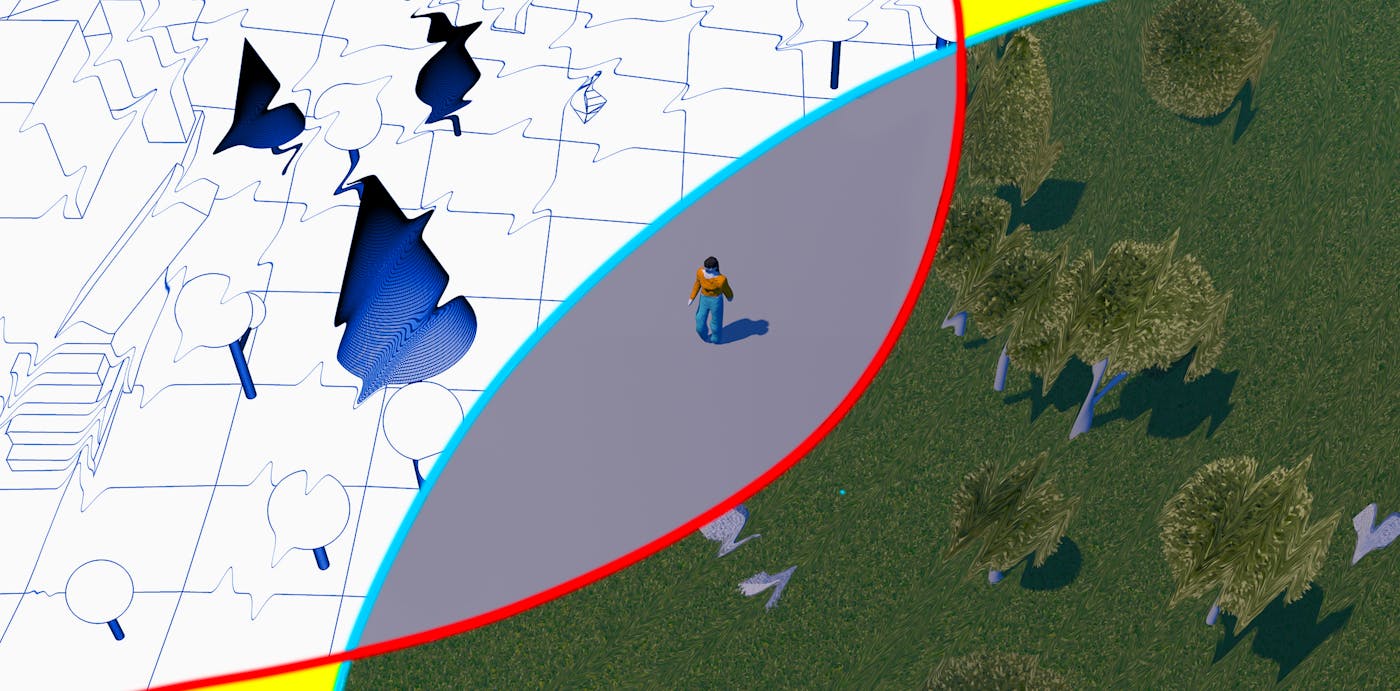
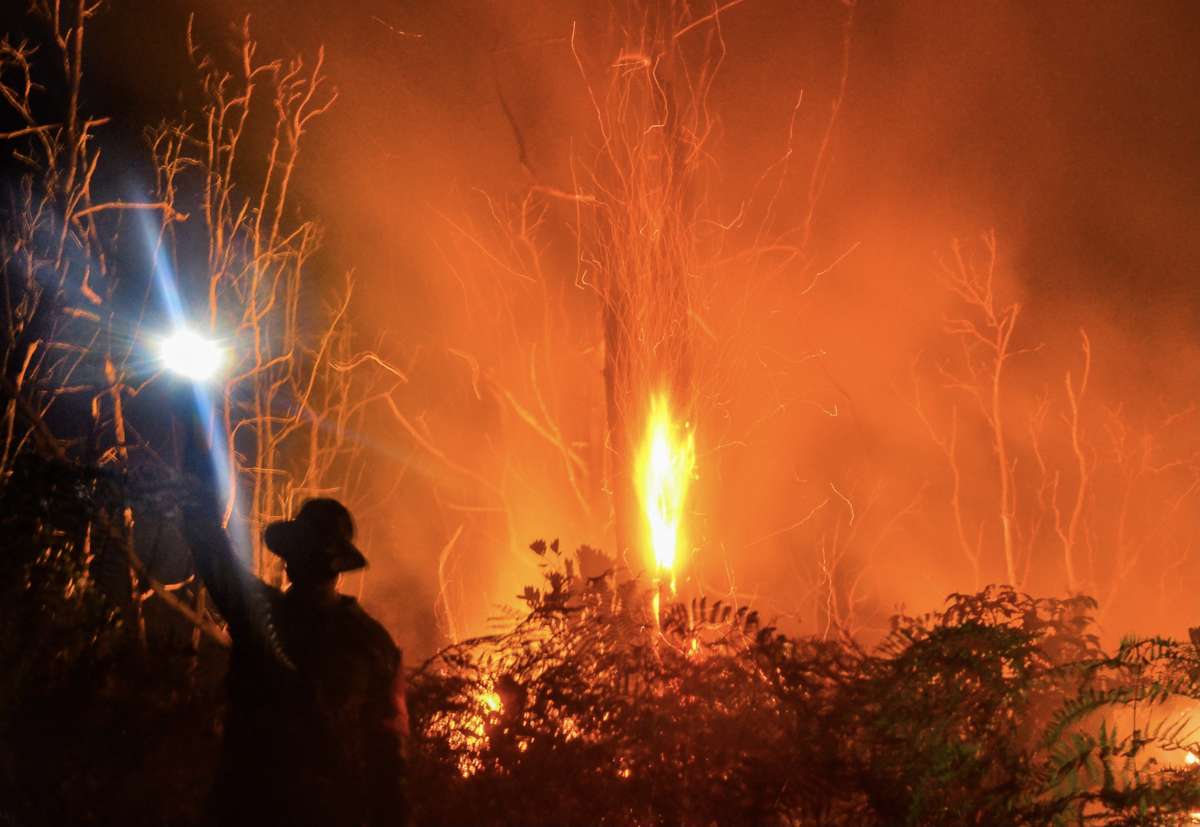
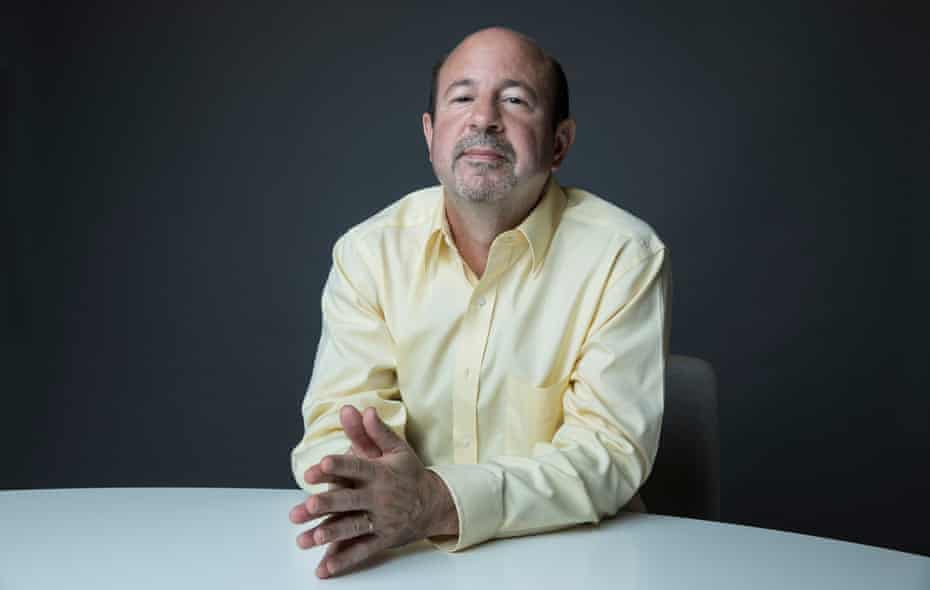
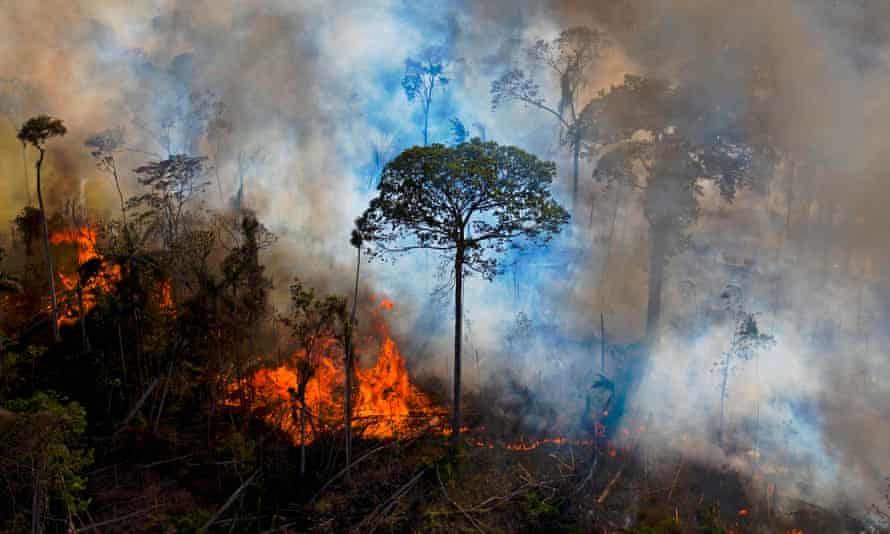
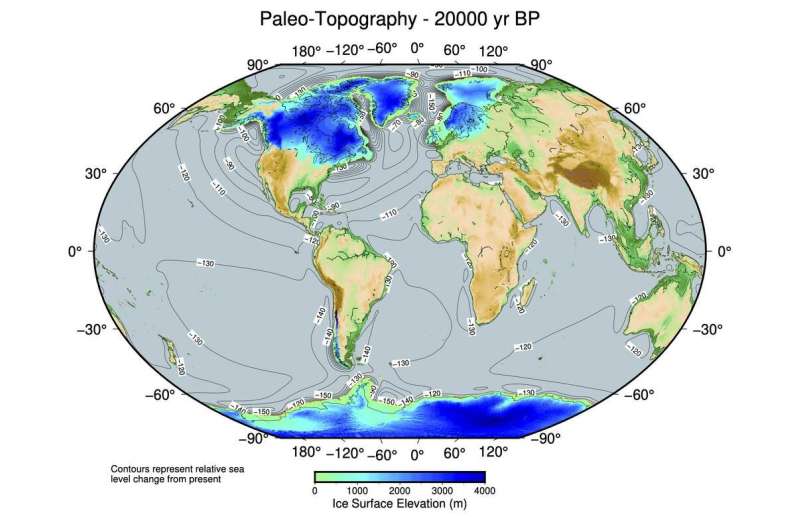
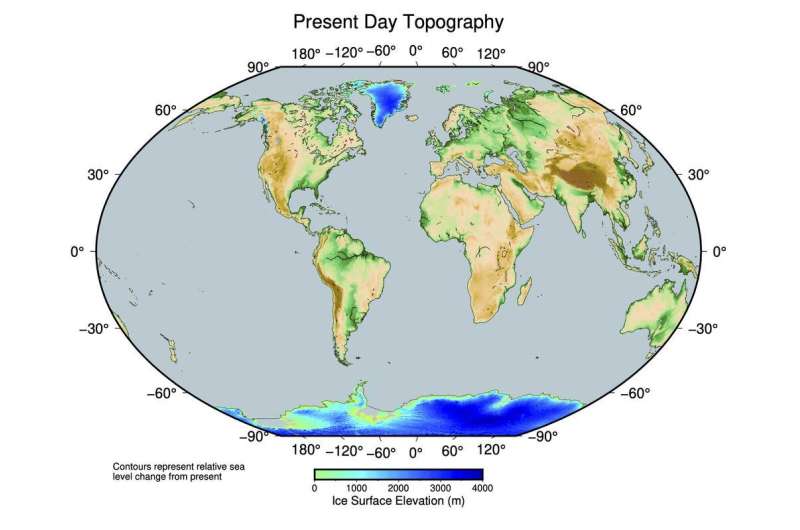
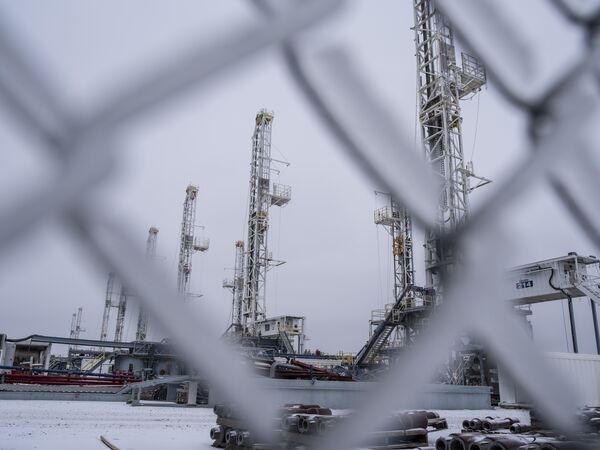
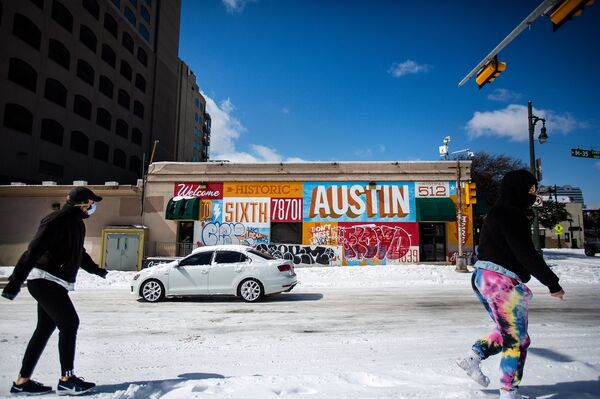
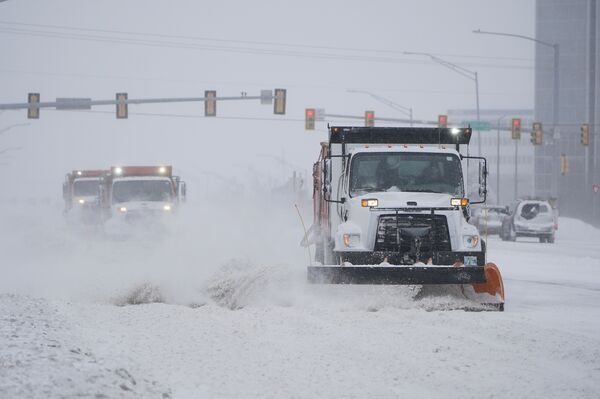

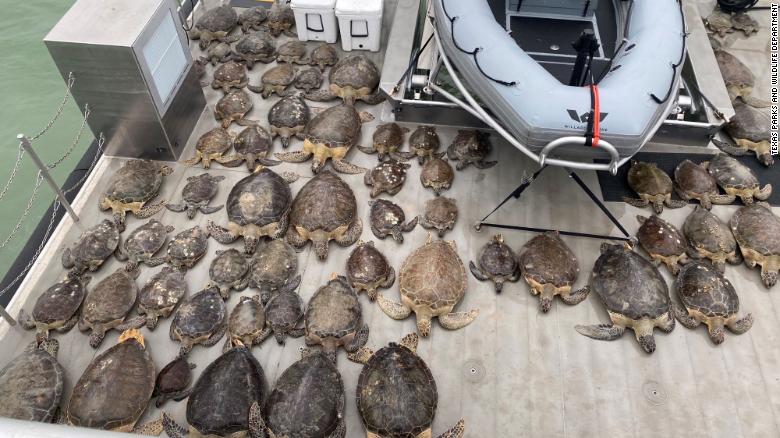 Texas Game Wardens rescued 141 sea turtles from the frigid waters of the Brownsville Ship Channel and surrounding bays in the last week.On Wednesday, Texas Game Wardens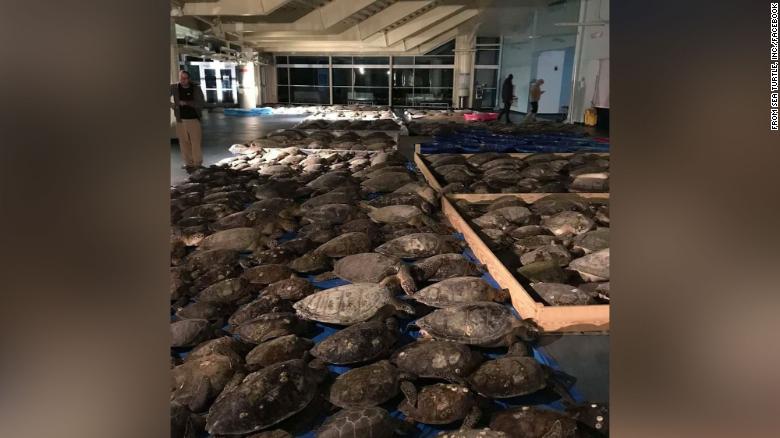
 Exposing the Big Game
