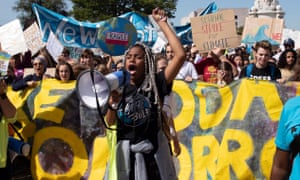
Climate crisis breaks open generational rifts in US families

A sense of despair and outrage among young people over global heating is being met with indifference and dismissal among some older relativesSupported byAbout this content

Oliver Milman @olliemilman

Mon 2 Nov 2020 10.00 ESTLast modified on Mon 2 Nov 2020 11.40 EST

https://www.theguardian.com/environment/2020/nov/02/climate-crisis-differences-old-and-young-families

Shares59

Young people at the DC Climate Strike March in Washington DC, on 20 September 2019 as they become more active around the perils of the climate crisis.
 Young people at the DC Climate Strike March in Washington DC, on 20 September 2019 as they become more active around the perils of the climate crisis. Photograph: Michael Reynolds/EPA

The climate crisis lingers in the back of Gemma Gutierrez’s mind, a gnawing anxiety that blossoms fully when she reads about wildfires, flooding or other climate-related disasters. It’s a nagging concern that clouds how the 16-year-old sees her future.

“I have a sense of dread,” says Gutierrez, who lives with her parents in Milwaukee. “I dread that in my lifetime the clean water I have now or the parks I’m lucky enough to be able to go to won’t be there any more. It weighs on my mind.”

Like a growing number of young people in the US, Gutierrez sees climate change casting a long shadow over her adult years. She has been inspired by Greta Thunberg, the teenage climate activist, and has contacted her local elected representatives to raise her concerns.

The looming US presidential election has only sharpened her fears, as well as underlining a generational rift in her family. In a scenario playing out in many American families, a sense of despair and outrage among young people over global heating is being met with indifference and even dismissal among some of their older relatives.

Gemma Gutierrez: ‘I dread that in my lifetime the clean water I have now or the parks I’m lucky enough to be able to go to won’t be there anymore.’
 Gemma Gutierrez: ‘I dread that in my lifetime the clean water I have now or the parks I’m lucky enough to be able to go to won’t be there any more.’ Photograph: Gemma Gutierrez

“The climate has always changed and what’s the bad part of it getting a bit warmer? I like warm days,” says Dennis Miller, Gutierrez’s maternal grandfather, who describes himself as a conservative and credits Donald Trump for building a strong economy before the Covid-19 pandemic hit.

Miller, a former Exxon employee who lives in North Carolina, believes that his granddaughter has been misled over climate change. (Scientists are unequivocal that the climate is changing with human activity the primary cause.) “Youngsters are youngsters,” Miller says. “Kids go with the crowd and everyone is talking about climate change. They have to get a bit older and learn a little more.”

Gutierrez plans to write a letter to her grandparents to explain her distress, although she is mindful that previous conversations about climate change have become fractious. “I would try to speak to my grandmother but the conversation automatically gets very heated,” she says. “She will get very defensive and say hurtful things. What the president says is very authoritative to her. I feel [older people] are voting against the better interests of our climate and I want them to see a different perspective. I think I would be doing the world a disservice by not trying.”

I want older people to see a different perspective. I would be doing the world a disservice by not trying

Advertisement

While polling shows a clear majority of Americans accept that the climate is changing and want the federal government to respond to the myriad threats this poses, the issue has been polarized in the US to extremes not seen in other leading democracies.

An ideological aversion among Republicans to accept climate science and act against fossil fuel interests has led to two starkly different visions laid out by the 2020 presidential candidates. While Trump has rolled back dozens of pollution regulations, dismissed and sidelined climate science and pulled the US from the Paris climate accords, Joe Biden is pushing a $2tn plan to create a 100% clean energy grid within 15 years, and has called the climate crisis “an existential threat” to the US.

But a generational divide is also opening up, with younger people – even young conservatives – increasingly alarmed over the impact of global heating. An overwhelming 80% of voters aged between 18 and 29 consider the climate crisis “a major threat to life on Earth”, according to a poll taken earlier this year. Levels of concern among older people, particularly Republican voters, lag significantly.

Meet generation Greta: young climate activists around the world

 Read more

“I can see a really clear generational split,” says Lily Jarosz, a 17-year-old who lives near Pittsburgh. Jarosz says her parents are “apolitical Gen X-ers” while her grandmother is openly hostile when she raises the subject of climate change.“She’s said to me multiple times ‘why does it matter?’ That hurts me so much, like she doesn’t care about me or understand the immediacy of the issue,” says Jarosz.

“Climate change is visceral for young people,” says Kathryn Stevenson, an academic at NC State University who has studied how educating children on climate change raises the level of concern among their parents. “They can see this coming down on them in their future.”

Stevenson says it is important to confront the issue at home, as well as school. “Simple conversations at home seem to be having an impact upon parents,” she says. “It’s hard to look a kid in the face and ignore them when they are talking about their future.”

Anisa Nanavati with her family members
 Anisa Nanavati with her family members. Photograph: Courtesy Anisa Nanavati

Some of these exchanges can be fraught, however. Anisa Nanavati, who is 16, learned about climate change in school, which she says helped her connect the dots to her experiences of scorching heatwaves and hiding under the staircase when Hurricane Irma menaced her home town of Tampa, Florida, in 2017. “Not only me but a lot of my friends are experiencing a sort of climate anxiety,” Nanavati says. “It’s crazy to me that parts of my city will become unlivable. It’s hard to digest.”Advertisement

Nanavati was stunned when her conservative uncle told her he didn’t believe in climate change, leading to a two-hour debate at the kitchen table. “I said to him I wasn’t going to leave until he got the scientific facts of this,” she says. “I also mentioned his daughter and that her future is at stake, which is one of the moments that changed things with him a bit. We ended the conversation amicably.”

Anand Shah, the uncle, says that he does in fact accept the science of climate change. However, he believes that ““Anisa, because she’s young, wants to make drastic changes now that won’t work in the long run. In a realistic world, that doesn’t happen.”

Nanavati says she wants her own family in the future but questions if that will be sensible amid a collapsing environment. “If you just think ‘I won’t be around then, I’ll just won’t care and take the lower taxes’ then I think that’s quite selfish,” she says. Trump, Nanavati adds, is a “threat to everything I love and everyone close to me.”

‘Sleeping giant’ Arctic methane deposits starting to release, scientists find

Exclusive: expedition discovers new source of greenhouse gas off East Siberian coast has been triggered

Jonathan Watts Global environment editor @jonathanwatts

Tue 27 Oct 2020 11.40 EDTLast modified on Wed 28 Oct 2020 00.36 EDT

Shares32,901

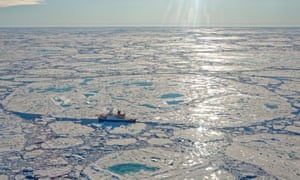
Researchers worry that the Laptev Sea findings may signal a new climate feedback loop has been triggered.
 Researchers worry that the Laptev Sea findings may signal a new climate feedback loop has been triggered. Photograph: Markus Rex/Alfred-Wegener-Institut

Scientists have found evidence that frozen methane deposits in the Arctic Ocean – known as the “sleeping giants of the carbon cycle” – have started to be released over a large area of the continental slope off the East Siberian coast, the Guardian can reveal.

High levels of the potent greenhouse gas have been detected down to a depth of 350 metres in the Laptev Sea near Russia, prompting concern among researchers that a new climate feedback loop may have been triggered that could accelerate the pace of global heating.

The slope sediments in the Arctic contain a huge quantity of frozen methane and other gases – known as hydrates. Methane has a warming effect 80 times stronger than carbon dioxide over 20 years. The United States Geological Survey has previously listed Arctic hydrate destabilisation as one of four most serious scenarios for abrupt climate change.

The international team onboard the Russian research ship R/V Akademik Keldysh said most of the bubbles were currently dissolving in the water but methane levels at the surface were four to eight times what would normally be expected and this was venting into the atmosphere.

“At this moment, there is unlikely to be any major impact on global warming, but the point is that this process has now been triggered. This East Siberian slope methane hydrate system has been perturbed and the process will be ongoing,” said the Swedish scientist Örjan Gustafsson, of Stockholm University, in a satellite call from the vessel.Quick guide

Methane and the Arctic

ShowAdvertisementhttps://080ff7328341ed5e174eb8e7357ac173.safeframe.googlesyndication.com/safeframe/1-0-37/html/container.html

The scientists – who are part of a multi-year International Shelf Study Expedition – stressed their findings were preliminary. The scale of methane releases will not be confirmed until they return, analyse the data and have their studies published in a peer-reviewed journal.

But the discovery of potentially destabilised slope frozen methane raises concerns that a new tipping point has been reached that could increase the speed of global heating.

The Arctic is considered ground zero in the debate about the vulnerability of frozen methane deposits in the ocean.

With the Arctic temperature now rising more than twice as fast as the global average, the question of when – or even whether – they will be released into the atmosphere has been a matter of considerable uncertainty in climate computer models.

The 60-member team on the Akademik Keldysh believe they are the first to observationally confirm the methane release is already under way across a wide area of the slope about 600km offshore.

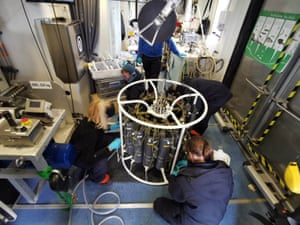
Scientists at work on the test cruise Electra 1, prior to the Akademik Keldysh expedition.
 Scientists at work on the test cruise Electra 1, prior to the Akademik Keldysh expedition. Photograph: ISSS2020

Advertisementhttps://080ff7328341ed5e174eb8e7357ac173.safeframe.googlesyndication.com/safeframe/1-0-37/html/container.html

At six monitoring points over a slope area 150km in length and 10km wide, they saw clouds of bubbles released from sediment.

At one location on the Laptev Sea slope at a depth of about 300 metres they found methane concentrations of up to 1,600 nanomoles per litre, which is 400 times higher than would be expected if the sea and the atmosphere were in equilibrium.

Igor Semiletov, of the Russian Academy of Sciences, who is the chief scientist onboard, said the discharges were “significantly larger” than anything found before. “The discovery of actively releasing shelf slope hydrates is very important and unknown until now,” he said. “This is a new page. Potentially they can have serious climate consequences, but we need more study before we can confirm that.”

The most likely cause of the instability is an intrusion of warm Atlantic currents into the east Arctic. This “Atlantification” is driven by human-induced climate disruption.

The end of the Arctic as we know it

 Read more

The latest discovery potentially marks the third source of methane emissions from the region. Semiletov, who has been studying this area for two decades, has previously reported the gas is being released from the shelf of the Arctic – the biggest of any sea.

For the second year in a row, his team have found crater-like pockmarks in the shallower parts of the Laptev Sea and East Siberian Sea that are discharging bubble jets of methane, which is reaching the sea surface at levels tens to hundreds of times higher than normal. This is similar to the craters and sinkholes reported from inland Siberian tundra earlier this autumn.

Temperatures in Siberia were 5C higher than average from January to June this year, an anomaly that was made at least 600 times more likely by human-caused emissions of carbon dioxide and methane. Last winter’s sea ice melted unusually early. This winter’s freeze has yet to begin, already a later start than at any time on record.

Exclusive: expedition discovers new source of greenhouse gas off East Siberian coast has been triggered

https://www.theguardian.com/science/2020/oct/27/sleeping-giant-arctic-methane-deposits-starting-to-release-scientists-find

Jonathan Watts Global environment editor @jonathanwatts

Tue 27 Oct 2020 11.40 EDTLast modified on Wed 28 Oct 2020 00.36 EDT

2020 Election Will Be Crucial in Determining Whether We Avoid a Climate Catastrophe

BY RENEE CHO |OCTOBER 29, 20203 Comments

https://blogs.ei.columbia.edu/2020/10/29/2020-election-climate-catastrophe/

Photo: NASA

The ability of humans to live safely and comfortably as we have for centuries is on the November ballot. We are already experiencing increased flooding; sea level rise as the ice caps continue to melt; slower and stronger hurricanes; more intense wildfires, including in the Amazon and the Arctic; drought and water scarcity; and the dying of coral reefs. The World Bank predicted these climate impacts could force 100 million more people into extreme poverty by 2030.

The next 10 years are critical because the Intergovernmental Panel on Climate Change (IPCC) has warned that the planet could warm 1.5˚C above pre-industrial levels by 2030. Overshooting 1.5˚C could precipitate disastrous climate impacts, potentially sending us over tipping points that would hasten more warming and send Earth into an irreversible “hothouse” state.

To avert this catastrophic future and keep the global temperature rise to 1.5˚C, we must cut CO2 emissions 45 percent from 2010 levels by 2030, and reach net zero by 2050. What happens in the next few years will determine our fate, which makes the outcome of the U.S.’s November 3 presidential election critically important.

“The 1.5˚C temperature target is very difficult to achieve right now, although it is theoretically possible,” Michael Gerrard, director of the Sabin Center for Climate Law at Columbia University has said. “If Trump is re-elected, I think it goes into the realm of physical impossibility. We’d have to wait another four years for another election to try to rectify that. But by then, a lot more fossil fuel infrastructure will have been locked in and a lot more greenhouse gases will have gone into the atmosphere. So, it would be very bad news for the climate indeed.”

What are our options?

Donald Trump’s plan

Photo: Gage Skidmore

President Trump, who does not acknowledge the role of human activity in climate change, does not have a plan to combat climate change, though he claims to champion clean water and clean air. In 2017, he pulled the U.S. out of the Paris Agreement, making the U.S. the lone country to renege. The U.S. withdrawal becomes official on November 4, one day after Election Day. Since the U.S withdrew, some countries, such as Australia, Saudi Arabia, Brazil and Russia have done little to cut their emissions.

Trump’s goal is to ensure U.S. energy independence. To achieve this, his administration has supported domestic fossil fuel production and rolled back many environmental regulations that it considers burdensome to the fossil fuel industry.

According to the Sabin Center for Climate Change Law at Columbia University, Trump has taken 163 actions to roll back climate mitigation and adaptation measures. He rescinded the Obama administration’s Clean Power Plan, which was expected to cut power sector emissions 32 percent by 2030, relative to 2005, replacing it with the Affordable Clean Energy rule. Because the replacement does not set limits for emissions, it will lead to more emissions and air pollution, which the Environmental Protection Agency (EPA) itself has projected could result in 1,400 additional premature deaths. He has weakened regulations  limiting methane emissions from oil and gas production on federal lands, and the requirement to report methane emissions. The Environmental Defense Fund estimated that this could result in an increase of five million metric tons of methane emissions each year. Methane is a greenhouse gas that, over 20 years, traps more than 84 times more heat in the atmosphere than carbon dioxide does.

Domestic bills to phase down hydrofluorocarbons (HFCs)—potent greenhouse gases used in air conditioners and refrigerants—are being discussed in the Senate and House of Representatives, but the Trump administration has not ratified the Kigali Amendment to the Montreal Protocol, which would require countries to set targets to cut their use of HFCs.

Trump signed an executive order to join the global One Trillion Trees Initiative, a World Economic Forum proposal to slow deforestation and climate change. And he has allotted $900 million a year to the Land and Conservation Fund and $9.5 billion over five years for land conservation as part of the Great American Outdoors Act. But he has also opened U.S. waters and public lands to oil and gas drilling, including national monument land in Utah and the Arctic National Wildlife Refuge; he allowed logging and road construction on nine million acres of Alaska’s Tongas National Forest; and attempted to ease the pipeline permitting process.

Trump has loosened fuel economy standards for vehicles for model years 2021 through 2026; they now only need to increase fuel economy by 1.5 percent a year instead of the Obama rule’s 5 percent a year. In addition, he has moved to revoke California’s waiver—its right to determine its own more stringent fuel economy standards, which are followed by 14 states and the District of Columbia.

Trump issued an executive action to speed reviews of infrastructure projects under the National Environmental Policy Act, Clean Water Act, and Endangered Species Act. He claims that the loosening of these rules will save money because it limits environmental reviews of major federal infrastructure projects such as highways, power plants and pipelines, and speeds their completion.

The Rhodium Group, an independent research provider, has estimated that as a result of the Trump rollbacks already in place, U.S. emissions will increase by 1.8 gigatons by 2035, an amount equal to almost one-third of all U.S. emissions in 2019. Total U.S. emissions will be 3 percent higher in 2035 than they would have been under the Obama regulations.

The Sabin Center’s Romany Webb, associate research scholar, and Daniel Metzger, postdoctoral research scholar, identified policy objectives that Trump is expected to advance if re-elected. Continuing his support for fossil fuels, he would open more federal land and the continental shelf to oil and gas drilling and loosen regulations for operating there.

The Trump Department of Energy has already weakened energy efficiency standards for light bulbs, which is projected to increase carbon emissions by 34 million metric tons by 2025. In a second Trump term, the administration might also cut energy efficiency standards for appliances. Other possible proposals include weakening regulations on greenhouse gas emissions from landfills, reducing penalties on carmakers that don’t meet fuel economy standards, and limiting the ability of states to take actions against climate change that are more aggressive than those of the federal government.

Trump is expected to continue to reduce the role of science in decision-making by agencies. One proposal for rules developed under the Clean Air Act would limit the consideration of co-benefits—often pollution reduction, which impacts public health—when conducting cost-benefit analyses of new agency rules.

To ensure that the U.S. continues to rely on fossil fuels, the Department of Energy has earmarked $72 million for research into carbon capture technologies, of which $21 million was allocated for direct air capture. Trump will also likely promote nuclear energy over renewable energy.

Adapting to climate change

A $16 billion program overseen by Trump’s Department of Housing and Urban Development will help states prepare for natural disasters, although when the rules were announced, there was no mention of climate change or global warming. The Federal Emergency Management Agency (FEMA) will spend $500 million, with more to come, to relocate communities from flood zones.

If the Republicans hold onto Congress, Trump’s overall plans are expected to create 11.2 million jobs during his second term, according to Moody’s Analytics.

Legal considerations

Many of Trump’s actions have been stymied in the courts. The Institute for Policy Integrity at the New York University School of Law found that the Trump administration has lost 87 percent of the challenges to all (not just environmental) of its deregulation efforts. Some of the major environmental rule changes that are currently being challenged in court include the Affordable Clean Energy Rule, methane emissions rules, the fuel efficiency standard and the California waiver. If Trump is re-elected, the Department of Justice will no doubt vigorously defend these cases; in addition, the administration would likely revisit environmental rule changes that courts have struck down and revamp them to try to get them right.

Joe Biden’s plan

Photo: Gage Skidmore

Joe Biden knows climate change is an existential threat to our future. One of his priorities as president would be to rejoin the Paris climate agreement and encourage countries to make their climate goals more ambitious. This is key because all countries are expected to submit their ramped-up climate goals by the end of this year, and U.S. leadership could motivate other countries to set more ambitious targets.

Biden has unveiled a plan of $2 trillion to be spent over four years to both help the economy recover from the pandemic and deal with climate change by expanding the use of clean energy and cutting fossil fuel emissions. He aims to make the power sector emissions-free by 2035 and reach net-zero before 2050. To achieve this, he would establish an enforcement mechanism that requires emitters to pay the cost of their carbon polluting and could conceivably institute a carbon tax.

Biden has promised to immediately issue executive actions to limit methane emissions for new and existing oil and gas projects, and develop new fuel-economy and energy efficiency standards.

He would end new oil and gas drilling, including fracking, on federal lands. While he does not support a ban on fracking, he would regulate its methane emissions.

Biden would incentivize utilities and developers to build new renewable energy power plants. Because he wants all new U.S. cars and trucks to be electric by 2035, he would encourage the adoption of electric vehicles through tax credits, provide incentives for automakers to produce electric vehicles, and establish a federal procurement program for clean energy and zero-emission vehicles.

A Biden administration would invest $400 billion to research and develop clean tech such as battery storage, new nuclear reactors and carbon capture. Biden will also push the agriculture sector to employ practices that remove CO2 from the air and store it in the soil.

Biden would upgrade infrastructure, including railroads, mass transit, roads, bridges, and the electrical grid, and by 2030, build 500,000 public charging stations for electric vehicles nationwide.

His goal is to reduce the carbon footprint of buildings by 50 percent by 2035; this entails making four million buildings more energy efficient, and weatherizing two million homes. To achieve this, he will offer incentives for retrofits that involve appliance electrification, efficiency, and clean energy.

Biden would invest more in communities of color and ensure that solutions to environmental issues are developed through an inclusive, community-driven process.

To protect biodiversity, slow extinction rates, and draw on natural climate mitigation processes, Biden aims to conserve 30 percent of America’s lands and waters by 2030.

Moody’s Analytics estimates that if the Democrats sweep Congress, Biden’s overall economic plan will create 7.4 million more jobs than Trump’s, based on the candidates’ campaign proposals.

Adapting to climate change

Beyond modernizing infrastructure, Biden will develop regional climate resilience plans in conjunction with universities and national labs to prepare for climate impacts. He will invite innovators to help design zoning and building codes that enable communities to better deal with natural disasters. In addition, any new federal infrastructure funding will have to take climate change into consideration to ensure that buildings, water, transportation, and energy infrastructure can withstand the impacts of climate change.

Legal considerations

The Sabin Center’s Romany Webb said that, to reverse any Trump administration rollbacks that have already been finalized, the Biden administration would have to start over in the regulatory process. “For example, for the replacement for the Clean Power Plan, the Biden administration has to go to a new regulatory process.” The process for an agency like the EPA to issue regulations or change regulations and get them finalized entails first putting out a proposal and asking for public comment on it; after it accepts public comment, and reviews all the comments, it can then move to a final proposal. By contrast, for regulatory rollbacks that have not been finalized, “The Biden administration could just choose not to finalize them. And we’d be left with those pre-existing regulations that the Trump administration was trying to get rid of,” Webb said.

To deal with Trump’s attempted rollback of rules that are being challenged in court but are in early stages, the Department of Justice under Biden could go to the court and ask to have the case held in “abeyance”—put on hold. Biden could then ask that the rule be returned to the agency that issued it for review, and the agency would be in a position to write new more stringent regulations. “A Biden administration could go further, filling in those regulatory gaps that were left at the end of the Obama administration and that the Trump administration has not done anything about,” said Webb.

Ultimately, to achieve his ambitious climate goals, Biden will need a Democratic Congress to pass legislation that is less susceptible to reversal by legal challenges. According to the New York Times, Biden will likely try to incorporate climate actions into legislation with more bi-partisan support, such as an economic recovery bill. To facilitate climate legislation, however, a Democratic Congress might need to get rid of the filibuster, which allows any senator to block action on a bill unless 60 senators agree to end debate. If a Republican Congress thwarts Biden, he has promised to use executive actions; however, the risk of using administrative executive actions to address climate change is that they can be undone by the next Republican administration, said Webb. This is what happened to Obama’s efforts to mitigate climate change.

What difference in climate could we see?

While cutting carbon emissions now is essential to saving human lives and natural ecosystems in the short and long term, it’s important to understand that even with strong measures, we likely won’t see temperatures drop for decades.

Because of the COVID-19 lockdowns, CO2 emissions in the first half of this year dropped an unprecedented 8.8 percent from the same period in 2019 and as much as 17 percent in April. Many have wondered if this decrease would make a difference in global temperatures. Unfortunately, because of the amount of CO2 already in the atmosphere, it will not.

Galen McKinley, a professor of earth and environmental sciences at Columbia University and Lamont-Doherty Earth Observatory, said, “Changes in emissions that are being discussed right now will not substantially reduce climate change through 2030. If we were to stop all emissions right now, which is not feasible, we could likely stabilize the temperature at the current level by 2030.“

That’s because although emissions cuts would lead to less heat being absorbed, it might take decades before any temperature reduction could be measured as the climate responds so slowly to changes in emissions. We might not see any decrease in global temperatures before 2035, according to a recent study by Norway’s Center for International Climate Research, which analyzed the effect of immediately implementing drastic measures to slash all greenhouse gas emissions, black carbon and other pollutants. The researchers stressed that this does not mean, however, that the cuts in emissions would not be working. Over the long term, they would still make a difference in reducing the severity of climate impacts.

“Since to cut off all CO2 emissions immediately is not feasible, we must plan for adaptation to change in addition to committing to mitigation,” said McKinley. “The mitigation we do today will have substantial impact on climate past 2050, and can prevent catastrophic changes via warming and sea level rise in the second half of this century. In other words, the mitigation we do now is in the interest of keeping Earth in a state where our children and grandchildren can continue to live using the infrastructure that we and our parents and grandparents have built.”

A Grim Prediction Gave These Ice Caps 5 Years. They Didn’t Even Last That Long

https://www.sciencealert.com/a-grim-2017-prediction-about-the-canadian-ice-caps-has-come-true


DAVID NIELD
4 AUGUST 2020

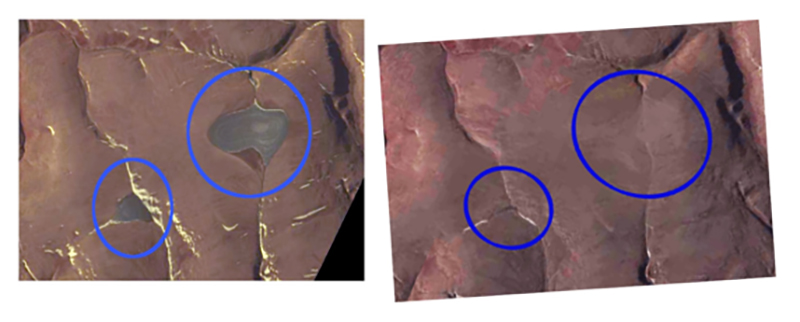
Scientists don’t always like being right: take the team that warned in a paper published in 2017 that the St. Patrick Bay ice caps in Canada would soon disappear, for example. The latest NASA satellite imagery shows that their prediction has sadly come true, and even faster than they expected.

Scientists from the National Snow and Ice Data Centre (NSIDC) at the University of Colorado Boulder initially predicted the disappearance of the St. Patrick Bay ice caps would take place over five years, but it’s actually only taken three.

The frozen sheets, probably in place for several centuries, measured more than 10 square kilometres (3.86 square miles) combined at the end of the 1950s, and have now shrunk down to nothing. It’s a sign of the climate change that’s gaining momentum all around the world, and showing no signs of stopping.

“When I first visited those ice caps, they seemed like such a permanent fixture of the landscape,” says geographer and NSIDC director Mark Serreze. “To watch them die in less than 40 years just blows me away.”

canada 2Ice cover in 2015 (left) and 2020 (right). (Bruce Raup/NSIDC)
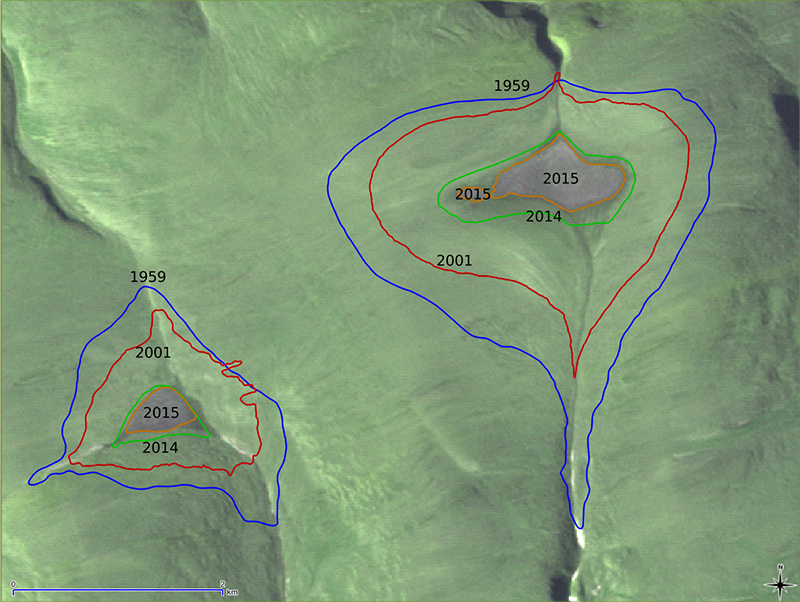
Serreze was a young graduate student when he first set foot on the ice caps in 1982, and he was the lead author of the 2017 paper alerting the world to their drastic demise. By 2015, the ice caps were only five percent the size of what they were in 1959.

Recent imagery from the Advanced Spaceborne Thermal Emission and Reflection Radiometer (ASTER) instrument on the NASA Terra satellite shows no trace of the St. Patrick Bay ice at all. The ice in this region is unlikely to return any time soon.

The two ice caps that have vanished are part of a group on the Hazen Plateau, in the north of Ellesmere Island in Nunavut, way up in the Arctic Archipelago – one of the most northerly points of Canada.

Two ice caps often linked with the St. Patrick Bay pair, the Murray and Simmons ice caps, are faring better due to their higher elevation – in 2015 their ice cover was at 39 percent and 25 percent respectively, compared with the 1959 figure. However, scientists think they too could soon be gone.

When Serreze and his colleagues first started surveying the Hazen Plateau ice at the start of the 1980s, scientific consensus on global warming was still forming, and some researchers had suggested the planet was actually in a period of global cooling. The studies started back then were partly an attempt to find out one way or the other.

canada 3Ice cover tracked over time. (NSIDC)

Now there’s no doubt what’s happening. While the St. Patrick Bay ice caps may not be two of the most famous or significant points of geological interest in the world, they represent a small microcosm that reflects what’s happening to our planet as a whole.

They’re also a reminder that while scientists aren’t infallible, they very often do know what they’re talking about – and that when we get warnings about what’s coming our way in the future, we’d do well to take heed and to take action.

“We’ve long known that as climate change takes hold, the effects would be especially pronounced in the Arctic,” says Serreze.

“But the death of those two little caps that I once knew so well has made climate change very personal. All that’s left are some photographs and a lot of memories.”

The original 2017 research was first published in The Cryosphere.

Animal Agriculture and Its Negative Impact on Climate Change

Animal Agriculture and Its Negative Impact on Climate Change

One of the most overlooked factors of accelerated climate change is animal agriculture. Could changes to the human diet help us slow down the climate crisis?Reading Time: 6 minutes

Animal agriculture has long left its mark upon the earth. Forests have fallen and grasslands trampled in favor of crops and pastureland. Now, however, this sector’s impacts are being felt in the atmosphere – carrying troubling implications for every living thing on the planet.

The agriculture sector is one of the biggest drivers of anthropogenic – meaning human-caused – climate change. Animal agriculture, which sees the raising and processing of ruminants, poultry, and marine life, accounts for some of the biggest sources of greenhouse gasses. Global temperatures rise as forest cover decreases, and oceans warm as they absorb ever-more carbon dioxide. 

Yet there are solutions to these problems – among which is the adoption of plant-based diets. It is not too late for the world to take action against the perils of a changing climate, but time for action is now. 

How Does Animal Agriculture Affect The Environment

Practicing agriculture does not necessarily come naturally to us as a species. For much of human prehistory, people lived in societies oriented around hunting and gathering. The earliest signs of agriculture can be dated at around 12,000 years ago, yet since the dawn of the Industrial Revolution, agriculture has taken on an entirely new face, adopting intensive practices such as concentrated animal feeding operations (CAFOs) which foster truly heartbreaking conditions for farmworkers, animals, and surrounding communities alike. 

Called humanity’s greatest mistake by some due to the resulting hard labor, diminished nutrition, and social inequality brought by agriculture, this system of food production now presents the world with a new quandary: environmental destruction on scales that can no longer be ignored. 

CAFOs produce enormous amounts of waste, which collect in vast open-air lagoons that can be breached by extreme weather events or gradually seep into groundwater. Water pollution from CAFOs can cause algal blooms which can devastate entire marine ecosystems. Air pollution is generated from CAFOs as manure is vaporized, sending toxic wafts through the air to surrounding communities. 

Vast fields of monocrops also cause a host of environmental effects, including air pollution. Pesticides and herbicides are sprayed in liberal amounts, which can cause a host of debilitating illnesses, including cancers, for farmworkers and surrounding communities. Soil depletion is also a serious looming issue. Monocropping, along with the overuse of agrochemicals including synthetic fertilizers like nitrogen and phosphorus, are denying fields a fallow period or crop rotation has the effect of leeching soils of their nutrients. These practices render soils far less productive over time. It takes hundreds, if not thousands, of years for soils to become abundantly fertile again. 

Impact Of Animal Agriculture On Climate Change

Out of all the human activities that cause climate change, agriculture is one of the biggest contributors. Estimates as of 2020 put the sector’s global contributions at 37 percent. Below are a few key factors accounting for climate change emissions resulting from human-cased agriculture. 

Land Use

A full 50 percent of the world’s livable land – meaning land that is ice-free and fertile – is being used for agriculture. No other human activity takes up more space. In contrast, all urban areas account for around one percent of livable land use. A whopping 77 percent of agricultural land is dedicated to raising animals, including grazing and the land used to grow their feed, including vast monocrops of species like corn and soy. Surprisingly, this huge expenditure of resources and land use provides only 18 percent of the world’s calories. 

Land used for any type of agriculture – be it livestock or crops meant for people or animals – is brought under cultivation by clearing forests and grasslands, which are carbon sinks due to their abilities to absorb carbon. Currently, forests consume roughly a quarter of all anthropogenic CO2, yet the more forests are slashed and burned to make way for pastureland or monocrops, the less carbon will be absorbed, resulting in accelerated climate change.

Livestock

Farmed animals – referred to as livestock – generate over 14 percent of all anthropogenic emissions, with estimated totals hovering around seven gigatonnes of carbon dioxide emitted every year. The bulk of these emissions are due to raising cattle for meat and dairy, contributing 60 percent of total livestock emissions.  These emissions are thanks to the vast amounts of resources cows consume, the land they require for pasture (in the case of beef cattle), and other manure they produce. Cow manure contains nitrous oxide and methane, the latter being one of the most potent greenhouse gasses due to its outsized ability to absorb heat. 

Fisheries

Marine life, including fish, shellfish, shrimp, and other animals are taken from the seas in astronomical numbers. Nets, some of which are large enough to contain 12 jumbo jet airplanes, are dragged through the water or across the bottom of the seafloor, capturing everything in their path. Direct fishing activity, plus the energy expended to transport, process, and refrigerate carcasses amounted to an estimated total of 179 million tonnes of greenhouse gasses in 2011 – and this number likely will continue to grow as demand for seafood increases. 

How Do Greenhouse Gases Affect the Climate?

In greenhouses designed to grow plants, the transparent glass structure allows sunlight into the greenhouse while preventing heat from escaping. The earth’s atmosphere functions in a similar way, with gas molecules acting like the glass. Certain gases are more effective at absorbing heat than others; these include methane, nitrous oxide, and perhaps the most infamous, carbon dioxide. These three gasses are among the main culprits of climatic warming and change caused by human activities. 

One of the biggest drivers of global warming has been the release of carbon into the atmosphere due to the burning of fossil fuels such as natural gas, oil, and coal, which power many aspects of modern life. Even electric cars, which run on batteries and do not themselves generate carbon emissions, draw electricity from grids still run on fossil fuels (although the goal of using 100% renewable energy for electric grids is more achievable than ever). When carbon released from fossil fuel burning is released into the atmosphere, it binds with oxygen and forms carbon dioxide and begins trapping heat in the atmosphere. Because carbon emissions make up the vast majority (81 percent, as of 2018) of total greenhouse gases, they pose one of the gravest threats to climate stability. 

Although carbon is the greatest emitted by volume, other greenhouse gases can be much more potent. For example, one ton of nitrous oxide – emitted by agricultural processes including the use of nitrogen fertilizers in crop production – is equivalent to nearly 300 tons of carbon dioxide.

Methane is approximately 30 times more potent in its ability to absorb and trap heat in the atmosphere than carbon dioxide.

Can Greenhouse Gas Emissions From Animal Agriculture Be Reduced?

By far, the most effective way to reduce the animal agriculture sector’s greenhouse gas footprint is to significantly reduce, and eventually eliminate animal agriculture. While this might sound “extreme”, it is the state of industrial animal agriculture – characterized by inhumane CAFOs, waste lagoons teeming with pathogens and antibiotics, and requiring enormous land and feed inputs – which is even more extreme

This is not to say that eliminating animal agriculture is something easily accomplished. Demand will have to decrease, thanks to people turning to plant-based diets. The ease of adopting these diets is not the same for everyone, however. Many lower-income neighborhoods in the United States are classified as food deserts, where a lack of grocery stores forces people to endure extremely limited options, such as gas stations or fast-food restaurants. 

People in nations like the United States who do not live in food deserts bear much of the responsibility for reducing demand for animal products. Fortunately, plant-based options abound to replace animals in a wide range of products, from cheese to milk to burgers and sausages. Beyond Meat and Impossible Foods are two of the leading companies in the plant-based meat sector, helping the idea of plant-based meats go mainstream and helping people understand that it’s possible to achieve the BBQ-worthy tastes without the climate side-effects. Plant-based meats use up to 99 percent less land and emit up to 90 percent fewer greenhouse gas emissions.

Animal Agriculture And Global Warming

Flying in planes or driving SUVs have long been understood as having negative impacts on the global climate. While these are certainly deserving of critique and change, the agriculture sector deserves time in the spotlight. If industrial agriculture continues to grow unchecked, global warming will increase – with potentially disastrous impacts, the beginnings of which are being felt today. Methane, produced by livestock including sheep, goats, and cows, is a greenhouse gas with a terrific ability to trap heat in the atmosphere. The agriculture industry is responsible for fully 40 percent of the total anthropogenic greenhouse gas emissions.

In order to curb global warming, and keep the global temperature increase below 1.5 degrees Celsius, the United Nations Intergovernmental Panel on Climate Change says that global emissions will need to be reduced by around 40 to 50 percent. According to the U.N., the only way to achieve these reductions is to drastically increase forested land – which means reclaiming land currently under cultivation and to stop intrusions into existing forests.  

Conclusion

Due to its profound impacts on the climate and environment around the world, agriculture may well be humanity’s gravest mistake – because it may be our undoing. Unless greenhouse gas emissions are seriously curbed, the world is going to be a far more difficult place to endure. Reducing demand for animal agriculture and adopting a plant-based diet is among the most important actions any individual can make. 

Burger King’s New Low-Methane Burgers Aren’t Going to Save Us

Burger King’s New Low-Methane Burgers Aren’t Going to Save Us

The meat industry is under intense scrutiny for its climate impact, with beef singled out as the biggest culprit. But if you want to save the planet, opt for the salad. It’s that simple.Reading Time: 5 minutes

July is over and with it Burger King’s short-lived but much-touted experiment with low-methane burgers. Two weeks ago, an ad for burgers made from cows fed with lemongrass to reduce the climate impact of their burps went viral, garnering the company free advertising by virtually all major media networks as well as some well-deserved criticism. Now the ad, like all things viral, is on its way to being forgotten, and the allegedly low-methane burger will fade off menus. But the whole episode can tell us a lot about how meat producers are greenwashing their products.

Burger King, like other companies that sell beef, is beginning to feel the heat from global climate change, and they are responding to the climate crisis by presenting unsustainable products as environmentally friendly. Don’t be fooled. Any way you slice it, beef’s climate cost can’t be reduced with marginal fixes like lemongrass.

The viral ad announcing Burger King’s new “low emissions” burger is a joke—and a fart joke at that. It opens with a boy styled in a white cowboy suit with a guitar in hand. He kicks open a saloon door embedded in a gassy bovine rectum (yes, really!) and, backed by a chorus of two-stepping tykes, he honky-tonks his way through psychedelic pastures and rolling hills among farting woodcut cows. The kids dance past melting icebergs and above billowing methane clouds, before donning hats decorated with lemongrass tufts. “Since we are part of the problem, we’re working to be part of the solution,” Burger King concludes. But they’re only half right!

The scene sure is something, but the science is dubious. Cows mostly burp, not fart methane. That Burger King is sniffing the wrong end of the cow is, at best, a joke and, regardless, a reminder that the company is in the burger business and not science business. The 33 percent methane reduction the company promises by switching to “low emissions” beef is also misleading. The claim is not based on peer-reviewed science, and the alleged reduction only accounts for emissions in the final “fattening” stage of production—as opposed to a cow’s entire life—meaning its total contribution to reducing greenhouse gasses (GHGs) is probably closer to 3-4 percent. Tellingly, Burger King released the ad on the same day that scientists announced that global methane emissions have grown dramatically in the past two decades.

Burger King’s ad is just the latest example of a growing trend of greenwashing in beef marketing. Beef industry organizations such as the National Cattlemen’s Beef Association and the Beef Checkoff Program regularly issue press releases and factsheets touting the “sustainability” of beef, while major beef producers publicly swear they’re cutting GHG emissions. And it seems to be working, with some major media organizations lapping up the message that “Low-methane meat is a thing now.”

It’s easy to see why Big Beef is working hard to cast their product as climate-friendly. Over the past two decades, the meat industry has come under intense scrutiny for its climate impact, with beef singled out as the biggest culprit. Livestock—between methane emissions, the production of feed, and other production costs—contribute about 15 percent of total global GHGs and, since cattle make up 40 percent of that, cattle alone make up about 6 percent of humanity’s GHG footprint. In the U.S., cattle represent 3.7 percent, or about 240,500,000 metric tons, of GHGs per year.

The average American eats about 57 pounds of beef per year, and between the domestic and export market, the U.S. produces around 27 billion pounds annually. That’s 33.6 million head of cattle, with just four enormous producers—Cargill, Tyson Foods, JBS USA, and National Beef—accounting for 85 percent of the supply. These cattle have a massive environmental footprint and require an enormous amount of land.

Beef advocates are mustering a defense of their climate impact under the slogan, “It’s not the Cow. It’s the How.” Some acknowledge the impact of large-scale, feedlot-fed beef, but encourage smaller-scale “regenerative” agriculture. These advocates contend that cattle grazing stimulates carbon sequestration in soils and that cows’ manure can substitute for carbon-intensive synthetic fertilizers, thereby offsetting methane emissions and making cattle GHG-neutral. Evangelists of regenerative agriculture argue that it could become the dominant form of cattle production. This is unlikely. Not only is the scientific community not sold on its climate benefits, but the system cannot be scaled up to supply low-cost beef to low-cost retailers and restaurants like Burger King. According to Matthew Hayek, Ph.D., who studies the environmental impacts of our food system at New York University, there simply isn’t enough land in the U.S. to graze all those cows.

For the commodity beef producers, meanwhile, their only option is to find ways of cutting emissions within existing production chains. Increasingly, they have resorted to changing cows’ diets to try and reduce their carbon footprint. Studies have shown, for instance, that feeding cows seaweed can potentially reduce methane emissions by upwards of 60 percent. The industry has been quick to use these studies to boast that they are part of the solution to global climate change.

But these methane reductions are theoretical, marginal, and impractical. Globally, most cows eat a standard diet. It is unclear that feed additives can be produced affordably at scale. Enormous monocultures of algae required for cattle feed may also have serious ecological costs. And, like Burger King’s sustainability claims, these solutions focus primarily on the “finishing” stage of production. To put it simply, there’s no such thing as a zero-emissions cow, and even a reduced-emissions cow produces far more GHGs than other protein sources. And none of this addresses the cattle industry’s other ecological impacts, like deforestation and contamination of waterways. This solution is also incompatible with regenerative agriculture: feed additives require standardization and scaled mass confinement, exactly the thing regenerative grazing is supposed to eliminate.

Big Beef is trying to put lipstick on the, er, cow. The emerging scientific consensus is that beef production needs to be massively reduced globally, and diets need to adapt if we’re to keep food production within planetary limits.

Meanwhile, the entire meat industry now faces heightened criticism unrelated to GHGs. Recently, we’ve seen packers strong-arm vulnerable workers into COVID-19 “superspreader” slaughterhouses. We’ve seen the industry respond to production bottlenecks by “depopulating” (industry-speak for killing) millions of farm animals. We’ve seen hurricanes dump millions of gallons of livestock manure into drinking water. Now add this to the butcher’s bill: agriculture is responsible for half of all zoonotic disease and a full quarter of all infectious diseases since 1940.

This moment of crisis should be a moment of transformation, not greenwashing. Whatever consumers choose to order at Burger King (we recommend the meat-free, actually low-impact Impossible Burger), we should not applaud solutions that trivialize the scale and nature of the problem. Big Beef must be regulated to ensure that its workers are safe and that the price of its product reflects its true cost to the public, workers, future generations, and animals. It should be taxed, and those monies should be invested in public projects aimed at environmental sustainability, GHG reduction, and the development of cellular agriculture that would allow consumers to eat beef without the cows and their burps. And, ultimately, industrial animal agriculture should be eliminated.

In the meantime, being a conscientious consumer is hard. We all make compromises. But if you think that eating Burger King’s “low emissions” burger is a real solution, you’re the sucker. Want to save the planet? Opt for the salad. It’s that simple.

The Trump administration cooks the climate change numbers once again

https://thehill.com/opinion/energy-environment/507929-the-trump-administration-cooks-the-climate-change-numbers-once?fbclid=IwAR1QB7P8rlTTux2XP452QK73L1EDKBtVbnPwwEI0LcwqWRvBRxGMX0ya7qI#.XxM31SeOFtQ.facebook

BY RICHARD RICHELS, HENRY D. JACOBY, GARY YOHE AND BEN SANTER, OPINION CONTRIBUTORS — 07/18/20 09:00 AM EDT  885THE VIEWS EXPRESSED BY CONTRIBUTORS ARE THEIR OWN AND NOT THE VIEW OF THE HILL147

Just In…

by

The Trump administration cooks the climate change numbers once again

© iStock

In its campaign against action on greenhouse gas emissions, one of the more subtle moves by the Trump administration is its manipulation of the Social Cost of Carbon (SCC). This number is used to represent the damage resulting from emitting an additional ton of carbon. Climate economists sometimes refer to it as the most important number you’ve never heard of. Undermine the SCC and you can discredit action to fight climate change, boost support for the fossil fuel industry, tip the scales away from renewable energy and counter other important policy initiatives. Fortunately, in a detailed report on the estimation of the SCC, the congressional watchdog General Accounting Office has called out this latest affront to reliable assessment of the science and risks of climate change.

The SCC is a key input to the benefit-cost analyses required of all federal regulatory actions, and thus is an important factor in their justification. The federal SCC estimate has also been adopted by several states. Examples of the SCC’s use are abundant, including the setting of reasonable federal standards for the performance of private automobiles and appliances.

Estimating the SCC requires joint consideration of natural and social science aspects of the climate change problem. A federal working group spent nearly a decade on this process. Recognizing that the underlying methodology needed rigorous and impartial review, the interagency group commissioned a comprehensive update by the U.S. National Academy of Sciences (NAS). The 2017 NAS report supported the previous approach to valuing the SCC, recommending a program of research and analysis to improve the estimate.

The Trump administration did not follow this recommendation. Instead, it imposed measures to hobble reliable estimation of the SCC. The earlier working group was disbanded, associated documents were withdrawn and the NAS study was ignored. Instead, changes were made to limit the SCC’s scope and the weight it gave to future generations. These changes cannot be justified by either the science or the standards deemed acceptable for benefit-cost studies.

As a result of the administration’s changes, the previous central value for the SCC – roughly $50 per ton of CO2 – was reduced by nearly 90 percent.  

These changes are misguided and pernicious. They limit damages to those occurring within U.S. borders, and thus reflect a tragic misunderstanding about climate change and the U.S. national interest. CO2 emissions, primarily from the burning of fossil fuels, impact every person on the planet, regardless of the geographical location of the source. To limit current and future climate change damages, it is in the U.S. national interest not only to reduce its own emissions, but also to encourage other countries to do the same. The administration’s near-zero SCC does just the opposite, offering other countries a pretense for adopting positions that mimic those of the world’s second-largest emitter. 

There are many other causes for concern. The impacts of our emissions will be felt most cruelly by the most vulnerable Americans, and by those countries least able to cope with the ensuing damages. Ignoring the needs of these individuals and countries threatens to exacerbate societal inequities at home and to create millions of environmental refugees abroad. Humanitarian crises that would burden rich and poor nations alike are the obvious consequences. Preventing these crises is both the right thing to do and in our own self-interest.

Another critical aspect of the SCC calculation is the value placed on future generations. Intergenerational equity is a contentious topic. There are reasonable debates among social scientists about what constitutes fairness in the treatment of unborn generations. Despite these disagreements, there is convergence among scholars as to what represents a plausible range of discount factors. The administration, ignoring the prudent advice of the NAS authors and other knowledgeable experts, provides no analysis of its own. It simply mandates a set of discount rates at the higher end of the spectrum, to the disadvantage of future generations. 

In its assessment of the administration’s SCC procedure, the GAO uses careful diplomatic language. It writes that, “. . . the federal government may not be well positioned to ensure agencies’ future regulatory analyses are using the best available science.” Our interpretation is more direct: Ignoring the science to cook the numbers discredits the federal process for public decision-making.

The GAO recommends that a federal agency should be made responsible for addressing the NAS report, and for ensuring that the best-available science is used in calculating the SCC. Sadly, there is little expectation that this recommendation will be heeded by an administration that denies the reality and seriousness of the climate threat.

Richard Richels directed climate change research at the Electric Power Research Institute (EPRI). He served on the National Assessment Synthesis Team for the first U.S. National Climate Assessment.

Henry D. Jacoby is the William F. Pounds Professor of Management, Emeritus in the M.I.T. Sloan School of Management and former co-director of the M.I.T. Joint Program on the Science and Policy of Global Change.

Gary Yohe is the Huffington Foundation Professor of Economics and Environmental Studies, Emeritus, at Wesleyan University in Connecticut. He served as convening lead author for multiple chapters and the Synthesis Report for the IPCC from 1990 through 2014 and was vice-chair of the Third US National Climate Assessment.

Ben Santer is a climate scientist and member of the U.S. National Academy of Sciences. He served as convening lead author of the climate change detection and attribution chapter of the IPCC’s Second Assessment Report and has contributed to all five IPCC assessments. 

Soaring methane emissions threaten to put climate change goals out of reach

https://www.nbcnews.com/science/environment/soaring-methane-emissions-threaten-put-climate-change-goals-out-reach-n1233831

Global emissions of methane, a potent greenhouse gas, have soared over the past decade, according to two new studies that tracked growing sources of the odorless, colorless gas.

Image:

Environmentalists say that agriculture and transportation activities have boosted the amount of Methane in Earth’s atmosphere.Dago Galdieri / Bloomberg via Getty ImagesJuly 14, 2020, 4:17 PM PDTBy Denise Chow

Earth’s climate crisis is starting to look even worse than scientists had feared — in part because of just how much meat we eat and how we get around.

Global emissions of methane, a potent greenhouse gas, have soared over the past decade, according to two new studies that tracked growing sources of the odorless, colorless gas. The increased methane, combined with carbon dioxide and other greenhouse gases, could warm Earth’s atmosphere by 3 to 4 degrees Celsius before the end of this century — significantly above the levels that scientists have warned could be catastrophic for millions of people around the world.

“This completely overshoots our budget to stay below 1.5 to 2 degrees of warming,” said Benjamin Poulter, a research scientist at NASA’s Goddard Space Flight Center in Greenbelt, Maryland. Poulter is an author on both studies published Tuesday, one in the journal Earth System Science Data and the other in the journal Environmental Research Letters.

Poulter and his colleagues found that since 2000, the biggest increases in methane emissions came from agricultural activities — particularly from livestock, such as cattle and sheep — and the fossil fuel industry, which includes coal mining as well as oil and gas production.

Human activities account for about 60 percent of global methane emissions, according to the researchers. Agriculture makes up roughly two-thirds of that, with fossil fuel production and use contributing most of the rest.

JULY 14, 202002:01

In the new studies, researchers analyzed methane emissions from 2000 through 2017 — the latest year for which complete global methane figures are available — and found that a record 600 million tons of methane were released into the atmosphere in 2017. Annual emissions of methane have also increased by 9 percent since the early 2000s, a pace that could contribute to more than 2 degrees Celsius of global warming by 2100.

report released by the Intergovernmental Panel on Climate Change in October 2018 highlighted that the planet has already warmed by 1 degree Celsius since the 19th century; it used 1.5 degrees of warming above pre-industrial levels as a threshold beyond which the effects of climate change, including extreme heat and sea-level rise, become life-threatening for tens of millions of people around the world.

Another author on both studies, Rob Jackson, a professor of Earth system science at Stanford University, said the amount of methane released into the atmosphere since 2000 is roughly equivalent to adding 350 million more cars on the road.

In 2017, methane emissions from agriculture rose by nearly 11 percent from the 2000-06 average, while methane from fossil fuels jumped by nearly 15 percent compared to the early 2000s.

Methane is released into the atmosphere when coal, oil and natural gas are mined and transported, but microbes also emit it in low-oxygen environments.

“Any place where there is little to no oxygen — wetlands, rice paddies, landfills, the gut of a cow — are all sources of methane,” Jackson said.

Recommended

DATA GRAPHICSCoronavirus deaths: U.S map shows number of fatalities compared to confirmed cases

DATA GRAPHICSGraphic: Coronavirus deaths in the U.S., per day

Overall, methane makes up a much smaller percentage of global greenhouse gas emissions than carbon dioxide does, but it’s of particular concern to scientists because methane’s molecular structure makes it more readily able to absorb thermal radiation.

“Methane doesn’t last as long in the atmosphere as carbon dioxide, but it’s much more efficient at trapping heat than carbon dioxide,” Poulter said, which makes the gas a key factor in global warming.

To curb methane emissions, countries need to reduce their reliance on fossil fuels, in addition to reducing the number of harmful leaks from pipelines and wells, Jackson said.

Scientists are also studying how to minimize methane emissions in agricultural practices, such as altering water levels in rice paddies and experimenting with changes in the diets of cattle and sheep to reduce the amount of methane belched from their digestive systems. Burger King recently announced that it is adding lemongrass to the diet of its cows to reduce methane emissions with a lower-carb feeding regimen.

But slowing greenhouse gas emissions will also require bigger changes in human behavior, Jackson said.

“Diet matters,” Jackson said. “Here in the U.S., we have one of the highest rates of red meat consumption in the world. We don’t have to stop eating red meat necessarily, but eating less meat or eating more fish and chicken instead of beef will reduce emissions, too.”

And while the coronavirus pandemic is expected to result in significant decreases in carbon dioxide emissions in 2020 — primarily from economic slowdowns and lockdowns that sharply reduced air travel and other transportation — similar declines are not anticipated with methane.

“Our farmers are still producing food, oil and gas production hasn’t fallen much yet, and methane plays only a tiny part in the transportation sector,” Jackson said. “So while we may see a small decrease this year because of the coronavirus, methane emissions over the last decade are marching upward. And at this rate, we won’t see peak methane emissions any time soon.”

The Impacts of Climate Change and the Trump Administration’s Anti-Environmental Agenda in North Dakota

June 26, 2020, 9:00 am

Getty/Scott Olson

Download the PDF here.

Just in the past three years, the Trump administration has attempted to roll back at least 95 environmental rules and regulations to the detriment of the environment and Americans’ public health. Moreover, the administration refuses to act to mitigate the effects of climate change—instead loosening requirements for polluters emitting the greenhouse gases that fuel the climate crisis. This dangerous agenda is affecting the lives of Americans across all 50 states.

Between 2017 and 2019, North Dakota experienced one severe flood and one intense drought. The damages of these events led to losses of at least $1 billion.

Impacts of climate change

Extreme weather

Temperature

  • North Dakota currently averages 10 heat wave days per year, but projections indicate that number will increase fivefold to nearly 50 days per year by 2050. This endangers the lives of the approximately 20,000 people living in North Dakota who are especially vulnerable to extreme heat.
  • Fargo, North Dakota, is the 10th fastest-warming city in the United States.

Impacts of the Trump administration’s anti-environmental policies

Climate

  • In March 2020, the Trump administration announced its final rule to overturn Obama-era fuel efficiency standards for cars. These weakened fuel standards will lead to higher greenhouse gas and particulate matter emissions and will cost North Dakota residents $74.8 million
  • In August 2019, the Trump administration proposed eliminating federal requirements for oil and gas companies to control leaks of methane from new wells, storage facilities, and pipelines. In 2016, researchers found that the Bakken region in Montana and North Dakota, a significant oil and gas producing area, emits 275,000 tons of methane per year. Methane, a potent greenhouse gas, is responsible for one-quarter of greenhouse gas-driven global warming.
  • The Trump administration is attempting to gut climate considerations from major infrastructure projects by eliminating the “cumulative impact” requirement of the National Environmental Policy Act. This is concerning because North Dakota’s economy relies heavily on its agriculture, tourism, and outdoor recreation industries—all of which are highly dependent on climate and weather conditions.

Air quality

  • Mercury emissions in North Dakota decreased by nearly 55 percent from 2011 to 2017, yet the Trump administration just undermined limits on the amount of mercury and other toxic emissions that are allowed from power plants.

Water quality

  • On the fourth day of Trump’s presidency, the administration issued an executive order advancing the construction of the Keystone XL and Dakota Access pipelines. In June 2017, the pipelines were fully functional and over the next year saw more than one dozen small spills. In March 2019, more than 9,000 barrels of crude oil had spilled in North Dakota alone, which caused immediate impacts on nearby wetlands.