Exposing the Big Game

Forget Hunters' Feeble Rationalizations and Trust Your Gut Feelings: Making Sport of Killing Is Not Healthy Human Behavior

Exposing the Big Game

COVID-19’s Long-Term Effects on Climate Change—For Better or Worse

BY RENEE CHO |JUNE 25, 20206014

https://blogs.ei.columbia.edu/2020/06/25/covid-19-impacts-climate-change/

Washington D.C. Photo: dmbosstone

As a result of the lockdowns around the world to control COVID-19, huge decreases in transportation and industrial activity resulted in a drop in daily global carbon emissions of 17 percent in April. Nonetheless, CO2 levels in the atmosphere reached their highest monthly average ever recorded in May — 417.1 parts per million. This is because the carbon dioxide humans have already emitted can remain in the atmosphere for a hundred years; some of it could last tens of thousands of years.

Beyond carbon emissions, however, COVID-19 is resulting in changes in individual behavior and social attitudes, and in responses by governments that will have impacts on the environment and on our ability to combat climate change. Many of these will make matters worse, while others could make them better. While it’s unclear how these factors will balance out in the end, one thing is certain: more large-scale actions will be essential to avoid the worst impacts of climate change.

For worse

Delay of COP26

The Paris climate accord of 2015, adopted by every country, all of which pledged to take action to keep global average temperatures from rising more than 2° C beyond preindustrial levels, was set to reconvene in November this year at COP26. The countries were to announce plans to ratchet up climate actions, since the plans they submitted in 2015 could still allow global temperatures to rise by a potentially catastrophic 3°C. Now COP26 has been delayed a year. If the conference occurred this fall, countries would likely be more compelled to introduce economic recovery plans for COVID-19 that also further their climate change goals. The delay, however, could enable countries to enact stimulus plans that do not incorporate climate change strategies.

International negotiations delayed

A variety of international negotiations to protect the environment have also been delayed. The World Conservation Congress to evaluate global conservation measures has been postponed to January 2021. The Convention on Biological Diversity, which would have established new global rules to protect wildlife and plants from climate change and other threats, has been postponed until next year. The 2020 U.N. Ocean Conference scheduled for June to plan for sustainable solutions to manage the oceans has been delayed but no new date has been set. And a meeting to finalize the High Seas Treaty to establish agreements for conservation and sustainable development for ocean biodiversity in international waters — a meeting that took years of negotiations to arrange— has been pushed to 2021. These delays could allow some countries to shift their priorities away from the environment.

Deforestation in the Amazon

Brazilian president Jair Bolsonaro has been calling for more commercial development in the Amazon rainforest, which absorbs two billion tons of CO2 from the atmosphere a year.

Illegal logging in the Amazon. Photo: quapan

Now as Brazil, hard hit by COVID-19, is focused on controlling the virus, illegal loggers and miners are taking advantage of the situation to cut down large swaths of the Amazon. Between January and April, 464 square miles of the rainforest were razed, 55 percent more area than was destroyed in the same period in 2019. The cleared area will be burned to make it suitable for cattle grazing, which could increase the chance of wildfires; wildfires burning out of control in 2019 destroyed an estimated 3,500 square miles of rainforest.

Weakening of climate policies

Some countries and private companies may delay or cancel investments in renewable energy or climate action policies if their finances have been impacted by the pandemic. For example, airlines, responsible for two to three percent of global carbon emissions, have been hard hit financially by the cessation of travel. They are clamoring to defer impending carbon taxes for flights within Europe. And after years of negotiation, a global plan to reduce aviation emissions, set to go into effect in 2021, would compel airlines to improve their international flights’ fuel economy by capping emissions at a 2020 baseline; any increase in future emissions would need to be offset by carbon reduction projects. But because a 2020 baseline would be relatively low, if air travel returns to its “normal” levels, they would be counted as growth and increase the burden on airlines; the United Nations’ International Civil Aviation Organization is considering making 2019 the baseline.

Rollback of U.S. environmental measures

President Trump signed an executive order that enables federal agencies to waive environmental review for infrastructure projects such as highways and pipelines to speed the economic recovery. It weakens the National Environmental Policy Act (NEPA) that requires government agencies to conduct a review of potential environmental and public health impacts before a project is approved and enables local communities to weigh in. The executive order gives NEPA “flexibility” in emergency situations, and allows agencies to put aside normal environmental reviews and make alternative plans.

The EPA has announced that it will temporarily “exercise enforcement discretion” with regard to violations of environmental laws as a result of COVID-19. New guidelines enable companies to monitor themselves to determine if they are violating air and water quality regulations. In other words, entities unable to comply with regulations due to social distancing or shortage of workers will not be penalized. States and environmental groups are suing the EPA for abdicating its duty. Gina McCarthy, head of the EPA under the Obama administration, now president of the Natural Resources Defense Council, called it “an open license to pollute.”

One result of the EPA’s action is that manufacturing or energy production facilities, coal mines, industrial waste landfills and others can delay reporting of their greenhouse gas emissions. This emissions data is necessary to help the EPA assess its existing greenhouse gas regulations and determine if additional ones are necessary.

Using the pandemic as cover, President Trump is continuing his efforts to weaken environmental regulations. The EPA has proposed a new rule that would alter the cost-benefit formulas used in Clean Air Act regulations. “Co-benefits” such as improvements in public health from reducing pollution, will no longer be given as much weight in justifying regulations.

Northeast Canyons and Seamounts Marine National Monument. Photo: NOAA

In addition, Trump signed another executive order opening up a marine conservation area off New England to commercial fishing. The Northeast Canyons and Seamounts Marine National Monument established by President Obama is a haven for endangered right whales and other vulnerable marine creatures.

The Pipeline and Hazardous Materials Safety Administration declared that it would exercise discretion in enforcing natural gas pipeline safety regulations during the pandemic. This could result in more methane (a greenhouse gas with 80 times more global warming potential than CO2 over a 20-year span) being emitted from leaking pipelines. The EPA estimates that the natural gas pipeline system was responsible for almost 13 percent of national methane emissions in 2018.

Less money for climate resilience and renewable energy

The need for more emergency services coupled with a reduction in tax revenue has taken an economic toll on cities and states. As a result, some have had to delay and divert funding away from climate resilience projects and renewable energy. Miami, which began elevating its flood-prone roads in 2015, had only completed about 20 percent of the work when COVID-19 struck and cut tourism income. The city has lost about one quarter of its total revenue, which will make finishing the job more challenging.

The Obama administration’s $1 billion National Disaster Resilience Competition set aside $1 billion in funding for innovative projects that make cities and states more resilient to climate change, but the funds must be spent by fall 2022. Many projects will need an extension.

Flooding in Norfolk, VA. Photo: Will Parson/Chesapeake Bay Program

For instance, Virginia, which won $121 million to build a flood wall, raise roads and incorporate green infrastructure and pumps to curb flooding in Norfolk, has broken ground on the project, but needs more time to spend all the funds. If Congress does not extend the deadline, most of the 13 projects will not be completed.

While U.S. renewable energy generation doubled over the past 10 years, COVID-19 may undo much of this progress—600,000 jobs in renewable energy, energy efficiency, green vehicles and energy storage have been lost since March. The wind industry estimates it could lose 35,000 jobs, and the Solar Energy Industries Association predicts half its workforce will be out of work by the end of 2020. For example, sales and installations in Illinois, a once booming solar market due to its Future Energy Jobs Act enacted in 2016 to move the state to a clean energy future, have slowed due to COVID-19. Many workers have already been laid off or furloughed with more job losses expected; smaller companies may not survive.

Scientific research disrupted

Due to lockdowns and travel bans, scientists have been unable to travel to do their fieldwork, and there’s a limit to how much some can accomplish with data and computers alone. Columbia University’s Lamont-Doherty Earth Observatory (LDEO) closed its labs in March, affecting its researchers. Jacqueline Austermann, an LDEO earth scientist, had a National Science Foundation grant to collect coral fossil samples in the Bahamas this spring; the samples would have helped researchers better understand historical sea levels and how climate change might affect future sea level. The project was put on hold.

Galen McKinley, a professor of Earth and Environmental Sciences at Columbia University and LDEO, studies the ocean and the carbon cycle, working mostly on the computer, running models and simulations. She depends on data collected by investigators who collect surface ocean carbon data, but many research cruises have been cancelled due to COVID-19.

McKinley explained that in some parts of the ocean, carbon uptake is only measured once every decade or so. “These sections [of ocean research] are very expensive to do. You have to have a ship out there for a couple months to accomplish it with people and equipment. If these sections get cancelled midstream, as one was in the Pacific, those data won’t be taken. So we’ll have a hole in our ability to observe the change in the total uptake of carbon and heat by the ocean. There will be a 10-year gap in our ability to monitor that and understand how the ocean is responding to climate change.”

The cancellation of research cruises not only means a gap in the data, it also means the loss of an unprecedented opportunity. COVID-19 may result in an approximately five to eight percent reduction in average global emissions for the year, and while this is a small amount in the context of the whole system, it offers a rare opportunity to see how Earth responds to cuts on carbon emissions. “All of our observations of the Earth system have been made under a situation where atmospheric CO2 is going up exponentially every year,” said McKinley. “We don’t really know what the Earth will do when we start cutting our emissions, but this is what we want and need to do under the Paris accord. That is one reason why this is a valuable opportunity to tease out any signals of what we can expect the Earth system to do in response to cutting emissions.”

McKinley and colleagues recently found that the ocean’s capacity to absorb carbon dioxide from the atmosphere depends on the amount of CO2 in the atmosphere; in other words, as CO2 emissions decrease, the ocean’s absorption of CO2 will slow. As we cut our emissions, the ocean will eventually begin to release carbon back into the atmosphere. But we don’t know whether this will happen in a few years or a few decades, and the current dip in emissions could provide some clues if researchers could go out in the field to take measurements. Understanding how the ocean circulation and carbon cycle work is key to making more accurate predictions about future conditions.

More plastic

COVID-19 has vastly increased our use of plastic: gloves and masks, plexiglass dividers in stores and offices, and disposable shopping bags.

Litter in Brooklyn. Photo courtesy Kim Mesches

Discarded gloves and masks are littering streets and parks, and personal protective gear is already washing up on beaches around the world. The use of plastic packaging and bags has soared because restaurants rely on take-out and delivery food. Ordering all sorts of other items online has also resulted in more packaging materials, increasing the carbon footprint of e-commerce. Some cities and states have temporarily banned reusable shopping bags, and delayed or rolled back plastic-bag bans. Most large cities are continuing with recycling, but some smaller communities such as Fayetteville, AK and Dalton, GA, have curtailed it altogether.

More cars

The CDC has recommended that people returning to work minimize contact with others, and urged companies to offer incentives to encourage people to ride or drive alone. These guidelines are prompting more individual car use, which will cause traffic congestion and air pollution, and increase greenhouse gas emissions. Apple Maps data have detected many more requests for directions from people driving cars. The CDC advice will also increase the fear many have of taking public transportation.

According to a recent poll, about one third of Americans are considering moving out of cities to less dense areas in the wake of COVID-19. Real estate agents have reported a boom in demand from New York City residents for suburban homes in New Jersey and Connecticut. But suburban living means more driving. A 2014 reportfound that half the household carbon footprint of the U.S. comes from suburban living, as a result of transportation, household energy use and consumption of food and services.

For better

Green recovery in other countries

The European Commission, the executive branch of the European Union, has put forth the world’s greenest stimulus plan — a 750 billion euro ($825 billion) economic recovery plan with the goal for the EU to be carbon neutral by 2050. It includes financing for renewable energy, electric vehicle charging and other emissions-friendly projects, including retrofitting old buildings and developing no-carbon fuels like hydrogen. The stimulus plan still needs to be approved by the EU’s 27 member states.

“To the extent that Europe takes moves, that will make it more attractive for other countries to act,” said Scott Barrett, vice dean at Columbia University’s School of International and Public Affairs. “But I don’t think example is enough. I think what’s more powerful would be not only their demonstration that it can be done, but a change in the economic calculus—because technology’s changed, because systems are interconnected, and because when Europe did it, it actually became more economic and easier, and possibly necessary for others to do it. If they [EU] are able to lower the cost of alternative energy sources, then those actions would actually make other countries be more inclined to use those alternatives. That leverage creates a positive feedback so that when more countries do more, others want to do more.”

Some countries are also using the pandemic as an opportunity to make their societies more resilient to the looming climate crisis. Germany’s $145 billion stimulus plan devotes about one third of its funds to public transportation, electric vehicles and renewable energy, with no money provided for combustion engine vehicles. The government is also driving down the cost of clean energy, increasing research and development of green hydrogen, and investing in more sustainable agriculture and forest management as well as initiatives to decrease shipping and airlines emissions.

France is investing $8.8 billion to help its car industry, with the aim of becoming the main producer of electric vehicles in Europe. Its plan includes financial incentives to encourage people to exchange their old cars for lower-emissions vehicles and to buy electric cars.

South Korea has introduced a Green New Deal that would make it the first East Asian country to commit to a goal of net-zero emissions by 2050. The plan, which still needs to be signed into law, would include a carbon tax, more investment in renewable energy, training for workers displaced by the transition to clean energy, and an end to public financing of fossil fuel projects.

While the U.S.’s relief plans have so far lacked policies that help combat climate change, House Democrats have proposed a $1.5 green infrastructure plan with much of it focused on green initiatives, resiliency, and reducing the emissions of the transportation sector. It allots $300 billion to fixing and building bridges and roads. The plan also includes funding for education, broadband, clean water and housing. The Republican-led Senate, however, is likely to oppose the plan.

A renewable energy extension

The U.S. Treasury Department has given renewable energy projects more time to take advantage of the production tax credit and the investment tax credit. Renewable energy facilities will now have five years (instead of four) to complete projects that commenced in 2016 and 2017 and still be eligible for the tax credits.

More biking and walking

To help residents trying to avoid public transportation, many cities have closed off streets for pedestrians and increased bike lanes.

Biking in Paris. Photo: Andrew Nash

Oakland, CA introduced Slow Streets, which banned cars on 74 miles of streets, encouraged slower driving, and promoted biking and walking. New York, San Francisco, Minneapolis and Seattle have followed suit. Brookline, MA, a Boston suburb, used temporary structures to widen sidewalks and increase bike lanes.

European cities have also expanded biking. Barcelona added 13 miles of city streets for biking; Berlin has 14 new miles of bike lanes and Rome is building 93 miles for biking. Paris opened almost 400 miles of bikeways as of May.

Less international travel

Transportation is responsible for 23 percent of global carbon emissions, with 11 percent of the sector’s greenhouse gas emissions attributable to aviation. The enormous decrease in international air travel due to COVID-19 has reduced CO2 and nitrogen oxide emissions as well as ozone creation and particulate matter.

Vancouver International Airport. Photo: GoToVan

As people realize they can be equally or more productive at home, remote working will likely become much more common in the future. This may mean more teleconferencing and less international business travel. International trade may also decrease as countries recognize the need to produce more goods domestically.

McKinley said that oceanography research has a particularly large carbon footprint; because collaborators are all over the world, the work entails a lot of long trips. She has been heartened by the success of COVID-19-induced virtual meetings because they actually enable more international colleagues to attend and participate.

Working remotely will likely increase. Photo: Kai Hendry

She cited the example of a virtual meeting in May at Lamont studying the ocean carbon cycle. The working group was only 15 people, but because the meeting was virtual, they ended up with 150 people around the world listening in. Not only did the virtual meeting make for a smaller carbon footprint than an in-person meeting, “I think it really opened up the ideas to a much broader community,” said McKinley. She would still want some scientific meetings be in person, however, because she feels it’s important for young scientists to get to know others face-to-face. “So much of the educational experience of becoming a scientist, particularly for graduate students, is the experience of being part of a scientific community,” she said.

Living more simply

Lockdowns and quarantines have compelled people to stay at home and cook, which benefits the environment because it requires fewer resources than ordering in or eating out—processing, packaging and transporting food add to its carbon footprint. And because COVID-19 has hit people with preexisting conditions harder and meat prices rose, more people may be trying to eat less meat and instead opt for more organic, vegetarian or vegan foods. Having experienced the sight of empty shelves in grocery stores during the pandemic, they may also be inclined to waste less food. People who want to know where their food comes from may move away from processed foods, and eat more locally or grow a garden.

Photo: prodigy130

Living simply within our homes has encouraged many people to reexamine their pre-pandemic more materialistic and consumerist lives. Do we really need the latest fashion or the newest gadget? Consumer goods contribute to climate change throughout their life cycles: raw materials extraction, processing, logistics, retail and storage, consumer use and disposal all result in carbon emissions. Perhaps we will no longer be as susceptible to the planned obsolescence inherent in fashion and many other consumer products.

With stores, restaurants and movie theaters shuttered, people have sought relief by walking outside in parks and in nature. This experience could foster a new appreciation for nature, and more understanding about the impacts humans have on the environment. Hopefully it will translate into an impetus to protect and care for the environment.

Renewed faith in science and expertise

Our experience with COVID-19 should help people realize the importance of science and of preparing for what is to come, whether that’s a pandemic or climate change, as both are phenomena that scientists have foreseen.

“Scientists have been waiting for a pandemic like this for a very long time, so for the infectious disease experts and historians who understand pathogens and interactions between humans and their environment, this is not an unusual thing,” said Barrett. “I think what’s been interesting has been how the public and some policy makers have been paying attention to what the infectious disease community, especially the modelers, are telling them. Also, we’re now very aware of the delay between the time you act and the time you start to see results. It’s pretty clear that if we had acted when we should have acted in the U.S., we would have saved a lot of people. This is a reminder that expertise matters. Nature is real. Scientists do understand how it works. We need to heed what they tell us and the warnings that they’ve given us.”

Hope

Barrett believes that problems like COVID-19 and climate are collective problems that have to be addressed collectively. “Ultimately, we’re only going to address these problems if countries work together,” he said. He feels this is a real opportunity. If countries can work collaboratively to develop a vaccine and ultimately eliminate COVID-19, “I think people would say, ‘Wow,’ we can really do something together. Let’s go back to this climate problem.”

There’s no quick fix for climate change

Scientists looked for a ‘shortcut’ and didn’t find oneBy Justine Calma@justcalma  Jul 7, 2020, 11:00am EDT

Share this story

It could take decades before cuts to greenhouse gases actually affect global temperatures, according to a new study. 2035 is probably the earliest that scientists could see a statistically significant change in temperature — and that’s only if humans take dramatic action to combat climate change.BE READY FOR THE LONG HAUL

Specifically, 2035 is the year we might expect to see results if we switch from business-as-usual pollution to an ambitious path that limits global warming to under 2 degrees Celsius — the target laid out in the Paris climate agreement. The world isn’t on track to meet that goal, so we might not see the fruits of our labor until even later. That means policymakers need to be ready for the long haul, and we’re all going to need to be patient while we wait for the changes we make now to take effect.

“I foresee this kind of train wreck coming where we make all this effort, and we have nothing to show for it,” says lead author of the study, Bjørn Samset. “This will take time.”

It will be time well spent if we manage to cut emissions — even if we have to wait to see results. Humans have so far warmed up the planet by about 1 degree Celsius. That’s already come with more devastating superstorms and wildfires and has forced people from Louisiana to Papua New Guinea to abandon their homes as rising sea levels flood their lands. Even keeping the planet to the 2 degree goal would result in the near annihilation of the world’s coral reefs. Taking into consideration all of the commitments from world leaders to work together on climate change, we’re currently careening toward global warming of about 3 degrees Celsius above preindustrial levels.

To avoid burnout and keep aspirations high when it comes to tackling climate change, scientists and policymakers will need to be realistic about what’s ahead. The first line of the new study, published today in the journal Nature Communications, reads: “This paper is about managing our expectations.”

The study looks at the effects of cutting down on carbon dioxide, black carbon, and methane emissions. Carbon dioxide is the toughest greenhouse gas to tackle because so much of the world economy still relies on burning fossil fuels.

Methane (a more potent greenhouse that comes from agriculture and natural gas production) and black carbon (a big component of soot) are, in theory, easier to cut back. Using climate models and statistical analysis,Samset and his colleagues wanted to know whether addressing these other pollutants might lead to faster results. Their analysis isolated the effects that reducing methane and black carbon might have. They found that temperatures might respond quicker to axing these pollutants, but it wouldn’t have as big of an effect in the long term as pushing down our carbon emissions. The best bet is to tackle all three at once.“IS THERE A SHORTCUT?”

“We kind of break this apart and try to see, is there a shortcut? Is there anything we can do to give people the impression that things are having an effect? And unfortunately, the answer is no,” says Samset. “There’s no quick fix to this.”

Part of the problem is that carbon dioxide can persist in the atmosphere for hundreds of years after being released by burning coal, oil, and gas. Natural variations in climate can also delay the impact that cutting down greenhouse gases has on global temperatures.

“There is this fundamental misunderstanding of the climate system by non climate scientists trying to use trends on a 10 year time scale for climate change, when [with] climate change a 100 or 200-year timescale is relevant,” explains Natalie Mahowald, a climate scientist at Cornell University who was not involved in the study.

“All our hard work today, we will not be able to see for 20 or 30 years — this is the crux of the problem,” Mahowald says. “Humans have a really hard time doing something for future generations.”

Jane Goodall on conservation, climate change and COVID-19: “If we carry on with business as usual, we’re going to destroy ourselves”


BY JEFF BERARDELLI

JULY 2, 2020 / 6:57 PM / CBS NEWS

https://www.cbsnews.com/news/jane-goodall-climate-change-coronavirus-environment-interview/

While COVID-19 and protests for racial justice command the world’s collective attention, ecological destruction, species extinction and climate change continue unabated. While the world’s been focused on other crises, an alarming study was released warning that species extinction is now progressing so fast that the consequences of “biological annihilation” may soon be “unimaginable.”

Dr. Jane Goodall, the world-renowned conservationist, desperately wants the world to pay attention to what she sees as the greatest threat to humanity’s existence.

CBS News recently spoke to Goodall over a video conference call and asked her questions about the state of our planet. Her soft-spoken grace somehow helped cushion what was otherwise extremely sobering news: “I just know that if we carry on with business as usual, we’re going to destroy ourselves. It would be the end of us, as well as life on Earth as we know it,” warned Goodall.

Walt Disney World Awaken Summer - Media Preview
Dr. Jane Goodall at a reception in honor of Disney Conservation Funds 20th anniversary on April 18, 2016 in Orlando, Florida.GUSTAVO CABALLERO / GETTY IMAGES

What follows is a lightly edited transcript of our conversation.
 
Jeff Berardelli: Destruction of nature is causing some really big concerns around the world. One that comes to the forefront right now is emergent diseases like COVID-19. Can you describe how destruction of the environment contributes to this?

Get Breaking News Delivered to Your Inbox

https://www.cbsnews.com/newsletters/widget/e879?view=compact

Dr. Jane Goodall: Well, the thing is, we brought this on ourselves because the scientists that have been studying these so-called zoonotic diseases that jump from an animal to a human have been predicting something like this for so long. As we chop down at stake tropical rainforest, with its rich biodiversity, we are eating away the habitats of millions of animals, and many of them are being pushed into greater contact with humans. We’re driving deeper and deeper, making roads throughout the habitat, which again brings people and animals in contact with each other. People are hunting the animals and selling the meat, or trafficking the infants, and all of this is creating environments which are perfect for a virus or a bacteria to cross that species barrier and sometimes, like COVID-19, it becomes very contagious and we’re suffering from it. 

But we know if we don’t stop destroying the environment and disrespecting animals — we’re hunting them, killing them, eating them; killing and eating chimpanzees in Central Africa led to HIV/AIDS — there will be another one. It’s inevitable.

Do you fear that the next [pandemic] will be a lot worse than this one?

Climate Change 

Well, we’ve been lucky with this one because, although it’s incredibly infectious, the percentage of people who die is relatively low. Mostly they recover and hopefully then build up some immunity. But supposing the next one is just as contagious and has a percentage of deaths like Ebola, for example, this would have an even more devastating effect on humanity than this one.

I think people have a hard time connecting these, what may look like chance events, with our interactions and relationship with nature. Can you describe to people why the way that we treat the natural world is so important? 

Well, first of all, it’s not just leading to zoonotic diseases, and there are many of them. The destruction of the environment is also contributing to the climate crisis, which tends to be put in second place because of our panic about the pandemic. We will get through the pandemic like we got through World War II, World War I, and the horrors following the World Trade towers being destroyed. But climate change is a very real existential threat to humankind and we don’t have that long to slow it down. 

Intensive farming, where we’re destroying the land slowly with the chemical poisons, and the monocultures — which can be wiped out by a disease because there is no variation of crops being grown — is leading to habitat destruction. It’s leading to the creation of more CO2 through fossil fuels, methane gas and other greenhouse gas [released] by digestion from the billions of domestic animals.https://c08e3ca301573b8802c73c1c8cc0e9db.safeframe.googlesyndication.com/safeframe/1-0-37/html/container.html

It’s pretty grim. We need to realize we’re part of the environment, that we need the natural world. We depend on it. We can’t go on destroying. We’ve got to somehow understand that we’re not separated from it, we are all intertwined. Harm nature, harm ourselves.

If we continue on with business as usual, what do you fear the outcome will be?

Well,if we continue with business as usual, we’re going to come to the point of no return.  At a certain point the ecosystems of the world will just give up and collapse and that’s the end of us eventually too. 

What about our children? We’re still bringing children into the world — what a grim future is theirs to look forward to. It’s pretty shocking but my hope is, during this pandemic, with people trapped inside, factories closed down temporarily, and people not driving, it has cleared up the atmosphere amazingly. The people in the big cities can look up at the night sky and sea stars are bright, not looking through a layer of pollution. So when people emerge [from the pandemic] they’re not going to want to go back to the old polluted

Now, in some countries there’s not much they can do about it. But if enough of them, a groundswell becomes bigger and bigger and bigger [and] people say: “No I don’t want to go down this road. We want to find a different, green economy. We don’t want to always put economic development ahead of protecting the environment. We care about the future. We care about the health of the planet. We need nature,” maybe in the end the big guys will have to listen.

I often think our economic future, which is always put at the forefront, is actually dependent upon our ecological future. Without an ecological future, there is not going to be any economic growth. Would you agree? 

Absolutely. I mean, it’s all been said again and again, but fossil fuels are not infinite, they will come to an end, leading to a lot more destruction of the environment for sure. Forests and natural resources are not infinite and yet we’re treating them as though they are, and in some places using them up more quickly than nature can replenish them. 

We have to have a different kind of economy, we need a different way of thinking about what is success.Is it just about having more and more money, more and more stuff, being able to show off to your friends, and the wasteful society we live in? We waste clothes, we waste food, we waste laptops and cellphones. That pollutes the environment. So we’ve got to think differently, haven’t we?

So what do we do? Right now our worldview is based on GDP. You suggest that we think of it in a different way. So do you have a suggestion of how we rate our success other than GDP?

I’m not an economist.I just know that if we carry on with business as usual, we’re going to destroy ourselves. It would be the end of us, as well as life on Earth as we know it.

So one thing we can do, those of us in affluent societies can almost all do with a bit less. We have a very unsustainable lifestyle. You can’t really blame people, they grew up into it. But if you went through World War II like I did, when you took nothing for granted, one square of chocolate for a week is what we had and everything was rationed. So, you appreciate it. We never wasted even an ounce of food; not like today. 

Then, we also have to alleviate poverty. Because if you’re really poor you destroy the environment, you cut down the last trees to make land to grow more food for your family, or fish the last fish. Or if you’re in an urban area you buy the cheapest junk food. You don’t have the luxury of asking: how is this made, did it harm the environment, did it lead to the suffering of animals like in the factory farms, is it cheap because of child slave labor? You just have to buy the cheapest in order to survive. 

Then the third thing, which nobody wants to talk about, but nevertheless … there are approximately 7.8 billion of us on the planet today and already in some places we’re using up natural resources faster than nature can replenish them. In 2050 it’s estimated that there will be 9.7 billion of us. What will happen? We can’t just go on burying it under the carpet. 

Population issues are politically sensitive so I talk about voluntary population optimization. So that’s OK, it’s voluntary, it is your choice. You optimize it for your financial situation. People are desperate to educate their children and they can’t educate eight anymore. So they love family planning, and women can space out their children so that they can have a child and look after it. https://c08e3ca301573b8802c73c1c8cc0e9db.safeframe.googlesyndication.com/safeframe/1-0-37/html/container.html

Let’s switch gears. I don’t eat animals. I have a dog. I love my dog. Let’s talk about the idea that animals have feelings and that pigs are as intelligent as dogs…

You know, animals are so much more intelligent than people used to think, and they have feelings and emotions and personalities, like your dog, any animal you share your life with. You know, birds now are making tools and octopus are incredibly intelligent. And when we think of all this trafficking of animals, selling them in meat markets or factory farms, when you think that each one one is an individual, can feel fear and pain, can suffer mentally as well as physically, isn’t it shocking? I’m glad you don’t eat them. I don’t either, of course. 

Jane Goodall, the world's foremost autho
Jane Goodall, the world’s foremost authority on chimpanzees, communicates with a chimp named Nana at the zoo in Magdeburg, Germany, on June 6, 2004.JENS SCHLUETER/DDP/AFP VIA GETTY IMAGES

The shock and horror because in China and South Korea they eat dogs — well, the thought of eating a dog makes me feel particularly sick, but not more sick than eating a pig. They eat dogs and we don’t like it, but we eat pigs, and they are as intelligent as dogs. 

Isn’t the point, if you must eat an animal shouldn’t you treat it really well, like the Native Americans, respect the animal and give thanks that it’s sacrificed itself for you?

This is a bit more of a thought-provoking question: What has led us to this over-consumption in society? There is an idea that perhaps there is a Biblical basis, that we have dominion, that we’re in charge, and because we’re in charge we’re able to do what we want. Can you give me an idea of why we are where we are, as a world right now, and what led us here? 

[Laughing]You think I’m going to be able to answer all these questions?

I know it’s a lot, but I know that you must have some thoughts on this. 

Well, first of all, I do think that religion has played a role. I was told by a Hebrew scholar the original translation of that word that you just mentioned, “dominion,” is wrong. It’s actually something more like “stewardship.” That’s very different. If God gave us stewardship that’s different from saying we have dominion. So I think religion started this thinking that we’re so different from all the other animals and I was taught there was a difference in kind, not degree. Thank goodness the chimpanzees are so like us biologically, as well as behaviorally, that science had to start thinking differently. 

So how did we get there? It’s sort of been like this all throughout human history. There were so many fewer of us back then that we could have these unsustainable lifestyles and it didn’t really matter; they were sustainable. Think of how people have always exploited the natural world just because we can. And so there’s been a lag between developing new technologies [which enable us to] destroy whole forests. Whereas the indigenous people might take a week to cut down the big tree, we can do it in an hour. And the moral evolution and the sense of a spiritual awareness and connection to the natural world on which we depend, that’s lagged behind as well.

So how do we repair that? How do we rediscover our connection to the rest of the natural world?

As I think you know, I began a program for young people back in 1991 called Roots and Shoots because young people had lost hope in the future. I’ve met them all over the world. They were mostly apathetic and didn’t seem to care. Or they were angry or deeply depressed and they told me they felt like that because we compromised their future and there was nothing they could do about it. And we have compromised their future. We’ve been stealing it for years and years. And yes, we still are still stealing it today. But when they said there was nothing they could do I thought, no, that’s not right. We got this window of time. If we all get together, take action, we can start healing some of the harm, we can start slowing down climate change and we can work on educating people. 

Kids are really good at educating their parents and grandparents, some of whom may be in positions to make a huge difference, like CEOs of big companies or people in government. That program is now kindergarten to university and everything in between. It’s in 68 countries and growing. Every group has the message: Each one of us — and that means you as well as me — we make some impact every single day and we have the luxury of choosing the impact that we make. 

Here’s how COVID-19 creates food waste mountains that threaten the environment

A worker operates a front loader at a waste treatment facility that turns vegetable waste into fertilizers, in Zaozhuang, Shandong province, China December 25, 2018. Picture taken December 25, 2018. REUTERS/Stringer  ATTENTION EDITORS - THIS IMAGE WAS PROVIDED BY A THIRD PARTY. CHINA OUT. - RC1D688F5E40
Coronavirus has caused mountains of food to go to waste.Image: REUTERS/Stringer

https://www.weforum.org/agenda/2020/06/covid-19-food-waste-mountains-environment/

30 Jun 2020

  1. Emma CharltonSenior Writer, Formative Content

 The World Economic Forum COVID Action PlatformLearn moreMost PopularLocusts are putting 5 million people at risk of starvation – and that’s without COVID-19Emma Charlton 26 Jun 2020An expert explains: Why it’s wrong to talk about a second wave of COVID-19 Jeremy Rossman · The Conversation 23 Jun 2020COVID-19: What you need to know about coronavirus on 26 JuneKate Whiting 26 Jun 2020More on the agendaForum in focusHere’s how we’re ensuring there’ll be enough sustainable and nutritious food for 9.8 billion people by 2050Read more about this projectExplore contextCOVID-19Explore the latest strategic trends, research and analysis

  • Mountains of food, including eggs, milk and onions, are going to waste.
  • Shuttered restaurants, cafés and canteens have led to a drop in demand.
  • Excess food rots to create methane, a potent greenhouse gas.
  • UN warns methane levels may rise sharply in the crisis and immediately after.
  • The excess food supply has also caused food prices to collapse.

Gluts of food left to rot as a consequence of coronavirus aren’t just wasteful – they’re also likely to damage the environment.

Have you read?

Mountains of produce, including eggs, milk and onions, are going to waste as the COVID-19 pandemic shutters restaurants, restricts transport, limits what workers are able to do and disrupts supply chains. And as that food decays, it releases methane, a powerful greenhouse gas.

Fresh milk and eggs have been dumped, and some ripe crops reploughed back into fields, according to reports in the Wall Street Journal and the New York Times. While consumer demand for some supermarket items has risen as a result of lockdowns, it’s unlikely to offset steep declines elsewhere, such in restaurants and school and workplace canteens.CORONAVIRUS, HEALTH, COVID19, PANDEMIC

What is the World Economic Forum doing to manage emerging risks from COVID-19?

Show

Methane on the rise

Not only is this a tragic waste of food at a time when many are going hungry, it is also an environmental hazard and could contribute to global warming. Landfill gas – roughly half methane and half carbon dioxide (CO2) – is a natural byproduct of the decomposition of organic material.

food environment decompose decomposing gasses gas carbon co2 Coronavirus china virus health healthcare who world health organization disease deaths pandemic epidemic worries concerns Health virus contagious contagion viruses diseases disease
Food decay leads to production of greenhouse gases, methane and carbon dioxide.Image: EPA

Methane is a potent greenhouse gas, 28 to 36 times more effective than CO2 at trapping heat in the atmosphere over a 100-year period, according to the Intergovernmental Panel on Climate Change.

What’s the World Economic Forum doing about climate change?

Show

“Many export-oriented producers produce volumes far too large for output to be absorbed in local markets, and thus organic waste levels have mounted substantially,” says Robert Hamwey, Economic Affairs Officer at UN agency UNCTAD . “Because this waste is left to decay, levels of methane emissions, a greenhouse gas, from decaying produce are expected to rise sharply in the crisis and immediate post-crisis months.”

food environment decompose decomposing gasses gas carbon co2 Coronavirus china virus health healthcare who world health organization disease deaths pandemic epidemic worries concerns Health virus contagious contagion viruses diseases disease
Food supply chains are easily disrupted.Image: UN FAO

Dumping food was already a problem before the crisis. In America alone, $218 billion is spent growing, processing, transporting and disposing of food that is never eaten, estimates ReFED, a collection of business, non-profit and government leaders committed to reducing food waste. That’s equivalent to around 1.3% of GDP.

Since the pandemic took hold, farmers are dumping 14 million litres of milk each day because of disrupted supply routes, estimates Dairy Farmers of America. A chicken processor was forced to destroy 750,000 unhatched eggs a week, according to the New York Times, which also cited an onion farmer letting most of his harvest decompose because he couldn’t distribute or store them.

Food prices collapsing

The excess has also seen prices collapse. The FAO Food Price Index (FFPI) averaged 162.5 points in May 2020, down 3.1 points from April and reaching the lowest monthly average since December 2018. The gauge has dropped for four consecutive months, and the latest decline reflects falling values of all the food commodities – dairy, meat, cereal, vegetable – except sugar, which rose for the first time in three months.

All this while the pandemic is exacerbating other global food trends.

“This year, some 49 million extra people may fall into extreme poverty due to the COVID-19 crisis,” said António Guterres, Secretary-General of the UN. “The number of people who are acutely food or nutrition insecure will rapidly expand. Even in countries with abundant food, we see risks of disruptions in the food supply chain.”https://platform.twitter.com/embed/index.html?dnt=false&embedId=twitter-widget-0&frame=false&hideCard=false&hideThread=false&id=1271747397002067968&lang=en&origin=https%3A%2F%2Fwww.weforum.org%2Fagenda%2F2020%2F06%2Fcovid-19-food-waste-mountains-environment%2F&theme=light&widgetsVersion=9066bb2%3A1593540614199&width=550px

The World Economic Forum has launched its Great Reset initiative, which urgently calls for global stakeholders to cooperate in managing the consequences of the COVID-19 crisis. It calls on policymakers to put the environment at the heart of plans to rebuild as we emerge from the pandemic.

Global Warming Is Melting Our Sense of Time

https://nymag.com/intelligencer/2020/06/global-warming-is-melting-our-sense-of-time.html 

JUNE 27, 2020

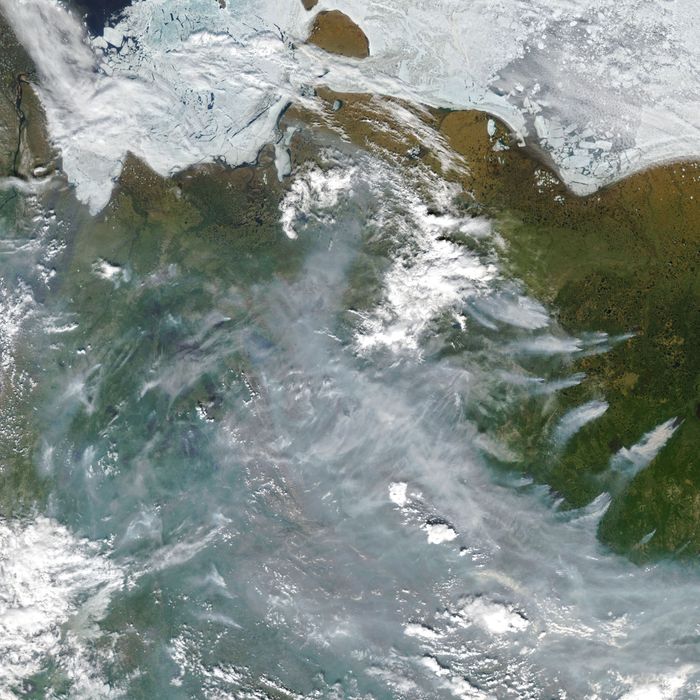
By David Wallace-WellsSatellite image of smoke from active fires burning near the Eastern Siberian town of Verkhoyansk, Russia, on June 23, 2020. Photo: Handout/NASA Earth Observatory
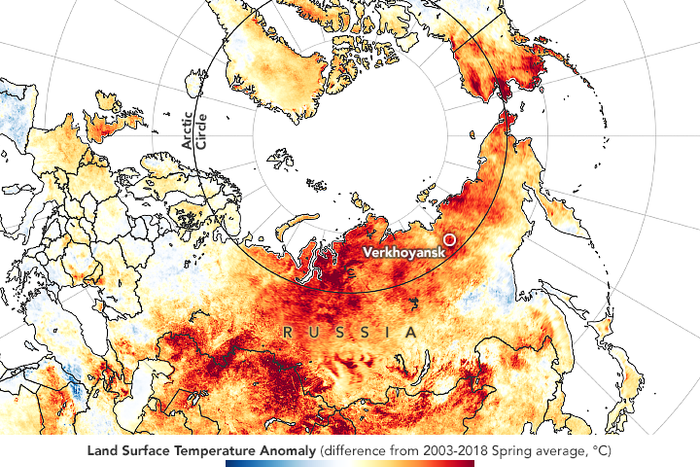

On June 20, in the small Siberian town of Verkhoyansk, north of the Arctic Circle, a heat wave baking the region peaked at 38 degrees Celsius — just over 100 degrees Fahrenheit. It was the highest temperature ever recorded in the Arctic. In a world without climate change, this anomaly, one Danish meteorologist calculated, would be a 1-in-100,000-year event. Thanks to climate change, that year is now.

If you saw this news, last weekend, it was probably only a glimpse (primetime network news didn’t even cover it). But the overwhelming coverage of perhaps more immediately pressing events — global protests, global pandemic, economic calamity — is only one reason for that climate occlusion. The extreme weather of the last few summers has already inured us to temperature anomalies like these, though we are only just at the beginning of the livable planet’s transformation by climate change — a transformation whose end is not yet visible, if it will ever be, and in which departures from the historical record will grow only more dramatic and more disorienting and more lethal, almost by the year. At just 1.1 degrees Celsius of warming, where the planet is today, we have already evicted ourselves from the “human climate niche,” and brought ourselves outside the range of global temperatures that enclose the entire history of human civilization. That history is roughly 10,000 years long, which means that in a stable climate you would only expect to encounter an anomaly like this one if you ran the full lifespan of all recorded human history ten times over — and even then would only encounter it once.

You may register temperature records like these merely as the sign of a new normal, in which record-breaking heat waves fade out of newsworthiness and into routine. But the fact of those records doesn’t mean only that change has arrived, because the records are not being set only once; in many cases, they are being set annually. The city of Houston, for instance, has been hit by five “500-year storms” in the last five years, and while the term has obviously lost some of its descriptive precision in a time of climate change, it’s worth remembering what it was originally meant to convey: a storm that had a one-in-500 chance of arriving in any given year, and could therefore be expected once in five centuries. How long is that timespan, the natural historical context for a storm like that? Five hundred years ago, Europeans had not yet arrived on American shores, so we are talking about a storm that we would expect to hit just once in that entire history — the history of European settlement and genocide, of the war for independence and the building of a slave empire, of the end of that empire through civil war, of industrialization and Jim Crow and World War I and World War II, the cold war and the age of American empire, civil rights and women’s rights and gay rights, the end of the cold war and the “end of history,” September 11 and 2008. One storm of this scale in all that time, is what meteorological history tells us to expect. Houston has been hit by five of them in the last five years, and may yet be hit with another this summer — which is already predicted to be a hurricane season of unusual intensity. Of course, that won’t be the end of the transformations. Climate change will continue, and those records — high temperatures, historic rainfall, drought, and wind speed and all the rest — will continue to fall. From here, literally everything that follows, climate-wise, will be literally unprecedented.$5 a month for unlimited access to Intelligencer and everything else New YorkLEARN MORE »

Land surface temperature anomalies from March 19 to June 20 in Eastern Siberia. The reds mark areas that were hotter than average for the same period from 2003-2018. The blues mark areas that were colder. From the Moderate Resolution Imaging Spectroradiometer (MODIS) on NASA’s Aqua satellite. Illustration: Handout/NASA Earth Observatory

The arctic numbers from June 20 are terrifying enough; with more context they become only more so. It was warmer there than it was that same day, in Miami, Florida. In fact, it was warmer north of the Arctic Circle than it has ever been, on any June day, in the entire recorded history of Miami, which has only once, in the whole tropical century for which temperatures there have been registered, reached 100. It was about 30 degrees Fahrenheit warmer, in Verkhonaysk, than the average high temperature in the region for June, which means the arctic record was the equivalent, in terms of temperature anomaly, of a 110-degree June day in New York or a 115-degree June day in Washington, D.C. According to preliminary satellite data, land surface temperature in parts of arctic Siberia reached that level last week, too — 45 Celsius, or 113 Fahrenheit. In terms of temperature anomaly, that’s the equivalent of a 130-degree day in D.C. On Capitol Hill, that would be, very comfortably, lethal heat.

Thankfully, for Americans at least, that isn’t how global warming works — its punishing effects are distributed unequally around the globe, and, at the moment, the Arctic is being punished most vindictively, warming at three times the rate of the rest of the planet. In Siberia, in May, temperatures averaged as much as 10 degrees Celsius higher than normal. The arrival of the arctic summer reignited “zombie fires” that had, improbably, burned through the arctic winter, smoldering in peat rather than burning out. Those fires, like all fires, released carbon, which is stored in trees as surely as it is in coal, in this case releasing as much CO2 in the last 18 months as had been produced by Siberian wildfires in the last 16 years. In early June, an industrial-scale oil-storage facility there collapsed when the melting permafrost on which it had been built finally destabilized, releasing about 21,000 tons of oil and turning local rivers red. That spill was about two-thirds the scale of the Exxon Valdez spill, which horrified an entire generation; this one, we’ve hardly read about, though it befell a far more ecologically degraded planet, with more than half of all carbon emissions ever produced by the burning of fossil fuels in the entire history of humanity coming since the Valdez spill. Perhaps though is a less precise word than because, the intervening generation of environmental calamity having quite thoroughly normalized horrors like these. Even Vladimir Putin — presiding over a petrostate which, so far north, actually stands to benefit from some amount of global warming — declared it an emergency. All told, the planet’s melting permafrost contains twice as much carbon as hangs in the planet’s atmosphere today, and it’s expected that over the course of the century, at least 100 billion tons of it will be released through melt, about three years worth of global emissions and functionally enough to close the window on the goals of the Paris accords.

A June 11 view of the site of a diesel fuel spill at Norilsk’s Combined Heat and Power Plant No 3 in Siberia. Photo: Denis Kozhevnikov/TASS via Getty Images

That window was not open very far to begin with. One recent study suggested that even the decarbonization targets of Britain and Sweden, often hailed as global climate leaders, would produce emissions between two and three times the carbon budget required to meet the Paris goals. (And those are just their decarbonization plans, which are probably optimistic.) Another analysis suggested that, for all the talk of halving our emissions by 2030 — as the IPCC says is necessary to safely avoid 2 degrees of warming — the planet has only a 0.3 percent chance of doing so. If Donald Trump won reelection, the analysis suggested, those chances would fall to 0.1 percent — one in a thousand.

If 2 degrees is now inevitable, that doesn’t make it comfortable. Indeed, it will be, for much of the world, a horror — and the space between those two things, inevitability and horror, is the one in which we will all be forced to learn to live. At 2 degrees, it’s expected that more than 150 million additional people would die from the effects of pollutionstorms that used to arrive once every century would hit every single yearand that lands that are today home to 1.5 billion people would become literally uninhabitable, at least by the standards of human history.

Those projections will invariably prove imprecise, or perhaps worse — that is both the nature of science, which proceeds by revision, and humanity, which will likely adapt to at least some measure of these impacts. But the Siberian heat wave reminds us just how large the scale of necessary adaptation will likely be — requiring us to respond not just by shoring up the proverbial shorelines of our civilizations but by preparing them in much more fundamental ways to endure conditions never seen before in the whole span of human history. It is also a reminder of just how much we miss when we regard the projections of any neat, linear model of future warming as a straightforward prediction of that future and of what level of adaptation will be require — especially when we reflexively discount the uncertainty warnings scientists invariably include, as any lay reader (including me) is likely to do. Perhaps the most important lesson of the freakish Siberian heatwave is: however terrifying you find projections of future warming, the actual experience of living on a heated planet will be considerably more unpredictable, and disorienting.

Just how freakish and unpredicted is this heatwave? Over the last few years, a growing chorus of critics have argued against one climate model built on predictions of high-end carbon emissions in particular, called RCP8.5 —arguing that, though it had been endorsed by the U.N.’s IPCC and formed the basis of much recent science since that organization’s last major report, its projections were simply implausible, relying as they did on the dramatic growth of coal use over the course if the century. As I’ve written before, that pathway does indeed look increasingly hard to credit as a model of our future, and is best understood, in terms of emissions, as an absolute worst-case scenario, which would require almost a global climate nihilism to achieve. But for those suggesting we should discard that model, or any other that charted a high-end course for warming, the arctic heatwave makes a very strong counterargument. Because even in that worst-case pathway, hundred-degree summer days in the Arctic do not become routine until the very end of the century. This heat wave is, today, an outlier, not a routine event. But that doesn’t make it irrelevant. Instead, it is giving us at least a brief preview of what the world would look like, more than a half-century from now, in a timeline we understand to be, at least in terms of emissions, impossibly pessimistic. But if our timeline could accommodate such extreme events from that worst-case one, and decades ahead of schedule, it is also a sign that “timeline” is probably a misguided way of thinking about the new swirling universe of extreme events we are plunging headlong into. Making sense of climate change requires more than trying to determine where on a particular linear plot we are and where on it we are likely to be in ten years, or in fifty. It may require more profoundly revising our sense of linearity itself. In this way, global warming isn’t just scrambling our sense of geography, with Verkhonaysk, at least briefly, playing the role of Miami. It is also scrambling our sense of time. You may feel, because of the pandemic, that you are living to some degree in 1918. The arctic temperatures of the past week suggest that at least part of the world is living, simultaneously, in 2098.

But climate change isn’t just a brutal form of time travel, it is discombobulating to our very sense of time. When looking at projections for future warming, an event like the Siberian heat wave appears as an acceleration of history, but when looking at the paleoclimate record, it seems like a trip deep into the prehuman past, toward eras like those, lasting millions of years, when palm trees dotted the Arctic and crocodiles walked in their shade there. Especially at extreme levels, warming threatens the apparent march of progress on which the modern, Western “timeline” model of history was built. But at least until the arrival of large-scale carbon removal technologies, it also illustrates the fact that time — in the form of carbon emissions, which hang in the atmosphere for centuries — is irreversible. Because we are doing so much damage so quickly, destabilizing the entire planet’s climate in the space of a few decades, warming can seem like a phenomena of the present. But its effects will unfurl for millennia, with the climate stabilizing perhaps only millions of years from now. Climate change unwinds history, melting ice frozen for many millennia and pushing rainforests like the Amazon closer to their long-overgrown savannah states. It also makes new history, drawing new borders and new riverbeds, turning breadbaskets like the Mediterranean into deserts and opening up arctic shipping routes to be contested by a new generation of great power military rivalries. It compresses history — those Houston storms, for instance, represent more than a millennia of extreme weather, concentrated in a period of just five years. And it scrambles and scatters it, too, disrupting the cycle of seasons and relocating rain belts and monsoons, among many other distortions. At the same time temperatures in Verkhoyansk reached 100 degrees, in other parts of Siberia it was snowing. Was it winter or summer, a Russian catching the national weather forecast could have been forgiven for asking. They may have wondered, is this our hellish climate future or the return of the Little Ice Age?

Contemplating the impacts of climate change from this perspective can seem naïvely abstract — and it is, when compared to the storms and the wildfires and the droughts. (Not to mention the literal plague of locusts, 360 billion of them, which have devastated agriculture in East Africa and South Asia this year, descending in clouds so thick you couldn’t see through the insects and leaving millions hungry.) But in addition to its humanitarian cruelties, for instance making pandemics like COVID-19 much more likely, warming is already recalibrating much more hard-headed models of time, too. This is a sign that warming is truly the meta-narrative of our century, touching every aspect of our lives. Beyond the catastrophes and crises, the surreal and disorienting aspects of climate change are showing up even in the most numbingly pragmatic places. Like, for instance, mortgages.

“Up and down the coastline, rising seas and climate change are transforming a fixture of American homeownership that dates back generations: the classic 30-year mortgage,” Christopher Flavelle of the New York Times reported June 19. (As it happens, the day before the record-setting temperatures in the Arctic.) As Kate Mackenzie has relentlessly chronicled for Bloomberg, mortgages aren’t the first or only financial instrument to feel the intrusion of a new climate reality much less forgiving, and less stable, than the one on which not just the financialization of the global economy but indeed all of human civilization has been erected. Insurance and reinsurance, municipal bonds and sovereign wealth funds, boutique hedge funds and massive asset-management operations are all beginning to reckon with a future made, at least, much rockier by climate change. How much rockier? Well, according to a Climate Central estimate, at least half a million American homes are on land expected, 30 years from now, to flood every single year. Altogether, those homes are today worth $241 billion. This is just homes, just in America, and annual flooding isn’t the only flood risk a homeowner or a bank might want to consider, which means, even looking only at flooding, many, many more homes are vulnerable than that. Of course, flooding is not, by any stretch, the only climate risk those homes and homeowners would face.

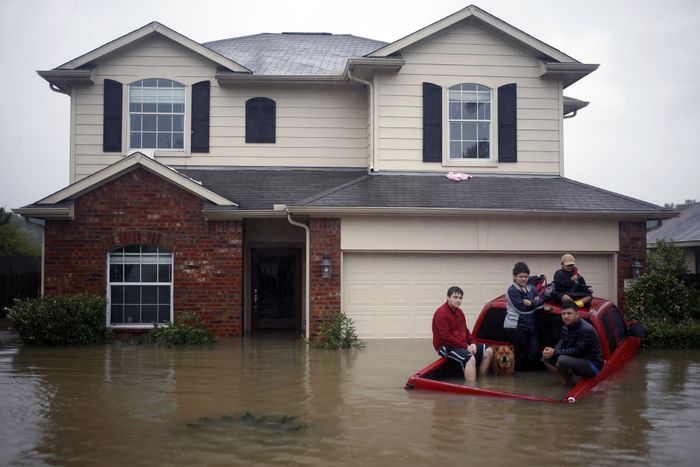
Residents with a dog sit in the back of a truck while waiting to be rescued from rising floodwaters due to Hurricane Harvey in Spring, Texas on August 28, 2017. Photo: Luke Sharrett/Bloomberg via Getty Images

Like many of those other financial instruments, a mortgage isn’t just an instrument but also a theory of time — a bet on future value built on the proposition that three decades is a long enough period to absorb the short-term turbulence of real-estate markets and a short-enough period that larger systemic shocks would not have time to develop and reverberate. That is, at least, how the mortgage looks from the bank side. From the consumer side, a mortgage represents a related, but slightly different, theory of time. For most of postwar American history, it has represented “adulthood,” as defined in mostly white and middle-class-and-up terms. For all those distortions and delusions embedded in it — ideas about housing and the real-estate market but also race and class and urbanization and family structure — the 30-year mortgage also embedded an idea about the stability of society through time, that one could expect to arrive at the end of adulthood in a world recognizable to the person who began it, and indeed that whatever changes had transpired would be, on net, of value to the homeowner, who by virtue of his or her property had become a small-scale stakeholder in the prospects of the community, the region, the nation and indeed the world as a whole. As the Times reports, both sides of that bargain are already, now, beginning to look very different.

More: https://nymag.com/intelligencer/2020/06/global-warming-is-melting-our-sense-of-time.html

Planet of the Censoring Humans

The campaign to remove Michael Moore’s new documentary from the Internet – led by Moore’s erstwhile progressive “allies” – is a significant advance in the censorship revolution

Matt Taibbi May 29

On April 21st, 2020, just before the 50th anniversary of the first Earth Day, Oscar-winning director/producer Michael Moore released a new movie called Planet of the Humans. Directed by Jeff Gibbs, the film is a searing look at the ostensible failures of the environmentalist movement, to which Moore and Gibbs both belonged.

“Jeff and I were at the first Earth Day celebrations,” Moore laughs. “That’s how old we are.”

Distributed for free on YouTube, the film’s central argument is that the environmentalist movement, fattened by corporate donations, has become seduced by an industrialist delusion.

“The whole idea of the film was to ask a question – after fifty years of the environmentalist movement, how are we doing?” recounts Moore. “It looks like, not very well.”

Moore and Gibbs challenged the idea that both the planet and humankind’s current patterns of industrial production can be saved through the magic bullet of “renewable energy.” The film shows lurid examples of various deceptions, like the oft-used trick of replacing coal plants with new natural gas plants, which are then called “clean” or “green,” or the hideous trend of describing the burning of trees as a “renewable” energy source.

Environmentalists denounced the film as riddled with “lies” and “misinformation,” claiming among other things that Moore used old data to discredit green technology. A campaign to remove the film from circulation immediately took shape.

“Within 24 hours of it going out on YouTube, people got to work on trying to take the film down,” explains Moore. He immediately started hearing about emails denouncing the film that were being circulated to what seemed like “everyone on the left.”

An “action letter” composed by environmentalist Josh Fox was circulated, describing the film as “dangerous, misleading, and destructive” and demanding an “immediate retraction.” Films for Action, an online archive of progressive movies, initially bent to Fox’s demands by taking the film out of its library, only to put it back up a half-day later out of a desire to avoid a “messy debate about censorship.”

An intense campaign of editorials followed, and a roughly month later, YouTube actually removed the film. The platform cited a four-second piece of footage shot by filmmaker Toby Smith that supposedly was a copyright infringement. Moore, who says all his films are “heavily lawyered,” insists the footage was legal under Fair Use laws, which allow the use of portions of copyrighted work without the permission of the owner. (In one of many ironies, Fair Use laws have long been celebrated by progressives as an invaluable tool for journalists and artists).

The significance of the Moore incident is that it shows that a long-developing pattern of deletions and removals is expanding. The early purges were mainly of small/fringe voices on either the far right or far left, or infamously fact-challenged personalities like Alex Jones. The removal of a film by Moore – a heavily-credentialed figure long revered by the liberal mainstream – takes place amid a dramatic acceleration of such speech-suppression incidents, many connected to the coronavirus disaster.

A pair of California doctors were taken off YouTube for declaring stay-at-home measures unnecessary; right-wing British broadcaster and trumpeter of shape-shifting reptile theories David Icke was taken off YouTube; a video by Rockefeller University epidemiologist Knut Wittknowski was taken down, apparently for advocating a “herd immunity” approach to combating the virus. These moves all came after the popular libertarian site Zero Hedge was banned from Twitter, ostensibly for suggesting a Chinese scientist in Wuhan was responsible for coronavirus.

In late April, the World Socialist Web Site – which has been one of the few consistent critics of Internet censorship and algorithmic manipulation – was removed by Reddit from the r/coronavirus subreddit on the grounds that it was not “reliable.” The site was also removed from the whitelist for r/politics, the primary driver of traffic from Reddit to the site. Then in early May, at least 52 Palestinian activists and journalists were removed from Facebook for “not following community standards,” part of a years-long pattern of removals made in cooperation with the Israeli government.

On May 13, human rights activist Jennifer Zeng noted that YouTube was automatically deleting Chinese-language references to terms insulting to the Chinese government, like gongfeior “communist bandit.” Congressional candidate Shahid Buttar complained an interview with Walker Bragman about Democrats supporting surveillance powers was removed by YouTube. Evan Greer of the speech advocacy group Fight for the Future had a post flagged by Facebook’s “independent fact checkers”—in this case, that noted pillar of factuality, USA Today – dinging him for a “partly false” claim that the Senate had voted to allow warrantless searches of browsing history.

These and many other incidents came in addition to a slew of moves aimed at right-wing speakers accused of varying degrees of conspiratorial misinformation and/or hate speech, from a decision by Twitter to begin “fact-checks” of Donald Trump to wholesale removals from Facebook of “anti-immigrant” sites like VDare and the Unz Review.

One problem is the so-called “reputable” fact-checking authorities many platforms are relying upon have terrible factual histories themselves. There’s an implication that “misinformation” by foreign or independent actors is somehow more dangerous than broadly-disseminated official deceptions about U.S. misbehavior abroad, or manufactured scandals like Russiagate. We now expect libertarian or socialist pages to be zapped at any minute, but none of the outlets which amplified the bogus Steele dossier have been put in Internet timeout.

Moreover, despite widespread propaganda to the contrary, the new movement to regulate speech on platforms like Twitter, Facebook, Instagram and YouTube is, actually, censorship. In the United States, high-ranking politicians in both parties have held congressional hearings and threatened these tech companies with tighter regulation and taxation if they do not develop policies for combating the “fomenting of discord.”

In response, these companies – which as recently as four or five years ago were disavowing editorial responsibilities, in the case of Facebook going so far as to deny being a media company at all – are now instituting vast new controls. It’s a clear symbiosis: governments permit mining of lucrative markets in exchange for access to the platforms’ monitoring powers.

“That’s censorship,” says Andre Damon of the World Socialist Web Site. “That’s a First Amendment issue.”

Throughout the last four years, it’s mainly been left to people affected by these new policies to point out the obvious, that relying on star-chambers of corporate gatekeepers to oversee information flow will have dramatic consequences. These voices seem to be the only ones interested in sticking up for the rights of political opponents.

“I don’t think anyone can confuse me for a supporter of Donald Trump, but I see the danger of celebration of Twitter fact-checking him, because that’s going to be the model for all of us,” says Ali Abuminah, author and co-founder of Electronic Intifada, which has extensively covered the suppression of speech in Palestine by Facebook, including the recent removals.

“It’s always presented as, ‘We’re going to crack down on white supremacists and anti-vaxxers,’” says Damon“But the practical impact of speech controls is always to advance the interests of the ruling class.”

The pseudonymous editor of Zero Hedge, Tyler Durden, points out that even when platform bans of sites like his are reported by mainstream press outlets, reporters rarely address the underlying rights issue. “Nobody really digs into the First Amendment angle,” he says. “They’re going after the far right, they’re going after the middle right. They’re going after the far left and the middle left. Where does it end?”

We already have a clear picture of what the endgame of public-private content regulation partnerships might look like, through the experience of other countries. In an extreme example, as far back as 2016, Israel’s Justice Minister boasted that Facebook was complying with “95 percent” of its requests for content regulation, deleting thousands of posts by Palestinians.

“Palestine is often the canary in the coal mine on speech issues,” laments Abunimah.

In Germany, which has strict hate speech laws, Facebook maintains an archipelago of ominously-named “deletion centers,” with as many as 1,200 employees at a single site, to sift through content in search of “community standards” violations. Under pressure from politicians and pundits alike, platforms began moving in this direction in the U.S. years ago, with Facebook announcing mass hires of employees with Orwellian titles like “community reviewers” and “news credibility specialists.”

The drive to step up “content control” isn’t all driven from the top down. A major additional factor has been the growth of a new intellectual movement geared toward delegitimizing speech and rationalizing censorship. The Moore incident provided a clear demonstration of how this new social reflex works.


In Planet of the Humans, Moore and Gibbs make a complex argument. In essence, they charge that people have become dependent upon the high-consumption lifestyles made possible by fossil fuels, and that it’s our addiction to that way of life, as much as to fossil fuels themselves, that is driving humanity off a “cliff.”

Their core criticism is aimed at big-name environmental leaders like Bill McKibben and Robert F. Kennedy, Jr., whom Gibbs and Moore argue have de-emphasized this truth to sell a fantasy – profitable equally to industry and environmental movements – that we can innovate our way to survival.

As is usually the case with Moore movies, Planet of the Humans across as a case for the prosecution. Whether he’s denouncing George W. Bush or the health care industry, Moore always sails close to the wind factually, and often leaves out mitigating information a traditional journalist would feel obligated to include. This movie is no different. For instance, audiences are not told until the credits that McKibben, who is depicted on film celebrating the “beauty” of burning wood chips, eventually came out against biomass plants.

It’s easy to see why McKibben would be upset at the portrayal of him in the center of an argument that the environmental movement has overstressed the possibilities of renewable energy at the expense of changing consumption patterns. After all, he’s written books and given talks addressing that problem. Then again, most of the “criticism” of McKibben comes in the form of footage of him talking, and liberal audiences never had a problem previously when Moore declined to add humanizing context to unflattering tape of the Don Rumsfelds and Charlton Hestons of the world.

Moore’s movies have always been designed to gut-punch audiences, and his M.O. is being unafraid to be accused of being “unfair” when he’s warning of disaster in Iraq, of a future of normalized mass shootings, of a failure to address working-class issues he (correctly) predicted would lead to electoral victory by Donald Trump, etc. He’s a provocateur who dares opponents to call him out on the facts (here he is musing about a $10,000 reward for anyone who can find errors in Fahrenheit 9/11). Planet of the Humans features all of these tactics that simultaneously made traditional journalists nervous but earned plaudits among committed liberals: one gets the sense that Moore, his skin leather-thick after years of media battles, is intentionally provoking a backlash in an effort to kick-start what he feels is a debate people are running out of time to have.

Still, it’s easy to understand why activists who’ve dedicated their lives to closing coal plants and developing cleaner energies would feel betrayed at the depiction of alternative energies as failed or even counterproductive exercises in self-deception. The footage that caused YouTube to yank the film came in the middle of a brutal montage showing all the different rare industrial materials that have been mined via earth-disfiguring methods in the making of solar panels — a sequence as painful to watch as the infamous “Wouldn’t it be Nice” montage of devastated Flint in Roger and Me.

Is it right, as multiple critics have wondered, to show such a punishing visual without noting advances that have made solar cleaner and more efficient since the early scenes in the film were shot?

If the criticisms of Moore’s film stopped with questions like these, they might have been more sympathetic. Moore and Gibbs seemed anxious to engage such questions.  “Maybe we’re wrong,” Moore says. “We’d have liked to have that discussion. That was a big reason we made the movie.”

Instead, critics rolled out a now-familiar playbook to depict the movie as too villainous to exist.

The Trump era has seen the unveiling of a range of nuclear arguments against unwelcome speech. Progressives who traditionally decried censorship now often embrace it with gusto in cases of “misinformation,” white supremacy and other forms of bigotry, and “conspiracy theory,” among other things.

The new take is that episodes like Brexit, the election of Donald Trump, the Charlottesville tragedy, a cascade of racially-motivated mass shootings and cases of police violence, and more recently the coronavirus disaster, have all proven that incorrect speech can no longer be tolerated. It’s now understood the consequences are simply too severe, especially for disadvantaged communities.

In the multitudinous critiques of Planet of the Humans, a creepy kind of rhetorical intersectionality is observed. Moore’s film is consistently depicted as not merely misinformation, conspiracy theory, or Trumpian hate speech, but somehow an interlocking combination of all of these things. Critics all seem to have gotten the same memo.

The biggest criticism comes in the film’s focus on overpopulation. In one much-derided scene, the director Gibbs notes it took modern humans “tens of thousands of years” to reach a world population of 700 million, but then tapped into millions of years of stored energy “increased by ten times in a mere two hundred years.” This fast-ascending population curve, Moore and Gibbs say, is also increasing consumption by as much as ten times per person.

Now, the environmentalist movement has been telling us for over half a century that rapid human growth and its insidious effects – sprawldeforestationhabitat lossoverfishing, etc. – are threatening species and warming the planet. It was not so long ago that deriding such concern was the exclusive preoccupation of right-wingers. Bush-era Republicans infamously thought liberal tree-huggers loved spotted owls more than people, and perhaps even nurtured plans for mass forced abortions to reduce world population (I wrote a book about an evangelical church that preached this idea).

With Planet of the Humans, we’ve come full circle. Now liberal critics are deriding all this tree-hugging as not just misanthropy, but supportive of racism and even genocide, using language that blows away Bush-era conservative rhetoric.

“Protecting the trees has almost always come with a judgment about which kind and color of humans they need protection from,” wrote Kate Aronoff at the New Republic. She added, “Gibbs does not appear to be a white nationalist himself, but his film echoes their approach.”

In The Nation, which lists Moore on its masthead as a contributing editor, Fox wrote a piece denouncing the film as not only “racist,” but, potentially, an “incitement to eco-fascist population controls.” He added:

We see old white male after old white male declaring there is no solution to climate change except reducing the population. (With this many white guys, we can only guess which groups of people are supposed to stop reproducing.)

Leah Stokes on Vox wrote the film’s takes on the dangers of overpopulation had “more in common with anti-immigration hate groups than the progressive movement” and expressed hope the film would be “buried.” Gizmodo argued the film has “more than a whiff of eugenics and ecofascism… Who are we going to knock off or control for?”

Given that the primary criticism of Moore’s film is that it unfairly depicts people like McKibben as sellouts, it’s more than a little odd that the apparently serious return criticism is that Michael Moore and Jeff Gibbs want to massacre nonwhite people. This would be laughable were it not for the fact that the campaign succeeded.

The director of Roger and Me and Bowling for Columbine has had plenty of prior experience with efforts to suppress his work. In 2001, HarperCollins blocked the release of his book Stupid White Men, on the grounds that a book critical of the U.S. government was inappropriate after 9/11. In 2004, Disney tried to block subsidiary Miramax from distributing Fahrenheit 9/11, a film that detailed links between the families of Bush and Osama bin Laden.

Both attempts failed. Stupid White Men was released after a group of librarians flooded the publisher with protest letters, and Fahrenheit 9/11 was ultimately distributed after Miramax and Disney reworked their deal.

The clear difference in this case was Moore and Gibbs are taking on Shibboleths on the left, instead of the right. Erstwhile liberal allies this time employed a tactic the right never used, describing the film as not merely wrong but “dangerous.” In conjunction with the new embrace of Internet control, this was enough to achieve something that Bush and Cheney never did: suppression of major motion picture.

In the past, a copyright dispute would have been a matter for courts. So, too, would questions of defamation that might have been raised by the likes of McKibben. Now critics can just run to Mommy and Daddy tech companies to settle disputes, and there’s no clear process for those removed to argue their cases.

This is a situation that carries serious ramifications, especially for people who have less reach and financial clout than Moore. “If they can do it to me, they can do it to anybody,” is how Moore puts it.

This is probably why, apart from a few brave institutional voices like PEN America, none of the traditional defenders of speech (ahem, ACLU) have spoken out. As was the case with Julian Assange and even Alex Jones, a fear factor is probably part of the equation. Who wants to be seen defending, even in the abstract, the rights of an ally of Putin? A race-baiting talk show host? An “eco-fascist”? Couldn’t such a defense itself invite reports of violating “community standards,” and bring a fresh threat of removal?

Maybe Moore is wrong about the environmental movement, but these new suppression tactics are infinitely more dangerous than one movie ever could be

, and progressives seem to have lost the ability to care.

You’re on the free list for Reporting by Matt Taibbi. For the full experience, become a paying subscriber.

Making Veggie Burgers Doesn’t Help The Climate, Impossible CEO Say


s

Impossible Foods has no interest in making a veggie burger that tastes like meat, its founder and CEO said Friday.

Veggie burgers don’t serve the company’s goal, said Patrick Brown—to solve “the catastrophic impact of the use of animals as a food technology”—because veggie burgers cater to vegetarians, not carnivores.

“All the plant-based foods that have been produced in the past—if you look at what was in the heads of the people who produced them—their target consumer was someone who is looking for an alternative, i.e. people who want to have a more vegetarian diet or something like that,” Brown said in a Zoom webinar. “If that’s your consumer, you’re not going to have any effect on the climate issues because that’s a very small population.”

When Marketing Professor Sanjog Misra asked Brown about making a veggie burger that tastes like meat, Brown interrupted him:

“That was not at all what we were trying to do,” Brown said. “It was to make the most delicious meat on earth directly from plants. What we think of ourselves as doing is making meat—a better way of making meat.”

Today In: Green Tech
  • Impossible Founder: We Can Repurpose The Meat Supply Chain, Minus The Slaughter Room

  • Why Sweden’s Approach To Coronavirus May Not Be What You Think

  • Swedish Wellbeing Startup Remente Gets Involved With Volvo’s 43,000 Workers

The Stanford University emeritus biochemistry professor took an 18-month sabbatical in 2009 to solve the most important problem he could think of, which he determined was the impact of animal agriculture on greenhouse gas emissions, water pollution, water consumption and land use.

“If you could vaporize that industry today, which I would do in a heartbeat,” he said, “and let the biomass on that land recover, it would outpace fossil-fuel emissions. It would literally begin to reduce the atmospheric CO2 concentrations, and you can do the math on that. We desperately need that.”

But Brown doesn’t expect carnivores to eat plant-based meat to mitigate climate change.

“It had been framed as we’ve got to get people to change their diets, or we have to compel that business to stop doing it and so forth, and that’s just like crazy. That is never going to work,” he said at the webinar hosted by the University of Chicago’s Rustandy Center for Social Sector Innovation.

“People are very wedded to the foods that they prefer. The pleasure that they get from eating the foods that they love is a huge part of the pleasure of life. It’s unreasonable to think you can ask them to give that up. And that defined the problem very crisply for me, which is that it’s a technology problem.”

Animal agricultural is a $1.5 trillion prehistoric technology, Brown said, that’s vastly inefficient and hasn’t significantly improved in millennia. So it’s a “sitting duck” for disruption.

He assembled a team of 80 research scientists to solve the technology problem, to make a plant-based meat that’s more affordable, more nutritious and more delicious than animal meat.

Plants already offer the advantage of nutrition and affordability, he added, so the challenge—what he called “the most important scientific question”—has been deliciousness.

“We’re not going to solve this problem by mushing a bunch of peas and carrots together and forming it into a patty,” he said. “We have to deliver for a committed meat eater, who is not looking for an alternative, they’re just looking for the most delicious, healthy, affordable meat they can buy given their taste.”

Brown doubts anyone can convince consumers to compromise what they want. The producer has to give them what they want. So the Impossible goal has been “to make the most delicious meat on earth directly from plants.”

Are Dairy Digesters the Renewable Energy Answer or a ‘False Solution’ to Climate Change?

Capturing the massive quantities of methane dairy farms emit could reduce overall carbon pollution. But critics say the effort is propping up Big Dairy.


logo for covering climate nowThis article is published in partnership with Covering Climate Now, a global journalism collaboration strengthening coverage of the climate story.

At first, California dairy farmer Felix Echeverria was skeptical about installing a dairy digester on his 12,000-cow operation. The process, which involved covering a pit of liquid manure and capturing the methane emissions it releases before “digesting” it anaerobically, is expensive and complex, and not something he was qualified to run. But he saw the benefits neighboring farmers in the Bakersfield area reaped from their digesters and decided to get ahead of a state law that would require him to reduce emissions by 2030.

“I realized I could stay ahead of the curve on greenhouse gas emissions,” Echeverria told Civil Eats. “To know we’ve been able to comply [with the law], that was the motive.”

The other deciding factor: Echeverria learned that he didn’t have to invest in or build the digester, as farmers in years past have. Instead, he partnered with a developer, California Bioenergy LLC (CalBio), that applied for public funding to help pay for the project and now operates the equipment. And in exchange for his manure biogas, Echeverria earns a percentage of sales from the electricity generated by the digester.

Get the latest articles in your inbox.

“There’s absolutely no drawbacks,” Echeverria said of the digester, which has operated on the farm since 2018.

Agriculture accounts for nearly a quarter of global greenhouse gas emissions, and as its role in changing the climate has become increasingly clear, farmers like Echeverria are being asked to do their part. In recent years, much of the attention—and the bulk of public dollars—has focused on anaerobic digesters, which help meat and dairy production facilities convert animal waste into energy that fuels vehicles and power grids.

Farmers, researchers, and policymakers across the U.S. see methane digestion as cost-efficient, effective, and revenue-generating for farmers. Proponents also see biogas and its cleaned-up version, biomethane (also known as renewable natural gas, or RNG) as a renewable source of energy that has a huge potential to replace more harmful legacy fuels.

Over the past decade, more than 250 digester projects have been built across the country, most of them on dairy farms. California alone has funded more than 100 digester projects, spending nearly $200 million of its ambitious California Climate Investments dollars on them. The state is poised to spend an additional $20-$25 million this year, though it’s unclear how the COVID-19 pandemic will impact the funding process going forward.

“The primary beneficiaries of these projects are the citizens of California. By reducing greenhouse gases, we are contributing to reducing global warming,” said Joyce Mansfield with the California Department of Food and Agriculture (CDFA), which runs a grant program for dairy digesters.

But digesters do have some drawbacks. They’re complex, expensive projects that farmers can’t afford on their own; they cost $3-5 million dollars each and typically require public subsidies to build—in the form of federal loans, state grants, tax credits, rebate programs, and myriad other incentives.

In the past, environmental advocates have supported digesters, but many have begun to see the technology in a new light. They say the emission reductions are not worth the massive public funding given that most manure-powered biogas comes from large-scale industrial dairy facilities known for their significant environmental impacts. (Straus Family Creamery in Northern California is one of a few exceptions.) As such, advocates say public financing of digesters amounts to supporting and helping to perpetuate large-scale factory farming—and in some cases, causing farms to grow in size—under the guise of mitigating climate change.

“Digesters are definitely reducing methane and generating fuel [and] electricity. It all sounds very good, but it’s not a clean fuel,” said Rebecca Spector, the West Coast director for the Center for Food Safety. “These enormous dairies are polluting the air and the water … and the state is promoting a false solution while propping them up.”

Ultimately, Spector said, portraying digesters as a panacea to dairies’ environmental woes is thwarting the move to a farming system that supports smaller-scale producers, reduced herd sizes, and cows on pastures. “We want dairies to move to more sustainable solutions and we support the state incentivizing that,” she said.

Pressure to Reduce Emissions

Large industrial dairies, also known as concentrated animal feeding operations, or CAFOs, clean manure out of their barns with water and store the liquid waste in large lagoons. As naturally occurring bacteria break down the manure, they release large quantities of methane, a greenhouse gas with a 25 times greater impact on global warming than carbon dioxide. In fact, more than half of California’s methane emissions come from dairies.

Manure management accounts for about 7 percent of agriculture emissions and in recent years, dairies across the U.S. have faced increased pressure to reduce that number. In California, the country’s largest dairy state, producers are required by 2030 to decrease their methane emissions by 40 percent from 2013 levels. And while much of the methane comes from cows belching, dairy manure lagoons account for approximately 25 percent of the state’s overall methane emissions.

Reducing those emissions is no small feat. In 2017, California housed 1.7 million cows—the vast majority of them residing in the Central Valley on approximately 1,300 dairies. According to the U.S. Environmental Protection Agency (EPA), an average dairy cow produces approximately 120 pounds of manure every day.

The digesters capture methane, convert the biogas to biomethane, and inject it into utility pipelines as renewable compressed natural gas (R-CNG) to power trucks, buses, and cars. In some cases, digesters also generate renewable electricity that’s used by the dairy, with the remainder sent into the grid. Dairy methane can also be turned into renewable electricity without combustion to power electric vehicles.

Because of the expense and scale of the projects, digesters are geared toward large dairies.

In the past, dairy producers built and operated their own digesters. But in recent years, as the projects have become more complex and their price tags have ballooned, big developers have largely taken over their funding, building, operating, and maintenance. Most of the digesters are now part of clusters, with the biogas sent to a centralized cleaning hub.

Because of the expense and scale of the projects, digesters are mainly geared toward large dairies—2,500 cows with support stock could support a standalone digester, according to digester developers. If a dairy is near a cluster project, it might work for it to be somewhat smaller.

While digesters may be expensive, data collected at the state level shows digester projects are cost-effective when it comes to reducing greenhouse gas emissions. In fact, the digester program is the second most cost-effective of the state’s 68 climate programs.

“Our projects are providing high value for the state in terms of return on their investment,” CalBio’s President Neil Black wrote in an email. “We are destroying methane, which has greater short-term warming impacts in initial years… [so] the climate benefits will be seen much sooner than projects that reduce carbon dioxide.”

Indeed, the greenhouse gas reductions can be substantial. Echeverria’s dairy digester was expected to cut its manure methane emissions by approximately 75 percent. It will also reduce energy costs and its use of fossil electricity from the grid. The digester delivers approximately 8 million kilowatt-hours of renewable electricity annually to state utility, Pacific Gas & Electric (PG&E). And the dairy is part of the Kern County Dairy Biogas cluster, a group of 16 dairies with approximately 60,000 milk cows that collectively produce approximately 6 million diesel gallon equivalents per year.

For large dairies, digesters can be a godsend: they cut the cost of complying with environmental rules, and offer a new source of revenue to supplement volatile milk prices. Farmers can also use electricity-engine waste heat to refrigerate their milk, resulting in further savings.

Digesters also provide benefits beyond emission reductions, Echeverria said. “We don’t have as much solids to deal with in the waste stream because a lot more material gets digested and turned into gas. We can move it around easier, our lagoons stay cleaner, and we get a better fertilizer source,” he said, referring to the fact that nutrients are broken down more thoroughly in the digester and are more available to the plants when the manure is spread on fields. And because digester projects are required to double-line the lagoons, he says nitrates don’t leach into groundwater.

Digesters also reduce emissions of hydrogen sulfide and other gases, said Black, CalBio’s president, improving air quality and reducing odors. The company is working to help convert truck fleets from diesel to natural gas, he said, which will significantly reduce nitrogen oxides, a major component of smog, in the highly polluted Central Valley where residents live with some of the worst fine particle pollution in the nation.

But Spector with the Center for Food Safety contends that while digesters do provide some benefits, they don’t solve the issue of nitrates contaminating groundwater—a major issue in the Central Valley, where low-income residents are often forced to rely on bottled water. That’s because nitrates often leach from manure applied as fertilizer into groundwater. Spector says that when digesters burn biogas they also produce air pollution. In addition, the digesters don’t address the climate impacts of enteric emissions (from cows releasing gas) which account for about half of the methane emissions from dairies.

Subsidies for Developers, Revenue to Industrial Dairies

Critics also decry the fact that much of the public funding for dairy digesters has gone into the hands of just a few developers.

In California, the CDFA has created a research and development program that is funded with the state’s cap and trade dollars. From 2015 to 2019, the program has awarded over $180 million to 108 projects, the agency told Civil Eats. And yet the vast majority of that money has gone to just two developers (only 12 developers have ever applied, the agency said).

CalBio has receive the largest amount: $99 million to date. And Maas Energy Works has been awarded $82.5 million. The CDFA grants require a 50 percent financial match, though those funds can also come from other public sources. Both companies also say they have received other public funding for their projects. Additional capital for the projects comes from investors and lenders.

CalBio currently operates five projects in California and is developing, according to its officials, more than 60 additional digesters in seven clusters of existing dairies that will produce renewable compressed natural gas for use in vehicle fleets. Maas Energy Works has a total of 27 digester projects, including 22 in California, three in Washington state, and two in Oregon.

“California has required the dairy industry to reduce their methane emissions by 40 percent. The best way to achieve that reduction is with dairy digesters,” Maas Energy Works spokesman Doug Bryant told Civil Eats via email.

The digester projects are a financial boon to both the developers and farmers. While in previous years, their value was based around renewable electricity generation and the sale of carbon credits, it now comes from the production of low carbon fuel, through the sale of natural gas, as well as the generation and sale of “credits” that can be sold to polluting companies and other organizations that use them to comply with state and federal requirements or voluntary emissions goals.

Precisely who benefits from these income streams varies from project to project. But with the new generation of digesters, it is often the developers who bring in the capital and who then own the digesters while the dairy producers rent their lagoon and provide the manure in return for a cut of the power sold. “Our company helps bring in the capital from lenders and investors. The dairies… receive the payment for contributing their manure, and the better the project performs, the more they will make,” said CalBio’s Black.

He added that dairies have an opportunity to invest in their projects, but that is optional. In Maas Energy Works projects, on the other hand, over half of the projects are 100 percent owned by the dairy farmer and the developer simply operates the digester for a fee, the company told Civil Eats.

Fight Over Renewable Gas

In the coming years, digester developers and dairy farmers may tap into an even bigger source of income as the gas industry looks to replace some of the “fossil-based” natural gas it currently sells. Natural gas companies such as SoCalGas and PG&E have heavily promoted biogas as a cost-effective, reliable “renewable natural gas.” The private utilities say that mixing RNG with regular gas in their pipelines will reduce its carbon intensity. And it appears the gas industry may get its way, at least in the short term.

While in the past, digester projects generated electricity for export to the grid, the current focus is on using the dairy biomethane—in the form of CRNG—as an alternative vehicle fuel and energy source. Out of 108 projects funded by the CDFA since 2015, 102 produce or will produce CRNG. And in recent years, these are built in a cluster of digesters that pipe gas to a centralized hub.

Two years ago, a new California law essentially mandated that a certain amount of biogas from manure and other renewable sources be included in utilities’ energy mix and for it to be injected into the gas pipeline system. The California Public Utilities Commission is currently in the process of creating a procurement standard to make that possible.

Legislators recently extended the ability to tap into $40 million in subsidies through a program that connects manure digesters to utility pipelines. And the SoCalGas settlement for the Aliso Canyon gas leak is also channeling $26.5 million toward the construction of dairy digester projects.

While some have praised this move, critics say it has created a whole set of ethical issues. Jim Walsh, a senior energy policy analyst with Food & Water Watch, says that using California Climate Investment funds to produce renewable gas from biomethane that utilities want in their portfolio supports not only factory farming but also the legacy fossil fuel industry—and could ultimately allow it to continue its polluting ways.

“These cap and trade funds are huge subsidies that utilities and other large polluters pay for to avoid their own emission reductions…. It allows them to greenwash themselves while proceeding with their practices,” Walsh said. “This is really just a shallow attempt to extend the life of their industry in the face of a growing backlash against fossil fuel development.”

Using biogas from manure as part of utilities renewables portfolio isn’t cost effective either, Walsh added, and will significantly increase rates for consumers. Methane-derived RNG can also leak through pipelines when transported, just like natural gas. And the bet on biogas from dairies is happening just as cities around the country are focusing more on electricity and passing laws to stop the building of new gas infrastructure.

In California, state officials have also pushed electricity as a strategy for cutting emissions from homes and workplaces. Meanwhile, utilities like SoCalGas counter that using biogas as part of their energy mix can reduce greenhouse gas emissions faster and cheaper than electrifying buildings.

Ultimately, what could make utilities’ move to biogas problematic is simply a problem of supply. Studies show there likely won’t be enough RNG/biomethane to meet the state’s climate goals.

Alternatives Underfunded, Lag Behind

Dairy digesters aren’t the only way to manage manure’s methane impact, but environmentalists say that other, more cost effective and sustainable methods tend to be much harder to get funded.

The CDFA runs a second methane reduction grants program called the Alternative Manure Management Program (AMMP). Those include projects focus on different ways to handle manure, such as composting and conversion to something called dry scrape collection, as well as enhanced pasture-based management practices (though few producers have applied to move their cows to pasture).

The program’s funding makes up only 20-30 percent of the total available for methane reduction programs, records show. More producers apply for the AMMP funding than for digester dollars, but in 2019 about half were rejected due to lack of funding.

The CDFA told Civil Eats that the dairy digester program has greater reductions of greenhouse gases than the alternative program. But Jeanne Merrill, policy director of California Climate and Agriculture Network (CalCAN), said the agency’s comparison is flawed. The CDFA calculates emission reduction impacts from AMMP projects on a 5-year project basis, she said, while those from the digester projects are calculated on a 10-year basis. “That’s comparing apples to oranges,” Merrill said.

CDFA officials said they use those time spans because they represent the expected duration of the projects. But Merrill said when greenhouse gas reductions are compared across both programs using similar timeframes, the AMMP projects fare quite well and sometimes do a better job with emission reductions per dollar.

AMMP projects are also faster to implement. Of the 108 digester projects awarded grants since 2015, only 13 are now complete and operational. The remaining 95 are at different stages of implementation.

Alternative methane reduction projects can also help protect water and air quality, Merrill added. Because they’re less expensive, they’re accessible to smaller farms and have greater geographic impact. And while digester projects are only guaranteed for 10 years (although Maas Energy Works told Civil Eats its digesters are expected to survive for at least 20), alternative projects are not subject to changes in complex technologies so are easier to maintain long-term.

“The trouble with digesters is that they only work for a quarter of the state’s dairies,” Merrill said. “Small and middle-sized dairies don’t have enough manure or capital to justify building digesters.”

Given the benefits, Merrill added, the CDFA should allocate half the available funding to non-digester programs.

Coronavirus May Stem the Tide of Funding

As the COVID-19 pandemic rages through California and the rest of the country, it’s still unclear how it might impact dairy digester projects. The pandemic has battered many smaller dairy farmers, with demand for dairy dropping and milk prices at historic lows. But both California Bioenergy and Maas Energy Works told Civil Eats that beyond minor delays and a slow-down in financing, the virus has had a limited impact on their operations so far.

In the near term, the impact may be financial. Before the pandemic, California’s governor Gavin Newsom proposed a budget that included a new ambitious Climate Catalyst Fund of $1 billion over the next four years. Companies—including farms and digester developers—could apply to get low-interest loans to reduce their climate impacts. That budget proposal, Newsom now says, “is no longer operable” and will have to be revised.

But given the fact that CDFA set its budget for 2020 loans last year, even the pandemic isn’t likely to stop the state’s fledgeling dairy digester industry from progressing—at least for the foreseeable future.


Top photo: The Riverview Dairy Digester in Pixley, California. It receives manure from roughly 3,000 cows, plus replacement stock. (Photo courtesy of Maas Energy Works)

Air pollution falls as coronavirus slows travel, but scientists warn of longer-term threat to climate change progress

KEY POINTS
  • The coronavirus pandemic is shutting down countries across the world, causing a significant decline in air pollution in major cities as countries implement stricter quarantines and travel restrictions.
  • The unintended air pollution declines from the virus outbreak are just temporary, experts say.
  • But the pandemic’s unintended climate impact could offer up a glimpse into how countries and corporations are equipped to deal with destruction of the slower-moving climate change crisis.
H/O: NASA Coronavirus pollution China map
NASA’s Earth Observatory pollution satellites show “significant decreases” in air pollution over China since the coronavirus outbreak began.
Courtesy of NASA.

Canal water in Venice has cleared up without boat traffic. Air pollution in China has plunged amid unprecedented lockdowns. In Thailand and Japan, mobs of monkeys and deer are roaming streets now devoid of tourists.

The coronavirus pandemic is shutting down countries across the world, causing a significant decline in air pollution in major cities as countries implement stricter quarantines and travel restrictions.

The unintended air pollution declines from the virus outbreak are just temporary, experts say.

But the pandemic’s unintended climate impact offers a glimpse into how countries and corporations are equipped to handle the slower-moving but destructive climate change crisis. So far, researchers warn that the world is ill-prepared.

For years, scientists have urged world leaders to combat planet-warming emissions, which have only continued to soar upward.

“In the midst of this rapidly moving global pandemic, it’s natural that we also think about that other massive threat facing us — global climate change —  and what we might learn now to help us prepare for tomorrow,”  said Peter Gleick, a climate scientist and founder of the Pacific Institute in Berkeley, California.

“The pandemic is fast, shining a spotlight on our ability or inability to respond to urgent threats. But like pandemics, climate change can be planned for in advance, if politicians pay attention to the warnings of scientists who are sounding the alarm,” Gleick said.

RT: Venice empty canal
Clear water is seen in Venice’s canals due to less tourists, motorboats and pollution, as the spread of the coronavirus disease (COVID-19) continues, in Venice, Italy, March 18, 2020.
Manuel Silvestri | Reuters

The virus has infected more than 311,000 people globally and killed at least 13,407. Countries like China and Italy have closed their borders and locked down cities, while the U.S. has closed its northern border with Canada and banned entry of foreign nationals from a slew of affected countries.

Satellite images from NASA’s Earth Observatory show significant drops in pollution across China and Italy since the start of the outbreak, as travel restrictions in those countries halt air, train and road traffic.

Italy, which has become a center of the outbreak outside of China, has undergone some visual environmental changes without tourism. Venice’s typically murky waterways have turned clear since the sediment remains on the ground without boat traffic. The water quality in the canals is not necessarily changed, but the air quality has improved.

“As for the environmental benefits we see from the slowdown of day-to-day life and economic activity in terms of improving air quality and other slight benefits, it’s a good sign that our ecosystems are somewhat resilient if we don’t completely destroy them,” Gleick said.

“But it would be nice if we could improve our environment without having to cripple our economy,” he added.

Scientists argue that the long-term impact of the coronavirus pandemic on climate change will depend on how countries and corporations respond to an economic crisis.

NASA Earth

@NASAEarth

Nitrogen dioxide over has dropped with the coronavirus quarantine, Chinese New Year, and a related economic slowdown. https://earthobservatory.nasa.gov/images/146362/airborne-nitrogen-dioxide-plummets-over-china 

View image on TwitterView image on Twitter
971 people are talking about this

The International Energy Agency, or IEA, has warned the virus will weaken global investments in clean energy and industry efforts to reduce emissions, and has called on governments to offer stimulus packages that consider climate change.

But an economic stimulus package that considers global warming will likely not be the response from many countries.

For example, the Prime Minister of the Czech Republic recently urged the European Union to abandon its landmark green law focusing on carbon neutrality as it grapples with the virus outbreak. The Czech Republic depends largely on nuclear energy and coal.

Furthermore, major U.S. airlines are asking for billions of dollars in government aid as they face potential bankruptcy from travel decline, which President Donald Trump has endorsed. Air travel is expected to bounce back after the pandemic subsides, and the industry’s emissions are expected to triple by 2050.

Climate researchers warn that the virus will hinder climate change action from corporations and countries in the long-run.

Rob Jackson, a professor of Earth system science at Stanford University and chair of the Global Carbon Project, said companies that are hurting financially will likely delay or cancel climate-friendly projects that require investment up front.

Sarah Myhre, a climate scientist and environmental justice activist, said that the way in which the world recovers from the pandemic is vital in the fight against climate change.

“If the actions here continue to bail out fossil fuel companies and multinational corporations and banks, and invest in fossil fuel infrastructure, then we are digging a hole deeper into a more violent and dangerous place,” Myhre said.

“I think that there’s potential for this pandemic to become a moment of mass awaking of our ability to have compassion for each other,” she added.

GP: Coronavirus Times Square New York City streets getting empty day by day
New York’s famous Times Square is seen nearly empty due to coronavirus (Covid-19) pandemic on March 16, 2020 in New York, United States.
Tayfun Coskun | Anadolu Agency | Getty Images

Our Endangered Species Need This Law to Survive.

By latest estimates, over 1 million species are in danger of disappearing globally. Much of this is due to biodiversity’s arch-enemy, climate change. But there is another culprit that is also picking off our earth’s beautiful animal species one by one – the lucrative and illegal wildlife trafficking trade. Many of these animals end up part of the tourism industry like the orcas and dolphins of SeaWorld to which Expedia still sells tickets. Other animals, on the other hand, are not so lucky.

Animals like lions, tigers, chimpanzees, gorillas, and many more are the targets of organized crime syndicates that trade in their flesh and bone, killing them in unsustainable numbers and selling them for souvenirs, trinkets, and “medicine.”

Passing this bill could help endangered animals. Sign to ask the U.S. Congress to do so.

It is paramount that governments like the United States create strong legislation that works against these organizations and the destruction they cause. One such remedy could be the Rescuing Animals With Rewards (RAWR) Act. The RAWR Act was introduced in May of 2019 and would empower the United States State Department to offer financial rewards in exchange for information that leads to the disruption of the multi-billion dollar wildlife trafficking trade. Since the bill’s introduction by U.S. Senators Susan Collins and Jeff Merkley, it has lingered in the Senate chamber. Meanwhile, the House acted swiftly and passed it in July.

Unfortunately, that wasn’t good enough to make it law. Now, in order to make it a reality, both the Senate and House will have to reintroduce the bill for the 2020 session. Last year’s delay in the Senate is worrying. This is a bill that could save millions of animal lives and help stem the global extinction crisis but it was allowed to fizzle out. Will there be movement this year?

It is more important than ever to strengthen our nation’s laws against trafficking and that’s why the RAWR Act is so crucial.

Tell Congress you support this important bill and that it must be reintroduced and passed this year without delay. Please sign the petition and tell them to do so today.