There is no such thing as a sustainable commercial fishing industry. Over 2 trillion fish are taken from the sea every year and that figure does not include the 120 billion killed on fish farms. This kill is far larger than the estimated 65 billion animals slaughtered each year for meat and fur. The critics of Seaspiracy are trying to say that fishing can be sustainable and necessary by pointing to artisanal and indigenous communities suggesting that the film is racist. That is a ridiculous accusation. The film is directed at the reality of industrialized commercial fishing. The fishermen in their tiny boats in the waters off Africa or India are not the problem. In fact they are the victims of the problem as industrialized highly technological ships plunder their seas for profit. Traditional artisanal fishing communities in the Southwest coastal province of Kerala have long suffered from the mechanized vessels funded by Norway.
Commercial Norwegian fishing off India forced hundreds of thousands of Indians into poverty with the result that today Norway, the 2nd largest exporter of fish in the world (And the world’s No. 1 killer of whales) is a major exporter of fish to India. By destroying artisanal fishing, Norway reduced competition in India and increased their export sales to India.
Norway is also the world’s largest producer of farm raised salmon. Pirate fishing is also a major problem and many of these illegal operations are funded by companies in Spain and China and untraceable trans-shipping of fish at sea makes it difficult to track fish catches. Who are the pirates of Somalia? Why is piracy becoming a problem now in the West African Gulf of Guinea? The answer is desperate artisanal fishermen forced into piracy by the depredations of the highly efficient illegal operations by Europe and Asian commercial fisheries.
When consumers order fish on the menu or buy it from the market they are supporting the destruction worldwide of marine eco-systems. They are supporting the impoverishment of artisanal and indigenous communities. They are supporting slavery and the murder at sea of observers and rebellious slaves. When consumers eat meat or wear fur they are also supporting the destruction of marine eco-systems and slavery because some 40% of fish caught are rendered into fishmeal to feed chickens, pigs, domestic salmon and farm raised fur-bearing animals. Additionally 2.4 million tons of wild fish caught each year is used directly for cat food.
This is more fish for cats than consumed by all four species of seals ((Harp seals (Phoca groenlandica), Hooded seals (Cystophora cristata), Grey seals (Halichoerus grypus) and Harbour seals(Phoca vitulina) in the waters of the Northwestern Atlantic Ocean. Chickens and pigs eat more fish than all the world’s puffins and albatross. This translates into a world out of balance and the antithesis of the word sustainable.In recent years the use of the words “sustainable” or “sustainability” has increased as species and eco-systems are depleted. It is the green-washing or blue-washing term of choice by the commercial fishing industry.
In 2021, no self respecting environmental NGO should be justifying, rationalizing and enabling commercial fishing operations. If they do so they are in willful denial of the reality of the threats to survival of life in the sea and on land.Since 1950, the seas have lost 40% of phytoplankton populations (Source: Scientific American). from pollution and diminishment of the nutrient base provided by marine life. Phytoplankton provides up to 70% of the oxygen in the air that sustains all life.
The Ocean is the life support system of this planet. Yes it provides food (Far too much for us and far too less for other species) but more importantly it provides oxygen and regulates climate and temperature. This life support system is maintained by a crew of living beings and we the human passengers feasting merrily and ignorantly oblivious at the table are murdering and consuming the crew that sustains this life support system.
Several days before Seaspiracy was released on Netflix, a response made by the National Fisheries Institute was leaked. Before audiences had gotten a chance to see the documentary, the fishing industry was already dismissing it as “vegan propaganda.” Unfortunately, it is unlikely that their opinion of the film emerged from any genuine Delphic foresight. Indeed, “propaganda” seems quite a puzzling label to stick on a movie that unravels its story in such a deliberate and reasoned manner.
The facts in the documentary are nothing short of remarkable. A marine biologist explains that the Deepwater Horizon Disaster, which spilled thousands of gallons of oil into the sea and saw countless images of seabirds coated in black, dying on slimy beaches, killed fewer animals than commercial fishing in the Gulf of Mexico kills in a single day. Indeed, the disaster actually allowed fish stocks in the Gulf to bounce back because it interfered with normal fishing operations. Other numbers in the film are so big they really can’t be comprehended, like the fact that humanity kills five million fish every second.
Lex Rigby, the head of investigations at Viva!, explained the apathy most people feel towards fish. “Whenever we talk about fish, we talk about harvesting them like crops,” she said. “We talk about their slaughter number in tonnage rather than individuals.” Perhaps this is one place Seaspiracy is a touch lackluster; it doesn’t dwell for long on the evidence that each fish is an individual with a distinct psychology, no matter how remote their experience is from ours, which can feel pain.
However, the movie does illustrate the troubling ways in which commercial fishing has been sidelined as an issue, even by the environmentally-conscious. Plastic is the favored bogeyman when it comes to ocean pollution, and it certainly is a serious problem. Yet popular talking points, like the murderous flotillas of plastic straws, are more or less total canards. Plastic straws make up 0.03 percent of ocean plastics, and all plastics combined kill roughly 1,000 sea turtles a year. Fishing, on the other hand, kills 250,000 sea turtles a year. Similarly, the origin of the plastic is often imagined to be apathetic consumers who purchase thirty plastic bags every trip they make to Walmart, and yet 46 percent of the Great Pacific Garbage Patch is made up of fishing nets. These nets drift through the open ocean for miles, tangling and strangling thousands of animals as they go, and are far deadlier than plastic bags.
It is not an accident that fishing has been neglected in discussions about ocean conservation either. The issue has been obscured by specious labeling and a culture of omertà amongst governments and regulators. The Earth Island Institute relies on captains’ self-reporting when they hand out their dolphin-free labels, which is an obviously poor standard of evidence. Rigby described the way self-reporting is abused by fishing vessels, drawing from her time with Sea Shepherd off the coast of West Africa, “We counted one hundred and seventeen sharks in one net. They only reported four.”
The Marine Stewardship Council, whose ubiquitous blue tick assures millions of consumers that they are purchasing vetted and sustainable seafood, seem to have included the word ‘stewardship’ in their title as some sort of bad joke. The more blue ticks they hand out, the more money they make, and one of their founding members was the food (including seafood) giant Unilever. Additionally, the world’s sustainable fisheries are proved to be anything but, seeing as 90 percent of them continue to allow commercial fishing.
Those invested with the powers of stewardship neglect them. Citizens are left in the dark with misleading labels and glib talk about sustainable fishing for a comfort blanket, while the oceans are scraped and pillaged. Aquaculture, like salmon farming, is not a sustainable alternative to wild fishing, although it is promised to be. Salmon are fed wild fish, with 1.2 kilograms of wild fish producing 1 kilogram of salmon. The farms are teeming with lice which feed on the salmon while their accumulated waste creates zero-oxygen dead-zones.
Like all great explorations of ecology, Seaspiracy highlights the dramatic intersection between animal wellbeing, environmental health, and human prosperity. European and North American fishing fleets scouring the coasts of Africa drive local fishermen to bushmeat hunting, which causes pandemics like Ebola, or piracy, as happened in Somalia. Rigby described these local fishermen as “really the only sustainable fishing there is, just one man and his net pulling up enough to feed his family.” It is these sustainable communities which industrialized seafood has ruined; and they aren’t the only ones. Indeed, mangroves are cleared at the peril of locals, who are made vulnerable to tsunamis and typhoons, and the shrimp farms that replace them are often exploited by slave labor.
The documentary finishes with a famous event on the relatively obscure Faroe Island archipelago. Communities there participate in whale hunts, called Grindadráp, where locals round up pilot whales on boats before harpooning them en masse in the shallows. It is a gory and relentless scene, and the sea sloshes in Biblical reds under grim and misty cliffs. Here, the movie sticks the landing. Sustainable fishing has been discredited and the severity of human pillaging of the oceans has been put beyond doubt. Yet, even if these things could be managed, the film begs us to question if it would be worth it. It questions if fish and chips are really worth killing for, if dead whales soaking in a Norse lagoon is an acceptable sight in a world where kinder, greener and healthier alternatives exist. Such disturbing spectacles are by no means unique to the Faroes; one articulate whaler in the documentary points out that suffering is universal in global meat and fish production. Rigby described disturbing scenes from her own experience, from endangered whale sharks scooped up in nets in Africa, to lice-ridden salmon suffering on Scottish farms.
In 90 minutes, the film provides helpful graphics, illustrations, anecdotes, filmed evidence, mountains of data, and the opinion of scientists and ethicists to make its point. It doesn’t shrink from violence, nor does it fetishize it. The arguments are concise and plainly presented. Yet all this can be waved away by the magic wand of the fishing industry and fellow travelers as “vegan propaganda,” and well before the movie is even released. Remind me again who the propagandists are?Read More
It’s Time to Make a Big Deal About Something And That Something is the Dying Ocean..
By Captain Paul Watson.
Predictably, the successful release of Seaspiracy on Netflix is receiving some criticism from the usual subjects. That was expected, but it really is not all that important. Many documentaries that I have been involved with over the years have been met with similar negativity and vitriol. I remember the criticisms of Rob Stewart and his wonderful film Sharkwater. And The Cove also was belittled by some although the criticisms did not prevent the film from winning the Academy Award for best documentary of the year. Sea of Shadows was also belittled as was even my own film WATSON by Leslie Chicott and I do remember Lesley’s earlier film Inconvenient Truth and all the climate change denialists with their hired “scientist” apologists lambasting the credibility of Al Gore. And don’t even get me started on all the “experts” denouncing Greta Thunberg for being too dramatic, too, young, and too naïve for their taste. Seaspiracy as a film is what it is, a message transmitted by a medium to provoke discussion and to expose and illustrate a global problem and as such it is both powerful and influential and most importantly thanks to Netflix it is reaching millions and trending phenomenally. It was never meant to be some academic scientific dissertation filled with footnotes and boring references to peer reviewed papers. It’s a film, not some doctoral thesis to be picked apart in search of validation to justify a particular bias.
If we were to produce a 90-minute film with a purely objective scientific fact confirmed narrative as suggested, it would most likely not appeal to the general public and nothing would change. The corporations and those who work for them already know the facts. They just don’t care because they are motivated by profit.Film making is story telling. It’s meant to be emotive. It’s designed to captivate viewers and to entice discussion and controversy. If people are talking about it that means it’s a success. If people are criticizing it, that means it is having an impact. If some people are condemning it, that means that some people are threatened by it.Personally, I don’t care if there are scientists and industry people who dislike the film. I don’t need biostitutes and P.R. firms to lecture me on something I have seen and witnessed with my own eyes over the last 60 years. There is no such thing as a sustainable fishery. That is my considered observation based on 60 years of experience. Phytoplankton populations in the sea have been reduced by 40% since 1950 and that is probably the most important validated scientific fact to be concerned about. (Source: https://www.scientificamerican.com/…/phytoplankton…/
Life in the Ocean is being diminished and that diminishment is escalating. I’m not surprised that there are many who wish to deny this just as there have been many quick to deny climate change.Change comes about through stories and in today’s world, the most powerful communication medium is film. Lucy and Ali Tabrizi are telling an important story and it’s a great deal to tell in a mere 90 minutes. I would have liked to have seen more details, but more tends to be difficult when making a film because there always tends to be too much material and too little time. Seaspiracy is a hit and it is reaching millions and Ali and Lucy Tabrizi have done a wonderful job in a project that I have actively been involved with for the last few years and proud to be associated with as I’m sure Captain Peter Hammarstedt and Dr. Sylvia Earle are as well. Fisheries consultant Francisco Blaha amusingly generalized the filmmakers by stating that the film has a tendency to generalize. He tweeted, “I’m over the set up where the ‘bad guys’ are predominantly Asian, the ‘victims’ predominantly black/brown, and the ‘good guys’ talking about it and saving the ocean are predominantly white.”Blaha admits in a tweet that he actually did not see the entire film and his bias is apparent in his job title as “fisheries consultant” to industrialized fishing corporations. In the film the bad guys are not predominantly Asian. The film focus is on European as well as Asian fishermen and shows how artisanal fishing communities in Africa are being devastated by industrialized fishing. Industrialized fishing corporations are the bad guys. His assertion that those in the film are predominantly white males is also incorrect. The film was made by a man of Middle Eastern background and a woman – Lucy Tabrizi and features the voices of Dr. Sylvia Earle, Dr. Jane Hightower, Tamara Arenovich, Lori Marino and Lamya Essemlali amongst others. As for Sea Shepherd, we are working hand in hand with African and Latin American nations to oppose Asian AND European exploitation of the waters of these nations. We are in fact working with and for African and Central and South America nations. This means we are working in opposition to the industry that Blaha consults for. In 2019, Blaha was the winner of the 2019 World Seafood Champion Award which is all we need to know to understand his bias
This film by Ali and Lucy is their project, it is their voice and they have every right to tell their story the way they wish to tell their story. If the critics don’t like it they should take up the challenge and make their own film. In fact, that is the only valid response. All this chatter and pooh-poohing of a film they happen to not like is irrelevant and meaningless.If they want to make a film with what they consider to be “real” science they should do it. It’s easy to be a critic, easy to slam the work and creativity of others. If there is a film they would rather see produced, one that meets with their approval they should just shut up and make it.
Farley Mowat wrote and made a TV series Sea of Slaughter a few decades ago. Solid science it was indeed yet it was dismissed by industry and restricted to the limited audience of the CBC and he was also told that he was not delivering his message properly meaning he should be doing it by not offending anyone. He warned us years ago about what was happening yet nothing changed and things became much worse.
This film despite the naysayers and the critics is a critically acclaimed success and that is a fact. It is a weapon of revelation and it is influencing millions and it needs to be built upon and not dismissed or belittled, especially by people who profess to care about marine ecology. The Ocean does not have time for the justifiers, the appeasers and the complainers. Right now, the Ocean needs activists more than scientists.https://www.ecowatch.com/commercial-fishing-netflix…
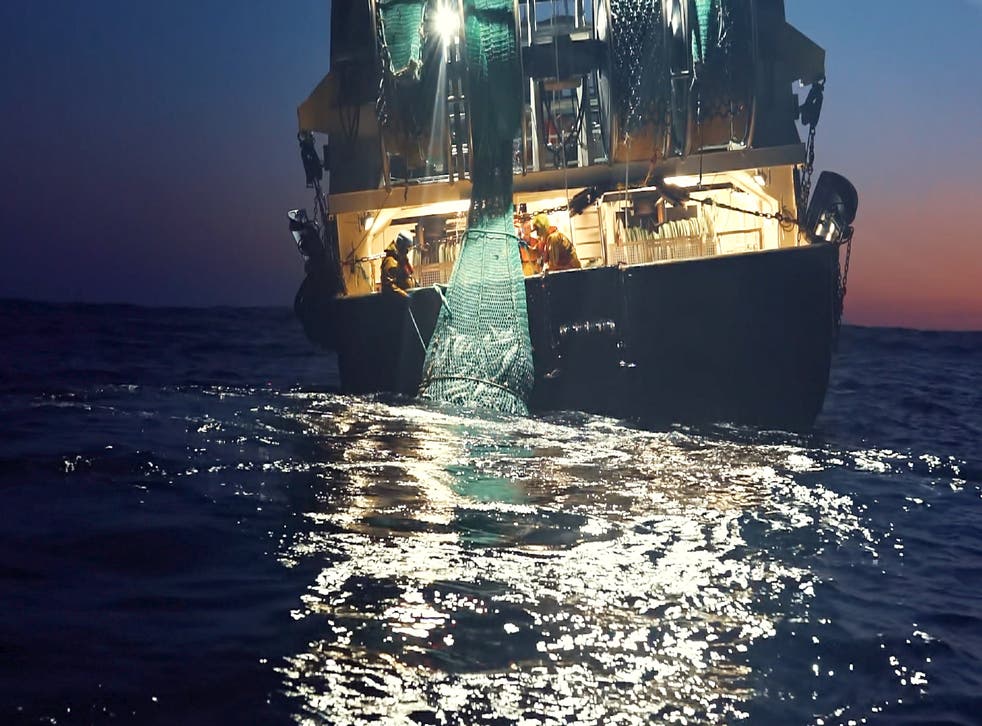
The corporate industrialized fishing interests as expected are working overtime in their attempts to discredit Seaspiracy. They are cherry picking the science and trying to suggest that industrial fishing is both sustainable and necessary. It’s not.Commercial industrialized fishing is not sustainable. It exists because of billions of dollars of government subsidies to prop it up. Remove the subsidies and the entire industry, an industry based on short term profit for short term gain will collapse.This film Seaspiracy is not directed at artisanal or indigenous fishing. In fact artisanal and indigenous fishing communities are being diminished and destroyed by corporate fishing. There are some positives. Kudos to Alaska for banning fish farms and for the hatcheries that support the wild salmon runs but this is an exception to the norm.For the most part the sea is being strangled of life by the super trawlers, the bottom trawlers, the huge seiners, the long-liners, the gill netters and by aquaculture.The situation is serious. It involves slavery, it promotes high seas piracy, it scours the sea bottom, it pollutes the marine environment with millions of tons of discarded plastic fishing debris.Corporate fishing is a global scheme of short term investment for short term gain and the fact is that coral reefs are dying, plastic is choking the depths, fish populations are being dangerously depleted and phytoplankton populations have been diminished by 40% since 1950 and phytoplankton produces more oxygen and sequesters more CO2 than all the trees and plants on land.How can it be justified for an endangered fish (Antarctic toothfish) to be caught and transported across the globe to be sold as Chilean sea bass in restaurants in Denver, Paris or a hundred other different cities? How can it be justified to feed millions of fish every year to pigs, chickens, farm raised salmon, cats and fur farms? How can it be justified to wipe out the herring runs off British Columbia to feed salmon in cages or to destroy seals in Canada or dolphins in Japan as scapegoats for the excessive greed of the fishing industry. I was raised in an Eastern Canadian fishing village in the Fifties and I have witnessed this steady diminishment of life in the sea and the astonishing ability of humanity to adapt and accept this diminishment. I have spent more than a half a century at sea in all the world’s oceans and I have seen the death, the destruction, the pollution and the greed.I don’t care what propaganda the industry and its enablers spread or how many biostitutes they hire to justify their greed. The fact is that a super trawler is an abomination against nature, a 100-mile long gill net or longliner is a weapon of mass ecological destruction and government subsidies are the evidence that worldwide, many governments are willingly complicit in the extermination of marine life and the collapse of marine eco-systems.I have seen with my own eyes the heart-breaking devastation of the Great Barrier Reef. We pulled one gill net from one ship (Thunder) from the depth of 2 kilometers off the coast of Antarctica that was 72 kilometers long and weighed 70 tons. We seized a drift net in the North Pacific that was over 100 miles in length and I’ve seen and smelt the bodies of a quarter of a million salmon rotting on the beach in Chile. Sustainable fishing is a myth and slapping the word onto a can of tuna claiming that no dolphins died is a blatant lie. And what about the tuna? 90% of Bluefin tuna populations have been eradicated? We massacre 70 million sharks a year primarily for their fins for a soup that has zero nutrition and then we complain when an average of five people die from shark attacks per year, a number lower than that of 40 people on average that die each year from falling from a skateboard. The fishing industry is driven by the politics and the economics of extinction. The more scarce the fish, the greater the demand and thus the greater the profit and there is almost a universal lack of economic or political will to police the high seas and to crack down on the poachers, the quota exceeders, the by-catch wasters and the corporate cartels that finance and control them. Predictably the industry trots out images of traditional fishermen, usually artisanal fishing communities implying that it is these hard-working individuals that we are seeking to shut down when it is the industrialized fishing operations that have been devastating artisanal and indigenous fishing communities around the world. After a long lifetime of voyages and campaigns and tens of thousands of sea miles, I have realized a truth and a reality that the industry works hard to ignore, discredit and deny. That truth is that life in the Ocean is being diminished and the very fact that we have lost 40% of our oxygen producing phytoplankton bodes darkly ill for the future of humanity. This is the reality. When the Ocean dies, we die with it.Note: For those who will surely try to claim that I am exaggerating about phytoplankton diminishment, here is a source for reference: (1) Source: Scientific American. Phytoplankton Population Drops 40 percent Since 1950 by Lauren Morello 2010.
As Netflix’s newest sustainability documentary racks up views, Sophie Gallagher looks at the biggest takeaways from the 90-minute film on fishing, marine destruction and modern slavery
he internet is home to tens of thousands of documentaries on everything from cat killers to Fyre festival, but some manage to cut through the noise, change the conversation and get people thinking differently. Just as Blackfish did in 2013 on animals in captivity, then Cowspiracy: The Sustainability Secret in 2014 on meat farming, now Netflix presents the 2021 version – Seaspiracy.
From the co-creators of Cowspiracy, this documentary on the fishing industry breaks new ground on the conversation around what it really means for seafood to be sustainable. It examines global fisheries, and shows how while many of us have been distracted by the problems caused by land agriculture, there was another problem brewing in our waters.
Travelling across the world from the Faroe Islands, to Thailand, Japan and Scotland, filmmaker and narrator Ali Tabrizi (and his partner) chart a journey from a childhood love of the ocean to pulling back the curtain on some of the biggest problems it faces, and whether those tasked with caring for it are really the stewards the public believe they are.
The documentary opens with all-too-familiar headlines of whales and other sea animals being washed up on beaches, their stomachs filled with plastic. As well as snapshots of highly-publicised campaigns about reducing the amount of plastic humans contribute to the ocean – in particular, cotton buds, straws and plastic bottles.
Tabrizi says: “There is a garbage truck load of plastic dumped every minute into the ocean and over 150 billion tonnes of microplastics are already there – they [the microplastics] now outnumber the stars in the milky way.” So far, nothing we don’t already know or haven’t seen in a David Attenborough documentary.
But it is not necessarily the plastic you might imagine
Given the amount of attention given to reducing household or personal plastic use and government campaigns to ban plastic cotton buds, straws and drinks stirrers, it is only fair that the public would see these as the greatest threats to the marine environment.
INDY/LIFE Newsletter
Be inspired with the latest lifestyle trends every week
Please enter your email addressPlease enter a valid email addressPlease enter a valid email addressSIGN UPI would like to be emailed about offers, events and updates from The Independent.Read our privacy notice
But Seaspiracy argues that actually one of the biggest plastic deposits are byproducts of commercial fishing, such as nets, claiming 46 per cent of waste in the great pacific garbage patch [a collection of marine debris in the North Pacific Ocean, also known as the Pacific trash vortex] is made up of fishing nets, while plastic straws only account for 0.03 per cent of plastic entering the ocean. And long-line fishing sets down enough lines to wrap around the planet 500 times every day.
(Netflix/Seaspiracy)
Environmentalist George Monbiot says: “Discarded fishing nets are far more dangerous for marine life than our plastic straws because they are designed to kill.”
It also claims that while 1,000 turtles are killed by plastic in the oceans, 250,000 sea turtles are captured, injured or killed by fishing vessels. Professor Calumn Roberts, a marine scientist, claims that the Deepwater Horizon oil spill in 2010 actually “benefited” marine life because “large areas were closed to fishing” giving the oceans a “respite”.
Bycatch is a huge problem caused by fishing
Bycatch is the fish or other mammals unintentionally caught when fishermen are trying to catch a target fish – for example, catching dolphins in nets designed for tuna fishing. Some of this bycatch is killed instantly but even that which is thrown back into the sea, it says is unlikely to survive. The film suggests that as many as 50 million sharks are caught annually as bycatch.about:blankabout:blank✕
Captain Peter Hammarstedt, from the Sea Shepherd nonprofit conservation society, says: “One of the most shocking things that most people don’t realise is that the greatest threat to whales and dolphins is commercial fishing. Over 300,000 whales and dolphins are killed every single year as a bycatch of industrial fishing.” Sea Shepherd also claims that up to 10,000 dolphins are caught in the Atlantic, off the west coast of France, every year during fishing.
Not only is this problematic in terms of destroying species but also for the climate, because whales and dolphins play a crucial role in fertilising phytoplankton in the sea, which Seaspiracy says absorbs four times as much carbon dioxide as the Amazon rainforest, and generates 85 per cent of all oxygen on earth.
(Netflix/Seaspiracy)
Labels aren’t all they are cracked up to be
If you are reassuring yourself that your seafood consumption is not harming dolphins as bycatch – or any other marine life – because it has the ‘dolphin safe’ label on the tin, or the Marine Stewardship Council labels, then Seaspiracy urges consumers to think again.Top Articles
Asked whether he could guarantee that every can of fish labelled ‘dolphin safe’ is actually so, Mark J. Palmer of the Earth Island Institute, in charge of the dolphin safe program, says: “No – nobody can [guarantee the product is dolphin safe] – once you’re out there in the ocean. How do you know what they’re doing? We have observers on board but the observers can be bribed and are not out on a regular basis.”
However in a followup statement on their website, Palmer has clarified: “When asked whether we could guarantee that no dolphins were ever killed in any tuna fishery anywhere in the world, I answered that there are no guarantees in life, but that by drastically reducing the number of vessels intentionally chasing and netting dolphins as well as other regulations in place, that the number of dolphins that are killed is very low.
We have observers on board but the observers can be bribed and are not out on a regular basis
“The film took my statement out of context to suggest that there is no oversight and we don’t know whether dolphins are being killed. This is simply not true.
“The bottom line is that the Dolphin Safe label and fishing restrictions save dolphin lives. Yes, commercial fishing is out of control in many cases worldwide. But canned Dolphin Safe tuna is far more protective of dolphins and target fish stocks than the vast majority of other fisheries.”
A spokesperson for the Marine Stewardship Council (MSC) added in defence of its own certification labels: “This certification process is not carried out by the MSC – it is independent of us and carried out by expert assessment bodies. It is an entirely transparent process and NGOs and others have multiple opportunities to provide input. All our assessments can be viewed online at Track a Fishery. Only fisheries that meet the rigorous requirements of our Standard get certified.
(Netflix/Seaspiracy)
“Contrary to what the film-makers say, certification is not an easy process, and some fisheries spend many years improving their practices in order to reach our standard. In fact, our analysis shows that the vast majority of fisheries that carry out pre-assessments against our criteria, do not meet these and need to make significant improvements to gain certification.”
Sustainable is not a defined term in seafood
As well as raising questions over labels such as ‘dolphin safe’ the film also asks whether there is any way that fishing can be sustainable or any type of fish we can eat that is not as bad for the oceans as large-scale commercial fishing. But much of the documentary seems to suggest sustainability is still too much of a grey term to be useful.
María José Cornax is the fisheries campaigns manager for Oceana Europe, a nonprofit ocean conservation organisation, says: “There is not a definition of sustainability as a whole for fisheries…The consumer cannot assess right not properly what fish is sustainable and what is not. The consumer cannot make an informed decision right now.”
There will be practically empty oceans by 2048
Dr Sylvia Alice Earle, an American marine biologist, explorer, author, and lecturer, says; “The estimate is by middle of 21st century if we keep taking wild fish at the level we are today there won’t be enough fish to catch,” predicting virtually empty oceans by by as soon as 2048.
Seaspiracy claims fishing catches up to 2.7 trillion fish per year, or 5,000,000 every single minute, and says that no industry on earth has killed as many mammals. It also highlights the problems generated by fishing methods such as bottom trawling [a method of fishing that involves dragging heavy weighted nets across the sea floor], which it claims wipes out an estimated 3.9 billion acres of sea floor per year.
Farming not the answer
The programme presents the option of farming as an alternative to catching wild fish from the seas. But on a visit to a salmon farm in Scotland, it reveals the problems of breeding in captivity such as illness, lice, and waste production.
It says that each salmon farm produces as much organic waste as 20,000 people and that the Scottish salmon industry produces organic waste equivalent to the entire population of Scotland each year. It also claims that as a result of shrimp and prawn farming, 38 per cent of the world’s mangrove forests have been destroyed.
(Netflix/Seaspiracy)
Slavery at sea is a massive problem
George Monbiot makes the comparison to “blood diamonds” when talking about the human impact of fisheries on the labour market, saying that slavery is still used on boats.
The documentary makes a comparison between the number of American soldiers that died during five years of the Iraq War – 4,500 – to the reported 360,000 deaths of fish workers during the same period. Captain Hammarstedt from Sea Shepherd says: “[It is] the same criminal groups behind drug trafficking and human trafficking.”
Former fishermen are interviewed at a safehouse in Thailand and claim that they were kept on boats for years – one says he was at sea for a decade – living in squalid conditions, facing death threats and being held at gunpoint. One claimed the ship’s captain kept dead bodies of other sailors in the freezer on board.
As well as human misery in the form of slavery – the documentary also makes the connection between the destruction of local fishing communities and people in poor communities being driven to subsistence on the land, eating more bush meat and land mammals, where fish is in short supply. The documentary makes the link between this increase and the outbreak of Ebola in west Africa.
(Netflix/Seaspiracy)
The best thing you can do is stop eating fish
Although the documentary does explore different options – such as eating more sustainable fish or only fish from farms rather than from the wild – it concludes that the “best thing to do for marine ecosystems is not eat fish” at all. It also says that there should be established “no take zones” for fishing around the world in order to preserve underwater habitats.
It says that long-held beliefs that fish do not feel pain or are not intelligent enough to be fearful is unfounded, and that other reasons to avoid fish include the heavy contamination of industrial pollutants – including mercury, heavy metals and dioxins.
As far as Seaspiracy is concerned, fish should be off the menu altogether.
But MSC says: “Sustainable fishing does exist and helps protect our oceans…One of the amazing things about our oceans is that fish stocks can recover and replenish if they are managed carefully for the long-term.
“While we disagree with much of what the Seaspiracy documentary-makers say, one thing we do agree with is that there is a crisis of overfishing in our oceans. However, millions around the world rely on seafood for their protein needs. With the global population set to reach 10 billion by 2050, the need to harness our natural resources more responsibly is more urgent than ever. Sustainable fishing has a vital role to play in securing those resources.”
Global dolphin populations are on the decline and eating fish may be the reason why as the mammals are frequenty bycatch of the fishing industry.BY CHARLOTTE POINTING
Fewer dolphins are turning up in fishing bycatch. Initially, this might seem like a reason to celebrate. But what this actually indicates, according to a new study, is that the population has declined and there are fewer dolphins left in the oceans to be caught.
What Is Bycatch?
Bycatch is one of the leading causes of death for dolphins and other cetaceans around the world. It happens when the animals accidentally swim into nets intended for fish, usually tuna.
Between 1950 and 2018, the fishing industry unintentionally caught around 4.1 million dolphins, says Dr. Putu Liza Mustika, who worked on the study. The research team—led by Dr. Charles Anderson of the Maldivian Manta Marine organization—looked at bycatch rates in the Indian ocean to draw its conclusions.
They estimate that the dolphin population in the Indian Ocean stands at 13 percent of what it was in the 1980s. Mustika notes that the figures in the study are “ball-park figures,” and therefore have a lot of uncertainties. But what they do confirm is the magnitude of the problem.
“Millions of dolphins [were] accidentally caught between 1950 and 2018,” she told LIVEKINDLY. “Millions. Not just a few hundreds of dolphins.”
Experts predict Iran has the biggest bycatch rate. Indonesia, India, Sri Lanka, Pakistan, Oman, Yemen, UAE, and Tanzania follow.
“The study includes a number of dolphins (and whale species), including indo-Pacific bottlenose dolphins, humpback, Risso’s, and common dolphins,” adds Dr. Sarah Dolman from Whale and Dolphin Conservation (WDC).
She told LIVEKINDLY, “the scale of bycatch is almost certainly impacting regional and local dolphin populations. The study states that although tuna catches are increasing, dolphin bycatch stagnated in the 1990s. [It] has since declined, and is therefore unsustainable and impacting populations.”
Dolphins often end up as bycatch.
The Problem With Gillnets
According to Mustika, gillnets—a wall of netting that hangs in the ocean—are particularly lethal for dolphins. They can vary in length, ranging from 100 meters to more than 30 kilometers.
“Gillnets used to be made of cotton or hemp,” Mustika says. “But in the late 50s, they changed it to stronger materials (monofilaments). And also smaller mesh size to catch more fish (to meet human demand).”
It’s not just dolphins that end up as bycatch. The World Wildlife Fund (WWF) says, “entanglement in fishing gear is the leading threat for whales and dolphins around the globe. [It’s] estimated to cause at least 300,000 deaths per year.”
“Bycatch has led to the almost certain demise of the world’s smallest porpoise, the vaquita in the Gulf of California,” it adds. “Several more species are likely to follow if governments and fishers aren’t able to effective means to halt this unwanted and unnecessary cause of morality for cetaceans worldwide.”
According to Dolman, fishers caught 75 percent of odontocete species (toothed cetaceans) in gillnets in the past 20-plus years. Sixty-four percent of mysticetes species (baleen whales) have ended up as bycatch in the same time period, as well as 66 percent of pinnipeds (that’s animals like seals, sea lions, and walruses).
Sharks can also be victims of the fishing industry. Angie Coulter—a researcher with the Sea Around Us initiative at the University of British Columbia—spoke to National Public Radio (NPR) about the dangers of sharks getting caught up in bycatch.
“Sharks are apex predators,” she explained. “They hold all of these food chains together. If we’re removing these sharks [from the ecosystem], they really can’t catch up and will decline more and more.”
Fishers accidentally catch around 80,000 dolphins every year.
How Do We Save Dolphins From Bycatch?
Per 1,000 tonnes of tuna, the study estimates that 175 dolphins accidentally get caught in nets. At current levels, this means fishers accidentally catch about 80,000 dolphins every year.
“Bycatch is one of the main threats, if not the main threat to world-wide dolphin populations,” says Mustika. “If we can make fishing more sustainable, then we help dolphin populations.” She recommends that fishers use different gear, like a traditional pole and line.
Dolman notes that authorities have taken some action to mitigate the situation, including fishing bans and gear modifications, but more needs to be done.
“The countries who are fishing in the region and the Indian Ocean Tuna Commission is the Regional Fisheries Management Organisation that has responsibility for this issue, need to act,” she says. “There is much that can be done to better monitor, mitigate report, and enforce dolphin bycatch.”
She adds that the Food and Agriculture Organization of the United Nations (FAO) is currently producing best practice guidelines to prevent and reduce marine mammal bycatch. She notes: “this would be a good place to start.”
What About Tuna?
Dolphins, whales, and other cetaceans need urgent protection. But tuna themselves are at risk too. In 2018, fishers pulled nearly six million metric tonnes of tuna from the ocean.
Just like dolphins, some species of tuna are in decline. The World Wildlife Fund (WWF) says bluefin tuna is critically endangered.
“As the methods of catching tuna have advanced over the years, the conservation and management of tuna has not evolved as quickly,” says the WWF.
According to the FAO, most tuna stocks are “fully exploited” with “no room for fishery expansion.”
Shana Miller—the director of the Global Tuna Conservation Project—told NPR, “everywhere tuna swim, they’re being pursued by industrial fisheries.”
Consider opting for vegan tuna, like Tuno.
Vegan Fish
One way to save the dolphins and the tuna? Avoid fish altogether and choose vegan fish instead. Brands like Atlantic Natural Foods’ Tuno and Good Catch offer plant-based alternatives to tuna.
“Overfishing is a global problem that is getting worse by the day,” Tuno founder Doug Hines told Forbes. “The number of illegal vessels and underreporting is rampant on the high seas. And governments tend to turn the other way.”
Good Catch’s tuna features a six legume blend, but it still has that fishy taste, thanks to the addition of seaweed and algae extract.
CEO of the brand Chris Kerr told LIVEKINDLY, “our mission is to create delicious plant-based seafood options, giving people everything they like about seafood, but without the concerns about mercury and other pollutants, ocean harm or overfishing.“
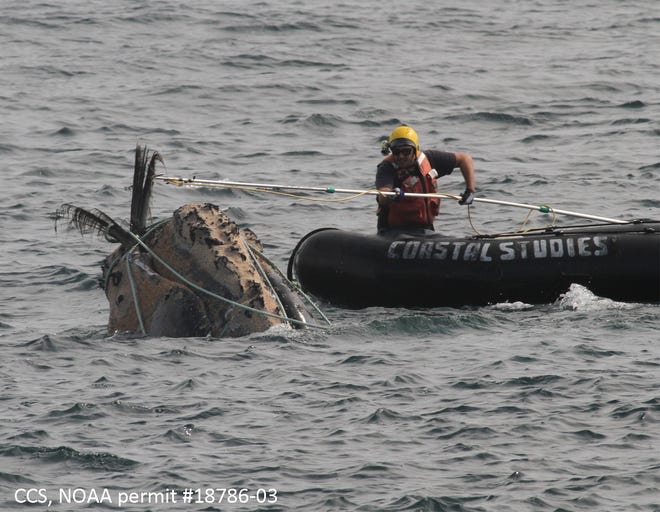
The National Ocean and Atmospheric Administration released a much-anticipated plan on Wednesday that it says will reduce North Atlantic right whale mortalities from entanglement in fishing gear by 60%.
The right whale is the most endangered great whale on the planet, with around 360 individuals remaining, including less than 100 breeding-age females.
The new plan achieves the 60% mortality reduction through new seasonally closed areas, increases in the number of pots connected to a buoy line and requirements to add more weak links that allow a whale to break vertical lines and hopefully shed lines and pots.
New closures include an area south of Nantucket where right whales are congregating year-round but had been subject only to voluntary speed reductions.
NOAA will be holding public hearings on the draft environmental impact statement for the new whale plan, and public comments will be taken until March 1, with an eye toward having new regulations in place for the beginning of the new fishing year on May 1.
The North Atlantic population size has been lower, with an estimated 270 individuals in 1990. The population rebounded to 481 by 2011.
Since then, however, the species has been in decline. Recently, as right whales have migrated into new territory in Canada in search of food, the number of dead right whales caught in fishing gear or hit by vessels has shot up. Particularly hard hit were females, leading some researchers to worry that the species could reach functional extinction — too few females to rebuild the species — within a decade or two.
Scientists have determined that less than one right whale per year, on average, can die of human-induced causes. But that number has been exceeded every year, particularly since 2017 when 17 right whales died, including 12 in Canada and five in the U.S.
NOAA reported that there were only 22 calves born from 2017 to November 2020, with 31 mortalities over that same period. An additional 13 right whales are considered to have life-threatening injuries. Ship strikes were once the leading cause of right whale death, but that has changed, with entanglements causing 85% of mortalities between 2010 and 2015.
The NOAA plan resembles one that was passed by an advisory group, the Atlantic Large Whale Take Reduction Team, over a year ago that also sought a 60% reduction in mortalities, including a 50% cut in the number of vertical lines in Maine and a 30% cut in Massachusetts, the two leading states in landings and effort for the lobster fishery. Maine subsequently withdrew from that multi-state agreement, and NOAA then took over the plan.
Environmental groups, scientists and animal rights activists worried that NOAA was going too slow as right whales continued to die and inch closer to extinction. Many also saw the measure as just an intermediate step bridging to the development of affordable and effective technology that would remove much of the vertical lines that ensnare whales by having gear buoys resting on the bottom until summoned by a signal from the fishing boat on the surface.
“After such an unprecedented delay, this new rule will help stem the surge of right whale deaths we’ve seen over the last several years,” said Erica Fuller, senior attorney at the Conservation Law Foundation. “Ropeless fishing is the only solution that protects whales and fishermen, and the rule expands that practice. However, NOAA must end its reliance on weak rope as a solution and get emergency protections on the water immediately while this rule is finalized.”
Sharon Young, the field director for marine wildlife protection for the Humane Society of the United States, worried that the fishing industry and others might think this was the solution.
“It’s a step in the right direction, however, there will still be a lot of risk-prone lines in the water that will entangle whales, and what we need to work towards is line-free fishing,” Young said. “By no means does this fix the problem of fatal entanglements in a declining species.”
A vast fishing armada off Ecuador’s biodiverse Pacific islands has stirred alarm over ‘indiscriminate’ fishing practicesSeascape: the state of our oceans is supported byAbout this content
Thu 6 Aug 2020 05.30 EDTLast modified on Thu 6 Aug 2020 11.18 EDT
Shares3,875
The Chinese reefer ship Fu Yuan Yu Leng 999 was intercepted in the Galápagos marine reserve in 2017 with about 300 tonnes of mostly sharks, including protected species. Photograph: Archivo Parque Nacional Galápagos
Jonathan Green had been tracking a whale shark named Hope across the eastern Pacific for 280 days when the satellite transmissions from a GPS tag on her dorsal fin abruptly stopped.
It was not unusual for the GPS signal to go silent, even for weeks at a time, said Green, a scientist who has been studying the world’s largest fish for three decades in the unique marine ecosystem around the Galápagos Islands.
But then he looked at satellite images in the area where Hope was last tracked – more than a thousand nautical miles west of the islands – and noticed the ocean was being patrolled by hundreds of Chinese fishing boats.
“I began to look into it and found that at the very end of her track she began to speed up,” said Green, co-founder and director of the Galápagos Whale Shark Project.
“It went from one knot to six or seven knots for the last 32 minutes – which is, of course, the speed of a fishing boat,” he said.
The fishing vessels that Green saw on the satellite images are believed to belong to an enormous Chinese-flagged fleet which Ecuadorian authorities last week warned was just outside the Galápagos Islands’ territorial waters.
“I don’t have proof but my hypothesis is that she was caught by vessels from the same fleet which is now situated to the south of the islands,” Green told the Guardian. She is the third GPS-tracked whale shark to have gone missing in the last decade, he added.
The Chinese fleet, numbering more than 200 vessels, is in international waters just outside a maritime border around the Galápagos Islands and also Ecuador’s coastal waters, said Norman Wray, the islands’ governor.
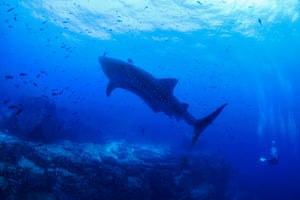
A female whale shark in the Galápagos archipelago. ‘The Galápagos Marine Reserve is a place of very great productivity, high biomass but also biodiversity.’ Photograph: Simon J Pierce
Chinese fishing vessels come every year to the seas around the Galápagos, which were declared a Unesco world heritage site in 1978, but this year’s fleet is one of the largest seen in recent years. Of the 248 vessels, 243 are flagged to China including to companies with suspected records of illegal, unreported and unregulated, or IUU, fishing, according to research by C4ADS, a data analysis NGO.
The fleet includes fishing boats and refrigerated container – or reefer – ships to store enormous catches.
Transferring cargo between vessels is prohibited under international maritime law yet the Chinese flotilla has supply and storage ships along with longline and squid fishing boats.
“There are some fleets which don’t seem to abide by any regulations,” said Wray.
One captain of an Ecuadorian tuna boat saw the Chinese fishing boats up close in early July, before the end of the tuna season.
“They just pull up everything!” said the captain, who asked not to be named. “We are obliged to take a biologist aboard who checks our haul; if we catch a shark we have to put it back, but who controls them?”
He recalled navigating through the fleet at night, constantly changing course to avoid boats, as their lights illuminated the sea to attract squid to the surface.
The longline fishing boats had up to 500 lines, each with thousands of fishhooks, he estimated, and claimed that some of the vessels would turn off their automatic tracking systems to avoid detection, particularly when operating in protected areas.
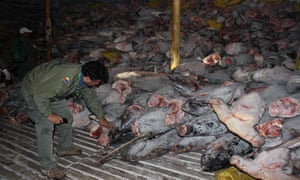
Chinese fishing practices first caught the attention of Ecuador in 2017 when its navy seized the Chinese reefer Fu Yuan Yu Leng 999 within the Galápagos marine reserve. Inside its containers were 6,000 frozen sharks – including the endangered hammerhead shark and whale shark.
“It was a slaughterhouse,” said Green, describing the images of the cargo hold. “This kind of slaughter is going on on a massive scale in international waters and nobody is witnessing it.”
The arrival of the latest fleet has also stirred public outrage and a formal complaint by Ecuador as its navy is on alert for any incursion into Ecuadorian waters.
The Chinese embassy in Quito said that China was a “responsible fishing nation” with a “zero-tolerance” attitude towards illegal fishing. It had confirmed with Ecuador’s navy that all the Chinese fishing vessels were operating legally “and don’t represent a threat to anyone”, it said in a statement last month. On Thursday China announced a three-month fishing ban in the high seas west of the marine reserve, but it will not come into force until September.
Roque Sevilla, a former mayor of Quito, who is leading a team in charge of designing a “protection strategy” for the islands, said the fleet practices “indiscriminate fishing – regardless of species or age – which is causing a serious deterioration of the quality of fauna that we will have in our seas”.
Ecuador would establish a corridor of marine reserves with Pacific-facing neighbours Costa Rica, Panama and Colombia to seal off important areas of marine diversity, Sevilla told the Guardian.
Protecting the Cocos Ridge, an underwater mountain range which connects the Galápagos Islands to mainland Costa Rica, and the Carnegie Ridge which links the archipelago to Ecuador and continental South America, could close off more than 200,000 sq nautical miles of ocean otherwise vulnerable to industrial fishing, he said.
He added Ecuador had called for a diplomatic meeting with Chile, Peru, Colombia and Panama to present a formal protest against China.Advertisementhttps://tpc.googlesyndication.com/safeframe/1-0-37/html/container.html
“When the Galápagos’s protected area was first created it was cutting edge,” said Matt Rand, director of the Pew Bertarelli Ocean Legacy, “but compared to other newer marine protected areas Galápagos is now potentially lacking in size to protect the biodiversity.”
Milton Castillo, the Galápagos Islands’ representative for Ecuador’s human rights ombudsman’s office, said he had asked the prosecutor’s office to inspect the cargo holds of the Chinese ships based on the legal principle of the universal and extraterritorial protection of endangered species.
The fleet often fishes in the territorial waters of low-income countries, the report said, having depleted fish stocks in domestic waters.
Green said the “explosion of life” created by the confluence of cold and warm ocean currents around the Galápagos Islands is exactly why the Chinese armada is hovering around the archipelago’s waters.
“The Galápagos marine reserve is a place of very great productivity, high biomass but also biodiversity,” he said. The longline fishing technique used by the fleet catch big fish like tuna, but also sharks, rays, turtles and marine mammals like sea lions and dolphins, he added.
“This is not fishing any more, it is simply destroying the resources of our oceans,” Green said. “We should ask whether any nation on this planet has the right to destroy what is common ground.”
A vast fishing armada off Ecuador’s biodiverse Pacific islands has stirred alarm over ‘indiscriminate’ fishing practicesSeascape: the state of our oceans is supported byAbout this content
Thu 6 Aug 2020 05.30 EDTLast modified on Thu 6 Aug 2020 11.18 EDT
Shares3,875
The Chinese reefer ship Fu Yuan Yu Leng 999 was intercepted in the Galápagos marine reserve in 2017 with about 300 tonnes of mostly sharks, including protected species. Photograph: Archivo Parque Nacional Galápagos
Jonathan Green had been tracking a whale shark named Hope across the eastern Pacific for 280 days when the satellite transmissions from a GPS tag on her dorsal fin abruptly stopped.
It was not unusual for the GPS signal to go silent, even for weeks at a time, said Green, a scientist who has been studying the world’s largest fish for three decades in the unique marine ecosystem around the Galápagos Islands.
But then he looked at satellite images in the area where Hope was last tracked – more than a thousand nautical miles west of the islands – and noticed the ocean was being patrolled by hundreds of Chinese fishing boats.
“I began to look into it and found that at the very end of her track she began to speed up,” said Green, co-founder and director of the Galápagos Whale Shark Project.
“It went from one knot to six or seven knots for the last 32 minutes – which is, of course, the speed of a fishing boat,” he said.
The fishing vessels that Green saw on the satellite images are believed to belong to an enormous Chinese-flagged fleet which Ecuadorian authorities last week warned was just outside the Galápagos Islands’ territorial waters.
“I don’t have proof but my hypothesis is that she was caught by vessels from the same fleet which is now situated to the south of the islands,” Green told the Guardian. She is the third GPS-tracked whale shark to have gone missing in the last decade, he added.
The Chinese fleet, numbering more than 200 vessels, is in international waters just outside a maritime border around the Galápagos Islands and also Ecuador’s coastal waters, said Norman Wray, the islands’ governor.
A female whale shark in the Galápagos archipelago. ‘The Galápagos Marine Reserve is a place of very great productivity, high biomass but also biodiversity.’ Photograph: Simon J Pierce
Chinese fishing vessels come every year to the seas around the Galápagos, which were declared a Unesco world heritage site in 1978, but this year’s fleet is one of the largest seen in recent years. Of the 248 vessels, 243 are flagged to China including to companies with suspected records of illegal, unreported and unregulated, or IUU, fishing, according to research by C4ADS, a data analysis NGO.
The fleet includes fishing boats and refrigerated container – or reefer – ships to store enormous catches.
Transferring cargo between vessels is prohibited under international maritime law yet the Chinese flotilla has supply and storage ships along with longline and squid fishing boats.
“There are some fleets which don’t seem to abide by any regulations,” said Wray.
One captain of an Ecuadorian tuna boat saw the Chinese fishing boats up close in early July, before the end of the tuna season.
“They just pull up everything!” said the captain, who asked not to be named. “We are obliged to take a biologist aboard who checks our haul; if we catch a shark we have to put it back, but who controls them?”
He recalled navigating through the fleet at night, constantly changing course to avoid boats, as their lights illuminated the sea to attract squid to the surface.
The longline fishing boats had up to 500 lines, each with thousands of fishhooks, he estimated, and claimed that some of the vessels would turn off their automatic tracking systems to avoid detection, particularly when operating in protected areas.
Chinese fishing practices first caught the attention of Ecuador in 2017 when its navy seized the Chinese reefer Fu Yuan Yu Leng 999 within the Galápagos marine reserve. Inside its containers were 6,000 frozen sharks – including the endangered hammerhead shark and whale shark.
“It was a slaughterhouse,” said Green, describing the images of the cargo hold. “This kind of slaughter is going on on a massive scale in international waters and nobody is witnessing it.”
The arrival of the latest fleet has also stirred public outrage and a formal complaint by Ecuador as its navy is on alert for any incursion into Ecuadorian waters.
The Chinese embassy in Quito said that China was a “responsible fishing nation” with a “zero-tolerance” attitude towards illegal fishing. It had confirmed with Ecuador’s navy that all the Chinese fishing vessels were operating legally “and don’t represent a threat to anyone”, it said in a statement last month. On Thursday China announced a three-month fishing ban in the high seas west of the marine reserve, but it will not come into force until September.
Roque Sevilla, a former mayor of Quito, who is leading a team in charge of designing a “protection strategy” for the islands, said the fleet practices “indiscriminate fishing – regardless of species or age – which is causing a serious deterioration of the quality of fauna that we will have in our seas”.
Ecuador would establish a corridor of marine reserves with Pacific-facing neighbours Costa Rica, Panama and Colombia to seal off important areas of marine diversity, Sevilla told the Guardian.
Protecting the Cocos Ridge, an underwater mountain range which connects the Galápagos Islands to mainland Costa Rica, and the Carnegie Ridge which links the archipelago to Ecuador and continental South America, could close off more than 200,000 sq nautical miles of ocean otherwise vulnerable to industrial fishing, he said.
He added Ecuador had called for a diplomatic meeting with Chile, Peru, Colombia and Panama to present a formal protest against China.Advertisementhttps://tpc.googlesyndication.com/safeframe/1-0-37/html/container.html
“When the Galápagos’s protected area was first created it was cutting edge,” said Matt Rand, director of the Pew Bertarelli Ocean Legacy, “but compared to other newer marine protected areas Galápagos is now potentially lacking in size to protect the biodiversity.”
Milton Castillo, the Galápagos Islands’ representative for Ecuador’s human rights ombudsman’s office, said he had asked the prosecutor’s office to inspect the cargo holds of the Chinese ships based on the legal principle of the universal and extraterritorial protection of endangered species.
The fleet often fishes in the territorial waters of low-income countries, the report said, having depleted fish stocks in domestic waters.
Green said the “explosion of life” created by the confluence of cold and warm ocean currents around the Galápagos Islands is exactly why the Chinese armada is hovering around the archipelago’s waters.
“The Galápagos marine reserve is a place of very great productivity, high biomass but also biodiversity,” he said. The longline fishing technique used by the fleet catch big fish like tuna, but also sharks, rays, turtles and marine mammals like sea lions and dolphins, he added.
“This is not fishing any more, it is simply destroying the resources of our oceans,” Green said. “We should ask whether any nation on this planet has the right to destroy what is common ground.”
The fleet, found just outside a protected zone, raises the prospect of damage to the marine ecosystemSeascape: the state of our oceans is supported byAbout this content
Mon 27 Jul 2020 20.01 EDTFirst published on Mon 27 Jul 2020 19.42 EDT
Shares13,659
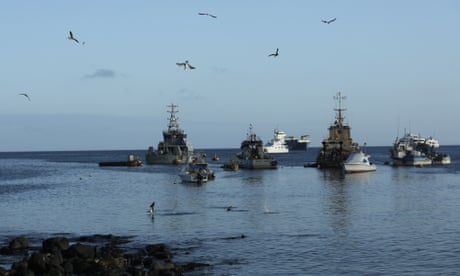
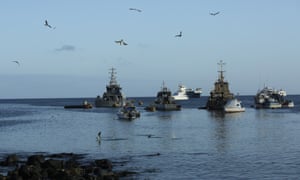
Fishing and tourist boats are anchored in the bay of San Cristóbal, Galapagos Islands, Ecuador. Photograph: Adrian Vasquez/AP
Ecuador has sounded the alarm after its navy discovered a huge fishing fleet of mostly Chinese-flagged vessels some 200 miles from the Galápagos Islands, the archipelago which inspired Charles Darwin’s theory of evolution.
About 260 ships are currently in international waters just outside a 188-mile wide exclusive economic zone around the island, but their presence has already raised the prospect of serious damage to the delicate marine ecosystem, said a former environment minister, Yolanda Kakabadse.
“This fleet’s size and aggressiveness against marine species is a big threat to the balance of species in the Galápagos,” she told the Guardian.
Kakabadse and an ex-mayor of Quito, Roque Sevilla, were on Monday put in charge of designing a “protection strategy” for the islands, which lie 563 miles west of the South American mainland.
Chinese fishing vessels come every year to the seas around the Galápagos, which were declared a Unesco world heritage site in 1978, but this year’s fleet is one of the largest seen in recent years.
Sevilla said that diplomatic efforts would be made to request the withdrawal of the Chinese fishing fleet. “Unchecked Chinese fishing just on the edge of the protected zone is ruining Ecuador’s efforts to protect marine life in the Galápagos,” he said.
He added that the team would also seek to enforce international agreements that protect migratory species. The Galápagos marine reserve has one of the world’s greatest concentrations of shark species, including endangered whale and hammerhead varieties.
Kakabadse said efforts would also be made to extend the exclusive economic zone to a 350-mile circumference around the islands which would join up with the Ecuadorian mainland’s economic zone, closing off a corridor of international waters in between the two where the Chinese fleet is currently located.
Ecuador is also trying to establish a corridor of marine reserves between Pacific-facing neighbours Costa Rica, Panama and Colombia which would seal off important areas of marine diversity, Kakabadse said.
Ecuador’s president, Lenín Moreno, described the archipelago as “one of the richest fishing areas and a seedbed of life for the entire planet”, in a message on Twitter over the weekend.
The Galápagos Islands are renowned for their unique plants and wildlife. Unesco describes the archipelago – visited by a quarter of a million tourists every year – as a “living museum and a showcase for evolution”.Advertisementhttps://tpc.googlesyndication.com/safeframe/1-0-37/html/container.html
The Ecuadorian navy has been monitoring the fishing fleet since it was spotted last week, according to the country’s defence minister, Oswaldo Jarrín. “We are on alert, [conducting] surveillance, patrolling to avoid an incident such as what happened in 2017,” he said.
The 2017 incident he referred to was the capture by the Ecuadorean navy within the Galápagos marine reserve of a Chinese vessel. The Fu Yuan Yu Leng 999, part of an even larger fleet than the current one, was found to be carrying 300 tonnes of marine wildlife, mostly sharks.
“We were appalled to discover that a massive Chinese industrial fishing fleet is currently off the Galápagos Islands,” said John Hourston, a spokesman for the Blue Planet Society, a NGO which campaigns against overfishing.
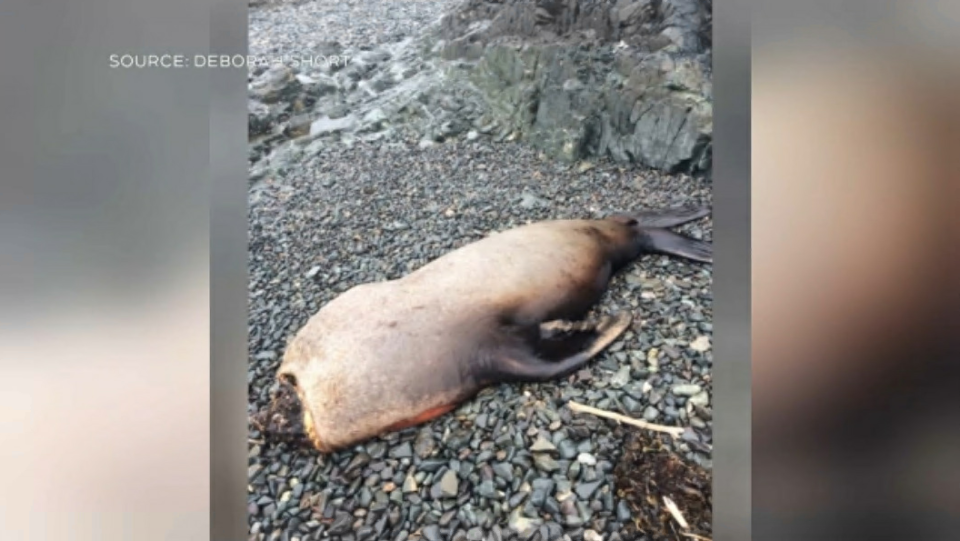
@Ian_HollidayContactPublished Saturday, June 27, 2020 6:17PM PDTLast Updated Saturday, June 27, 2020 6:59PM PDThttps://imasdk.googleapis.com/js/core/bridge3.392.0_en.html#goog_233142281Volume 90% Disturbing discoveries on Vancouver IslandNOW PLAYINGHeadless sea lions are washing up on the shore of Vancouver Island, and marine experts say it’s a deliberate, disgusting act.
VANCOUVER — Headless sea lions have been washing up on Vancouver Island since spring, and a marine mammal expert says it’s likely the animals were deliberately beheaded by humans.
Anna Hall is a marine mammal zoologist at Sea View Marine Sciences. She says photos of the dead pinnipeds suggest a pattern in their injuries.
“To me, this looks intentional, whether it’s by a single person or a group of people,” Hall said. “I sincerely hope that fisheries and oceans canada pursues this case to determine who is doing this and to bring them to justice because this is a violation of federal law.”
Most of the photos CTV News showed to Hall were taken by Nanaimo resident Deborah Short, who says she’s personally encountered several dead sea lions without heads on the shore between Campbell River and Nanaimo.
Short discovered the first one while walking along the beach at Neck Point Park in Nanaimo.
“I was devastated, completely devastated by it,” she said. “I couldn’t believe that somebody could sever the head of a sea lion … It was shocking to me.”
Soon, though, she learned of another headless sea lion that had been found near Campbell River. And then she started encountering more herself.
In total, she says, she’s aware of five headless sea lions that have washed up on Vancouver Island since March.
“When you see something like that, it moves you,” Short said. “It moves you in a way where you want to find more, and you want to do something about it.”
While there’s no indication that the headless sea lions Short discovered are in any way related to the proposal to cull the local population, she said she’s determined to stop the killing of additional marine mammals.
CTV News Vancouver Island reached out to Fisheries and Oceans Canada and was told the federal agency is looking into the headless sea lion phenomenon.
Hall, the marine mammal zoologist, said at least one of the sea lions Short photographed appears to be a Steller sea lion, which is a species that has a special conservation status under the Species at Risk Act.
She said all marine mammals are also protected from disturbance, injury or harm by clauses in the Fisheries Act.
Hall hopes Fisheries and Oceans Canada will do a necropsy on one of the deceased sea lions to determine its cause of death.
“It’s absolutely horrific and appalling that there’s anybody on this coastline that would feel that this is an appropriate course of action with regard to a marine mammal or any animal at all,” Hall said.RELATED IMAGES
Headless sea lions have been washing up on Vancouver Island since spring, and a marine mammal expert says it’s likely the animals were deliberately beheaded by humans. (Photo: Deborah Short)
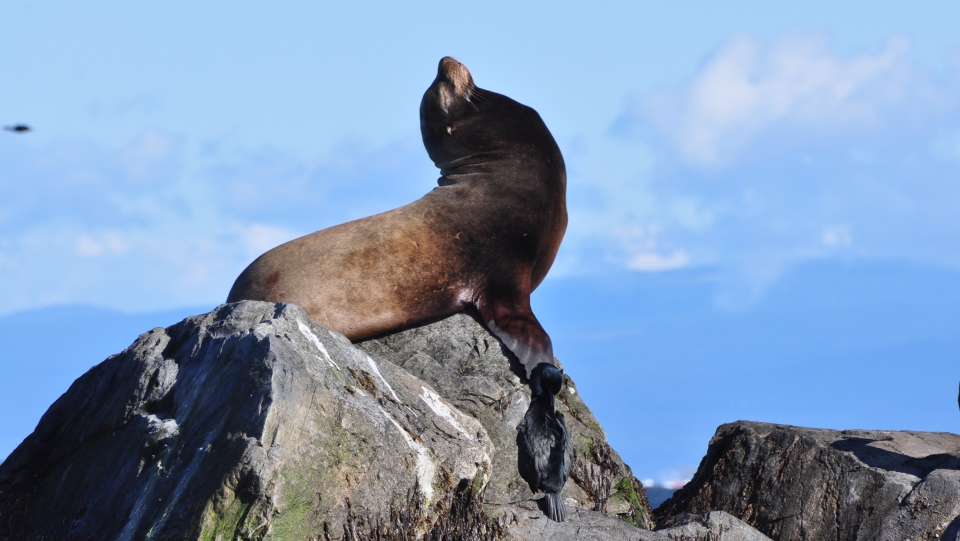
A sea lion soaks up the sun on a jetty near the mouth of the Fraser River in this photo from David Price, submitted through Weather Watch by CTV Vancouver.

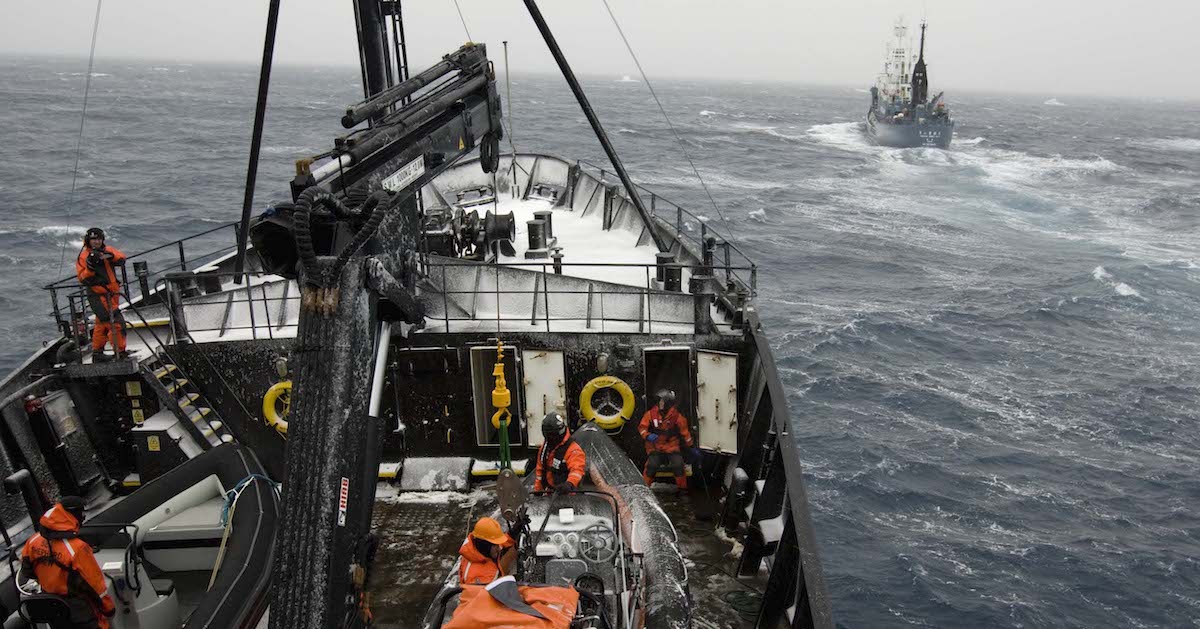 Adam Lau / Sea Shepherd Conservation Society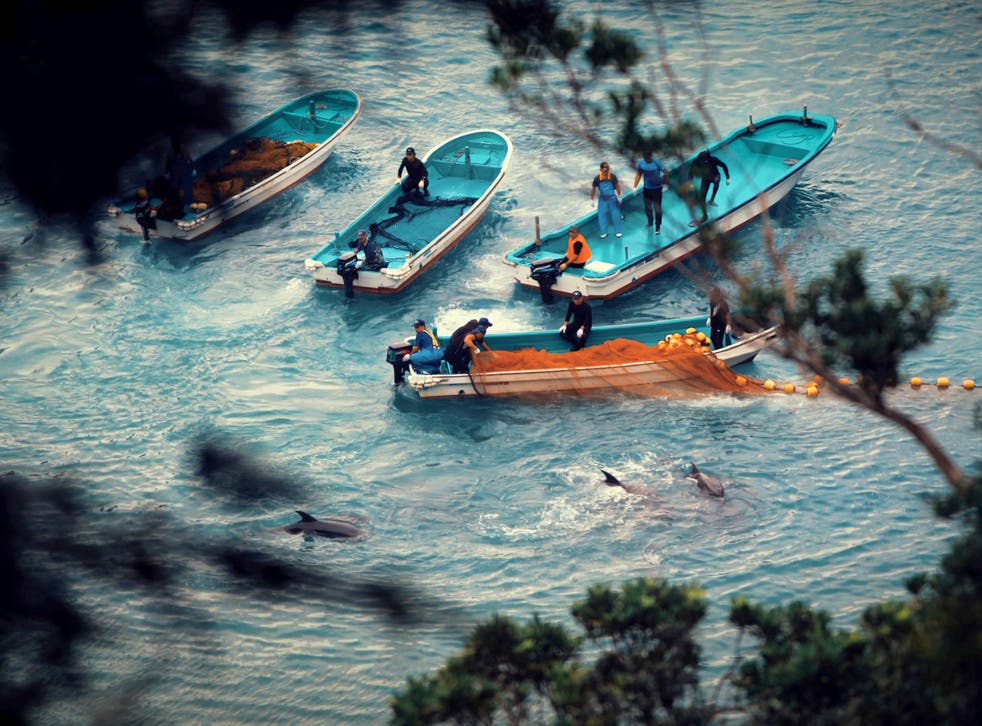







 Exposing the Big Game