Anonymous collective hackers bring down Iceland sites in whaling protest

Image

Activist hackers from the Anonymous collective have claimed responsibility for bringing down five government websites in Iceland in a protest against whale-hunting by the North Atlantic nation.

The sites, which included the prime minister’s official website and that of the environment and interior ministries, went offline on Friday and remained down until about midday on Saturday.

In an anti-whaling video posted on social media, activists called for people to hack websites linked to Iceland to protest persistent commercial hunting despite an international moratorium.

On a new Twitter account devoted to the campaign, screenshots showing the sites down were published late on Friday by activists who said they belonged to the loose Anonymous collective. The government made no comment about the outage.

Iceland is a member of the International Whaling Commission (IWC), an inter-governmental body which imposed a ban on all commercial whaling from 1986. The moratorium remains in place, but both Iceland and Norway continue to hunt whales.

Iceland has come under fire for whaling for decades, including in the 1970s and 1980s when activists from Greenpeace and the Sea Shepherd Conservation Society tried to disrupt annual hunts using boats or by sabotaging hunting stations.

Isolated in the North Atlantic with only Greenland as its close neighbor, Iceland has relied on fishing and whaling as a key part of its economy. Icelanders argue whales reduce the stocks of the fish they hunt for.

Since its devastating financial meltdown in 2008 and a sharp currency devaluation, however, tourism has boomed and whale tours are increasingly popular.

(Reporting by Ragnhildur Sigurðardóttir in Reykjavik and Sabina Zawadzki in Copenhagen; Editing by Helen Popper)

Read the article on News Republic

Read the original article

Paris talks a fraud: Watered down climate agreement is too little, too late

by Sea Shepherd’s Captain Paul Watson

COP 21 – The Positives and the Negatives

The positive: (1) The attention of the world has been focused on the issue of climate change. (2) The issue has been given great credibility through the recognition and participation of 195 nations. (3) there will most likely be a surge in support for alternative energy technologies. (4) It could have been worst.

The negatives: (1) Having attended these international conferences since 1972 I’ve yet to see any past agreements translated into action. So we shall see. Promises are cheap. (2) the Ocean was virtually ignored. (3) Oxygen depletion was completely ignored as was phytoplankton diminishment. (4) the issue of animal agriculture was not only ignored it, the food concessions at the events contradicted that concern 100%. Serving fish and chips during an ocean forum and hamburgers at forums dealing with greenhouse gas emissions was a disconnect that was painfully obvious. You would think the delegates and the NGO’s could have weathered a meat free two weeks considering that the animal agriculture industry slaughtering 65 billion animals a year produces more greenhouse gas emissions than the entire transportation industry. (5) and no one wanted to hear about cutting off the 75 + billion dollar government subsidies to the industrialized fishing industry.

In the agreement signed in the COP21 climate deal: the words “fossil fuels” do not appear. Neither do the words “oil” or “coal.” I find that quite revealing.

My two solutions to address climate change were two solutions that no one wanted to hear. (1) shut down industrialized fishing and allow the ocean ecosystems to repair themselves. And (2) convert the majority of the 7.5. billion humans on the planet to a plant based diet.

My summation is that this watered down agreement is too little, too late, and what is on paper will most likely not see any realistic application in practice.

Hopefully I will be proven wrong.

11214207_829677830435133_118593585578390559_n

Also: James Hansen, father of climate change awareness, calls Paris talks ‘a fraud’

The former Nasa scientist criticizes the talks, intended to reach a new global deal on cutting carbon emissions beyond 2020,

“It’s a fraud really, a fake,” he says, rubbing his head. “It’s just bullshit for them to say: ‘We’ll have a 2C warming target and then try to do a little better every five years.’ It’s just worthless words. There is no action, just promises. As long as fossil fuels appear to be the cheapest fuels out there, they will be continued to be burned.”

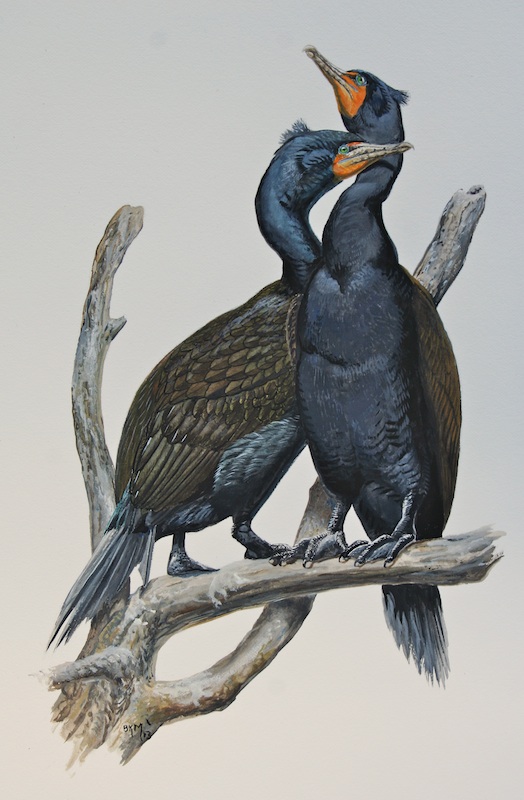
Killing of Cormorant Over…For Now

Painting Courtesy Barry Kent McKay

Painting Courtesy Barry Kent McKay

http://www.chinookobserver.com/co/local-news/20151109/cormorant-killing-comes-to-seasonal-end-litigation-set-for-march

CHINOOK — The federal government last month stopped shooting cormorants and oiling their nests to reduce cormorant predation on juvenile salmon and steelhead in the Columbia River estuary.

Wildlife Services, a federal agency contracted by the U.S. Army Corps of Engineers, killed 2,346 double-crested cormorants and destroyed more than 5,000 nests on East Sand Island between May 28 and Oct. 1. The island is located in Baker Bay near Chinook and the gunfire could sometime be heard echoing around the bay.

The U.S. Fish and Wildlife Service gave the Corps a one-year permit in April 2015 to kill 3,489 double-crested cormorants and to oil 5,879 nests through the end of January 2016. The permit also includes destroying 105 Brandt’s cormorants and 10 pelagic cormorants.

This year’s culling activities end once most of the birds begin to migrate south for warmer climates, which is usually by the end of October.


Salmon impacts


NOAA Fisheries estimated that during 1998-2012, double-crested cormorants consumed 6.7 percent of juvenile steelhead, 2.8 percent of Chinook yearlings and 1.3 percent of juvenile sockeye migrating to the ocean.

Looking at it another way, NOAA also calculated the birds ate an annual average of 12 million juvenile salmonids, many of them listed under the Endangered Species Act.

The East Sand Island’s cormorant colony, estimated at 15,000 nesting pairs, represents about 98 percent of the double-crested cormorant population in the lower Columbia River. In 1989 the cormorant breeding population was about 100 pairs.

As tons of dredged rock and soil from the Columbia River streambed piled up over the years, avian predators, such as cormorants and Caspian terns, set up colonies on the fill.

The Corps has a four-year plan to reduce the cormorant population in the estuary by 56 percent. The plan is spelled out in the final environmental impact statement, dated Feb. 6, 2015.


Lawsuit pursues end to bird cull


In response, the Audubon Society of Portland and four other groups filed for a preliminary injunction against the Corps, U.S. Fish and Wildlife Service, and Wildlife Services in April 2015. The environmental groups argued their suit was not about “birds versus fish.” Rather, they said, federal agencies were targeting cormorants rather than operating dams to minimize juvenile salmon mortalities.

NOAA Fisheries calculated annual cormorant consumption rates of juvenile steelhead, yearling Chinook and juvenile sockeye at 6.7 percent, 2.8 percent and 1.3 percent, respectively, based on data from 1998-2012.

U.S. District Judge Michael Simon ruled against the Audubon and its allies May 8, citing their failure to prove that lethally removing the number of cormorants stated in the Corps’ plan would likely cause “irrevocable harm” to the overall population. The decision allowed the federal agencies to start their 2015 culling operation in late May.

Final oral arguments in the case are scheduled for March 7, 2016, before Simon.

Meanwhile, on Goose Island upstream of the Columbia’s confluence with the Snake River, fewer than 20 nesting pairs of Caspian terns have been counted this year.

“Last year, before the dissuasion program, there were about 400 nesting pairs,” said Michael Lesky, natural resource specialist for the U.S. Bureau of Reclamation’s Ephrata Field Office.

Caspian tern

This Caspian tern wears ankle bracelets, actually bands that indicate where the bird was tagged.

Tern populations have been big consumers of juvenile salmonids. Studies conducted during 2008-2013 estimated terns were annually taking 16 percent of upper Columbia River steelhead smolts and 2.5 percent of spring Chinook. BuRec and the Corps will release estimates next month of the number of juvenile salmon and steelhead taken by Caspian terns in 2015.

Relocation efforts

As part of the dissuasion plan, federal agencies have created alternative Caspian tern nesting habitat at Don Edwards National Wildlife Refuge in San Francisco Bay. The alternative habitat was available for the 2015 spring nesting season.

Lesky, who visited the refuge in May, said he saw the birds nesting, rearing their young and using the habitat there.

The purpose of the new California habitat is to attract Caspian terns away from the Columbia River to a location where there are fewer or no ESA-listed species for prey. The San Francisco Bay refuge is on the bird’s annual flyway.

It won’t be known if Caspian terns at the Don Edwards refuge are terns from Goose Island until agency personnel have information from satellite tags on the terns, which will come later this year, Lesky said. The terns nesting there could also be from East Sand Island on the lower Columbia, where efforts to reduce their numbers have met with limited success.

To redistribute Caspian terns, a method called social attraction is used to entice them away. This involves the Corps of Engineers building up islands at appropriate locations, and biologists then holding a big, loud party there. Instead of setting out chairs and tables and turning on music, they plant the new terrain with Caspian tern decoys and blast audio recordings of screeching terns.

Social attraction seems to work to lure a limited number of the terns to new areas, but it’s hard to predict whether this widely dispersed and migratory species will continue to return to a new island or breed there, and whether relocation helps reduce Caspian tern consumption of juvenile salmon and steelhead on the Columbia.

Entangled Whale Partially Freed off California Coast

http://abcnews.go.com/US/wireStory/entangled-whale-partially-freed-off-california-coast-34877294

Rescuers who removed 150 feet of rope from a humpback whale entangled in fishing gear off the California coast said Saturday that they hoped to remove the rest of the netting but weren’t sure if the animal would resurface close enough to shore.

A rescue team with the National Oceanic and Atmospheric Administration was able to cut away some of the line late Friday after hours of trying, but about 100 feet of rope is still trailing from the whale. Rescuers are especially concerned because the rope appears to be stuck in the whale’s mouth, which will make it hard for it to eat, Jim Milbury, a NOAA spokesman, said Saturday.

The whale dove deep after the team did its work, and authorities aren’t sure where it will show up again — if at all.

A whale watching vessel reported the entangled whale Friday morning.

Rescuers are asking boaters to notify authorities if they spot the whale over the weekend.

Enforce Laws & Regulations to Protect Whales & Dolphins from Fishing Entanglements

Enforce Laws & Regulations to Protect Whales & Dolphins from Fishing Entanglements

  • BY: Sue Lee
  • TARGET: National Marine Fisheries Service (NMFS)

we’ve got 8,320 supporters, help us get to 9,000

So many whales and dolphins are continually caught in fishing gear and other methods of entanglement in the waters that they live in.  A major concern that affects these animals is entanglement among other concerns due to lacking of fishermen worldwide.

Many whales, dolphins and other marine mammals are unintentionally caught and killed in fishing gear worldwide each year.  Such entanglements often leads to the death of these animals.  A bill was passed back in 1972 that limited how many whales and dolphins would be caught by fishermen.  The laws continue to be ignored but the Center for Biological Diversity and the U. S. Government is stepping up the game to protect these mammals and other creatures of the sea through enforcement of the law.

Since the 1972 Marine Mammal Protection Act, we are encouraging the National Marine Fisheries Service to finalize its rules and be more diligent in protecting marine mammals. Such an action would drastically reduce the number of whales and dolphins that die in nets each year while also preserving those on the brink of extinction.

Our efforts through this petition is to help the whales, dolphins and other marine mammals from perils of fishing and possible extinction.  You can help in this matter by signing and sharing this petition.  We need to encourage the NMFS to be more diligent in protecting these mammals.

We assumed fish didn’t care about each other. We were wrong.

Researchers have long thought fish were heartless and cold, incapable of the relationships mammals cultivate, but new research among fish in coral reefs suggests fish can work in long-term paired relationships.

  • close
    A diver snorkels in the Great Barrier Reef off Australia’s Queensland state. Rabbitfishes from a coral reef have just been found to exhibit reciprocal cooperation, meaning they are the first fish known to take care of each other.
    Fish living in the vast network of coral reefs near Australia are already known to moviegoers for their devotion, thanks to the loving clownfish father-and-son pair in Pixar’s “Finding Nemo.”

But in reality, marine researchers have long thought fish were a bit cold and self-centered. A recent study published Friday indicates that their temperament is warming by a few degrees.

Clownfish like Marlin and Nemo do have a symbiotic relationship with anemones, according to PBS, but another inhabitant of the coral reef – the rabbitfish – shows the first-observed signs of what researchers call reciprocal cooperation. This means one fish helps another, and the effort, no matter how small, is somehow returned.

Marine population halved since 1970 – report

http://www.bbc.com/news/science-environment-34265672?SThisFB

Northern bluefin tuna. File photoImage copyright Science Photo Library
Image caption The report analysed more than 1,200 species of marine creatures in the past 45 years

Populations of marine mammals, birds, fish and reptiles have declined by 49% since 1970, a report says.

The study says some species people rely on for food are faring even worse, noting a 74% drop in the populations of tuna and mackerel.

In addition to human activity such as overfishing, the report also says climate change is having an impact.

The document was prepared by the World Wildlife Fund and the Zoological Society of London.

A sea cucumber feeds on algae. File photoImage copyright PA
Image caption Sea cucumbers – seen as luxury food throughout Asia – have seen a significant fall in numbers

“Human activity has severely damaged the ocean by catching fish faster than they can reproduce while also destroying their nurseries,” said Marco Lambertini, head of WWF International.

The report says that sea cucumbers – seen as a luxury food throughout Asia – have seen a significant fall in numbers, with a 98% in the Galapagos and 94% drop in the Red Sea over the past few years.

The study notes the decline of habitats – such as seagrass areas and mangrove cover – which are important for food and act as a nursery for many species.

Climate change has also played a role in the overall decline of marine populations.

The report says carbon dioxide is being absorbed into the oceans, making them more acidic, damaging a number of species.

The authors analysed more than 1,200 species of marine creatures in the past 45 years.

We Need to Stop Eating the Oceans

Yana Rusinovich Watson

by Captain Paul Watson

For centuries, the oceans have fed humanity. But in the last century, humans has destroyed oceanic eco-systems with an ecological ignorance that is insane.

The fisherman has now become one of the most ecologically destructive occupations on the planet. It’s time to put aside the outdated image of the hardy, independent, and hard-working fisherman working courageously to feed society and support his family.
No longer does the typical fishermen go to sea in dories with lines and small nets. Today’s industrial fishermen operate multi-million dollar vessels equipped with complex and expensive technological gear designed to hunt down and catch every fish they can find.

One manufacturer of electronic fish locators (Rayethon) even boasts that with their product, “the fish can run but they can’t hide.
And for the fish, there is no safe place as poachers hunt them down mercilessly, even in marine reserves and sanctuaries.

We humans have waged an intensive and ruthless exploitation on practically every species of fish in the sea and they are disappearing. If we don’t put an end to industrialized fishing vessels and heavy gear very soon, we will kill the oceans and in so doing, we will kill ourselves.

Scientists revealed that widespread malnutrition is affecting the fish, bird, and animal populations of our oceans. Not only are we depleting their populations, we are starving the survivors.

We are feeding fish to cats, pigs, and chickens, and we are sucking tens of thousands of small fish from the sea to feed larger fish raised in cages. House cats are eating more fish than seals; pigs are eating more fish than sharks; and factory-farmed chickens are eating more fish than puffins and albatross.

With other factors like global warming, chemical pollution, and ozone depletion causing plankton populations to decline, we are waging a global assault on all life in our oceans. The fish cannot compete with our excessive demands. We have already removed 90% of the large commercial fish from the sea. Chinese demand for shark fins is destroying practically every species of shark in the ocean.

Whereas the fishing industry once targeted and destroyed the large fish, they are now focusing on the smaller fish, the fish that have always fed the larger fish. Of the top ten fisheries in the world today, seven of them now target the small fish. If the fish are too small to feed to people, they are simply ground up into fishmeal to feed domestic animals and farm raised salmon or tuna.

And now Japanese and Norwegian fisheries are extracting tens of thousands of tons of plankton from the sea to convert into a protein rich animal feed.

Recently a report on the State of the World Fisheries and Aquaculture released by the U.N. Food and Agriculture Organization (FAO) concludes that 80% of all marine fish stocks are currently fully exploited, overexploited, depleted, or recovering from depletion; including stocks of the 7 largest prey fisheries. Very few marine fish populations remain with the potential to sustain production increases, and more have now reached their limit than ever before.

The Sea Shepherd Conservation Society is based on the ecological reality that commercial fishing is destroying our oceans.

We all know this. We are all aware of this diminishment. We feel it in our gut. The ecological reality is not only staring us in the face. The problem is that we are in absolute denial and we refuse to acknowledge that by stripping life from the seas, we will be undermining the foundation for our survival on land.

The public is becoming aware of the gravity of the ecological predicament that threatens life in the sea. And this is very encouraging. I can’t think of anything more important than the preservation of diversity in our oceans. Perhaps we can adapt to global warming, and perhaps we can survive a mass extinction even of species on land. But I know one thing to be an ecological certainty and that is if we kill the oceans – we kill ourselves.

In diversity is the preservation of life.

We must stop eating the oceans. Eating fish is for all intents and purposes – an ecological crime. There are no oceanic sustainable fisheries – not a one. That little sustainability card that some people carry around to pretend to be ecologically correct.

Some may think that a call to ban all commercial fishing is radical. Sea Shepherd view it as a very conservative and essential policy that we must implement to save the oceans and ourselves.

It looks like the fish are turning the tables on humanity. Not by choice but because ecological realities have boomeranged back upon humankind.

Tins of tuna fish now contain warnings that the product should not be eaten by pregnant women or young children because of high levels of mercury and other toxic heavy metals.

Farm raised salmon contain antibiotics, growth hormones and even a dye to colour the flesh a pleasing pink while still alive.

Long-living fish like halibut, cod, orange roughy and swordfish contain large amounts of heavy metals. When you can live over a century like a halibut, you accumulate decades of toxins. When you live high up on the food chain, you build up mercury and other heavy metals.

Orcas in the Pacific Northwest of the United States are the most chemically contaminated animals in the world. Beluga whales in the St Lawrence River are treated as toxic waste when they die.

We treat the oceans like sewers and then act surprised that the fish that is eaten is polluted.

Humans can be wilfully blind and deliberately ignorant when it comes to food. We would never eat a piece of fish sitting in a bowl of mercury, arsenic and PCBs garnished with a lump of human fecal material on top.

Yana Rusinovich Watson's photo.

Ocean warming puts fish, orcas in peril

http://www.dailyastorian.com/Local_News/20150910/salmon-nightmare-ahead-pending-ocean-warming-puts-fish-orcas-in-peril?utm_source=Daily+Astorian+Updates&utm_campaign=f6f6c5539f-TEMPLATE_Daily_Astorian_Newsletter_Update&utm_medium=email&utm_term=0_e787c9ed3c-f6f6c5539f-109860249
It’s too early to say for certain, but this year’s warm weather could have a big impact on future salmon runs as well as the animals that rely on the fish for food.
LONG BEACH, Wash. — Oregon and Washington will experience two big El Niño-like events in combination this year, scientists and fishery managers say. This has never happened before and the events could have major impacts on commercial and recreational fisheries — and ocean species from salmon to orcas — for years to come.

One of these events is a true El Niño — a big one — and brings with it the likelihood of less precipitation and warmer temperatures in the Pacific Northwest.

The other event, the “Blob,” is a warm expanse of water that has persisted off the West Coast for more than a year and only resembles El Niño.

It is an anomaly, a mystery. Formed by a completely different set of circumstances, it has brought about similar results as an El Niño. Scientists believe it could be one reason why Washington has experienced such unusually mild weather since spring 2014. It has certainly warmed the water off the West Coast, driving various ocean species farther north in search of cold water and drawing tropical species to the area.

So there is what everyone knows: The ocean is unusually warm right now and has been for the last two years. When El Niño arrives in full force, the ocean will likely continue to be warm. And warm water is never good for salmon.

Then there are the questions no one can answer yet.

Oregon and Washington are already beginning to see the effects of this big El Niño cycle, though the event itself has yet to arrive in full here in the North Pacific. When the Blob and El Niño meet — as scientists believe they will — what will happen?

And, after this year’s drought, record-breaking heat, massive toxic algal blooms off the West Coast and no snowpack in the mountains, what will life in the ocean look like next year?

Bill Peterson, an oceanographer with National Oceanic and Atmospheric Administration Fisheries, has a guess: “It’s going to be a nightmare, is what I suspect we’re going to see. … It’s kind of beyond our experience and all we can say is it’s not going to be good.”

Delicate chains

Heat up the ocean and many West Coast species begin struggling almost immediately.

Coho salmon, for example, have been “acting strange” this year, said Doug Milward, ocean salmon fishery manager for the Washington Department of Fish and Wildlife. He and others believe the fish are staying out in deeper water, waiting until the very last minute to enter Washington’s river systems where they will spawn. They are waiting for cooler water.

Sockeye, among the first salmon to run from the ocean to rivers and streams, were in trouble early on this season.

In July, more than a quarter million sockeye, approximately half of the 500,000 sockeye expected to return from the ocean, were dead or dying in the Columbia River and its tributaries due to warm water temperatures.

Meanwhile, salmon that were ocean-bound this spring and the ones that will head out next spring will face unknown conditions when they return several years later, but biologists say they are going into conditions that do not favor their survival; warm temperatures mean the salmon’s regular food sources may not be thriving either. The fish leaving next spring, reared in these conditions, may be even worse off. As for fish laid as tiny eggs in stream and river beds this year — no one knows.

Young salmon were certainly in trouble this summer, though. The warm temperatures led to outbreaks of bacterial diseases in hatcheries, killing off hundreds of thousands of young fish in Washington, Oregon and California.

Trouble for orcas?

Beyond salmon, biologists worry what this all could mean for the ocean species that rely on these fish for food.

Orcas often visit the communities near the Columbia River, but this year it seemed like people were spotting them constantly — NOAA wildlife biologist Brad Hanson says the number of sightings are probably not much higher than any other year; people are just paying more attention.

But, he added, salmon are an important part of an orca’s diet, likely one big reason why orcas flock to the region.

“With this year, with the drought occurring coastwide, it certainly is going to have an impact down the road. If not in the next couple of years, certainly in three or four years,” said Hanson, who was the chief scientist for a NOAA killer whale research cruise this spring. “… We are going to enter a period here in the not too distant future where we’re going to have reduced (salmon) run sizes. So the question is: How will the whales respond?”

Orcas must eat continuously. They can’t starve for extended periods of times the way other ocean mammals can, such as gray whales, living off fat reserves.

Orcas eat many kinds of fish, so Hanson and other biologists believe the large mammals could travel elsewhere for food. As the salmon change where and when they travel, the orcas might follow.

Still, Hanson added, if orcas are eating fish other than salmon, as the data suggests, how abundant is this other prey?

“It’s going to be critical for us to monitor that as best we can in the coming years,” he said.

Inland troubles

In the meantime, salmon fishing has been strong this summer. The Buoy 10 sport fishery near the mouth of the Columbia River ended with record catch rates, surpassing last year’s total catch within the opening weeks. Commercial fishing on the ocean has been brisk and conditions near shore have been normal, or as normal as the ocean, a shifting, swirling black box, ever is.

“When I look at this, I don’t see the warning signs I saw in the ’90s,” Milward said.

In the early ’90s, it was quickly becoming obvious that they were fishing on a very small pool of fish and that there were issues in the wide world beyond: climate shifts and damaged freshwater habitat.

“It’s been a wonderful fishing year in the ocean where I manage,” Milward said.

But it is in the areas beyond his management where he begins to worry.

From a human point of view, communities in Oregon and Washington had a beautiful spring and summer, the best longtime locals can remember.

For many, though, the summer’s beauty was marred by massive wildfires and drought. And with no snowpack to fuel streams and rivers in Washington and little rain, streams and rivers are running at an all time low. In June, the Washington Department of Ecology reported that the state’s snowpack was at zero percent of normal. Though there was still snow at higher elevations and in the glaciers, rivers and streams did not receive the boost they’d normally get from melting snow high in the mountains.

State and tribal fishery managers went into the summer worried about the effects of low-flow conditions on salmon-bearing streams and rivers in the Columbia Basin, conditions that can hamper fish passage and lead to high water temperatures (adding another stress on fish already stressed from their migration inland from the ocean). High temperatures and low flow can lead to less oxygen and put salmon more at risk of bacterial or fungal infection.

“I mean, those fish in the ocean now have no idea that we had no snowpack in the winter and no rain in the summer,” Milward said. The salmon are headed toward areas where “their native stream looks more like a creek than river.”

Red light, green light

Each year, Peterson and other NOAA scientists gather information that informs how fisheries will be run in the next season. They look at more than a dozen different indicators of ocean and fish health. They look at what is in the water, and they note what is missing. For each indicator, they put a red light or a green light next to it. Just like with traffic signals, green light means go. In the 1998 El Niño, all the indicators were red: Stop! In 2008, everything was green. In years where there’s a mix of red and green, it means, Peterson said, “basically we don’t know what’s going on (in the ocean).”

This year, he and state and federal fishery managers are ready for everything to come back red.

“I’m guessing redder than anything we’ve seen before,” Peterson said.

But the ocean is vast, he added, and scientists’ predications have been wrong before. “This could be an environmental disaster, or a blip on the screen that we forget in a couple of years.”

This year, sockeye — the salmon that had half of its total run wiped out by warm water when returning to the Columbia River and its tributaries — found other places to spawn. They ran up streams they’d never used before, streams where the water was still cold, where their young might survive.

To Peterson, salmon are a metaphor for resiliency.

“If you think about what they’ve put up with for the last 50 years and we still have them,” he said. “… They will find a way.”

Government Documents Reveal That Killing Cormorants Won’t Help Columbia River Salmon

August 12, 2015

Contact: Bob Sallinger, Audubon Society of Portland, (503) 380-9728 or bsallinger@audubonportland.org
Dan Rohlf, Earthrise Law Center, (503) 484-3943 or rohlf@lclark.edu
Collette Adkins, Center for Biological Diversity, (651) 955-3821 or cadkins@biologicaldiversity.org
Michael Harris, Friends of Animals, michaelharris@friendsofanimals.org
Megan Backus, Animal Legal Defense Fund, (707) 795-2533, x 1010 or mbackus@aldf.org
Sharnelle Fee, Wildlife Center of the North Coast, (503) 338-0331 or director@coastwildlife.org

Government Documents Reveal That Killing Cormorants Won’t Help Columbia River Salmon

Despite Findings, Federal Agency Authorized Killing More Than 10,000 Cormorants

PORTLAND, Ore.— Conservation groups today called for an investigation after agency documents, released last week under court order, showed that killing double-crested cormorants will not benefit salmon and steelhead in the Columbia River Basin. The U.S. Fish and Wildlife Service’s own biologists found that fish not eaten by cormorants would be eaten by other predators, but nevertheless authorized the killing of more than 10,000 double-crested cormorants and destruction of more than 26,000 cormorant nests on East Sand Island near the mouth of the Columbia.

Double-crested cormorant
Photo courtesy Flickr/Mark Dumont. This photo is available for media use.

“Dead set on killing cormorants, the Service ignored its own science,” said Collette Adkins, an attorney and biologist at the Center for Biological Diversity. “The agency’s own analysis makes clear that its cormorant-killing program is doing nothing to help endangered fish. My heart aches for all the birds that have needlessly suffered and died. The killing needs to stop now.”

Scientists with the Fish and Wildlife Service concluded in a 2014 report that salmon and steelhead mortality due to cormorant predation is “completely compensatory.” This means that fish eaten by the birds would have died anyway of other causes — primarily consumed by fish and other predators — making it worthless to kill cormorants to increase salmon and steelhead runs.

The report states that “efforts to reduce predation by double-crested cormorants are expected to result in no changes or benefits to these fish populations in terms of increasing adult returns or abundance.” In contrast, the report concludes that “efforts to reduce mortality during passage through the hydro system are expected to result in increased productivity and abundance of steelhead.”

“The Service’s analysis confirms what we’ve argued for years,” said Bob Sallinger, Audubon Society of Portland conservation director. “The federal agencies responsible for recovering endangered fish should take steps to save salmon and steelhead by improving federal dam operations rather than making native birds the scapegoats for human-caused declines in Columbia Basin salmon runs. This is a senseless slaughter and the government knew it and chose to conceal this information during the public process.”

This spring several conservation groups filed a lawsuit against the Service, the U.S. Army Corps of Engineers and U.S. Department of Agriculture Wildlife Services to stop the slaughter of thousands of double-crested cormorants in the Columbia River basin. The lawsuit asserts that the federal agencies are scapegoating the native birds for salmon declines when the real threat is mismanagement of the federal hydropower system. Through this litigation the court ordered the Service to release documents related to whether its cormorant-killing program will actually increase returns of adult fish, which led to last week’s release of the federal scientists’ analysis.

In today’s letter conservation groups called on Dan Ashe, the Fish and Wildlife Service director, to investigate why this information was not disclosed during the public process that led to the decision to kill cormorants on East Sand Island. The groups also demanded that the Service withdraw permits allowing the Army Corps to kill cormorants on East Sand Island, given the documented lack of scientific justification. So far this year, the federal agencies have killed more than 100 adult birds and destroyed thousands of nests, with more killings planned.