Endangered condors return to northern California skies after nearly a century

https://www.theguardian.com/us-news/2021/mar/26/california-condor-reintroduced-yurok-tribe?fbclid=IwAR2QBKXRvjH2utYYL79fjbuJEw6PI7unWc1whiVz6tBIaXW6z9yaLO5y_5A

Yurok Tribe will create a captive breeding facility in Redwood national park for birds that could be released as early as this fall
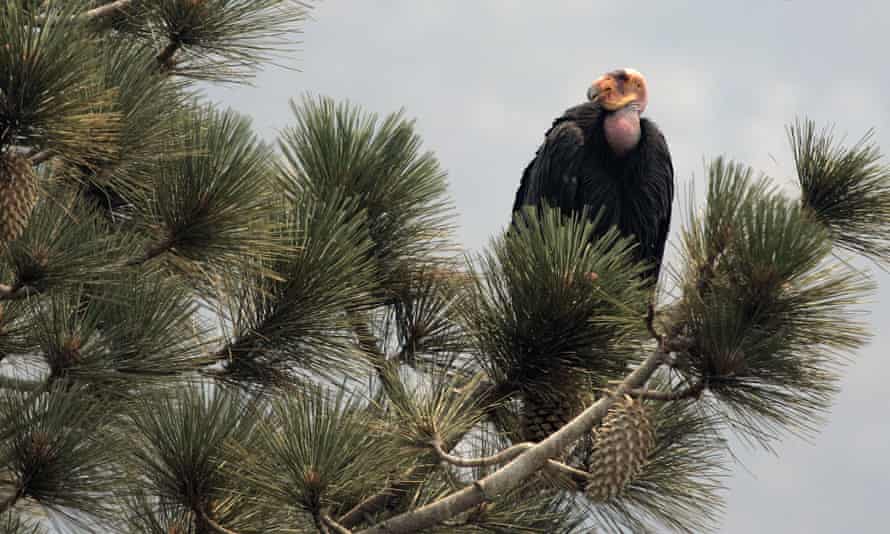
A California condor is perched atop a pine tree in the Los Padres national forest, east of Big Sur, California.
A California condor is perched atop a pine tree in the Los Padres national forest, east of Big Sur, California. Photograph: Marcio José Sánchez/AP

Sierra CistoneSat 27 Mar 2021 01.00 EDT

363

After a century of absence, the endangered California condor is set to return to the skies of the Pacific north-west.

The condor once soared from British Columbia to Mexico, but habitat loss, overhunting and, most significantly, poisoning from hunting ammunition drove the birds to near extinction.

By the early 1980s, these threats had caused such a precipitous decline in the population that only 22 remained in the wild. In an effort to regrow their numbers, biologists captured the remaining birds and began a breeding program.

Since then, the condor has been reintroduced to south and central California. Its population has expanded into parts of Utah, Arizona and Baja California in Mexico, with experts estimating the number of free flying birds at more than 300.
Now, the bird will be reintroduced in northern California. The reintroduction efforts there have largely been led by the Yurok Tribe, whose ancestral land encompasses large swaths of forest and coastline in northern California and parts of Redwood national park that were once home to the condor.

The tribe has planned for the bird’s return for over a decade, and its proposal was accepted on 24 March by the US Fish and Wildlife Service.

Through close collaboration with Redwood national park, the tribe will begin the creation of a captive breeding facility within the boundaries of the park. The facility will house captive-bred condors that could be released into the park as early as this fall.
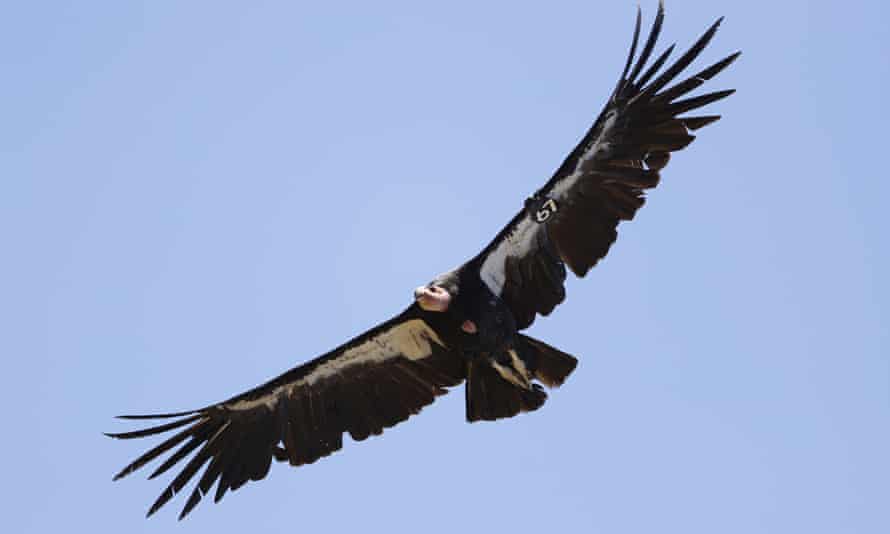
The California condor’s reintroduction has been led by the Yurok Tribe.
The California condor’s reintroduction has been led by the Yurok Tribe. Photograph: Marcio José Sánchez/AP

Advertisementhttps://2352a79ad1ba979066e4c66af1a55483.safeframe.googlesyndication.com/safeframe/1-0-38/html/container.html

Although the condor population is on the uphill, its survival in the Golden state still faces challenges. California has banned lead shot and ammunition, but the laws are unlikely to completely eradicate the lead poisoning problem. Poaching of wildlife and illegal use of lead ammunition could still pose a risk to wildlife and any reintroduced condors, said Chris West, the Yurok Tribe’s condor program manager.

Yet West is hopeful about the bird’s future. Starting this new population of California condors in the far northern portion of the state could offer the bird a better chance at continued survival overall, he argued.

“There’s a big success in the number of birds out there, but you don’t want to put all your eggs in one basket,” West said.

Increasing the population could also help buffer the species against the increasing effects of wildfires, climate change and loss of genetic diversity. Condors are an important part of a healthy and functioning ecosystem. As scavengers, the birds are an essential part of nature’s clean-up crew.

Strong, big beaks allow them to open fresh carcasses, a task too difficult for their close relatives, the turkey vulture. Their efforts allow other wildlife to access the carcasses, and accelerates the recycling of nutrients on the landscape.
Condors are scavengers; an essential part of nature’s clean-up crew.
Condors are scavengers; an essential part of nature’s clean-up crew. Photograph: Shadow_Hawk/Getty Images/iStockphoto

For the Yurok people, the return of the condor presents a milestone. The condor plays a critical role in the people’s tradition and culture, and the return of the bird to ancestral territory brings with it a sense of renewal for both people and the land, said Tiana Williams-Claussen, the director of Yurok Tribe’s wildlife department.

In 2003, the Yurok elder community identified the bird as the single-most important land animal to bring back to ancestral land. The reintroduction program was born only a few years after that decision, according to Williams-Claussen.

“When I actually see a condor in the sky again,” Williams-Claussen said, “it’s just mending that wound that was carried by my elders, is carried by me and that, at least in part, is not going to be carried by my children.”

Incredible condor soared for 100 miles without flapping its wings

Scientists are learning more about how big birds take advantage of air currents.

Amanda Kooser headshot

Amanda KooserJuly 14, 2020 11:09 a.m. PT

LISTEN- 01:30

condor
Turns out that Andean condors don’t have to flap their wings much.Facundo Vital

Look, ma, no wing flaps.

An Andean condor, one of the largest flying birds on the planet, soared through the air for 100 miles (172 kilometers) and didn’t bother with flapping its wings. This epic example of flight comes to us from a team led by researchers at Swansea University in the UK.

The scientists took a deep look at the connection between environmental conditions and the amount of effort large birds put into their flights. To do this, they attached data recorders to Andean condors that allowed them to log every single flap of the wings as well as the birds’ flight paths. 

CNET SCIENCE

From the lab to your inbox. Get the latest science stories from CNET every week.SIGN ME UP!

By signing up, you agree to our Terms of Use and acknowledge the data practices in our Privacy Policy. You may unsubscribe at any time.

The study, published on Monday in the Proceedings of the National Academy of Sciences, found that Andean condors only flap their wings for about 1% of their flight time. Most of that happened during takeoffs and when flying near the ground.

The condors’ soaring stamina is impressive, but these heavy birds must pick their battles when it comes to expending energy on wing flaps. 

COOL BIRDS

“Our results revealed the amount the birds flapped didn’t change substantially with the weather,” said study co-author Hannah Williams of the Max Planck Institute for Animal Behaviour. “This suggests that decisions about when and where to land are crucial, as not only do condors need to be able to take off again, but unnecessary landings will add significantly to their overall flight costs.”

The study draws a connection between today’s condors and some extinct giants that were “more like a dragon.” “Overall, this can help explain how extinct birds with twice the wingspan of condors could have flown,” the paper suggests.

There could be some life lessons for humans in here, too. You don’t always have to break a sweat. Sometimes the easiest route is the best one.

Great News! The “Sportsmen’s” Act is Dead…for Now

Great news—the “Sportsmen’s” Act of 2012 did not get past the Senate. Ironically, it was the Republicans that killed the bill. Not because of any great concern for wilderness or wildlife—quite the opposite; they just didn’t like how much of the budget the bill allocated for conservation projects.

What really doesn’t make sense is why every Democrat (except for Senator Barbara Boxer) voted to approve a bill with a main goal of opening up even more public lands for hunters. Why, for instance, did my two Senators from Washington State approve of a bill that would have allowed for the importation of “trophy” polar bear carcasses from Canada, undermining the ESA? And what did they stand to gain by giving a de facto federal thumbs-up to lead buckshot and other ammunition that have already poisoned so many birds, including endangered condors?

We dodged the bullet this time, but in the years to come there are sure to be other “sportsmen’s” acts rearing their hideously ugly heads (I was just going to say “ugly heads,” until I saw that one of my regular readers used the fitting adverb “hideously” before “ugly head” in reference to these contemptible acts). We can count on more puff about allowing bowhunting in parklands where wildlife is currently protected, more trophy hunters whining against regulations and most nauseating of all, politicians of both parties waxing poetic about hunting.

Hell, some people won’t be satisfied until Ted Nugent’s (hideously ugly) head is carved into Mt. Rushmore alongside Teddy Roosevelt’s.

Hunting: the Primary Cause of Extinction

Contrary to the preposterous—yet increasingly popular—belief that gas-guzzling, beer-can-tossing hunters are concerned environmentalists, hunting has been and continues to be the primary cause of extinctions world-wide. Even the plight of non-“game” animals, like the California condor, the country’s largest and perhaps most critically endangered bird species, stems from the same root cause that has led to the decimation of so many other species: hunting.

By the end of the nineteenth century, that darkest of times for wildlife in North America, rampant hunting had led to the extinction of the great auk, the passenger pigeon, two subspecies of elk and the near-total extinction of bison, pronghorn, trumpeter swans, bighorn sheep and a myriad of other coveted species. Meanwhile, scavengers like condors were collateral damage in the frenzied campaign to rid the continent of its native carnivores.

Together with ravens and vultures, condors were senselessly shot on sight by trigger-happy ranchers mistaking the huge birds for predators—an ignorance that continues to this day. Moreover, those scavengers, along with eagles, hawks and other raptors, perished from eating poisoned meat intended for wolves, coyotes, bears and cougars.

Incidental poisoning is an ongoing threat plaguing condors right up to this day. Like so many other egg-laying species, their population suffered another major setback from the widespread use of DDT during the mid-20th Century. That toxic chemical was finally banned, but the great birds continued to perish. By the time it was determined they were also dying from lead-poisoning as the result of scavenging the carcasses of animals killed with lead-based bullets and buckshot, the condor population was down to an all-time low of only 22 individuals.Thanks to concerted efforts, their numbers have increased nowadays and lead-based ammunition has been banned from the condor’s most critical habitat. But the 400 surviving birds are still threatened by the illegal use of lead shot and bullets, in addition to other anthropogenic pressures, like power lines and wind turbans.

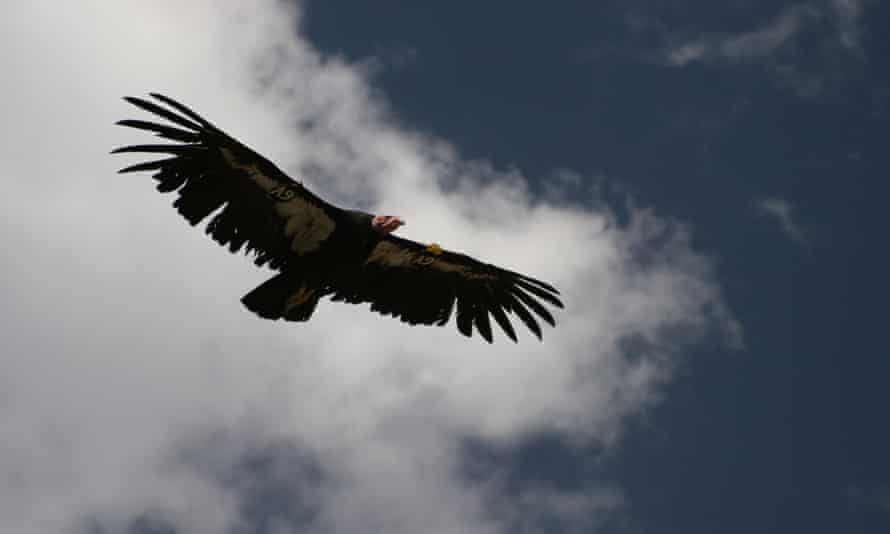
California condors have a life span of up to 60 years (longer than most human carnivores, prior to the discovery of statin drugs). And though they may appear ungainly on land, once a condor has worked his or her way up to a proper elevation, they can glide for miles without ever flapping a wing and sometimes attain speeds of 55 miles per hour, at elevations of 15,000 feet.

More proof that hunters aren’t really environmentalists: condors are still shot as pests or for target practice, and many “sportsmen” continue to oppose a nationwide-ban on lead-based ammo.