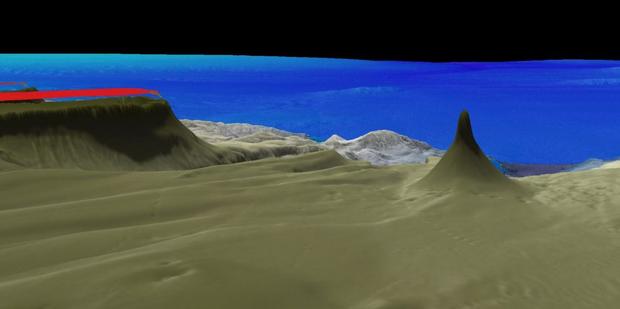
During a 12-month exploration of the ocean around Australia, scientists last week discovered an enormous detached coral reef in the Great Barrier Reef — the first to be discovered in over 120 years. According to the Schmidt Ocean Institute, the reef measures more than 1,640 feet, which is taller than the Empire State Building, the Sydney Tower and the Petronas Twin Towers.
A team of scientists led by Dr. Robin Beaman discovered the massive reef off North Queensland on October 20, before diving to explore it on Sunday. They found that the base of the “blade-like” reef is nearly a mile wide and rises over 1,600 feet to just 130 feet below the ocean’s surface.
“This unexpected discovery affirms that we continue to find unknown structures and new species in our Ocean,” Wendy Schmidt, co-founder of Schmidt Ocean Institute, said in a news release Monday. “The state of our knowledge about what’s in the ocean has long been so limited. Thanks to new technologies that work as our eyes, ears and hands in the deep ocean, we have the capacity to explore like never before. New oceanscapes are opening to us, revealing the ecosystems and diverse life forms that share the planet with us.”
The Great Barrier Reef, the largest in the world, is home to more than 1,600 species of fish and over 400 species of hard corals. But it is facing an ecological catastrophe, as more than 50% of its corals have died in the last 25 years, mostly due to climate change causing mass bleaching events. The reef is at risk of losing its coveted World Heritage status because of ocean warming damaging its health.
But scientists are continuing to explore the mysteries of the Great Barrier Reef — and they aren’t giving up hope that it could be saved.
“To find a new half-a-kilometer tall reef in the offshore Cape York area of the well-recognized Great Barrier Reef shows how mysterious the world is just beyond our coastline,” said Dr. Jyotika Virmani, executive director of Schmidt Ocean Institute. “This powerful combination of mapping data and underwater imagery will be used to understand this new reef and its role within the incredible Great Barrier Reef World Heritage Area.”
A newly-discovered 500-meter tall detached reef adds to the seven other tall detached reefs in the northern Great Barrier Reef.
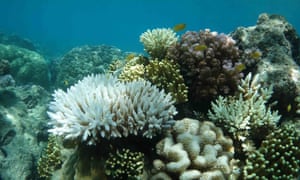
The Great Barrier Reef is in themidst of its third mass-bleaching event in the last five years. This year’s heat-induced bleaching—which occurs during the region’s summer season—is more severe than the previous two, with 25 percent of the reefs experiencing widespread bleaching. At this point, over 15 percent of the world’s largest reef system has turned a ghostly, skeletal white.
We stand at the very beginning of a long fight for the survival of coral. “Even if we stopped emitting CO2 today, the ocean would still get warmer for 30 to 40 years,” Stephen Palumbi, a coral researcher and professor of biology at Stanford University, told me. “It’s hard to conclude anything but that this ecosystem is in serious trouble.” As the ecosystem becomes more and more unstable, possible solutions become scarcer and increasingly expensive. High-tech measures like geoengineering, assisted evolution, and robot-assisted reproduction are quickly turning into scientists’ best bets.
The current reality of coral reefs is a clear warning about the future of the climate crisis. With each passing day of emissions, ecosystems under pressure become harder and more expensive to recover, eventually reaching a point where the only viable solutions could involve highly resource-intensive technology with uncertain outcomes. Coral reefs can show us what a losing battle the climate crisis could feel like once we reach a certain point.
Climate “tipping points” are thresholds where a tiny change in conditions pushes a system into a completely new state. While scientists say we’re not there yet with coral, we’re frighteningly close. Nearly50 percent of the world’s coral has died in the last 30 years; climate change is the primary culprit. Surface water temperature just a few degrees warmer than normal for several weeks is enough to drive widespread bleaching. Abnormally hot waters aremore common every year.
“Coral reefs provide a variety of different ecosystem services and functions,” said Emma Camp, a biologist and researcher focusing on coral reefs and climate change. “Many fish stock rely on coral reefs. Reefs play a huge role in nutrient recycling and coastal protection.”
The global economic value of coral reefs is estimated to be$36 billion each year. This revenue comes from diving, snorkeling, and wildlife watching as well as “reef-adjacent” tourism that relies on beautiful beaches and views. Reefs also serve as the first line of defense for many coastal areas against storm and wave activity, dissipating large waves and protecting islands from coastal erosion. “As we lose coral reefs, there will be socioeconomic ripple effects that spill far beyond the immediate communities affected,” Camp said.
Before the 2016-2017 bleaching in the Great Barrier Reef, the consensus among scientists was that those Pacific reefs wouldn’t require drastic technological solutions in order to be preserved. Now, out of necessity, the attitude has become closer to that of Silicon Valley than traditional science. Governments and private entities like Microsoft co-founderPaul Allen’s charity foundation and theUnited Arab Emirates havepoured billions of dollars into speculative initiatives to save coral reefs. While we’ve all heard about proposals like cloud-seeding or sun-shading floated as theoretical countermeasures to climate change, in the field of coral, many experts believe that the time to move forward with these risky geoengineering solutions isalready here.
In Australia, scientists tinker with creating new species of coral at the $25 millionNational Sea Simulator, using age-old plant domestication techniques and cutting-edge gene editing tools alike. An experimental program called assisted evolution brings corals into the lab and exposes them to heat gradually, creating coral that can survive under temperature stress for three times as long as the average coral.
While acknowledging the ethical implications of genetic engineering, Line Bay, a coral geneticist at the Australian Institute of Marine Science, toldScience magazine that delaying work on these proposals may leave the world unable to protect coral reefs in the future. “The worst thing that we could do is ignore genetic engineering because it’s frightening for some people, and then get 10 or 15 years down the road and realize it’s the only option,” Bay said.
Other proposals include geoengineering, such as spraying saltwater into the clouds to reflect more sunlight and dim the sun over the reefs. Another option involves countering ocean acidification—a side-effect of the oceans absorbing ever-greater amounts of carbon dioxide—by planting a massive amount of seagrass to turn seawater more alkaline. And the Australian government has already started funding the use of giant underwater fans to bring cooler water up to the surface.
Some scientists remain wary of some of these proposals. “I haven’t seen a geoengineering scheme that doesn’t make me really worried about what we’re doing,” Palumbi said, “especially without a couple of other planets to experiment on.”
Manufacturing and deploying massive fleets of underwater robots, while absurd on the surface, has quickly become one of the more scalable and easily controlled options when it comes to restoring dying reefs. In 2018, scientists at two Australian universities deployed robots to to re-seed reefs with millions of baby corals and help them grow back faster than they are bleaching.
The problem with coral restoration is the one we could soon be facing with multiple ecosystems: Its right to invest billions of dollars in protecting coral—without fighting to preserve these structures, we risk of the complete collapse of coral ecosystems, involving massive environmental and economic fallout. But focusing on coral-restoration technology can also draw attention away from the culprit driving this change to begin with: emissions.
The most important step for saving coral is moving away from a reliance on fossil fuels. “The future trajectory of reef health is entirely dependent on how soon we act,” Camp said. “The sooner we reduce emissions, the more likely we are to have healthy reefs in the future.” While scientists are increasingly wearing multiple hats as activists and communicators, the dialogue around restoring reefs can sometimes glance over the more important truth: Stopping emissions is the best and surest way to guarantee that reefs survive the century. Scientists have only turned to these alternative solutions because the world won’t act. “Our biggest tool to save coral, reducing emissions, isn’t working. So we have to think about the other tools in our toolbox like assisted evolution and geoengineering,” Camp said. But, at the same time, the emissions fight has never been more important: It’s the only way to avoid these battles of diminishing returns with other ecosystems down the line.
The situation facing coral reefs right now is a dry run for the tipping points rainforests, agriculture, and the polar ice caps could soon face. Right now, the most effective ways to save the Amazon rainforest are preventative—stopping deforestation and reducing carbon emissions. Butif the Amazon suddenly starts to collapse, it will already be too late and scientists will need to look to new, murky horizons, investing tremendous amounts of money in risky solutions in order to avoid imminent, drastic consequences.
Ecological systems under warming pressure can turn into a runaway train. The trillions of dollars in economic costs of climate inaction are not theoretical: The collapse of reef ecosystems today show us clearly what those economic and ecological costs will look like. Eliminating oil industry subsidies, a transition to a green economy, carbon taxes, far-reaching changes to individual lifestyles—everything needs to be on the table. While scientists can help coral survive into the short-term, it’s up to the greater community—and, in particular, that means policy at the national and international level—to create a future that coral can survive in.
Zoe Richards has seen great changes in the corals off Lizard Island since she started monitoring them in 2011. Photograph: Mike Emslie
When coral scientist Dr Zoe Richards left the Great Barrier Reef’s Lizard Island in late January, she was feeling optimistic.
Richards is a taxonomist. Since 2011 she has recorded and monitored 245 coral species at 14 locations around the island’s research station, about 270km north of Cairns.
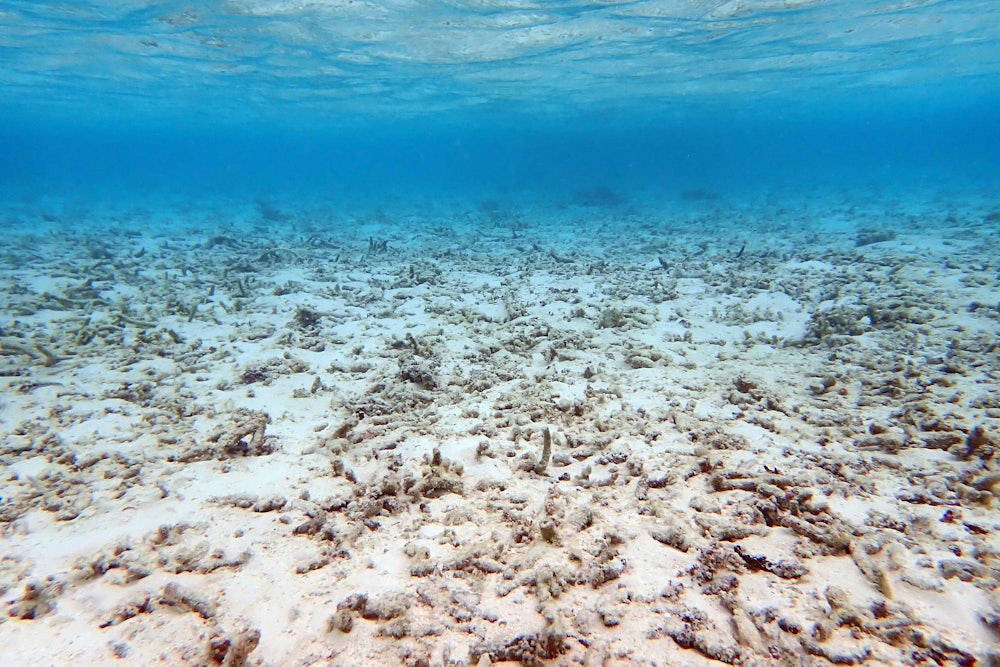
In 2017 she saw “mass destruction of the reef”. Back-to-back mass bleaching in 2016 and 2017, and cyclones in 2014 and 2015, had wreaked havoc.
But in January, she saw thousands of new colonies of fast-growing Acropora corals that had “claimed the space” left by dead and degraded corals. In a three-year window without spiralling heat or churning cyclones, some corals were in an adolescent bloom – not mature enough to spawn, but getting close.
“It was an incredible recovery,” says Richards, of Curtin University. “But I knew if it was hit again, it would be trouble – and that’s exactly what happened.”
In 2020, mass bleaching returned to Lizard Island – perhaps not as badly as in previous years – but enough, says Richards, to turn the clock back on the recovery she had seen.
Zoe Richards@ZoeR_Coral
Day 1 of coral biodiversity re-surveys @ Lizard I, GBR. After 2 cyclones & 2 bleaching events in a decade, it’s great to see a range of healthy young Acropora colonies fighting back! #coralnotcoal#recoveryispossible
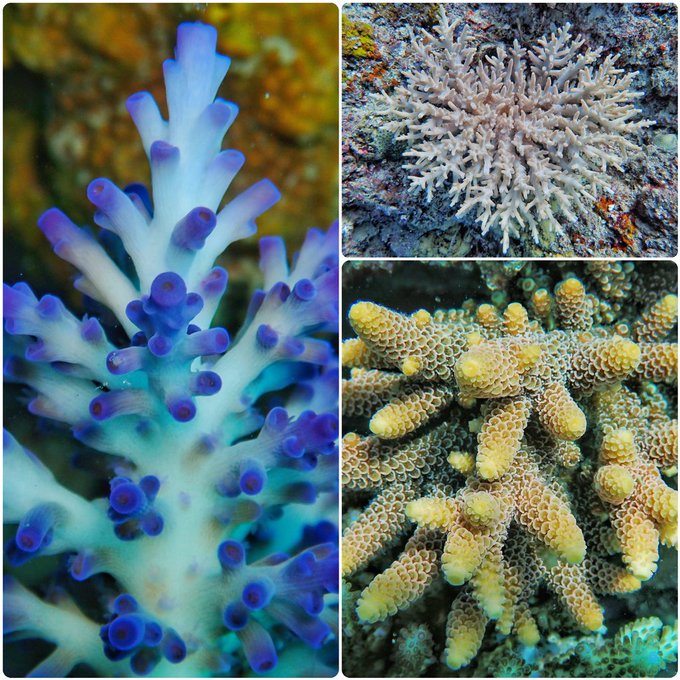
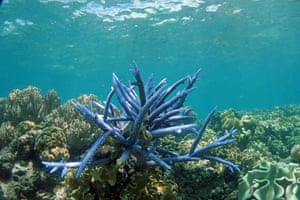
A. echinata (blue), A. speciosa (pink) & A. spathulata (orange)
This summer has delivered a third mass bleaching for the reef in just five years. The back-to-back bleaching of 2016 and 2017 was mostly confined to the northern and central sections.
Data from aerial surveys is still being analysed, but the Great Barrier Reef Marine Park Authority has said preliminary results suggest the 2020 bleaching had a much broader footprint.
When bleaching is mild, corals can and do recover, although it can make them more susceptible to disease. But severe bleaching can kill corals. Estimates are that the 2016 bleaching killed about 29% of the reef’s shallow water corals and the 2017 event took another 19%.
Some scientists are now concerned global heating may have reached a point where tropical reefs bleach almost every year.
What this means for the reef in the coming decades is an area of live research and debate among scientists.
Can we fix it?
Scientists Guardian Australia spoke to say the reef’s fortunes hang on the answers to two questions.
The first is whether governments around the world will make deeper cuts to greenhouse gas emissions than they have already agreed and, if so, how close they will get to keeping global heating to 1.5C.
A second is whether efforts to first identify and then deploy a swathe of potential measures that could reduce the impact of rising temperatures will be successful.
What seems clear is that without some human intervention, the magic of the world’s greatest coral reef system will be lost.
Prof Peter Mumby, professor of coral reef ecology at the University of Queensland, is the chief scientist at the Great Barrier Reef Foundation – the once-small not-for-profit that was awarded a controversial $443m government grant in 2018.
He said the 2020 bleaching “is giving us greater pause, given it seems we can see quite frequent coral bleaching events earlier than people had previously expected”.
Mumby says bleaching events have been “patchy”, and the fact that some areas have escaped “means there’s an opportunity for management”.
What keeps the reef functioning as a single ecosystem is the way each reef connects to another through the way corals reproduce. They all either spawn, or produce larvae, that can float in the water column and settle on nearby reefs.
Mumby and colleagues have identified about 100 reefs along the GBR that are well spread, well connected to other reefs by ocean currents, and tend to experience cooler temperatures.
He says making sure those reefs stay as healthy as possible – in particular by managing outbreaks of the coral-eating crown of thorns starfish – could be crucial in keeping the wider reef viable.
The reef’s unrivalled size and diversity – almost 4,000 reefs, cays and islands stretching for more than 2,000 kilometres – gives it extra resilience, he says.
Climate change is still the reef’s biggest threat and society will need to focus on tackling it, “but there needs to be a way to adapt to how we manage reefs so that they can roll with the punches – we have to do both those things”.
The Australian Institute of Marine Sciences (AIMS) has produced an as-yet unpublished study, sent to the federal government, that reviews more than 160 different interventions that have been suggested for the reef, identifying about 40 that could be worth further study.
Heat-stressed corals off Lizard Island in February 2020. Photograph: Dr Lyle Vail, Director of the Australian Museum’s Lizard Island Research Station
Dr Lina Bay, a principal research scientists at AIMS, says one promising area of study is what’s known as “assisted gene flow”, where the spawn of corals with better tolerance for heat could be captured and then dispersed.
“Not all corals are created equal,” she says. “Some have a higher stress tolerance than others. Over many years we’ve shown that the variation in bleaching tolerance is hereditable – it gets passed from parents to offspring.”
She says these differences can exist even among the same species, meaning those corals can be selectively grown in a lab setting to promote more heat tolerance.
AIMS scientist Dr Neal Cantin has just finished a three-year experiment with one fast-growing coral species called Pocillopora acuta, which behaves like a weed by filling in the gaps when less hardy corals die off.
Starting with 90 parent specimens taken from three different parts of the Great Barrier Reef, Cantin and colleagues grew 7,500 offspring and then subjected them to rising levels of CO2 and temperatures of up to 2C warming.
Even at high temperatures, some of these corals survived, and they were able to tolerate higher levels of heat as the experiment went on.
Having a street-fighting weedy coral like this is important, says Cantin. Dead areas of coral reefs tend to get covered in algae, but Cantin says a weedy coral that can compete with the algae can then make room for slower-growing corals to also grow.
“The whole goal of a lot of these interventions is to work with species that can be successful on their own. We won’t be able to work with 600 species of corals, but we could probably work with 20 that fill the functional roles of a healthy reef community.
“You can’t deny bleaching events are becoming more frequent and more severe and they’re impacting across a bigger area than before. We can just document that demise, or we can learn from it and have some corals for future generations.”
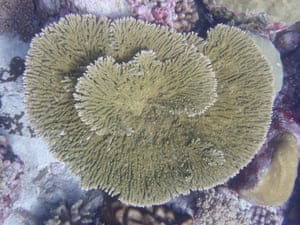
An unbleached specimen of Acropora clathrata on the Great Barrier Reef. Photograph: Zoe Richards
That demise is clear and it happens at scale, and also in detail. Zoe Richards has already seen evidence of likely local extinctions of some corals at Lizard Island. One is a spiralised plate coral – Acropora clathrata – that she hasn’t been able to find for years.
“It’s these silent extinctions that go on,” she says.
“The entire reef is operating like one big meta population with sub-populations that are connected to each other. If you successively take out nodes in that population, sooner or later you will end up with parts that don’t connect. It will be fragmented into subsets that will continue to erode in terms of diversity. It’s degradation of the [coral] community at a very large scale.”
‘At 3C, you basically have nothing’
Prof Ove Hoegh-Guldberg, of the University of Queensland, has done pioneering work on the study of coral bleaching going back to the mid-1980s.
He remembers Lizard Island as a “picture perfect” place to do research on corals in the late 80s, when his research there found rising temperatures caused corals to lose their “symbionts” – the algae that lives in the coral and gives them much of their nutrients and colour.
The Great Barrier Reef’s first major mass bleaching event happened in 1998. There was another in 2002, and again in 2016, 2017 and 2020.
Hoegh-Guldberg says: “We knew there was a temperature effect, and we knew that temperatures were going up. At the end of the 90s, I could put those two things together.”
The year after the reef’s first mass bleaching, Hoegh-Guldberg took climate models to forecast that if greenhouse gas emissions kept growing then, by 2020, “the average bleaching event is likely to be similar or greater than the 1998 event”.
As 2020 approached, the models showed reefs across the northern, central and southern regions would see between eight and 10 bleaching events per decade.
“I wished I’d been wrong” he says. “I think I said at the time that I’d have egg on my face if I was wrong. But there’s no egg on my face.”
Corals at Lizard Island had been showing signs of recovery before this year’s bleaching. Photograph: Dr Lyle Vail, Director of the Australian Museum’s Lizard Island Research Station
Hoegh-Guldberg says manually replanting corals is uneconomic at scale but there’s merit in helping the dispersal of coral larvae, pointing to a technique being developed by a scientist at Southern Cross University that captures millions of larvae in floating pools.
But he says the main game is keeping global heating down.
“Let’s say we get to 1.5C and then we can stabilise – that’s really the last call for reefs. Corals will come back and there will be winners and losers, but you’ll have a functional reef that supports fisheries and tourism.”
The problem is that right now, government pledges under the Paris agreement are enough to raise temperatures by 3C – not 1.5C.
“At 2C all the reef-building corals have plummeted and instead you are looking at the dominance of other organisms like algae. At 3C you basically have nothing.
“I’m fearful that in the next 10 years we will see the loss of coral across the planet at phenomenal rates,” he says. “That’s what keeps me up at night.”
The sun glows red during the ACT bushfires, one of the events that contributed to a disastrous 2019 for the environment in Australia. Photograph: Mike Bowers/The Guardian
Record heat and drought across Australia delivered the worst environmental conditions across the country since at least 2000, with river flows, tree cover and wildlife being hit on an “unprecedented scale”, according to a new report.
The index of environmental conditions in Australia scored 2019 at 0.8 out of 10 – the worst result across all the years analysed from 2000.
The year delivered unprecedented bushfires, record heat, very low soil moisture, low vegetation growth and 40 additions to the threatened species list.
The report’s lead author, Prof Albert van Dijk of the Australian National University’s Fenner school of environment and society, told Guardian Australia 2019 was “probably the worst in a century or more” for the environment.
“This is not the new normal – this is just getting worse and worse,” he said, adding that 2019 had seen a “continuing descent into an ever more dismal future. You start to see ecosystems fall apart and then struggle to recover before the next major disturbance.”
The Australia’s Environment report scored environmental conditions across seven indicators – inundation, streamflow, vegetation growth, leaf area, soil protection, tree cover and the number of hot days.
Across all years analysed, 2005 was the next worst year, impacted by the millennium drought. The year 2010 was the best; it was also one of Australia’s wettest on record.
Van Dijk said the cause of the impacts for 2019 were global heating as well as natural variability in Australia’s climate. The number of days above 35C was 36% higher than the previous 19 years.
The population had continued to grow and the country’s greenhouse gas emissions had remained high, the report said.
Greenhouse gas emissions per person were 11% below the 2000-18 average, but remained among the highest in the world because of high energy use per person and the burning of coal for electricity.
Findings were underpinned by about 1m gigabytes of data, including satellite data that only became available from 2000, as well as field data and on-the-ground surveys.
Reviewing biodiversity impacts, the report highlighted the number of spectacled flying foxes – one of many species vulnerable to heat stress – had dropped to 47,000 from an average of 100,000 before 2016.
The numbers of threatened species had risen by 36% since 2000, the report said.
River flows were 43% below the 2000-18 average, causing water storages to drop and mass fish deaths in the Murray-Darling Basin, and wetland environments had also seen record-low inundation.
River flows were above average around the coast of northern Queensland, around Karratha in Western Australia and at Strahan in Tasmania’s west.
The protection of soils by vegetation and moisture was “extremely poor”, causing dust storms. The average soil moisture was also lowest since at least 2000 and farming productivity had been hit.
World heritage-listed Gondwana rainforests, the Blue Mountains, alpine regions, eastern Gippsland and Kangaroo Island had all been badly hit by bushfires.
A co-author of the report, Dr Marta Yebra, said: “Our data clearly shows that the combination of dry forests and hot weather made for an especially explosive mixture.”
All the findings and data from the report, now in its fifth year, can be viewed on a website and interactive map.


.png)


 Exposing the Big Game