Amid COVID-19 Outbreak, Activists Rally at City Hall to Shut Down the 85 Live Animal Markets and Slaughterhouses in NYC

MARCH 18, 2020 BY  — LEAVE A COMMENT

Amid COVID-19 Outbreak, Activists Rally at City Hall to Shut Down the 85 Live Animal Markets and Slaughterhouses in NYC


The News

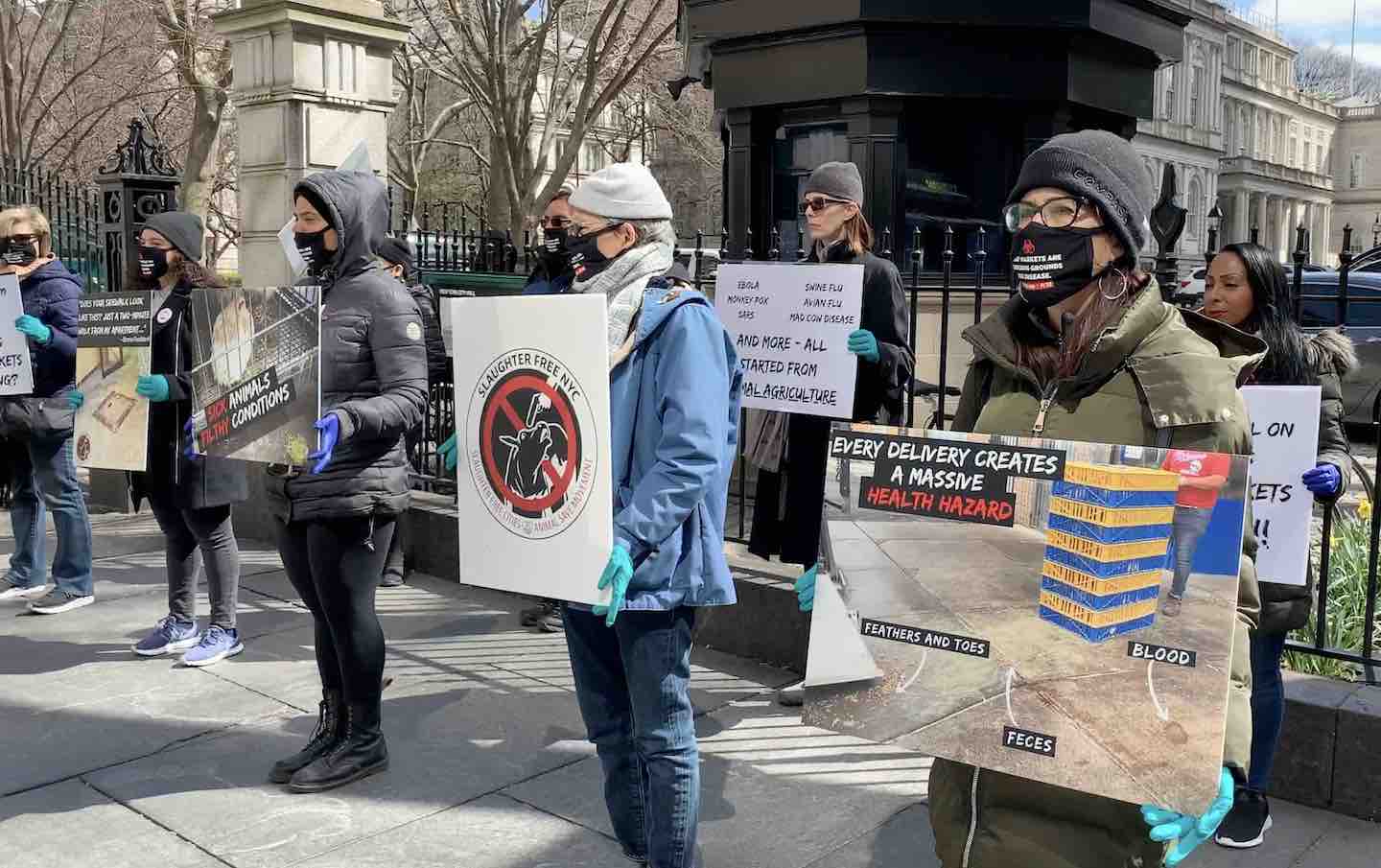
As New York City began to shut down due to the spread of COVID-19, approximately twenty public health and animal rights activists staged a rally at City Hall to demand that city and state health authorities shut down the 85 live animal markets and slaughterhouses in NYC. COVID-19, also known as the corona virus, is believed to have jumped to humans from animals being sold in a live animal market in Wuhan, China.

“Live markets, which are storefront slaughterhouses open to the public, are a petri dish of infectious diseases that jeopardize the health of all New Yorkers,” said Jill Carnegie, an organizer with Slaughter Free NYC.

Amid COVID-19 outbreak, public health and animal rights activists are asking New York City and State health officials, including NYC Health Commissioner Dr. Oxiris Barbot and Assistant Commission Dr. Demetre Daskalakis, to shut down the 85 live animal markets and slaughterhouses in NYC

After the corona virus outbreak was traced back to a “wet market” in Wuhan which sold wild and domesticated animals for meat, the Chinese government is reported to have shuttered live animal markets across the country.

“The pandemic didn’t happen to us; we brought it upon ourselves because we didn’t learn our lesson from bird flu, swine flu, mad cow, SARS and the many other infectious diseases that jumped to humans from the animals who we eat,” said Maureen Medina, an organizer with Slaughter Free NYC. “Mother Nature has sent us so many warnings, and we’ve put bandaids on all of them instead of taking the most obvious measure to prevent them, which is to switch to a plant-base diet.”

An estimated 85 live animal markets in NYC sell cows, chickens, goats, sheep, guinea pigs, rabbits and others animals who they slaughter on site

Slaughter Free NYC and The Save Movement have been staging vigils and conducting educational outreach at live markets in NYC. Organizers hope that the COVID-19 pandemic will be a wake-up call for elected officials and for the New York City Department of Health and NY State Ag & Markets who have, until now, ignored their pleas to shutter the city’s live markets.  Slaughter Free NYC has launched a petition.

Slaughter Free NYC Petition to Shut Down Live Animal Markets and Slaughterhouses in heavily populated five boroughs of New York

Coronavirus myths debunked by the World Health Organization

A woman is pictured wearing a mask while walking down Oxford Street, central London, on 17 March. The UK has confirmed 1,960 cases since the outbreak began. (Getty Images)

The World Health Organization (WHO) has debunked some of the misleading myths surrounding the coronavirus outbreak.

The previously-unknown Covid-19 virus is thought to have emerged at a seafood and live animal market in the Chinese city Wuhan at the end of last year.

It has since spread internationally, with more than 190,000 confirmed cases worldwide since the outbreak was identified, according to John Hopkins University data.

While officials are urging the public to wash their hands regularly and maintain social distancing, the internet is awash with false information about how to stay virus-free.

The WHO has debunked the most widespread, and ludicrous claims, in an attempt to combat the outbreak sooner.

Latest coronavirus news, updates and advice

Live: Follow all the latest updates from the UK and around the world

Fact-checker: The number of Covid-19 cases in your local area

Explained: Symptoms, latest advice and how it compares to the flu

Globally, the death toll has exceeded 7,000.

While this is alarming, more than 80,600 of the 190,000 confirmed patients are known to have “recovered”.

China, where the outbreak began, has seen cases plateauing since the end of February.

Europe is now the epicentre of the pandemic, with Italy alone having more than 27,900 confirmed cases and over 2,000 deaths.

A masked solider is pictured talking to a driver in the island Luzon in the Philippines on 18 March. The Philippines has had 187 confirmed cases. (Getty Images)

Coronavirus myths debunked by the World Health Organization

‘Cold temperatures kill the coronavirus’

“There is no reason to believe cold weather can kill the new coronavirus”, according to the WHO.

The Covid-19 virus is one of seven strains of the coronavirus class that are known to infect the airways of humans.

A human’s body temperature remains around 36.5°C to 37°C (97.7°F to 98.6°F) regardless of the conditions outside.

Although unclear, some experts wonder whether cold weather could actually be making the outbreak worse, with it potentially easing as temperatures warm up.

Flu may be more prevalent in the northern hemisphere’s winter due to the cold weather driving people to “huddle” indoors.

Calgary Stampede announces mass layoffs amid COVID-19 outbreak

Article content

The Calgary Stampede has temporarily laid off close to 900 staff — around 80 per cent of its workforce — amid uncertainty from the ongoing outbreak of the new coronavirus.

The majority of the staff affected are casual, part-time employees. The layoffs also include full-time staff.

The Stampede informed its volunteer base of the move on Tuesday.

“As a not-for-profit organization, we unfortunately have to take these temporary measures of dramatic layoffs. We’re looking to support the long-term sustainment of the organization, its role in the community and the jobs that we provide, and certainly we did not take these decisions lightly today,” Stampede CEO Warren Connell told Postmedia.

“These decisions were about looking toward the future and the sustainability of the Stampede.”

A total of 890 people were laid off, including 608 casual, part-time employees and 282 regular, part-time and regular, full-time staff.

Connell said the Stampede was “saddened” by the measure.

“With the recent restrictions of mass gatherings as a result of COVID-19, the Calgary Stampede is currently facing an unprecedented halt in activity,” the organization added in a statement.

Despite the move, the annual 10-day July event has not been called off.

But Connell said the Stampede is planning for “contingencies for what Stampede would look like this year.”

“It’s far too early to speculate on whether the Stampede will happen this year,” he said.

“We have not called Stampede. Stampede is still in the mix of what we’re planning on. We just don’t know, depending on timelines and . . . the unknowns the whole community is facing, exactly what that looks like.”

Calgary Stampede CEO, Warren Connell, speaks to the reporters following a collision on Thursday that led to the third horse death of this year's chuckwagon races and a driver disqualified for the first time in the Stampede's history. Friday, July 12, 2019. Brendan Miller/Postmedia
Calgary Stampede CEO Warren Connell /Brendan Miller/Postmedia

He said the organization is involved in about 1,200 events a year outside its marquee fair.

“The majority of the staff we’re talking about support those events,” Connell said.

It’s unclear how long the Stampede’s temporary layoffs will last.

Connell said the organization has set up a program to help affected staff cope financially.

For employees who qualify for employment insurance, the Stampede is bridging their first two weeks of pay to a value equal to 95 per cent of their regular earnings, the maximum allowed according to federal rules.

For employees on the Stampede’s benefits program, the organization will pay both employer and employee costs throughout the duration of the temporary layoffs.

Connell likened the uncertainty surrounding the 2020 event, which is scheduled to take place July 3 to 12, to the 2013 edition that was preceded by mass floods throughout Calgary and southern Alberta.

The Stampede grounds were especially affected, as the late June floods shut down buildings on site. Others, including the Saddledome, were in the midst of reclamation as the event went forth.

“Certainly, if time is our friend and things come around, we’re planning for having a Stampede,” Connell said.

But he acknowledged the event would likely see fewer guests, especially from across the world, if it proceeds as planned.

“You just have to follow the airline industry and the tourism industry and their reduced bookings,” he said.

“We know it’s going to have a significant impact. People plan these events, when you’re an international traveller, many months out.”

Are These Vegan Foods Left Unsold During the COVID-19 Pandemic?

Even looming food shortages are apparently not enough to prompt some consumers to try soy- and tofu-based products.

  • PUBLISHED 17 MARCH 2020

Claim

A photograph shows store shelves stripped of all foodstuffs except for vegan products during the COVID-19 pandemic.

Rating

Miscaptioned

About this rating 

Origin

The COVID-19 coronavirus disease pandemic that began spreading globally in the first part of 2020 prompted runs on grocery stores and other food outlets that left many store shelves stripped bare of consumables. As social media users began sharing photographs of barren shelves to document the extent of the situation, a few delighted in posting pictures that showed a few foodstuffs left behind in otherwise empty stores — with the implication that these comestibles were so awful tasting that people were unwilling to purchase them, even in a time of crisis.

One common subject of such photographs was food identified (correctly or otherwise) as being “vegan” (i.e., containing no animal products). One particular picture of that nature was shared by multiple Facebook and Twitter users:

Keira Savage@KeiraSavage00

Not even the threat of starvation from a panic buying food shortage can move vegan food off the shelves..

View image on Twitter
260 people are talking about this

Although the photograph may be fairly representative of the general concept and does picture some vegan food products, it did not originate with the COVID-19 pandemic.

The earliest versions of this picture we were able to find online had been posted well over two years before the COVID-19 outbreak and dated from September 2017 — just after Hurricane Harvey made landfall in Texas and Louisiana in August 2017 and prompted a similar run on grocery stores by residents in the storm’s path:

Do I need to worry that my dog has coronavirus?

Posted on 06/03/2020 by World Animal Protection US

The simple answer is no. It’s understandable that many of us are feeling concerned about the possibility of contracting coronavirus, but to turn our attention towards dogs would be entirely misguided.

Traffic Jam Ahead: COVID-19 and Livestock Market Risks

02:48PM Mar 16, 2020
Liv
U.S. livestock sector backed by domestic, global demand.

( Farm Journal )

Pork, beef and poultry production continue to run significantly higher than a year ago, in part because packer margins are in excellent shape as retail demand has been strong, says Len Steiner in his Daily Livestock Report.

“It is important to remember that there are a lot of animals on the ground and that supply cannot simply be turned off,” Steiner noted.

In January, U.S. beef, pork and poultry producers were hoping to capitalize on the global protein shortfall and fulfilling China’s needs because of the Phase 1 deal. The inventory of market hogs on Dec. 1 was estimated at 70.9 million head, 3.1% higher than the previous year and 5.8% higher than two years ago, Steiner said.

“Given the number of hogs that have come to market during the last three months, that estimate was on the lower end,” he added.

Meanwhile, cattle inventories on Jan. 1 were estimated at 94.413 million head, slightly lower than a year ago but still about 5.2 million head larger than in 2015. Broiler producers also expanded the size of the broiler hatchery flock, currently pegged at 61.124 million, 3.2% higher than a year ago and the highest broiler hatchery supply on record.

“Hog and cattle futures have collapsed in the last two weeks. Part of that may be money flow,” Steiner said. “The other part could be the extreme risk that demand/supply fundamentals that were quite robust in the first two months of the year may/could/will change quite rapidly in the next few weeks.”

He said the April hog contract will expire a month from now and futures are trading potential prices for that time. The fed cattle contract will also expire at the end of April.

How will demand change?
Demand remains a critical risk. With restaurants being closed down throughout the country and more people working from home due to the novel coronavirus pandemic (COVID-19), demand is changing quickly.

“It is difficult to know if even more drastic measures will be needed in order to slow down the progress of the virus. One thing to also remember is that we have yet to see the effect of the changes that are just now taking place,” he said.

Although many restaurant distributors have yet to see the order flows drop, he said that will likely change in the next two weeks. Once that happens, the order flows from distributors to the processors and then back to the packers will also be impacted.

“Just like in a traffic jam, some cars may be going at speed as they approach the accident but eventually it will all slow down. The bigger risk is the damage this all will do to the economy,” Steiner said. “Economic data has yet to catch up with what’s happening, but the crash in the equity market is a clear indicator that markets think we are heading for a major contraction in output.”

The demand risk is big but there is also a supply flow risk that is impossible to predict. The U.S. workforce in the plants, on the road and at the farms are as vulnerable as anyone to COVID-19.

“There are significant risks that we face in the coming weeks and months. While eventually we will persevere, it will not be easy and it will not be cheap,” Steiner said.

For more coronavirus coverage, check out our landing page on the topic here.
More from Farm Journal’s PORK:

Universities Enact COVID-19 Prevention

COVID-19: 5 Things Your Farm Should Do Now

Universities Forge Forward with Research, Extension Despite COVID-19

EXPLAINER-What’s in the U.S. coronavirus aid bill?

EPA Expands COVID-19 Disinfectant List

Inslee orders all restaurants, bars shut down because of coronavirus


6
VIEW ALL PHOTOS
Tyler Baldwin mops the floor after closing for the night at the Taproom at Pike Place, Sunday, March 15, 2020 where he works as a bartender in Seattle. (AP Photo/Ted S. Warren)

OLYMPIA, Wash. — All bars, entertainment and recreational facilities have been ordered by the state to close across Washington and restaurants will be limited to take-out or delivery orders only, Gov. Jay Inslee said Sunday night.

The order goes into effect at 12:01 a.m. Tuesday morning, an Inslee spokesperson said, though King County has chosen to enact its ban immediately.

Gov. Inslee Press Conf. on COVID-19 Update

“Given the explosion of COVID-19 in our state and globally, I will sign a statewide emergency proclamation tomorrow to temporarily shut down restaurants, bars and entertainment and recreational facilities,” Inslee said in a press release announcing the new order. “Restaurants will be allowed to provide take-out and delivery services but no in-person dining will be permitted. The ban will not apply to grocery stores and pharmacies. Other retail outlets will have reduced occupancy.”

Retail outlets include gas stations, banks, hardware, stores and shopping centers.

Governor Jay Inslee

@GovInslee

King County will shut down these establishments immediately. As the largest population center and current epicenter of this outbreak, they must act with even greater urgency. I applaud @kcexec’s decision.

We will hold a joint press conference with more details tomorrow. 5/6

Governor Jay Inslee

@GovInslee

We’re in this together, Washington. How each of us responds matters.

And I know we’re up for the challenge.

My full statement: http://bit.ly/SocialDistancingWA 
6/6

View image on Twitter
1,986 people are talking about this

The closure is in effect until March 31 for now.

“Hopefully it’s just a couple weeks, but we don’t know,” said Grace Jurado, General Manager of Red Mill Burgers.

Red Mill Burgers was already planning to make changes to its restaurant operations before Inslee’s announcement Sunday night. The Red Mill Burgers Totem House location in Ballard is now temporarily closed. Starting Tuesday, the locations in Phinney Ridge and Interbay will have limited hours and only take to-go orders without cash, Jurado said.

“We were trying to get ahead of the curve on it, but I’m happy that right now – it’s allowing us to at least stay open for to-go orders,” she told KOMO News on Sunday night.

Inslee orders all restaurants, bars shut down in state in wake of coronavirus

Inslee also increased a ban on gatherings over 250 people down to a ban of over 50 people, and all gatherings under 50 people are prohibited unless previously announced criteria for public health and social distancing are met.

“We are at a critical moment in this crisis,” said King County Executive Dow Constantine. “We are leaving the phase of COVID-19 outbreaks in concentrated areas of the county, and entering the phase of potentially rapid and widespread infection.”

He suggests just assume the new coronavirus is already widespread.

“It is time, right now, for people to assume that they and everyone they meet is infected, to avoid any unnecessary interactions that might lead to further infection, and to wait and monitor to see if they have in fact been infected so that they can isolate and recover without presenting a risk to others,” Constantine said.

Seattle Mayor Jenny Durkan says a recent study by the Institute for Disease Modeling found that if the Puget Sound region didn’t take any mitigating steps for the virus, that by early April the Puget Sound region could have as many as 25,000 cases of COVID-19, and 400 deaths. But with strong to extreme social distancing efforts, we can limit future infections to between 1,700 and 4,800 in the region with 30-100 deaths, depending on their effectiveness, the study found.

“The study underscored the importance of social distancing in saving lives, preventing the further spread of the virus, and relieving pressure on the health care system and first responders,” Durkan said.

‘Your actions could kill someone’

The announcement comes hours after Inslee had stern words Sunday for those who are ignoring the state mandates to avoid large crowds and practice strong social distancing as the new coronavirus continues to spread:

“Your actions could kill someone. Stop it.”

Governor Jay Inslee

@GovInslee

Most Washingtonians are helping slow COVID-19’s spread by practicing strong social distancing.

To those of you that can be but are choosing not to: Your actions could kill someone.

Stop it.

10.4K people are talking about this

Inslee’s tweet praised most Washingtonians for adhering to the recommendations, designed to slow the widening outbreak. Two more deaths were announced Sunday afternoon in King County, bringing the county’s total to 37 and the statewide total to 42 with 769 total cases.

The deaths include a woman in her 60s who died at Franciscan Medical on March 14 and a woman in her 70s who died on March 12. Both were residents of Life Care Center of Kirkland.

Of the 37 deaths reported in King County, 29 are associated with Life Care. As of Saturday, 47 staff members tested positive for coronavirus, 24 tested negative, one test came back inconclusive, and five tests are still pending. Eighteen additional employees will be tested Saturday.

So far, more than 9,000 people who tested for coronavirus came back with negative results.

“Although the laboratory test is becoming more broadly available, there are limitations in the health care industry’s capacity to obtain samples from people as rapidly as we would like,” Public Health Seattle & King County wrote in a press release. “In addition, people do not always need to be tested for clinical care purposes since there is currently no medication to treat COVID-19.”

EvergreenHealth Hospital ER Doctor hospitalized with coronavirus

An emergency room doctor with EvergreenHealth hospital, which is treating several COVID-19 cases, has been hospitalized himself due to the coronavirus infection, hospital officials and the American College of Emergency Officials said Sunday.

Hospital officials say the doctor is in critical but stable condition. His name is not being released due health privacy laws.

“I am deeply saddened by this news, but not surprised,” ACEP President Dr. William Jaquis said in a statement. “As emergency physicians, we know the risks of our calling. We stand united with our colleagues and our thoughts and prayers for a full and speedy recovery are with each of them and their families.”

Jaquis says it’s unclear whether the doctor picked up the virus at the hospital or via community spread.

Don’t overstock on supplies

Inslee also praised most state residents for buying supplies responsibly but noted that those that are overbuying are “putting their friends and neighbors at risk.”

“Grocers say consumer overstocking – not a disrupted supply chain — is the main reason their store shelves are empty of many supplies and food items, especially hand sanitizer, disinfectant wipes, toilet paper, and plastic gloves,” according to a Department of Health Press Release.

Officials say they want to assure everyone once shoppers return to the normal pace of purchases there will be an adequate supply. They added that water supplies are fine and there is no need to overstock bottled water.

“These are very difficult decisions, but hours count here and very strong measures are necessary to slow the spread of the virus,” Inslee said. “I know there will be significant economic impacts to all our communities and we are looking at steps to help address those challenges.”

CDC: Avoid gatherings over 50 for 8 weeks

Officials across the country curtailed many elements of American life to fight the coronavirus outbreak on Sunday, with health officials recommending that groups of 50 or more don’t get together and a government expert saying a 14-day national shutdown may be needed.

Governors were closing restaurants, bars, and schools as the nation sank deeper into chaos over the crisis. Travelers returning home from overseas trips were stuck in line for hours at major airports for screenings, causing them to be crammed into just the kind of crowded spaces that public health officials have been urging people to avoid.

As Americans struggled to come to terms with how to change their daily habits, the Centers for Disease Control and Prevention issued a dramatic recommendation: Because large events can fuel the spread of the disease, it said gatherings of 50 people or more should be canceled or postponed throughout the country for the next eight weeks. It added that, at any event, proper precautions should be taken, including making sure people are washing their hands and not getting too close.

But in a sign of the difficulty of striking the right balance, the statement from the CDC also said the recommendation does not apply to “the day to day operation of organizations such as schools, institutes of higher learning, or businesses.”

Blood supply in jeopardy of collapse

Health officials say that the local blood supply is in jeopardy of collapsing with multiple blood drives closing and more than 2,500 donations lost amid coronavirus concerns.

“New donors are needed now to step-up and save a life, and for donors to make this a generous and consistent habit,” Public Health Seattle & King County said. “All types of blood are needed for cancer treatment, trauma cases and many other situations. The process only takes an hour and actual donation time is about ten minutes.”

“Donating blood is a safe activity, and there is no risk of contracting coronavirus from the blood donation process,” health officials added.

Inslee said the coronavirus outbreak has now spread to 15 counties in Washington state, where 70% of the state’s population lives.

First vaccine trial begins in Seattle Monday

A clinical trial evaluating a vaccine designed to protect against the new coronavirus will begin Monday in Seattle, according to a government official.

The first participant in the trial will receive the experimental vaccine on Monday, the official said, speaking on the condition of anonymity because the trial has not been publicly announced yet. The National Institutes of Health is funding the trial, which is taking place at the Kaiser Permanente Washington Health Research Institute in Seattle, the official said.

Public health officials say it will take a year to 18 months to fully validate any potential vaccine.

Starbucks implements “To-Go” model in its stores

Starbucks is implementing a “to go” model for at least two weeks to encourage social distancing and help contain the spread of coronavirus.

The policy will apply to all company-owned stores in the U.S. and Canada. The Seattle-based coffee giant will close in high-social gathering locations, including malls and university campuses. Communities with high clusters of COVID-19 cases will also temporarily close or have reduced operating hours.

Other changes include pausing all use of seating, including both in the café and patio areas. Customers may still walk up and order at the counter, through the “order ahead” feature in the Starbucks app or drive-through.

Pike Place Market member tests positive for COVID-19

A member of the Pike Place Market community has tested positive for new coronavirus, according to a Market spokesperson.

“The individual spent time in a very specific area of the Market and that area has been closed and is undergoing a deep cleaning,” says spokesperson Madison Bristol. “We are following the cleaning regimen advised by public health officials.”

Market officials have notified everyone at the market who came in contact with the person so they can evaluate their exposure risk and any need to self-quarantine, Bristol said.

“Currently, the risk to the public is low to Market visitors, according to county officials,” Bristol said, adding that the Market remains open.

Sounders support staff member tests positive for COVID-19

Seattle Sounders FC announced Sunday that the club has learned a member of the organization’s support staff has been confirmed to have COVID-19.

So far it’s the only known case in the organization and the person is in an “appropriate isolation protocol,” according to the team.

The person did work the Sounders’ March 7 match against Columbus but did not interact with the general public. His symptoms didn’t surface until 4 days after the match and experts don’t believe he has posed a risk to the general public, team members or visiting team members.

Seattle food truck struggles to stay open as virus forces customers to work from home

Veronica Weaver is among many local food truck operators feeling the pinch of the coronavirus.

“We go from working five days a week to maybe working one to two days or maybe none at all,” she said.

That’s because the coronavirus outbreak is causing people to work at home, meaning many offices are empty.

“I go to a lot of the big corporations like Microsoft and Expedia and now those locations are shut down to us,” Weaver said.

Less business means the trucks stay parked and charging while Weaver continues to lose money.

“We’re down 80 to 90% of our revenue during this time,” she said.

Skiers leave Alpine resorts as coronavirus measures imposed

CHAMPERY, Switzerland (Reuters) – Alpine ski resorts emptied on Sunday as governments ordered new measures to limit the spread of coronavirus in Europe, including the closure of ski lifts and restaurants.

Skiers walk past a closed chair-lift after the closure of all ski resorts, including Les Portes du Soleil, since March 14 because of the outbreak of the coronavirus disease (COVID-19) in Les Crosets, Switzerland, March 15, 2020. REUTERS/Denis Balibouse

Switzerland, which has more than 1,500 confirmed cases and is wedged between badly affected European neighbors, on Friday ordered a ban on gatherings of more than 100 people, saying it applied also to ski resorts.

France adopted even stricter measures on Saturday closing cafes, shops and restaurants. Austria’s western region of Tyrol, home to popular ski resorts where the country’s first cases were reported, announced a total lockdown on Sunday.

In the Swiss village of Champery, part of the vast Portes du Soleil resort that spans the border with France, tourists were checking out of hotels and removing skis from rental lockers. Large slope maps showed red crosses over the lifts.

“It’s sad as the snow is magnificent,” said Damien Gavillet, a 39-year-old ski instructor, at the bottom of the lift. “It’s true we are nearly at the end of the season but there are still great opportunities.”

Some determined skiers, lured by the good conditions and sunshine, didn’t let the lack of working lifts deter them and hiked up to the top on back-country skis and enjoyed empty slopes.

Others donned snowshoes and walked to the top of the slopes in bright sunshine to enjoy picnics there. Lower down, a few families with small children were sledding on the nursery slopes.

Around 5,000 people earn a living, either directly or indirectly, from tourism on the Swiss side of Portes du Soleil resort. Normally, the ski season here would last until late April, after the Easter holidays.

“It’s a catastrophe,” said a shop owner in the village, dotted with wooden chalets. “People have been leaving the village for the last 48 hours.”

Switzerland has made 10 billion Swiss francs ($10.52 billion) available in immediate assistance to mitigate the economic impact of the coronavirus outbreak, the government said on Friday.

ADVERTISEMENT

Perhaps aware of the blow to tourism, some Swiss resorts kept lifts running on Saturday, witnesses said, but all appeared to be conforming on Sunday after Berne sent a reminder.

Some saw the bright side, noting the fact that it was a great location to avoid the crowds.

“This is an ideal place for isolation,” said a German woman.

Top infectious disease expert doesn’t rule out supporting temporary national lockdown to combat coronavirus

Washington (CNN)The nation’s top infectious disease expert on Sunday did not rule out supporting a temporary national lockdown of the country’s restaurants and bars in order to curb the spread of coronavirus, saying he’d like to see a “dramatic” reduction in activity in order to fight the disease.

Asked by CNN’s Brianna Keilar on “State of the Union” if he’d like a “national lockdown” where people are being told they need to stay home and out of restaurants and bars, Dr. Anthony Fauci, the director of the National Institute of Allergy and Infectious Disease, said he’d “like to see a dramatic diminution of the personal interaction that we see” in those places.
“Whatever it takes to do that, that’s what I’d like to see,” Fauci added.
Fauci, a key member of the Trump administration’s coronavirus task force, told Keilar that Americans will need to come to terms with the fact that life will begin to look much different as the country tries to slow the spread of the disease.
“We need to be very serious about — for a while, life is not going to be the way it used to be in the United States,” he said. “We have to just accept that if we want to do what’s best for the American public.”
The comments from Fauci come as officials continue to urge “social distancing” as a way to slow the spread of the disease. Dozens of national and local events have been canceled or postponed in recent days as companies, organizations and governments try to reduce the number of people congregated in a single area.
The US Centers for Disease Control and Prevention defines “social distancing” as “remaining out of places where people meet or gather,” and “avoiding local public transportation.”
Already, some states and cities have implemented dramatic policies amid the pandemic.
The New Jersey city of Hoboken is implementing a city-wide curfew and new restrictions, starting Monday, in response to coronavirus. Residents must stay home from 10 p.m. until 5 a.m. ET, unless they have to work during those hours.
The city of Austin, Texas, has banned gatherings of 250 people starting early Sunday until at least May 1, while New York Democratic Gov. Andrew Cuomo said gatherings of 500 or more people — except for schools, hospitals, nursing homes and mass transit — are banned in the state because of the outbreak.
As of Sunday morning, there were 2,885 cases of coronavirus in the US and the disease had resulted in at least 60 deaths, according to figures from state and local health agencies, governments and the CDC.
This story has been updated with additional information from Fauci’s Sunday interview.