Exposing the Big Game

Forget Hunters' Feeble Rationalizations and Trust Your Gut Feelings: Making Sport of Killing Is Not Healthy Human Behavior

Exposing the Big Game

South Korea seeks coronavirus murder charges, over 3,000 dead worldwide

SEOUL/BEIJING (Reuters) – South Korea sought murder charges against leaders of a secretive church at the heart of its ballooning coronavirus outbreak on Monday as the global death toll rose above 3,000 and the Chinese province at the epicentre reported a fall in new cases.

World stock markets regained some calm as hopes for global interest rate cuts to soften the economic blow of the virus steadied nerves after last week’s worst plunge since the 2008 financial crisis.

The global death toll was up to 3,044, according to a Reuters tally.

In the largest outbreak outside China, South Korea has had 26 deaths and reported another 599 infections on Monday, taking its tally to 4,335 following Saturday’s biggest daily jump.

Of the new cases in South Korea, 377 were from the city of Daegu, home to a branch of the Shincheonji Church of Jesus, to which most of South Korea’s cases have been traced after some members visited China’s Wuhan city where the disease emerged.

The Seoul government asked prosecutors to launch a murder investigation into leaders of the church, a movement that reveres founder Lee Man-hee. Seoul Mayor Park Won-soon said that if Lee and other heads of the church had cooperated, preventive measures could have stopped fatalities.

“The situation is this serious and urgent, but where are the leaders of the Shincheonji, including Lee Man-hee, the chief director of this crisis?” Park said on Facebook late on Sunday.

Seoul’s city government said it had filed a criminal complaint with the Seoul Central District Prosecutors’ Office, asking for an investigation of Lee and 12 others on charges of murder and disease control act violations.

Lee knelt and apologised to the country on Monday that one church member had infected many others, calling the epidemic a “great calamity”. “We did our best but were not able to stop the spread of the virus,” Lee told reporters.

It was not immediately known how many of South Korea’s dead were directly connected to the church.

Graphic: Reuters graphics on the new coronavirus, here

‘OUTBREAKS ARE CURBED’

Wuhan, at the centre of the epidemic in Hubei province, closed the first of 16 specially built hospitals, hurriedly put up to treat people with the virus, after it discharged its last recovered patients, state broadcaster CCTV said on Monday.

Lee Man-hee, founder of the Shincheonji Church of Jesus the Temple of the Tabernacle of the Testimony, makes a deep bow during a news conference at its facility in Gapyeong, South Korea, March 2, 2020. Yonhap via REUTERS

News of the closure coincided with a steep fall in new cases in Hubei, but China remained on alert for people returning home with the virus from other countries.

“The rapid rising trend of virus cases in Wuhan has been controlled,” Mi Feng, a spokesman for China’s National Health Commission, told a briefing.

“Outbreaks in Hubei outside of Wuhan are curbed and provinces outside of Hubei are showing a positive trend.”

The virus broke out in Wuhan late last year and has since infected more than 86,500 people, most in China.

Tracking the coronavirus here

ADVERTISEMENT

Outside China, it has in recent days spread rapidly, now to 53 countries, with more than 6,500 cases and more than 100 deaths. Italy has 1,694 cases, the vast majority in the wealthy northern regions of Lombardy, Veneto and Emilia Romagna.

All members of the Lombardy local government were to undergo tests after a councillor tested positive.

Another of the worst-hit nations, Iran, reported infections rising to 1,501 on Monday, with 66 deaths.

In Britain, which has 36 confirmed cases, Prime Minister Boris Johnson urged people to be prepared for further spread.

Slideshow (16 Images)

ECONOMIC DAMAGE

Global factories took a beating in February from the outbreak, with activity in China shrinking at a record pace, surveys showed, raising the prospect of a coordinated policy response by central banks.

The global spread has forced the postponement of festivals, exhibitions, trade fairs and sports events. It has crippled tourism, retail sales and global supply chains, especially in China, the world’s second-largest economy.

Middle East airlines have lost an estimated $100 million so far due to the outbreak and governments should help the carriers through this “difficult period”, an official of the International Air Transport Association (IATA) said.

Global airlines stand to lose $1.5 billion this year due to the virus, he added.

The Organisation for Economic Cooperation and Development warned that the outbreak was pitching the world economy into its worst downturn since the global financial crisis, urging governments and central banks to fight back.

Officials in U.S. President Donald Trump’s administration on Sunday tried to calm market panic that the coronavirus could cause a global recession, saying the U.S. public had over-reacted and stocks would rebound due to the American economy’s underlying strength.

The S&P 500 index tumbled 11.5% last week. Roughly $4 trillion has been wiped off the value of U.S. stocks.

Speaking to NBC’s “Meet the Press” on Sunday, Vice President Mike Pence, who is leading the administration’s response to the virus, said the market “will come back”.

“The fundamentals of this economy are strong,” he said.
The facts about coronavirus: What you need to know


Coronavirus began in China several months ago, and since then, the virus – and fear of it – have been spreading around the world. There is no vaccine for coronavirus yet, but there is a treatment for fear. It’s called facts.

And here is a dose of them:

What is Coronavirus?

Coronavirus causes a respiratory disease called COVID-19. Symptoms include fever, cough, and shortness of breath. Most cases (about eight out of ten) are mild. The more serious cases can lead to severe lung damage.

Coronavirus is thought to spread mostly through close contact. An infected person coughs or sneezes, sending droplets containing the virus through the air. Someone nearby – say, up to about six feet away – breathes those droplets and can become infected. The virus can also spread hand-to-hand. You touch an object that has the virus on it, then touch your mouth, nose, perhaps even your eye. Scientists are studying how long the coronavirus can survive on various surfaces or whether there are other ways of spread.

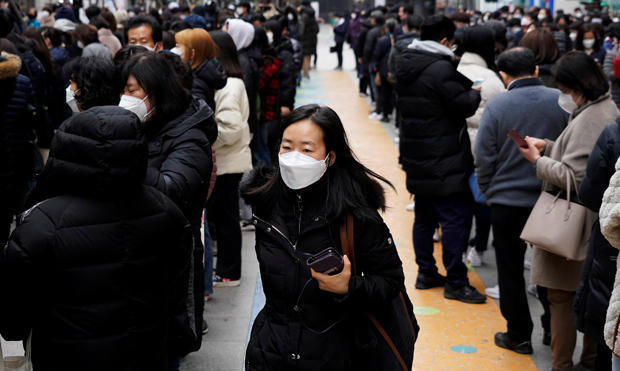
People wearing masks after the coronavirus outbreak wait in a line to buy masks in front of a department store in Seoul
Lines form outside a department store selling masks in Seoul, South Korea, February 28, 2020.  KIM HONG-JI/REUTERS

Mortality rate

Just two days ago, a study from China of nearly 1,100 patients with COVID-19 reported a mortality rate of 1.4 percent; that means that of every thousand people infected, 14 will die. The death rate with flu is about 1 in a thousand.

But some scientists feel the actual rate with coronavirus may be lower, and, in fact, closer to flu, because there are likely many cases we don’t know about, either because they are mild or the patients have no symptoms at all.

Also, people who are older or who have other ailments, such as diabetes or lung disease, appear to be at greater risk for getting a severe case of coronavirus. But for some reason children seem to be relatively spared.

Testing kits

Right now, there’s a shortage of testing kits for the virus. When more testing is available, we’ll get a better idea of how widespread this virus is. We’ll be able to screen communities for both active infection and evidence of past infection.

What are “Community Spread” cases?

In the United States, we’re starting to hear about a small number of cases of COVID-19 from what’s called community spread. That means there is no clear source of infection (such as travel to an affected region, or close contact with a patient). This is not at all surprising, especially since people will likely not have effective immunity to this new type of coronavirus. We should expect the number of these community spread cases to continue to rise.

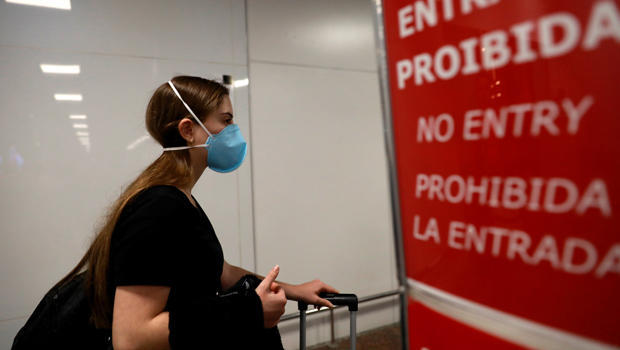
Traveller, wears a mask as a precautionary measure due to the coronavirus, is seen at Salgado Filho airport in Porto Alegre
A traveler wearing a mask as a precautionary measure due to the coronavirus is seen at Salgado Filho Airport in Porto Alegre, Brazil, February 27, 2020.  DIEGO VARA/REUTERS

Is there a vaccine?

Vaccines are being developed at record speed, and several will begin clinical testing in the coming weeks. But it will take time to confirm their safety and their ability to protect against the virus. So, they aren’t expected to become widely available for at least a year. Antiviral drugs and other therapies are also being studied, but for now the main treatment involves supportive care, including breathing tubes in cases of severe lung damage.

How to protect yourself and others

So, where does that leave us? What can you do to protect yourself? Here are a few suggestions:

1.  Get the flu vaccine, and get your family protected. The flu can mimic coronavirus and make you think you have COVID-19 when you don’t.

2.  Stuff your mother could have told you: Wash your hands, including the tips of your fingers, for 20 seconds (I know that’s a long time, but do the best you can); keep your hands away from your face; and cough into the crook of your arm, not into your hand or – worst of all – into the air.

3. Stay home if you’re sick. You’re not doing the boss a favor by coming to work and making everyone else sick.

4. Stay informed. A great source of information is the CDC website, cdc.gov. It’s especially helpful for information and advice about travel.

What about those surgical face masks so many people are wearing?

They may give some partial protection by catching droplets containing virus, but the virus is so tiny it can go right through the mask, or around it. If you’re sick, a mask might help protect others, but the CDC does not recommend it for routine use.

What should we expect in the future?

Since this is a new type of coronavirus, it’s very difficult to predict. Respiratory viruses often like cold, dry air and may possibly start to die down with warmer, moister weather. But we don’t know that for sure, and there could be more waves of infection to come. Bottom line: There’s no way of knowing right now how long coronavirus will remain a problem.

One thing we should definitely expect is another outbreak of another type of virus. COVID-19 is just the latest example of a deadly viral disease jumping from animals to people. SARS, MERS and Ebola are others. We need to study why this has been happening. In Asia, deforestation may have increased contact between humans and bats, which can carry the virus that causes SARS or COVID-19. And we must think globally about how to prevent and respond to future outbreaks.


Rumours on coronavirus severely impacting poultry sale in India, say officials

Chickens

NEW DELHI: Rumours claiming spread of coronavirus through chickens, circulated widely through social media platforms such as, WhatsApp, has severely impacted sale of chickens in the country.

Chicken sales have come odwn by 50 percent, said an official from Agribusiness company Godrej Agrovet Limited.

Godrej Agrovet Managing Director B S Yadav said that sales have fallen to 40 million birds from 75 million in just four weeks.

Farmers have also been hurt as they are unable to recover costs earning Rs 30-Rs 35 per bird.

According to some reports, farmers have already started cutting down on production which might cost price hike in coming months.

It is important to note that bird flu is also a huge concern for many people.

In January this year, as many as 900 fowls were culled after the avian influenza virus was detected in a dead bird in Bangalore. “A chicken was found dead on December 29 at a chicken shop in (suburban) Dasarahalli area and it was confirmed after lab tests that the bird was infected with the H5N1 avian influenza virus,” Bruhat Bengaluru Mahagara Palike (BBMP) Joint Commissioner S. garaju told IANS.

China has reported a deadly H5N1 bird flu outbreak among chickens in Hunan province, which lies on the southern border of Hubei, the epicenter of the rapidly spreading coronavirus that has killed 304 people.

More than 100,000 poultry have been culled in 10 provinces and cities of Vietnam where A/H5N6 and A/H5N1 bird flu broke out, Vietnam News Agency cited the country’s Ministry of Agriculture and Rural Development.

The Vietnamese Ministry of Agriculture and Rural Development said that between early January and February 24, Vietnam had 34 bird flu outbreaks with over 100,000 poultry culled, among which 29 were A/H5N6 and the rest five were A/H5N1 in 10 provinces and cities of Hanoi, Bac Ninh, Thanh Hoa, Nghe An, Tra Vinh, Thai Binh, Binh Duong, Ninh Binh, Hai Phong, and Quang Ninh.

H5N1 virus-infected birds spread the virus through their saliva, mucus and faeces. Although the virus does not usually infect people, it can cause fever, diarrhoea, respiratory illnesses in some affected people.

1 dead from coron avirus in King County, health officials confirm

Microscopic view of Coronavirus, a pathogen that attacks the respiratory tract. (File photo)

SEATTLE — One person has died from the coronavirus in King County, the Washington state Department of Health said Saturday in a media advisory.

No other details were given about the death as of Saturday morning.

Officials plan to hold a press conference at 1 p.m. with more details.

The Department of Health announced Friday evening two presumably new cases of coronavirus, including a school-aged student in Snohomish County.

The department said the results from the individuals’ tests came back “preemptively positive,” but are pending official confirmation from the Centers of Disease Control and Prevention.

A student from Jackson High School in Mill Creek with no travel history is one of the people infected with the COVID-19 virus. The student started feeling ill Monday with body aches, chills and a headache, the department said. Health officials said the student returned to school when he started feeling better, before results Friday revealed the child was sick with coronavirus.

Everett Public Schools said in a tweet Friday evening Jackson High School will be closed March 2 for three days to disinfect the campus.

The other presumed positive coronavirus test was a woman in her 50s from King County. Health officials said the woman traveled to Daegu, South Korea Feb. 7-23 and returned to Seattle to work Monday before she felt symptoms Tuesday. She reported her symptoms to health officials Wednesday and was tested for the virus Thursday.

Her results came back positive Friday.

Health officials said she is improving without any complications. The woman has not been in public since her symptoms started, the department said, and her husband is under home quarantine.

This story is breaking. More information will be updated when it becomes available.

Trump says the coronavirus is the Democrats’ ‘new hoax’

KEY POINTS
  • President Trump says that Democrats are using the virulent coronavirus as a “hoax” to damage him and his administration.
  • “The Democrats are politicizing the coronavirus,” he said from a campaign rally in North Charleston, South Carolina. “This is their new hoax.”
  • The coronavirus, which began in Wuhan, China, has now killed more than 2,800 people worldwide and infected more than 80,000.
  • The total number of cases in the U.S. was 63 as of the latest announcements, with most cases being former passengers on the Diamond Princess cruise ship and evacuees from Wuhan.
GP: Donald Trump rally Toledo Ohio US-POLITICS-TRUMP
US President Donald Trump speaks during a “Keep America Great” campaign rally at Huntington Center in Toledo, Ohio, on January 9, 2020.
Saul Loeb | AFP | Getty Images

President Donald Trump said Friday that Democrats are using the virulent coronavirus as a “hoax” to damage him and his administration.

“The Democrats are politicizing the coronavirus,” he said from a campaign rally in North Charleston, South Carolina.

“One of my people came up to me and said ‘Mr. President they tried to beat you on Russia, Russia, Russia. That didn’t work out too well.’ They couldn’t do it. They tried the impeachment hoax that was on a perfect conversation,” he continued.

VIDEO06:03
What if the US actually does suffer a major outbreak?

“This is their new hoax,” he said, referring to the coronavirus.

The disease, which originated in Wuhan, China, has now killed more than 2,800 people worldwide and infected more than 80,000. The latest reports from the World Health Organization show the pace of new cases in China slowing, but jumping in South Korea, Japan, Italy, and Iran.

In the U.S., the Santa Clara Public Health Department announced a third case of coronavirus in the county Friday evening. The announcement brings the total number of confirmed coronavirus cases in California to 10 and the total number of cases in the U.S. to 63, most of which were passengers on the Diamond Princess cruise ship and evacuees from Wuhan.

close dialog
Warren Buffett Watch Newsletter
Weekly news on all things Warren Buffet delivered straight to your inbox!
SIGN UP
By signing up for newsletters you are agreeing to our Terms of Use and Privacy Policy and opting into receiving updates, announcements, offers and general marketing emails from CNBC.

“We are magnificently organized with the best professionals in the world,” Trump said of the administration’s preparations to help contain the spread of the virus.

“We have to take it very, very seriously … We are preparing for the worst,” he continued. “My administration has taken the most aggressive action in modern history to prevent the spread of this illness in the United States. We are ready. We are ready. Totally ready.”

In other headlines, a Google employee tested positive for the coronavirus, the company said Friday. New Zealand and Nigeria reported overnight their first coronavirus cases.

VIDEO05:56
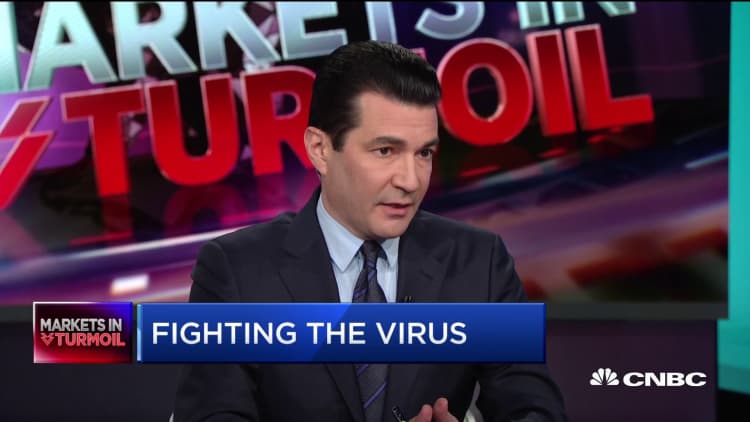
Fighting the coronavirus

“We will do everything in our power to keep the infection and those carrying the infection from entering our country. We have no choice,” Trump said. “Whether it’s the virus we’re talking about or many other public health threats, the Democrat policy of open borders is a direct threat to the health and wellbeing of all Americans.”

Coronavirus risk upgraded to “very high” by World Health Organization as death toll mounts

The World Health Organization on Friday upgraded the global risk from the new coronavirus to “very high” as the virus continued to spread, disrupting plans for everything from major sports tournaments and concerts to planned U.S. military exercises. The global death toll was over 2,800 and the disease made its first worrying appearance in sub-Saharan Africa.

More than 83,000 cases of the COVID-19 disease have now been confirmed in more than 50 countries. While about 36,000 of those people have recovered, fast-growing outbreaks in South Korea, Italy and Iran — along with the first case confirmed in Nigeria — show the battle to contain the virus is still in its early stages. Officials have worried the disease could spread widely in countries with weaker public health systems, specifically in Africa and Latin America.

In the U.S., at least 62 people were being treated for COVID-19 as of Thursday, most of them evacuated from Asia. The origin of one case, a woman in California, has been impossible for doctors to trace, leading the CDC to warn the U.S. has likely seen its first case of “community spread.”

The head of the World Health Organization said that kind of transmission, of unknown origin and possibly from the general population, represented the third of four outbreak stages that every nation must be prepared for: “Every country must be ready for its first case, its first cluster, the first evidence of community transmission, and for dealing with sustained community transmission,” WHO Director-General Tedros Adhanom Ghebreyesus said.

“We are not defenseless,” insisted Tedros, urging “every country and every person” to help ensure cases are detected early and that authorities are able to trace contacts, provide care and prevent widespread community transmissions.

 12M AGO

New coronavirus cases among cruise ship passengers quarantined in U.S.

Two more people who were evacuated from a cruise ship in Japan earlier this month have tested positive for the coronavirus, Dr. Nancy Messonnier with the Centers for Disease Control and Prevention told reporters Friday. The U.S. evacuated more than 300 people from the Diamond Princess nearly two weeks ago, and 44 of them have contracted the COVID-19 disease.

Messonnier, director of the National Center for Immunization and Respiratory Diseases, didn’t provide additional details about the two new cases. All U.S. evacuees from the cruise ship and from the epicenter of the outbreak in Wuhan, China, have been ordered to undergo a 14-day quarantine.

BY ALEX SUNDBY

 12:14 PM

Coronavirus quarantines in U.S. appear inevitable, doctor says

Amid fears of a coronavirus outbreak, one doctor suggested that Americans worried about quarantines should begin preparing. CBS News medical consultant Dr. David Agus predicted the question would be “not if but when and where” quarantines will be occurring during an appearance on “CBS This Morning.”

“The death rate is very low with this virus. Most people will survive this virus,” he said.

Agus advised asking companies what their work from home policy would be, and being aware that children in the household may have to take school from home.

“Get a week of food, dry food in your house. And be ready for this. There’s no reason to panic, we’re all going to do fine,” he said. “But there’s going to be a new way of life, and we have to prepare for that way of life.”

Agus also recommended stocking up on two to three weeks of medicines.

BY ELIZABETH ELKIND

 11:48 AM

Bloodbath on Wall Street as stocks continue to sink

Financial markets opened sharply lower on Friday, putting stocks on track for a seventh straight day of losses as investors brace for the economic fallout from the widening coronavirus outbreak.

The Dow plunged 1,026 points, or 4%, to 24,741 in morning trading, following a nearly 1,200 point drop on Thursday. The broader S&P 500 stock index fell 3.7% in early trading, and the tech-heavy Nasdaq composite declined 3%.

The value of U.S. equities has tumbled more than $3 trillion from their market highs last week amid turbulence caused by the widening outbreak. The downdraft puts stocks on track for their worst week since October of 2008, when markets cratered during the financial crisis.

BY AIMEE PICCHI

 11:03 AM

WHO upgrades global risk of virus spread to “very high”

The United Nations health agency on Friday upgraded the global risk from the new coronavirus to “very high.” The World Health Organization said the continued increase in cases and countries affected was “clearly of concern”.

“We have now increased our assessment of the risk of spread and the risk of impact of COVID-19 to very high at global level,” WHO chief Tedros Adhanom Ghebreyesus told reporters.

World Health Organization (WHO)

@WHO

“The continued increase in the number of cases, & the number of affected countries over the last few days, are clearly of concern”-@DrTedros

World Health Organization (WHO)

@WHO

🚨 “Our epidemiologists have been monitoring these developments continuously, and we have now increased our assessment of the risk of spread and the risk of impact of to very high at a global level”-@DrTedros
585 people are talking about this
BY STEPHEN SMITH

 9:38 AM

Iran warns “tough week ahead” as it grapples with growing virus outbreak

Iran’s success or failure in combating the coronavirus will have an impact far beyond the country’s 80 million people, as the majority of cases in the Mideast now link back to Iran.

“We will have a tough week ahead,” Iranian Health Minister Saeed Namaki warned Friday. “The main peak of the coronavirus will be in next week and coming days.”

Health Ministry spokesman Kianoush Jahanpour again reported a huge spike in cases, saying there were 388 confirmed coronavirus cases in Iran and 34 deaths as of Friday. In brief remarks from Tehran, he cautioned the number of cases would likely further spike as Iran now has 15 laboratories testing samples.

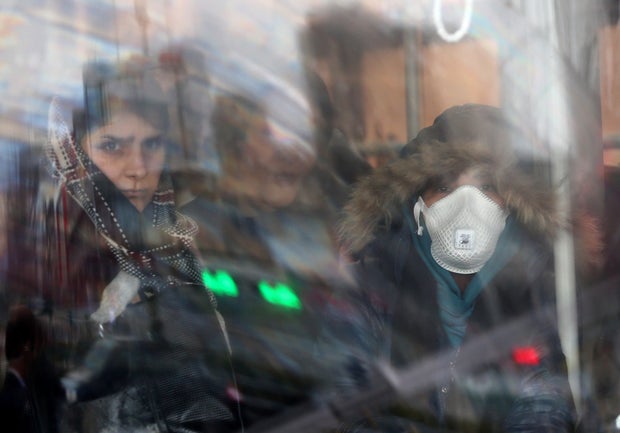
An Iranian woman wears a protective masks to prevent contracting coronavirus, as she sits in the bus in Tehran
An Iranian woman wears a protective masks to prevent contracting coronavirus, as she sits in a bus in Tehran, Iran, February 25, 2020.WANA NEWS AGENCY/REUTERS

In Tehran and other cities, authorities canceled Friday prayer services to limit crowds. Universities are to remain closed another week. Schools will be closed for at least three days, Namaki said. Parliament also will be closed, state television said, citing a lawmaker.

Questions remain over Iran’s true coronavirus case count. Experts, including at the World Health Organization, worry the Islamic Republic may be under-counting, or underreporting the number of cases in the country.

– CBS/AP

BY TUCKER REALS

 9:11 AM

U.K. passenger from virus-stricken cruise ship dies in Japan

A British man who was on board a coronavirus-stricken cruise ship quarantined near Tokyo has died, Japan’s health ministry said on Friday.

The ministry confirmed the man’s nationality and death on Friday without giving any identifying details.

The man was the first foreigner to have died from the illness after spending time aboard the Diamond Princess. Another five Japanese nationals on the vessel have died and more than 700 others tested positive for the disease.

– AFP

 8:53 AM

Mexico reports first cases of virus

Mexico’s assistant health secretary announced Friday that the country now has two confirmed cases of the new coronavirus. Hugo Lopez-Gatell said one of the patients is in Mexico City and the other in the northern state of Sinaloa, and neither is seriously ill.

At least five family contacts of the first patient have been placed in isolation. He said one of the men had contact with someone who had traveled to the northern Italian region where there has been an outbreak.

Brazil on Wednesday confirmed Latin America’s first confirmed case of the new coronavirus in a man who traveled to Italy this month.

– Associated Press

 8:11 AM

Azerbaijan reports first case of coronavirus

Azerbaijan confirmed its first case of the new coronavirus disease on Friday, according to Russia’s Interfax news agency.

“This is a Russian citizen who arrived in Azerbaijan from Iran. He is placed in the infectious unit of the special regime (quarantine),” the country’s emergency coordination office was quoted as saying by Interfax. The patient was reportedly in stable condition.

Health officials were tracing the patients’ contacts. Azerbaijan is the 53rd nation to confirm the presence of the new disease, which is estimated to kill between 1 and 2% of those infected.

BY TUCKER REALS

 7:46 AM

California monitoring 8,400 for virus as they try to track origin of mystery case

California is currently monitoring 8,400 people for the new coronavirus as doctors try to work out how a woman in the state contracted the illness without any connection to a likely origin.

Multiple health care personnel who were exposed to the patient in the days before her diagnosis were also being kept in isolation and even quarantine. Governor Gavin Newsom announced Thursday that federal officials have promised to send more testing kits as part of the government’s emergency initiative to increase coronavirus testing capabilities nationwide.

 7:28 AM

Russia imposes new travel restrictions on Iranians, South Koreans

Russia decided Friday to temporarily bar the entry of all Iranian citizens as the coronavirus outbreak in the Islamic Republic grew quickly and spread from their across the Middle East. Similar restrictions were imposed on South Korean citizens, but the restrictions would not apply to official delegations from either country wishing to visit Russia.

“Citizens of the Member States of the Eurasian Economic Union (Russia, Armenia, Belarus, Kazakhstan and Kyrgyzstan), crews of aircraft, members of official delegations and persons holding a residence permit in Russia, coming from Iran, are not subject to the restrictions,” according to the official Russian government order.

Flights to and from South Korea were to be banned starting March 1, but Russia’s government was not, as of Friday, planning to evacuate nationals from South Korea, home to the largest COVID-19 outbreak outside China. The Russian Embassy in Seoul did not rule out such evacuation flights in the future, however.

– Tucker Reals and Svetlana Berdnikova

 6:55 AM

U.S. schools brace for coronavirus

Schools across the United States are canceling trips abroad, preparing online lessons and even rethinking “perfect attendance” awards as they brace for the possibility that the new coronavirus could begin spreading in their communities.

Districts have been rushing to update emergency plans this week after federal officials warned that the virus, which started in China, is almost certain to begin spreading in the U.S. Many are preparing for possible school closures that could stretch weeks or longer, even as they work to tamp down panic among students, parents and teachers.

President Trump has worked to minimize fears about the virus, but on Wednesday he also recommended that schools to start planning for arrival of the COVID-19 virus “just in case.”

– Associated Press

 6:49 AM

“Slightly unwell” Pope Francis nixes public events amid Italy’s virus outbreak

Pope Francis, still feeling “slightly unwell” after appearing to cough and wipe his nose earlier this week, cancelled all of his public audiences Friday amid a growing and deadly outbreak of the new coronavirus in Italy. The Vatican said Francis would, however, hold all of his scheduled afternoon appointments at his residence.

There has been no suggestion the pope himself might have COVID-19 disease, and the Vatican has not mentioned a fever — considered the most common symptom of it.

“The Holy Father celebrated Mass this morning and at the end, as usual, greeted the participants, but he decided to postpone today’s official audiences,” the Vatican said in a statement. In spite of guidance from global health experts for people, particularly in countries with significant outbreaks of the new virus, to limit direct contact with others, the Vatican confirmed to CBS News that the pope had greeted participants at the Mass as usual, shaking their hands and exchanging a few words with them.”

Italy Pope Ash Wednesday
Pope Francis wipes his nose as he celebrates the Ash Wednesday Mass in the Santa Sabina Basilica, in Rome, February 26, 2020.GREGORIO BORGIA/AP

It was not clear Friday whether Francis had been tested specifically for the new disease. Now 83, he has generally enjoyed good health, but he had part of a lung removed as a young man due to an infection, and the coronavirus is known to be particularly dangerous for older patients and those with underlying health conditions.

– Anna Matranga and Tucker Reals

 6:05 AM

Hong Kong virus patients’ pets to be quarantined after dog tests “weak positive”

Dogs, cats and other mammals owned as pets by confirmed COVID-19 patients in Hong Kong must now undergo a mandatory 14-day quarantine after a pet dog tested “weak positive” for the virus, Hong Kong health officials said Friday.

The semi-autonomous Chinese city’s Agriculture, Fisheries and Conservation Department said in a statement that the dog was not showing any symptoms, and there was no evidence to suggest pets could be infected, or be a source of infection for humans, despite the preliminary test result on the animal.

The dog was being quarantined at a veterinary facility and undergoing further tests to determine whether it had genuinely contracted the new coronavirus, or whether the test result might have come from environmental contamination of its mouth and nose, the agency said.

HONG KONG-CHINA-HEALTH-VIRUS
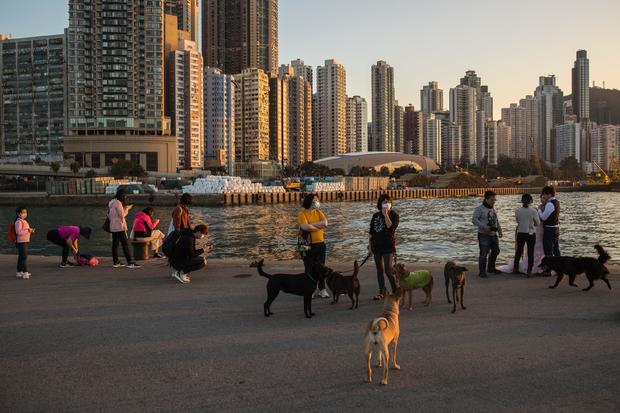
Women wearing masks walk their dogs on a pier in Hong Kong in a January 30, 2020 file photo, amid a coronavirus outbreak centered in mainland China.DALE DE LA REY/AFP/GETTY

If confirmed, the dog would be the first case of a pet catching the new coronavirus.

– Grace Qi

 UPDATED 5:30 AM

Lithuania becomes 50th country to confirm presence of coronavirus

Lithuania confirmed its first case of the novel coronavirus in a woman who returned from Italy, the government said on Friday. The 39-year-old, who returned from Verona on Monday and immediately went on sick leave, has been isolated in hospital in the Baltic state’s northern city of Siauliai and has mild symptoms. Her family members are being monitored.

“We are putting all efforts to establish all people who contacted the infected person so that we can adopt preventive measures and (stop) the spread of the virus,” Deputy Health Minister Algirdas Seselgis said in a statement.

The government also decided to deploy troops at airports to help take down the contact info of people arriving from infected regions. Health experts are also on duty for consultations and, if needed, medical check-ups.

 AFP

 5:22 AM

South Korea coronavirus cases top 2,000

South Korea’s Centers for Disease Control and Prevention reported 256 new coronavirus cases Friday, according to Reuters. That brings the total number of infections there to at least 2,022.

Nearly 200 of the new cases came from Daegu, the southeastern city at the center of South Korea’s coronavirus outbreak, Reuters added, citing the KCDC.

 5:20 AM

Nigeria reports first confirmed coronavirus case

Nigeria confirmed its first coronavirus case Thursday in Lagos State, according to a tweet from the country’s Federal Ministry of Health.

Health officials added that the patient is an Italian citizen who works in Nigeria, and returned from Milan on February 25. The patient, who has no serious symptoms, is being cared for at a hospital in Lagos.

NIGERIA-HEALTH-PREVENTION-VIRUS
A Port Health Service staff member stands next to a thermal scanner as passengers arrive at the Murtala Mohammed International Airport in Lagos, Nigeria, January 27, 2020.PIUS UTOMI EKPEI/AFP/GETTY

Nigeria was the 49th country to report a coronavirus case, but one of the first in Africa.

BY VICTORIA ALBERT

 5:19 AM

China reports 327 new confirmed cases, 44 new deaths

Chinese officials reported 327 new cases of the coronavirus and 44 new deaths Friday morning. That announcement brings the global death toll to more than 2,800, and the total number of cases in China to more than 78,000.

BY VICTORIA ALBERT

 5:18 AM

First case of coronavirus confirmed in the Netherlands

The first case of coronavirus in the Netherlands was detected on Thursday, the national public health institute announced. The patient had travelled to northern Italy, the worst-hit area in Europe.

All those who have been in “close contact” with the person involved have been checked out and the patient has been placed in isolation, the National Institute for Public Health and the Environment said. The public health body advised everyone in the country to be careful to avoid more infections.

– AFP

 5:18 AM

Pelosi says bipartisan agreement close on coronavirus response bill

Congress is working on a bill to fund the federal emergency response to coronavirus, and both Republicans and Democrats said now is not the time to play politics. “We’re coming close to a bipartisan agreement in the Congress as to how we can go forward with a number — that is a good start,” House Speaker Nancy Pelosi said Thursday.

Minority Leader Kevin McCarthy is pointing a finger at the Chinese government. “If China would’ve allowed our doctors and our scientists in earlier, the world would be safer,” he said.

Congress is set to receive a fourth briefing on the coronavirus from the Trump administration on Friday. On Thursday, Vice President Mike Pence met with the coronavirus task force.

“The president has no higher priority than the health and safety of the American people,” he said.

– Skyler Henry

Sorry Mother Nature, you’ll have to come up with something better if you want to stop humans


Image may contain: bird, possible text that says 'Its not Corona, its Karma'


Coronovirus, climate change and anything else Nature has thrown at them, so far, has failed to put the species Homo sapiens in their place. The reasons for her (inadequate) efforts are clear to see for anyone willing to look: humans have taken over the entire planet and driven all her other special children to the brink of extinction. Humans simply don’t care about anything outside themselves and their own species to do what it takes to keep this diverse, once-thriving planet alive…

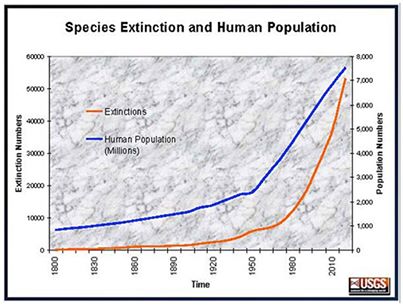
While most species are hovering at the precipice of existence, humans are increasing at the rate of 227,000 births per day! And that’s even with the perils of a warming planet and an emerging pandemic to put them in their place. No Mam, it’ll take more than that if you want to rid the world of and save the Earth from arguably the most successful and clearly the most destructive and in-grateful beings you’ve ever brought into this world. Just look at how they treated all the other species who dared to share their genus in centuries past. Bred them to extinction my eye—humans forced themselves on the others just as surely as Harvey Weinstein or Koby Bryant didn’t simply ‘bred’ with their unwilling victims.


Here’s some light reading on overpopulation, for those who want to take a look at the bigger and bigger picture: http://www.biologicaldiversity.org/programs/population_and_sustainability/

There are more than 7 billion people on the planet, and we’re adding 227,000 more every day. The toll on wildlife is impossible to miss: Species are disappearing 1,000 to 10,000 times faster than the natural rate. It’s clear that these issues need to be addressed before it’s too late…

1451324_650954518277931_1616731734_n

Don’t Fall for These 3 Myths About the New Coronavirus

Share on Pinterest
There’s no evidence that dogs can get the new coronavirus. Getty Images
  • Bonkers theories about the Wuhan coronavirus are floating around social media. Don’t believe everything you read.
  • Myths have been spreading, including the idea that pets can get the new virus.
  • Facebook and other social media sites are taking steps to crack down on misinformation.

https://www.healthline.com/health-news/3-myths-about-the-coronavirus-to-know

Did the coronavirus come from Corona beer? It might sound like a far-fetched idea, but searches for “coronavirus beer” spiked over the last few weeks — an indication of the kinds of questions people have been asking about this health emergency.

In case it needs to be said, an icy cold pale lager isn’t the source of the coronavirus.

“The term ‘corona’ simply means crown,” said Dr. Gregory Poland, a virus expert and head of the Vaccine Research Group at the Mayo Clinic. “When you look at the virus through an electron microscope, it has these projections called S-spikes that look kind of crown-like.”

The beer rumor is just one of dozens of strange theories about the novel coronavirus, 2019-nCoV, that have been swirling around social media. Some of them contain dangerous medical advice that could seriously harm your health.

Here are a few myths about this coronavirus to watch out for, along with the truth behind these claims.

Myth #1: Pets can catch and spread the coronavirus

A company that produces breathing masks for dogs told Fox Business that customers have been buying its products in droves in places where the coronavirus has been confirmed in recent weeks. There are even pictures of dogs wearing the masks in public.

“You’re not going to get a dangerous human coronavirus from Fido,” said Poland. “It’s true that dogs, cats, and most species carry their own kinds of coronavirus, but those are not human pathogens.”

There’s no need to put a mask on your furry friend, he added. The World Health Organization (WHO) reports that there’s no evidence that the coronavirus can infect companion animals, like dogs and catsTrusted Source.

Myth #2: Drinking Miracle Mineral Solution will protect you from the coronavirus

Miracle Mineral Solution has been touted by some social media users as a remedy for everything from autism to HIV — claims that the Food and Drug Administration (FDA) has already dismissedTrusted Source.

Is there any truth behind new rumors that drinking the solution will kill the coronavirus?

“Drinking a strange beverage will not prevent you from acquiring the infection,” said Dr. Andres Romero, infectious disease specialist at Providence Saint John’s Health Center in Santa Monica, Calif.

In fact, Miracle Mineral Solution (and similar products) contains sodium chlorite, which turns into bleach when mixed with citric acid as per the instructions.

“You will end up with esophageal pathology if you drink diluted bleach,” warned Poland. “The way this virus infects you is in your respiratory cells, not your gastrointestinal system.”

Myth #3: Antibiotics can prevent or treat the new coronavirus

Maybe you have some antibiotics hanging around your medicine cabinet. Should you take them if you come down with symptoms of the coronavirus? How about as a preventive measure?

According to the Centers for Disease Control and Prevention (CDC)Trusted Source, antibiotics only treat bacterial infections — not viruses like the coronavirus.

As for prevention, antibiotics won’t help with that either, said Poland.

How to protect yourself

There are a few simple steps you can take to reduce your risk of catching or spreading the coronavirus. Although if you’re in the United States, your chances of contracting the virus remain very small.

“Wash your hands frequently, don’t touch your face, and cover your mouth when you cough or sneeze,” said Romero.

If you know you’ll be in close quarters with people who are coughing and sneezing, like on an airplane, consider wearing an N95 face mask, said Poland.

He added that while the coronavirus is alarming, the top health concern for Americans should be the flu, which the CDC predicts will kill at least 10,000 people and infect up to 26 million in total this seasonTrusted Source.

Fortunately, the same precautionary measures experts recommend taking to avoid the coronavirus can also help ward off the flu.

If you do come down with symptoms — such as a fever, cough, or shortness of breathTrusted Source — that might indicate you have the coronavirus, avoid contact with others and get in touch with your doctor right away.

“The only thing we can do is provide supportive care [to people with the coronavirus],” explained Poland. “More severe cases may need hospitalization, ventilatory support, and fluids or nutrients intravenously, but it depends on how severe or complex the disease is.”

Cracking down on misinformation about the coronavirus

The coronavirus has put people around the world on edge. That has resulted in a surge of social media posts that contain false theories about the virus, which could ultimately worsen the public health crisis.

On Jan. 30, Facebook announced it would remove content with conspiracy theories and unproven information about the coronavirus from its platform.

While that may help curb the spread of some rumors, people who are concerned about the coronavirus still need to be careful about where they’re getting their information, said Romero.

“You should always double-check your sources,” said Romero. “Don’t rely on just one source, and look at information coming from other countries so you can understand how this virus is really behaving.”

The CDC and WHO are trustworthy places to go for information about the coronavirus. Unbiased, fact-checked media sources can also keep you up to date on the latest health news.

And always keep your own risk level for the virus in perspective to avoid panic.

“The average American has an unquantifiably low risk of this novel coronavirus at this point in time,” said Poland.

Coronavirus closures reveal vast scale of China’s secretive wildlife farm industry

Peacocks, porcupines and pangolins among species bred on 20,000 farms closed in wake of virus

Freshly-slaughtered meat from wildlife and farm animals is preferred over meat that has been slaughtered before being shipped.
 Freshly-slaughtered meat from wildlife and farm animals is preferred over meat that has been slaughtered before being shipped. Photograph: Visual China Group/Getty

Nearly 20,000 wildlife farms raising species including peacocks, civet cats, porcupines, ostriches, wild geese and boar have been shut down across China in the wake of the coronavirus, in a move that has exposed the hitherto unknown size of the industry.

Until a few weeks ago wildlife farming was still being promoted by government agencies as an easy way for rural Chinese people to get rich.

But the Covid-19 outbreak, which has now led to 2,666 deaths and over 77,700 known infections, is thought to have originated in wildlife sold at a market in Wuhan in early December, prompting a massive rethink by authorities on how to manage the trade.

China issued a temporary ban on wildlife trade to curb the spread of the virus at the end of January and began a widespread crackdown on breeding facilities in early February.

The country’s top legislative officials are now rushing to amend the country’s wildlife protection law and possibly restructure regulations on the use of wildlife for food and traditional Chinese medicine.

The current version of the law is seen as problematic by wildlife conservation groups because it focuses on utilisation of wildlife rather than its protection.

“The coronavirus epidemic is swiftly pushing China to reevaluate its relationship with wildlife,” Steve Blake, chief representative of WildAid in Beijing, told the Guardian. “There is a high level of risk from this scale of breeding operations both to human health and to the impacts on populations of these animals in the wild.”

The National People’s Congress released new measures on Monday restricting wildlife trade, banning consumption of bushmeat and sales of wildlife for meat consumption at wet markets between now and the time the Wildlife Protection Law can be amended and adopted. Untouched however, are breeding operations for traditional Chinese medicine, fur and leather, lucrative markets known to drive illegal poaching of animals including tigers and pangolins.

For the past few years China’s leadership has pushed the idea that “wildlife domestication” should be a key part of rural development, eco-tourism and poverty alleviation. A 2017 report by the Chinese Academy of Engineering on the development of the wildlife farming industry valued the wildlife-farming industry those operations at 520bn yuan, or £57bn.

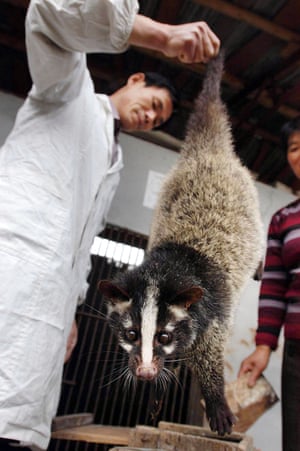
A civet cat is inspected on 10 November 2004 at a farm in Lu’an, China
Pinterest
 Civet cats – thought to be potential carriers of Sars – are among the animals farmed for meat in China. Photograph: China Photos/Getty

Just weeks before the outbreak, China’s State Forestry and Grassland Administration (SFGA) was still actively encouraging citizens to get into farming wildlife such as civet cats – a species pinpointed as a carrier of Sars, a disease similar to Covid-19. The SFGA regulates both farming and trade in terrestrial wildlife, and quotas of wildlife products – such as pangolin scales – allowed to be used by the Chinese medicine industry.

“Why are civet cats still encouraged to [be eaten] after the Sars outbreak in 2003? It’s because the hunters, operators, practitioners need that. How can they achieve that? They urged the government to support them under the pretext of economic development,” Jinfeng Zhou, secretary-general of the China Biodiversity Conservation and Green Development Foundation (CBCGDF), told the Guardian.

On state TV the popular series Secrets of Getting Rich, which has aired since 2001, often touts these kinds of breeding operations – bamboo rats, snakes, toads, porcupines and squirrels have all had starring roles.

But little was known about the scale of the wildlife farm industry before the coronavirus outbreak, with licensing mainly regulated by provincial and local-level forestry bureaus that do not divulge full information about the breeding operations under their watch. A report from state-run Xinhua news agency on 17 February revealed that from 2005–2013 the forestry administration only issued 3,725 breeding and operation licenses at the national level.

But since the outbreak at least 19,000 farms have been shut down around the country, including about 4,600 in Jilin province, a major centre for traditional Chinese medicine. About 3,900 wildlife-farming operations were shuttered in Hunan province, 2,900 in Sichuan, 2,300 in Yunnan, 2,000 in Liaoning, and 1,000 in Shaanxi.

Rats bred in Qinzhou, China, 24 July, 2019
Pinterest
 Breeding of animals such as rats has been seen as central to alleviating poverty in rural areas. Photograph: Zhang Ailin/Alamy

There is little detail available about the animals farmed across China, but local press reports mention civet cats, bamboo rats, ostriches, wild boar, sika deer, foxes, ostriches, blue peacocks, turkeys, quails, guinea fowl, wild geese, mallard ducks, red-billed geese, pigeons, and ring-necked pheasants.

Neither do reports offer much detail about the shutdowns and what is happening to the animals, although Blake said he does not think animals are being culled, due to issues over compensation.

Chen Hong, a peacock farmer in Liuyang, Hunan, said she is concerned about her losses and whether she will get compensation after her operations were suspended on 24 January.

“We now aren’t allowed to sell the animals, transport them, or let anyone near them, and we have to sanitise the facility once every day,” Chen said. “Usually this time of year would see our farm bustling with clients and visitors. We haven’t received notice on what to do yet, and the peacocks are still here, and we probably won’t know what to do with [them] until after the outbreak is contained.

“We’re very worried about the farm’s future,” she added. “The shutdown has resulted in a loss of 400,000–500,000 yuan (£44,000–55,000) in sales, and if they decide to put an outright ban on raising peacocks, we’ll lose even more, at least a million yuan(£110,000).”

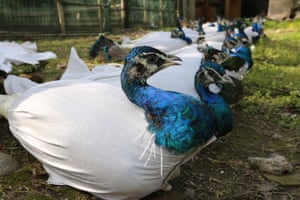
Live peacocks wrapped up in plastic bags, in Xiangyang, China
Pinterest
 Peacock breeders use plastic bags to wrap up the birds in transit to stop their feathers falling off. Photograph: Visual China Group/Getty

On a visit to Shaoguan, Guangdong province, last year, the Guardian and staff from CBCGDF saw a caged facility previously used for attempted breeding of the notoriously hard-to-breed pangolin.

While there were no longer pangolin at the site, several locals near the facility confirmed the species had been raised there, along with monkeys and other wildlife.

Besides being used for Chinese medicine, much of the meat from the wildlife trade is sold through online platforms or to “wet markets” like the one where the Covid-19 outbreak is thought to have started in Wuhan.

“All animals or their body parts for human consumption are supposed to go through food and health checks, but I don’t think the sellers ever bothered,” said Deborah Cao, a professor at Griffith University in Australia and an expert on animal protection in China. “Most of them [have been] sold without such health checks.”

There have been calls for a deep regulatory overhaul to remove the conflicting duties of the forestry administration, and for a shift in government mindset away from promoting the utilisation of wildlife and towards its protection.

Fox cubs in cages at a farm which breeds animals for fur in Zhangjiakou, Hebei province
Pinterest
 Zhangjiakou city has more than 1,500 firms processing furs from animals including foxes and racoons. Photograph: Greg Baker/Getty

“The ‘referee-player’ combination needs to be addressed and is the toughest [challenge],” Li Shuo, a senior campaigner at Greenpeace East Asia told the Guardian. “This goes back to the institutional identity [of the SFGA] which was established to oversee timber production. Protection was an afterthought.”

There are concerns that in trying to prevent outbreaks authorities may go too far in the culling of wild animals that can carry disease.

“Some law professors have suggested ‘ecological killing’ of disease-transmitting wild animals, such as pangolins, hedgehogs, bats, snakes, and some insects,” Zhou said. “We believe lawmakers need to learn [more about] biodiversity before advising on the revisions to the law, or they’ll bring disaster.”

Additional research and reporting assistance provided by Jonathan Zhong.

The coronavirus is hurting stocks, but here’s what could be the real problem

KEY POINTS
  • Bond yields continue to plummet, providing yet another cause for investor concern.
  • The 30-year bond traded at its all-time low, while the 10-year yield is around its Brexit level.
  • Jim Paulsen at Leuthold Group said the dynamic may be causing concern that the U.S. will see negative rates, like those in Europe and Japan.

VIDEO02:25
Stocks drop sharply on coronavirus concerns—Here’s what three experts are watching

The coronavirus is front and center as the cause of Monday’s dramatic stock market sell-off, but investors have more on their minds.

One issue that may not be getting enough credit for the uneasiness on Wall Street is the troubling slide in bond market yields. The 30-year bond is at historic lows, while the benchmark 10-year Treasury is at levels not seen since the Brexit unrest in the summer of 2016.

While that usually is a telltale sign that the market is pricing in low economic growth, the current dynamic is adding some twists that have investors unnerved.

“I don’t think this would be nearly as dramatic this morning were it not for the bond market. This might have more to do with the bond market pushing on an all-time low,” said Jim Paulsen, chief investment strategist at The Leuthold Group. “It opens up a whole new can of worms of whether bond yields can go negative in the United States.”

VIDEO05:18
Market sell-off is an opportunity to buy good value names: Portfolio manager

The bond moves came amid a sharp sell-off in the stock market, with major indexes seeing losses of 2.5% or more in Monday morning trading.

Negative nominal yields are prevalent across much of Europe and in Japan, involving about $11 trillion of global sovereign debt. The entire German yield curve traded in negative territory Monday.

The Fed’s fear

In the U.S., Federal Reserve officials have expressed doubt that government debt ever could see below-zero yields, a phenomenon that happens when bonds are priced so high above par that investors holding to duration receive below the principal amount at maturity.

But as investors keep buying bonds and inflation expectations dim, the prospect of negative yields is rising. While borrowers benefit in that situation, banks suffer, and negative yields have done little to boost overall growth in the countries where they prevail.

Paulsen, though, said the low rates in the U.S. may not be signaling low growth expectations but rather the belief that inflation will stay down for an extended duration.

VIDEO02:27
Stocks could lose 25% as investors price in coronavirus risk, strategist says

“The message in the bond market may not be that much different in stocks,” he said. “Bond yields are down this year, but credit spreads have not widened. That tells me the bond market is saying inflation is down but growth is OK.”

Still, the low yields are playing into fears expressed by Federal Reserve officials worried about inflation.

Central bankers have been talking up inflation, trying to reach a 2% goal so they can keep short-term rates high enough to provide policy room in the case of a downturn. Markets, though, are looking for more rate cuts; futures traders on Monday were pricing in a 56% chance of a reduction by April, according to the CME’s FedWatch tool.

Stocks are ‘vulnerable’

The bond market trends also represent a tricky calculus for stock market investors.

Normally, when stock prices are rising bond prices fall and yields rise as investors demand more of a premium for safe haven fixed income. However, that hasn’t been the case lately, with the correlation between bond prices and stocks at a four-year high, according to Lisa Shalett, chief investment officer at Morgan Stanley Wealth Management. Shalett said this is a case where “this time has been different.”

“As rates have gone down, equity investors have redoubled their focus on how low rates will drive valuations higher, which is risky,” she said in a note for clients. “We see stock prices as vulnerable, so if interest rates were to back up suddenly, the diversification that bonds usually provide could fail.”

For investors, Paulsen said it will be critical to watch spreads, or the difference between bonds of similar maturities but different credit quality. Widening spreads indicate greater market fear.

“If they stay in the range they’ve been in the last year, I think things will hold together,” he said.

VIDEO00:52
Buffett: Currently, investors get more for their money with stocks than bonds

Correction: Major indexes saw losses of 2.5% or more in Monday morning trading. An earlier version misstated the day.