More Cougars Fair Game? Groups Protest WA Hunting Quota

http://www.publicnewsservice.org/2015-09-28/animal-welfare/more-cougars-fair-game-groups-protest-wa-hunting-quota/a48310-1

Public News Service – WA | September 2015

September 28, 2015OLYMPIA, Wash. – Gov. Jay Inslee is being asked to intervene in a dispute between the state Fish and Wildlife Commission and eight groups advocating for Washington’s cougar population. The commission decided this spring to increase the percentage of cougars that can be hunted in some areas. The groups contend that defies the state’s own research about balancing the cougar population to minimize conflict with people and livestock.

Bob McCoy, a Washington volunteer with the Mountain Lion Foundation, explains cougars stake out wide-ranging territories and killing more of them creates conflict among the remaining males, and leaves cougar kittens without mothers. “It’s increasing the hunting to a point that it will end up with a younger population of cats,” McCoy says. “They’re the ones that are usually looking for territories, so they’re the ones we suspect are most likely to be causing problems.” The groups say the state spent about $5 million and more than a decade on research that found a hunting quota of 12 to 16 percent satisfies hunters without doing permanent damage to the cougar population. The Fish and Wildlife Commission has raised the quota to 17 to 21 percent, primarily in northeastern Washington. The groups say the commission got pressure from ranchers concerned about predators.

The ranchers aren’t allowed under Washington law to kill wolves, but Tim Coleman, director of the Kettle Range Conservation Group, says that shouldn’t be a justification for killing more cougars. “The two predators will keep each other in check, and we know that from experience, and we also know that their habitat is based on prey availability,” says Coleman. “Nature achieves a balance between the two species. But what the commission’s plan is, is unnatural.” The groups also contend the hunting quotas were increased without sufficient chance for public comment. The governor has about a month to rule on the appeal. Chris Thomas, Public News Service – WA – See more at: http://www.publicnewsservice.org/2015-09-28/animal-welfare/more-cougars-fair-game-groups-protest-wa-hunting-quota/a48310-1#sthash.xZ508T69.dpuf

Washington: Urge Gov. Inslee to Protect Cougars

https://secure.humanesociety.org/site/Advocacy?cmd=display&page=UserAction&id=7042&autologin=true&s_src=sh_fb

<!–
Replace this text and uncomment out to include a photo caption –>

Last spring, the Washington Fish and Wildlife Commission increased cougar-hunting quotas from 50 to 100 percent in areas where wolves also reside. These hugely-increased quotas will allow trophy hunters to devastate Washington cougars. Even worse, the Commission changed Washington’s wildlife policy without giving the public any notice of this change or an opportunity to comment.

The Humane Society of the United States and our conservation colleagues asked the Commission to reverse their unscientific course of action that will harm cougars, but they ignored us. Now, we need you to join us in our formal appeal to Gov. Jay Inslee to protect Washington’s iconic cougars from over-persecution by trophy hunters.

TAKE ACTION
Please call Gov. Inslee’s office today at 360-902-4111 and ask him to reverse this harmful decision made by the Fish and Wildlife Commission.

After making your call (please do not skip that crucial step!), fill in and submit the form below to send a follow-up message. Legislators receive a lot of email; be sure to edit your message so it stands out.

Share to Facebook Twitter

Endangered Species Act Under Threat/Challenging New Mexico’s War on Wolves, Bears and Cougars

From Project Coyote Newsletter:

Wildlife Killing Contests Featured at Speak for Wolves Conference

In August at the Speak for Wolves Conference in West Yellowstone, Project Coyote Founder and Executive Director Camilla Fox led a team of panelists to discuss the pervasive and cruel practice of “wildlife killing contests” that award prizes to those who kill the most and largest animals including coyotes, bobcats, foxes and even wolves – often on public lands. Conference attendees also got a sneak peek of Project Coyote’s film trailer that will help expose this unconscionable practice and empower citizens to take action to end it.

Watch the Trailer »

Challenging New Mexico’s War on Wolves, Bears and Cougars

In late August, Science Advisor Dave Parsons spoke out on behalf of Project Coyote at a rally and a public hearing as part of a coalition opposing the New Mexico Game Commission’s new rule allowing increases in cougar trapping and bear hunting. The Commission also denied a federal request to release more Mexican Gray Wolves into New Mexico.

Watch the Video »

Federal Endangered Species Act Under Threat

The U.S. Fish and Wildlife Service has proposed draconian changes to the long standing regulations for citizen petitions for adding species to the Endangered Species Act’s list of threatened and endangered species. The proposed changes would make it difficult if not impossible for most citizens and conservation organizations to file petitions. Project Coyote will submit a comment letter endorsed by members of our Science Advisory Committee opposing the proposed changes. The deadline for comments is September 18.

Read the Comment Letter

Meat is murder? Rockers go head to head over animal rights

http://www.theguardian.com/music/2015/jul/10/meat-is-rockers-go-head-to-head-over-animal-rights

In the past 24 hours, Paul McCartney has condemned proposals to bring back fox hunting, and Dr (yes, Dr!) Brian May of Queen has been on Newsnight, delivering a passionate and sweary tirade against the bloodsport.

It seems as though righteous hunt-based indignation is the new rock’n’roll. Which is somewhat counter to the genre’s origins as an excuse for all-purpose carnage and desecration. Musicians, and fans, are forced to take sides. You see, rock has conflicting impulses when it comes to our furry friends. From the start, rock’n’roll was primordial, raw, its prime movers born to be wild. But there are many artists, from Macca to Morrissey, who oppose this stance.

Take, for example, Metallica. Last year there was a 10,000-strong petition to ban the metal act from headlining Glastonbury due to frontman James Hetfield’s support for bear hunting. More surprisingly, Bryan Ferry caused a stir at a music awards ceremony when, amid boos and jeers, the Roxy Music crooner applauded his “brave son” Otis for his pro-hunt antics after he stormed the House of Commons in 2004 (indeed, he is still actively involved in lobbying for fox hunting’s return). I say “more surprisingly” with regard to Ferry, because he belongs to rock’s effete wing. You can’t imagine him tucking into a plate of red meat, let alone bestriding the corpses of albino deer.

Unlike retrograde moustachioed axeman Ted Nugent. You can imagine Nugent biting into the hide of a live albino deer while it’s still roaming the forest. The 70s rocker recently defended Kid Rock, who was criticised for killing a cougar. The Nuge responded to complaints from Peta by posing over the carcass of an African lion and posting a spirited (and grammatically suspect) defence of trophy hunting.

Kid Rock (right) with a cougar carcass.
Kid Rock (right) with a cougar carcass. Photograph: Facebook

And who could forget Jerry Lee Lewis, who I interviewed this week. Sex metaphor or not, rock’s carnivorous urges are made plain in the words of one of his songs, the Meat Man: “Plucked me a chicken in Memphis … Mama, I still got feathers in my teeth”.

Then there’s the aforementioned Smiths frontman at the other end of the scale. Moz is notoriously, militantly vegetarian. In 2010, Mr Meat Is Murder wrote an open letter decrying David Cameron – a Smiths fan, to add insult to injury – as someone who “hunts and shoots and kills stags, apparently for pleasure”, and the royal family, especially the Queen (not guitarist May, the other one), who “annually signs off on the terrorising slaughter of adult Canadian brown bears in order that her guards are supplied with fancy hats”. He also took the opportunity to rechristen Ferry’s son Odious Ferry.

Terrible puns aside, is there an essential contradiction in rock’n’rollers – supposedly synonymous with destruction and teenage rampage – siding with things ethical, moral and good? And can a clean, pure, meat-averse friend of the furry make a credible rock noise? Rock should be savage – but can it embody the feral while denying its primal urges?

Control Cruel Special Interest Groups, Not the Wild Animals.

Letter from Rosemary Lowe to the Albuquerque Journal:
NM Game Dept. Killing Machine
“Mexican Wolves belong on New Mexico lands, but there are special interests within the hunting & livestock industries which have a long history of prejudice about this (& other) wonderful native species. It is time to bring back the Lobo, and give it the priority & protection it needs. These cruel special interest groups need controlling, not the wild291789_400428663360054_2105335387_n animals.
The livestock industry grazes on public lands, at taxpayer expense, denuding & damaging water resources, native grasses, while demanding that the government slaughter native wild animals including wolves, bears, coyotes, mountain lions, & other innocent wildlife: a mindless hatred of so-called “predators.” Many of these species are in decline, despite the “pseudo-science” misinformation from the Game Dept.& other anti-wildlife interests.
Native wild animals are facing further declines as Climate Change worsens, affecting the health of remaining ecosystems, but the Game Dept. continues its antiquated “management” schemes to appease their special interest buddies.
Based upon the anti-wildlife mentality of the Game Dept. it does not belong in the 21st century. It must be abolished, if wildlife is to survive at all.

Biostitution: World’s oldest professions

11077925_428471050656229_1994090549220577260_n

http://foranimals.org/worlds-oldest-professions/

As the June meeting of the New Mexico Game Commission approaches, the so-called wildlife biologists of Game and Fish have modified their proposal on cougar trapping. Facing widespread opposition from editorials and letters in the Santa Fe New Mexican and Albuquerque Journal, culminating in a rally at the state capitol, they dropped their proposal to set cougar traps on public land. The new proposal would allow unrestricted cougar trapping on private land, while increasing other forms of cougar hunting on public land.

The career game managers who fancy themselves “biologists,” continue to serve the interests of ranchers and trappers, while ignoring the need to protect wildlife populations. The department’s original proposal had nothing to do with biology or any other science, as it was dropped in the face of public opposition. The current proposal is hardly better. And they continue to kill cougars while the proposal is up for discussion. Last week they killed a cougar in a Raton neighborhood for allegedly attacking a puppy, and they continue to set out cougar traps in Los Alamos.

Nothing has changed in the year since Scott Bidegain was forced to resign his position as Game Commission Chair after promoting an illegal cougar hunt. As a member of the New Mexico Cattle Growers Association Board of Directors, Bidegain personified the close connection between the livestock industry and the Game Commission.

For that matter, nothing has changed since the Game Commission was first set up in 1921, about the time President Warren Harding appointed NM rancher and former US Senator Albert Fall as Secretary of the Interior. Fall made a career out of opening up public lands to the oil industry in the notorious Teapot Dome Scandal.

With the support of hunting and livestock interests, New Mexico established a Game Commission to maintain populations of huntable wildlife in accord with the principles of the North American Model of Wildlife Conservation. The Rocky Mountain Elk Foundation has aptly summed up the model as follows:

Man has hunted since he walked the Earth. Every early culture relied on hunting for survival. Through hunting, man forged a connection with the land and learned quickly that stewardship of the land went hand-in-hand with maintaining wildlife – and their own way of life.

In the first half of the 20th century, leaders like Theodore Roosevelt and Aldo Leopold shaped a set of ideals that came to be known as the North American Model of Wildlife Conservation. They articulated the philosophy that all wildlife belong to all of us.

It is useless in any case to look to science to set public policy. In a Wildlife Society article titled An Inadequate Construct, Dr. Michael P. Nelson challenges the tenet of the North American Model which “asserts that Science is the Proper Tool for Discharge of Wildlife Policy.” Nelson states: “This is mistaken for equating a desire for policies informed by science with science discharging or determining, by itself, what policies ought to be adopted—a serious, but very common, error in ethical reasoning. Scientific facts about nature cannot, by themselves, determine how we ought to relate to nature or which policies are most appropriate.”

By making a career out of serving their political masters, New Mexico’s professional game managers have combined the world’s two oldest professions. To borrow a term popularized by Sea Shepherd Captain Paul Watson, the game managers are aptly described as biostitutes.

The current drought, exacerbated by anthropogenic climate change, is likely to continue for decades, threatening wildlife habitat. All wildlife is threatened, including species not officially recognized as endangered. It is time for the State of New Mexico to repeal outdated laws which view predators as threats to livestock. It is time to abolish the Game Commission.

Organizations Team Up in the Wake of a Severed Mountain Lion Foot Found in a Trap

Missoula, Mont. (April 14, 2015) – An unlikely alliance between the Bitterroot Houndsmen Association, Footloose Montana, and In Defense of Animals is calling on Montana’s Department of Fish, Wildlife, and Parks (FWP) for more accountability in the management of mountain lions in the Big Sky State after the gruesome and horrific discovery of a severed mountain lions limb in a foothold trap. The alliance is seeking a reduction in the overall quota of mountain lions in the Bitterroot Valley, by counting trap-related injuries and deaths toward the overall hunting quota, and by holding trappers accountable.

The severed mountain lion foot was discovered around March 24 by a resident in the Bitterroot Valley. He reported deep claw marks on a nearby tree, indicating that the estimated four-year-old male lion was desperately trying to seek shelter and escape the source of pain – a foothold trap set for wolves. Thanks to recreational and commercial trapping, this mountain lion is likely dead now, either succumbing to starvation, attack by other carnivores, shock, or a painful infection of the severed limb.

The illegally set trap had no identification tag attached to it, and was placed outside the official wolf trapping season, which ended on February 28.
According to Anja Heister with In Defense of Animals, “At least 15 mountain lions have been reported to FWP as caught in traps specifically set for wolves in addition to other species over the course of two trapping seasons, between 2012 and 2014. Yet, these tragic trapping-related injuries and mortalities do not count toward the overall quota for mountain lions. They are also considered merely “incidental” and go unpunished.”

The FWP Commission meets this Wednesday, April 15 to deliberate the quota for the 2015 mountain lion hunting season and we strongly encourage them to adopt the inclusion of incidental mortalities. “There is no question that the mortality of mountain lions exceeds what the Commission allows,” said Cal Ruark, former president of the Bitterroot Houndsmen Association. “It is time to reconcile the two numbers and reduce the quota, as well as acknowledging so-called “non-target incidents” as what they are – deaths of animals, which, at a very minimum, need to be recognized and counted.”

The Commission must be empowered and do the right thing as a result of this recent disturbing discovery. The maiming and likely subsequent death of this mountain lion is not an isolated incident and the time has come to make bold changes and offer dynamic solutions in order to prevent further animals from suffering the same horrific fate.

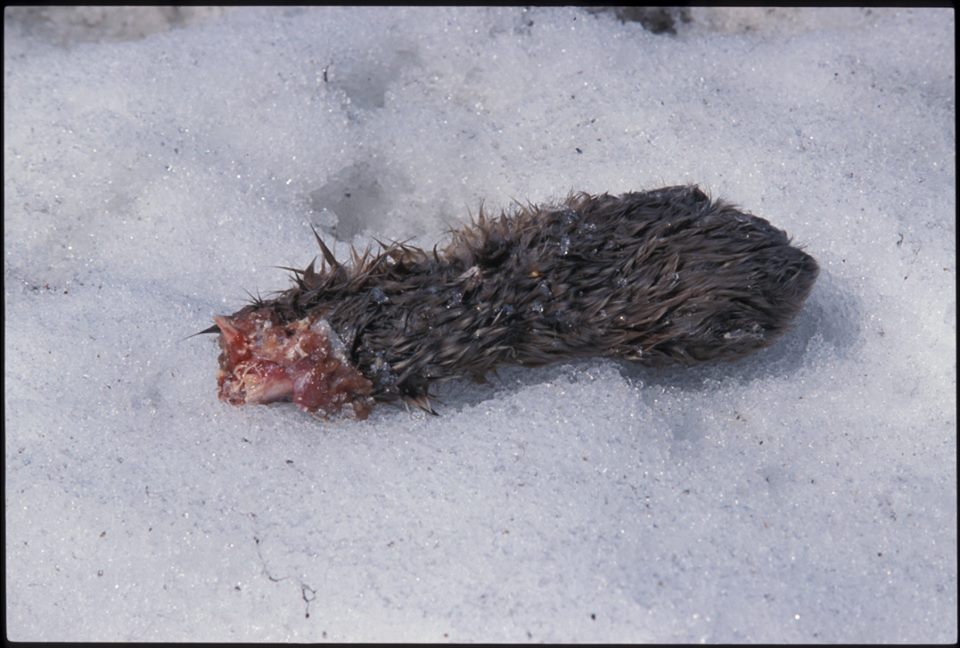
Chewed-off Canadian lynx foot--another trapping victim.  Photo by Jim Robertson

Chewed-off Canadian lynx foot–another trapping victim. Photo by Jim Robertson

Cougar Chews Off Foot to Escape Wolf Trap

Photo Jim Robertson

Photo Jim Robertson

I’ve had more than my share of heart-wrenching experiences with the gruesome evils of trapping. On a walk near our home in Eastern Washington, my dog stepped into a leg-hold trap that clamped down onto his front paw, prying his toes apart. He cried out in terror and frantically tried to shake it off, biting at the trap, at his paw, and at me as I fought to open the mindless steel jaws. The trap continued to cut deeper into his tender flesh and my efforts caused him even more pain. Finally, after many harrowing minutes, I was able to loosen the torture device enough for him to pull his foot free.  

Another dog I freed was caught in two leg-hold traps. One was latched onto her front leg, while the second gripped her hind leg, forcing her to remain standing for untold agonizing hours. Judging by how fatigued and dehydrated she was, she had been stuck there for several days. The sinister traps caused so much damage that a vet had to amputate one of her injured legs.  

With no other hope of escape and feeling vulnerable to anyone that comes along, many trapped animals resort to amputating their own leg. Trappers callously label this grim act of despair “wring-off”. Truly, freedom is precious to any animal desperate enough to take this extreme step. But if they don’t bleed to death or die from infection, they spend the rest of their lives crippled and quite possibly unable to keep up with a demanding life in the wild. Unlike the fictional character “Little Big Man,” who was distraught to the brink of suicide when he found that an animal had chewed off its leg to escape one of his traps, most trappers who find a wring-off are indifferent to the suffering they caused as they begrudgingly pitch the chewed-off limb and reset their trap.   

While I was camped near Bowron Lakes Provincial Park in B.C., Canada, in late March, my dog found just such a discarded limb–the front leg of a trapped lynx. In what has to be one of the more deceitful abuses of trust ever, free roaming animals– safely protected within the arbitrary boundaries of parks– lose all such protection and are deemed “fair game” for trapping as soon as they step across an invisible dividing line. Trappers consider the lands adjoining parks the most “productive” and will pay tens of thousands of dollars for permits to run trap-lines in those areas. I’ve had the displeasure of seeing three-legged coyotes near the North Cascades National Park, and within the Grand Tetons National Park.  

Sidestepping the indisputable cruelty issue, pro-trapping factions try to perpetuate the myth that trapping is sustainable. But time and again entire populations of “furbearers” are completely trapped out of an area, often within a single season. The winter after I found wolf tracks in Alaska’s Katmai National Park, all seven members of a pack who had found a niche in and around that preserve were killed–permissibly “harvested”– by trappers. Though wolves are extinct or endangered in most of the U.S., 1,500 are legally trapped in Alaska each year.

The preceding was excerpt from the book Exposing the Big Game,

http://www.earth-books.net/books/exposing-the-big-game

No animal should EVER go through the evil of trapping. And yet, in Montana, the Missoulian just reported that a mountain lion just got caught in a wolf trap: Mountain lion paw in wolf trap upsets Darby ex-houndsman

http://missoulian.com/news/local/mountain-lion-paw-in-wolf-trap-upsets-darby-ex-houndsman/article_1e1f05bc-0ccf-5603-8882-45982cd49763.html

April 11, 2015 8:00 am  •  by

HAMILTON – A mountain lion paw found torn off in a wolf trap has a former houndsman from Darby asking for change in the way the state manages the predator.

A little over two weeks ago, a friend of Cal Ruark’s dropped off the trap with the severed lion paw in it.

Ruark – a former president of the Bitterroot Houndsmen Association and now a mountain lion advocate – said his friend was antler hunting in the Reimel Creek area, east of the Sula Ranger District, when he made the gruesome find.

The man told Ruark there were deep claw marks in a tree near the location of the trap.

“He told me the trees were all tore to hell,” Ruark said. “The drag on the trap was hung up on a tree and there were claw marks on the trees where the lion had stood up on its back legs and tried to climb.”

Ruark is sure the mountain lion didn’t survive.

“It might have been able to get along for a little while, but it’s dead now,” he said. “It can’t hunt on three legs.”

Every year, mountain lions die after being caught in traps set for wolves or other furbearers.

Under the current rules, those dead lions are not considered under the quota system that Fish, Wildlife and Parks uses to manage mountain lion numbers.

Ruark believes that needs to change. He will take that request before the Fish and Wildlife Commission at its regular meeting this month.

***

KC York of Hamilton is leading an effort place a referendum on the ballot that could ban all trapping on public lands.

York said between October 2013 and February 2015, 32 mountain lions were captured in traps set for furbearers other than wolves. State records showed that 21 died, six suffered some type of damage to their paws, but were released and another five were set free unharmed.

“So 84 percent of those mountain lions captured in non-wolf sets were either dead or injured,” York said. “Only one of those trappings was determined to be illegal.”

In the two years that wolf trapping has been legal in Montana, York said state FWP records show that 16 mountain lions were caught in traps set for wolves. Five of those lions died.

York said 96 percent of the trappings were considered legal.

“You can’t legally trap a mountain lion in Montana,” she said. “These trappings are considered incidental. It goes with the territory of trapping in this state.”

Anja Heister, co-founder of Footloose Montana, said no one knows for sure how often a mountain lion loses a paw or toes to a trap.

“It was a horrific sight,” Heister said about the lion’s paw in the trap. “This was an incident that was actually discovered. No one knows for sure how often it happens. Trappers have a term for it when an animal loses a foot or a toe. They call it twist off or ring off.”

***

The Ravalli Republic contacted Montana Trapping Association president Toby Walrath of Corvallis for a comment on this story. Walrath said he would either provide a written comment or a phone contact for someone else in the organization Thursday night. By Friday’s end, the newspaper had received neither.

Montana Fish, Wildlife and Parks regional wildlife manager Mike Thompson said all he could say about the issue at this point is that it was being investigated.

Ruark said he wants people to know about this.

“There are a lot of people who should be angry about this lion caught in a wolf trap,” Ruark said. “Trappers should be mad because it makes them look bad. Outfitters should be thoroughly angry because they get $5,000 a pop from their clients to kill one and now there’s one less to hunt. The fact that it’s not counted toward the quota should make local houndsmen angry, too. Everyone involved should be upset.

“But unless there’s a consequence, it’s only going to get worse,” he said. “It’s not right to ignore it when a mountain lion dies.”

If someone put all the mountain lions that died after being trapped in a pile and took a photograph, Ruark said people would pay attention.

“From my perspective, these incidental kills should be counted,” he said.

Cougar in Bend did not need to be killed

http://www.bendbulletin.com/opinion/3056576-151/letter-cougar-in-bend-did-not-need-to#

Letter: Cougar in Bend did not need to be killed

<!– returnByline =

–><!– byline4 =

–>By George Wuerthner / <!– –>

Published Apr 11, 2015 at 12:02AM

<!– zz22

The recent killing of yet another cougar in Bend represents a tragic and unnecessary death of an animal that was just minding its own business and posed no threat to anyone.

The hype surrounding the killing lacks ecological perspective. Recent research in predator ecology suggests that killing animals like cougars (or wolves, coyotes and bears) only increases conflicts with humans. Though this information is widely known in ecological circles, apparently the Oregon Department of Fish and Wildlife hasn’t read any new science in decades because they continue to foster the myth that indiscriminate killing of predators will reduce conflicts. Here’s what ODFW doesn’t tell you:

First, all predators are social animals. When their social relationships are disrupted by hunting and trapping, it creates “social chaos.” For instance, in a study done in Washington state found that as the cougar population declined due to hunting, the number of reported conflicts went up. There is a good reason for this observation.

In cougar society a dominant male controls the territory overlapping two to five female cougars. The dominant male kills young teenage male cougars that enter its territory. But when hunters kill the dominant male, they unleash a free-for-all of young “teenagers” vying for that territory. You may suddenly have two to four young males occupying the same geographical area as formerly occupied by one older male.

Furthermore, teenage cougars, like human male teenagers, are more reckless, bolder and less skillful hunters. This means they are far more likely to prey on livestock and/or enter the backyard of a house to capture a dog or cat.

A similar disruption of social bonds occurs when a female cougar is killed. Unlike deer or elk that produce young in the spring, female cougars produce a litter of kittens at any time of year. That means a female killed even in the winter months may have dependent kittens. Since cougars are not fully able to hunt on their own until they are 15 to 16 months old, orphaned kittens are also more likely to kill easy prey like livestock or pets.

Cougars also will fill any void if the habitat is good. Killing a cougar on Pilot Butte means that another cougar is likely already moving into the same territory. The new cougar may be less experienced than the cougar killed. In any event, killing does not solve the issue.

The threat posed by cougars is infinitely small. Since 1890 there has only been 24 documented fatal cougar attacks in all of North America! The so-called threat posed by the cougar on Pilot Butte was almost nonexistent. By contrast, every year in the US there are 30 to 40 fatal attacks by domestic dogs, and millions of nonlethal attacks. In other words, the dogs that are regularly taken up the Pilot Butte trails pose a greater threat to people than any cougar, yet most of us do not give the dogs a thought.

A more humane approach to the cougar presence would have been to close the park temporarily and allow the cougar to scamper off. Or alternatively to sedate, capture and move it out of town.

But the real problem is the ongoing cougar killing championed by the ODFW that ignores good science and feeds public fears. Indiscriminate killing by hunters and trappers is the ultimate source of predator conflicts in Oregon. In California, where cougar hunting has been banned for decades, there are far fewer conflicts with livestock and humans, despite the fact that California has more cattle, far more people and the highest cougar populations in the West.

— George Wuerthner is a former biologist with the Bureau of Land Management. He lives in Bend.

–><!–

The recent killing of yet another cougar in Bend represents a tragic and unnecessary death of an animal that was just minding its own business and posed no threat to anyone.

The hype surrounding the killing lacks ecological perspective. Recent research in predator ecology suggests that killing animals like cougars (or wolves, coyotes and bears) only increases conflicts with humans. Though this information is widely known in ecological circles, apparently the Oregon Department of Fish and Wildlife hasn’t read any new science in decades because they continue to foster the myth that indiscriminate killing of predators will reduce conflicts. Here’s what ODFW doesn’t tell you:

First, all predators are social animals. When their social relationships are disrupted by hunting and trapping, it creates “social chaos.” For instance, in a study done in Washington state found that as the cougar population declined due to hunting, the number of reported conflicts went up. There is a good reason for this observation.

In cougar society a dominant male controls the territory overlapping two to five female cougars. The dominant male kills young teenage male cougars that enter its territory. But when hunters kill the dominant male, they unleash a free-for-all of young “teenagers” vying for that territory. You may suddenly have two to four young males occupying the same geographical area as formerly occupied by one older male.

Furthermore, teenage cougars, like human male teenagers, are more reckless, bolder and less skillful hunters. This means they are far more likely to prey on livestock and/or enter the backyard of a house to capture a dog or cat.

A similar disruption of social bonds occurs when a female cougar is killed. Unlike deer or elk that produce young in the spring, female cougars produce a litter of kittens at any time of year. That means a female killed even in the winter months may have dependent kittens. Since cougars are not fully able to hunt on their own until they are 15 to 16 months old, orphaned kittens are also more likely to kill easy prey like livestock or pets.

Cougars also will fill any void if the habitat is good. Killing a cougar on Pilot Butte means that another cougar is likely already moving into the same territory. The new cougar may be less experienced than the cougar killed. In any event, killing does not solve the issue.

The threat posed by cougars is infinitely small. Since 1890 there has only been 24 documented fatal cougar attacks in all of North America! The so-called threat posed by the cougar on Pilot Butte was almost nonexistent. By contrast, every year in the US there are 30 to 40 fatal attacks by domestic dogs, and millions of nonlethal attacks. In other words, the dogs that are regularly taken up the Pilot Butte trails pose a greater threat to people than any cougar, yet most of us do not give the dogs a thought.

A more humane approach to the cougar presence would have been to close the park temporarily and allow the cougar to scamper off. Or alternatively to sedate, capture and move it out of town.

But the real problem is the ongoing cougar killing championed by the ODFW that ignores good science and feeds public fears. Indiscriminate killing by hunters and trappers is the ultimate source of predator conflicts in Oregon. In California, where cougar hunting has been banned for decades, there are far fewer conflicts with livestock and humans, despite the fact that California has more cattle, far more people and the highest cougar populations in the West.

— George Wuerthner is a former biologist with the Bureau of Land Management. He lives in Bend.

–>

The recent killing of yet another cougar in Bend represents a tragic and unnecessary death of an animal that was just minding its own business and posed no threat to anyone.

The hype surrounding the killing lacks ecological perspective. Recent research in predator ecology suggests that killing animals like cougars (or wolves, coyotes and bears) only increases conflicts with humans. Though this information is widely known in ecological circles, apparently the Oregon Department of Fish and Wildlife hasn’t read any new science in decades because they continue to foster the myth that indiscriminate killing of predators will reduce conflicts. Here’s what ODFW doesn’t tell you:

First, all predators are social animals. When their social relationships are disrupted by hunting and trapping, it creates “social chaos.” For instance, in a study done in Washington state found that as the cougar population declined due to hunting, the number of reported conflicts went up. There is a good reason for this observation.

In cougar society a dominant male controls the territory overlapping two to five female cougars. The dominant male kills young teenage male cougars that enter its territory. But when hunters kill the dominant male, they unleash a free-for-all of young “teenagers” vying for that territory. You may suddenly have two to four young males occupying the same geographical area as formerly occupied by one older male.

Furthermore, teenage cougars, like human male teenagers, are more reckless, bolder and less skillful hunters. This means they are far more likely to prey on livestock and/or enter the backyard of a house to capture a dog or cat.

A similar disruption of social bonds occurs when a female cougar is killed. Unlike deer or elk that produce young in the spring, female cougars produce a litter of kittens at any time of year. That means a female killed even in the winter months may have dependent kittens. Since cougars are not fully able to hunt on their own until they are 15 to 16 months old, orphaned kittens are also more likely to kill easy prey like livestock or pets.

Cougars also will fill any void if the habitat is good. Killing a cougar on Pilot Butte means that another cougar is likely already moving into the same territory. The new cougar may be less experienced than the cougar killed. In any event, killing does not solve the issue.

The threat posed by cougars is infinitely small. Since 1890 there has only been 24 documented fatal cougar attacks in all of North America! The so-called threat posed by the cougar on Pilot Butte was almost nonexistent. By contrast, every year in the US there are 30 to 40 fatal attacks by domestic dogs, and millions of nonlethal attacks. In other words, the dogs that are regularly taken up the Pilot Butte trails pose a greater threat to people than any cougar, yet most of us do not give the dogs a thought.

A more humane approach to the cougar presence would have been to close the park temporarily and allow the cougar to scamper off. Or alternatively to sedate, capture and move it out of town.

But the real problem is the ongoing cougar killing championed by the ODFW that ignores good science and feeds public fears. Indiscriminate killing by hunters and trappers is the ultimate source of predator conflicts in Oregon. In California, where cougar hunting has been banned for decades, there are far fewer conflicts with livestock and humans, despite the fact that California has more cattle, far more people and the highest cougar populations in the West.

— George Wuerthner is a former biologist with the Bureau of Land Management. He lives in Bend.

Wildlife group condemns Bend police cougar kill

File photo

Cougar spotted in early 2010 in Squaw Creek Canyon area near Sisters

ByFrom KTVZ.COM news sources

Published On: Mar 30 2015 10:18:55 AM CDT


EUGENE, Ore. – A Eugene-based wildlife advocacy group on Monday condemned the actions of Bend police for shooting and killing a cougar near the summit of Pilot Butte over the weekend.

Here’s the rest of the statement from Predator Defense, in full. (Also note this incident is the topic of our new KTVZ.COM Poll, which you can find halfway down the right side of our home page.):

Predator Defense condemns the actions of the Bend police for killing a cougar at Pilot Butte State Park this weekend.

There was no incident between the animal and the public.   The cougar did not approach or threaten anyone.  There were other options available but instead the police chose to shoot the cougar.

“Once again, authorities grossly overreacted – there was no need to kill this animal,” said Brooks Fahy, executive director of Predator Defense.  “What was needed was a calm, humane and logical approach, not a bullet.”

“Closing the trails at the park was the smart thing to do, and that is all that was needed.  Given space and time the cougar would have moved on, the incident would have been simply and safely resolved.  Hazing the cougar is another option to negatively associate town visits.”

“The people of Bend and all Oregonians should be outraged at this extreme reaction.  This animal posed no threat, even according to state’s bear and cougar public safety law.  He did not have to die.” Fahy said.

Cougars are elusive and secretive, and they rarely pose any threat to people.  There has never been a documented cougar attack on a person in Oregon’s history.

More cougars are killed today than ever before in Oregon’s history – compare the current approximate annual mortality of 500 to the 200 average in the early ‘90s.

“Oregon’s cougar management is solely focused on increasing cougar mortality and they’ve succeeded, but that may not be the best strategy for safety and preventing conflict”, said George Wuerthner, Bend resident and nationally known ecologist and wildlife biologist.

“Ironically, hammering the cougar population may well be causing increased conflicts between people and cougars,” he said.

“That’s exactly the results reported in published peer reviewed field research from Washington State Carnivore Laboratory: areas with heavily hunted cougar populations typically have more young male cats, the age group most often found close to people and livestock, creating conflicts.”

Oregon’s policy of always responding to cougar and bear presence by killing the animal and justifying that by saying it is the only safe outcome is simply untrue.

This practice is not followed in other states such as California and Washington where animals are relocated or given space and time to move off on their own.

The argument that relocating the animal creates disruption with animals in the area is groundless because the ‘relocation’ is simply returning the animal to the perimeter of town where he came from.

The group also has a video “press kit” online at https://www.youtube.com/watch?v=TsJCeROdEqI&sns=em

Source: http://m.ktvz.com/news/Wildlife-group-condemns-Bend-police-cougar-kill/32086606