Charles Darwin Would See Right Through Mike Pence

http://www.thedailybeast.com/articles/2017/02/18/charles-darwin-would-see-right-through-mike-pence.html

The vice president dodges the question of whether he believes in evolution but he has his own version of intelligent design as he rides the wave of a new kind of ignorance.

by CLIVE IRVING

02.17.17

One of the first priorities of demagoguery is the fostering of ignorance. Lies require collaboration from those who are being lied to, and for a propaganda machine to be effective it needs a special kind of public ignorance.

This can happen in societies that otherwise seem to be sophisticated and highly advanced scientifically. Invariably the case of Germany in the early 1930s is cited as proof. That, however, carries the danger of false analogies and misses what is immediate and novel. Propaganda and the nurturing of ignorance have moved on apace since the Nazis and Joseph Goebbels.

The Trump White House is demonstrating in its own innovative ways just how far habitual lying can clear the way for the triumph of ideology over truth. This can’t be simplified by charging Trump himself with being a pathological liar. His administration has invented a new and distinctly American propaganda machine that is built on lies. But not enough attention has been given to its willing partner in this exercise: a carefully nurtured kind of public ignorance that it can exploit.

One reason this isn’t being discussed is that politicians are rightly wary of insulting any constituency by calling it ignorant. Hillary Clinton’s “basket of deplorables” was a disastrously patronizing misjudgment. But in the context of the Age of Trump, ignorance is not actually a pejorative term, it’s a description of a set of beliefs in which knowledge and truth are less persuasive than prejudice and fear.

This process began long before Trump decided to run. Years of talk radio diatribes fueled by Obama-phobia and Fox News harangues prepared the soil and then Breitbart, the alt-right, and fake news softened it further. Trump understood this better than anyone and harvested its fruits.

In fact, the bedrock beneath this process was much older and a uniquely American phenomenon, a widespread consensual ignorance. There is a strain of dogmatic religious activism here that does not exist to anything like the same extent in other advanced democracies. It uses religion—or misuses religion—to resist or rollback changes in social behavior and to suggest who the alien “other” should be.

This consensual ignorance involves accepting a set of ordained beliefs while at the same time rejecting others that are not ordained, no matter whether they are based on facts. What begins as a theological system easily slips into a secular one: the habit of denying what is an inconvenient truth or of simplifying a complex exterior world into stereotypical threats.

This is not the ignorance of unlearned knowledge—it’s more potent than that. It’s a tutored ignorance, and in its most basic form it’s anti-scientific.

And that is why the present and future influence of Vice President Mike Pence needs to get close attention.

“The Bible tells us that God created man in His own image, male and female; He created them,” Pence has said. “And I believe that God created the known universe, the Earth, and everything in it including man, and I also believe that some day, scientists will come to see that only the theory of intelligent design provides an even remotely rational explanation for the known universe.”

Pence also argued that evolution should not be taught in schools without a parallel commentary of Biblical explanations as being equally valid.

With Pence in the White House it could be that control of the most scientifically advanced country in the world has now fallen into the hands of people to whom science is an enemy. The EPA’s website has already been purged of any references to Obama’s climate action plan and carbon pollution as a cause of climate change. Universities across the nation have teams working to safeguard masses of government data that contradicts White House dogma before it, too, is wiped.

That’s why this is a good moment to consult the man who, more than any other, had to struggle with how to argue that the advance of science was not a threat to the Christian faith, Charles Darwin.

The idea that when Darwin published On The Origin of Species in 1859 he provoked outrage from Biblical literalists is nonsense. Victorian Britain was a scientific powerhouse, science teaching was a key part of the drive toward universal public education and one branch of science in particular, paleontology, was assembling through the evidence of fossils a picture of the Earth’s evolution that already made the idea that our planet was only 6,000 years old risible. In the introduction to his book Darwin reviewed the work of 34 scientists who had paved the way for his breakthrough theory of natural selection.

Nonetheless the popular press took the opportunity to stir up a circulation-building debate between two sides cast as the sacred and profane. Cartoons appeared in which Darwin was half-man and half-ape, even though his revelatory theory, the tree of life, was more about the evolution of butterflies than about homo sapiens.

Darwin was very careful to accept why Victorians might have problems grasping the scale of what he had revealed.

“The belief that species were immutable productions was almost unavoidable as long as the history of the world was thought to be of short duration… the chief cause of our natural willingness to admit that one species has given birth to clear and distinct species is that we are always slow in admitting great changes of which we do not see the steps.”

After the first edition of On The Origin of Species had been subjected to review by his peers and publicly debated, Darwin incorporated some of the responses in later editions. One clergyman, Charles Kingsley, spoke for many who had no problem reconciling Darwin’s science with the work of the Creator. Darwin wrote of Kingsley: “he has gradually learnt to see that it is just as noble a conception of the Diety to believe that He created a few original forms capable of self-development into other and needful forms, as to believe He required a fresh act of creation to supply the voids caused by the action of His laws.”

Darwin himself was an agnostic. Whether he actually believed that the hidden architecture of life that he had described for the first time had divine origin doesn’t really matter. He was not a dogmatic scientist. He was open-minded and prepared to concede to those like Kingsley if they were not dogmatists and were comfortable that their own beliefs were not under threat—and recognized that science was an engine of social progress.

Darwin recalled that Sir Isaac Newton had been attacked for “the greatest discovery ever made by man, namely, the law of the attraction of gravity” by people who saw it as subversive of religion. Darwin himself was the beneficiary of a long-established British tolerance for unsettling scientific ideas. Science had not yet locked itself into the confines of a profession with its own hierarchy. From Newton onwards there were as many gentlemen amateurs probing for scientific truths as there were vocational scientists at work in England—and some of them were clergymen.

All of which makes it strange that anyone today would think it reasonable to persist, as Pence does, with the idea of “intelligent design.” Indeed, Darwin saw that idea coming and dealt with it dismissively: “It is so easy to hide our ignorance under such expressions as the ‘plan of creation’ ‘unity of design’ etc and to think that we give an explanation when we only re-state a fact.”

All along, Pence has been very careful not to make a specific denial of evolution. His classic evasion came in a 2009 interview with Chris Matthews on MSNBC:

Matthews: “Do you believe in evolution, sir?”

Pence: “I embrace the view that God created the heavens and the earth and the seas and all that’s in them.”

Matthews: “But do you believe in evolution as the way he did it?”

Pence: “The means, Chris, that He used to do that, I can’t say.”

That’s what intellectual cowardice sounds like as a politician dances within the boundaries of his base, and it becomes much more consequential now that that man is at the heart of White House policy making—Pence is the essential conduit between Trump and the agenda of Congressional Republicans. He is also the quiet agent of the religious right, supported by fellow believer Attorney General Jeff Sessions.

This movement may sail under religious colors but its agenda reflects the way that religion has become a euphemism for atavism. Buried within the code of “Make America Great Again” there was always the promise of restoring a repressive social order.

When so-called fundamentalists and evangelists embrace a crotch-grabbing sexual predator they display a shameless level of cant but it doesn’t seem to bother them. Is this really theology or a return to a kind of muscular Christianity based on a 1930s model of a white man’s world? Whatever the truth, the primary targets are clear: Planned Parenthood, abortion clinics, voting rights, gun regulations, any extension of LGBT rights, and even roll back gay marriage.

There is no Darwin-like tolerance of opposing beliefs here. No open debate with enlightened values. The Christian right movement in this country has reached the level of an intrusive crusade, sensing that its moment has come, and is bent on policing the personal choices and lives of others, particularly women.

Trump’s White House may be in chaos but that chaos hides the long game that Pence has the patience and guile to pursue. The continuing barrage of propaganda and outrageous lies still finds a ready audience among his constituency, where the mainstream media has no credibility. Consensual ignorance provides its own extensive comfort zone where yesterday has a lot more to recommend it than tomorrow.

Whether or not Pence really believes the earth is only 6,000 years old is immaterial. His version of intelligent design is really not about Old Testament divine creation but a new social order—or, rather, an old social order that was supposed to be long extinct.

The New Christmas Story & Commandents

DSC_0002
by Marc Bedner & Rosemary Lowe
In the beginning the Great Felidæ said, “Let the Earth bring forth every kind of living creature. And we will make cats in our image, after our likeness. They shall rule.”
And it was foretold: the wolf & grizzly shall once again roam free, and the leopard shall lie down with the kid; and a little kitten shall lead them.
And it came to pass, after much begetting, that many cats had gone astray, and there was no room in the shelter. Then an angel of the Felidæ came to Mary and Joseph and said, “we need foster parents.” And she delivered to them a kitten wrapped in swaddling clothes.
And lo, three wise men came to bring gifts to the baby kitten and to worship her. The kitten had many titles: wonderful, counselor, princess of peace, Queen of Judæa. The wise men wondered what to call her.
The one who brought gold said, we should call her name Manuela, the Goddess is with us. The one who brought incense said we should call her Gloria, her Excellency. The third asked the kitten what she thought.
The kitten responded “Mrrrrh.” And there was a twinkling in her eye. And she said: Humans are corruptible.
For verily, I say unto thee, I am thy cat, a jealous cat, there shall be no others before me; humans will be humbled, and few.
Remaining Humans will now obey the New Commandments:
  1. Humans shall no longer multiply and subdue the Earth.
  2. Thou shalt not wear, eat, experiment upon, hunt, trap, harass, capture, poison, torture, or otherwise, in any way, mistreat or disrespect non-human creation.
3. Non-humans: those who crawl, burrow, fly, walk, swim, run, climb–from the great mammals to the smallest insects and bacteria–will be free from human bondage, never-ending human development and destruction, at last.
  1. All the waters of the Earth shall once again flow free. Dams, and other human diversions, machines, will be destroyed.
  2. Non-humans will take precedence over the land. Humans will be relegated to certain, small areas of the Earth, which will not disturb non-humans.
  3. Wild Nature will be held Sacred and Secure, as the Apostle, Walkin’ Jim Stoltz proclaimed in his songs to the Earth.
  4. Humans shall not make War anymore. Those lands scarred and desecrated by Endless Human War shall be restored.
  5. All weapons shall no longer exist: Guns, Arrows, Snares, Bombs, Cages, Spears, & any other weapon used to injure, kill, or capture, will be no more.
  6. Humanist Ideology & Religion shall now be replaced by Wisdom, Awe, Respect, Adoration, and Humbleness to The Great Filedae, who will Reign Over All.
  7. The Earth will breath a sigh of relief from the terror, greed, avarice, ignorance, prejudice, and mindlessness of The Rogue Species, once called Humans.
These New Commandments Shall Now Declare a New Earth, birthed from the ashes of the sick, dying Earth humans have made. We now sing praises to the Great Felidae. “unto her, all the Power, the Glory, and Majesty—-FOREVER, AMEN.
 

Maybe If We Had Worshipped the Creation

Created by Jim Robertson

Sunday school children are taught that it is blasphemy to worship the creation instead of the Creator. Rather than encouraging people to praise the miraculous (in the non-secular sense of the word) living planet and all its incredible diversity of sentient life forms, western religions threaten eternal damnation if you don’t swear blind allegiance to some patriarchal creation of the human imagination, created in the image of man.

Hence, Homo sapiens has run roughshod over the Earth, destroying the very same natural systems that allowed us to come into being and trampling the rights of all other beings in our obsessed quest for domination over a world we’ve proven unworthy of even having dominion over.

Now, with so much of the land divided and conquered, the seas losing oxygen and turning acidic and the air encrusted in carbon, only fire remains untamed. Maybe if we had worshipped the creation and treated the Mother Earth with the respect she deserves, we would be feeling her love—instead of her punishing wrath.

Why is it so hard for otherwise hyper-intelligent humans to feel a sense of awe for a living world that came into form through the process of evolution, rather than one created by a mythical man-like creature? We see it happen every year, when life springs forth from a formerly frozen “wasteland.” Do people really believe some grey-bearded Santa Claus look-alike (minus the jolly disposition) waves a magic wand at every plant that shoots up to the heavens and every animal who, in their own way, rejoices?

Religion is supposed to teach humility, but after constantly being reminded that they are the Creator’s crowning achievement, humankind is anything but humble.

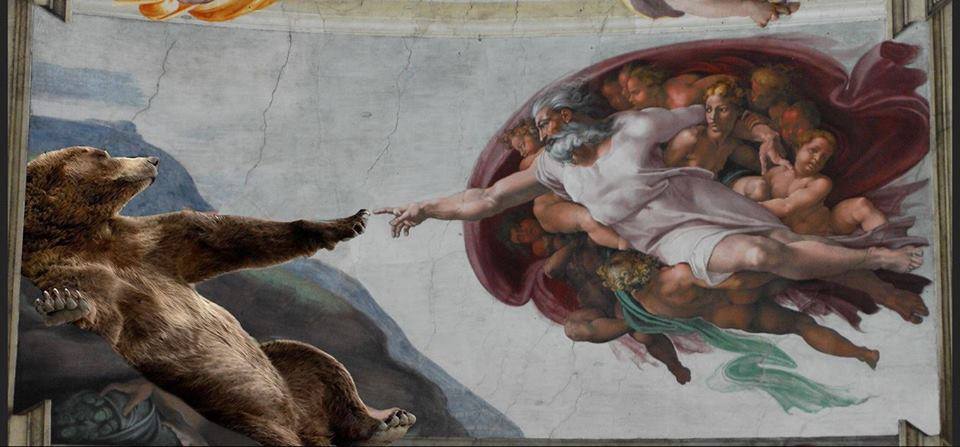
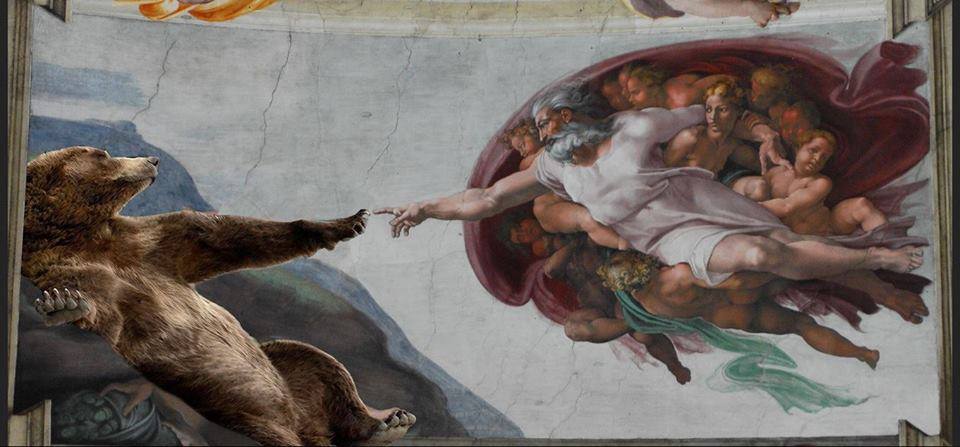
Holy bear

Bible vs. Science: Big Online ‘Origins of the Universe’ Debate Tomorrow Night

http://www.scienceworldreport.com/articles/12617/20140203/bible-vs-science-big-online-origins-universe-debate-tomorrow-night.html

1450979_10151664623727554_134905332_n

Thomas Carannante

Feb 03, 2014 10:38

Bill Nye “the science guy”, a childhood idol of many, will be participating in a creationism vs. evolution debate tomorrow night. His opponent is Ken Ham, who is one of the founders of a creationist ministry, Answers in Genesis. (Photo : Ed Schipul)

Bill Nye “the science guy”, a childhood idol of many, will be participating in a creationism vs. evolution debate tomorrow night. His opponent is Ken Ham, who is one of the founders of a creationist ministry, Answers in Genesis, located in the Creation Museum in Petersburg, Kentucky.

It’s estimated that over one million people will be watching the debate online, which will focus on the origins of humankind. Bill Nye has been a celebrity for years, dating back to his television show “Bill Nye the Science Guy” that aired from 1993-1998. His opponent, Ken Ham, is the president of the Answers in Genesis ministry in the Creation Museum that supports young Earth creationism and the literal interpretation of the Book of Genesis.

Since its inception seven years ago, “Answers in Genesis” has been subjected to widespread criticism for challenging the evolution of man with the interpretation of biblical story. But that hasn’t prevented hundreds of thousands of people from visiting the museum. They are also planning to build a Noah’s Ark theme park 40 miles from the museum, which is expected to cost $60 million.

Ham has expressed his nerves leading up to the debate, citing “a little fear, trepidation, and stress,” in this USA Today article. Perhaps there is more fuel on the side of Bill Nye, since scientists such as himself are insulted by the views of creationism believers such as Ham.

“I say to the grown-ups, if you want to deny evolution and live in your world, in your world that’s completely inconsistent with everything we observe in the universe, that’s fine,” Nye said in the same USA Today Article. “But don’t make your kids do it, because we need them.”

The debate at the Creation Museum is expected to draw 900 audience members and nearly 1 million online viewers; 800,000 were already registered for the debate’s online stream two weeks ago. And although each speaker isn’t likely to change anyone’s mind, it should certainly be an entertaining debate.

15 ways atheists can stand up for rationality

http://www.salon.com/2014/01/11/15_ways_atheists_can_stand_up_for_rationality/

Atheists need to assert ourselves! Here’s how
by Jeffrey Tayler

I’ve often wondered how the term “New Atheism” gained such currency. It is a misnomer. There is nothing new about nonbelief. All of us, without exception, are born knowing nothing of God or gods, and acquire notions of religion solely through interaction with others – or, most often, indoctrination by others, an indoctrination usually commencing well before we can reason. Our primal state is, thus, one of nonbelief. The New Atheists (most prominently Richard Dawkins, Sam Harris and the late Christopher Hitchens) have, in essence, done nothing more than try to bring us back to our senses, to return us to a pure and innate mental clarity. Yet their efforts have generated all manner of controversy. Far outnumbered, and facing a popular mindset according kneejerk respect to men (yes, mostly they are men) of faith — reverends, priests, pastors, rabbis, imams and so on – the New Atheists have by necessity explained their views with zeal, which has often irked the religious, who are accustomed to unconditional deference. Even some nonbelievers who, again thanks to custom, consider religion too touchy a subject to discuss openly have been riled.

We atheists, however, need to buck up, assert our rationality, and change the way we deal with the religious, with everyday affronts delivered (at times unknowingly) by believers, with the casual presumptions that historically have tended to favor the faithful and grant them unmerited respect. A lot is at stake. Religion is a serious matter, reaching far beyond the pale of individual conscience and sometimes translating into violence, sexism, sexual harassment and assault, and sundry legal attempts to restrict a woman’s right to abortion or outlaw it altogether, to say nothing of terrorism and war. Now is the time to act. Polls – see here and here – show the zeitgeist in the United States is turning increasingly godless, that there are more atheists now than ever before (surely thanks in part to the efforts of the New Atheists). Most of Europe entered the post-faith era decades ago. Americans need to catch up.

I propose here a credo for atheists – concrete responses to faith-based affronts, to religious presumption, to what Hitchens called “clerical bullying.” (I’ll deal below with the three monotheistic, Abrahamic religions, but what I say applies to other confessions as well.) The faithful are entitled to their beliefs, of course, but have no inherent right to air them without expecting criticism. Religion should be subject to commonsense appraisal and rational review, as openly discussible as, say, politics, art and the weather. The First Amendment, we should recall, forbids Congress both from establishing laws designating a state religion and from abridging freedom of speech. There is no reason why we should shy away from speaking freely about religion, no reason why it should be thought impolite to debate it, especially when, as so often happens, religious folk bring it up on their own and try to impose it on others.

Herewith, some common religious pronouncements and how atheists can respond to them.

1. “Let’s say grace!”

No, let’s not. When you’re seated at the family dinner table and a relative suggests clasping hands, lowering heads and thanking the Lord, say “No thanks. I’m an atheist. So I’ll opt out.” Nonbelievers have every right to object when being asked to take part in superstitious rituals; in fact, if children are present, they are morally obliged to do so. Courteously refusing to pray will set an example of rational behavior for the young, and contribute to furthering the atheist zeitgeist.

2. “Religion is a personal matter. It’s not polite to bring it up.”

No, religion is fundamentally collective, and since time immemorial has served societies in fostering union, but also in inciting xenophobia and violence (especially against “unchaste” women and “impure” minorities), often on a mass scale. Nonbelievers need to further advance the cause of rationality by discussing it openly; doing so, as uncomfortable as it may be at times, will help puncture the aura of sanctity surrounding faith and expose it for what it is.

3. “You’re an atheist? I feel sorry for you.”

No, please rejoice for me. I fear no hell, just as I expect no heaven. Nabokov summed up a nonbeliever’s view of the cosmos, and our place in it, thus: “The cradle rocks above an abyss, and common sense tells us that our existence is but a brief crack of light between two eternities of darkness.” The 19th-century Scottish historian Thomas Carlyle put it slightly differently: “One life. A little gleam of Time between two Eternities.” Though I have many memories to cherish, I value the present, my time on earth, those around me now. I miss those who have departed, and recognize, painful as it is, that I will never be reunited with them. There is the here and now – no more. But certainly no less. Being an adult means, as Orwell put it, having the “power of facing unpleasant facts.” True adulthood begins with doing just that, with renouncing comforting fables. There is something liberating in recognizing ourselves as mammals with some fourscore years (if we’re lucky) to make the most of on this earth.

There is also something intrinsically courageous about being an atheist. Atheists confront death without mythology or sugarcoating. That takes courage.

4. “If you’re an atheist, life has no purpose.”

A purpose derived from a false premise – that a deity has ordained submission to his will – cannot merit respect. The pursuit of Enlightenment-era goals — solving our world’s problems through rational discourse, rather than though religion and tradition – provide ample grounds for a purposive existence. It is not for nothing that the Enlightenment, when atheism truly began to take hold, was also known as the Age of Reason.

5. “If you abolish religion, nothing will stop people from killing, raping and looting.”

No, killing, raping and looting have been common practices in religious societies, and often carried out with clerical sanction. The catalogue of notorious barbarities – wars and massacres, acts of terrorism, the Inquisition, the Crusades, the chopping off of thieves’ hands, the slicing off of clitorises and labia majora, the use of gang rape as punishment, and manifold other savageries committed in the name of one faith or another — attests to religion’s longstanding propensity to induce barbarity, or at the very least to give it free rein. The Bible and the Quran have served to justify these atrocities and more, with women and gay people suffering disproportionately. There is a reason the Middle Ages in Europe were long referred to as the Dark Ages; the millennium of theocratic rule that ended only with the Renaissance (that is, with Europe’s turn away from God toward humankind) was a violent time.

Morality arises out of our innate desire for safety, stability and order, without which no society can function; basic moral precepts (that murder and theft are wrong, for example) antedated religion. Those who abstain from crime solely because they fear divine wrath, and not because they recognize the difference between right and wrong, are not to be lauded, much less trusted. Just which practices are moral at a given time must be a matter of rational debate. The “master-slave” ethos – obligatory obeisance to a deity — pervading the revealed religions is inimical to such debate. We need to chart our moral course as equals, or there can be no justice.

6. “Nothing can equal the majesty of God and His creation.”

No need to inject God into this. “Creation” is majestic enough on its own, as anyone who has gazed into the Grand Canyon or the night sky already knows. While paddling a pirogue down the Congo, at night I often marveled to the point of ecstasy at the brilliance of the stars, the salience of the planets against the Milky Way – just one of the many quasi-transcendental experiences I have had as an atheist globetrotter. The world is a thing of wonder that requires no faith, but only alert senses, to appreciate.

7. “It is irrational to believe that the world came about without a creator.”

No, it is irrational to infer an invisible omnipotent being from what we see around us. The burden of proof lies on the one making supernatural claims, as the New Atheists have tirelessly pointed out. But here again the New Atheists are really doing nothing novel. Almost 200 years ago, the British poet Shelley, in his essay “The Necessity of Atheism,” noted that “God is an hypothesis, and, as such, stands in need of proof: the onus probandi rests on the theist.” This was clear to him even before we had mapped the human genome, discovered the Higgs boson, or even invented the telegraph.

8. “I will pray for you to see the light.”

Not necessary, but do as you like. Abraham Lincoln noted that, “What is to be, will be, and no prayers of ours can arrest the decree.”

9. “If you’re wrong about God, you go to hell. It’s safer to believe.”

Pascal’s wager survives even among people who have never heard the name of the 17th-century French philosopher and mathematician. Leaving aside whether blatant self-interest would please a god demanding to be loved unconditionally, which god will save us from hell? The god of Catholicism? Judaism? Islam? Doctrines of all three Abrahamic faiths prohibit entry into paradise for adherents of rival confessions.

10. “Religion is of great comfort to me, especially in times of loss. Too bad it isn’t for you.”

George Bernard Shaw noted that, “The fact that a believer is happier than a skeptic is no more to the point than the fact that a drunken man is happier than a sober one. The happiness of credulity is a cheap and dangerous quality.” A few shots of vodka will do for me, and are more to the point.

After the passing away of his son, Lincoln, in dire need of solace, nevertheless remarked that, “My earlier views of the unsoundness of the Christian scheme of salvation and the human origin of the scriptures, have become clearer and stronger with advancing years and I see no reason for thinking I shall ever change them.”

10. “As you age and face death, you will come to need religion.”

Perhaps in dotage anything is possible, but this turn of events is unlikely. Aging and the prospect of dying by no means enhance the attractiveness of fictitious comforts to come in paradise, or the veracity of malicious myths about hellfire and damnation. Fear and feeblemindedness cannot be credibly pressed into service to support fantastic claims about the cosmos and our ultimate destiny.

Whether one would even consider turning to religion in advanced years has much to do with upbringing, which makes all the more important standing up to the presumptions of the religious in front of children. One would regard the Biblical events – a spontaneously igniting bush, a sea’s parting, human parthenogenesis, a resurrected prophet and so on – that supposedly heralded God’s intervention in our affairs as the stuff of fairy tales were it not for the credibility we unwittingly lend them by keeping quiet out of mistaken notions of propriety.

11. “You have no right to criticize my religious beliefs.”

Wrong. Such a declaration aims to suppress free speech and dialogue about a matter influential in almost every aspect of our societies. No one has a right to make unsubstantiated assertions, or vouch for the truthfulness of unsubstantiated assertions on the basis of “sacred” texts, without expecting objections from thinking folk.

12. “Jesus was merciful.”

If he existed – and there is still, after centuries of searching, no proof that he did – he was at times a heartless prophet of doom for the sinners he supposedly loved, commanding those who failed to give comfort to the poor to “depart . . . ye cursed, into everlasting fire, prepared for the devil and his angels.”

13. ”You can’t prove there’s no God.”

Correct, at least epistemologically speaking. Reasonable atheists, “New” and old, would not argue with this. Richard Dawkins, for example, has told audiences that he is nominally an agnostic, since proving that something does not exist is impossible. He claims to be an atheist “only” in the sense that he is an “a-leprechaunist, an a-fairiest, and an a-pink-unicornist.” The evidence for God, fairies and leprechauns, he remarked, “is equally poor.”

14. “My religion is true for me.”

A soppy, solipsistic and juvenile declaration and cop-out bordering on the delusional and contradicting Christianity and Islam, neither of which recognize the other, and both of which espouse universalist pretensions. You will not find a scientist who will say, “quantum physics is true for me.” No one would have trusted Jonas Salk if he had promoted the efficacy of his polio vaccine as “true for him.”

15. “Don’t take everything in the Bible literally.”

Not taking the Bible (or other texts based on “revealed truths”) literally leaves it up to the reader to cherry-pick elements for belief. There exists no guide for such cherry-picking, and zero religious sanction for it.

I’m not counseling incivility — but arm yourself with the courage of your rationalist convictions and go forth. We will all be better off for it.

Jeffrey Tayler
Jeffrey Tayler is a contributing editor at The Atlantic.

1450979_10151664623727554_134905332_n

No Offense, but You’re an Animal

I’m an animal, and if you don’t know it yet, it’s my duty to inform you, you’re one too. All we animals, the big-brained two-leggers, the furry four-leggers, the feathered and the finned are carbon-based creatures made up of the same ingredients. Every last earthling oozed from the same original, primordial stew pot.

The sooner we accept that we’re all animals, the sooner we can make peace with the others of this planet, rather than doing battle with them. Ultimately, it’s to our detriment that we deny evolution any longer. Humankind can’t live in a vacuum. We need all our best science to figure how to live with the many diverse, interconnected life forms that help keep this planet hospitable.

Bill Nye, ‘the Science Guy,’ recently stated in his Big Think video (which has been viewed nearly 3 million times so far), “I say to the grownups, if you want to deny evolution and live in your world, that’s completely inconsistent with the world we observe, that’s fine. But don’t make your kids do it.”

In rebuttal, the spokesman of a group of ‘Young Earth Creationists’ proclaimed, “No, we are not just evolved animals as Nye believes; we are all made in the image of God.” Young Earth Creationists, or ‘Biblical Creationists,’ as they prefer to be called, believe in a literal interpretation of the creation story in the book of Genesis. They say the weeklong account of God creating the earth and everything in it represents six 24-hour periods (plus one day of rest) and date the age of the earth between 6,000 and 10,000 years.

Nye’s view falls in line with the vast majority of scientists, who date the age of the earth and the universe as 4.5 billion years old. “The idea of deep time of billions of years explains so much of the world around us. If you try to ignore that, your worldview becomes crazy, untenable, itself inconsistent,” Nye said in his video. Still, polling from Gallup has shown for the past 30 years that between 40-46% of the survey respondents believe in creationism: that God created humans and the world within the past 10,000 years.

Granted, there are folks whose belief in creationism compels them to treat “God’s creatures” with compassion. As far as I’m concerned, people can believe whatever they want—as long as it promotes kindness to all sentient beings. Although I’ve never read it, I understand the Bible contains a number of passages that promote benevolence toward the vulnerable. (Before someone says something like, ‘If you haven’t read the bible, you’re ignorant of what you speak,’ I will argue that a person could end up even more ignorant and confused after reading it.)

Unfortunately, for the majority of believers, creationism leads to a sense of human superiority and the self-serving notion that we humans are in a higher realm of importance than the rest of the animal kingdom. This convenient fallacy has been used to justify the exploitation of animals over the centuries and continues to have widespread acceptance to this day.

For example, my uncle, a hunter who boasted of killing the largest black bear in the state, held to a word for word interpretation of the Bible which led to his belief that, “Humans were meant to subdue the earth” drawing his own conclusion, “There’s no earthly purpose for cougars.” His reasoning, shared by so many people the country over, was: to make life better for humans we should rid the world of species like cougars, bears, coyotes and wolves. Another example of this kind of stinkin’ thinkin,’ Republican vice Presidential candidate Paul Ryan is a “pro-life” creationist bow-hunter who doesn’t see the hypocrisy in committing the sin of killing non-human animals for sport.

The idea of creationism was abandoned by the mainstream scientific community shortly after Darwin introduced The Origin of Species in 1859. By 1880 nearly every major university in America was teaching evolution. Bill Nye summed up his video with, “In another couple centuries I’m sure that worldview [creationism] won’t even exist. There’s no evidence for it.” While it seems only logical that any continued cultural advancement would include the acceptance of sciences such as geology, paleontology and evolution, I’m not so sure I share his optimism for the further progress of humanity.

Text and Wildlife Photography ©Jim Robertson

Into the Tar Pit of Religion

Well, I touched the hot button of overpopulation without getting burned, so perhaps it’s safe to wade into the tar pit of religion without going too far under…

First, a fair warning to lurking hunter trolls:  your comments and feeble rationalizations (and we’ve heard them all before) will not be posted on this blog, but will get filed as such and may be used against you anytime they help prove a point. For example, here’s part of a comment I received from a hunter the other day: “I love animals, but fully understand that all living things have their place in God’s plan and on His Earth. He gave us domain over animals. Read Genisis [sic] and wake up!”

How convenient. But do people really still believe that kind of crap?

Sadly, the answer appears to be yes.

A staggering 46% of Americans believe that god created humans in their present form within the past 10,000 years, according to a USA Today/Gallup survey conducted this year from May 10th to the 13th. Not only has that number not changed much in the past 30 years since Gallup first asked the question on Creationism vs Evolution, it’s actually gone up 2%, from 44% in 1982 to 46% in 2012!

Gallup’s Frank Newport told CNN, “Despite the many changes that have taken place in American society and culture over the past 30 years, including new discoveries in biological and social science, there has been virtually no sustained change in Americans’ views of the origins of the human species since 1982. All in all, there’s no evidence in this trend of a substantial movement toward a secular viewpoint on human origins.”

So, why do I care what people believe? Why won’t I just let them have their fun?

Because such dogma can directly affect how non-humans are treated.

The literal belief that humans have some kind of god-given authority over every other species of animal bestows undeserved power into unreliable hands. Creationist claptrap that favors one species over another perpetuates speciesist doctrine devised to demean and control our fellow animals in the same way that notions of racial superiority were used against our fellow humans.

The second most common view of those polled—held by 32% of respondents–is that humans evolved with god’s guidance. Again, a very convenient conviction that can be used to put humans on top.

Newport goes on to say, “It would be hard to dispute that most scientists who study humans agree that the species evolved over millions of years, and that relatively few scientists believe that humans began in their current form only 10,000 years ago without the benefit of evolution. Thus, almost half of Americans hold a belief [in creationism] that is at odds with the preponderance of scientific literature.”

To their benefit, and to the detriment of every other living thing on the planet, I might add.

Wildlife Photography Copyright Jim Robertson