Exposing the Big Game

Forget Hunters' Feeble Rationalizations and Trust Your Gut Feelings: Making Sport of Killing Is Not Healthy Human Behavior

Exposing the Big Game

Fur Takes Major Hit Due to Coronavirus

https://mailchi.mp/f94662811f94/fur-takes-major-hit-due-to-coronavirus?e=34cb4196ed

This is a very difficult and challenging time for us all. However, there is a silver lining to the coronavirus.

In mid March, just days before the event was to begin, we watched, waited and advocated for the cancellation of the largest wild fur auction house in North America.

Almost 500,000 animal pelts were in the preliminary listing for sale in Toronto at the Fur Harvester’s (FHA) March Auction.

On March 16, as TFMPL was preparing to step it up, Canada, in response to the coronavirus, responsibly closed their doors, basically to non-Canadians, thereby forcing the cancellation of the Fur Harvester’s March auction.

The major purchasers of fur from our North American wildlife are China and Russia. Italy, Greece and South Korea are also players in the fur trade.

Why is this so significant?

In the fall of 2019, the 350 year old North American Fur Auctions, (NAFA), with proclaimed roots to Hudson Bay company, recognized as the world’s largest producer of wild fur, announced they would no longer be selling wild fur. In a letter to trappers, NAFA said their banking partners had decided to get out of the fur business. The names of the banks were not provided. According to the NAFA CEO, “the entire industry is still facing an unprecedented market correction and no sector is immune, including the auction houses.”

The Fur Harvesters Auction claimed NAFA’s problems were due to ranch fur and had nothing to do with wild fur. The cost for the production of ranch fur is now about double the profit. The prediction has been that the demand for wild fur would rise as the ranch fur market decreases.

Fur Harvesters Auction were provided a virtual monopoly on wild fur sales. Trappers were assured they would still get their money at the Fur Harvester’s auction. Some in the fur business actually give monetary advances to trappers.

The Fur Harvester’s Auction states, “The global fur market is always set at the International Auctions.” They go on to advise trappers “as the last remaining wild fur action house on the continent, the market will not be set until the conclusion of our March 24th /26th 2020 auction”. Now that has been cancelled. Postponed.

An expert told us all these pelts over time go stale reducing their value.

Even though, we know trappers say the number one reason they trap is for fun, trapping is market driven. With the downturn of fur prices over the years, trapping has been on the downward trend, too! Some have said it simply isn’t worth it anymore or is becoming more cost prohibitive. Heaven forbid!


*Photo courtesty: Montana Trappers Association Western States Fur Auction Feb 2018

You may be surprised to know in the past, Montana Fish Wildlife and Parks responded to low bobcat prices by increasing their quota in order to spark interest again in trappers. Nowadays, bobcat remain one of the more lucrative animals to trap and kill. However, the days of recent highs of $1,000 for a bobcat pelt are a rarity. The bobcat average price has also dropped $200 to an average of $300 – $400.

Unfortunately, the popularity of coyote trim jackets, courtesy of Canada Goose, has caused coyote pelts to rise as well as the persecution on them.  This is further exacerbated in places like Montana where coyotes can be trapped, killed by any means, year round, unlimited, no annual $28 trapping license required of residents and no reporting either. This, of course, is reinforced by the powerful livestock industry. There were 50,000 coyotes at this cancelled auction, alone. These were just the ones accepted for sale. Many, probably most, are not. Western coyotes are the favorites.

Locally, fur auctions in Montana and fundraisers to embrace trapping have been cancelled due to the coronavirus restrictions.
Saga Furs, owned by the Finnish fur industry, just attempted to sell millions of ranch fur online and failed miserably. They are now claiming they are laying all staff off for three months.

We can’t help but wonder with this pandemic and the upcoming widespread financial ramifications to come, who all will wind up buying furs? Add to that the growing fashion designers, stores, cities, and states ending the selling of fur.

Prior to this year’s auction, the trapper owned Fur Harvesters, wrote, “FHA remains deeply committed to the trappers of North America on all levels.” Well we know that but now we’ll see.

Not long ago the fur industry was still estimated at $15 billion! 50,000 animals on average are reported trapped annually in Montana but along with the price of fur, that number has been declining. Millions of wildlife nationally have been estimated trapped in the US each year.

There are so many wrongs with trapping that there are multiple ways to attack it! We need your help though!

In this scary and uncertain time, we can’t wait to see the bottom fall out of this blood money! It can’t happen soon enough, friends!

*Images are the courtesy of Fur Harvesters Auction unless otherwise noted.

Thank you Friends of Trap Free Montana Public Lands and Trap Free Montana

DENR official sees revival of native monkey farming amid global virus contagion

The Department of Environment and Natural Resources (DENR) is looking into the population boom of an “aggressive” disease-carrying native monkey species in Banton, Romblon, following the reported jump of the ape population in the island municipality.

DENR Assistant Secretary Ricardo Calderon said a team was sent by him to conduct preliminary investigation in the area and verified the report.

“We have already sent a team on the island and we verified the report that there was indeed an increase in the number of monkey population on the island,” Calderon reported.

The Philippines’s long-tailed macaque (Macaca fascicularis philippensis) is a subspecies of the crab-eating macaque. Aside from being a potential carrier of a deadly virus such as Ebola, they are also known to be very aggressive as they tend to be protective of their troop.

Although there are still no recorded, or reported unprovoked attacks on the human population, so far, these monkeys that became highly dependent on food handouts by tourists sometimes go out to raid houses for morsels.

In Romblon, Calderon said, there are reports that they are not only raiding houses but are destroying farms—targeting small banana and cassava farms, including those planted by subsistence farmers.

With the increasing number of monkeys on the island, Calderon said the DENR is now mulling over to start issuing special permits that will allow the capture of these monkey for research and development and purposes.

“Monkeys are usually exported for purpose of scientific research to produce a cure to diseases, or vaccines, because monkeys are closely associated with humans,” he said.

In the Philippines, he said, there are at least seven monkey farms with special permits to breed native species of monkeys.

“These monkey farms suddenly stopped operation because of the reported spread of the Ebola virus disease several years back, but their permits are still active,” he said, adding that he believes that with the increasing demand for a live specimen for the conduct of scientific research, these farms would soon revive their captive breeding program.

The DENR’s Biodiversity Management Bureau (BMB) allows farming of monkeys, recognizing their important role in scientific research to fight deadly viruses that could cause global pandemic, such as the novel coronavirus that causes Covid-19.

These farms are strictly regulated.

“They export the progeny, or the offspring of captive monkeys, to laboratories conducting scientific research in search of vaccines,” Calderon said.

He said that while the DENR-BMB also issues special permits for wild animals as pets, monkeys are discouraged because of the threat of the Ebola virus. Monkeys may be imported and exported under the Convention on International Trade in Endangered Species of Wild Fauna and Flora or CITES.

A signatory to CITES, the Philippines strictly adhere to its policy to prohibit the export of species on the endangered list. Native monkeys in the Philippines are considered a “least concern species,” which means they do not qualify as threatened, or near threatened.

“So far, there’s one permit application that I came across with for harvesting monkeys,” Calderon said.  Before issuing a special permit, the DENR-BMB looks into the conservation status and conduct a background investigation of the applicants, he added.

Usually, these applicants work for monkey farms whose business is to breed monkeys and sell the offspring, usually to foreign buyers, Calderon said.

SIGN: JUSTICE FOR PIT BULL MOTHER DUMPED IN GARBAGE CAN AFTER GIVING BIRTH

SIGN: Justice for Pit Bull Mother Dumped in Garbage Can After Giving Birth
27457 Signatures Collected

Sign This Petition

LEAVE A COMMENT (OPTIONAL)
 DISPLAY MY NAME AND COMMENT
 SEND CONFIRMATION EMAIL

Sign Now

  By signing, you accept Lady Freethinker’s Terms of Service and Privacy Policy, and agree to receive email updates on this and other issues. You can unsubscribe at any time.

Share this petition


PETITION TARGET: Detroit Police Chief James Craig

A young female pit bull found cruelly dumped in a trash can showed scars on her neck from chains and signs of breeding abuse, as she had clearly recently given birth to puppies.

The emaciated and terrified dog was likely used as a breeding machine and thrown away when she was no longer useful to her supposed caretakers. The new mother’s puppies were nowhere to be found, and their fate is still unknown.

Disposing of a living creature with no regard for her wellbeing is an unthinkable act of cruelty and must not be tolerated in our society. Anyone capable of such a barbaric deed should not be caring for any animal, especially newborn puppies. Police must find the perpetrator(s) soon.

Sign this petition urging the Detroit Police Chief James Craig to use all available resources to find the culprit(s) responsible for this heinous act of animal abuse and ensure he or she never harms another dog again.

This is an ongoing investigation. If anyone has any information, please contact the Michigan Humane Society at 313-872-3401.

SIGN: Justice for Pit Bull Mother Dumped in Garbage Can After Giving Birth

PETITION COMMENTS:

REPORT COMMENT

The people who did this do not deserve to live, find them, find the babies and bring them to mom NOW!

REPORT COMMENT

please find and prosecute to the fullest extent of the law the person responsible for cruelly throwing the poor pit bull mother out in the garbage. So sad!

REPORT COMMENT

Disgusting vile cruel monster did this. Scum.

Coronavirus should be a wake-up call to our treatment of the animal world

Calgary Stampede announces mass layoffs amid COVID-19 outbreak

Article content

The Calgary Stampede has temporarily laid off close to 900 staff — around 80 per cent of its workforce — amid uncertainty from the ongoing outbreak of the new coronavirus.

The majority of the staff affected are casual, part-time employees. The layoffs also include full-time staff.

The Stampede informed its volunteer base of the move on Tuesday.

“As a not-for-profit organization, we unfortunately have to take these temporary measures of dramatic layoffs. We’re looking to support the long-term sustainment of the organization, its role in the community and the jobs that we provide, and certainly we did not take these decisions lightly today,” Stampede CEO Warren Connell told Postmedia.

“These decisions were about looking toward the future and the sustainability of the Stampede.”

A total of 890 people were laid off, including 608 casual, part-time employees and 282 regular, part-time and regular, full-time staff.

Connell said the Stampede was “saddened” by the measure.

“With the recent restrictions of mass gatherings as a result of COVID-19, the Calgary Stampede is currently facing an unprecedented halt in activity,” the organization added in a statement.

Despite the move, the annual 10-day July event has not been called off.

But Connell said the Stampede is planning for “contingencies for what Stampede would look like this year.”

“It’s far too early to speculate on whether the Stampede will happen this year,” he said.

“We have not called Stampede. Stampede is still in the mix of what we’re planning on. We just don’t know, depending on timelines and . . . the unknowns the whole community is facing, exactly what that looks like.”

Calgary Stampede CEO, Warren Connell, speaks to the reporters following a collision on Thursday that led to the third horse death of this year's chuckwagon races and a driver disqualified for the first time in the Stampede's history. Friday, July 12, 2019. Brendan Miller/Postmedia
Calgary Stampede CEO Warren Connell /Brendan Miller/Postmedia

He said the organization is involved in about 1,200 events a year outside its marquee fair.

“The majority of the staff we’re talking about support those events,” Connell said.

It’s unclear how long the Stampede’s temporary layoffs will last.

Connell said the organization has set up a program to help affected staff cope financially.

For employees who qualify for employment insurance, the Stampede is bridging their first two weeks of pay to a value equal to 95 per cent of their regular earnings, the maximum allowed according to federal rules.

For employees on the Stampede’s benefits program, the organization will pay both employer and employee costs throughout the duration of the temporary layoffs.

Connell likened the uncertainty surrounding the 2020 event, which is scheduled to take place July 3 to 12, to the 2013 edition that was preceded by mass floods throughout Calgary and southern Alberta.

The Stampede grounds were especially affected, as the late June floods shut down buildings on site. Others, including the Saddledome, were in the midst of reclamation as the event went forth.

“Certainly, if time is our friend and things come around, we’re planning for having a Stampede,” Connell said.

But he acknowledged the event would likely see fewer guests, especially from across the world, if it proceeds as planned.

“You just have to follow the airline industry and the tourism industry and their reduced bookings,” he said.

“We know it’s going to have a significant impact. People plan these events, when you’re an international traveller, many months out.”

Canada’s beleaguered seals are running out of time

March 13, 2020 0 Comments

For decades, Humane Society International and the Humane Society of the United States have worked to stop Canada’s brutal commercial seal hunt, where seal pups are mercilessly clubbed and shot to death for their fur. Leading this fight has been Rebecca Aldworth, executive director of HSI/Canada. For 18 years, Rebecca has traveled to the ice floes to document the slaughter and focus a global spotlight on this important animal protection issue. Those efforts have helped turn the tide for seals—today more than 37 countries ban commercial seal product trade, which has led to a drop in demand and prices for seal fur in Atlantic Canada.

Unfortunately, the killing has continued, and the seals now face more threats than ever before, including climate change. In this guest post today, Rebecca discusses why Canada needs to act fast to stop commercial sealing before it is too late for these iconic animals.

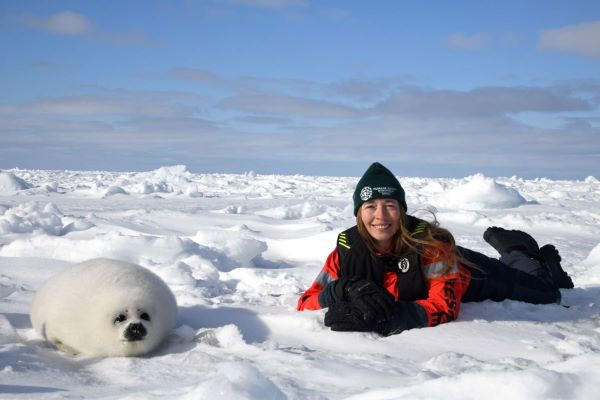
Right now, mother harp seals are nursing their pups on the spectacular ice floes off Canada’s east coast. The scene is breathtakingly beautiful and incredibly peaceful—and it draws people from all over the world to witness it firsthand. I’ve been lucky enough to be on the ice several times this week, documenting the harp seal nursery for Humane Society International.

But it’s a bittersweet experience, because the adorable pups who live in this pristine environment are already facing mortal threats to their survival.

A recent segment on “Good Morning America” exposed the devastating impacts of climate change on the ice breeding harp seals. Over the past five decades, scientists have tracked a significant and constant decline in the sea ice cover in eastern Canada. For the harp seal pups born on that ice, it spells disaster. Warming temperatures are causing the ice to literally melt from under the pups and so many are forced into the water before they are strong enough to survive there. In some recent years we have witnessed up to 100% mortality in seal pups born in key whelping areas because of the vanishing sea ice.

But there is another story—an even greater risk to the seal pups—and it is one that GMA chose not to tell. The very harp seals who are contending with these devastating impacts of climate change are the primary targets of Canada’s commercial seal hunt, the largest and cruelest slaughter of marine mammals on earth. In just a few weeks’ time, Canadian seal hunters will descend on the peaceful harp seal nursery and turn it into an open air slaughterhouse. The pups who survive the destruction of their sea ice habitat will be brutally clubbed and shot to death for their fur, their tiny bodies left on the ice to rot. Our Protect Seals team has exposed the cruelty of this so-called hunt for years; defenseless four-week-old seal pups are routinely shot and left crawling through their own blood, impaled on metal hooks, dragged onto bloody boat decks and clubbed to death. Notably, veterinarians who have studied the killing have labelled all killing methods at the commercial seal hunt “inherently inhumane.”

Our campaign has stopped so much of this cruelty, by closing the most important global markets for products of commercial sealing. In the past decade, our work has saved millions of pups from the slaughter. Yet the killing continues, with tens of thousands of seal pups falling victim to the commercial seal hunt each year.

Tragically, there is no way to reverse the impacts of climate change on the harp seals’ sea ice habitat in the near term. But a responsible government can and should end commercial seal hunting. That is exactly what we are urging Canada’s Prime Minister, Justin Trudeau, to do.

Everyone should have the opportunity to see the stunning harp seal nursery in their lifetime. But if Canada fails to take action soon, that opportunity may be lost forever—for us and for future generations.

Help us end the commercial seal slaughter in Canada

For me, the modern chicken industry is an expression of humankind at its worst. My visit last night to Ciales slaughterhouse in Bucktown to document the delivery of birds showed me nothing new, except for new victims whose expressions communicate a fresh pain, horror and despair that words fail to articulate. I know the expressions and behavior of happy chickens which makes the contrast even more disturbing. As we shine a light through the darkness on these birds’ faces and bodies, “I can’t imagine” thoughts flood my mind.

I can’t imagine how we could make someone more miserable or inflict more suffering.

I can’t imagine how we could engineer a domestic species from its wild counterpart in a way that so grotesquely robs them of all of the richness and complexity of their tropical rainforest lives and at the same time renders their bodies lethally obese in just weeks of being born.

I can’t imagine how we can raise birds only to be slaughtered at six weeks old, how we can grab them by their legs and stuff them into crates packed so tight, they are forced to squat in their own waste for hours and even days.

I can’t imagine how we can handle them so roughly during transport that they suffer from fractured wings and legs, bruises, and open wounds.

I can’t imagine that we can haul them around in trucks that offer zero protection from the extremes of of cold, heat, wind, rain and ice, that we can deny them any food or water or any comfort an infant animal might yearn for, that we allow many of them to arrive dead from heart failure, hypothermia, dehydration, starvation and heat stroke due to this grueling journey from one hell to another hell.

I can’t imagine how we can slam these crates of birds around causing further injury and terror at their destination. And I can’t imagine how we then allow them to languish in these filthy, feces-caked crates for many more hours, perhaps even days, awaiting their violent end.

I can’t imagine how we can try to deceive ourselves by calling the “kill cone” method of slaughter “humane:” stuffing a bird head-first down a metal cone, pulling their necks through the bottom opening, and slashing their throats while fully conscious, while their bodies thrash and they suffocate in their own blood.

I can’t imagine how we can watch this footage and continue to support this industry. And I can’t imagine how we can shower some animals in our lives with such affection and adoration and yet support an industry that treats other animals with such contempt and utter disregard for their suffering.

I can’t imagine how we can allow this atrocity to even exist in the 21st century. Shut them down!

Charges laid in controversial B.C. ‘seal bomb’ incident caught on camera

 WATCH: This video may be disturbing to some viewers. A B.C. fisherman launches a ‘bear banger’ into the water near a pack of sea lions.
A B.C. man filmed throwing a so-called “bear banger” into a raft of sea lions near Hornby Island last spring is facing charges under the Fisheries Act and Explosives Act.

The video, which came to light last March, shows Allen Marsden lighting the fuse on one of the explosive noise-makers and throwing it into the water where a large number of the animals had congregated.

READ MORE: ‘Disturbing’ video of ‘seal bomb’ sparks debate about conflict between fishers, B.C. sea lions

Court records show Marsden facing three charges, related to the disturbance of marine mammals and the use of explosives.

Fisherman criticized for using ‘bear banger’ on sea lions

Fisherman criticized for using ‘bear banger’ on sea lions

The records also indicate an intent to plead guilty.

The video was initially posted to the Facebook group of the Pacific Balance Pinniped Society, a group of First Nations and commercial fishers advocating for a West Coast seal hunt, and drew support from other fishers and condemnation from people who describe the action as cruel.

Many fishers on B.C.’s south coast argue that the sea lion population has exploded in recent years and is devastating the fishery.

READ MORE: Seal meat supper? B.C. group calls for West Coast seal hunt

In a phone interview at the time the video emerged, Marsden told Global News the video was shot while he and his crew were taking samples of herring roe for the fishing industry.

Marsden said there were as many as 500 sea lions in the area, and that the bear banger was not actually effective on the animals, who he described as a danger to his crew.

However the Vancouver Aquarium says the device could cause injury to the sea lions’ face, eyes or jaw along with their hearing.

The aquarium says the area’s sea lion population has not exploded, but rather, has returned to historical levels after decades of aggressive hunting.

Hunting-killing for sport is barbaric

https://www.portsmouth-dailytimes.com/opinion/46515/hunting-killing-for-sport-is-barbaric

By Melissa Martin


Humans eat animals. Cow, hog, chicken, turkey, deer, squirrel, racoon, reindeer, rabbit, fish, and many other creatures. Animal meat provides subsistence and nutrition. But killing just for the challenge and the thrill is cruel.

“The year was 1905 and President Theodore “Teddy” Roosevelt was living up to his reputation as a cowboy. The renowned outdoorsman was on a Mississippi hunting trip, and most of his companions had already brought down an animal. In an effort to please their boss, some of his attendants cornered, clubbed, and then tied a black bear to a tree before bringing Teddy over to shoot it. To their surprise, the President refused, calling the act unsportsmanlike,” according to a 2016 article at http://www.goodhousekeeping.com.

Hunting for food is one thing, but hunting for recreation is barbarous. A powerful passion for being a human predator over the animal kingdom reveals a lust for blood and death. And wildlife killing contests should be banned. Find another way to have fun.

Guys, if you just want to bond around the campfire—then say so. You don’t have to kill animals as an excuse to get together for male friendship circles.

Hunting in USA

According to an article for NPR, “State wildlife agencies and the country’s wildlife conservation system are heavily dependent on sportsmen for funding. Money generated from license fees and excise taxes on guns, ammunition and angling equipment provide about 60 percent of the funding for state wildlife agencies, which manage most of the wildlife in the U.S.”

Once again, it’s about money. Let’s allow anything that generates funds. Endangered species, no problem as long as the cash flows.

Deer Hunting in Appalachia Ohio

The white-tailed deer (Odocoileus virginianus) is Ohio’s most popular big game animal. Is hunting and killing necessary to stop overpopulation of deer? That’s a controversial debate.

PETA says, “No. Starvation and disease are unfortunate, but they are nature’s way of ensuring that the strong survive. Natural predators help keep prey species strong by killing the only ones they can catch—the sick and weak.” http://www.peta.org.

The goal of Ohio Department of Natural Resources, Division of Wildlife, “has been to maintain county deer populations at a level that provides maximum recreational opportunity including hunting, viewing, and photographing, while minimizing conflicts with agriculture, motor travel, and other areas of human endeavor. In short, our goal is to provide enough deer to hunt and enjoy, but not so many that they cause undue human hardship.” http://www.wildlife.ohiodnr.gov.

The ODNR Division of Wildlife issued 429,006 deer permits during the 2017-18 license year, 3.6 percent fewer than last year and the eighth consecutive year that sales have declined… Since 2011 the number of individuals purchasing at least one deer permit has dropped from 359,000 to 309,000 – a 14 percent decline in just the last six years. http://www.wildlife.ohiodnr.gov.

Ohio’s white-tailed deer hunters concluded the 2019-2020 hunting season by harvesting 184,465 deer, according to ODNR Division of Wildlife. Deer hunting in Ohio began Sept. 28, 2019, and concluded Feb. 2, 2020. The final harvest total represents all deer taken during archery, gun, muzzleloader, and youth seasons.

Do you consume the deer you hunt and kill? Venison is an alternative to beef or a way for a family to supplement another source of protein. Eating what you kill is different than killing just for recreation or population control.

Boom! The sound of a rifle goes off. “Quick, to the thicket!” Bambi’s mother yells to him. “Faster! Faster, Bambi! Don’t look back! Keep running! Keep running!”

Feds propose new rules for cormorant control

The federal government is often viewed, rightly or wrongly, as having an endless appetite for issuing rules and regulations. Ambitious politicians routinely promise that if we elect them they will put a stop to it, “cut through the red tape,” and perhaps even roll back regulations that are already on the books.

Not everyone is aware that the purpose of regulations is to interpret and provide guidelines for how the laws passed by these same politicians are to be carried out. The absence of regulations could be compared to a chef lacking recipes for the meals he’s expected to create. The chef may know what an entrée is supposed to look and taste like, but without knowing the ingredients—and how and when they should be assembled—the odds of having a great meal are poor. When all is said and done, some regulations are needed to carry out the intent of our laws.

There’s also a common belief that regulations are only about telling us what we can’t do. Don’t pour that used motor oil or paint thinner down your garage drain. Farmer, don’t locate a cattle feed lot where spring flooding can wash fish-killing nutrients into a nearby river. Fishermen, don’t catch and keep more than 10 crappies in a day’s fishing.

Some regulations, however, expand boundaries and make possible things that would otherwise be prohibited. A recent example is an “advance notice of proposed rulemaking”—the first step in proposing new regulations—in this case, for the management of a familiar Minnesota bird, the double-crested cormorant.

The U.S. Fish & Wildlife Service (USFWS) is considering whether to give state natural resource agencies more authority to control the population of these waterfowl that prey on small fish, including those prized by anglers, as well as fish raised in commercial aquaculture—fish farming—done primarily in the South. Minnesota’s Leech Lake and Lake of the Woods, to name just two state waters, have seen spikes in the number of double-crested cormorants. Not so long ago, a downturn in walleye numbers on Leech Lake was attributed—at least by some—to a growing population of nesting cormorants there.

Larger than a duck, but somewhat smaller than a common loon, cormorants nest in high-density colonies. Their “guano” is highly acidic, and the concentration found in these colonies can kill ground vegetation, and even the trees in which the birds nest. Cormorants can denude entire small islands, leaving them looking like they were chemically defoliated.

It is a human prejudice to describe a cormorant as unhandsome, but there is something almost vulture-like in their appearance, with large broad wings, a snake-like neck and hooked beak. A duck, goose, swan or loon is graceful by comparison. It may be a further irony that Minnesotans revere the common loon, even though it earns its living chiefly as cormorants do, by eating fish. The loon’s strikingly beautiful plumage, and its distinctive and haunting call, contribute to this prejudice in its favor. This, and the lore and legend that have linked the loon to wilderness.

Cormorants were at a population low point nationally in the 1970s, according to the U.S. Department of Agriculture. But by the late 1990s, natural resource agencies in more than half the states were reporting declines in popular and valued fish in their waters. Agencies in 10 states were on record as considering the cormorant a major threat to their fisheries management programs.

One of the most important federal conservation laws ever enacted is the Migratory Bird Treaty Act of 1918, an agreement initially between the U.S. and Great Britain—acting then on behalf of Canada—with Mexico later added to the agreement. This Act “makes it illegal to take, possess, import, export, transport, sell, purchase, barter … any migratory bird … except under the terms of a valid federal permit.” The waterfowl hunting license we purchase for the privilege of hunting migratory ducks, geese, woodcock or snipe, is an example of such a “valid federal permit.”

Because cormorants are a migratory bird, they are protected under this Act. But from 2003 to 2016, in light of their depredations on wild fish stocks and fish farms, wildlife agencies in 24 states had broad authority to control cormorant populations that were considered a threat. In thirteen states, fish farmers had the right to control cormorants preying on their fish stocks without the need for individual permits.

This changed in 2016. A federal judge in U.S. District Court for the District of Columbia (Washington, D.C.) ruled for plaintiffs who had objected to the “culling”—the killing—of cormorants under these broad permits during the 2003 to 2016 period. The judge found that the governing agency—the USFWS—had not sufficiently made the case for broad authority to kill cormorants, versus permits that would be sought on a case-by-case basis.

Since 2016, those “case-by-case” rules have been in place while the USFWS did its homework, and—it now appears—will try to make a better case to again give state agencies discretion to determine “whether, when, where and for what purpose, to control cormorants.” A similar proposal is being made by USFWS to allow the taking of cormorants without individual permits where they’re found to be causing fish farming losses.

For now, we’re in a 45-day public comment, which began on January 22nd, when this proposal was published. Comments received by USFWS may shape its decision on the degree of freedom the states should have in decisions to control—or not control–their cormorant populations. Also shaping these regulations—we can safely assume—will be a USFWS judgment on whether they would be likely to withstand another challenge in court.

Anglers and fish farmers will be eagerly awaiting the outcome.