Exposing the Big Game

Forget Hunters' Feeble Rationalizations and Trust Your Gut Feelings: Making Sport of Killing Is Not Healthy Human Behavior

Exposing the Big Game

Why My New Year’s Resolution Is To Speak Up About The Suffering Of Fish

A Fishes Article from All-Creatures.org

FROM Chas Newkey-Burden, PlantBasedNews.org
December 2018


Fish are gentle, sensitive, intelligent, and complex creatures – yet we massacre them in their billions. It’s time to speak out about the hell these creatures endure.
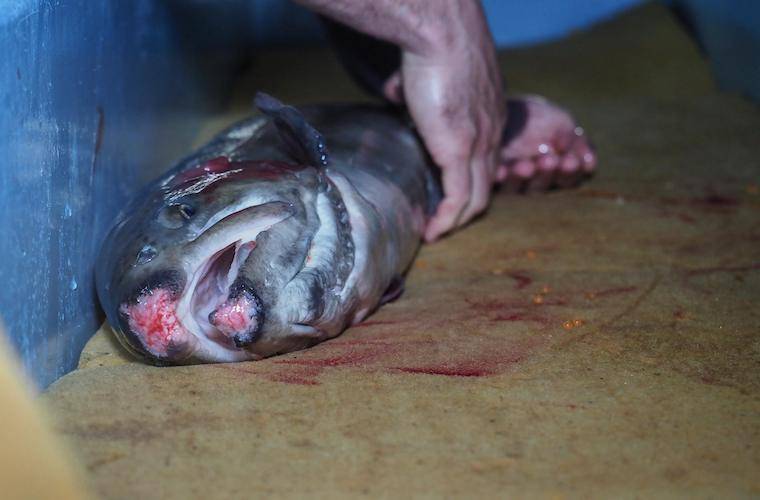
rainbow trout
A rainbow trout is manipulated for stripping – squeezing of eggs for artificial spawning – Photo: Compassion In World Farming

“But you can eat fish, right?” Lots of vegans and vegetarians have been asked this well-meant question and it reveals an important truth: when it comes to speciesism, the more a creature looks and acts like a human, the easier it is for most humans to appreciate it.

Small creatures that live in the water somehow seem less important than big creatures that live on the land, like us.

So fish get a particularly hard time – not breathing like us or moving like us, they are harder for us to relate to.

Hypocrisy

I’ve noticed this in myself over the years. As a kid, I raged about slaughterhouses, fly-posted about vivisection and spoke out against fox-hunting. My visceral horror was stirred up by thoughts of cows in abattoirs and cats in labs, and foxes in pieces. I’m sure I cared about fish and sea mammals, but I don’t remember feeling it the same way.

I do remember finding other people’s hypocrisy odd though. School friends were proud when the tuna in their sandwiches was ‘dolphin-friendly’ – meaning it was caught using methods that didn’t also kill dolphins. That’s great, I’d say, but what about the tunas?

One guy wore a ‘Save the Whale’ badge but ate fish and chips every Friday night. The double-standard seemed so glaring to me. Another friend who adored his pet dogs nevertheless bragged about ‘catching’ – ie killing – fish at the weekend.

I couldn’t get my head round it. I’d never heard of speciesism at the time. I just assumed I was a weirdo. Being a vegan in 2019 – especially with access to the internet – is a walk in the park compared to those days, trust me.

Even now I notice some fishy double-standards. There are people who campaign against fish abuse at SeaWorld yet eat fish fingers from intensive farms. These dreadful places kill fish in far worse conditions than SeaWorld.

Then there are the people who say we must stop using so much plastic because it hurts the fish…even though they chomp on the flesh of these fish.

A voice for the fish

Looking back, I do remember one time I spoke up for the water creatures. I was 12, and my aunt had taken me to a marine park. After a worker had proudly got dolphins to perform a whole series of tricks, he asked if anyone had any questions. I raised my hand and tore him, his work and the whole marine park to pieces. I still remember my aunt’s face.

Vegan advocacy as a whole is very focused on land animals: we concentrate on the animals killed for their meat, their milk, their eggs or their fur. Rarely the fishes. I’m as guilty as anyone because I’ve written dozens of articles about animal abuse for The Guardian and other papers, yet only one about fish.

The suffering of fish

Their experiences are horrific. Fish that get caught in trawl nets are often crushed to death under the weight of other fish. Their eyes balloon out. If they survive that, they are either left to slowly suffocate or they are disemboweled with a gutting knife while still conscious.

Fish from factory farms are usually cut across the gills and left to bleed to death, electrocuted in a water bath, or smashed over the head with a blunt instrument.

Fishermen say the fish don’t feel pain but this has been disproved. Professor Donald Broom, a scientific advisor to the government, said: “The scientific literature is quite clear. Anatomically, physiologically and biologically, the pain system in fish is virtually the same as in birds and mammals.”

Experts have found that lobsters may actually feel more pain than humans would. They say that lobsters, who can live up to 100 years in the wild, are ‘quite amazingly smart animals’. Yet restaurant diners often think nothing of picking one from a tank and asking for him to be boiled alive.

Fish aren’t stupid

The idea fish are stupid is stupid in itself. Researchers have shown that, contrary to legend, goldfish have longer ‘sustained attention’ spans than humans. Some fish woo potential partners by singing to them or creating art. Scuba divers tell beautiful stories of individual fish they have made friends with.

Dr. Sylvia Earle, a leading marine biologist, said: “They’re so good-natured, so curious. You know, fish are sensitive, they have personalities, they hurt when they’re wounded.”

These are the creatures we kill on an unimaginable scale. The fishing industry measures the losses in tonnes rather than individual lives. The global wild fish catch stands at about 90 million tonnes, with a further 42 million tonnes coming from fish farms. Trillions of lives.

We might not mourn the cods and haddocks in the same way we do the cows, sheep, and pigs. We may feel it differently. But we can each speak out in our own way.

That’s why my New Year’s Resolution is to put fish in the spotlight. It’s time to do more than wear a Sea Shepherd hoody – though, like so, so many vegans, I’ve got one of those.

After Franz Kafka went vegetarian, he saw some fish and thought: “Now at last I can look at you in peace, I don’t eat you anymore.”

This is beautiful. Every vegan can relate. But wouldn’t that peace be all the more blissful if, as well as not eating them, we lent them our voice too?

5 horses shot to death, Ft. Polk investigating

Generic horse stock photo: MGN
By Matthew Segura |
 

(KNOE) – Ft. Polk personnel are investigating the deaths of five horses at Peason Ridge Wildlife Management Area. The horses appear to have been shot.

The following statement was released by Ft. Polk:

“Fort Polk personnel found the five horses in the northwest portion of Peason Ridge and immediately reported it. The Directorate of Emergency Services Game Enforcement section is actively investigating.”

According to the Fort Polk Horses of Kisatchie Facebook page, advocates for the deceased horses believe the act was deliberate.

“It appears at least 5 horses have been found dead today, shot by what is being described as possibly a ‘high powered rifle,'” described a person who saw the horses.

“One horse (likely the first) was shot in the face and then it appears as though the other horses in the herd were shot as they tried to run away,” the poster wrote.

The post continued, “While accidents happen during hunting season…. THIS most certainly was INTENTIONAL AND DELIBERATE and not a case of ‘mistaken for a deer.’”

You can read more on the Fort Polk Horses of Kisatchie Facebook page.

The Peason Ridge Wildlife Management Area is located west of Alexandria.

← Back

Thank you for your response. ✨

Manitoba trapper sorry after cougar caught in snare

Gerry Sherman found the endangered animal in a snare near Gilbert Plains, Man. last week

The cougar was pulled from the trap sometime between Dec. 28 and Dec. 31. (Supplied)

A Manitoba trapper is sorry a rare and protected animal species was caught in one of his snares.

Gerry Sherman went out last week to check his snares in Duck Mountain Provincial Forest near Gilbert Plains, Man., and at first thought he snagged a wolf. But when he got closer, he realized it was something else — a cougar, a rare species that used to live in Manitoba but was driven out of the province.

“I wondered what I was supposed to do because I knew it was a [protected] species,” Sherman told CBC. “The proper thing that I came up with was take it out of the snare and take it home and once I got home I called Manitoba Conservation.”

Sherman is a registered trapper and uses the provincial forest, which borders Duck Mountain Provincial Park, with permission.

He said a pair of Manitoba Conservation officers came and picked up the animal on New Year’s Day and were very understanding about the whole ordeal.

“I am really sorry that it happened,” Sherman added. “Nobody likes to catch endangered species.”

“I am really sorry that it happened” – Gerry Sherman 

Bill Watkins is a wildlife biologist with the province. He confirmed the wild cat was caught sometime between December 28th and 31st.

“It’s what we refer to as bycatch,” he said. “There’s no way that a trapper could control the animals that wander into the trap. It was set for wolves so everything is completely legitimate.”

Watkins said that while the find was concerning, it could be a sign that the cougar population is recolonizing Manitoba. The animals were very rare in the province up until about six years ago.

Now, there are two to three sightings per year. A sign, according to Watkins, that they could be repopulating. The latest estimates pegged the population in Manitoba at fewer than 50.

Sherman said it’s the first time he’s heard of a cougar being caught in the Duck Mountains. He believes the animal will be stuffed and put on display at the Duck Mountain Interpretive Centre near Minitonas, Man., once it’s been inspected by a biologist.

“It’s a magnificent animal,” he said. “Anyone destroying these animals at will should be punished. On an accidental catch like this there is really nothing anyone can do.”

Not the first time

It’s the second time in just months that a cougar has been accidentally caught in Manitoba.

A female cougar was caught and killed near Boissevain, Man., on Nov. 21.

Watkins, at the time, said it is possible that the animal wandered up from North or South Dakota.

Big game hunter who held a bloodied sex toy next to a sheep she killed faces criminal charges

Police in Scotland have confirmed that Larysa Switlyk has been reported for firearms offences along with a 41-year-old man who is also from the United States

Big game hunter who held a bloodied sex toy next to a sheep she killed faces criminal charges

A 33-year-old big-game hunter from Sarasota, Florida, Larysa Switlyk, who boasted of shooting and killing local animals while visiting a Scottish island is now reportedly facing criminal charges. Switlyk, “a world-renowned hunter”, was accused of “trophy hunting” wild animals on the island of Islay, Scotland in September after she posed with several of her kills and posted the pictures on Instagram.

Police in Scotland have now confirmed that the hunter has been reported for firearms offences, along with a 41-year-old man, who is also from the United States, according to the Daily Mail.

Although hunting animals in season is not illegal in Scotland, Switlyk is facing a charge under Section 11a of the Firearms Act, which is linked to how one can use borrowed shotguns legally.

Larysa Switlyk posing with her game (Instagram/laryasaunleashed)

Switlyk, in November, had stirred controversy after she posted a picture of herself in Norfolk, posing next to a sheep she had just killed and holding a blood-smeared sex toy. Scotland police said that they had received multiple complaints about hunting in September and the Procurator Fiscal is now probing the incidents, according to the Daily Mail.

Switlyk, a television presenter, in one of her Instagram pictures can be seen dressed in camouflage gear and kneeling beside the corpse of a goat, while another image shows her posing “in sniper mode” and lying in grass while pointing a gun into the distance.

Reports state that her games also include stags and she had captioned one of her pictures with: “In awe of my Scottish Stag — can’t wait to bring it back to the castle for the chefs to cook it up!”

Larysa Switlyk posing with her game (Instagram/laryasaunleashed)

The images she posted of the hunt sparked outrage in the country, with one Member of the Scottish Parliament warning that he would be looking into whether the hunts were organized by an official group or not. It is legal to hunt red stags between July 1 and October 20, given that the hunters use firearms and have a licence for their weapons and have the permission of the landowner.

A spokesperson for the Scottish government at the time had said: “We fully understand why so many people find these images of hunted animals being held up as trophies so upsetting. Responsible and appropriate culling of animals is a necessary part of sustainable land management and the culling of some wild animals, including deer and goats, is not illegal.”

Larysa Switlyk posing with her game (Instagram/laryasaunleashed)

“However, we understand the concerns caused by these images and, in light of them, the Environment Secretary will review the situation and consider whether any clarification of or changes to the law might be required,” the spokesperson added.

URGENT: Help Stop Insidious ‘Opossum Drop’ in Andrews, North Carolina!

https://www.peta.org/action/action-alerts/urgent-insidious-opossum-drop-andrews-north-carolina/

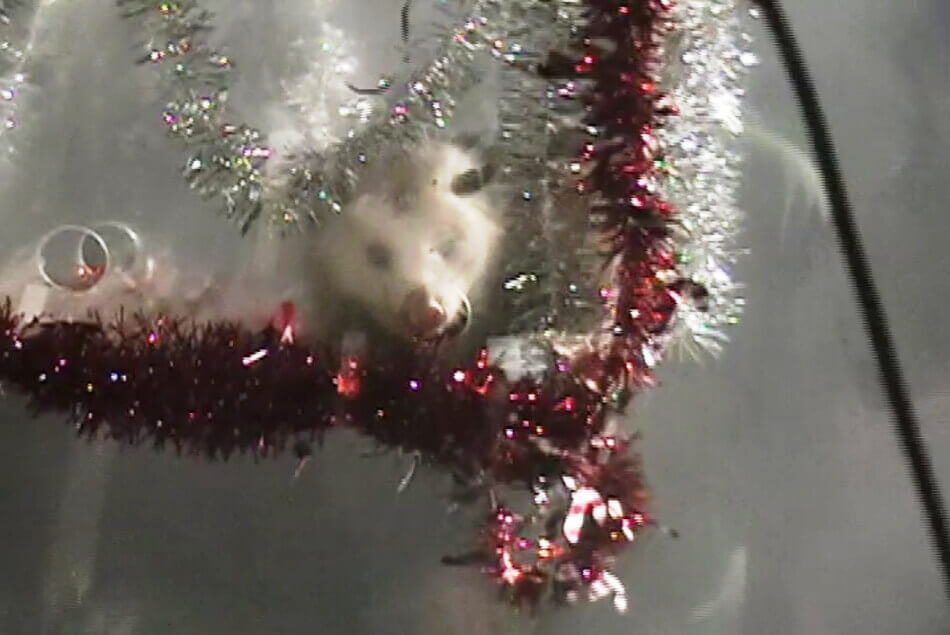
Andrews, North Carolina, apparently intends to “celebrate” New Year’s Eve by hosting a sadistic so-called “opossum drop,” during which a wild-caught opossum would be imprisoned inside a Plexiglas box for hours above a rowdy crowd. At midnight—after being forced to endure a near-constant barrage of live music, a noisy marching band leading the animal in, and fireworks displays replete with the usual explosions and smoke—the terrified opossum would be slowly lowered to signify the dawning of the new year. Because this sensitive and elusive prey species naturally avoids human contact at all costs, subjecting one of them to hordes of partiers, chaos, and blaring noise is inhumane and would very likely result in potentially fatal stress-induced conditions. PETA scheduled a meeting with Mayor James Reid in order to describe our concerns and to encourage city officials to “drop” any one of countless nonliving articles that won’t suffer, but he canceled the meeting at the last minute, even declining to discuss the matter by phone—so now it’s your turn!

Please politely urge the following city officials and event sponsors to cancel the cruel event, then spread this alert far and wide. Remember, it’s vital that you keep it polite! Polite comments can be directed to:

The Honorable James Reid
Mayor of Andrews, North Carolina
mayor@andrewsnc.com
https://www.facebook.com/james.reid.735

Mr. Steve Jordan
Alderman and Mayor Pro Tempore
Town of Andrews, North Carolina
s.jordan@andrewsnc.com

Ms. Richelle Phillips
Alderman
Town of Andrews, North Carolina
r.phillips@andrewsnc.com

Mr. Mike Sheidy
Alderman
Town of Andrews, North Carolina
m.sheidy@andrewsnc.com

Mr. Scott Stalcup
Alderman
Town of Andrews, North Carolina
s.stalcup@andrewsnc.com

Ms. Sandra Daley, Chair
Cherokee County Tourism Development Authority (Event Sponsor)
sandra.daley.sd@gmail.com

Mr. Mark Kimball, CEO
Erlanger Murphy Medical Center (Event Sponsor)
Mark.Kimball@erlanger.org

Mr. Joel Storrow
President
McGill Associates (Event Sponsor)
joel.storrow@mcgillengineers.com

Christmas Has Become A Festival Of Cruelty — The Peak Of Animal Abuse

An Animal Rights Article from All-Creatures.org

FROM

Chas Newkey-Burden, PlantBasedNews.org
December 2018

This time of year can be grueling for vegans, whose compassion is mocked and treated as a nuisance. But it’s worse for the animals who can’t escape exploitation.

free range Turkey
Free range, organic turkey at a small farm in Canada, 2006 (Photo: We Animals)

It’s often said that turkeys wouldn’t vote for Christmas. But why would any animal put a tick in that box? The 12 days have become a festival of cruelty – the annual peak of human abuse of animals.

The exploitation begins at Christmas fetes. Reindeers endure long journeys to these events across the country. The Born Free Foundation says the journeys and the shows themselves cause huge suffering for the reindeers. Animal Aid recently filmed undercover at UK reindeer centers and documented abuses, including a worker repeatedly kicking a reindeer.

Horses and camels are sometimes dragged along to these fetes, too. Like reindeers, they are sensitive animals who should be free and joyful in the wild, not used as props to be paraded around in chains for human entertainment at festive circuses.

Meanwhile, puppies are arriving in the UK to meet Christmas demand. The Dogs Trust says that thousands of puppies are illegally smuggled in at this time of year. They are shipped in shocking conditions: puppies as young as four weeks old spend protracted journeys eating their own feces as they are smuggled in cramped crates.

For dogs, Christmas can be a time of rejection. However much we are reminded that a dog is for life, not just for Christmas, many will be unwanted as presents. Within days they are dumped at refuges, or simply left tied on the street. Dogs and other pets are often left at home for long periods at this time of year, as people travel to far-flung family get-togethers.

The centerpiece of these get-togethers is usually the turkey and the pig. Once everyone has stuffed themselves with so much food that they feel sick, the leftovers are scraped into the bin. If killing animals to eat them is dreadful, then killing animals to not eat them is surely even worse.

More than 14 million turkeys were killed in the UK last year – two million of them in December. Most spent their short lives in crowded industrial sheds and were never allowed to go outside. Countless abuses have been exposed at British turkey farms, including workers playing baseball with turkeys at a Bernard Matthews farm.

Between the ages of just eight weeks and 26 weeks, turkeys are sent to the slaughterhouse. They are hung upside down by their legs and have their throats slit. Or they are killed with gas, or by strangulation. You won’t see that on the supermarkets’ Christmas ads.

Alongside turkey on the Christmas dinner plate is a new favorite: pigs in blankets. The pig’s route to the plate is no happier. About 60 percent of sows reared in the UK are kept in metal crates which are just centimetres bigger than them. Little piglets have their ears punctured, teeth clipped, and tails cut without anaesthetic before being grown to the required size. One-third of pigs in the UK are slaughtered in gas chambers.

From the factory farm to the gas chamber, to the shop to the dinner table to the bin – the lives, and deaths, of these animals shame humanity. But then what Christmas has become is nothing to be proud of either.

From early November, shop are crammed with ‘gift’ ideas that are little more than brainless fops – tacky, plastic-bound, panic buys with just a tenuous connection to the recipient. Rather than being imaginative, heartfelt gestures, they scream ‘That’ll do’ and demean the giver, the recipient, and the festival itself.

It’s a festival that can be a particularly challenging time for vegans. At family meals, there is often one tipsy, bored relative who treats our compassion as an irritant or a joke. As meals are planned, for 12 days, we will repeatedly be seen as the ‘difficult’ one because we won’t eat the corpses of traumatized animals.

But at least as humans can choose how much of modern Christmas we buy into. For animals there is no way out – and many face a final terror on New Year’s Eve, as firework displays terrify pets and wild animals alike.

The compassion and godliness of this religious festival have been lost. In fact, at this time of year, I am reminded of a quote from William Ralph Inge:

We have enslaved the rest of the animal creation, and have treated our distant cousins in fur and feathers so badly that beyond doubt, if they were able to formulate a religion, they would depict the Devil in human form.

Japan confirms it will quit IWC to resume commercial whaling

https://www.theguardian.com/environment/2018/dec/26/japan-confirms-it-will-quit-iwc-to-resume-commercial-whaling

Japan will resume hunting in its waters in July but will end controversial expeditions to the Southern ocean

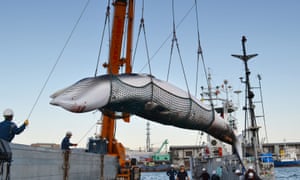
A minke whale is landed at a port in Kushiro on Japan’s northernmost main island of Hokkaido in 2017.
 A minke whale is landed at a port in Kushiro on Japan’s northernmost main island of Hokkaido in 2017. Photograph: Kyodo News/Kyodo News via Getty Images

Japan is facing international condemnation after confirming it will resuming commercial whaling for the first time in more than 30 years.

The country’s fleet will resume commercial operations in July next 2019, the government’s chief spokesman, Yoshihide Suga, said of the decision to defy the 1986 global ban on commercial whaling.

Suga told reporters the country’s fleet would confine its hunts to Japanese territorial waters and exclusive economic zone, adding that its controversial annual expeditions to the Southern Ocean – a major source of diplomatic friction between Tokyo and Canberra – would end.

He said Japan would officially inform the IWC of its decision by the end of the year, which will mean the withdrawal comes into effect by 30 June.

Its decision prompted criticism from conservationists and other nations including the UK and Australia.

The UK’s environment secretary, Michael Gove, said he was “extremely disappointed” by Japan’s move.

He said in a tweet: “The UK is strongly opposed to commercial whaling and will continue to fight for the protection and welfare of these majestic mammals.”

Michael Gove

@michaelgove

Extremely disappointed to hear that Japan has decided to withdraw from the International Whaling Commission to resume commercial whaling. The UK is strongly opposed to commercial whaling and will continue to fight for the protection and welfare of these majestic mammals.

958 people are talking about this

Greenpeace disputed Japan‘s view that whale stocks have recovered, noting also that ocean life is being threatened by pollution as well as overfishing.

“The declaration today is out of step with the international community, let alone the protection needed to safeguard the future of our oceans and these majestic creatures,” Sam Annesley, executive director at Greenpeace Japan, said in a statement.

“The government of Japan must urgently act to conserve marine ecosystems, rather than resume commercial whaling.”

It also accused Japan of timing the announcement to avoid criticism.

“It’s clear that the government is trying to sneak in this announcement at the end of year, away from the spotlight of international media, but the world sees this for what it is,” Annesley, said.

“Most whale populations have not yet recovered, including larger whales such as blue whales, fin whales and sei whales.”

Backbench Conservative MP and former foreign secretary Boris Johnson said Japan’s decision was “appalling” and urged it think again.

Boris Johnson

@BorisJohnson

Appalling decision by Japanese government. They must rethink. https://www.bbc.co.uk/news/world-asia-46682976 

1,410 people are talking about this

Astrid Fuchs, programme lead at Whale and Dolphin Conservation, said it was “terrible decision” that could encourage other countries to quit the IWC.

She added: “The oversight that the IWC was having over Japan’s whaling will now be lost. We won’t know how many whales they are catching, we won’t know how they will report it. It might spell doom for some populations. There is an endangered population of Minke whales off Japan, which is already under threat.”

Erik Solheim, a Norwegian diplomat who was the head of the United Nations Environment Programme until earlier this year, said Japan’s decision to leave the international whaling commission was “dangerous”.

In a tweet he called for a global campaign to urge Japan to reconsider.

Erik Solheim

@ErikSolheim

Japan will start commercial whaling.
Let’s ask Japan to reconsider!
It’s dangerous when nations break out of global agreements and start setting their own rules.https://www.bbc.com/news/world-asia-46682976 

158 people are talking about this

Jack Ashley, manager of the Cambridge University’s Zoology Museum said government around the world should condemn the decision.

In a joint statement on Wednesday, Australia’s foreign minister Marise Payne and the environment minister, Melissa Price, said the Australian government was “extremely disappointed” that Japan was withdrawing from the commission and resuming commercial whaling.

“The International Whaling Commission plays a crucial role in international cooperation on whale conservation,” they said.

“The commission is the pre-eminent global body responsible for the conservation and management of whales and leads international efforts to tackle the growing range of threats to whales globally, including by-catch, ship strikes, entanglement, noise, and whaling.

“Their decision to withdraw is regrettable and Australia urges Japan to return to the Convention and Commission as a matter of priority.”

The Australian Marine Conservation Society said the decision to halt the Antarctic hunt would be “welcome and long overdue”. Its chief executive, Darren Kindleysides, called on the Australian government to demand the Japanese fleet left immediately rather than at the end of its normal hunting season in February or March.

“Australians have been fighting for decades to get the whalers out of the Antarctic,” Kindleysides said. “However, it would be a bittersweet victory if it comes with unchecked commercial whaling by Japan in their own waters, and their leaving could damage the future of the IWC itself.”

Wednesday’s announcement had been widely expected after Japan recently failed to win IWC support for a proposal to change the body’s decision-making process – a move that would have made it easier for Japan to secure enough votes to end the commercial whaling ban, which went into effect in 1986 to protect dwindling whale stocks.

Japan argues that the moratorium was supposed to be a temporary measure and has accused a “dysfunctional” IWC of abandoning its original purpose – managing the sustainable use of global whale stocks.

“I support the government’s decision” to withdraw, Itsunori Onodera, a former defence minister who advises the ruling Liberal Democratic Party on fisheries, told public broadcaster NHK. “I have attended IWC meetings several times in the past, and I was struck by their extremely biased views. The IWC has become a dysfunctional organisation.”

Japanese fisheries officials claim that populations of certain types of whale – such as the minke – have recovered sufficiently to allow the resumption of “sustainable” hunting.

It has used a loophole in the ban to hunt a certain number of whales for what it claims is scientific research. Byproduct from the hunts is sold on the domestic market, although Japan’s appetite for whale meat has declined dramatically since the postwar years, when it was an important source of protein.

The country ate 200,000 tons of whale meat a year in the 1960s, but consumption has plummeted to about 5,000 tons in recent years, according to government data.

Japan will join Iceland and Norway in openly defying the ban on commercial whale hunting.

Should Plant-Based Proteins Be Called “Meat”?

Should Plant-Based Proteins Be Called “Meat”?

Fried chicken, bacon cheeseburgers and pepperoni pizza aren’t uncommon to see on vegan menus — or even the meat-free freezer section of your local supermarket — but should we be calling these mock meat dishes the same names? A new Missouri law doesn’t think so. The state’s law, which forbids “misrepresenting a product as meat that is not derived from harvested production livestock or poultry,” has led to a contentious ethical, legal and linguistic debate. Four organizations — Tofurky, The Good Food Institute, the American Civil Liberties Union of Missouri and the Animal Legal Defense Fund — are now suing the state on the basis that not only is the law against the United States Constitution, but it favors meat producers for unfair market competition.

While some newly formulated meat-free products, like the plant-based Beyond Burger or its rival the Impossible Burger (the veggie burger that “bleeds”), may be deceptively meat-like, it’s hard to understand how consumers could actually be duped into thinking non-meat products are legitimately meat.

“The law violates constitutional right to free speech,” explains Animal Legal Defense Fund attorney Amanda Howell. “It’s wide in scope, vague, broad and problematic. An ordinary person can’t tell you what this law is about.” Although legal jargon is often hard for the typical non-attorney to understand, Howell explains that one thing is easy for the everyday American: distinguishing plant-based meat-like products from actual meat. To date, there are zero consumer complaints on file in Missouri of shoppers confusing meat-like products with actual meat, according to Howell and the Animal Legal Defense Fund.

Missouri currently produces the third-highest amount of beef cattle in the US (preceded by Oklahoma, and Texas at the top spot), and the beef industry is threatened by imitation meat products, proven to be better for the environment (though Beef Magazine attempts to negate climate science) and sometimes healthier than animal-derived red meat. As food science disrupts what people think of as “meat,” the future of the livestock industry may be endangered, and that’s a threat to ranchers.

Legally, there’s no reason why fake sausage or imitation turkey can’t be labeled as such. Under the Consumer Protection Law, as long as a product’s statement of identity is “truthful and not misleading, it’s legal,” says Howell. This statement of identity informs consumers of what’s inside a package and can help inform them of how to use and eat a product. “Consumers would be more confused if they were not able to use meat-related terminology,” Howell says. “It’s pretty obvious that they’re taking away the terminology so consumers won’t know what the products are, and they’ll sound less appealing.” Vegan sausage is understandable; seasoned soy patties, not so much. “Consumers should have access to truthful information, clearly labeled [foods], instead of taking away naming conventions just because an industry is scared,” Howell says.

People for the Ethical Treatment of Animals (PETA), which takes a staunchly anti-meat stance, also stands behind using meat terms and “letting the terms ‘steak’ and ‘sausage’ evolve with the times,” according to Ben Williamson, PETA’s senior international media director.

“The meat industry is going up against a public that is learning that eating meat is responsible for tremendous animal abuse, linked to diabetes, strokes, heart disease and cancer, and is an environmental nightmare,” Williamson said. “Healthy, ethical and 100-percent humane, vegan products are a booming market, and lawmakers’ time and efforts would be better served helping transition meat producers into vegan companies.”

Linguistically, calling plant-based meat “meat” is not necessarily an issue in English. “If we go back to what meat used to mean, it referred to food in general,” says linguist Carrie Gillon. “In about 1300, the definition changed to mean animal flesh food.” But even though the definition of “meat” narrowed centuries ago, that doesn’t mean it can’t also be used more generally as language evolves. Gillon uses prototype theory to explain this — that is, the theory that each noun we use has a prototype. If you think of a bird, you may think of a wren, but a penguin is also very much a bird — it just doesn’t share all the characteristics of a stereotypical bird, like flying. This theory could also apply to meat, or non-meat meat: When we think of meat, we think animal flesh, but why not expand the definition to foods that share characteristics with meat, like the meat of a peach, perhaps, or ground tofu that mimics ground beef?

“As long as the food has something in common with meat, like texture or taste, it makes total sense to extend the word meat to plant-based proteins,” Gillon says, noting that this wouldn’t work, say, with just a block of tofu, but anything that has something in common with our prototype of meat.

For vegetarians like food blogger Lori Nelson, meat-free foods named after their animal counterparts are preferred, for clarity. “Labels like ‘vegan chicken’ save me time because I don’t eat meat. If it’s labeled ‘vegan chicken,’ I don’t have to worry about it being actual chicken,” she explains. Plus, for vegetarians who have previously eaten meat, or at least seen meat in media, these mock products’ names provide a clearer idea of what they will taste like.

“We’re just trying to ensure a level playing field for plant-based meats,” says Howell. “People want cruelty-free sausage.”

This article was produced by Earth | Food | Life, a project of the Independent Media Institute.

Protected birds injured by ‘barbaric trapping’

Protected birds injured by ‘barbaric trapping’

Police are investigating after the body of a buzzard was found in woodland with one of its legs severed and a hobby was found alive with one leg severed.

Buzzard

The police share this latest appeal. Ed


Officers from the Isle of Wight’s Country Watch team are investigating two incidents where protected birds have been injured, possibly by traps.

We are working with the RSPB to establish what happened after the birds were found in the Briddlesford area, both with severed legs.

On 14th March the body of a buzzard was found in woodland near to Littletown with one of its legs severed.

On 23rd September a hobby was found alive with one leg severed. This bird was taken to the RSPCA and humanely put down.

Illegal and barbaric method of trapping
PC Tim Campany from the Country Watch team said:

“We are working closely with our colleagues from the RSPB to establish what happened. One line of enquiry is that the birds may have been caught and held in a spring-type trap.

“This is illegal and is a barbaric method of trapping, it leaves the bird once freed from the trap unable to land and feed and it will eventually die of starvation.

“All wild birds are protected by law under the Wildlife and Countryside Act 1981 which makes it an offence to intentionally harm them. Anyone found to have done so faces an unlimited fine and/or up to six months in jail.

“Raptor persecution is a priority of the National Wildlife Crime Unit and will not be tolerated. I would urge anyone with information on suspicious vehicles, persons, or traps located in the Briddlesford area to call us on 101.”

Get in touch
Anyone with information should call 101 quoting 4418 0374 840.

For more information about the Country Watch team please visit the Website.

Image: rorals under CC BY 2.0

Location map
View the location of this story.

IVANKA TRUMP’S CHILDREN REQUEST VEGETARIAN THANKSGIVING AFTER WHITE HOUSE TURKEY PARDON

https://www.livekindly.co/ivanka-trumps-vegetarian-thanksgiving-white-house-turkey-pardon/

Ivanka Trump’s children, Joseph and Arabella, requested a vegetarian
thanksgiving after watching the president – their grandfather – pardon the
Thanksgiving turkeys this year.

Presidents and turkeys go way back, with reports of gifts of the animal
being sent to the White House dating back to 1870. However, it was in 1989
– when George H.W. Bush was the American head of state – that the White
Houses’ official turkey pardoning ceremony tradition was cemented.

According to White House History
<https://www.whitehousehistory.org/pardoning-the-thanksgiving-turkey>,
after being presented with a turkey – wary of animal rights activists
picketing nearby – Bush stated, *“Let me assure you, and this fine tom
turkey, that he will not end up on anyone’s dinner table, not this guy —
he’s granted a Presidential pardon as of right now — and allow him to live
out his days on a children’s farm not far from here.”*

This year, it was the turn of turkeys Peas and Carrots to be pardoned by
the President
<https://www.livekindly.co/irelands-former-president-mary-robinson-go-vegan-global-warming/>,
and his grandchildren were quite taken with the pair. According to Trump
<https://www.livekindly.co/vegan-pamela-anderson-reason-melania-trump-kim-kardashian-ditched-fur/>,
who posted pictures of Arabella, Joseph, and Theodore meeting the turkeys
on her Instagram account, *“After watching their Grandpa pardon Peas and
Carrots at the White House on Tuesday, Joseph and Arabella have sworn off
turkey and are insisting on a vegetarian Thanksgiving!”*

The children are not alone in asking for a turkey-free holiday. A number of
celebrities urged their fans to leave meat off the table this year,
including star of “The Big Bang Theory” Kaley Cuoco.
<https://www.livekindly.co/vegetarian-big-bang-theory-kaley-cuoco-adopt-turkeys-thanksgiving/>

In a video for the animal rescue organization Farm Sanctuary, the
vegetarian actor said, *“Each year 46 million turkeys
<https://www.livekindly.co/vegan-james-cromwell-helps-rescue-100-turkeys/> are
inhumanely raised and slaughtered for Thanksgiving. The majority of these
birds are raised on factory farms, which are linked to numerous
environmental problems hurting us and our planet.”*

Filmmaker Kevin Smith
<https://www.livekindly.co/filmmaker-kevin-smith-urges-americans-go-vegan-thanksgiving/>

who turned vegan at the beginning of this year following a heart attack –
also asked consumers to consider choosing a cruelty-free option over a
turkey ahead of this years’ Thanksgiving
<https://www.livekindly.co/this-vintage-vegan-thanksgiving-ad-with-joaquin-phoenix-is-back-from-the-90s/>.
Speaking to two of the animals – again in a video for Farm Sanctuary –
Smith, who appeared alongside his daughter Harley Quinn, said, *“You have
my solemn word ladies, I will never eat another turkey. And I will go out
of my way to see that others might not as well.”*