Trapping is torture

By Annoula Wylderich -April 30, 2021 Facebook Twitter

Cover image from Born Free USA “Crushing Cruelty” report released in April.

Trapping is perhaps the most egregious abuse of our wildlife. The targeted animals (and often, untargeted creatures who get caught incidentally) can sit in a trap for up to 96 hours in the state of Nevada without the requirement for trappers to check on them. Don’t bet that every trapper will check after four days, if it isn’t convenient for them.

Reports from the Born Free USA wildlife advocacy organization have exposed the trapping industry and found that the few existing regulations that monitor trapping are often ignored by trappers who leave traps out after the close of the trapping season, continuing to capture animals. There are no authorities present when traps are set or an animal is killed.  

The animals who get caught in these barbaric, archaic devices (conibear, leghold, and snare traps) are helpless as they experience the elements, pain, hunger, thirst, fear and possible attacks by predators. Sometimes they leave behind cubs or pups who are too young to survive on their own.

Oftentimes, a mother will chew off her own limb in a desperate attempt to get back to her young. She will risk blood loss and infection in doing so; and she will be severely hindered for the remainder of her life by the loss of that limb if she does survive.

It’s not uncommon for an animal to become an incidental victim. A Born Free USA investigator speaking with a trapper reported the following:  “In one of [the foothold traps] we find a fox squirrel, caught by both front paws. [The trapper] released the fox squirrel from the trap. Both of its front legs are stripped down to the flesh by the trap. He doesn’t usually use fox squirrel, though others will use the fur, so he lets it go. At the same time he says it probably won’t survive and that seems the case as it limps off slowly.” One can imagine that animal’s agony.

The steel-jaw leghold trap is more commonly used by both commercial and recreational trappers. More than 85 foreign countries have banned the use of this trap, but only a few U.S. states have either banned or severely restricted its use. While a few states have reduced their trap check time to 24 hours, Nevada isn’t among them. The American Veterinary Medical Association, American Animal Hospital Association, World Veterinary Association and the National Animal Control Association have declared leghold traps to be inhumane.

Federal and state wildlife services also kill a staggering number of animals with various trapping devices, in addition to using poison and aerial shooting. These techniques are primarily random and non-selective, which result in the deaths of untargeted animals, as well. Those can include dogs, cats, birds, rabbits, turtles, bears, squirrels, and endangered species. 

In 2017, Nevadans who were polled indicated strong support for the reform of the state’s trapping regulations in order to reduce the suffering of wildlife, and to protect pets and public safety.

In 2019, the Nevada Assembly Committee on Natural Resources, Agriculture, and Mining introduced Assembly Bill 473, which would have banned the use of leghold traps and reduced trap check time to 24 hours. Sadly, there was little progress as it seems that the general public’s wishes are continually ignored in favor of sporting interests in spite of the fact that trappers comprise a minority of Nevada’s population (voters/constituents).

Our representatives should be urged to implement alternative humane methods of animal control; and where trapping is still permitted, to reduce the trap check time to 24 hours and ensure that regulations are enforced.

We should all be on the lookout for hidden traps when hiking with our dogs and report any incidents to local law enforcement and Nevada’s Department of Wildlife (be sure to document).

Those who reside in rural areas are encouraged to post signs and prosecute anyone who sets a trap on private property.
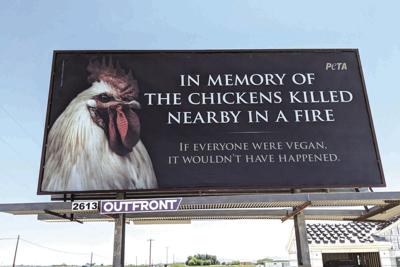
PETA billboard ‘memorializes’ dead hens

https://www.westvalleyview.com/news/peta-billboard-memorializes-dead-hens/article_bbb5a352-a2c7-11eb-80c0-5b260db6ff85.html

  • By Christina Fuoco-Karasinski, West Valley View Executive Editor
  • 14 hrs ago
PETA
PETA’s billboard is at MC 85 between South 223rd and South 221st avenues. Photo by Janelle Hines

PETA erected a billboard near the main office of Hickman’s Family Farms “in memory” of the more than 165,000 birds who were killed in March in a fire at a facility owned by the company.

The billboard, at MC 85 between South 223rd and South 221st avenues, urges anyone upset by the animals’ suffering to take personal responsibility by no longer buying eggs and by going vegan.

“We’re encouraging people who were feeling sympathetic to those birds to take a look at their own actions that are also making those birds suffer on a daily basis,” said Amber Canavan, PETA senior campaigner spokesperson. 

Canavan said PETA watches out for incidents in the news involving animals on farms. 

“That goes for fires and transport trucks,” Canavan explained. “Transport trucks have fairly high incidents of crashes on the way to slaughterhouses, from facility to facility.

“There are least 100 a year. Many are not even reported or make it into the news. Those animals are crammed onto transport trucks, shoulder to shoulder, in there for days without food, water or rest.”

She said the public rarely thinks about animals locked behind closed doors, “out of sight, out of mind.” 

“We want to make sure that they don’t just say, ‘Oh, that’s sad and go on about their day.’ We have the power to help them in many cases by not buying meat, dairy and eggs in the first place.”

PETA’s statement said hens used for egg production are confined to cramped barns, where each bird has no more than a square foot of space. Few farms install smoke detectors or fire-suppression systems. 

PETA notes that going vegan spares animals immense suffering and helps prevent future epidemics and pandemics. SARS, swine flu, bird flu and COVID-19 all stemmed from confining and killing animals for food.

PETA Billboard to Honor Cows Killed in Truck Crash

ShareTweet

For Immediate Release:
April 22, 2021

Contact:
Brooke Rossi 202-483-7382

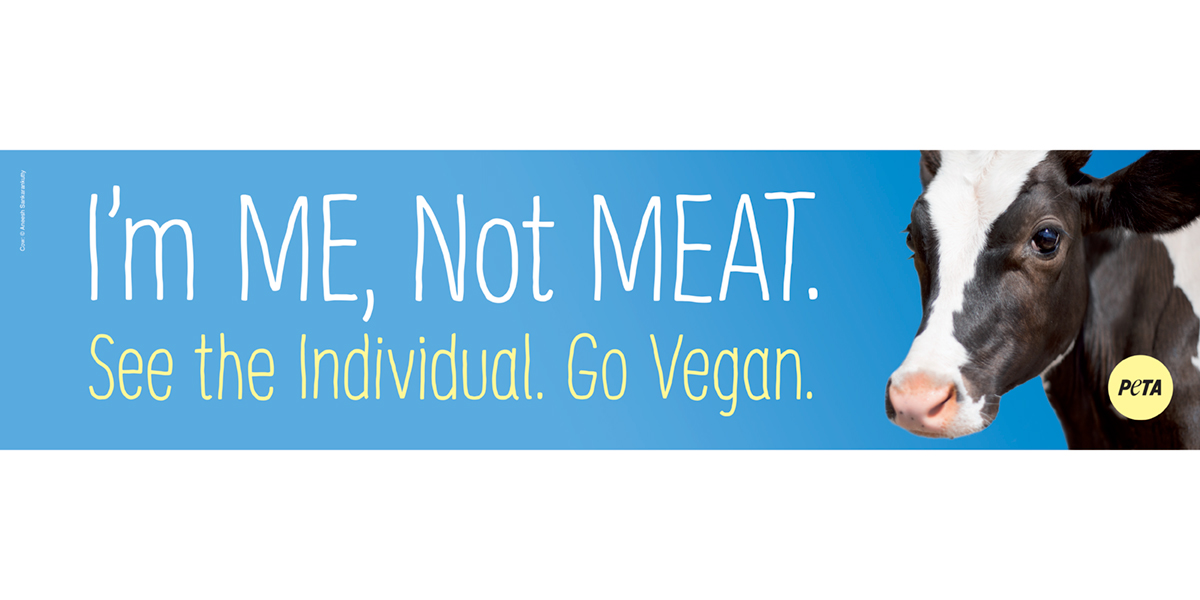
Green Bay, Wis. – In honor of the 12 cows who were killed when a truck reportedly carrying them to a JBS slaughterhouse overturned at the roundabout of N. Packerland Drive and Highway 29 on Monday, PETA plans to place a billboard near the crash site proclaiming, “See the Individual. Go Vegan.” Some of the 12 died instantly, while others had to be shot dead on the scene after being severely injured.

“Twelve gentle cows died in terror and agony as a result of this crash, and the traumatized survivors were likely hauled off for their throats to be slit and their bodies carved up for food,” says PETA Executive Vice President Tracy Reiman. “PETA’s ad encourages anyone disturbed by the thought of animals suffering on the side of the road or under the slaughterhouse knife to go vegan.”

Cows in the meat industry are often confined to cramped, filthy feedlots without protection from the elements. At the slaughterhouse, workers shoot them in the head with a captive-bolt gun, hang them up by one leg, and cut their throat—often while they’re still conscious.

‘It’s bizarre’: Almost two dozen seals found decapitated along Nova Scotia beaches

https://nationalpost.com/news/its-bizarre-almost-two-dozen-seals-found-decapitated-along-nova-scotia-beaches

‘I was in disbelief … I’ve never seen anything like it’Author of the article:Samantha PopePublishing date:Apr 16, 2021  •  1 day ago  •  4 minute read  •   71 Comments

Kimberly Hayman said she hopes an investigation will get to the bottom of what happened to the headless seals she found along the shores of two local beaches.
Kimberly Hayman said she hopes an investigation will get to the bottom of what happened to the headless seals she found along the shores of two local beaches. PHOTO BY KIMBERLY HAYMAN

Article content

A Cape Breton resident has made a disturbing discovery: Almost two dozen decapitated seals dotting the shores of two beaches.

“I was in disbelief … I’ve never seen anything like it,” said Kimberly Hayman, who’s lived in Dominion, Nova Scotia for three years. “I don’t like to see any animals suffer. I was just really disturbed.”

Former Toronto Maple Leafs GM wins tax battle as judge calls CRA’s position ‘absurd’
Close sticky video

 https://c5x8i7c7.ssl.hwcdn.net/vplayer-parallel/20210408_1900/ima_html5/index.htmlhttps://c5x8i7c7.ssl.hwcdn.net/vplayer-parallel/20210408_1900/videojs/show.html?controls=1&loop=30&autoplay=0&tracker=6c5c108a-8425-4e32-801e-54122191b59c&height=316&width=562&vurl=%2F%2Fa.jsrdn.com%2Fvideos%2Fcdgv_nationalpost%2F20210418054549_607bc5f1517fc%2Fcdgv_nationalpost_trending_articles_20210418054549_607bc5f1517fc_new.mp4&poster=%2F%2Fa.jsrdn.com%2Fvideos%2Fcdgv_nationalpost%2F20210418054549_607bc5f1517fc%2Fcdgv_nationalpost_trending_articles_20210418054549_607bc5f1517fc_new.jpg

dslogo

While on a midday stroll along Big Glace Bay’s shoreline on Sunday, Hayman said she and some friends were startled to find 10 headless seals — all with holes in their torsos — sprawled along the pebbly beach. There was no odour and the bodies still looked pretty fresh, she said, with dogs curiously running over to investigate.

Though she said she felt upset by the sight, she didn’t think much else of it. Then the next day, while out on her usual sunrise walk along nearby Dominion Beach, Hayman said she counted 11 more of these decapitated animals and began to wonder what was going on.  

Advertisement

STORY CONTINUES BELOWThis advertisement has not loaded yet, but your article continues below.

Article content

“I just kept taking pictures because I was thinking, ‘This can’t be normal — that’s 21 in total,’” she said.  

Twenty-one decapitated seals were found along the shores of two Cape Breton beaches, all with a “hole in their torso,” Hayman said.
Twenty-one decapitated seals were found along the shores of two Cape Breton beaches, all with a “hole in their torso,” Hayman said. PHOTO BY KIMBERLY HAYMAN

Fisheries and Oceans Canada confirmed it is aware of the headless seals, though it said Nova Scotia’s Marine Animal Response Society (MARS) is taking the lead on the situation. It’s a familiar incident to the group, as several hundred dead seals were also found washed up near Cape Breton and Sambro shores in April last year. 

In that case, the society’s response co-ordinator told CBC News it didn’t appear like the seals were killed as part of the seal hunt, as their skulls were intact and had not been crushed. This time around, Hayman said she saw no skulls nearby.

Similar issues have also persisted on the west coast of Canada, with headless sea lions found along British Columbia shores instead of seals. Last June, marine mammal zoologist Dr. Anna Hall said she believed decapitated sea lions along eastern Vancouver Island shores were deliberately beheaded by humans, with one incident being filmed on camera.

As for what’s happening on Nova Scotia beaches, Hall said she believes a similar crime may be happening. There appears to be consistencies among the carcasses, she said, reminding her of what she saw last summer on Vancouver Island.

Advertisement

STORY CONTINUES BELOWThis advertisement has not loaded yet, but your article continues below.

Article content

“The carcasses have a distinct similarity to them,” she said. “While we can’t say definitely that the seals on the east coast have been decapitated by human efforts, it does seem that is a distinct possibility looking at the photographs.”

However, MARS’s executive director and marine mammal biologist Tonya Wimmer said it appears to be a natural occurrence that happens every year to varying degrees, especially when sea ice has not been particularly thick or prevalent.

Though she hasn’t received images of all the seals yet, Wimmer said the holes don’t appear to be man-made, despite people assuming they have been caused by gunshots or other human-related trauma.

“From the images and information we’ve received, many of the holes are where the umbilicus would have been and is likely scavenging by other animals,” she said, explaining how it’s quite common for scavengers to target the area around the belly button, genitals or eyes.

Though there have been different theories about what happened, including that seal heads are being crushed by moving ice, Wimmer said she can’t say for certainty that’s what’s happening this time around.

Advertisement

STORY CONTINUES BELOWThis advertisement has not loaded yet, but your article continues below.

Article content

“The cause remains unknown,” she said. “(But) for the majority of animals we’ve examined during the incidents we’ve documented, it doesn’t appear to be due to human interactions.”

Hall said she doubts sea ice is to blame.

“I would be very surprised that this many seals would be decapitated by sea ice,” she said. “I’ve never heard of that before. That being said, I’m in Pacific Canada where we don’t have that issue.”

Either way, Hall said it’s disturbing to see that many decapitated seals in one localized region — which she said is cause for suspicion. While she said it could also be a result of shark predation, she said she still believes there might be something more to it.

“The sheer number of animals discovered within such a short time frame — 21 animals in three days — suggests that there is a possibility that those numbers could actually be higher,” she said. “It seems more likely that there is a human element to this, and I would really hope that DFO will take the appropriate steps to determine definitively what the cause of death of these animals were.”

For Hayman, she said coming across these seals was quite an unsettling experience, especially not knowing for sure what happened to them. She added she would hate to see it happen each year.

“I just feel like if this isn’t happening naturally, then what the heck is happening?” Hayman said. “To me, it’s bizarre.”

Motorist, 18, ticketed for intentionally hitting, critically injuring deer with pickup truck in Old Forge

https://www.syracuse.com/outdoors/2021/04/dec-motorist-ticketed-for-intentionally-hitting-critically-injuring-deer-with-his-pickup-truck-in-old-forge.html?fbclid=IwAR3pZksjt2FDcFeYvwRvIteu_7_Q71r0JOQKd-xkH0trrIWktUbJfyl_1aA

[Only ticketed?!!?]

Updated Apr 15, 2021; Posted Apr 15, 2021

A white-tailed deer.

Facebook ShareTwitter Share928sharesBy David Figura | dfigura@nyup.com

An 18-year-old driver in Old Forge was ticketed late last month by state conservation officers for intentionally speeding up his pickup truck, hitting and critically injuring a white-tailed deer.

That incident and other recent incidents below involving state Department of Environmental Conservation officers (ECOs) was reported this week by the DEC.

Intentional Deer Strike – Herkimer County

“On March 31, Town of Webb Police contacted a state Conservation Officer about a deer struck and killed by a vehicle in the village of Old Forge. Multiple eyewitnesses claimed the driver intentionally accelerated his truck toward two deer standing in the road, striking one and dragging it approximately 70 to 100 yards down the road. Due to the extent of its injuries, the deer had to be euthanized, according to wktv.com. An officer accessed video footage from a local business’ security camera that corroborated eyewitness statements. With help from Old Forge Police, ECOs located the truck and driver in the town of Forestport, Oneida County, and found deer hair in the front bumper of the suspect’s truck. After interviewing him and presenting him with the evidence, the driver, Grady Boulier, 18, admitted to accelerating toward the two deer, striking one, and dragging it down the road before stopping. The subject was issued appearance tickets to the Town of Webb Court for Environmental Conservation Law violations of taking deer from a public highway, taking deer while in a motor vehicle and taking deer during the closed season.”

PETA: WHO’s New Live-Market Call to Action: Too Little, Too Late?

ShareTweetPublished April 14, 2021 by Katherine Sullivan.

BREAKING: In response to the World Health Organization’s (WHO) partial call to action—suspending the sale of live mammals at food markets—PETA is nominating PETA Asia Director Jason Baker for the agency’s executive board.

WITH EXPERT BAKER ON BOARD, PERHAPS WE’D GET SENSIBLE AND TIMELY DECISIONS ABOUT SAFETY.

PETA, PETA Asia, and our other affiliates have done the research, and we know that preventing future zoonotic diseases cannot be achieved by feebly halting the sale of only live mammals at food markets. Did avian flu teach the world nothing? It’s not just mammals, and it’s not just food markets—sales of birds, reptiles, and fish; fur and exotic-skins farms; and roadside zoos all risk the possibility—no, make that the probability—of spawning the next pandemic.

SO LONG AS LIVE-ANIMAL MARKETS ARE OPEN AND OPERATING, ANIMALS SUFFER AND NO ONE IS SAFE.

On March 25, 2020, PETA President Ingrid Newkirk sent an urgent letter to WHO Director-General Tedros Adhanom Ghebreyesus:

We’re writing to you urgently because, while the trajectory of the COVID-19 pandemic remains unpredictable, one thing is certain: Live-animal meat markets will continue to put the planet’s human population at enormous risk. On behalf of PETA and more than our 6.5 million members and supporters worldwide, we respectfully ask that you call for the immediate and permanent closure of these markets, in which dangerous viruses and other pathogens flourish.

Now, more than a year later and following nearly 3 million COVID-19 deaths worldwide, WHO is finally doing something about live-animal markets, like the one in which the novel coronavirus is believed to have originated. But here’s where the agency stopped too short: It’s only urging countries to suspend sales of “live caught wild animals of mammalian species for food or breeding purposes and close sections of food markets selling live caught wild animals of mammalian species as an emergency measure unless demonstrable effective regulations and adequate risk assessment are in place.” But just as Newkirk said back in May, “for the sake of every other species sold and slaughtered in them—and for the survival of the human species itself”—all live-animal markets must be shut down.  https://www.youtube.com/embed/sHBBOcHXojI?wmode=transparent&rel=0

Prior to WHO’s lackluster call to action, PETA had also launched an action alert, which more than 162,000 people signed, urging the agency to shut down live-animal markets worldwide; set up a “‘blood’-soaked ‘live market’” outside WHO’s headquarters in Washington, D.C., urging the agency in person to close all live-animal markets permanently; and, with help from Slaughter Free NYC, exposed the disgusting conditions at poorly regulated stateside live-animal markets, like those in New York City. Across the pond, PETA U.K. held its own protest outside WHO’s Copenhagen office, echoing our call for a total live-animal market ban. And PETA Asia conducted investigations into live-animal markets in Cambodia, China, Indonesia, the Philippines, Thailand, and Vietnam as well as follow-up investigations in Thailand and Indonesia months after the pandemic began, which verified that the bloody, filthy markets were still operating as usual, despite a mounting COVID-19 death toll. Throughout the investigations, PETA Asia observed that non-wild and non-mammalian animals were being trafficked, and they still posed a threat for the spread of disease—plus, these animals themselves are threatened by disease (consider, for example, the 1.3 million chickens Sweden announced it would “cull,” or slaughter, after it reportedly became the epicenter of a bird flu outbreak in Europe just a few short months ago).

URGE WHO TO CALL FOR THE CLOSURE OF ALL LIVE-ANIMAL MARKETS

Don’t wait for WHO or anyone else to protect you or the animals we should be living in harmony with. You can take action right now to help prevent the next global pandemic: Ditch meateggs, and dairygo vegan. And help others you know do the same. Feed them vegan food and they’ll never go back to those truly dirty dietary habits.

Greenwashing Our Food: Exposing “Sustainable” Labels

https://upc-online.org/videos/210409_greenwashing_our_food-exposing_sustainable_labels.html

9 April 2021

Hope Bohanec

In honor of Earth Day, this episode of UPC’s Hope for the Animals Podcast exposes the environmental impact of animal agriculture and the new “sustainable” labels that are becoming more prevalent on meat, dairy, and egg products. On the podcast today, Hope will be flying solo and sharing her knowledge about this issue. She has written a book on humane-washing and greenwashing called The Ultimate Betrayal: Is There Happy Meat? In Episode 25, Hope will reveal the truth about labels like local, organic, free-range, and grassfed.

LISTEN TO EPISODE 25

Here are some reviews of the Hope for the Animals Podcast from listeners on iTunes:

“This is an excellent podcast where every episode is filled with educational and thought-provoking content on the animal agriculture industry.” -Greg_B_21

“Before listening to this podcast, I thought I knew everything there was to know about veganism. I always learn something new with every episode of Hope for the Animals. This is a must listen podcast!” -Namaste Kitten

“I always learn something from listening to Hope. The interviews are both a wealth of information and emotionally hard-hitting.” -Plant Based Janice

Does Emu Oil “support your passion for wellness to change the world”?

https://upc-online.org/ostriches/210402_does_emu_oil_support_your_passion_for_wellness_to_change_the_world.html?fbclid=IwAR2NtUkugsoeIU55xZ6bQMb9t06Y6r501HeArYt7WPNDPbQ7w_KGJB6u9L0

United Poultry Concerns

2 April 2021

Does Emu Oil “support your passion for wellness to change the world”?

Jan Whalen and Bluie the Emu
Jan Whalen and Bluie the Emu in Everett, Washington

“As amazing as it may sound, many people wonder whether an emu must be killed to get emu oil.” — UPC Supporter

Emu oil is obtained by slaughtering an emu. There is no other way to get this oil which is touted by emu exploiters as a virtual cure-all for whatever ails you (except as a balm for the sin-sick soul which wearing this oil can only make sicker). Put a glow on your face by smearing slaughtered emu oil on your nose, lips, and cheeks. Soothe and smooth your body with it. Just make sure before purchasing those dainty bottles and tubes of this wondrous “wellness” ointment that it is “sustainably, ethically sourced.”

What does this mean? It means commercial assurance that the emus are/were “free-range” and “humanely” killed. Oh, and “treated with respect and affection.” Most importantly, it means assurance that the emu was not slaughtered only for his or her oil, processed from the thick layer of fat beneath the bird’s skin, a reserve for hard times in the emu’s native Australia where this fleet-footed, flightless, and gentle nomad evolved 90 million years ago.

“Sustainably, ethically sourced,” means turning 95 percent of the dead bird into marketable products: “The emu’s skin can be used to make leather for clothing and accessories; the meat, which is lean but high in omega-3 fatty acids, is a popular protein; there are potential uses for emu feathers; and the bird’s giant black eggs are carved and painted to create unique pieces of art.”

On March 29, 2021, UPC posted the following letter to a wellness/mindfulness business at www.mindbodygreen.com that in 2019 featured an article boasting the health and beauty benefits of emu oil. We encourage you to contact support@mindbodygreen.com and politely urge refraining from promoting slaughtered animal parts as health and beauty aids. When you encounter promotions of emu oil or other slaughter products, please educate and advocate for the birds. If we want our own bodies to be respected, let’s practice respect (not “respect”) for theirs as well. Thank you.


UPC logo

United Poultry Concerns, Inc.
PO Box 150, Machipongo, VA 23405-0150
Phone: 757-678-7875 • FAX: 757-678-5070
www.upc-online.org • info@upc-online.org

March 29, 2021

To Kayleigh Roberts and Mind Body Green

Via: support@mindbodygreen.com

I am writing to ask you to please not promote emu oil as a “health and beauty” benefit as per your article in Mind Body Green.

It is disturbing to click on this link and see a woman smearing a slaughterhouse product on her face. The suggestion, however well-meant, that emus may be brought into the world to be killed for their oil reserves, feathers and other body parts is incompatible with a spirit of true mindfulness and care for our fellow creatures, regardless of species. A truly mindful (informed) sensibility cannot possibly find comfort in making an animal die for “benefits” that are already available from plants. How can we value the life and feelings of an emu or any creature so little as to destroy them, short of self-defense?

Emus are gentle, family-oriented birds who evolved in Nature millions of years ago to roam over vast spaces of land. They are not meant for confined areas and being manhandled; and no matter what their exploiters say, slaughtering emus is a HORRIBLE, brutal process.

Mindfulness must surely respect the dignity of our fellow creatures, not their humiliation and degradation into “products.” We humans have enough commercial products already, way more than enough to benefit our personal well-being.

Please consider these concerns. I would be happy to hear from you if you care to respond.

Sincerely,

signature

Karen Davis, PhD, President
United Poultry Concerns

‘Fur is a horribly cruel industry’

https://www.recorder.com/ltr-becker-OpEdConnelly-39437867

Published: 3/21/2021 8:06:18 AM

I am writing in response to a recent guest columnist piece by Patrick Connelly entitled “Wrong for people, wrong for animals, wrong for science.” Unfortunately it is full of wrong statements.

First off, wildlife management trapping businesses will not be affected by SD1029 /HD 1592: An Act Prohibiting the Sale of Fur Products in Massachusetts. This bill does not interfere at all with trapping or hunting in the commonwealth.

Second, images of fur farms are not inaccurate and disingenuous. I have yet to hear of or see pictures of a “humane” large-scale fur farm.

Fur is a horribly cruel industry and a potential source of future pandemics. SD1029 /HD 1592 would merely prevent the sale of real fur, 90% of which comes from factory fur farms where thousands of animals are kept in cramped, unsanitary conditions for the duration of their lives, unable to ever participate in behaviors natural to their species.

Self-mutilation and cannibalism are common outcomes of the emotional distress caused by this confinement. But their deaths are even crueler since the cheapest methods are used, including anal electrocution, gassing, and clubbing. There are even numerous documented instances of animals being skinned alive while incapacitated on fur farms in China, from where the majority of fur sold in the U.S. is imported.

Further, mink have tested positive for COVID on fur farms across Europe and several states in the U.S. The mink, in turn, have transmitted new COVID variants back to humans, which have now spread across the world, resulting in mass cullings of tens of millions of mink and potentially undermining vaccine effectiveness. Multiple fur farming bans have already been passed in Europe, and now Massachusetts can aid in this fight by banning new fur sales.

It is time to put an end to these reservoirs of disease and cruelty. Please urge your state legislators to support this bill.

Sheryl Gail Becker

Agawam

Octopuses Are Being Devoured Alive at New York Restaurant!

ShareTweet https://www.peta.org/action/action-alerts/octopuses-new-york-restaurant/?utm_source=PETA::E-Mail&utm_medium=Alert&utm_campaign=0321::veg::PETA::E-Mail::Octopuses%20Devoured%20Alive%20at%20New%20York%20Restaurant::::aa%20em

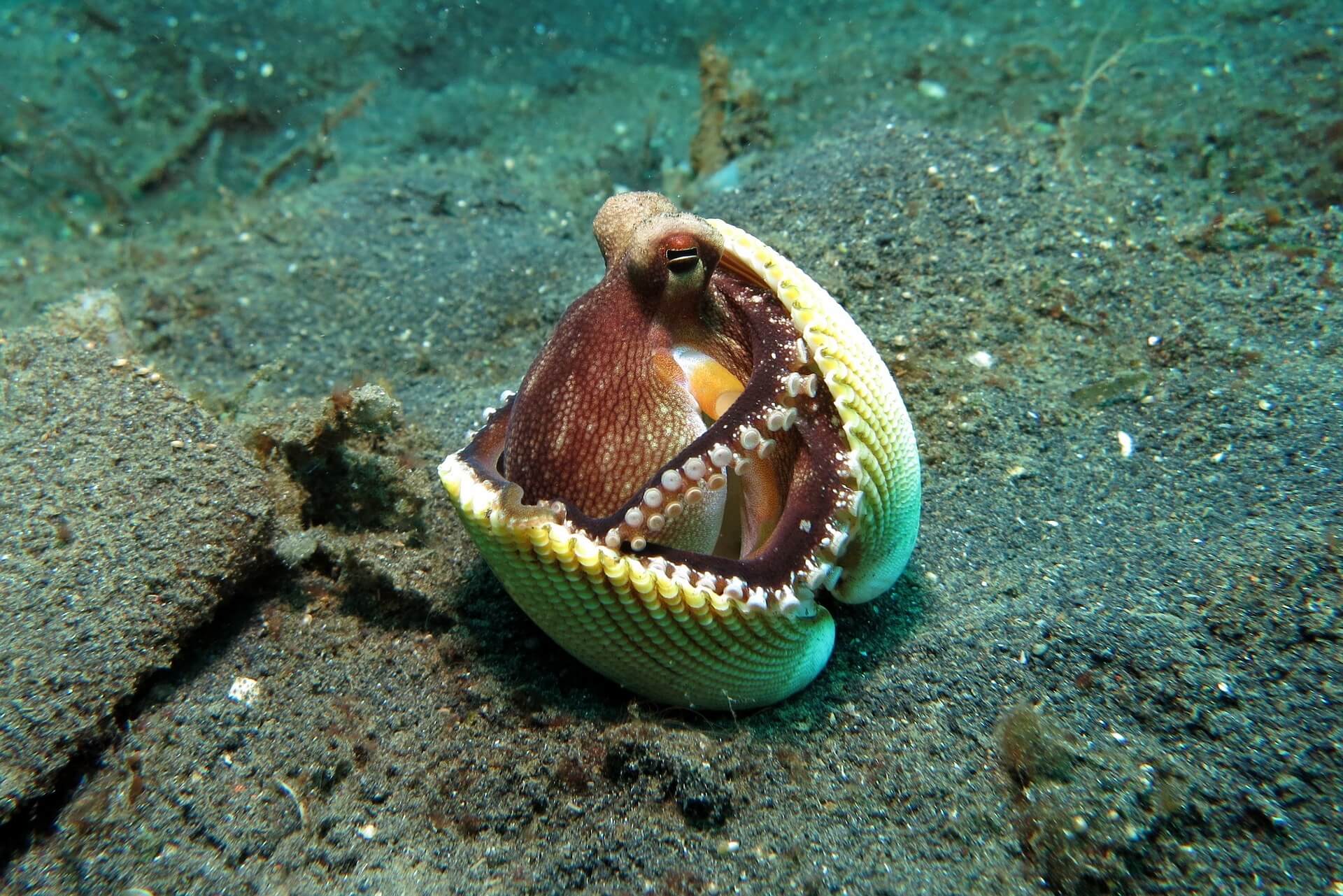
The intelligence of octopuses is well known, but did you know that they have been observed decorating their homes with pretty bits of glass, shells, and bottle tops? They’ve also been seen using tools and playing games! Octopuses have extremely sensitive skin for both touch sensation and chemical recognition. Their suckers are the equivalent of a tongue or fingertip, and the linings are regularly shed to maintain sensitivity to touch and taste. These brilliant beings are like us in so many ways that for most people, the thought of eating one alive is unimaginable.

However, Sik Gaek in Queens, New York, has for years insisted on serving octopuses and lobsters—another complex, misunderstood species also known to have the ability to experience great pain—still squirming on dinner plates, to those customers who find slowly hacking apart living, suffering animals to be appetizing. The restaurant even brags about this horrific practice on its website.

Sik Gaek needs to continue hearing from the compassionate public until it decides to join the 21st century and leave this barbarism behind. Please contact its management and tell them what you think!

After you’ve submitted the form, please also leave a comment on Sik Gaek’s Facebook page.

Please send polite comments to:

Sik Gaek
woodsidesikgaek@gmail.com

EMAIL SIK GAEK

SIK GAEK ON FACEBOOK

Please feel free to use our sample letter, but remember that using your own words is always more effective.

GET PETA UPDATES

FOLLOW US

ShareTweetDonate

GET PETA UPDATES

Stay up to date on the latest vegan trends and get breaking animal rights news delivered straight to your inbox!

https://www.peta.org/action/action-alerts/octopuses-new-york-restaurant/?utm_source=PETA::E-Mail&utm_medium=Alert&utm_campaign=0321::veg::PETA::E-Mail::Octopuses%20Devoured%20Alive%20at%20New%20York%20Restaurant::::aa%20em