The Egg Industry Grapples With a Grim Practice: Chick Culling

NEWS & FEATURESPRINT

REPUBLISH

After the U.S. egg industry missed its own deadline to eliminate the practice, some wonder when change will ever come.

Visual: Edwin Remsburg / VW Pics via Getty ImagesBY JONATHAN MOENS03.15.20210 COMMENTS

EVERY YEAR, up to 7 billion day-old male chicks are tossed into shredding machines, gassed, or suffocated in plastic bags — a process known as chick culling. This grim ritual is underpinned by both biology and economics: Male chicks don’t lay eggs, and they fatten up too slowly to be sold as meat. Across the globe, culling has become the default strategy for the egg industry to eliminate the unwanted hatchlings.

“It is horrible. You see these puffy, newly hatched chicks on a conveyor belt,” headed toward a large blade that slices them “into a gazillion pieces,” said Leah Garcés, president of Mercy for Animals, an animal rights advocacy group in the United States. In recent years, local and international animal rights groups, particularly in France, Germany, and the U.S., have been ramping up pressure on governments and the egg industry to commit to ending the practice — particularly given technological innovations that allow producers to identify the sex of a developing chick before it hatches. The process is called in-ovo sexing, and such technologies, versions of which are already deployed in some countries, can obviate the need for live chick culling.herd of cows on grassland during daytime

RELATED

Can Biotechnology Transform the Cattle Industry?

Nearly five years agoUnited Egg Producers, an agricultural co-operative whose members are responsible for producing more than 90 percent of all commercial eggs in the U.S., released a statement pledging to eliminate chick culling by 2020, or as soon as a “commercially available” and “economically feasible” technology became accessible. That pledge was negotiated with the Humane League, an animal rights nonprofit organization. But 2020 has come and gone, and while UEP’s pledge wasn’t legally binding, some egg industry leaders and scientists say there is little sign that the industry is anywhere near phasing in cull-free technologies that could still meet the colossal supply of more than 100 billion eggs produced every year in the U.S.

Part of the reason for the sluggish pace of change, critics say, is that the U.S. has been investing in and nurturing the development of sophisticated cull-free technologies that, while promising, remain expensive and could take several more years to develop, scale, and deploy across the nation — particularly given that the Covid-19 pandemic has shuttered labs and otherwise slowed the pace of innovation. Meanwhile, a method of in-ovo sexing of eggs is already being used in Europe — though some American stakeholders say that method, which involves creating a tiny hole in the eggshell with a laser, is sub-par, because it increases the risk of contamination. European developers dispute this, however, and as of this year, cull-free eggs are available in thousands of supermarkets in Germany, the Netherlands, Switzerland, and France with only modest additional costs to consumers and hatcheries.

What’s clear is that as the hunt for a solution drags on, the U.S.-based culling continues apace. “I don’t like false promises,” said Michael Sencer, executive vice president for Hidden Villa Ranch, a California-based food company that owns egg and dairy subsidiaries. Sencer expressed support for UEP’s pledge, but he acknowledged, “They’ve supported a number of groups that said they could come up with the technology and nothing has happened.”

UEP declined to be interviewed by Undark and instead provided a press statement highlighting its continued commitment to end culling. “We remain hopeful a breakthrough is on the horizon,” Chad Gregory, president and CEO of UEP, said in the statement.

Whether U.S.-based producers could be nudged by critics to explore existing technologies rather than pursue new ones remains unclear, but both animal rights groups and industry leaders agree that chick culling is not only cruel — it is wasteful. “I mean, name another industry where 50 percent of the finished product immediately goes to the garbage can,” said Jonathan Hoopes, president of Ovabrite, a Texas-based startup developing an in-ovo sexing technique. Incubating male eggs also takes up unnecessary space, energy, and money, making a solution to culling in the interest of both animal rights activists and egg producers.

“Forgetting the ethics of not killing all those birds, look at the money saving,” said Sencer, who estimated that the industry could save billions of dollars with the right technology. “It’s mind-boggling.”


SINCE THE 2016 statement, the largest funding initiative to eliminate chick culling has come from the Foundation for Food & Agriculture Research (FFAR), which launched the “Egg-Tech Prize” — a public-private research initiative that provides funding for scientists and startups seeking to develop in-ovo sexing technologies — with Open Philanthropy in 2019. Deploying such a technology would not only make chick culling obsolete, it would also allow the industry to repurpose unwanted male eggs for food, animal feed, or vaccine development.

In November of 2019, FFAR announced six finalists who received more than $2 million in total seed funding to develop sex identification technologies. Phase II of the competition will award up to $3.7 million for a single working prototype.

Animal rights groups and industry leaders agree that chick culling is not only cruel — it is wasteful.

According to Tim Kurt, FFAR’s scientific program director, the deadline for submissions has been pushed back due to Covid-19 delays and is now scheduled for spring 2022. However, the foundation could also decide not to fund any of the teams if they are not satisfied with the timeline. That’s a prospect Tom Turpen, a contender for the prize, says is a real possibility, especially given that at least some of the teams — his included — have experienced setbacks since the start of the pandemic. With travel restrictions and university laboratories shut down, access to data, equipment, and supplies has made it harder for teams to make progress on particular aspects of their projects, says Kurt.

Finalists, who were awarded between $396,000 and $1.1 million dollars each include startups and research laboratories with big, out-of-the-box ideas. This includes Orbem, a German startup that sexes chicks by combining high-speed scanning of eggs with AI technology, and SensIT Ventures, Inc., a California-based company, which Turpen heads, that uses a microchip to sex chicks by identifying gases emitted by eggs early in development. The selection team specifically funded projects that could potentially upend the egg industry, says Kurt.

The technologies that were selected have “the potential to really transform the industry,” said Kurt, who was involved in the selection. “They might be a bit higher risk, but if they were successful, and our funding could help them become successful, they would really be the most ideal solution.”

For all of Undark’s coverage of the global Covid-19 pandemic, please visit our extensive coronavirus archive.

Kurt and other industry leaders are optimistic that some of these technologies will help eliminate chick culling in the near future, but others are less hopeful. Changing current practices, Sencer said, would require “billions of dollars of investment in new equipment. And it’s just not going to happen [quickly], it’s happening slowly.” Sencer added that he predicts the technology may be scalable towards the end of the decade.

Even researchers competing in the Egg-Tech Prize themselves admit that, while a sexing technology may be on the horizon, cull-free eggs won’t be scalable for at least two more years. Turpen says the biggest obstacle lies in developing a technology that is not only capable of rapidly and accurately sexing chicks, but is also readily affordable to consumers and hatcheries across the nation.

“You could do a lot of things to identify the sex of the egg. That’s not the point. The point is: Can you do it and still have eggs people can afford to eat?”

To avoid a surge in costs that would inevitably arise from suddenly adopting a new mode of production, Turpen says a more likely and more reasonable path to scaling this nationally would be a slow and incremental process. “The adoption and replacement of existing equipment — that’s going to look more like making the coal industry go away.” That industry “is going away,” Turpen said, “but it’s going to be a long time.”

Other researchers in the Egg-Tech Prize have also made it clear that an all-encompassing solution to culling is not around the corner. Benjamin Schusser, whose research with colleagues at the Technical University of Munich turned into the spin-off company, Orbem, declined an interview, saying “we don’t want to awake[n] hope that there is a solution almost ready for market.” Pedro Gómez, the CEO and co-founder of Orbem said in a 2019 interview with Germany’s Federal Ministry for Economic Affairs and Energy, that they hope to “classify one billion eggs per year by 2025.”

While a sexing technology may be on the horizon, cull-free eggs won’t be scalable for at least two more years.

Given the mismatch in expectations, some are baffled by UEP’s ambitious commitments to stamping out culling. Hoopes says the industry has made similar pledges in the past and they failed to yield tangible results.

But David Coman-Hidy, president of the Humane League, considers the progress in research and development since 2016 a “major win,” and credits the UEP pledge with heightening awareness about a cruel and largely unheard-of practice while bolstering innovation in in-ovo sexing technologies. In fact, the Humane League saw the 2020 goal as somewhat flexible, says Coman-Hidy. “Back then, it was such early days, we didn’t know how quickly or how many companies would get involved or what the research would look like.”


MEANWHILE, COMMERCIALLY VIABLE, in-ovo sexing technologies already exist in Germany and France. And Germany is poised to become the first country to ban industrial culling of male chicks, after the government approved a draft law to end the practice from 2022 onwards.

Currently, a company based in Germany and the Netherlands called respeggt GmbH uses in-ovo sexing by creating a tiny hole into the egg using a laser, extracting fluids, and sexing the chick by testing for specific hormones, explains Kristin Hoeller, head of business development and public affairs for respeggt. The technique, known as Seleggt, is based on research by scientists at the University of Leipzig and further developed in collaboration with REWE, a German supermarket chain, and HatchTech, a Dutch technology company specializing in incubation and hatchery equipment.

The method can sort chicks on the ninth day of development, when it is “exceptionally unlikely” that chick embryos experience any sensations whatsoever, David Mellor, professor emeritus of animal welfare science and bioethics at Massey University in New Zealand, wrote in an email. This is a crucial detail given that chick embryos have the capacity to experience pain at later stages of development. A procedure that might cause harm, such as using the male egg for food or vaccine development, may simply be shifting the cruel practice to an earlier stage, says Peter Singer, an animal rights advocate and professor of bioethics at Princeton University.

“The adoption and replacement of existing equipment — that’s going to look more like making the coal industry go away,” said Turpen.

Using this method, respeggt now has cull-free eggs in more than 6,000 supermarkets across France, Germany, Switzerland, and the Netherlands, with hopes to expand further. They have also devised a ready-to-implement business strategy for producing commercial cull-free eggs. Hatcheries won’t have to invest anything, Hoeller said. Instead, costs will be passed onto centers where eggs are packed into cartons for commercial distribution. These packing stations will have to pay a license fee of around 2 Euro cents, about the same in U.S. currency, per egg. While respeggt plays no role in how supermarkets price eggs, the cost to consumers ranges between 2 and 5 Euro cents more per respeggt egg than regular ones.

Many U.S. experts, however, are concerned that creating a hole in the eggs could pose a serious food safety risk, given that it increases the chances of contamination from external sources. “It’s a risk that I think the industry would rather not take,” said Turpen. Kurt echoes this, saying that all finalists explicitly use non-invasive techniques to avoid this possibility. Focusing on non-invasive techniques also means they can be more easily repurposed for other scientific endeavors, such as vaccine development, he adds.

Hoeller disputes the suggestion that their technology poses an infection risk. “The perforation of the eggshell with the laser has no negative results at all,” she said, adding that the hole is so small it actually closes itself naturally within 30 minutes.

To be sure, some animal rights groups suggest that quibbling over a technological solution distracts from what they see as the real problem at hand: the egg industry itself. “Instead of putting a Band-Aid on a Band-Aid on a Band-Aid and trying to fix all these problems with more technology and more technology, here’s another idea: Why don’t we do plant-based eggs?” said Garcés. She and other animal rights activists point to food waste, animal suffering, and health-associated costs as reasons to divest money away from the egg industry to support companies that produce plant-based alternatives.

Short of that, though, other non-invasive egg sexing technologies have also been developed in Europe. Prior to the coronavirus pandemic, and amid pressure by the French government to ban culling by the end of 2021, Carrefoursupermarkets planned to launch their first round of cull-free eggs on May 1, 2020. However, experts note that this technology sexes chicks on the 13th day of development, a period where the chick fetus may experience pain. Anticipating these criticisms, the German company behind this technology, Agri Advanced Technologies GmbH, a subsidiary of EW Group, is currently developing another technology aimed at determining the sex of chicks on the fourth day of development.

While imperfect, Hoopes suggested that the existence of viable, up-and-running technologies in Europe raises questions about why the U.S. is taking a slower, more ambitious approach. But other experts speculate that the technologies being pursued in the U.S. may ultimately prove cheaper and more flexible in the long run. “You would think the simplest method of doing this would be the best,” said Singer. “But maybe for very large producers, the investment is worth it. Maybe it pays off in saving labor costs or other costs.”

At this point it’s not clear what the best strategy to eliminate culling is yet, says Singer, but he believes there is a moral imperative to at least try and stamp out the practice from hatcheries around the globe. It’s also important to continue to pressure the industry to change, he said, but change will require not only perseverance, but patience. “These things,” he said, “will take some time.”


Police seize hundreds of roosters in illegal cockfighting investigation

By 9News Staff8:44am Mar 12, 2021https://imasdk.googleapis.com/js/core/bridge3.446.1_en.html#goog_392972310Play VideoPolice seize hundreds of roosters in illegal cockfighting investigation

https://www.9news.com.au/national/police-seize-hundreds-of-roosters-cockfighting-investigation/34bf69a8-a4a6-4194-adb8-f5d7e49b7f55

Police and RSPCA inspectors have seized 540 roosters in Sydney as part of an investigation into an illegal cockfighting ring.The birds were confiscated after a raid on a property at at Horsley Park in the city’s west yesterday.Authorities found more than 540 fighting cockerels, roosters and chickens, as well as cockfighting paraphernalia.READ MORE:Koala survives attack that left her with horrific injuries

NSW Police and RSPCA inspectors seized hundreds of roosters during the raid. (NSW Police)

A crime scene was set up and will be maintained at the property today while RSPCA inspectors safely remove the animals.A man was detained by police and spoken to at the property before being released.The operation was part of an extensive police investigation into animal cruelty offences in Sydney’s south-west.

Illegal cockfighting equipment was found during the raid in western Sydney. (NSW Police)

YOU MAY ALSO LIKERecommended by4 Steps to Government Security: Investigate, Monitor, Analyze, Act.SPONSORED | SplunkLimited Time Offer – Bloomberg.com For Just $1.99SPONSORED | Bloomberg.com[Pics] Ancient Infant’s DNA Changes What We Know About North American HistorySPONSORED | EliteHeraldOn December 13 last year a police found a designated cockfighting area and several large sheds used to house 71 fighting cockerels, as well as metal spikes, spurs and other cockfighting paraphernalia at a property in Catherine Field.Police also seized $107,170 cash and several electronic devices from the premises.The animals were taken by RSPCA inspectors, with several requiring veterinary care for serious injuries.

Illegal cockfighting equipment was found during the raid in western Sydney. (NSW Police)

A 56-year-old man was taken into the custody of the Department of Home Affairs over his visa status, while 34 men were detained at the scene.The 34 men are next due to appear in court on April 1 over animal cruelty charges.Anyone with information should contact CrimeStoppers on 1800 333 000 or at CrimeStoppers.com.au

How early humans’ quest for food stoked the flames of evolution

The Banquet of the Monarchs, c1579, by Alonzo Sanchez Coello
The Banquet of the Monarchs, c1579, by Alonzo Sanchez Coello: ‘high food culture’ in the middle ages. Photograph: Album/Alamy

[The painting with the elephant being burned alive tells the whole story.]

https://www.theguardian.com/science/2021/mar/07/how-early-humans-quest-for-food-stoked-the-flames-of-evolution

A love of complex smells and flavours gave our ancestors an edge and stove pped hangoversDonna FergusonSun 7 Mar 2021 01.16 EST

279

Human evolution and exploration of the world were shaped by a hunger for tasty food – “a quest for deliciousness” – according to two leading academics.

Ancient humans who had the ability to smell and desire more complex aromas, and enjoy food and drink with a sour taste, gained evolutionary advantages over their less-discerning rivals, argue the authors of a new book about the part played by flavour in our development.

Some of the most significant inventions early humans made, such as stone tools and the controlled use of fire, were also partly driven by their pursuit of flavour and a preference for food they considered delicious, according to the new hypothesis.Advertisementhttps://5037925012011699e0d1c13b2cbcd914.safeframe.googlesyndication.com/safeframe/1-0-37/html/container.html

“This key moment when we decide whether or not to use fire has, at its core, just the tastiness of food and the pleasure it provides. That is the moment in which our ancestors confront a choice between cooking things and not cooking things,” said Rob Dunn, a professor of applied ecology at North Carolina State University. “And they chose flavour.”

Cooked food tasted more delicious than uncooked food – and that’s why we opted to continue cooking it, he says: not just because, as academics have argued, cooked roots and meat were easier and safer to digest, and rewarded us with more calories.

Some scientists think the controlled use of fire, which was probably adopted a million years ago, was central to human evolution and helped us to evolve bigger brains.

“Having a big brain becomes less costly when you free up more calories from your food by cooking it,” said Dunn, who co-wrote Delicious: The Evolution of Flavour and How it Made Us Human with Monica Sanchez, a medical anthropologist.Advertisementhttps://5037925012011699e0d1c13b2cbcd914.safeframe.googlesyndication.com/safeframe/1-0-37/html/container.html

However, accessing more calories was not the primary reason our ancestors decided to cook food. “Scientists often focus on what the eventual benefit is, rather than the immediate mechanism that allowed our ancestors to make the choice. We made the choice because of deliciousness. And then the eventual benefit was more calories and fewer pathogens.”

Human ancestors who preferred the taste of cooked meat over raw meat began to enjoy an evolutionary advantage over others. “In general, flavour rewards us for eating the things we’ve needed to eat in the past,” said Dunn.

In particular, people who evolved a preference for complex aromas are likely to have developed an evolutionary advantage, because the smell of cooked meat, for example, is much more complex than that of raw meat. “Meat goes from having tens of aromas to having hundreds of different aroma compounds,” said Dunn.

Prehistoric woolly mammoth hunters
Prehistoric woolly mammoth hunters. Photograph: North Wind Picture Archives/Alamy

This predilection for more complex aromas made early humans more likely to turn their noses up at old, rotten meat, which often has “really simple smells”. “They would have been less likely to eat that food,” said Dunn. “Retronasal olfaction is a super-important part of our flavour system.”

The legacy of humanity’s remarkable preference for food which has a multitude of aroma compounds is reflected in “high food culture” today, Dunn says. “It’s a food culture that really caters for our ability to appreciate these complexities of aroma. We’ve made this very expensive kind of cuisine that somehow fits into our ancient sensory ability.”Advertisement

Similarly, our proclivity for sour-tasting food and fermented beverages like beer and wine may stem from the evolutionary advantage that eating sour food and drink gave our ancestors.

“Most mammals have sour taste receptors,” said Dunn. “But in almost all of them, with very few exceptions, the sour taste is aversive – so most primates and other mammals, in general, will, if they taste something sour, spit it out. They don’t like it.”

Humans are among the few species that like sour, he says, another notable exception being pigs.

At some point, he thinks, humans’ and pigs’ sour taste receptors evolved to reward them if they found and ate decomposing food that tasted sour, especially if it also tasted a little sweet – because that is how acidic bacteria tastes. And that, in turn, is a sign that the food is fermenting, not putrefying.

“The acid produced by the bacteria kills off the pathogens in the rotten food. So we think that the sour taste on our tongue, and the way we appreciate it, actually may have served our ancestors as a kind of pH strip to know which of these fermented foods was safe,” said Dunn.

Human ancestors who were able to accurately identify rotting food that was actually fermenting, and therefore OK to eat, would have had an evolutionary advantage over others, he argues. If they also figured out how to safely ferment food to eat over winter, they further increased their food supply.

The negative consequence of this is that fermented, alcoholic fruit juice, a sort of “proto wine”, would also have tasted good – and that probably led to horrific hangovers.

“At some point, our ancestors evolved a version of the gene that produces the enzyme that breaks down alcohol in our bodies, which is 40 times faster than that of other primates,” added Dunn. “And so that really made our ancestors much more able to get the calories out of these fermented drinks, and it would also probably have lessened the extent to which they had hangovers every day from drinking.”Advertisementhttps://5037925012011699e0d1c13b2cbcd914.safeframe.googlesyndication.com/safeframe/1-0-37/html/container.html

Flavour also drove humanity to innovate and explore, Dunn says. He thinks one reason our ancestors were inspired to begin using tools was to get hold of otherwise inaccessible food that tasted delicious: “If you look at what chimpanzees use tools to get, it’s almost always really delicious things, like honey.”

Having a portfolio of tools that they could use to find tasty things to eatgave our ancestors the confidence to explore new environments, knowing they would be able to find food, whatever the season threw at them. “It really allows our ancestors to move out into the world and do new things.”

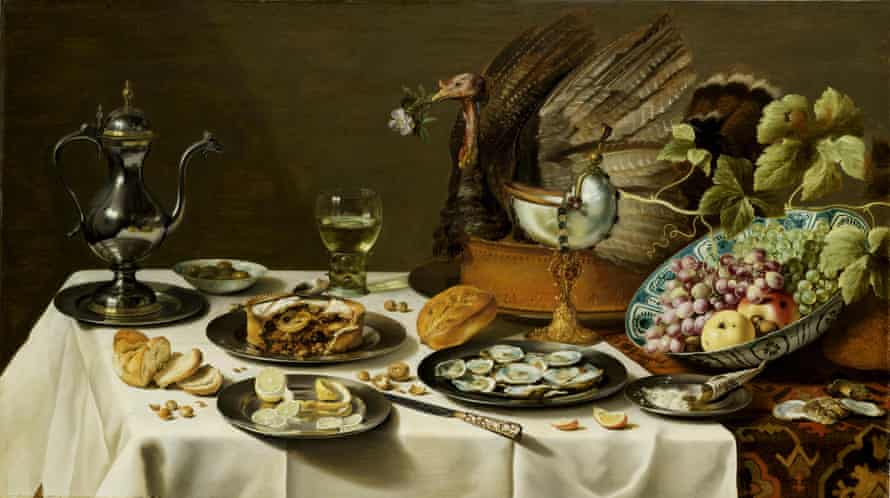
Still Life with a Turkey Pie, by Pieter Claesz, 1627.
Still Life with a Turkey Pie, by Pieter Claesz, 1627. Photograph: FineArt/Alamy

Stone tools in particular “fast-forward” the ability of humans to find delicious food. “Once they can hunt, using spears, they have access to this whole world of foods that were not available to them before.”

At this point, Dunn thinks humanity’s pursuit of tasty food started to have terrible consequences for other species. “We know that humans around the world hunted species to extinction, once they figured out how to hunt really effectively.”

Dunn strongly suspects that the mammals that first went extinct were the most delicious ones. “From what we were able to reconstruct, it looks like the mammoths, mastodons and giant sloths all would have been unusually tasty.”Paleolithic diet may not have been that ‘paleo’, scientists sayRead more

To replicate the eating habits of prehistoric humans, the book, published later this month, details how one scientist dropped a horse who had just died into a pond and assessed how it fermented over time. “He would sample some meat to see if it was safe to eat. He described it as delicious – a little bit like a blue cheese,” said Dunn.

TRACTOR SUPPLY:CRUELER THAN EVER TO BABY CHICKS

6 March 2021

Tractor Supply’s animal cruelty must be challenged.

https://upc-online.org/diet/210306_tractor_supply-crueler_than_ever_to_baby_chicks.html

Key West hen with chicks

Photo by Davida G. Breier. Tractor Supply chicks never experience the comfort and care of their own mother hen. They’re nothing but things for this company to make money from.

Dear Friends,

Since posting Protect Baby Chicks & Ducklings: Sign & Share Petition and Ducklings & Baby Chicks are NOT Easter Toys! Take Action! in late February, we’ve received emails from Tractor Supply visitors describing an increase in the cruelty of this company’s local stores, as summarized in the following email to United Poultry Concerns, March 5, 2021:

“I am not sure to whom I should file a complaint. Perhaps you can point me in the right direction. I went to Tractor Supply to pick up sunflower seeds and to my horror I saw baby chicks for sale in a new display that houses the chicks of different breeds stacked on top of each other and they are walking on wire mesh! It was very disturbing and quite different from how they were housed last year. There is no place for them to rest/sleep comfortably and they looked very stressed. Thank you very much for reading my email. Please let me know if there is anything I can do. I am a certified veterinary technician and understand farming and keeping chickens. This new setup at Tractor Supply is inhumane.”

What Can I Do?

  • Sign and share our Change.org petition to Tractor Supply, which includes direct contact information for the company CEO Hal Lawton. Sign & Share.
  • Contact Mr. Lawton and tell him what you saw at your local store. Tell him the situation is inhumane and that you will not shop at Tractor Supply until it is rectified.
  • Speak to the local store manager and urge that the store provide proper bedding, sheltered resting areas and other comforts for these suffering chicks.
  • Post a comment. Each Tractor Supply store appears to have its own local Facebook page where it is advertising baby chicks for sale.
  • Write a letter to the editor of your local newspaper(s) about this inhumane situation.
  • Alert your local humane society and urge them to intervene with the local Tractor Supply to help these chicks.

Tractor Supply and other farm supply stores are notoriously neglectful and indifferent toward the chicks and ducklings they display and sell each spring in thousands of local stores. This new way of keeping these baby birds, in stacked drawers on wire mesh, exceeds even the traditional inhumaneness. In addition, these stores are teaching customers by their example that such inhumane treatment is acceptable, thus encouraging buyers to imitate the abuse.

Sign the Petition

Thank you for taking action.
United Poultry Concerns

WHAT I WITNESSED INVESTIGATING FACTORY FARMS DURING THE PANDEMIC

WHAT I WITNESSED INVESTIGATING FACTORY FARMS DURING THE PANDEMIC
 By: Clément Martz  |   Reading time: 6 minutes
Out of all the countries, why did you choose Sweden? We are one of the countries with the highest animal welfare standards in the world,” the police officer asked while I was being interrogated after photographing the conditions inside a pig farm. “Is keeping pigs indoors, unable to see the daylight, crowded in tight dirty stalls while standing in their own excrement until they are sent to slaughter at 6 months of age considered high welfare standards?” I replied.
In the last year, I have been to countless Swedish farms, documenting these so-called “high welfare standards” during the pandemic. What I have witnessed and documented shows me that the way these animals are being treated is an immediate concern. Their conditions are shocking and seeing them for myself was an urgent wake-up call.

COVID-19 has affected farmed animals across the globe. Although the virus has largely been transmitted between humans, animals raised for food have still felt the consequences. 

From animals being buried and burnt alive to slowed operations in slaughterhouses and worsening conditions in the West, millions of farmed animals are also victims of this pandemic.

In Sweden like most other countries in the world, factory-farmed animals are raised for food in confined and overcrowded conditions. According to the Swedish Board of Agriculture, Sweden has 63,000 farms and over 50 percent of Swedish farms have animal production. 

Each year, Sweden produces:2.6 million pigs100 million chickens8 million egg-laying hens290,000 tonnes (over 319,600 US tons) of cow’s milk
INVESTIGATING FARMS AROUND THE WORLD 

Animal agriculture keeps hidden the daily treatment of farmed animals. Hearing—and seeing—directly from undercover investigators what they have witnessed inside factory farms is a powerful eye-opener. Here at Sentient Media, we’re making sure their stories are told:The Forgotten Victims of Factory Farming: Lex Rigby, Head of Investigations at UK nonprofit Viva!, writes that fish farming is “the world’s fastest-growing food production sector, generating over half of the fish filling our supermarket shelves.”

“As with land-based factory farms, conditions on fish farms cannot easily replicate the complexities of an animal’s natural environment—leading to increasing concerns regarding their welfare,” writes Rigby.

Later this month, Rigby will join Pulitzer Prize winner Ian Urbina and undercover investigator Pete Paxton to talk about the impacts of industrial fishing in our next Sentient Session: Reporting Life at Sea. Learn more and register here.
 What a Dairy Farm Really Looks Like: “I remember their eyelashes,” writes Natalie Blanton, recalling the calves she met in childhood in Utah, growing up around “idyllic” dairy farms—and the realizations that led her to stop consuming dairy.

“As I matured, and after enough games of hide-and-go-seek among these rows of sheds housing tiny young calves,  I started to piece together a more sinister cycle taking place. It was a gradual tugging on threads of understanding, an unraveling of a dark truth behind those happy cows on those happy milk cartons,” she writes. 
 Stepping Out From Behind the Camera: After many years spent documenting factory farming, Gemunu de Silva now leads Tracks Investigations, an organization with over 250 investigations under its belt. 

“For such a staple of the animal advocacy world, Gem and Tracks have flown surprisingly under the radar. But that is by design. Up until this year, Gem avoided doing press, leaving it to the NGOs to draw the media’s attention to the cruelties his investigations exposed. It is only as the pandemic has forced a hiatus on the majority of Tracks’ projects that Gem has begun telling the stories of his decades-long career,” writes Claire Hamlett. 
 Helping Others Expose Animal Abuse: Now leading the investigations department at Animal Outlook, Erin Wing was once an investigator too, drawn to taking action for farmed animals after experiencing trauma and abuse herself. She shares what she saw inside factory farms, including a dairy farm where, she writes, “I reached the limit of what I could endure.”

“There, brutal violence was a daily occurrence. The last effort that I felt I owed to the animals before retiring from the field for good was holding out at Dick Van Dam Dairy for a few more weeks so I could rescue a newborn calf named Samuel. I found comfort in the fact that we escaped the dark world of factory farming together,” writes Wing.
Read more from Sentient Media.

A rooster stabbed a man to death with a knife during a cockfight

jgerstein@businessinsider.com (Julie Gerstein)  13 hrs ago

A rooster stabbed a man to death with a knife during a cockfight (msn.com)


How soon might you receive a $1,400 stimulus check?Sarah Lawrence student seen as cult victim is now chargeda person holding a bird: People place a knife to a rooster's leg before a cockfight at The Tampak Siring Temple in Bali, Indonesia on January 18, 2018. Cockfight is an old tradition in Balinese Hinduism. It is a part of the Tabuh Rah ritual, a religious purification to expel evil spirit through animal sacrifice via the blood of the roosters. Cockfights without a religious purpose are considered gambling in Indonesia. Mahendra Moonstar/Anadolu Agency/Getty Images© Provided by INSIDER People place a knife to a rooster’s leg before a cockfight at The Tampak Siring Temple in Bali, Indonesia on January 18, 2018. Cockfight is an old tradition in Balinese Hinduism. It is a part of the Tabuh Rah ritual, a religious purification to expel evil spirit through animal sacrifice via the blood of the roosters. Cockfights without a religious purpose are considered gambling in Indonesia. Mahendra Moonstar/Anadolu Agency/Getty Images
  • An Indian man died after being stabbed by a rooster he was training for cockfighting.
  • The rooster had been outfitted with a three-inch knife on its leg.
  • Though cockfighting is illegal in most countries, it continues to attract fans.
  • Visit Insider’s homepage for more stories.

A rooster fitted with a knife around its foot stabbed its owner to death during practice for an illegal cockfight in India.https://www.dianomi.com/smartads.epl?id=3533

Thangulla Satish, 45, died of blood loss after the rooster repeatedly stabbed him in the groin with a three-inch knife that had been tied around the animal’s leg, according to the Associated Press

Satish was among 16 people organizing the cockfight in the village of Lothunur in the Indian state of Telegana, the AP reported.

Authorities are currently searching for the other 15 organizers, who could be charged with manslaughter. They each face up to two years in prison, according to Al-Jazeera

Animal rights activists say the sport is especially cruel because it takes advantage of the birds’ natural survival mechanisms in forcing them to fight.

To make matches gorier, some cockfighting trainers fit their birds with what’s known as a “gaff” – a long, dagger-like knife attached to the animal’s foot. Birds often will have many of their feathers plucked out before matches to make it more difficult for their opponents to attack, according to the ASPCA.

They are also sometimes drugged with methamphetamines to enhance their aggressiveness.

Even birds that win their matches often suffer injuries so severe that they, too, are killed. 

Despite India’s Supreme Court outlawing the practice in the 1960s, cockfighting continues to be popular in many of the country’s southern states.

In the US, cockfighting is considered a felony in 42 states, though federal authorities continue to regularly break up fighting rings around the country. In August of last year, the Los Angeles Sheriff’s Department busted a ring with more than 2,000 birds, USA Today reported.

Authorities in New York – in a 2014 sting they dubbed “Operation Angry Birds” – arrested more than 70 people and confiscated more than 3,000 birds, the New York Post reported

This is not the first time a bird handler has been killed by a gamecock. Last year, a 55-year-old Indian man from Andhra Pradesh died after a gamecock slashed him in the neck and abdomen during a match held to mark the Hindu festival of Makar Sankranti. And in 2018, a 34-year-old man from Rajavaram, India, bled to death after a rooster gaff pierced his thigh and testicles. 

A Ban on Mail Order Chicks?

FEB 22, 2021Tove Danovich

New York legislators are considering a bill that would prohibit shipping live animals within the state.A new bill proposes banning mail order chicks in New York.Photography by Stephanie Frey via Shutterstock773SHARES

There are a lot of ways to look forward to a long winter’s end. For some people, it’s the arrival of tulips and daffodils. For others, it’s the song of nesting birds. But for many, there’s only one kind of spring fever they know—baby chick season. The United States Postal Service has been shipping chicks through the mail since 1918 and, until last summer, there’s only ever been a small contingent of people speaking out against it. Generally speaking, people either don’t know that hundreds of thousands of chicks are shipped every year to farms and individuals through the USPS or they’re the ones ordering them.

That changed when an article from the Portland Press Herald went viral in August 2020 and detailed how at least 4,800 chicks had died on the way to farms in Maine. Service cuts and delays at the USPS were largely blamed, but the issue of whether live animals should be shipped at all started attracting the attention of lawmakers. Earlier this month, Linda Rosenthal, a New York State assembly member from Manhattan, introduced a bill that would end the shipment of any live animals by mail into or within her state. In addition to day-old poultry, the bill would also impact the reptile trade, which frequently relies on the mail to move animals. 

In the current version of the bill, each animal shipped would be counted as a separate offense—each punishable by a civil penalty of up to $1,000. That bill was referred to the agriculture committee where it seems unlikely to make much progress as written. This is because the USPS is a federal agency regulated by the constitution and, therefore, state bans can’t override federal law, says Kimberly Frum, a postal service spokesperson. 

Since news of  the bill started spreading through farming, hatchery and backyard chicken committees, lawmakers have heard from many businesses and individuals who are concerned about how a ban on shipping chicks could affect them. Catherine Raleigh-Boylan, a co-owner of Raleigh’s Poultry Farm in Kings Park, New York, says not having access to day-old chicks would affect her business drastically.

“It wouldn’t be cost effective at all,” she tells Modern Farmer. Raleigh-Boylan says that, even in 2020, she’s never had an issue with shipments from the post office to her farm—which was started by her parents and has been ordering chicks by mail for 60 years. “You might lose one or two out of two-hundred. The rest are always healthy,” she says.

While large, vertically integrated companies such as Tyson Foods have their own hatcheries and truck chicks between them and the farms that raise poultry for meat, most small farmers rely on getting multiple shipments of chicks in the mail throughout the year. Many individuals who raise chickens choose to buy them from local farm stores rather than through the mail, but the vast majority of those farm stores also get their chicks in large shipments through the USPS. Of course, those who don’t live close enough to a hatchery to pick up chicks in person could always order fertilized hatching eggs through the mail,  but this would require buying an incubator and—if the owner wanted to vaccinate their chicks—doing it themselves despite the fact that most vaccines are only sold in batches between 500 and 10,000 doses. 

Many farmers have a similar story to that of Raleigh-Boylan. John Metzer, the owner of Metzer Farms, a California hatchery, says he thinks the post office does a good job overall. “But, sometimes, somebody makes a mistake and puts the chicks on the wrong truck or forgets to take it off. It’s a human error thing,” says Metzer, who is also a board member of a group of hatchery owners called the Bird Shippers of America. Industry wisdom dictates that chicks are okay as long as they arrive at their final destination within 72 hours of their hatch date. Chicks absorb the yolk in their egg before hatching, which gives them enough nutrition that, in nature, they won’t starve to death while the rest of the hen’s clutch of eggs hatch; some always take longer than others. This is the basic principle that allows the mail order chick business to exist. Metzer says that 90 percent of his chicks get where they’re going within two days and the rest in three.

“The fact that they can not starve to death and die of dehydration in a 72-hour period does not make it humane,” says Karen Davis, founder of United Poultry Concerns, an animal rights organization that focuses on poultry. She raises the point that because hatchery chicks are incubated en masse—and do hatch at different times—a chick that’s part of the “Monday” group didn’t necessarily hatch on Monday morning. “Seventy-two hours from when? When they’re put in shipping boxes or when they’re taken to a truck?” she says. If they have to be shipped at all, Davis would like to see chicks reach their final destination within 24 hours of hatching, although she doesn’t see an easy way to enforce it. There doesn’t seem to be any scientific research on how far apart chicks actually hatch on average under a hen and, therefore, how long chicks usually go without food or water after hatching in nature. 

It’s clear that many farmers and backyard chicken keepers want the shipment of day-old chicks to continue. And, other than this summer, it’s not an issue that’s gotten a lot of attention even among the animal welfare community. “There’s so much to attend to as far as farmed animals are concerned,” Davis says. “You can go into a [factory farm] and videotape and document what’s going on there and show it on the internet, but you can’t really do that when the birds are in a cargo area of an airplane.” And other than dying on the way to their destinations, chicks don’t have a lot of ways to communicate how they feel about the experience of being shipped in the mail in a cardboard box. The wisdom thus far has seemed to be: As long as they arrive alive, the system is working. 

But even within the industry, not everyone agrees that shipping day-old chicks should continue as is. “I think it’s ridiculous I can buy light bulbs and get them overnighted from China, but I put a baby chick on a plane and then get told it will be two to three days and no guarantee on that,” says Tom Watkins, vice president of Murray McMurray hatchery in Iowa. He thinks there’s a real need for kind and compassionate animal transportation. “I care very much about the chicks. Things are not ideal. While even [in] the best of circumstances not every chick will make it, we need to give them a fighting chance,” he says.

The chick shipping season generally goes from February through October, months that—especially lately—are full of winter snowstorms or heat waves, both of which can be deadly to chicks. Either the chicks can die from overheating or freezing or because of postal delays that take the chicks far beyond the 72-hour period. In mid-February 2021, winter storms were so severe that the USPS actually suspended the shipment of all live animals from February 12 through February 16. Because of the dates, it may not have had much of an effect on chicks (they usually ship on Monday or Tuesday), but, generally speaking, if the post office isn’t shipping chicks, it doesn’t mean the chicks aren’t hatching. Commercial hatcheries may be able to slightly delay hatching with advanced notice, but they certainly don’t have the resources to care for all the surprise chicks. (Hatcheries also can’t hold on to them and ship them a week later since the USPS only accepts day-old and adult birds.) MyPetChicken, a hatchery popular with backyard keepers, announced it was suspending chick shipments for the week of February 15 and “would use as many as possible” as six-week-old birds or perhaps put them back into their breeding program.

The 4,800 chicks that died in Maine got a lot of press thanks to the way they fit into the narrative about USPS delays over the summer. Regular—and some might say predictable—losses from the weather or chicks that are too weak after a long delay between hatching and getting into a heated brooder easily cause more deaths every year. 

A farm store employee in the Pacific Northwest tells Modern Farmer that her store had an order of a few hundred chicks, hatched Tuesday, February 9 and set to arrive by Friday—before the USPS restriction on live animal shipment went into effect. Modern Farmer is not identifying the employee as she was not authorized to speak to the press about her job. The chicks got stuck on the way there because of the winter storm in the region. Between the delay and the long weekend, there’s no way that the chicks would make it to their final destination alive. “Other stores had non-arrival and delay notices, too,” she says. The number of chicks that don’t make it in time can add up quickly when multiplied across farm stores and personal orders throughout a weather-affected region.

She adds that February cold snaps are common and are why she never orders chicks this early. She also avoids even incubating them at home due to the risk of the power going out and the chicks’ heat source with it. “I’d prefer to see them start shipping in March when the temperatures don’t seem to be quite as extreme,” she says, adding that she wished more hatcheries had a policy of not shipping during weeks with a federal holiday. “Unfortunately, consumer demand drives us to purchase and ship them this early.” And since the pandemic started, that demand has skyrocketed.

North Carolina man faces a dozen animal cruelty charges after 12 dogs seized from home

NEWS

by: Nexstar Media WirePosted: Feb 23, 2021 / 06:31 AM EST / Updated: Feb 23, 2021 / 06:31 AM EST

Courtesy: Robeson County Sheriff’s Office

PEMBROKE, N.C. (WBTW) – A Pembroke man is facing twelve misdemeanor cruelty to animals charges after a dozen dogs were seized from a home in Robeson County.

Deputies with the Robeson County Sheriff’s Office say Nehemiah Pate, 25, was arrested Monday. Deputies were tipped off by a community member about the living conditions and malnourishment of several dogs at Pate’s home on Ottmus Road.North Carolina woman accused of stabbing man, breathing in deputy’s face after saying she tested positive for COVID 

The dogs were rescued and transported to local veterinarian hospitals for treatment and care. The sheriff’s office provided photos of the dogs.

  • Courtesy: Robeson County Sheriff’s OfficeRead More »
  • Courtesy: Robeson County Sheriff’s OfficeRead More »
  • Courtesy: Robeson County Sheriff’s OfficeRead More »
  • Courtesy: Robeson County Sheriff’s OfficeRead More »
  • Courtesy: Robeson County Sheriff’s OfficeRead More »
  • Courtesy: Robeson County Sheriff’s OfficeRead More »
  • Courtesy: Robeson County Sheriff’s OfficeRead More »
  • Courtesy: Robeson County Sheriff’s OfficeRead More »

Courtesy: Robeson County Sheriff’s OfficeRead More »

“There is no excuse for animal cruelty,” Sheriff Burnis Wilkins said. “Animals can’t express their feelings but when abuse is recognized, we must become their voice.” Sheriff Wilkins also called the case “horrific”.

Anyone with information about the case or other cases of animal cruelty is asked to contact the Robeson County Sheriff’s Office at (910) 671-3170 or (910) 671-3100.

There’s No Such Thing as “Wounding” a Deer With Your Car

May be an image of deer, food and nature
Text and photos by Jim Robertson

If you’re barreling down the road safely behind the wheel of your carbon-spewing steel-cage-contraption and “clip,” “wing” or “sideswipe” a soft-bodied deer trying to cross one of the ubiquitous roadways, even if it hobbles away looking “okay” you killed the poor creature. Maybe not outright and maybe not today, but you can bet that he or she won’t make it through too many cold nights without succumbing to his or her injuries.

The fact is, there are just far too many cars, driving far too fast for conditions (which include marked or unmarked deer crossings) for any semblance of sanity.

Just this morning, I had the displeasure of having to “put down” a wounded deer who had been staying in our hay shed for the past two nights. I knew he (one of his antlers was lost when the car or truck hit him) was wounded, but it wasn’t until he limped off yesterday morning dragging his broken and mangled hind leg that I knew for certain he had no hope of any natural recovery. The bone was protruding from the compound fracture which would never heal right on its own—and no vet around here would treat an injured deer since this county fancies itself a “trophy” mule deer area and deer are just a “resource.”

As much as I hate to take the life of any animal, I was forced to do what the deer ultimately wanted of me and end his suffering as quickly and humanely as possible. After the deed (I shot using a high-powered rifle with a scope through the open bathroom window), my wife and I rolled his lifeless body onto a tarp and slid it across the snow to a safe spot for scavengers to feed.

“Roadkill” is so prevalent in this valley that signs have been placed at either end of the highways leading into what should just be a deer wintering range warning motorists that the annual tally of deer deaths are 150+ (that figure updated yearly). But more ominous to most drivers is the estimated cost repairing their precious vehicles. Still, no dollar-value or loss of non-human life would convince most drivers they should change the speed limit to 25 or 35 miles-per-hour (as it’s marked and enforced through the towns).

I’m sure it would be considered heresy these days to demand an enforced 45 mph daytime speed limit on any highway bisecting any deer winter range, but that’s the kind of “extreme” step we’ll have to take if we want to go on using the name homo sapiens, meaning “intelligent ape,” and not be demoted to something reflecting recklessness or self-centered-ness—something like homo erraticus, homo psychopathicus, homo drive-too-fasticus or whatever type of homo scientists deem appropriate.

May be an image of deer and nature

Animal rights activists lambaste Costco supplier over its rotisserie chickens

20 hours ago

The poultry supplier is accused of having ‘large piles of dead, rotting animals’

By Daniella GenoveseFOXBusinesshttps://static.foxnews.com/static/orion/html/video/iframe/vod.html?v=20210209231724#uid=fnc-embed-1

Fox Business Flash top headlines for February 9

Fox Business Flash top headlines are here. Check out what’s clicking on FoxBusiness.com.

Costco-owned slaughterhouse is being accused of engaging in “cruel” animal practices including cramming chickens into “filthy sheds” and breeding them to grow to an unnatural weight.

An undercover investigation allegedly revealed how Lincoln Premium Poultry’s practices directly contrast “Costco’s claim that animal welfare is a critical component” of its chicken supply chain, according to Animal rights group Mercy for Animals “Revealing the hidden price of Costco chicken” investigation.

Representatives for Lincoln Premium Poultry did not immediately return FOX Business’ request for comment.

In 2019, farmers began raising chickens for the Nebraska slaughterhouse which supplies the wholesale club with many of the tens of millions of rotisserie chickens it sells each year, Mercy said.

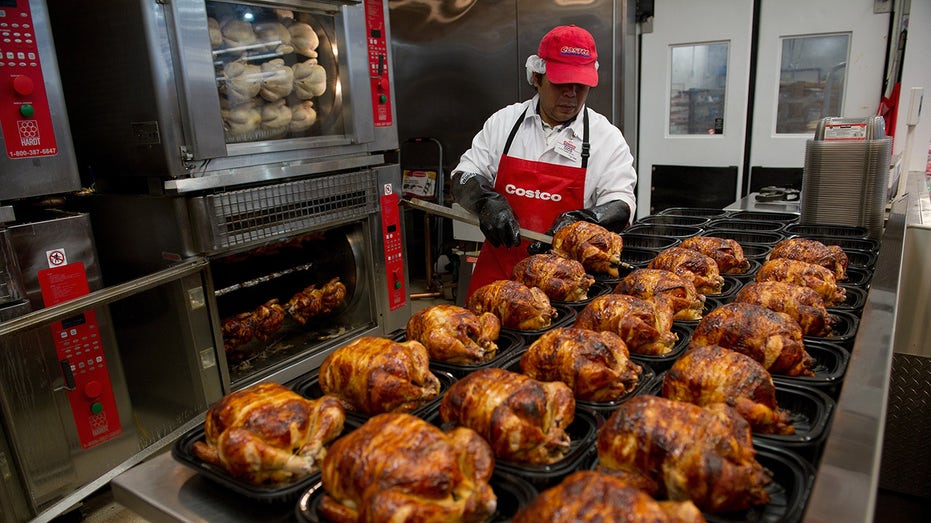
Dios Ruiz, a service deli worker for Costco Wholesale Corp., places cooked rotisserie chickens in containers at a store in San Francisco, California, U.S., on Tuesday, Dec. 6, 2011. Costco Wholesale Corp., a wholesale membership warehouse company, is (David Paul Morris/Bloomberg via Getty Images)https://www.credible.com/partners-widgets/credit-card/rich-cta/?variation=interactive&theme=fox&credclid=abd3fbe6-22c0-4d39-90ec-3a324f3fc376&pageUrl=https%3A%2F%2Fwww.foxbusiness.com%2Flifestyle%2Fcostco-rotisserie-chicken-animal-rights

One year later, the animal’s rights group said it discovered “large piles of dead, rotting animals” on the facility’s grounds outside the barns which housed live chickens.

“Costco members deserve to know the truth about where their chickens come from and how Costco is failing to live up to the animal welfare standards members expect and the company claims to support,” the group said.

Additionally, an undercover investigator captured animals being forced to live for weeks in their own waste while being raised to “grow so large so fast that they often cannot support their weight.” The animals allegedly struggle to walk and “many die from organ failure,” the group said.

COSTCO DROPS COCONUT MILK BRAND FOLLOWING ALLEGATIONS OF FORCED MONKEY LABOR, PETA SAYS

Aside from the terrible living conditions, the investigator allegedly witnessed “countless birds with open wounds, ammonia burns, broken bones, and twisted necks and beaks,” the group said.

Costco told FOX Business that “independent audits are regularly performed to ensure all parties are consistently in compliance” and that Costco and Lincoln will “use the results of our audits as well as other sources of information, including this video” to further improve its animal welfare processes.

“Costco is committed to maintaining the highest standards of animal welfare, humane processes and ethical conduct throughout the supply chain,” the company said in a statement. “Lincoln Premium Poultry (LPP) shares our commitment, as do the independent growers selected for the program who have been carefully chosen based on our mutual business philosophies.”

Mercy for Animals says Costco has the “power to implement meaningful animal welfare requirements for these farms” and is urging the company to take action.

GET FOX BUSINESS ON THE GO BY CLICKING HERE

According to Mercy for Animals, over 200 companies have already adopted Better Chicken Commitment standards which “ban the worst cruelty from their operations” and so far, “Costco has failed to do the same.”