PETA Will Praise Shoppers Who Save Animals and Protect Slaughterhouse Workers by Buying Vegan Foods
For Immediate Release: July 15, 2020
Contact: Brooke Rossi 202-483-7382
Seattle – Slaughterhouse Shame Month continues on Thursday with a PETA protest outside QFC, where the group’s supporters will stand with paper bags over their heads that read, “Meat Shame,” and shirts that say, “I Bought Meat and a Slaughterhouse Worker Died From COVID-19” or “I Bought Meat and an Animal Was Killed for It.”
When: Thursday, July 16, 12 noon
Where: QFC, 1401 Broadway, Seattle
Other PETA supporters will offer shoppers a choice of two bags: a nice tote sporting the words “I Care About Animals and Workers. I Buy Vegan Foods” or a paper bag that states, “I Don’t Care About Animals or Workers. I Buy Meat.” The group notes that confining and killing animals for food has been linked to SARS, swine flu, bird flu, and COVID-19—and a new strain of swine flu with “pandemic potential” is now spreading from pigs to humans in China.
“Anyone who is still supporting slaughterhouses, where animals’ throats are slit and more than 35,000 workers have tested positive for COVID-19, should be ashamed,” says PETA Executive Vice President Tracy Reiman. “PETA is urging everyone to practice compassion by choosing only delicious, healthy, and versatile vegan foods that never caused a pandemic.”
PETA—whose motto reads, in part, that “animals are not ours to eat”—opposes speciesism, which is a human-supremacist worldview. For more information, please visit PETA.org.
By Kitty Block and Sara Amundson July 16, 2020In our video, a former big lick trainer says that “without some type of soring, they’re not going to do the big lick.” What that means, essentially, is that a horse who is not sored would not have a chance of winning at the Celebration or any big lick walking horse event. Photo by the HSUSTrainers who paint horses’ legs with harsh acids and chemicals that burn through the skin, causing unspeakable pain to the animals, then add heavy shoes and tie chains on top of those wounds to intensify their suffering. Trainers who hit horses with sticks and shove electric prods in their faces to get them to do what they want. Trainers who drag and force horses to stand when they are hurting too much to do so.A video we are releasing today presents some shocking scenes from the Humane Society of the United States’ undercover investigations of the Tennessee walking horse industry. Above all, it shows the abject cruelty visited upon the animals to get them to perform an artificial, high-stepping gait called the “big lick” at competitions by “soring” the animals.It is some of the worst animal abuse you will see, but here’s the kicker: it has been allowed to continue for half a century with very little to no accountability for those who break the law.Even now, as the nation reels under a pandemic, the big lick segment of the industry, after several months of forced shutdowns, is returning to business as usual. Preparations for the annual Tennessee Walking Horse National Celebration at an arena in Shelbyville, Tennessee, to be held between August 26 and September 5, appear to be on in full swing, despite a reported increase in coronavirus cases in Bedford County, which is home to Shelbyville.The only acknowledgement of the coronavirus threat was the organizers noted in their press release that they felt it “prudent to select two alternates for this year’s show in case any of the five initial selections were to fall ill and be forced to quarantine.”Such callousness is not surprising in an industry that has always put winning ribbons above animal welfare. The Celebration has, in recent years, been little more than a showcase for some of the industry’s worst offenders, and there’s little reason to think that it will be any different this year. In our video, a former big lick trainer says that “without some type of soring, they’re not going to do the big lick.” What that means, essentially, is that a horse who is not sored would not have a chance of winning at the Celebration or any big lick walking horse event.What has made it easier for these animal abusers to get away with their misdeeds is the increasingly lax enforcement of the Horse Protection Act by the U.S. Department of Agriculture under the Trump administration. The USDA is charged by Congress with the job of inspecting horses at shows to ensure they have not been sored. But as we have been reporting, the number of citations and enforcement under the law has plummeted in recent years. The USDA has also repeatedly stated that the industry’s self-run inspection programs should be the primary line for enforcing the HPA.Not surprisingly, those industry groups—riddled with conflicts of interest—rarely, if ever, cite violations or issue penalties, and even allow participants to keep their prizes and titles if they’re found in violation after their wins. Making matters worse, the rider/trainers of the top three placing horses in the Celebration’s World Grand Championship class last year were all slated to begin federal disqualifications after they were allowed to compete. One doesn’t even begin his USDA-set disqualification until after this year’s Celebration, and another, after the 2022 show.The administration has taken other steps to facilitate the scofflaws. In 2017, the Trump administration withdrew a federal rule that had broad bipartisan support and was finalized in the last week of the Obama administration. That rule would have ended walking horse industry self-regulation and banned the use of the torture devices that are integral to the soring process. The HSUS and Humane Society Legislative Fund are suing the agency for withdrawing the rule.Congress remains our only hope now if we are to stop this abuse swiftly, and a sweeping majority there, cutting across party lines, is eager to end soring.Last year, in a historic vote, the House voted to pass the Prevent All Soring Tactics (PAST) Act by an overwhelming margin of 333 to 96. The bill would ban the use of devices integral to the soring process, end the industry’s failed system of self-policing, and significantly increase penalties for violators. Recently, the House Appropriations Committee also voted to double funding for HPA enforcement in FY 2021.The PAST Act has a bipartisan majority of 52 cosponsors in the Senate but it has languished in the upper chamber for months now because some senators, including Senate Majority Leader Mitch McConnell, are co-sponsoring competing legislation, introduced by Sen. Lamar Alexander, R-Tenn., and supported by those engaged in horse soring, which allows the industry to continue policing itself with no accountability and no restriction on the use of soring devices or tougher penalties.The HSUS and HSLF have long shined the spotlight on soring, and we won’t stop until it’s stamped out for good. As the cruelty on display in our video shows, it is high time for our elected leaders to stop giving cover to those who break the law and bring the PAST Act to a vote on the Senate floor. Please contact your senators to urge them to cosponsor the PAST Act, S. 1007, and do all they can to help secure swift passage of this crucial bill. It’s the only solution now before us to end the gruesome and archaic practice of soring that has caused so much unnecessary suffering for so many horses, all in the name of “entertainment” and for the sake of a ribbon.Sara Amundson is president of the Humane Society Legislative Fund.The post HSUS/HSLF video lays bare the terrible practice of soring, as industry prepares for annual walking horse ‘Celebration’ appeared first on A Humane World.Related StoriesHSUS/HSLF video lays bare the terrible practice of soring as industry prepares for annual walking horse ‘Celebration’HSUS/HSLF video lays bare the terrible practice of soring as industry prepares for annual walking horse ‘Celebration’ – EnclosureSouth Carolina pet owners sue Petland for selling them sick puppies
For Immediate Release: July 16, 2020Contact: Randi Feilich, Project Coyote Southern Cal. Rep. (310) 498-2975, rfeilich@projectcoyote.org Camilla Fox, Project Coyote Executive Director Incident Under Criminal Investigation ~ Wildlife Protection Organizations Call for Justice VALLEY VILLAGE, CA—California-based Project Coyote has released a video depicting a coyote pup captured in an illegally set leghold trap in the upscale neighborhood of Valley Village (adjacent to North Hollywood), and law enforcement agencies are currently investigating the incident for possible criminal violations.The video shows—in graphic detail—the coyote pup struggling in the trap, desperate to free itself, with no cover in the searing summer heat on the Fourth of July weekend when illegal fireworks and firecrackers no doubt terrorized the trapped pup further. According to neighbors, the pup likely suffered in the trap for days before local residents heard him crying. The animal’s injuries were so severe that he had to be euthanized by LA Animal Services.The coyote was trapped through a GoFundMe campaign organized by Valley Village resident Lisa Johnson Mandell who solicited money from neighbors for “humane wildlife removal.” “This was a reprehensible act of animal cruelty to a young coyote pup, separated from his mother, dying in a slow painful death,” said Project Coyote Southern California Representative Randi Feilich, and added, “Neighbors are shocked to learn that donations were used to hire a trapper to set cruel, indiscriminate and illegal leghold traps.” The GoFundMe page has since been deleted.The trapper is believed to have violated multiple state laws and is now under investigation by Los Angeles Animal Cruelty Task Force and the California Department of Wildlife. “Leghold traps were banned by California voters in 1998 so this trap set is clearly in violation of that law,” said Camilla Fox, Project Coyote Founder and Executive Director. “Moreover, California law requires that trappers check their traps daily and obtain written permission from property owners when setting traps less than 150 yards from a residence, which this trapper clearly failed to do.””Despite a state law banning leghold traps, many private trappers and ‘pest’ control businesses continue to use them in clear violation of the law,” said Fox. “Until these trappers receive more than a slap on the wrist, they will continue to flagrantly violate the law. We must crackdown on this unconscionable cruelty so another animal does not suffer such a painful and needless death.”Watch the video of the captured coyote here.Warning: Graphic ContentProject Coyote’s Coyote Friendly Communities program offers humane and proactive educational resources, tools and expertise to help communities peacefully and safely coexist with coyotes and other wild neighbors. Learn more here.
Marineland is putting the brakes on plans to reopen this weekend.
After announcing last week it would open for its 59th season July 17, the park issued a statement late Monday that it “decided to push back” its opening date to July 24.
“The decision comes after the park’s efforts to make sure some, if not all, of the most popular attractions can open with the park,” the statement reads.
Marineland says the delay is meant to offer guests a “better experience in the coming days,” and is in accordance with “recent updates” from the Ontario government.
On Monday, Premier Doug Ford announced much of the province will move to Phase 3 of its reopening Friday, but Niagara will remain in Phase 2.
According to the Reopening Ontario <https://www.ontario.ca/page/reopening-ontario> website, waterparks and amusement parks are to be closed in Phase 2, and they will remain closed during Phase 3.
In its statement, Marineland says it is “working closely with health and government officials to ensure that all health and safety protocols are in place before the park opens to make sure the public can have a safe and enjoyable experience.”
In its reopening press release, the park said its Polar Splash water park would be open, with staff monitoring the number of guests allowed in.
It also said staff would be provided with face masks.
When asked about opening in light of the provincial guidelines, a parks spokesperson said Marineland is allowed to operate under Stage 2 as a “zoo/aquarium.”
In Monday’s statement, Marineland owner Marie Holer – wife of late owner John Holer – said “we are lucky we are an outdoor facility with lots of room for people to social distance while still enjoying the attractions.”
Marineland is putting the brakes on plans to reopen this weekend. After announcing last week it would open for its 59th season July 17, the park issued a statement late Monday that it “decided to push back” its opening date to July 24. “The decision comes after the park’s efforts to make …
by Thomas Yazwinski | KEPR-TV NewsThursday, July 9th 2020AA
Photo: Walla Walla Parks & Recreation Dept.
WALLA WALLA, Wash. — Police say they have apprehended a 15-year-old they believe is responsible for killing several exotic birds at the Walla Walla Aviary in May.
The teen was arrested on suspicion of nine counts of first degree animal cruelty, four counts of first degree criminal trespass and four counts of malicious mischief.
Police say they made the arrest after a citizen called in with a tip about the crimes. The Columbia County Sheriff’s Office assisted in the arrest of the suspect.
Police say on May 14, the following birds were killed, injured, beaten and/or stolen:
A blue peacock had several cuts to its head and had tail feathers pulled. It survived but is now blind in one eye and has not recovered from the attack
A white peacock was found dead in the pond
A blue peahen was killed and found dead in the pond
A white-crested Kalij was killed and found dead in the pond
Three Coturnix quail were stolen
One valley quail was stolen
One black Swedish duckling was stolen
Again on May 29, several birds were killed and one was injured:
A blue peahen that had been nesting on a clutch of five eggs was killed
A wood duck hen was killed
A paradise shelduck was killed
A female swan was injured
Since the killings, the Walla Walla Aviary has received numerous donations to improve the settings at the aviary. New construction on the enclosure is expected to better protect the birds that call the aviary home.
The 16-inch arrow went all the way through the top of the dog’s head, but miraculously he survived.
Officers from Nassau County Animal Services picked the four-year-old dog up and rushed him to a veterinary hospital for emergency surgery.
Amazingly, they were able to remove the arrow, and the dog doesn’t appear to have any serious damage.
The officers dubbed the dog “Unicorn.”https://www.facebook.com/plugins/video.php?href=https%3A%2F%2Fwww.facebook.com%2FNassauCountyAnimalServices%2Fvideos%2F543842206310876%2F&show_text=0&width=267
With Unicorn safe and recovering, the big question was who shot the poor dog with an arrow.
But it didn’t take long for the officers to find the culprit: Carey Wilson, a 37-year-old Nassau County resident, was arrested for felony animal cruelty.
She admitted to the crime, but defended her actions by saying she was not trying to hurt or kill the dog but “scare it off” after finding him “peeing on her car tire.”
“The dog doesn’t want to leave, so I grabbed a crossbow, my intentions were not to kill the dog, but to try to get the message across, ‘Get out the yard,” Wilson told Action News Jax. But the network also notes that the police report calls her a liar.
Footage captured at a zoo in Beijing, China shows a captive tiger walking in endless circles in his enclosure. A staff member told reporters that this type of behavior is actually common for animals who have been staying at the zoo for a long time.
Representatives with the zoo say that the Bengal tiger was later given “psychological counseling” after zookeepers noticed the strange behavior. However, the so-called “psychological counseling” that the animal was given did not seem very professional.
“We have taken the animal to receive behavior training. We also brought more food and toys for the tiger. It’s like “psychological counseling”,’ a zookeeper told reporters.
When tigers are in the wild, they usually cover a lot of ground and do a lot of exploring in their day to day activities, and that is what their instincts tell them to do.
Sun Quanhui, a senior scientific adviser at a non-profit organization called World Animal Protection China told the South China Morning Post that this is a common problem in Chinese zoos.
“Let’s just give the example of how beasts of prey are kept. In almost every Chinese zoo, we see them in cement cages or behind steel bars, which to some extent is considered maltreatment. Some are species that naturally live in groups, but they’re often isolated, which also causes them huge psychological distress.” Quanhui said.
Tigers are listed as Endangered on the IUCN Red List since 1986. As of 2015, the global wild tiger population was estimated to number between 3,062 and 3,948, but the number in captivity is far higher.
The animals are crammed into tiny wire cages where they can barely move. It’s the only space they’ll ever know, and it is a terrible one. Feces pile up under the cages, and their water bowls are either dry or a fetid pool of algae.Share186TweetRedditEmail186SHARES
The cruelty of fur is on terrifying display in these scenes from a fur farm, captured on video by investigators working with Humane Society International. Foxes are pulled out of their cages, one by one, usually by their tails as they try to cling to the wire walls in terror. Each is thrown to the ground and repeatedly bludgeoned in the head and face with a metal rod. The animals struggle and tremble, badly injured but not yet dead. The ground is stained with the blood that pours out of their heads.
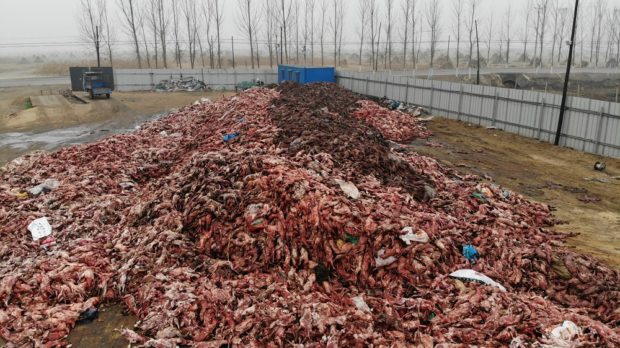
Moments later, if you can still bear to watch (warning: the linked video contains images that many will find disturbing), you’ll see men skinning the animals, some still alive, after which their bodies are dumped like trash. The camera moves to a pile of discarded carcasses, including one skinned animal who raises his head, slowly and painfully.
It’s hard to imagine a worse way to die. But the lives of the nearly 100 million animals killed each year for their fur, including foxes, raccoon dogs and mink, are hardly any better: they spend all of their days in captivity at fur factory farms like these. As you see in the undercover footage, the animals are crammed into tiny wire cages where they can barely move. It’s the only space they’ll ever know, and it is a terrible one. Feces pile up under the cages, and their water bowls are either dry or a fetid pool of algae. The animals are never seen by a veterinarian, and many exhibit symptoms of mental distress and decline.
Skinned animals are heaped in a pile at a fur farm. Animals are sometimes skinned while still alive.
Investigators filmed this footage at 11 randomly selected fur farms in one of the top fur-producing countries in Asia. We are choosing not to reveal the country in order to protect the identity of the investigators. Besides, it’s important not to lose sight of the true culprits here: fur factory farms like these would not exist if designers, retailers and consumers did not provide a market for these cruel products.
With growing awareness about the immense suffering of animals in the fur industry, major fashion houses and retailers the world over have shunned it. In the last few years alone, we have worked with major fashion brands and retailers, including Macy’s, Bloomingdale’s, Prada, Gucci, Armani, Michael Kors, Jimmy Choo, YOOX Net-A-Porter, Farfetch, Donna Karan, Burberry, Coach and others, to announce fur-free policies. California last year became the first U.S. state to ban fur, and we are working to pass similar bans in cities and states across the United States, including Minneapolis, Rhode Island and Hawaii.
Globally, HSI has kept up the momentum against fur. HSI/United Kingdom spearheads the campaign to make Britain the first country in the world to ban the sale of fur. The U.K. banned fur farming two decades ago but still imports tens of thousands of pounds of fur each year. More than a dozen European countries, including Austria, the Czech Republic and Norway, have also banned fur production.
The Netherlands, once the third largest fur farming country in the world, banned fur production in 2013 with an 11-year phaseout. But in recent months, the coronavirus crisis has added even more urgency to end the fur trade there and around the world. After two fur farm workers in the Netherlands were reported to have contracted the virus from infected mink, the country killed hundreds of thousands of mink, most of them pups, on 20 Dutch fur factory farms to stop any further spread of the virus. The Dutch government is now considering a permanent closure of all mink fur farms in the country. Denmark, which is Europe’s largest mink producer, has also discovered infected mink on three fur farms. Infectious disease experts had already warned fur farms could act as reservoirs for the disease, and with this cull, we have seen even more needless suffering play out for these animals.
The fur trade has nothing to offer except the worst sort of cruelty for a product no one needs. So many warm and stylish alternatives indistinguishable from animal fur are now widely available to consumers, and even a single animal bred and killed for their fur is one too many. This gruesome video is a reminder that we still have a long way to go, but we won’t stop until this cruel commodity is wiped out for good, and no animal is beaten to death and skinned alive on a fur farm anywhere in the world.
The Iowa law, signed on June 29, provides much-needed upgrades to the state’s animal cruelty law, including requiring outdoor shelter, grooming and veterinary care for dogs. Photo by Meredith Lee/The HSUSShare1KTweetRedditEmail1KSHARES
We have good news to share from Mississippi and Iowa, the only two states in the nation without a law on the books that would make acts of animal torture, like burning, drowning and intentional starvation, an automatic felony. Recently, Mississippi’s state legislature passed a bill that would do exactly this. And although we are still fighting for a similar outcome in Iowa, we are pleased to report that the state recently made its first significant update to its domestic animal cruelty law in 20 years.
The win in Mississippi is an especially proud moment for us here at the Humane Society of the United States, because we have led the battle for a felony animal cruelty law there for more than a decade. The final bill that passed the statehouse on July 1 mimics language from the federal PACT Act, which we also pushed for and which was signed into law last year. While the federal law allows prosecutors to bring federal felony charges when these acts occur within federal jurisdiction or when animals are moved across state lines, or the internet is used as part of a criminal enterprise, a state law is needed to prosecute those who commit violent acts against animals on Mississippi soil.
The bill that passed in the state increases the penalty for egregious animal abuse such as torture and intentional starvation from a misdemeanor to a felony, and prohibits ownership of dogs and cats for a period set by the court after conviction. It also addresses an oddity in the law that allows the defendant to be charged with just one misdemeanor no matter how many animals were abused.
We applaud Mississippi lawmakers for passing the bill, and we urge the governor to sign it into law. We are especially grateful to Mississippi state Sen. Angela Hill for her dedication to sponsor the bill year after year, and Sen. Brice Wiggins, Rep. Jill Ford, and Speaker Phillip Gunn for supporting and promoting its passage. A strong law against animal torture doesn’t just protect animals; it protects people of the state as well. We now know that violent behavior toward animals has been continuously linked with other forms of criminal violence, including child abuse and domestic violence, making it all the more important to catch and stop those who commit acts of animal abuse early.
The Iowa law, signed on June 29, provides much-needed upgrades to the state’s animal cruelty law, including requiring outdoor shelter, grooming and veterinary care for dogs. Puppy mill owners with a previous conviction for animal cruelty would face a felony penalty for abuse or neglect if the act causes serious injury or leads to the animal dying.
The law, which passed despite strong opposition from the American Kennel Club and puppy mill operators, including some who appear on the HSUS Horrible Hundred list, also strikes nonsensical language in a previous law that allowed charges to be filed only if a person committed abuse against an animal owned by another person and exempted owners from charges when they abused their own animals.
While these changes will certainly improve the quality of life for animals in Iowa, we are saddened that the Iowa General Assembly missed an opportunity to join the rest of the country in making the torture of companion animals an automatic felony. Language that would have done so was included in the original bill, but lawmakers beholden to Iowa’s agriculture industry pressured their colleagues to strip it from the bill. Most Iowans support such a law, and a Remington Research poll in December 2019 showed 69% of Iowans believe domestic animal torture should be a felony charge.
Iowa is now a glaring outlier in our nation where the justice system and all levels of government have, just in the past five years, made tremendous progress in recognizing the link between human and animal cruelty. In addition to the PACT Act becoming law last year, the FBI has added animal cruelty as a separate category in the National Incident Based Reporting System, classifying it as a crime against society, the same category as rape and murder. The National Sheriffs Association created its first Animal Cruelty Committee and houses the National Law Enforcement Center on Animal Abuse, ensuring that the country’s law enforcement community has the best knowledge and resources at its disposal to combat animal cruelty. The Joint Counterterrorism Assessment Team, made up of the FBI, Department of Homeland Security and National Counterterrorism Center, determined in July 2018 that premeditated animal cruelty is a possible warning sign for terrorism.
We congratulate Iowa on strengthening protections for animals, and we now urge lawmakers there to quickly pass a bill joining the rest of the nation in making animal cruelty an automatic felony. By ensuring that the worst acts of animal torture do not go unpunished, they would not just make their state more humane for its animals, but they would also be ensuring the long-term safety of their citizens.
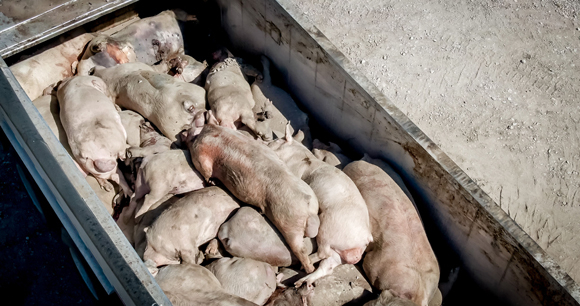
Washington, DC—COVID-19 has shut down, at least temporarily, dozens of pig, chicken, and turkey slaughter plants in the United States, leaving millions of farm animals with nowhere to go. Some producers have arranged to keep animals on the farm until plants reopen, while others have chosen to kill healthy animals and bury or compost their bodies.
The term euthanasia, which literally means “a good death,” has been inappropriately used to characterize the killing by inhumane methods of healthy farm animals due to slaughter and processing capacity problems. The American Veterinary Medical Association (AVMA) uses the term “depopulation” to describe the rapid destruction of a population of animals in response to urgent circumstances. One method that has been used to kill large numbers of farm animals is “ventilation shutdown,” which involves turning off the airflow in a barn and ratcheting up the heat to as high as 120 degrees, leaving trapped birds and pigs to die from a combination of heat stress and suffocation.
Dena Jones, director of the farm animal program at the Animal Welfare Institute (AWI), issued the following statement regarding the use of ventilation shutdown to kill farm animals due to limited slaughter capacity during the pandemic:
The ventilation shutdown process can take hours and likely results in severe animal suffering. Intentionally inflicting death in a manner that causes elevated and prolonged distress is unacceptable and does not qualify as “euthanasia.” It is particularly insupportable for the AVMA — a professional scientific body representing veterinarians sworn to protect animals — to allow its guidelines to be used in such an inappropriate manner.
When the AVMA proposed allowing the use of ventilation shutdown to kill animals “in constrained circumstances,” AWI warned that the AVMA guidelines might not prevent producers from using this extreme method in situations that instead call for euthanasia. In fact, that is exactly what is happening now; healthy animals posing no public health risk are being killed by a grossly inhumane method to aid the meatpacking industry.
Ventilation shutdown was last used in 2015 in response to an outbreak of highly pathogenic bird flu, which killed nearly 50 million chickens and turkeys in the United States. During the current pandemic, however, animals are not suffering from disease, nor are they at risk of transmitting disease to other animals or to humans. Instead, they are being destroyed because meat companies have failed to properly protect their slaughterhouse workers.
The modern animal agriculture industry in the United States routinely puts profits over the well-being of both animals and workers. It runs slaughter lines as fast as possible, provides animals the lowest level of care required, and offers minimal health and safety protections to its workers. There is no margin for error in this intensive, high-production system. As a result, the wave of plant closures has left millions of animals in limbo. Nevertheless, the current situation does not justify subjecting any animal to a cruel death.

 For Immediate Release: July 16, 2020Contact: Randi Feilich, Project Coyote Southern Cal. Rep. (310) 498-2975,


 THE ANIMAL CLUB July 8, 2020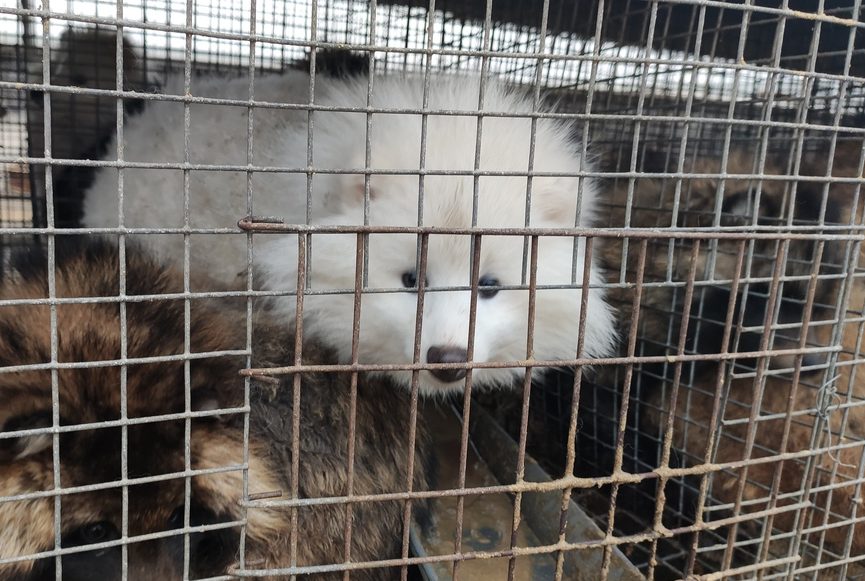
 Exposing the Big Game