Killing of Coyotes in Laurelhurst‏

http://unionbaywatch.blogspot.com/2016/07/coyote-challenge.html

Tuesday, July 5, 2016

Coyote Challenge

To my readers,

I was extremely disappointed to learn that three coyotes were killed last week, near Union Bay, in the Laurelhurst neighborhood of Seattle. Historically, humanity’s fear and ignorance of wild creatures has often led to killing and extermination. My fear is, if we do not learn to coexist with wild creatures then future generations will live in a dismal world of crows, concrete and mechanical contraptions. 
 
My personal goal is to promote harmony between nature and humanity, specifically around Union Bay which includes the Laurelhurst area. My blog about nature-in-the-city is called, Union Bay Watch. I believe that if we pay attention to wildlife, and treat wild creatures intelligently, we can find ways to coexist. 
 
A few weeks ago, I met one of the adult coyotes on the trail in the Union Bay Natural Area. Given the time of the year and because the coyote was out and about at mid-day, I suspect it was looking for food for its young. The coyote turned and fled into the brush as I approached. A perfectly acceptable response from a truly wild creature.
 
Because of my blog and my local interactions, I have talked with many different people who have seen the coyotes. No one who I spoke with mentioned any aggressive behavior. I truly believe the majority of the local people have been excited and happy to have coyotes as neighbors. I hope we can all agree that killing wild creatures should be a last resort.
 
The information I have read and the reaction from the neighbors causes me to seriously question whether extermination was warranted. The only justification I can find for the killing is, as reported on King5 NewsWildlife services received a request to assist in the management of several coyotes near the Laurelhurst neighborhood in Seattle. The coyotes had become increasingly aggressive towards people and pets in the area.
 
This statement leaves a lot to the imagination. I admit I do not know the details. I can however make a couple of logical assumptions given the information provided.
 
a) Since no injuries to humans were reported, I suspect the coyotes did not injure anyone.
 
b) Since no injuries to pets were noted, I suspect the coyotes did not injure any pets, either.
 
If the coyotes did not injure any humans or their pets then I wonder, What exactly did they do? What does “increasingly aggressive” really mean? 
 
Does it mean that in the Spring, with young to feed, the coyotes were being seen more often during the day, because their normal nocturnal hunting was not sufficient? Does it mean that the coyotes chased someone’s cat up a tree? Does it mean that they growled at an off-leash dog that came near their den? Does it mean that the coyotes came into to someone’s yard because the owner left pet food or open garbage outside? All of these fictional examples could be resolved with human education. It makes me wonder if the actual situation could have also been resolved with community guidance and instruction.
 
The Washington Department of Fish and Wildlife provides an extensive online resource entitled, Living with Wildlife. The highlighted link goes directly to the specific portion of the site related to coyotes. The site lists many non-lethal options.
 
Our Canadian friends propose a simple three-step process for learning to deal with coyotes. The Stanley Park Ecological Society says, “1) Be Big, Brave and Loud. 2) Never Feed. 3) Spread the Word.” They have additional links and information on their site, Co-existing with Coyotes. Please note that they even have an educational program for K-7 students. If our northern neighbors can teach their kindergarten students how to safely encounter coyotes I suspect we should be able to do the same. 
 
Was education given a fair chance? I have read nothing which implies that the folks in Laurelhurst were provided instruction on how to co-exist with coyotes. The next time your organization is contacted to resolved an issue with coyotes, I sincerely hope you will ensure that the community as a whole gets to participate in the process and that the educational alternatives are fully exhausted.
 
Thank you in advance for your thoughtful consideration of this issue.
 
Larry Hubbell
www.UnionBayWatch.blogspot.com

Update to Readers:

Does anyone happen to have a photo of the coyotes they would be willing to share?

Thank you to Doug Parrott for sharing his coyote photo taken on June 26th at the Union Bay Natural Area.

More Updates:

From the folks at The Laurelhurst Blog.

Here is the post the Laurelhurst Blog did on Friday about the killings:

Hazed birds flock to Astoria (OR) bridge

http://www.dailyastorian.com/Local_News/20160624/hazed-birds-flock

By Katie Frankowicz

For The Daily Astorian

Published on June 24, 2016 7:56AM

Cormorants rest below the Astoria Bridge Wednesday.

Danny Miller/The Daily Astorian

A lone cormorant takes flight under the Astoria Bridge.

The Astoria Bridge is experiencing a housing boom.

As many as 11,000 cormorants are roosting there at night, and observers have counted around 600 nests there within the past few weeks. Last year, there were only 400.

This surge in the bridge’s cormorant population comes a month after roughly 17,000 double-crested cormorants, for reasons still unknown, abandoned their nests and eggs on East Sand Island, located at the mouth of the Columbia River near Chinook, Washington.

“The bottom line is we believe most of the cormorants have remained in the estuary and the increased number of nests on the Astoria-Megler Bridge seems to indicate that,” said Diana Fredlund, a spokeswoman for the U.S. Army Corps of Engineers, which manages East Sand Island and the massive cormorant colony that used to nest there seasonally.

“But our observers are in the process of counting all the birds and nests in the estuary right now,” Fredlund added. “They can’t say definitively that they are from East Sand Island, but it seems likely.”

The bridge has hosted the fish-eating birds before, acting as a seasonal home to around 75 to 100 nesting pairs of cormorants on average, according to studies by the Corps — nothing compared to what has been observed in the past few weeks. It isn’t clear what the increase means for the bridge itself, or if the nests will remain in use after the regular nesting season has passed.

Meanwhile, the Oregon Department of Fish and Wildlife is continuing with regularly scheduled hazing of double-crested cormorants along Oregon estuaries to protect smolt.

The bulk of this work wrapped up in May, but Clatsop County’s Fisheries Project holds a permit from the state that allows them to also harass the birds in July, when the department typically releases fish from net pens in Youngs Bay and Tongue Point. With lower numbers of brood stock this year, however, Natural Resources Manager Steve Meschke doubts they’ll need to go out in their boats and chase cormorants around the bay — Clatsop County’s usual method.
Different methods, same birds
Oregon’s state-run hazing is very different from the methods undertaken by the Corps on East Sand Island.

Last year, the Corps obtained a permit from the U.S. Fish and Wildlife Service that allowed them to begin targeting and killing double-crested cormorants, planning to ultimately reduce approximately 14,900 breeding pairs of double-crested cormorants to 5,900 breeding pairs by 2018. The agency says the birds eat millions of protected salmon and steelhead traveling through the Columbia River estuary and threaten the survival of those runs, statements and reasoning the Portland Audubon Society and others have since challenged.

As of May 16, the Corps’ contractors killed 2,394 double-crested cormorants and oiled 1,092 nests to prevent eggs from hatching before all the birds disappeared and culling activities were halted early.

The goal for the Oregon Department of Fish and Wildlife hazing is similar, but different. Instead of using guns, the state and the other groups it contracts with or issues permits to for hazing work are more likely to chase the birds around in boats or use laser pointers to wake them up and move them away from areas where young fish are going to be passing through.

Their goal with this nonlethal hazing is to increase the survival of smolts, particularly the Oregon Coast coho population that is federally listed as threatened, by changing the cormorants’ behavior for a short period of time. The hazing occurs when the fish are passing through estuaries along the southern and mid-coast — Tillamook, Nehalem, Nestucca, Elsie and Coquille — and in the Lower Columbia River. Such hazing has regularly occurred since the 1980s.
Stresses on fish
Oregon Fish and Wildlife can’t say for certain that this hazing ultimately reduces the number of birds traveling to sensitive areas, or if keeping the birds away from smolts means more fish survive to come back as adults.

“The diet data indicates cormorants don’t really care what they eat, they eat what’s around and what’s easy to catch,” said James Lawonn, a biologist and avian predation coordinator for the department. As other prey begin to run through the rivers and up and down the coast after May, research by the department and Oregon State University show salmon make up even less of the birds’ diet.

Salmon survival depends on a variety of factors, including huge variables like ocean conditions and habitat loss, Lawonn said. Still, the state is trying to ease any additional stresses the fish may face.

This sort of nonlethal hazing will likely continue for the foreseeable future — the state’s particular hazing program is already in the budget for next year — but it is, Lawonn believes, ultimately a social question.

“How much does society want to harass a native bird to promote survival of salmon, some of which are in conservation danger, some of which aren’t?” he said.

Is hunting really a conservation tool?

A new UW-Madison study upends central notion about predator management

by

May 10, 2016

6:00 PM

– See more at: http://isthmus.com/news/news/wolf-hunting-study/#sthash.B9LfrolM.dpuf

Petition on BC Wolves

http://action.sumofus.org/a/stop-wolf-cull/?sub=fb

Nearly 200 wolves are going to be shot from helicopters over the next few weeks — a bloody attempt to save an endangered caribou herd in western Canada. And these killings are likely to go on for five years.

Oil, gas, mining, and logging companies have been trashing the mountain caribou’s habitat for decades — but instead of curtailing this industrial habitat destruction, the British Columbia (BC) provincial government is scapegoating wolves, condemning them to a gruesome death.

This cull is just a stopgap measure and not a viable long-term solution to the caribou’s problems. It will, however, cause immense suffering to the wolves, who are highly social and intelligent creatures.

Tell the BC government to stop the industrial encroachment of the caribou’s and wolves’ territory!

Decades of habitat destruction and human encroachment have led to this tragic situation. The BC government needs to be protecting the caribou’s critical food and natural habitat, such as lichen-rich interior forests.

Part of the problem is the caribou’s natural protection from wolves has been undermined by commercial activity. Normally, thick winter snow is enough to keep them safe from most predators, but the wolves have been using the industrial infrastructure of pipeline corridors, roads, railways and snowmobile trails to move through the landscape and hunt. Some feel the cull is awful but necessary to save the caribous, and others feel the cull should be canceled outright — but fundamentally, the BC government should never have let the problem get to this point.

We need to stand up for nature against profit-making companies who are destroying our wildernesses all over the world. These innocent wolves, who are right now being hunted from the skies, are a powerful symbol of how the long-term future of the natural world is being sacrificed for short-term profit.

Please add your voice to ask BC to place responsibility at the feet of the oil, gas, mining and logging companies who are causing the real damage to caribou and wolves.

Sign the petition asking the BC government to protect caribous and wolves from industrial encroachment.

********** More information:

B.C. wolf cull will likely last 5 years, assistant deputy minister says, CBC News,

‘Carnivore cleansing’ is damaging ecosystems, scientists warn

http://www.theguardian.com/environment/2014/jan/09/carnivore-cleansing-damaging-ecosystems?CMP=share_btn_fb

Extermination of large predators such as wolves and bears has a cascading effect on delicate ecological balance

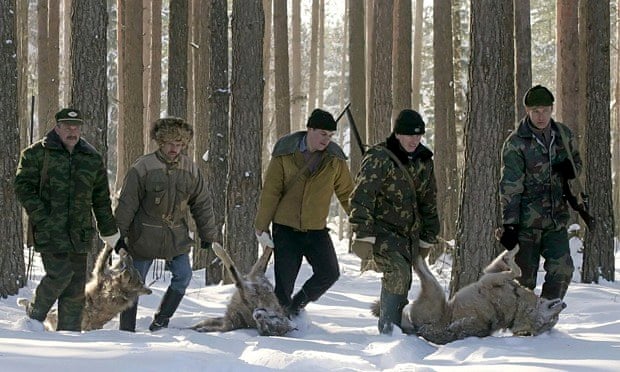
Carnivore extermination damaging ecosystems : hunters drag wolves they killed, Belarus
Belarus hunters drag wolves they killed overnight near village Pruzhanka, some 110 km south-east of Minsk February 8, 2005. Hunting for wolfs in Belarus is legal throughout the whole year with a hunter getting 168,000 Belarus roubles ($77 US dollars) for every wolf killed. Photograph: Vasily Fedosenko/Reuters

IBMP plan calls for reduction of bison population in Yellowstone National Park

January 6, 2016, 36 mins ago

between Mammoth and Norris in Yellowstone National Park in November, 2013. (Neal Herbert/NPS Photo)

YELLOWSTONE NATIONAL PARK – Members of the Interagency Bison Management Plan (IBMP) have signed a winter operations plan that aims to reduce the current population of 4,900 animals.

The announcement was made in a press release from Yellowstone National Park.

The park says that because the Yellowstone bison population has high reproductive and survival rates, it will be necessary to cull 600-900 animals to offset the population increase expected this year.

The population will be decreased using two methods, according to the IBMP:

(1) Public and tribal hunting outside the park

(2) Capturing bison near the park boundary and transferring them to Native American tribes for processing and distribution of meat and hides to their members.

The press release says that bison are a migratory species and they move across a vast landscape. When they are inside Yellowstone, they have access to all habitat. But in the winter, when some bison migrate to lower elevations outside the park in search of food, the surrounding states and some private landowners don’t offer the same access to habitat.

Wild bison are only allowed in limited areas outside of Yellowstone…

“Many people are uncomfortable with the practice of culling bison, including the National Park Service,” says Yellowstone National Park Superintendent Dan Wenk.

More: http://www.ktvh.com/2016/01/ibmp-plan-calls-for-reduction-of-bison-population-in-yellowstone-national-park/

Also: http://billingsgazette.com/lifestyles/recreation/bison-plan-draws-comments-from-around-nation-world/article_8c85c77b-ba21-5aaa-b6e7-deb7187d70e2.html

And: http://billingsgazette.com/news/state-and-regional/montana/officials-agree-to-slaughter-to-yellowstone-bison-this-winter/article_96bf9650-d569-5838-9507-64465364b9c5.html?utm_medium=social&utm_source=facebook&utm_campaign=user-share


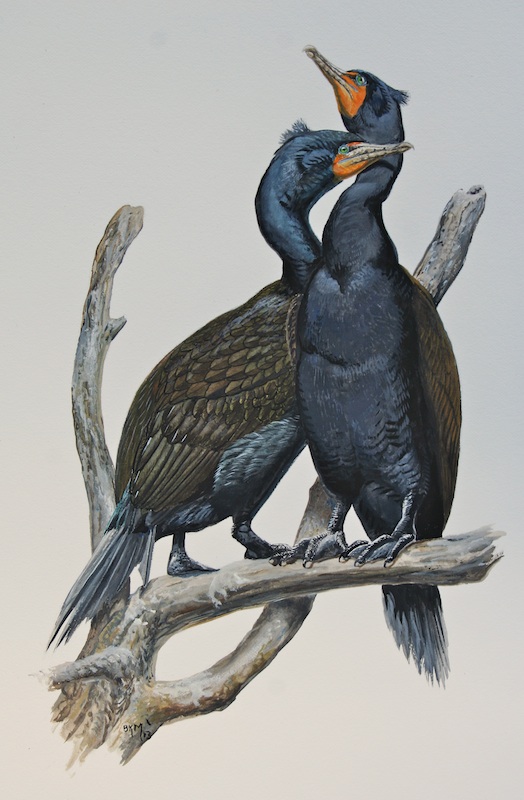
Killing of Cormorant Over…For Now

Painting Courtesy Barry Kent McKay

Painting Courtesy Barry Kent McKay

http://www.chinookobserver.com/co/local-news/20151109/cormorant-killing-comes-to-seasonal-end-litigation-set-for-march

CHINOOK — The federal government last month stopped shooting cormorants and oiling their nests to reduce cormorant predation on juvenile salmon and steelhead in the Columbia River estuary.

Wildlife Services, a federal agency contracted by the U.S. Army Corps of Engineers, killed 2,346 double-crested cormorants and destroyed more than 5,000 nests on East Sand Island between May 28 and Oct. 1. The island is located in Baker Bay near Chinook and the gunfire could sometime be heard echoing around the bay.

The U.S. Fish and Wildlife Service gave the Corps a one-year permit in April 2015 to kill 3,489 double-crested cormorants and to oil 5,879 nests through the end of January 2016. The permit also includes destroying 105 Brandt’s cormorants and 10 pelagic cormorants.

This year’s culling activities end once most of the birds begin to migrate south for warmer climates, which is usually by the end of October.


Salmon impacts


NOAA Fisheries estimated that during 1998-2012, double-crested cormorants consumed 6.7 percent of juvenile steelhead, 2.8 percent of Chinook yearlings and 1.3 percent of juvenile sockeye migrating to the ocean.

Looking at it another way, NOAA also calculated the birds ate an annual average of 12 million juvenile salmonids, many of them listed under the Endangered Species Act.

The East Sand Island’s cormorant colony, estimated at 15,000 nesting pairs, represents about 98 percent of the double-crested cormorant population in the lower Columbia River. In 1989 the cormorant breeding population was about 100 pairs.

As tons of dredged rock and soil from the Columbia River streambed piled up over the years, avian predators, such as cormorants and Caspian terns, set up colonies on the fill.

The Corps has a four-year plan to reduce the cormorant population in the estuary by 56 percent. The plan is spelled out in the final environmental impact statement, dated Feb. 6, 2015.


Lawsuit pursues end to bird cull


In response, the Audubon Society of Portland and four other groups filed for a preliminary injunction against the Corps, U.S. Fish and Wildlife Service, and Wildlife Services in April 2015. The environmental groups argued their suit was not about “birds versus fish.” Rather, they said, federal agencies were targeting cormorants rather than operating dams to minimize juvenile salmon mortalities.

NOAA Fisheries calculated annual cormorant consumption rates of juvenile steelhead, yearling Chinook and juvenile sockeye at 6.7 percent, 2.8 percent and 1.3 percent, respectively, based on data from 1998-2012.

U.S. District Judge Michael Simon ruled against the Audubon and its allies May 8, citing their failure to prove that lethally removing the number of cormorants stated in the Corps’ plan would likely cause “irrevocable harm” to the overall population. The decision allowed the federal agencies to start their 2015 culling operation in late May.

Final oral arguments in the case are scheduled for March 7, 2016, before Simon.

Meanwhile, on Goose Island upstream of the Columbia’s confluence with the Snake River, fewer than 20 nesting pairs of Caspian terns have been counted this year.

“Last year, before the dissuasion program, there were about 400 nesting pairs,” said Michael Lesky, natural resource specialist for the U.S. Bureau of Reclamation’s Ephrata Field Office.

Caspian tern

This Caspian tern wears ankle bracelets, actually bands that indicate where the bird was tagged.

Tern populations have been big consumers of juvenile salmonids. Studies conducted during 2008-2013 estimated terns were annually taking 16 percent of upper Columbia River steelhead smolts and 2.5 percent of spring Chinook. BuRec and the Corps will release estimates next month of the number of juvenile salmon and steelhead taken by Caspian terns in 2015.

Relocation efforts

As part of the dissuasion plan, federal agencies have created alternative Caspian tern nesting habitat at Don Edwards National Wildlife Refuge in San Francisco Bay. The alternative habitat was available for the 2015 spring nesting season.

Lesky, who visited the refuge in May, said he saw the birds nesting, rearing their young and using the habitat there.

The purpose of the new California habitat is to attract Caspian terns away from the Columbia River to a location where there are fewer or no ESA-listed species for prey. The San Francisco Bay refuge is on the bird’s annual flyway.

It won’t be known if Caspian terns at the Don Edwards refuge are terns from Goose Island until agency personnel have information from satellite tags on the terns, which will come later this year, Lesky said. The terns nesting there could also be from East Sand Island on the lower Columbia, where efforts to reduce their numbers have met with limited success.

To redistribute Caspian terns, a method called social attraction is used to entice them away. This involves the Corps of Engineers building up islands at appropriate locations, and biologists then holding a big, loud party there. Instead of setting out chairs and tables and turning on music, they plant the new terrain with Caspian tern decoys and blast audio recordings of screeching terns.

Social attraction seems to work to lure a limited number of the terns to new areas, but it’s hard to predict whether this widely dispersed and migratory species will continue to return to a new island or breed there, and whether relocation helps reduce Caspian tern consumption of juvenile salmon and steelhead on the Columbia.

Cormorant massacre underway

http://www.animals24-7.org/2015/09/25/cormorant-massacre-underway/

Headline shotby Bob Sallinger,  conservation director, Audubon Society of Portland

Further to my ANIMALS 24-7 posting of September 14,  2015,  Feds resume killing cormorants despite admitting “nesting population targets were met,  for the past two weeks, federal government employees from the Wildlife Services office of the U.S. Department of Agriculture have been shooting double-crested cormorants from a boat in the Columbia River Estuary near East Sand Island.  Shotgun blasts have been audible from shore.  Observers on shore have also been able to see three federal employees moving about in a small boat shooting cormorants out of the sky and collecting them from the water with nets. The U.S. Army Corps of Engineers,  which is in charge of the operation,  reports that they have shot 863 double-crested cormorants and 10 non-target Brandt’s cormorants in the past two weeks.  The Corps intends to continue the shooting into the fall in order to achieve their goal of killing more than 4,000 double-crested cormorants this season.

OPB photo #2

Oregon Public Broadcasting was able to get the first footage of the killings earlier this week. It is now posted on their website:

Countryside braced for renewed badger cull protests

With the culling of badgers set to be extended to Dorset farmers are braced for further confrontations with animal rights activists

Facebook
609
Twitter
96
Pinterest
0
LinkedIn
0
Share
705
Email

In Somerset, 341 badgers were culled last year

In Somerset, 341 badgers were culled last year Photo: Alamy

<!– remove the whitespace added by escenic before end of tag –>

Farmers have pledged to stand up to intimidation from animal rights extremists who are threatening a major campaign of disorder to sabotage the planned extension of the controversial badger cull.

Militant groups say plans to extend the cull from Somerset and Gloucestershire into Dorset will make it easier for them to mobilise hundreds of activists from across south east England to confront farmers and contractors who carry out the shooting and trapping of badgers.

The threat comes as farmers urged the Government to extend the cull as a matter of urgency in a bid to tackle the continuing spread of bovine tuberculosis from badgers to dairy cattle herds in south west England.

Farmers in Dorset have applied to Natural England for the cull to be extended to their country to tackle what they describe as a “desperate situation”. It is understood that farmers in Devon and Cornwall have also applied for culling licences.

More than 15,000 cattle were slaughtered because of bovine TB across the South West last year and at the same time more than 2,200 herds that had previously been clear of the disease were affected by it.

Speculation is growing that Natural England could give permission for culling could start in Dorset as soon as the end of the summer or start of autumn, though it says it will not “give a running commentary” on culling licence applications.

However, David Cameron made it clear only last month that the Government regards culling as “absolutely the right thing to do” and the new cull is expected to be given the go-ahead.

Trevor Cligg, the chairman of the National Farmers Union in Dorset, said: “Without expanding the cull into Dorset and all the other areas where bTB is endemic we are not going to beat this disease. We can take all the cattle control – and we should – and vaccination has a part to play but in itself it won’t be enough.”

Read More: http://www.telegraph.co.uk/news/earth/agriculture/11805397/Countryside-braced-for-renewed-badger-cull-protests.html

Killing cormorants: Study finding culling to have no impact ignored, Audubon Society says

image

http://www.dailyastorian.com/Free/20150812/killing-cormorants-study-finding-culling-to-have-no-impact-ignored-audubon-society-says?utm_source=Daily+Astorian+Updates&utm_campaign=223d46e2ba-TEMPLATE_Daily_Astorian_Newsletter_Update&utm_medium=email&utm_term=0_e787c9ed3c-223d46e2ba-109860249

By GOSIA WOZNIACKA33

Associated Press

August 12, 2015 6:00PM

One of the newly disclosed documents is an analysis by U.S. Fish and Wildlife biologists concluding that killing double-crested cormorants would not benefit Snake River steelhead.

PORTLAND — Conservation groups opposed to the ongoing killing of cormorants on the Columbia River to protect steelhead and salmon say they have documents showing a federal agency ignored a finding by its own biologists that the measure would not help the fish.

The Audubon Society of Portland and several other groups made the documents public Wednesday. They were obtained from the U.S. Fish and Wildlife Service under a court order.

The groups had challenged the killing in a federal lawsuit. In May, a judge declined to block the plan to shoot the cormorants, but the lawsuit is ongoing.

One of the newly disclosed documents is an analysis by U.S. Fish and Wildlife biologists concluding that killing double-crested cormorants would not benefit Snake River steelhead — which are most affected by cormorant predation — because fish not eaten by the birds would be eaten by other predators.

“As a consequence, efforts to reduce cormorant predation on steelhead are expected to have no effect on Snake River steelhead population productivity or adult abundance,” the analysis says. It adds that killing cormorants is “similarly unlikely to benefit the productivity of… other salmonid populations.”

The second document, a timeline written by Fish and Wildlife biologists, shows multiple staff at the agency were aware of the analysis and its conclusion. It also shows the biologists were concerned that the U.S. Corps of Engineers did not address their findings.

Despite the analysis, earlier this year U.S. Fish and Wildlife authorized the Corps to kill about 11,000 cormorants — or 5,600 breeding pairs — on East Sand Island at the mouth of the Columbia between Oregon and Washington. The uninhabited island is North America’s biggest cormorant nesting colony. The agency also authorized the Corps to oil 26,000 nests to prevent the eggs inside them from hatching.

Both agencies declined to comment on the documents, citing ongoing litigation. It’s unclear whether the Corps was aware of the analysis when it wrote its environmental impact statement.

Federal agencies blame the cormorants for eating an average 12 million juvenile salmon a year as they migrate down the Columbia to the ocean. Some of the fish are federally protected species.

Bob Sallinger, conservation director for the Audubon Society of Portland, said conservation groups repeatedly asked the agencies whether killing cormorants would make a difference.

“We went through a major public process, which is supposed to ensure transparency,” said Sallinger. “They never disclosed that their own biologists were fundamentally questioning the efficacy of this action. They chose to bury it and that’s unconscionable.”

Sallinger also said the analysis confirmed what conservation groups have been saying all along, including in their lawsuit: that it’s the dams that most impact fish. In their analysis, the federal biologists found that efforts to reduce mortality during passage through the hydro system on the Columbia would result in increased productivity and abundance of steelhead.

The focus on cormorants, Sallinger said, is “about distracting the public from the real reason of salmon decline, the hydro system. They’re spending tax dollars killing protected birds that will have absolutely no impact on salmon.”

The conservationists are calling for the government to stop killing the cormorants, and to launch an investigation into why the agencies ignored their own biologists’ findings and didn’t disclose the documents to the public. So far, 158 cormorants have been killed using .22-caliber rifles and more than 5,089 nests have been oiled, destroying the eggs inside them.

Cormorants are not the only animals to be targeted for eating salmon. Caspian terns have also been pushed off an island in the Columbia, and sea lions have been killed to reduce the numbers of salmon eaten.