Army Corps resumes killing East Sand Island cormorants

Dailyastorian.com

By Katie Wilson

EO Media Group

July 17, 2015 12:01AM

Madeline Kalbach/Submitted Photo
Double-crested cormorants like this one spread their wings in the sun to dry after getting them wet in the pursuit of small fish in the water. East Sand Island near Chinook is the location of a major colony of the birds.

<!–

–>

Death toll hit 158 in early July.

CHINOOK, Wash. — Contractors for the U.S. Army Corps of Engineers are once again killing double-crested cormorants on East Sand Island after stopping for a week at the end of June, saying they didn’t want to disturb nesting birds or orphan newly hatched chicks.

According to numbers released on the Army Corps website, contractors killed 33 birds sometime between July 3 and July 9, bringing the total killed this year to 158. The website does not clarify if the birds killed were only double-crested cormorants; the agency’s depredation permit allows for the accidental take of other cormorant species, including Brandt’s cormorants which also nest on the island, and pelagic cormorants that sometimes fly nearby.

No nests were destroyed through a process called “oiling” during this most recent lethal take period, but sometime between June 9 (the last time numbers were published on the website) and June 24 (when killing had been halted for roughly a week) and before July 3 (the beginning of the most recent take), contractors apparently oiled 3,320 nests, bringing the total of nests oiled to date to 5,089.

This is just 790 nests shy of the total take of nests allowed under a one-year depredation permit issued by the U.S. Fish and Wildlife Service. Oiling prevents eggs from hatching and the bird embryos die in the shell.

Killing authorized

The killing is authorized under a depredation permit the Corps obtained this year as part of a management plan the agency says will protect runs of juvenile salmon by removing a large number of the birds that prey on them.

Two species of cormorant nest seasonally on East Sand Island, a 62-acre island at the mouth of the Columbia River, but only one is targeted under the management plan: double-crested cormorants. The colony’s numbers have swelled in recent years and the Corps says adult birds consume millions of young protected and endangered salmon every year.

The depredation permit, which must be renewed annually, is valid through Jan. 31, 2016. But the birds are only on the island seasonally, arriving in the early spring to begin nesting and departing when colder weather rolls in.

Orphaned chicks could starve

The Audubon Society of Portland fears killing birds at the height of the nesting season impacts the colony in ways the agencies have not adequately accounted for, since any orphaned chicks will likely starve to death or die from exposure.

Audubon is suing the Corps, the U.S. Fish and Wildlife Service and the Corps’ contractors — the U.S. Department of Agriculture’s Animal and Plant Health Inspection Service — regarding the double-crested cormorant management plan.

The Corps says the contractors are taking care not to shoot nesting parent birds.

“They’re very specific about how they’re only culling adults where they can clearly see there are no eggs present,” said Army Corps spokeswoman Diana Fredlund.

Under the management plan, the Corps plans to reduce the total number of breeding pairs on the island from about 14,000 to 5,600 by 2018, a move the Audubon Society says unnecessarily slashes a healthy colony during a time when double-crested cormorants are struggling elsewhere.

The Seal Army, The Seals Of Nam and Ricky Gervais condemns Namibia Seal Hunt

http://www.thesealsofnam.org/ricky-gervais-condemns-namibia-seal-hunt/

Subject: Ricky Gervais condemns Namibia Seal Hunt

On Wednesday 1 July 2015, the activist organization The Seals Of Nam partnered with social media experts from The Seal Army in a global outcry against the Namibian seal hunt. The online protest set social media ablaze with hash tags #Namibia and #sealhunt trending in 5th place on Twitter. At the latest count, over 13 000 tweets condemning the annual slaughter were sent, peaking at over 6 000 tweets per hour.

Ricky Gervais Namibia seal hunt

The “Tweet Storm” received a further boost when UK celebrity Ricky Gervais, known for his stance against cruelty to animals, joined in. Gervais posted links on both Facebook and Twitter with the comment “RIP the 80 000 seals to be savagely slaughtered in Namibia.”

Ricky Gervais Namibia Seal Hunt

This is not the first time The Seals Of Nam has garnered the attentions of A-list celebrities in their online campaign against the hunt. In a similar event held earlier this year, celebrity George Lopez also took to Twitter in reply to a tweet, asking what people could do to help with the cause.

The Namibian seal hunt is fast gaining international notoriety, with calls for a consumer boycott having a negative impact on tourism. The ripple effect is expected to be further impacted to include Namibian fisheries when The Seals of Nam release a cell-phone app later this month. The app has a barcode scanner and will tell European consumers the background of the fish and the relation to the Namibian seal hunt.

This app could have devastating effects, particularly since over 95% of Namibia’s fisheries harvest is exported to the EU where produce from the seal hunt is banned. Speaking on behalf of the organization, Pat Dickens said the ethical reasons of the app have been translated into European languages. A series of emails targeting fish mongers, restaurants, hotels and catering outfits will be sent out once the app is released.

The Namibian government claims the slaughter is a population management control measure necessary to protect dwindling fishing stocks. This claim is rubbished by Dickens who points to bribery, corruption, incompetence and mismanagement of the resource.

Namibia is the only country in the world to slaughter seal cubs still on the teat. The slaughter is regarded by scientists as the cruelest massacre of animals on earth and amounts to the largest slaughter of wildlife in Africa.

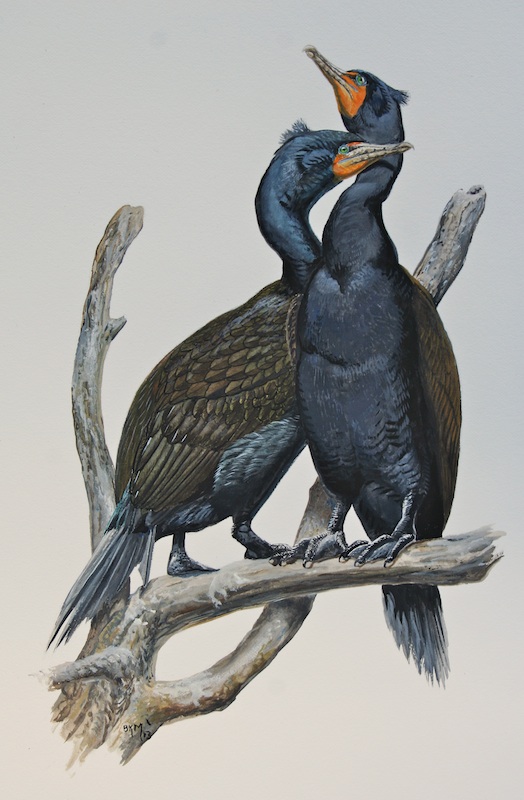
One cormorant’s plea to stop the slaughter

Painting Courtesy Barry Kent McKay

Painting Courtesy Barry Kent McKay

https://wordpress.com/post/35261376/new/

The Corps, the Cormorants, and the Cull

One cormorant’s plea to stop the slaughter

The U.S. Army Corps of Engineers recently approved a culling of the large mixed seabird colony on East Sand Island, near the mouth of the Columbia River. The plan aims to reduce the number of double-crested cormorants to 5,600 breeding pairs from roughly 13,000 by 2018, through a combination of hazing, oiling the eggs in 15,000 nests, and shooting approximately 11,000 individuals. The cull is necessary, says the Corps, because cormorants eat an average of 11 million young salmon and steelhead each year—up to 20 percent of hatchery releases—as the smolts migrate out to sea.

During the drafting of the environmental impact statement, the Corps received more than 150,000 public comments, of which about 98 percent opposed its plan. Here is one such letter, dredged up from the very bottom of the pile.

To Whom It May Concern:

I realize the comment period may be over, and that as of March 19, your plan has received the blessing of the necessary higher-ups. But I feel I have to speak out.

To begin, I admit that we are not the most beloved of birds. People kill more than 40,000 of us each year all over the country. And I get it. We have a taste for fish, and an enviable talent for catching them. When you make said fish freely available to us by raising great numbers of them all in one place and sending them downstream, we simply can’t help helping ourselves. (I am pretty sure that if you happened upon an all-you-can-eat buffet you would tuck in, too.) True, we sometimes drive out animals more couth than ourselves. We poop so much that trees sometimes die. But it is natural for us to travel in large groups, and make ourselves at home as we see fit. This is a behavior with which you, as part of the U.S. Army, are familiar, I think? But I’m just speculating here.

In any case, this brings me to the present circumstance. I don’t want to embarrass you, but you, people of the Corps, do remember that you created East Sand Island for birds, right? Back in the 1990s, thousands of Caspian Terns nested on Rice Island, a few miles upriver. They, too, ate millions of young salmon and steelhead. So you drove the terns to this island, which you had created out of sand. Once they settled in, they shifted their diet to other small fishes. (Terns are agreeable like that, bless their hearts.)

But we cormorants showed up, too. We took a look around and thought, Hey, nice island! What better place to pluck out the young hatchery fish sent out every year in tremendous, naïve waves to the sea! (You’ve dammed up so many other streams and rivers that there are few ways left for them to get around us. Thanks!) Our numbers increased. We started eating the—excuse me—your salmon. And yes, we eat a lot of them. So you tried to thwart our voracious appetites. You tried to make the island less homey. You confined us to ever-smaller areas, and surrounded us with walls, fences, and observation towers. Our colony now looks like a prison camp! But we didn’t leave. Indeed, we persevered in spite of your best efforts. What can I say? We are a hardy folk.

I can see how this might be frustrating for you. And by “this” I mean the nuances of ecology and all of its unintended consequences, its unforeseen contingencies. You are the Corps of Engineers, after all. You have a proud history of seeing the world as a place where Tab A goes into Slot B, just so. You see: salmon. You see: cormorants. You see: cormorants eating salmon. Subtract: cormorants. Problem: solved. Or so you assume. (Never mind that most of those extremely tasty smolts wouldn’t have made it back to their native hatcheries; that states like Montana and Washington actually consider hatchery steelhead and salmon harmful to wild genetic stocks.)

I can’t help but admire your resolve. Your decision-making has the solidity of concrete. Rest assured, I don’t write to critique the relative merits of your plans. I’ll leave that to others more qualified than I, such as the several biologists—including the one you yourself hired to study my comings and goings for nearly 20 years—who say you both misinterpret and misrepresent the data and therefore are not making the correct use of the best available science.

Granted, we do eat a lot of fish. Mea culpa. And I know it is easier and—and let’s be honest here—more viscerally satisfying to blast away at me and few thousand of my kin than it is to confront the full range of ecological complications for which you are responsible. (We are a far ranging species—we remember Katrina.) Yet I must remind you: Cormorants can’t build dams. It is not thanks to us that well over half of the Columbia salmon and steelhead runs are threatened or endangered. But now that you’re confronted with what to you seems a distasteful side effect of your work (to us it is glorious!), you go all ballistic. It hardly seems fair. We’re just doing what nature intended us birds to do.

Thank you for considering these comments. Perhaps we could discuss the issue one day over a little (wild) salmon. I hear Cabezon up in Northeast Portland serves a nice fillet.

From one rampant consumer to another,

DCCO

P.S. To all you sea lions yukking it up at the East Mooring Basin in Astoria: Stop laughing. Your time will come.

Update: On Monday, April 13, the U.S. Army Corps of Engineers received the necessary permits to proceed with the cull. The plans will wipe out 15 percent of the Double-crested Cormorants west of the Rocky Mountains. The Audubon Society of Portland plans to sue the Army Corps of Engineers, according to an April 14 press release. “We are deeply disappointed in the U.S. Fish and Wildlife Service for issuing these permits,” Audubon Society of Portland conservation director Bob Sallinger said in the release. “The pubic looks to the Fish and Wildlife Service to protect wild birds, not to permit wanton slaughter.”

Learn more about how you can help.

Tribes, Fisherman Rally For Sea Lion Removal

Wildlife Photography ©Jim Robertson, 2015. All Rights Reserved

Wildlife Photography ©Jim Robertson, 2015. All Rights Reserved

http://www.opb.org/news/article/tribes-fisherman-rally-for-sea-lion-removal/

Tribes, Fisherman Rally For Sea Lion Removal

Around 200 fisherman and tribal members rallied near Willamette Falls Saturday. They showed support for a bill that would allow tribes with fishing rights to kill some sea lions on the Columbia river.

Sara Thompson, with the Columbia River Inter-Tribal Fish Commission, says sea lions have eaten about twice as many fish as usual at the dams this year.

“We’ve seen probably, just in the quarter mile below Bonneville dam, over 8,000 Salmon and Steelhead consumed by sea lions,” she said.

The bill, HR 564, is  sponsored by Oregon Democrat Kurt Schrader and Washington Republican Jaime Herrera-Beutler.

State wildlife managers in Oregon, Washington and Idaho already have the authority to trap and kill sea lions, and have euthanized at least 30 this year.

The bill would also allow states and tribes to target sea lions that prey on a broader range of fish, not just those that snack on threatened salmon.

Federal biologists say the high number of sea lions spotted this year on the Columbia are the result of strong smelt and salmon runs. They say unusually warm ocean temperatures have made it difficult for the marine mammals to find prey off the California coast and have driven them north.

The Cormorant Death Toll So Far, 109…

http://www.dailyastorian.com/Free/20150528/corps-reports-killing-109-cormorants-so-far-to-help-salmon?utm_source=Daily+Astorian+Updates&utm_campaign=f7bac2e1bf-TEMPLATE_Daily_Astorian_Newsletter_Update&utm_medium=email&utm_term=0_e787c9ed3c-f7bac2e1bf-109860249

also

http://koin.com/2015/05/26/cormorant-culling-underway-to-save-salmon/

Cormorant culling underway to save salmon

Plans to reduce the population of double crested cormorants from about 14,000 breeding pairs to 5,600 by 2018

PORTLAND, Ore. (KOIN) — The coast is clear for the United States Army Corps of Engineers to kill nearly 10,000 cormorants that feed on salmon, and bird lovers have exhausted their legal appeals.

Culling of thousands of cormorants began this past weekend in an effort to reduce their breeding population from about 14,000 breeding pairs to 5,600 by 2018.

According to the Corps, the concentration of cormorants on East Sand Island in the mouth of the Columbia River could be the largest in the world. As cormorant numbers continue to grow, so does their need for salmon.

“As they are nesting they need to feed their young and it’s a perfect food source as the smolts migrate out toward the ocean,” Robert Winters with the Corps told KOIN 6 News.

Winters said simply scaring the birds away would not eliminate the problem, and killing them would save nearly 11 million juvenile salmon from being eaten every year.

“If you put that into context, there’s 3.8 million people living in Oregon, so that’s 2.5 times the population of Oregon,” Winters said. “It’s a significant impact.”

An environmental impact statement calls for the Corps to shoot adult birds, spray eggs with oil so they won’t hatch, and destroy nests.

The Corps hopes to keep cormorants out of the lower Columbia River. The further up the Columbia the birds go, the more dangerous they can be to salmon populations.

U.S. Army Corps of Engineers spokeswoman Diana Fredlund told KOIN 6 News the culling began a few days ago. However, the times when culling or egg oiling is done will not be disclosed, she said.

Conservation groups lost their latest appeal last week when a judge refused to stop the bird kill plan. Some conservationists say dams are to blame for killing the fish, not the cormorants. A lawsuit challenging the plan is scheduled for a court hearing this summer.

image

The Columbia Cormorant ‘Cull’ Begins

image

http://www.dailyastorian.com/Local_News/20150528/the-cull-begins-corps-shoots-cormorants-to-save-salmon

By JEFF BARNARD

Associated Press

Published:May 28, 2015 8:46AM

Armed with rifles equipped with silencers, government hunters have started shooting seabirds on an uninhabited island at the mouth of the Columbia River, to reduce their consumption of juvenile salmon migrating to the ocean.

The U.S. Army Corps of Engineers acknowledged Wednesday that wildlife control personnel from the U.S. Department of Agriculture’s Wildlife Services started over the weekend implementing the corps’ plan to cut by more than half the numbers of double-crested cormorants nesting on East Sand Island between Oregon and Washington, where they eat millions of juvenile salmon migrating to the ocean. The island is the biggest double-crested cormorant nesting site in North America, and some of the salmon are protected species.

Bob Winters, program manager for the corps, said a team of three to four wildlife control personnel armed with .22-caliber rifles would be killing birds on the island through August. The goal is to reduce the colony from about 14,000 breeding pairs to 5,600 pairs by 2018.

The Audubon Society of Portland has challenged the killing in a federal lawsuit that argues the corps is ignoring the biggest threat to salmon, hydroelectric dams on the Columbia. Conservation director Bob Sallinger called on the corps to allow independent observers on the island so the public can know how the killing is being carried out, and to call off the killing until the lawsuit has run its course.

“The idea of turning the largest cormorant colony in the United States into as shooting gallery and killing cormorants on the nest is a low point in terms of recent wildlife management efforts,” Sallinger said.

Winters said Wildlife Services personnel are focusing on portions of the colony where eggs have yet to hatch, so as not to create a situation where chicks are left without parents to feed them. Numbers of how many birds have been killed and eggs oiled to prevent them from hatching are to be posted on a corps website on Thursdays each week.

He added the corps has a contract with people who are verifying the culling is being done in accordance with the environmental impact statement.

Brian May blasts David Cameron over support for ‘psychopathic’ fox hunting and badger cull

The Queen guitarist and animal rights campaigner gave the Prime Minister both barrels, calling him ‘the worst kind of Tory’ and saying he has no compassion for animals.

http://www.mirror.co.uk/news/uk-news/brian-blasts-david-cameron-over-5698905?fb_ref=Default#ICID=sharebar_facebook

Brian May has launched a passionate attack on David Cameron, who he says has “no compassion for animals whatsoever.”

The Queen guitar legend and animal rights campaigner condemned the Prime Minister’s support for the badger cull and the legalisation of fox hunting.

Speaking exclusively to the Mirror, he said: “It looks like nothing can stand in Cameron’s way. Now he’s got a majority he can plough through with the things he was hesitating on, like fox hunting.

“I think Cameron is a special kind of Tory. The worst kind of Tory. The kind that has no compassion for animals whatsoever.”

He said: “The most appalling thing is that they fought this election on the economy, and now the first thing that comes up is fox hunting.”

Dr May has been vocal on animal rights issues since 2005.

He runs animal rights organisation Save Me, with whom he’s campaigned against blood sports and the badger cull.

Reuters Fox hunt
Dr May says enjoying the suffering of another creature is “psychopathic”

He says that of the dozen or so reasons people give for why fox hunting is necessary, all but one fall down on close inspection.

“The only thing you can honestly say about fox hunting is that people enjoy it,” he said. “People have a sadistic pleasure in seeing an animal ripped apart.

“It’s sadism. To be honest, it’s psychopathic behaviour to enjoy the suffering of another creature.”

He added: “People who have no compassion for animals tend not to have compassion for humans either.”

The Mirror contacted Downing Street for a response to Dr May’s comments, but they had not responded at the time of publication.

He said the one glimmer of hope was that when the bill to repeal the Hunting Act is introduced to the Commons, it will be a free vote.

“I think all votes should be free votes,” he said. “It’s by no means certain he’ll have the full support of his party.”

He said a new petition would be set up in the coming days on the government’s website against the repeal.

Should Britain bring back fox hunting?

Dr May was a key campaigner against the badger cull, which was piloted by former environment secretary Owen Patterson, and looks set to continue under his successor Liz Truss.

The 2013 pilot badger culls in Gloucester and Somerset were described as “ineffective” at stemming the spread of bovine TB and failed the test for humaneness, according to an independent panel of experts put together by the Department for the Environment, Food and Rural Affairs (Defra).

And yesterday it was revealed that at a time when the government is planning £12bn in cuts to welfare, they are content to spend more than £5,000 per badger killed in the heavily criticised plan.

In February, Liz Truss told the annual conference of the National Farmers’ Union (NFU) she would press on with the cull in spite of the criticism

She said: “We will not let up, whatever complaints we get from protesters groups. We are in it for the long haul and we will not walk away.”

Dr May said: “She speaks from the same hymn book as Patterson – which is the same hymn book as Cameron, who it seems has some kind of behind closed doors agreement with the NFU to continue the cull regardless of the evidence.”

NFU Director General Andy Robertson said: “The NFU has always been clear about the need for a badger cull as part of a comprehensive strategy to address the scourge of TB. However, we have not met the Prime Minister and Brian May’s claim of a behind the scenes deal therefore makes him look ridiculous.”

PA A wild badger
‘Obscene waste of tax payers’ money’: The badger cull was resurrected last year

In the run up to the election, Dr May launched Common Decency, a project intended to encourage people to vote for people who would act with decency in the House of Commons.

He admits he’s disappointed in the outcome of the election.

He says he has no plans to abandon the project, but will be changing his methods.

“A lot of the old methods don’t work,” he said. “Even getting a vote in the House of Commons and winning that vote is no guarantee you’ll influence the government.”

But the Queen guitarist played down reports of a rift between him and Prince Charles.

In one of the Prince’s recently revealed “black spider” letters, the Prince describes the anti-badger cull lobby as “intellectually dishonest”.

But the letter was sent a decade ago, before Dr May was vocal on animal rights issues – and crucially, before the independent report declared the badger cull pilot ineffective.

Dr May said: “I imagine Prince Charles’ views could have changed.

“Somebody should ask him.

Brian May is a panelist on tonight’s Question Time tonight on BBC One at 10.45pm.

Also on the panel are Ukip leader Nigel Farage, and Jeremy Hunt, who confirmed last week that a bill to repeal the Hunting Act would be on the government’s agenda for this Parliament.

Lawsuit filed to stop cormorant slaughter by federal agencies

http://audubonportland.org/news/april20-2015

April 20, 2015: Five conservation and animal welfare organizations initiated a lawsuit today against the U.S. Army Corps of Engineers, U.S. Fish and Wildlife Service and USDA Wildlife Services to stop the slaughter of thousands of Double-crested Cormorants in the Columbia River basin. According to the lawsuit, the agencies are scapegoating the native birds for salmon declines while ignoring the real threat to salmon: mismanagement of the federal hydropower system. Unless stopped, the agencies will kill more than 15 percent of the entire population of Double-crested Cormorants west of the Rocky Mountains.

The federal agencies are set to kill more than 10,000 Double-crested Cormorants using shotguns as the birds forage for food over water. Snipers with night vision goggles and high-powered rifles will also shoot birds from elevated platforms as the birds care for their eggs and young on their nesting grounds at East Sand Island in the Columbia River. The agencies also plan to destroy more than 26,000 Double-crested Cormorant nests through oiling of eggs, egg failure, and starvation of nestlings whose parents have been shot.

“This is not about birds versus fish,” said Bob Sallinger, Audubon Society of Portland conservation director. “The Corps and other federal agencies have proposed rolling back dam operations that benefit salmon while at the same time targeting thousands of cormorants. Blaming salmon and steelhead declines on wild birds that have coexisted with salmon since time immemorial is nothing more than a diversion.”

The lawsuit identifies several ways in which the Corps and Fish and Wildlife Service violated federal laws in their decision to move forward with the cormorant slaughter, including by refusing to analyze alternative dam operations to benefit salmon as required by the National Environmental Policy Act and the Migratory Bird Treaty Act. In addition, the agencies failed to utilize available non-lethal methods of cormorant control, such as habitat modification on East Sand Island.

“The Corps has lost four lawsuits in federal court over the past decade due to its failure to address the impacts of dams on salmon,” said Stephen Wells, ALDF executive director. “Rather than addressing this ongoing violation of federal law, the Corps is now trying to blame wild birds who co-existed with healthy salmon runs for millennia before the Corps of Engineers came on the scene.”

It is particularly troubling that the Corps and the Service both admit that this slaughter will drive cormorant populations below sustainable levels. The agencies define a “sustainable” cormorant population as one that is “able to maintain a long-term trend with numbers above a level that would not result in a major decline or cause a species to be threatened or endangered.”

“It is unprecedented that federal agencies would deliberately drive a native species below levels defined as sustainable,” said Michael Harris, Friends of Animals’ legal director. “We expect the federal government to protect native wildlife, not intentionally cause major declines.”

“The agencies need to stop scapegoating these native birds,” said Collette Adkins, a senior attorney at the Center for Biological Diversity. “The Corps’ refusal to modify dam operations is the real threat to salmon, and the deaths of thousands of cormorants will be another casualty of the agency’s mismanagement of the Columbia River ecosystem.”

“The saddest part about this action is that it will do little or nothing to protect salmon,” said Sharnelle Fee, director of the Wildlife Center of the North Coast. “The science supporting this lethal control action is remarkably weak and this action is virtually meaningless from a salmon recovery perspective.”

Cormorants eat a very small portion of migrating salmon and also eat their predators, so the killing will have little benefit for salmon. But the killing will have a significant impact on the cormorant population. According to scientific experts, cormorant populations are under tremendous pressure throughout the Western United States from natural hazards such as drought and climate change. They are also under pressure from deliberate hazing, harassment and lethal control by humans. Western cormorant populations are currently less than 10 percent of their historic levels.

The plaintiffs on this lawsuit are: Audubon Society of Portland, Center for Biological Diversity, Wildlife Center of the North Coast, Animal Legal Defense Fund, and Friends of Animals. Plaintiffs are represented by Dan Rohlf and Earthrise Law Center. The plaintiffs will seek an injunction to stop the killing while the case proceeds through the court system.

Complaint for Declaratory and Injunctive Relief – filed by plaintiffs on April 20, 2015.

Learn more about the Audubon Society of Portland’s work to protect cormorants on East Sand Island.

How You Can Help

Please make a donation to support the Audubon Society of Portland’s efforts to protect East Sand Island cormorants from horrific lethal control.

Double-crested Cormorant - Jim Cruce
Double-crested Cormorant – Jim Cruce

Groups sue Corps over Cormorant-Kill

April 23, 2015

The Army Corps of Engineers proposes to kill thousands of the double-crested cormorants nesting on Sand Island near the mouth of the Columbia River because the birds eat too many young salmon and steelhead.
The Wildlife Center of the North Coast joins lawsuit against cormorant killing

COLUMBIA RIVER — A permit the U.S. Army Corps of Engineers needed to proceed with its plan to kill thousands of double-crested cormorants nesting on the Lower Columbia River’s East Sand Island is now in place — and so is the first lawsuit.

The U.S. Fish and Wildlife Service issued a depredation permit April 13. The permit, valid through Jan. 31, 2016, will allow contractors to kill 3,489 double-crested cormorants and 5,879 nests, 105 Brandt’s cormorants and 10 pelagic cormorants in 2015.

On April 20, the Audubon Society of Portland, along with four other nonprofit or volunteer-led organizations, filed a complaint for declaratory and injunctive relief against the Corps, the U.S. Fish and Wildlife Service and the U.S. Department of Agriculture Wildlife Services, which is authorized by the Fish and Wildlife Service to kill the allowed number of birds and eggs.

The Wildlife Center of the North Coast, a private volunteer-based nonprofit, recently joined the lawsuit.

Audubon argues cormorants are being blamed for damage to salmon runs that is actually caused by dams, and that the Corps’ management plan would cause the Western population of double-crested cormorants to dip below “sustainable levels” as defined by the U.S. Fish and Wildlife Service itself.

With the lawsuit filed, the Audubon Society of Portland will seek an injunction to put a halt this year to the Corps’ plans to cut the nesting population on the island almost in half by 2018.

“I don’t know exactly where this is going to take us,” said Amy Echols, assistant chief with the Corps’ public affairs office in Portland, about the complaint.

Bob Sallinger, the society’s conservation director, is also concerned about the timing of the culling. Peak nesting season is approaching on the island — Oregon State University researchers on the island say the first eggs are usually laid between mid-April and early May — and the Corps estimates that an additional 3,489 nestlings and eggs might die if their parents are shot and they are orphaned. A Corps spokesperson said contractors are on the island now, erecting fencing that will separate out nesting areas, but that it will be several more weeks before they begin killing the birds.

More: http://www.dailyastorian.com/Local_News/20150423/wildlife-groups-sue-corps-over-cormorants

image

Experimental wolf cull in Alberta ignites scientific criticism over inhumane research

“The caribou are endangered because extensive and unabated industrial development of [obscenely omnipotent] oil, [goddamn] gas and [fucking] forestry operations has destroyed and degraded the habitat that provides life sustaining food, shelter, and security.” [NOT because of the wolf!!]

http://www.raincoast.org/2015/02/wolf-cull-ignites-critisim/

Experimental wolf cull in Alberta ignites scientific criticism over inhumane research

Scientists highlight the failure to abide by ethical standards of animal research and welfare.

3 running wolves-PCP

In a scathing commentary published today in the peer-reviewed journal, Canadian Wildlife Biology and Management, scientists from the Raincoast Conservation Foundation and the Universities of Saskatchewan and Victoria denounce the failure of researchers, government agencies, research institutions, and the scientific publishing process to abide by recognized ethical standards of animal research and welfare.

Download  the journal paper Maintaining ethical standards during conservation crises

In the November issue of the Canadian Journal of Zoology, a team of researchers described a gruesome wolf culling experiment and last-minute bid to halt the decline of the Little Smoky caribou herd in Alberta. The caribou are endangered because extensive and unabated industrial development of oil, gas and forestry operations has destroyed and degraded the habitat that provides life sustaining food, shelter, and security.

The researchers oversaw a study in which at least 733 wolves and hundreds of other animals suffered and died by methods considered inhumane by the Canadian Council of Animal Care (CCAC). The CCAC provides ethical guidelines that scientists in Canada normally comply with to ensure that animals used in research are treated humanely. Bypassing CCAC standards, managers from Alberta Environment and Sustainable Resource Development administered the killing. Cooperative university investigators assessed the outcome of the cull. Most wolves died violent deaths via aerial gunning from helicopters. Others succumbed to poisoning after ingesting baits laced with strychnine. These methods of killing do not conform to CCAC’s recognized and acceptable standards of euthanasia, owing to the extended pain and suffering they often cause.

“Expedient but inadequate emergency ‘fixes’ have been experimentally implemented to arrest the impending loss of caribou”, said co-author Dr. Ryan Brook of the University of Saskatchewan, “but no context can justify methods that impose such suffering”.

Co-author Dr. Gilbert Proulx, Director of Science at Alpha Wildlife Research & Management Ltd, agreed. “There is a need to improve checks and balances that would normally prevent the approval, execution, and publication of unethical animal research”, he said. Despite questionably modest improvements to caribou declines, the researchers advocated for the continued killing of wolves. “Such short-sighted recommendations add fuel to the fire regarding the growing controversy and scrutiny of the unethical and unscientific Alberta wolf cull”, stated Chris Genovali, Executive Director of the Raincoast Conservation Foundation.

The study also troubled co-author Dr. Chris Darimont, Hakai-Raincoast Professor at the University of Victoria and science director for the Raincoast Conservation Foundation. “Proponents of resource extraction can now announce that a ‘solution’ to the caribou crisis is in hand, enabling additional habitat destruction that harms caribou and wolves. So despite intentions otherwise, wolf control creates greater long-term harm than good to animals and ecosystems, failing a simple test of ethics.”

“In this case, the intended but very uncertain ends cannot justify the means”, said co-author Dr. Paul Paquet, senior scientist at the Raincoast Conservation Foundation and Adjunct Professor at the University of Victoria and. “Experiments that involve the intentional inhumane killing of animals violate the fundamental principles of ethical science and rightfully endanger the reputation of science and scientists, as well as the journals willing to publish them”.

Citation: Brook, Ryan, Marc. Cattet, Chris T. Darimont, Paul C. Paquet, & Gilbert Proulx. 2015. Maintaining ethical standards during conservation crises. Canadian Wildlife Biology and Management Issue 4, pages 72-79.

Available in Open Access format here or download the pdf