More Pro-Hunt Drivel: Locavore movement takes to deer hunting across US

http://news.yahoo.com/locavore-movement-takes-deer-hunting-across-us-171134620.html?soc_src=mediacontentstory&soc_trk=ma

MONTPELIER, Vt. (AP) — A decades-long national decline in the number of hunters has prompted states to tap into a new group of hunters — people who demand locally produced food, but don’t know the first thing about bagging a deer.

Books and blogs on the topic are numerous, and state wildlife departments are offering introductory deer hunting classes in urban areas to recruit newbies who want to kill their own local, sustainable and wild meat in what some say is an ecologically friendly way.

“It’s not easy and it’s not a surefire way to fill a freezer every year but it’s certainly more rewarding than even raising a cow behind your house and butchering it,” said Chris Saunders, hunter education coordinator for the Vermont Department of Fish and Wildlife. The department offered an introductory deer hunting course in Burlington this fall to recruit new hunters.

The number of people holding hunting licenses nationally had dropped over the last 30 years starting in 1983, mostly because of changes in demographics, such as an aging population and more people moving into urban areas, said Mark Damian Duda, executive director of Virginia-based Responsive Management, which does surveys for federal and state fish and wildlife departments.

But hunting participation increased by 9 percent from 2006 to 2011, the latest U.S. Fish and Wildlife Service’s national five-year survey found, and wildlife officials around the country suspect that it’s local food connoisseurs — or locavores — partly helping to level it off.

Reasons for hunting vary — recreation, spending time with friends and family, finding a trophy buck. The number of those hunting for meat nearly doubled from 16 percent in 2006 to 35 percent in 2011, according to a national survey of 1,000 hunters published last year by Responsive Management and other outdoors agencies. The survey found that part of the increase was driven by the locavore movement.

That’s why graduate student Francis Eanes, 27, enrolled in an introductory hunting course this summer and fall in Madison, Wisconsin.

“The motivation really was something that I can do for myself as a way of knowing where my food comes from,” he said. “I’ve worked on farms for a number of years and enjoy picking and helping grow some of my own produce and it seemed like a natural extension to apply that to at least some of the meat that I eat.”

He’s slaughtered pasture-raised rabbits and chickens, and said he feels at ease about killing a deer since it’s able to roam free and grow in a natural habitat. With a clean shot, the deer dies quickly, Eanes said.

“It’s definitely easier to pull carrots or pick tomatoes, but I’m fairly confident that if an opportunity were to present itself, I’d be able to take the shot,” said Eanes, who plans to get a deer during the state’s rifle season, which started Saturday.

Success isn’t guaranteed. Saunders told his hunting class — where meat was the No. 1 motivation for the attendees — that the success rate of hunters is between 15 and 18 percent.

But for many new hunters, it goes beyond knowing where your food comes from.

They enjoy the outdoors, the skill and the unknown — and there’s no negative ecological footprint, said Tovar Cerulli, author of “A Mindful Carnivore.” The 34-year-old former vegetarian and vegan turned hunter wrote his master’s thesis on what he calls adult-onset hunting.

Deer are part of the forest where he lives in Marshfield, Vermont, he said, and if he gets one, he shares it with friends and family. The frozen meat tends to last he and his wife an entire year.

The experience of taking a piece of venison that he shot and butchered out of the freezer is more satisfying than taking out store-bought food out to cook.

“There’s such a specific and direct connection to where that came from and I know that individual animal, where it was, exactly when I killed it,” he said. “It’s all very specific and direct and personal.”
Hunter Shoots Another Hunter Dragging Dead Deer

http://www.vocativ.com/culture/fun/hunting-accidents/

Man Thinks Dead Deer Is Alive, Shoots, Misses, Hits Another Hunter

New York state’s hunting season started off with a bang on Saturday, with its first comic shooting accident. A Duchess County man thought he had the perfect trophy in his crosshairs when he took his shot. However, there was a slight hitch: The deer was already dead, and another hunter was dragging it out of the woods. Making things even more spectacular, the shooter missed the deer altogether and instead hit the other man in the buttocks and hand.

The wounded hunter was taken to a nearby hospital and treated for non-life-threatening injuries. No word on who got to keep the highly sought after deer carcass.

Deer and bear hunting season runs until Sunday, Dec. 7. There were 19 accidents in New York state in 2013, including five hunter-on-hunter/bystander. If opening day is anything to go by, we should pull out the lawn chairs and put on some popcorn, because this year looks set to be a doozy.

574922_10150775941916188_960382052_n


Bill would allow hunters to sell meat

W/poll here:

http://www.app.com/story/news/local/new-jersey/2014/11/11/oh-deer-bill-allow-hunters-sell-meat/18887497/

Bob Jordan,  November 12, 2014

There is no shortage of tips for drivers on how to avoid a collision with a deer. Drive slowly. Drive defensively. Make sure your brakes are in good working order.

Here’s a new one: Pay a hunter to put Bambi on the dinner table before it gets hit on the road.

A New Jersey lawmaker wants the state’s ban on commercial deer hunting lifted. Hunters motivated more by profit than by sport would be relied on to reduce deer populations and could sell their keep to butchers, supermarkets and restaurants.

Thank you for voting!
Yes, whatever it takes to control the deer population  39.81%  (82 votes)  


Yes, we already allow the sale of other animals  20.87%  (43 votes)  


No, the ban was put in place for a reason  33.5%  (69 votes)  


No, it is cruel to kill any animal for profit  6%  (12 votes)  


Total Votes: 206

<a href=”http://polldaddy.com/poll/8442848/”>Should hunters be allowed to sell deer meat?</a>

The sale of wild game has been restricted in all 50 states for more than a century, which explains why the venison on the menu at your favorite restaurant is most likely imported from New Zealand (or else the product of a U.S. deer farm).

In New Jersey it is is illegal for hunters to sell deer meat, deer antlers or any part of a deer except deer hides, tails and the lower portion of the legs.

Deer have bounced back after being overhunted early in the state’s history to the point when only a handful of animals were left in New Jersey in the early 1900s, state wildlife officials say. Now with an overabundance, gaming officials have lengthened the hunting season, increased bag limits and provided other incentives for hunters to kill more deer, but there’s still a lot of deer.

Monmouth County Assemblywoman Caroline Casagrande said the time has come to take additional steps to reduce the number of deer because of the health and safety risks from deer-vehicle collisions and Lyme disease.

“I have a personal interest in this. I have a 3-year-old and a 6-year-old and I live in a town, Colts Neck, where deer are prevalent,” Casagrande said.

Municipal officials in Colts Neck recently enacted a controversial ordinance to allow bow hunting within 150 feet of buildings to cull a rising white-tail deer population.

The April death of a Neptune man, whose vehicle struck a deer, a guardrail and then a tree on the center median of the Garden State Parkway at mile post 112.5, is an example of the worst result of deer-human conflicts.

Casagrande says the animals are also inflicting damage on the ecosytem, browsing on shrubs and saplings and diminishing the number of young trees to fill the canopy of forests, a contention shared by environmentalists.

“Anybody who lives in Monmouth County and is driving around is able to see a deer population that has exploded,” Casagrande said. “I’m concerned about the high number of Lyme cases and I’m also very concerned about the car accidents, half of which occur between October and December.”

There are some alarming numbers:

The National Highway Safety Administration (NHSA) says there are 1.5 million deer-related car accidents across the U.S. annually, causing approximately 175-200 human fatalities every year and 10,000 injuries.

[Too many cars, perhaps?]

Stephen Schapiro, a spokesman for the state Department of Transportation, said the department has spent $230,000 per year to remove an average 6,350 deer carcasses from state highways each year over the last three years. In 2013, Monmouth County topped the counties with 853 deer carcasses removed and Ocean County had 215 removals. The data doesn’t include the deer removed by counties and municipalities on roadways under their respective jurisdiction.

Casagrande, a Republican, introduced Assembly bill A3039 in March but it still hasn’t been posted for a hearing in the Agriculture and Natural Resources Committee after eight months.

The committee chairman, Bob Andrzejczak, a Democrat from Cape May County, didn’t return a call to explain what the holdup is, but conservationists say pursuing commercial hunt legislation could become politically explosive, with pressure from animal rights groups as well as sportsmen who don’t want to compete with commercial hunters.

“The problem with deer is it’s a sacred cow. People wouldn’t be upset if we were talking about gray squirrel because they don’t have the same emotional investment as they have with white-tailed deer,” said David Drake, a University of Wisconsin wildlife ecologist.

Drake introduced a panel of scientists at the Wildlife Society’s annual meeting last year that discussed allowing the limited sale of deer meat as a way to reduce deer population and limit damage.

As is the case in New Jersey, no other states have since overhauled laws on commercial deer hunting, but Drake said, “We’re encouraged because we’re gaining traction and more and more people are talking about this.”

Jeff Tittel, state director of the Sierra Club, said policy makers “should be looking more at non-lethal deer population control methods.”

“There needs to be a holistic approach to managing our lands. If you landscape your area with bayberry and other things deer can’t eat, you have a better chance of deer not coming on your property. Controling food sources is the best way to manage population,” he said.

Tittel said the current commercial game hunting laws “are sort of silly in a state that has so many deer. It makes no sense that we have farms that grow the deer when we have parts of the state overpopulated with deer.”

1441225_10151990537383491_1309889797_n


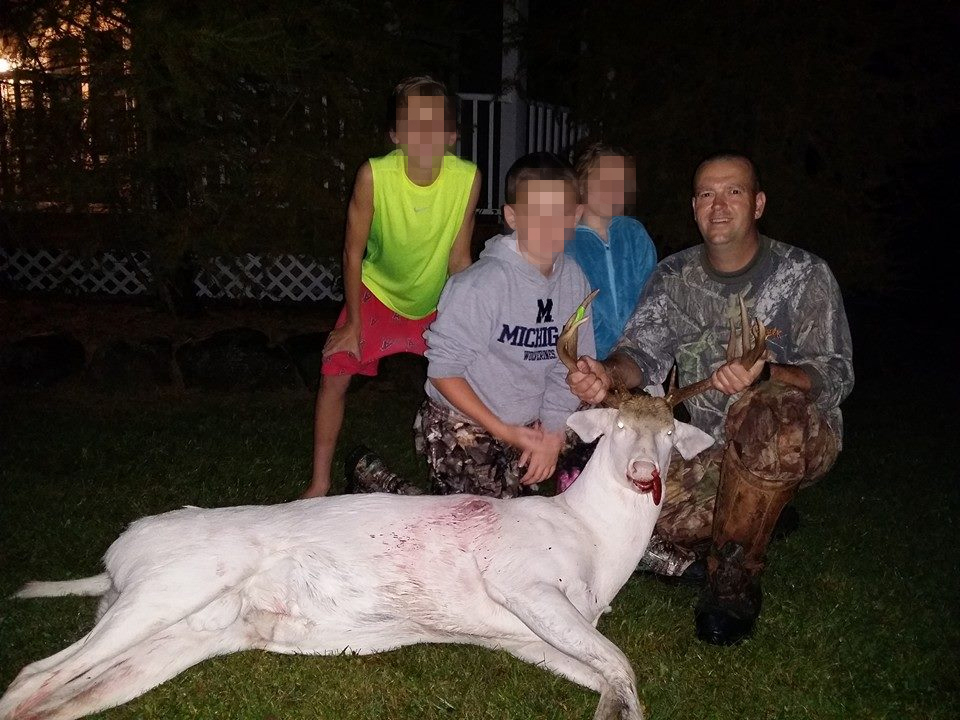
Hunter Encourages 11-Year-Old Son To Kill Rare Albino Deer

https://www.thedodo.com/hunter-encourages-11-year-old–775070621.html?utm_source=ahiaFb

 By Stephen Messenger

An 11-year-old boy in Michigan had an encounter last week with one of nature’s most awe-inspiring sights — an albino deer, alive and free in the wild. Only about one in 20,000 deer are born with albinism, and far fewer survive to maturity like this one had.

But the boy was on no nature walk; he was on a hunting trip with his father, and the rare deer wouldn’t survive the day.

Warning: Graphic image below

With the encouragement of his father, Mick Dingman, the sixth-grader steadied his crossbow and fired a fatal shot through the deer’s lungs, besmirching that snow-white coat with the spill and splatter of blood. The rare animal had been seen by folks around town leading up to that moment, but now this deer was the Dingmans’ alone.

Dingman tells the Livingston Daily that he plans to commemorate the killing by getting the 12-pointed buck mounted by a taxidermist: “It’s too rare and too pretty not to spend the extra money and have the whole thing done.”

“[My son] kind of feels like a rock star right now,” says Dingman, adding that the youth’s supposed accomplishment has caught the attention of hunting magazines, who are interested in sharing the story. But not everyone is so excited.

(Facebook/Mick Dingman)

Amy Sprecher, in neighboring Wisconsin, runs a white deer protection group composed of hunters and non-hunters who are opposed to killing albinos — and she says stories like this are “maddening.”

“It’s just wrong. I don’t understand why’d you’d want to take that animal away from everybody,” Sprecher told The Dodo. “There are people who want to hunt white deer for bragging rights, but that’s not what hunting is about. Hunters that would never shoot a white deer don’t understand these people either.”

And Sprecher is not alone in her outrage. Not long after the Livingston Daily posted this photo and story online, readers began expressing anger.

“Wouldn’t you much rather observe something so rare again year after year than just stare at this giant full mounted carcass for the rest of your life?” writes Christina Brown.

“This deer was in our backyard in the spring and my wife took a picture. All of the people near us wanted to only shoot pictures, not the deer. We aren’t anti hunting but instead wanted this rare deer to be able to spread his genes so his legacy lives on after he died of a natural cause,” writes Tim Reinert.

Given the rarity of albino deer, four states, Illinois, Iowa, Tennessee and Wisconsin, have made it illegal to kill them. Critics have argued that laws protecting white deer are based more on emotion than science — arguing that albinism is a genetic disorder, not something to be cherished — but emotions surrounding white deer is certainly nothing new.

According to Native American tradition, white deer, like the one killed by Mick Dingman’s son, are one of the most sacred creatures on the planet.

“Albino animals are looked at as a spirit animal, which you are suppose to learn from rather than shoot and kill,” Jonnie J. Sam, from Michigan’s Ottawa Indian tribe, told The Dodo.

“I’d be more inclined to see if the animal has something to teach me, but sadly not everybody looks at it that way.”

Roadblocks to Raise Funds for Victims of Hunting

An Alabama paper, the Gadsden Times, reported the other day that a goose hunter was critically wounded by friendly fire. Apparently the victim and his buddy were both carrying loaded shotguns when his buddy slipped and hit him point blank in the side. 

They followed that article up with news that there would be a roadblock set up to collect donations to help offset the victim’s hospital costs.

My first reaction mirrored that of a Facebook friend who succinctly commented, “Un-fucking-believable.” The nerve of stopping everyone on the highway to ask that they fund a hunter’s recovery from a hunting accident! 

Then the thought came to me: two can play at that game.

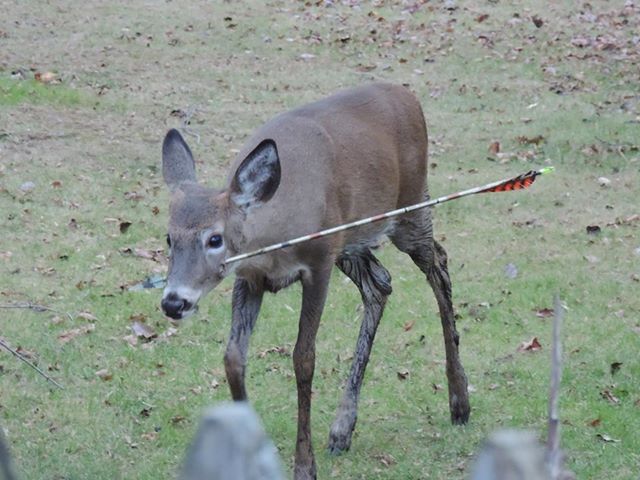
I propose we set up road-blocks—everywhere there is hunting going on—to collect funds for the wildlife victims of hunting. Whenever a goose is winged by a shotgun blast, a deer is crippled by an arrow, a bear escapes on three legs from a shoulder wound or an animal is found struggling in a trap, hunters would have to pay for their rehabilitation and return to the wild. 

I guarantee if hunters had to put their money where their mouths are, it would cut down on the prolonged animal suffering inherent in the sport of hunting.

1441225_10151990537383491_1309889797_n


WDFW fence out wildfire displaced wildlife, call for more hunting

Wildlife Photography ©Jim Robertson, 2014.

Wildlife Photography ©Jim Robertson, 2014.

(What the WDFW are essentially saying is, ‘Never mind that the deer just went through hell escaping a terrifying catastrophic wildfire, let’s kill them before winter so no human is inconvenienced.):

WDFW NEWS RELEASE
Washington Department of Fish and Wildlife
600 Capitol Way North, Olympia, WA 98501-1091

http://wdfw.wa.gov/

Aug. 7, 2014

Contact: Jim Brown, (509) 754-4624 ext. 219

WDFW assesses habitat affected by wildfires,
helps landowners fence out displaced wildlife
 

OLYMPIA – State wildlife managers are working with Okanogan landowners to protect their crops from deer displaced by area wildfires and are assessing the fires’ damage to wildlife habitat.

In addition to burning hundreds of homes, the Carlton Complex fire has scorched tens of thousands of acres of habitat used by wildlife, including mule deer, wild turkeys and western gray squirrels. The fire, which is still burning in some areas, has damaged 25,000 acres within five wildlife area units managed by the Washington Department of Fish and Wildlife (WDFW).

“A fire of this magnitude will have both short and long-term effects on wildlife populations and the landscape and that will have implications for hunting and grazing in the area,” said Jim Brown, WDFW regional director. “This is not a problem with easy answers.”

The burned area is home to a local mule deer population, which lives there year-round, and supports thousands of migratory deer during the winter. Some of the areas may still provide winter habitat depending on weather throughout this summer and fall.

Even if conditions are ideal, however, there will be too many deer for the area to support this winter and possibly for several years to come, said Scott Fitkin, WDFW district wildlife biologist in Okanogan County.

“We know we need to take steps to reduce the size of the herd,” Fitkin said. “That effort will focus initially on minimizing conflicts between deer and agricultural landowners.”

WDFW is working with local property owners to stop deer from moving into orchards, hay fields and pastures to seek food and cover. The department is helping landowners replace a limited number of fire-damaged fences and seek state and federal emergency funding.

“We expect more issues to arise as migratory deer return to the area this fall, but we are taking steps now to minimize those problems,” said Ellen Heilhecker, WDFW wildlife conflict specialist in Okanogan County.

WDFW likely will increase the number of antlerless deer permits issued this fall and winter, reaching out first to youth and senior hunters and hunters with disabilities. The department will directly contact hunters who already applied for deer permits in the area, so a new application process is unnecessary, Fitkin said.

The agency plans to draw deer and other wildlife away from agricultural lands with feed this summer and fall. WDFW is considering a feeding program for deer this winter.

“Winter feeding is not a long term solution,” Fitkin said. “At best, it’s a stop-gap measure until the deer population and habitat are back in balance.”

Sustained supplemental feeding is neither efficient nor beneficial to wildlife and often creates problems, he said. Feeding concentrates animals, making them more vulnerable to predators, poaching and disease, such as hair slip, which is already a concern for deer in the region. Having so many animals clustered in one area also causes damage to the land and can hinder restoration efforts.

In the winter, deer prefer to eat shrubs and bitterbrush, which WDFW plans to re-seed on department lands within the burned area. However, it will take many years for shrubs and bitterbrush to re-establish in the damaged area. Likewise, western gray squirrel habitat could take several years to recover. In some areas, ponderosa pine and Douglas fir tree stands sustained significant damage.

WDFW will work with other government agencies on restoration activities such as timber salvage and weed control. The agency also has located alternate wildlife units in Okanogan County with suitable forage for emergency livestock grazing. This grazing will be offered to department permit-holders first, then to others if enough land is available.

Like other public land managers, WDFW likely will close roads in some wildlife units due to hazardous trees, said Dale Swedberg, WDFW’s Okanogan lands operations manager. That could reduce access for hunting in the burned areas this fall.

“We’re developing contingency plans in anticipation of what happens during the remainder of the fire season, fall green-up and winter severity,” Swedberg said.

Hunters and others should check WDFW’s wildfire webpage at wdfw.wa.gov/wildfires for updates on conditions and access on WDFW lands. Information on wildlife and restoration efforts in the affected area also can be found on the webpage.


This message has been sent to the WDFW All Information mailing list.
Visit the WDFW News Release Archive at: 
http://wdfw.wa.gov/news/

Northern Ireland says ‘NO’ to fox and stag hunting

http://www.league.org.uk/news-and-opinion/press-releases/2014/july/northern-ireland-says-no-to-fox-and-stag-hunting

29 July 2014

Animal welfare charity, the League Against Cruel Sports, are appealing to the animal loving public of Northern Ireland to support their anti-hunting campaign by attending a rally against fox and stag hunting this Saturday 2nd August, from 2pm at the Stormont Buildings.

Stormont Rally 250The Rally which is being held by Noelle Robinson, Green Party Councillor for Bangor Central in partnership with the charity, will highlight that Northern Ireland is now the only region within the UK that has not introduced a complete ban on fox and stag hunting.

In 2002, the introduction of the Protection of Wild Mammals Act made it illegal to hunt a wild mammal with a pack of hounds in Scotland. In 2004, after 80 years of tireless campaigning by the League, England and Wales followed suit and the Hunting Act was passed. Ten years on, there is currently no hunting legislation that exists  in Northern Ireland and as such hunting foxes and stags with dogs, continues to be legal.

The charity have therefore given this campaign priority status and hope they will be able to ensure that this barbaric practice is also made illegal in Northern Ireland.

Janice Watt, Senior Public Affairs Officer in N.I said: “It is vital that we gain the support of both the N.I public and politicians in order to resign this cruel and blood thirsty sport to the history books where it belongs. It is not acceptable in the modern age for any animal to be chased to exhaustion, and then ripped apart whilst still alive. 

“The public were outraged at the leniency shown to dog fighters convicted this year in our courts – but what is the difference between setting dogs on a domestic pet, and setting dogs on a fox or stag? The answer is none. We are urging people to show their support for this campaign by attending the rally at Stormont on Saturday.”

Official figures released this month  revealed more individuals were prosecuted for hunting with dogs last year in England and Wales (2013), than in any other since the 2004 ban came into force. A total of 341 convictions under the Act, make it the most successful piece of wild animal legislation, with one person on average prosecuted under the Act every week, and over two-thirds of these convicted.

Did the Hunters Get your Wolves’ Elk?

In one of Edward Abbey’s many epic books he mentions seeing a bumper sticker on the back of a gas hog, redneck rig that went something like, “Did the coyotes get your deer?” It was an unabashed show of narcissistic entitlement which spelled out just how the driver felt about nature and the need for a diverse ecosystem.

Although his type doubtless have no qualms about supporting factory farming by buying a nightly meal of meat from the local “Western Family” grocery store, when hunting season rolls around they are right there to lay claim to the wildlife as well, in the form of deer, elk, moose or pronghorn.

It don’t mean shit that apex predators such as wolves, cougars, bobcats and coyotes have nothing else to eat and have evolved over eons to live in harmony with their wild prey. Hunters think of themselves as apex predators, decked out in their best Cabella’s camouflage outfit, tearing up the land on their trusty 4-bys or 4-wheelers, hoping a deer steps out in front of them.

But as a faithful reader pointed out this morning, human hunters aren’t apex predators, they’re apex parasites (Homo parasiticus).

Personally, I’d rather “my” deer went to the coyotes and “my” elk went to the wolves, as nature intended.

Text and Wildlife Photography ©Jim Robertson. All Rights Reserved

Text and Wildlife Photography ©Jim Robertson. All Rights Reserved