Ohio expands hours of youth deer-hunting season

[There are only around 8,000 wolves in the entire lower continental U.S., yet last year, young hunters checked nearly 9,200 white-tailed deer during the two-day season. How long, will it take a hunters and trappers to eliminate all the wolves?]
http://www.wkyc.com/story/sports/outdoors/2013/11/23/ohio-expands-hours-of-youth-deer-hunting-season/3685739/
The Associated Press

COLUMBUS — Ohio is slightly extending the hours during which young hunters

Wildlife Photography ©Jim Robertson

Wildlife Photography ©Jim Robertson

can take white-tailed deer during the two-day season this weekend.

The Ohio Department of Natural Resources says youngsters can hunt deer from 30 minutes before sunrise to 30 minutes after sunset on Saturday and Sunday. The hunters must have a hunting license and a deer permit. They’re required to wear hunter orange and be with an adult who isn’t hunting.

Last year, young hunters checked nearly 9,200 white-tailed deer during the two-day season.

Hunter Shoots, Wounds Montana Grizzly Bear

Grizzly survives after charging hunter, getting shot near Condon

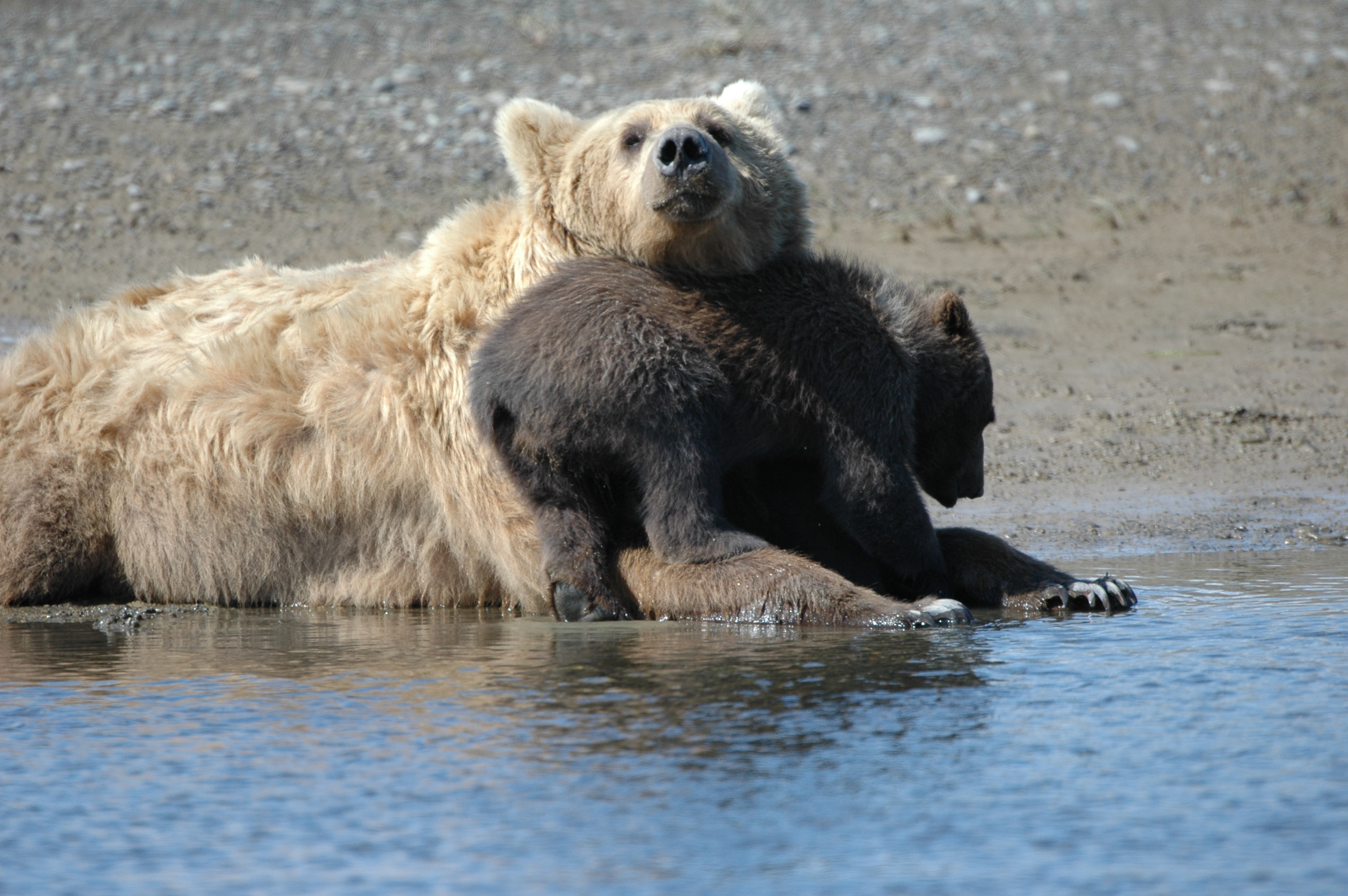
CONDON — A female grizzly with two cubs who was shot Wednesday when she charged a hunter in the Kraft Creek drainage near here has apparently survived.

The hunter immediately contacted Montana Fish, Wildlife and Parks, which tracked the bear on the ground and in the air as she moved west toward the Mission Mountains.

“The determination was made that the bear was not mortally wounded,” FWP spokesman John Fraley reported.

The hunter fired a shot after the grizzly charged to within 50 feet of him. Fraley said wardens discovered a deer carcass about 75 yards away that the grizzly and her two cubs had been feeding on.

The Flathead County Sheriff’s Department, Two-Bear Aviation and pilot Jim Bob Pierce helped FWP track the wounded bear.

The investigation continues, and Fraley reminded people to carry bear pepper spray when hunting in grizzly country, adding that experts say it is more effective than a firearm in stopping a bear.

[Great, so now there’s a wounded mother bear out there trying to avoid hunters and raise her two cubs in peace].

Photo Copyright Jim Robertson

Photo Copyright Jim Robertson

Hunting Is a Destructive Preoccupation

Not that it’s all that unusual considering the destructive nature of the so-called “sport,” but hunters seem to be chalking up a lot of cases of mistaken identity lately. A prime example: over the weekend in Montana, a hunter mistook someone’s dog for a wolf and shot it to death with his assault rifle, 20 yards from the dog’s guardian who yelled frantically for the shooter to stop.

Meanwhile today’s NY Daily News tells us of a “Long Island firefighter killed when mistaken for deer by friend in hunting tragedy” Their article reports:

A beloved Long Island firefighter was killed in an upstate hunting accident after a buddy mistook him for a deer, sources told the Daily News on Monday.

Charles Bruce, 52, was on an annual hunting trip with friends from the Malverne Fire Department when the tragedy unfolded about 10:20 a.m. Saturday in rural Westford, about 11 miles east of Cooperstown, law enforcement sources said.

“Unfortunately, it was a high-powered rifle. He was dead before he hit the ground,” Otsego County District Attorney John Muehl told The News.

“Charlie had a bad back, so he went back to his room to rest. And when he came back out, one guy saw a tree move and fired,” said a close friend of the victim’s who asked to remain anonymous.

The shooter was an active Malverne firefighter who moved on to a nonfirefighting role with the Department and is “destroyed” over the incident…

Photo Copyright Jim Robertson

Photo Copyright Jim Robertson

The shooter was “destroyed” emotionally; at the same time, his hunting partner, as well as the deer they shoot, are all destroyed literally.

Clearly, hunting is a pretty destructive preoccupation.

I don’t care how many hunter safety courses they attend, when it comes right down to the heat of the moment, trigger itch all too often takes the place of cool resolve or good judgment. Completely lost are notions of ethics or accuracy, not to mention target identification.

Deer Hunters Would Freak if They Saw a Wolf

Despite news that wolves are starting to spread out to other states, after their re-introduction to the Tri-state area of the Northern Rockies, wolves are still extinct in most of their former range in the continental U.S. Yet, it seems there’s no shortage of deer; in fact ungulate populations have been booming since the near continent-wide extermination of wolves and other predators that left the lower 48 in ecological turmoil.

Take Oklahoma for example. According to their “local OKC weekend hunting news”:

Oklahoma’s gun season opens Saturday. The rut is expected to be going  strong across the state in the coming days. State wildlife biologists in Okla. expect the peak of the rut in most areas of the state to happen sometime before Saturday’s opening. 

Barring any major weather events that keeps hunters at home,  Saturday will be the biggest deer hunting day of the year.  More deer are taken on the opening day of gun season than on any other. The rut, the mating season of deer, is triggered primarily by moon phases. However, the rutting activity that hunters see has more to do with the weather.

The first time Oklahoma hunters checked in 100,000 deer for all  seasons combined was 13 years ago.  Since then, there have been only three years that Oklahoma’s deer harvest has not exceeded 100,000.

Wildlife biologists estimate deer hunters take about 10 percent

Photo by Jim Robertson

Photo by Jim Robertson

of the deer population during hunting seasons. This gives Oklahoma an estimated deer population about one million.

Approximately one million deer in a state as small as Oklahoma. And exactly ZERO wolves. 100,000 deer killed during hunting season, and it’s not even a dent in the deer population. Natural processes have been ousted and ignored–hunters there would freak if they if they saw a wolf. I can just hear their screams of, “Those wolves are going to eat all our game…” It’s the same story that’s going on across the country. Hunters don’t want healthy deer or elk populations, they want a surplus to justify their “harvests.”

Deer-hunting season comes with self-inflicted hazards

By Michael Aubry ,Ottawa Sun

First posted: Saturday, November 16, 2013

Wildlife Photography ©Jim Robertson

Wildlife Photography ©Jim Robertson

A viciously amputated finger.

A bullet-sized hole to the shoulder.

These potentially fatal accidents are just some of the examples that have already plagued this year’s deer-hunting season.

A peaceful romp through the woods can easily prove deadly — and punctuated by shrill cries for help — after just a moment of inattention.

“It’s important to have proper respect for a firearm, it’s a lethal force and a dangerous weapon,” said Steven Aubry, district enforcement supervisor with the Ministry of Natural Resources.

“Any incident can be deadly. Hunting should be a safe and enjoyable pastime.”

Ontario Provincial Police are probing six accidental shootings in southern and eastern Ontario this year so far.

A 75-year-old man shot himself while hunting in North Glengarry Township Thursday.

Later that same day, a 23-year-old was shot in a hunting accident in North Grenville.

Earlier last week, a 59-year-old man was shot in an accident just outside Smiths Falls. But they likely won’t be the last.

There have been an average of 10 serious hunting incidents every year for the past 20 years, including last year when 22-year-old Andrew Winnicki was killed in a freak accident bird hunting in Osgoode.

Aubry said these rare slip-ups are almost always linked to the four cardinal rules of hunting — and those who break them.

Every hunter should assume their gun is loaded at all times.

That means maintaining control of their muzzle, keeping their finger off the trigger until they’re ready to shoot, and never point at something they don’t intend to kill.

“Hunters have to understand that when you point a loaded firearm at something, you’re prepared to destroy it, so gun control is so important,” he said

More: http://www.ottawasun.com/2013/11/16/deer-hunting-season-comes-with-self-inflicted-hazards

How are Deer Managed by State Wildlife Agencies?

http://animalrights.about.com/od/wildlife/a/DeerManagement.htm

By

Most people think of wildlife management agencies as serving the ecosystem, interfering minimally and mainly to preserve wildlife. These agencies do have programs to protect endangered species and to protect habitat in general. But instead of managing wildlife solely for the optimal health of the ecosystem, state wildlife management agencies also manage wildlife for recreation. The agencies have a financial incentive to do so.

Deer as a Resource

To these agencies, deer are a resource, not sentient beings with their own inherent rights. The resource must be conserved, or used wisely, so that there will be plenty of deer for future generations of hunters. As a result, deer management is usually designed to keep the deer population high. For example, the Arizona Game and Fish Department’s mission is:

To conserve, enhance, and restore Arizona’s diverse wildlife resources and habitats through aggressive protection and management programs, and to provide wildlife resources and safe watercraft and off-highway vehicle recreation for the enjoyment, appreciation, and use by present and future generations.

The desire for a high deer population led Pennsylvania and other states to stock deer in the early 20th century.

The Wisconsin Department of Natural Resources states in their annual report: “We rank first in the country for the highest single year deer harvest on record and are number one for deer harvest over the past decade. All of us work hard to keep it that way.”

The New York Department of Environmental Conservation takes the “needs” of hunters into account when determining their goals for deer management:

The goal is to balance deer with their habitat, human land uses and recreational interests. Ecological concerns and the needs of landowners, hunters, and other interest groups must be considered.

The Pennsylvania Game Commission also considers the desires of hunters in their deer management strategy:

Managing Pennsylvania’s deer herd is an enormous undertaking that frequently includes input from everyone from hunters and naturalists to farmers, foresters and suburbanites. Each has his or her own idea about how many deer we should have. As a general rule, hunters want as many as possible. Still others, particularly people made a living from their land, prefer fewer deer. But history has shown that no one group gets its way entirely.

These are just a few examples of state wildlife management agencies stating that they manage the deer population in a way that increases recreational hunting opportunities for hunters.

Financial Incentives

Most people find it incredible that their state wildlife management agencies are trying to keep deer populations high when so many residents complain that there are too many deer, but the agencies have financial incentives for pleasing hunters. The agencies depend on sales of hunting licenses for their funding, and hunters like a high deer population. The Michigan Department of Natural Resources states on their website:

Michigan hunters have supplied millions of dollars for the development of hunting regulations based on scientific data. They have also provided funds to enforce those rules in the field. Millions of dollars have been contributed for the acquisition of land and for the improvement of deer habitat on those lands. In many cases, legislative action to protect deer, acquire land, and improve deer range has been initiated by hunters themselves. This partnership among the Michigan deer hunter, the Department of Natural Resources, and the Michigan Legislature speaks well of our ability as citizens to work together through state government to manage wildlife.

Also, the federal Pittman-Robertson Act gives money from the excise taxes on sales of guns and ammunition to state wildlife agencies to increase wildlife populations. Pittman Robertson funds can also be used for land acquisition, hunter safety education and for the construction and maintenance of target ranges. To be eligible for Pittman-Robertson funds, a state must not divert money from the sales of hunting & fishing licenses outside of the state’s wildlife management agency.

How Do The Agencies Increase the Deer Popuation?

To increase the deer population, sections of forest in state wildlife management areas are clear-cut, to create the “edge habitat” that is preferred by deer. For example, the Virginia Department of Game and Inland Fisheries recommends for deer management:

Openings in a forested area encourage the production of preferred food plants and may compensate for yearly and seasonal fluctuations in food supplies, like acorns. Natural openings in forests should be maintained. Openings of one to three acres in size should be created, and be strategically located throughout an area to provide diversity and edge.

State wildlife management lands are also sometimes leased to farmers, and the farmers are required to plant deer-preferred crops and leave a certain amount of their crops standing so that the deer will be fed and reproduce more. Sometimes, the state wildlife management agencies will plant “deer mix” themselves, to increase the deer population. For example, the Illinois Department of Natural Resources explains,

Portions of the area are managed under a farm lease program to promote upland wildlife habitat and to demonstrate the potential for producing wildlife on farm lands. Site personnel supplement natural habitats with tree and shrub plantings, native grass seedings, specialty food crop production and succession control.

Of course, animal rights activists oppose hunting and oppose wildlife management that artificially increases the deer population. As long as state wildlife agencies are funded through sales of hunting licenses and Pittman-Robertson funds, they will have an incentive to manage deer as a source of recreation and they will continue to be at odds with animal rights activists.

Meanwhile in Oklahoma…

Oklahoma hunters have already checked in 30,500 deer this season. However, that pace is slightly behind last year.

As a general rule, deer aren’t moving much around during most of the muzzleloader season, but that will soon change with the beginning of the rut, the time of year when whitetails become less cautious. Deer are now starting to move more during the day, and some bucks already have been seen trailing does.

Okla.’s 16 day deer gun season, the biggest hunting season of the year, begins the Saturday before Thanksgiving. Almost 200,000 hunters in Okla. participate in the deer gun season.

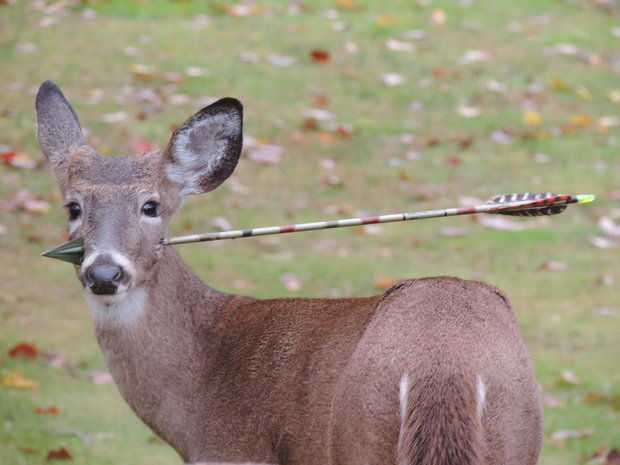
Archery deer season remains open thru Jan. 15th. [So, you can expect to see more of those arrow-impaled deer wandering around for another 2 months….]

The Okla. Dept. of Wildlife Conservation has extended the deadline for the agency’s guided youth waterfowl hunts to Nov. 21. The youth hunts are open to hunters ages 12 to 15 who have completed the hunter education course. An adult guardian must accompany the youth hunter. Many of the states wildlife refuges have guided hunts.

Wildlife Photography © Jim Robertson

Wildlife Photography © Jim Robertson


Happy Ending for Arrow-Impaled NJ Deer

N.J. biologists find injured Rockaway Township deer and remove arrow from its head

By Robin Wilson-Glover/The Star-Ledger13709511-mmmain
November 10, 2013

ROCKAWAY TOWNSHIP — A hunter’s arrow that had pierced both sides of a young deer’s head has been successfully removed, according to state officials and the woman who first notified authorities about the animal.

Staff from New Jersey Division of Fish and Wildlife tranquilized the deer Saturday afternoon in the backyard of Susan Darrah’s Rockaway Township home, removed the arrow, treated the wound and released it back in the wild, Darrah said today. DEP Spokesman Larry Hajna confirmed the arrow removal.

“Everybody loves a happy ending,” Darrah said.

After first spotting the deer with the arrow on Nov. 1, Darrah called Fish and Wildlife and authorities there instructed her to put out corn to draw the deer back into the yard. On different occasions, staff members staked out the area in an attempt to catch the animal and remove the arrow, she said.

Saturday evening, when the small deer wandered into her yard to eat, a member of Fish and Wildlife was able to tranquilize the animal, then follow it into the woods and bring it back into Darrah’s yard, she said.

They removed the arrow, put topical antibiotics on the wound, gave it a shot of antibiotics and then waited for it to wake up. The biologists who did the procedure say the arrow did not damage major arteries or organs and the deer’s prognosis for survival is excellent.

Once the deer was able to stand, it walked off into a nearby pasture and took a nap before it headed back into the woods, Darrah said.

“I can not say enough, give enough accolades to the guys at Fish and Wildlife,” Darrah said. “These guys were dedicated, determined and totally respective of me and my property… They were just terrific.”

The deer, which she had come to jokingly call Steve Martin because of the comedian’s stand-up routine with a fake arrow through his head, gained notoriety worldwide after Darrah shared the first images of it with The Star-Ledger last week.

Darrah said friends in the Netherlands told her the story appeared in the largest newspaper in Holland and a friend at the Nairobi Hilton in Kenya sent her an email, letting her know that the deer’s photograph and story also appeared in a newspaper there, as well.

Given the animal’s celebrity, she is hoping that the 5-month-old male deer will survive the fall bow hunting season.

“He has as good a chance as any when it comes to making it,” she said.

The Associated Press contributed to this report.

Wisconsin Adds Crossbows to Their Quiver

Now the only question that remains is, what cruel kill method is NOT allowed in Wisconsin?

I can think of only a few offhand:

-Grenade launcher
-Flame thrower
-Nerve gas
-Chemical weapons

Hell, why doesn’t the state DNR just nuke itself every fall (starting with this one) and be done with it? That should take care of their deer, rabbit, squirrel, duck, geese, sandhill crane and wolf “problems” once and for all.

__________________

Assembly unanimously passes crossbow hunting bill

By Paul A. Smith of the Journal Sentinel

Nov. 9, 2013

In an era of deep political divisions, Wisconsin legislators can agree on at least one thing: increased crossbow hunting opportunities.

On Oct. 27, the Assembly unanimously passed an amended version of AB 194.

The bill would create a crossbow hunting license and a crossbow hunting season. Hunters of all legal ages could purchase the license.

Under current state law, only hunters with physical disabilities and those age 65 and over are allowed to hunt deer with crossbows.

The crossbow hunting season would run concurrent with the archery deer season.

The amended version creates a three-year trial period during which the Department of Natural Resources will monitor harvest rates by crossbow hunters. The Senate approved the bill in September.

The Assembly vote was 91 ayes, 0 no.

The bill now awaits the signature of Gov. Scott Walker. If the governor signs it as expected, the crossbow hunting season will take effect in September 2014.

Wolf season update: As of Friday, hunters and trappers had registered 201 wolves in the 2013-’14 Wisconsin wolf season, according to the DNR.

Harvest quotas were filled in five of the six wolf management zones.

Trappers have taken 82% of the wolves; the balance have been killed by hunters with firearms.

Zone 3 in north central and northwestern Wisconsin remains open. Nineteen wolves had been registered in Zone 3 as of Friday morning; the quota is 71.

The zone will be open to wolf hunting and trapping until the quota is filled or Feb. 28, whichever comes first.

Given the fast pace of wolf kills since the season opened Oct. 15, the season could be over before the Wisconsin gun deer hunt begins Nov. 23, as well as before wolf hunters could begin using dogs Dec. 2.

The DNR had sold 1,837 resident and 11 nonresident wolf hunting and trapping licenses as of Friday. It authorized the sale of 2,510 licenses through a lottery.

State wildlife managers set a kill goal of 251 wolves for the season.

Hunters and trappers are responsible to know the status of zone closures. Information is available at dnr.wi.gov and by phone at (888) 936-7463 .

Read more from Journal Sentinel: http://www.jsonline.com/sports/outdoors/assembly-unanimously-passes-crossbow-hunting-bill-b99137922z1-231303281.html#ixzz2kGrLqn3p
Follow us: @NewsHub on Twitter

90641_Varminter

A Bloody Weekend’s in Store For Minnesota

Minnesota deer hunting: Firearms season starts Saturday

About 500,000 hunters will each try to kill one of Minnesota’s roughly 1

Wildlife Photography ©Jim Robertson

Wildlife Photography ©Jim Robertson

million deer Saturday on the opening day of the state’s firearms deer season.

It’s the state’s most popular outdoors event aside from the spring fishing opener, and unlike other types of hunting, deer hunting is holding its own, if not growing, in Minnesota.

As of Monday, license sales were ahead of last year’s pace. In 2012, nearly 522,000 firearms tags were sold, the most since at least 2000.

For the past several years, roughly 98 percent of all tags have been purchased by Minnesotans. Much of the reason for that, wildlife officials say, is that deer hunting is as much about family traditions as shooting a deer.

Still, it is a hunt, and more than 100,000 deer are expected to be taken.

The state’s total deer take for the year largely will be determined by how hunters fare Saturday and Sunday. Seventy percent of the kill occurs during opening weekend, according to the Department of Natural Resources.

Last year, 186,000 deer were killed during the fall archery, muzzleloader and regular firearms seasons, and with population levels and license restrictions generally similar to last year, the agency forecasts a similar take this year.

More: http://www.twincities.com/sports/ci_24477262/minnesota-deer-hunting-firearms-season-starts-saturday?source=rss