Exposing the Big Game

Forget Hunters' Feeble Rationalizations and Trust Your Gut Feelings: Making Sport of Killing Is Not Healthy Human Behavior

Exposing the Big Game

Parents chime in on decision eliminating state’s minimum hunting age

WISCONSIN The State Assembly passes a bill eliminating Wisconsin’s minimum hunting age.

“I think we’re losing sight of why the original law was put into place, it was put into place to protect children,” said Joe Slattery, a concerned parent.

Slattery opposes the measure. Right now the minimum age to buy a gun-hunt license is 12 years old, but children as young as 10 can be part of a mentored hunt.

This bill removes the minimum age from the mentored hunt program and eliminates the requirement of only one weapon between hunter and mentor.

Jordan Schuld is an avid hunter with five kids. He believes parents know their children’s capabilities.

“Each parent knows their own child and knows when they’re ready to go out in the woods, if they’re able to hold the gun weight wise and if they’re responsible enough to handle it,” Schuld said.

Schuld doesn’t agree with the entire proposal, he still favors a mentor hunt having only one gun.

“I just don’t think that there should be two weapons between the parent and the child, I think a mentor hunt is a mentor hunt, and if you have two weapons it’s not a mentor hunt anymore, two people are hunting,” said Schuld.

According to the Michigan DNR, studies show if children do not have an interest in an activity before the age of 10, it is unlikely that they will continue that activity later in life.

“As a parent, I would like my child to have the same interests as mine, but if they don’t– they’re their own individual,” said Slattery.

Slattery says this legislation would lead to more hunting accidents, like the one that took the life of his son.

“You can get them involved at six, by taking them hunting with you, that’s perfectly legal right now, you just don’t have to put a gun in their hands, my son was killed at the hands of another 13-year-old,” said Slattery.

“If one my kids seem ready and they’re under 10, I’ll absolutely take them hunting, if not, I’ll wait,” said Schuld.

The State Senate is expected to vote on the measure next week, if passed there it would head to the Governor’s desk for his signature.

Maryland Natural Resources Police Announces Charges Connected Deer Poaching

http://morningsidemaryland.com/maryland-natural-resources-police-announces-charges-connected-deer-poaching/

The Maryland Natural Resources Police arrested five Garrett County men for deer poaching activities, which stemmed back as far as 2016.

Public tips and social media posts prompted an investigation into a string of illegal hunting incidents. Homes in Garrett County were served search warrants in July, before charges were filed against the five suspects.

Twenty-nine-year-old Dakota Lee Hinebaugh, of Oakland, was fined for 24 hunting violations. He faces up to $39,500 in fines and loss of hunting privileges for up to five years, police said. He allegedly hunted without a license and during a closed season, as well as possessed a deer during a closed season. Hinebaugh is accused of hunting deer at night without written permission, with a spotlight and hiding a deer or removing the head before check-in, according to police.

Deer HuntingTwenty-one-year-old Michael DeWitt, of Swanton, was fined for a total of 30 violations. He faces maximum fines up to $45,500 and loss of his hunting privileges for up to five years, police said. DeWitt allegedly hunted during and possessed a deer in a closed season. He is also accused of firing his gun from a vehicle, hunting deer with a spotlight, hunting without written permission, failing to return a turkey kill, obstructing a police investigation and hiding a deer or removing a deer’s head before check-in.

Forty-two-year-old Michael Allen DeWitt, of Oakland, was charged with littering and hindering or obstructing a police investigation. He faces a 30-day jail sentence and a maximum fine of $1,500.

Forty-one-year-old Donald Lee Hinebaugh, of Oakland, was fined for aiding and abetting hunting without a licensed and failing to report two deer kills, police said. He faces a maximum five of $1,500.

Fifty-eight-year-old Phillip Lyle DeWitt, of Mount Lake Park, was fined for “failing to report a kill and failing to record the kill on his Big Game Harvest Record,” police said. He faces a maximum fine of $3,000.

Additionally, the Maryland State Police charged 19-year-old James Wesley Lewis, of Accident and 18-year-old Lukas Issac Holler, of Oakland, for possession of a shotgun or rifle and illegal ammunition after conviction of a disqualifying crime. Both men face a maximum three-year prison sentence and maximum $1,000 fine. They also face an additional one-year prison sentence and maximum fine of $1,000 for the ammunition charge.

Poaching suspects left lengthy digital trail for investigators to follow

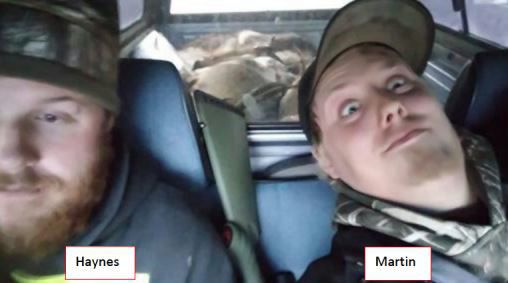
William Haynes and Erik Martin
William Haynes, left, and Erik Martin pose for a selfie in Haynes’ pickup truck. The image was sent from Martin to his girlfriend on November 19, 2016, according to case reports. In the back of the vehicle, multiple deer can be seen. According to case reports, the deer were illegally killed in Oregon and transported across state lines to Washington.

Washington Department of Fish and Wildlife case report

For individuals who apparently got a thrill by stalking and illegally killing wild animals, William J. Haynes and Erik Christian Martin did a poor job of covering their own tracks.

The suspected poachers unwittingly provided law enforcement officers with a huge cache of evidence, allowing Washington Department of Fish and Wildlife investigators to build a massive case against them and five other members of an alleged poaching group.

Based on case reports reviewed by The Daily News, there’s little sign the men ever thought about getting caught.

Instead, the 23-year-old Longview residents are suspects in an investigation into the killing of more than 50 animals including deer, elk, bears and bobcats in two different states. Along the way, they left a digital trail of shocking evidence for Fish and Wildlife investigators to follow.

The painstaking task required two Fish and Wildlife officers and a sergeant, who spent a majority of the past winter and early spring diligently retracing the suspects’ bloody steps.

Investigators were also assisted by more than 30 officers from multiple agencies, including the Cowlitz County Sheriff’s Office.

“We’ve used a lot of our manpower in this region in Western Washington to accomplish this case,” Fish and Wildlife Sergeant Brad Rhoden said in an interview.

Rhoden said he doesn’t want intense interest in the case to lead to a negative perception of honest hunters.

“I don’t want anybody to view the majority of our hunters in Washington as these types of individuals,” he said. “I don’t think there’s a sportsman out there who would say this is OK.”

Haynes is facing 61 separate charges in Skamania County District Court, including 26 charges of first-degree illegal hunting of big game. All of the charges are related to the use of dogs while hunting, which is illegal in Washington without a special permit that’s only granted in specific instances. Haynes was previously convicted of second-degree unlawful hunting of big game in Cowlitz County on Oct. 3, 2013. As a result, all of Haynes’ big game charges could be considered Class C felonies, which are punishable by up to five years in jail and a $10,000 fine.

Martin, who does not have any previous violations, is facing 28 separate charges for gross misdemeanors.

In addition to Haynes and Martin, three other suspects have been named in the investigation.

They are Joseph Allen Dills, 30, of Longview; Eddy Alvin Dills, 57, of Longview; and Bryan Christopher Tretiak, 31, of Morton. All of the suspects are awaiting preliminary appearance hearings in Skamania County later this month. Two female suspects were named in the case reports but no charges have been filed against them yet.

Dills, who has bear claws and dog paws tattooed on his left arm, pleaded guilty in Wahkiakum County District Court in 2008 to second-degree unlawful hunting of big game and second-degree criminal trespassing. He’s now facing 64 separate charges, including four first-degree unlawful big game hunting charges for the illegal use of dogs.

Had Haynes and Martin known that the contents of their phones would result in so many charges, it’s possible they may have opted not to document such a staggering number of alleged illegal hunting activities.

A mountain of evidence

Based on case reports, it’s not clear if Haynes or Martin thought twice before agreeing to allow two Oregon State police officers to look through their devices on December 3, 2016.

According to reports, the troopers had stopped the men after recognizing Haynes’ Toyota pickup as the same vehicle that appeared in several images captured by Oregon Department of Fish and Wildlife game cameras. The motion-activated cameras were set up in response to past illegal big game hunting activity in the Mount Hood National Forest during the months of November and December.

Upon questioning, Haynes and Martin confessed to illegally killing two buck deer and a silver gray squirrel, according to reports. The two men admitted to taking only the heads of the two deer and the entire squirrel back to a house in Longview, leaving the rest of the animals to rot.

At this point, Senior Trooper Craig Gunderson requested that Washington Fish and Wildlife Sergeant Brad Rhoden assist with recovering the illegally transported deer heads.

When Rhoden arrived, Gunderson informed him that Haynes and Martin had consented to having their cell phones searched. According to reports, it was at this point that the true scale of the ensuing investigation began to emerge.

An initial look through the devices revealed numerous photos of antlered deer skulls, dead bull elk, and — perhaps most disturbing — bear hunting with the use of dogs.

Gunderson seized the phones as evidence and obtained a search warrant to have a forensic analysis performed on the devices.

On Dec. 16, 2016, Rhoden met with Gunderson and several other officers to transfer evidence from the analysis.

The contents of Haynes’ phone provided hundreds of photos and videos documenting a pattern of brutal killings on more than 20 separate occasions.

In some cases, bears were still alive as Dills’ dogs gnawed on their flesh, Rhoden said.

Martin’s phone also held numerous photos and videos of the unlawful harvest of big game.

In addition to incriminating photos, videos and text messages, the evidence included crucial metadata which allowed investigators to pinpoint exactly where the illegal killings occurred using GPS coordinates.

Investigators could not have retraced the suspects’ steps if Haynes had not granted his phone’s camera permission to access its GPS location data.

“What was most difficult about this case is that we had to pore through so many records,” Rhoden said.

“ON THE ROAD”

Poem from Rosemary Lowe:
I HAVE BEEN LYING HERE FOR HOURS, SINCE THE COLD NIGHT’S DEATH WIND HURTLED MY LIVING BODY INTO THE COLD GRIP OF DEATH…
SO SOON  MY  YOUNG LIFE,  TORN FROM ME, TERRIFIED BY THE CRUSH OF METAL UPON MY FLESH–OH, THE BLOOD AND THE PAIN….
THE ROAD– HUMANS CALL IT– WITH THEIR POWERFUL KILLING MACHINES, SO FAST, SO FINAL—GOING WHERE?
MILLIONS OF MY KIND–FOUR LEGGEDS–WITH PLACES TO GO, FAMILIES TO BE WITH, NEVER TO MAKE IT TO OUR DESTINATION…
NEVER TO SNUGGLE AGAIN, AGAINST FAMILIAR FUR, THE WARMTH AND LOVE OF ONE’S OWN KIND…
TOO FAST, TOO BIG–HARD METAL AGAINST A SOFT LIVING BODY–THAT BREAKS AND BLEEDS..DO YOU HEAR MY CRIES?
DO YOU SEE MY SHATTERED, BLOOD-SOAKED BODY ON THE ROAD?— DO YOU EVER SEE?
I AM NOT JUST A BODY, A THING.
I WAS SOMEONE’S MATE, SOMEONE’S CHILD, I WAS SOMEONE.
I WAS AN ANIMAL, JUST LIKE YOU.
——Rosemary Lowe

Too Many Deer on the Road? Let Cougars Return, Study Says

Cougars can kill hundreds of deer over the course of their lives, leading some scientists to argue that restoring them to 19 states with large populations of deer could prevent automobile-deer collisions.
KONRAD WOTHE / MINDEN PICTURES
JULY 18, 2016
Trilobites
By JAMES GORMAN
What large mammal regularly kills humans in the Eastern United States?

And what other large mammal might significantly reduce those deaths?

The answer to the first question is the white-tailed deer. Deer do not set out to murder people, as far as anyone knows, but they do jump out in front of vehicles so often that they cause more than a million collisions a year, resulting in more than 200 deaths.

The answer to the second question, according to a new scientific study, is the cougar.
Show Full Article:

Today’s hunting accidents

da vinci

Man seriously injured after shooting self in hunting accident

Daily Republic  – ‎3 hours ago‎
Larry Maxwell and his son, Cody, of Mitchell, were goose hunting southwest of Miner County in Beaver Township around 3:30 p.m.
The Southland Times

man killed in Central Otago hunting accident

The Southland Times  – ‎Mar 3, 2016‎
A 61-year-old man killed in a hunting accident near Cromwell will be remembered as a hardworking family man, who loved to have a good laugh.

Southside man continues to recover from hunting accident

Gadsden Times  – ‎Feb 27, 2016‎
It took about an hour for help to arrive and be driven by four-wheelers to where the accident occurred. It was a long time for Grogan and his worried friends.
Otago Daily Times

At a loss over hunter’s death

Otago Daily Times  – ‎Mar 4, 2016‎

One Shot During Confrontation With Hunters

 http://www.northescambia.com/2015/07/one-shot-during-confrontation-with-hunter

  • July 20, 2015

    One person was shot after getting into an argument with hunters northeast of Munson Saturday night.

    According to witness accounts, there were several individuals deer hunting the area of Green Road and Yearling Lane. A confrontation began between the group of hunters and and another individual, the Santa Rosa County Sheriff’s Office said.

    At one point during the confrontation, a gun was pointed at the group of hunters when a shot was heard. The individual who was pointing the gun at the group was shot with a high powered rifle during the incident, the Santa Rosa County Sheriff’s Office said. The victim was airlifted to an area hospital.

    The victim remained in the hospital late Sunday recovering from a gunshot wound; their exact condition was not available.

    Detectives with the Santa Rosa County Sheriffs are actively working this investigation. The individual who shot the victim was identified and is being questioned about the incident.

    More information has not been released.

URGENT: Deer Trapped at Flooded Game Ranch in Pineville, Louisiana

http://www.peta.org/action/action-alerts/urgent-deer-trapped-at-flooded-game-ranch-in-pineville-louisiana/

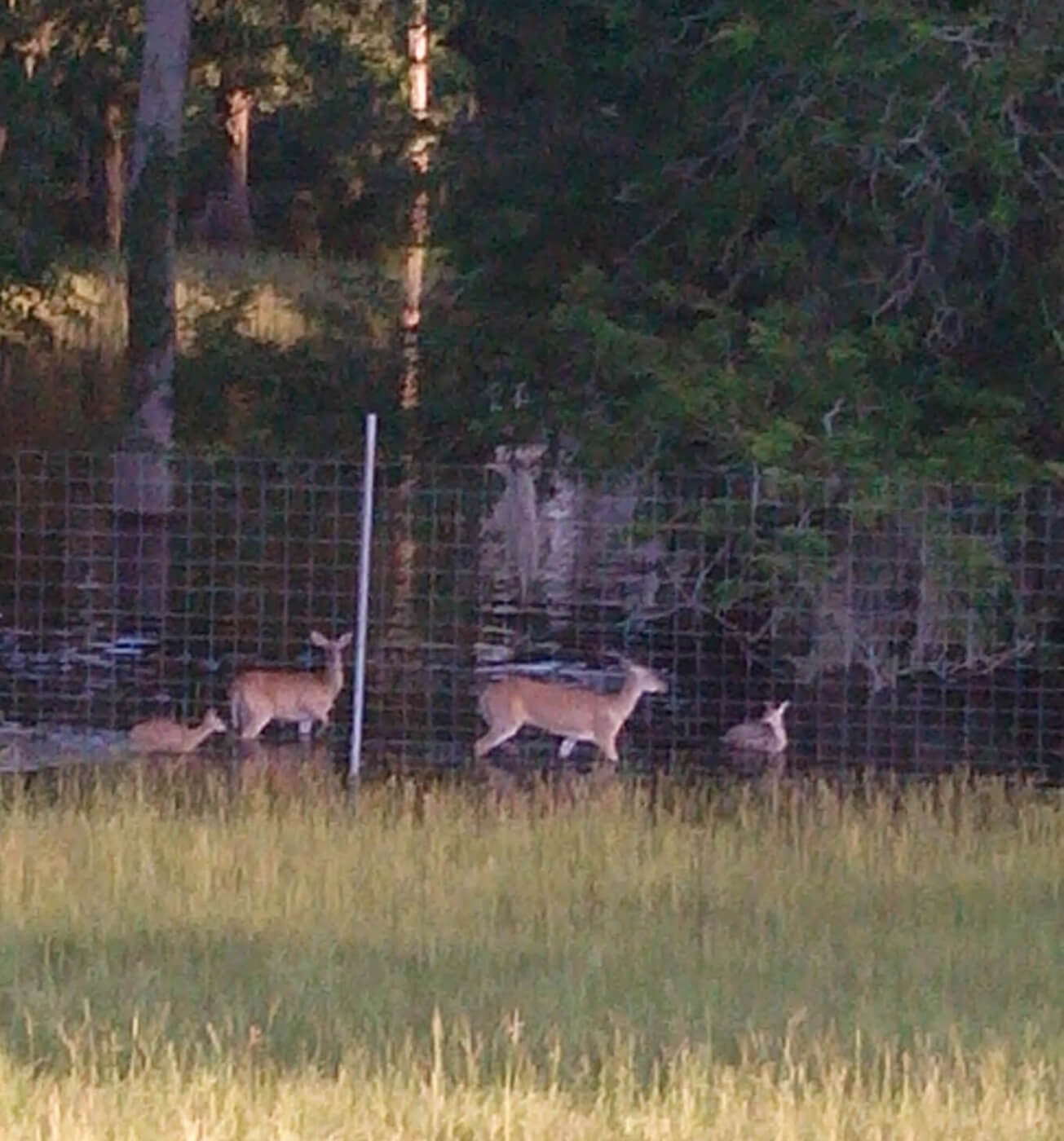
Jodi_Minion2015-06-10T165323_deeroldpicAllegedly, several deer are trapped in floodwaters at a game ranch in Pineville. Several does and fawns have been seen stuck along a fence line for days, unable to rest or lie down. Water levels are expected to rise several more feet, and these animals are in immediate danger of drowning! Officials have responded but apparently just chased away the does, who quickly returned for their young. In the meantime, we’re told that the game ranch owner is refusing to move the deer, even though other farmers in the area moved their animals to higher land days ago.

Please call or write to the game ranch owner and state agriculture officials and politely ask them to intervene and move the deer to higher ground before they drown:

Chet and Willie Cooper
Rigolette Deer Farm
318-640-3627 or 318-715-3980

John Walther
Assistant Commissioner, Animal Health and Food Safety
Louisiana Department of Agriculture and Forestry
225-925-3980
animalhealth@ldaf.state.la.us

Veronica Mosgrove
Press Secretary
Department of Agriculture and Forestry
225-922-1256
vmosgrove@ldaf.la.gov

Wild animals dying for a drink in drought-stricken West

By Darryl Fears
The Washington Post | Posted: Thursday, May 7, 2015 7:00 pm

For the giant kangaroo rat, death by nature is normally swift and dramatic: a hopeless dash for safety followed by a blood-curdling squeak as their bellies are torn open by eagles, foxes, bobcats and owls.

They’re not supposed to die the way they are today — emaciated and starved, their once abundant population dwindling to near nothing on California’s sprawling Carrizo Plain about 100 miles northwest of Los Angeles, where the drought is turning hundreds of thousands of acres of grassland into desert.

Without grass, long-legged kangaroo rats can’t eat. And as they go, so go a variety of threatened animals that depend on the keystone species to live. “That whole ecosystem changes without the giant kangaroo rat,” said Justin Brasheres, an associate professor of wildlife ecology and conservation at the University of California at Berkeley.

Endangered kangaroo rats are just one falling tile in the drought’s domino effect on wildlife in the lower Western states. Large fish kills are happening in several states as waters heated by higher temperatures drain and lose oxygen. In Northern California, salmon eggs have virtually disappeared as water levels fall. Thousands of migrating birds are crowding into wetland shrunk by drought, risking the spread of disease that can cause massive die-offs.

As the baking Western landscape becomes hotter and drier, land animals are being forced to seek water and food far outside their normal range. Herbivores such as deer and rabbits searching for a meal in urban gardens in Reno are sometimes pursued by hawks, bobcats and mountain lions. In Arizona, rattlesnakes have come to Flagstaff, joining bears and other animals in search of food that no longer exists in their habitat.

“You think about it. In our urban environments we have artificial water. We’re not relying on creeks,” said David Catalano, a supervisory biologist for the Nevada Department of Wildlife. “We have sprinkling systems. We water bushes with fruit and water gardens. That’s just a magnet for everything.

“We’ve seen an increase in coyote calls, bear calls, mountain lion calls — all the way to mice and deer,” Catalano said of residents placing distress calls to his department. “At your house everything is green and growing and flowering and they’re being drawn to it.”

The state wildlife agency said it’s preparing for a deluge of calls reporting bear sightings from Lake Tahoe this summer when berries and other foods they eat disappear for lack of rain.

About 4,000 mule deer have disappeared from a mountain range near Reno between late last year and now, likely because of drought. “Our level of concern is very high,” Catalano said. Nevada has placed low fiberglass pools called guzzlers that hold up to 3,600 gallons of water at more than a thousand wilderness areas across the state to provide water for wildlife.

The Arizona Game and Fish Department sent a message for a second year to residents in Flagstaff near Grand Canyon National Park: “Don’t be surprised if you see more wild animals around town in the next few months. Drought conditions may cause creatures like elk, deer, bobcats, foxes, coyotes and even bears to wander further into town than normal, as they seek sources of food and water.”

Don’t feed them, the department warned. Remove pet food, water bowls, garbage and other items that attract wild animals. It does more harm than good.

In California, where mandatory water restrictions were passed by the state water board on Tuesday, humans are already coming into contact with desperate wildlife from the 250,000-acre Carrizo Plain National Monument in California’s Central Valley, near Bakersfield.

“Just today, 20 minutes ago, four coyote cubs arrived” from the Bakersfield’s outskirts, said Don Richardson, curator of animals for the California Living Museum, which has an animal shelter in the city.

“We actually get everything from reptiles to mammals,” Richardson said. “We have 13 San Joaquin kit fox, an endangered species. They were abandoned, orphaned. The kit foxes health was impacted by the struggle to make it with reduced resources. Then of course we see a lot of birds of prey — owls and golden eagles.”

The animals are already suffering from the fragmentation of their habitat because of ranching and urban development. “It’s looking to be a very, very difficult year for wildlife,” Richardson said.

Endangered San Joaquin kit fox, coyotes and birds in the wildlands outside Bakersfield all rely on the giant kangaroo rat to survive. But those rodents are struggling themselves.

“We fear that a semi-arid grassland is becoming a desert,” said Brasheres. “The giant kangaroo rat can’t survive in desert.”

A study by the university recorded a 95 percent population loss since 2010.

Before the drought, 60 percent of their habitat was covered in grasses they eat and seeds they store for hard times in a network of underground burrows, Brasheres said. Four years of little rain has reduced the cover to 18 percent.

“They simply lack food so they starve,” Brasheres said. As the state wildfire season approaches, the remaining grasses could be wiped out.

For a study, biologist caught a few kangaroo rats this year to probe their condition. “They were skinny,” Brasheres said. “We looked at females to see whether they had young, whether they were lactating.” They weren’t.

In this reality where food is scarce and births are few, kangaroo rats are still a top prey item, further shrinking their numbers.

The demise of this species would be unthinkable, Brasheres said. There’s no overstating how important the rodent is in the ecosystem. Few others are around to feed snakes, badgers weasels and animals already mentioned. Even the soil kangaroo rats dig for burrows creates moist habitat for insects.

A worse situation is hard to imagine, said Stafford Lehr, chief of fisheries for the California Department of Fish and Wildlife. But there is one.

Chinook salmon are in great danger, he said. For two years, only 5 percent of their eggs have survived winter and spring migrations because the cold water their eggs need to survive drains from rivers and reservoirs.

“If you draw down a reservoir, cold water at the bottom drains first,” Lehr said.

To save them, wildlife officials tried to replenish cold water that drained from Shasta Lake north of Sacramento last year. “It didn’t work,” Lehr said.

“Ninety-five percent of eggs and juvenile brood in 2014 were killed,” Lehr said. “Those would be expected to return three years later. We also had heavy mortality in 2013, expected back in 2016. The 2015 fish are spawning right now. We’re trying everything in our power to have enough cold water in Shasta so we don’t have what we had last year.”

Salmon are only part of the problem. Smelt are at the lowest number ever recorded in the state. They are a major forage fish, feeding other fish and birds in the marine ecosystem.

“It’s part of the heritage resource in the state of California. It’s our responsibility to ensure they are protected,” Lehr said. “Every time you lose something it puts pressure on the environment.

“You lose it, and something else will replace it but it will be lost. They’re part of the ecosystem. Millions of dollars have been invested in their survival.”
Wildlife Photography ©Jim Robertson

Wildlife Photography ©Jim Robertson

Three 4-year-olds and a 99 y.o. woman reported killing deer in 2013

w/poll: At what age do you think kids are old enough to hunt deer and turkeys?

Total Votes: 24

1-4 0 0%
5-7 1 4%
8-12 10 42%
13 and older

http://lancasteronline.com/news/local/hunting-stats-three–year-olds-reported-killing-deer-in/article_14cb8108-a6fa-11e4-895b-b7f384993d31.html

January 28, 2015 9:29 am | Updated: 10:37 am, Wed Jan 28, 2015.

When the Pennsylvania Board of Game Commissioners on Tuesday proposed setting 7 as the minimum age for kids to get tags for hunting deer and turkeys, some people asked the obvious question:

“How many kids that young are actually killing deer and turkeys?”

We wondered the same thing.

The state’s mentored youth hunting program since 2006 has allowed kids of any age under the age of 12 – the minimum age for buying a hunting license – to hunt certain game, while under direct supervision of a licensed adult.

In most cases, we’re talking about parents or grandparents.

The board of Game Commissioners on Tuesday voted to tweak the program so that kids of any age under 12 still can hunt turkey and deer, but the state will only issue tags to kids age 7 and older.

If kids under 7 want to shoot turkeys or deer, their mentors have to transfer their own tags to the kids.

Many hunters and hunting organizations, such as the Pennsylvania Federation of Sportsmen’s Clubs, want the program to remain as is, with no minimum age placed on the program.

They call such limits “barriers” to hunting.

For example, they said, what if a parent has more than one kid under 7 who wants to go buck hunting?

In Pennsylvania, the parent can only have one buck tag, so only one kid would be able to shoot a buck.

While those who oppose any minimum age have been getting all the media attention, the commissioners said they’ve heard from plenty of hunters who agree with their proposal.

They said some even sent them comments stating they believe no kids under 12 should be allowed to hunt deer.

For those of you out there, like us, who have been wondering how many kids under the age of 7 have been out hunting deer and turkeys, here’s a table showing, by age of the hunters, the number of those animals reported to the Game Commission during the 2013-14 hunting season.

The numbers reported here don’t indicate the number of kids – or adults – of a particular age who were out hunting.

The list only shows how many animals were reported as being shot by hunters of a particular age.

Given historical data, more animals likely were shot, because Pennsylvania hunters are notorious for not reporting their kills to the Game Commission.

(By the way, even though we’re focused on kids, it’s interesting to note there was one buck last season reportedly shot by a 99-year-old woman.)

why