
Nina Hindmarsh and Skara Bohny22:19, Feb 22 2021

A human chain made up of around 150 volunteers is guiding a pod of whales back out to sea in chest-deep water, after successfully re-floating them at high tide.
Roughly 38 of the 49 long-finned pilot whales that stranded Monday morning at Farewell Spit were encircled by the human chain from 6.30 pm, after being re-grouped by the volunteers.
As the high tide came in and the sun began to set behind the mountains, volunteers wearing wetsuits sat in seawater up to their necks and held the whales to stop them from swimming away.
Some were getting frisky and thrashing about, while baby whales darted around volunteers in the water, looking for their parents and family members.
READ MORE:
* Volunteers on high alert after pilot whale calf washes up on Christchurch beach
* Dead whale towed to Farewell Spit tidal flats to decompose
* Project Jonah helps volunteers prepare for strandings in Taranaki
Some volunteers had been with their whales for up to six hours, dousing them in buckets of water, digging holes around them to fill up with water, and covering them in wet sheets and towels.
ADVERTISEMENTAdvertise with Stuff
At 7.30 pm, the human chain was still slowly leading the whales back out to sea.
Department of Conservation whale stranding operations manager, Darren Foxwell, said first they had to re-float the animals and let them get their balance back.https://imasdk.googleapis.com/js/core/bridge3.444.1_en.html#goog_1189197759PauseUnmuteCurrent Time 0:31/Duration 1:17Loaded: 64.27% FullscreenNINA HINDMARSH/STUFFVolunteers are working to keep stranded whales alive until they can refloat them at high tide at Farewell Spit Whale.
“So they re-orientate, and we keep them together, otherwise there’s a risk of re-stranding if they take off on their own.
“Then we let them go as a pod when they’ve all re-floated, and fingers crossed, they take off out to sea and don’t re-strand overnight.”
Foxwell said a local tour operator had discovered the 49 long finned pilot whales stranded at about 9.30am.
The scene was about 1.5 kilometres from the DOC carpark at the base of the spit.
“Volunteers started trickling in, and we’ve got enough for this part of the operation,” Foxwell said.

Foxwell said there was “rough, unofficial count” of 10 dead whales so far.
“But none have died since we’ve been here.”
“Quite often, it might be one animal that is injured, and one of the theories is that it holds the other animals in, the tide goes out, and they get stranded.”
There were “no large adult whales [stranded] here, not like there can be”, Foxwell said.
“At high tide, we hope to have these guys refloated, orientated, and swimming out towards Separation Point.”
About 2pm, a woman who was standing close to the rear of one of the largest whales was struck repeatedly by its tail, when the animal began flapping violently in distress, breaking her ankle.

The volunteer was seen crawling away and clutching her ankle, with others rushing to help, including a doctor who was also helping at the scene.
She was driven to the base of the spit and treated by an ambulance crew.
Following the incident, DOC staff were walking around reminding volunteers to keep a safe distance from the whales, and to remember that they were “still wild animals”.
Puponga resident and volunteer, Carolina Brejchova, was caring for six whales at the site.

“I’m just doing what I can, it’s not something I’ve done before and it’s not how I hoped to see whales. I just hope we can help them live and survive.”
Brejchova was caring for a baby whale “crying and communicating” to a larger one just a short distance away.
“There’s some sort of a bond between them, they are calling out to each other. It’s very sad.
“But as sad as it is, this kind of thing also brings people together.”
Auckland holidaymaker, Anna Taylor, was walking along the spit around lunchtime with her husband, when they saw groups of people arriving carrying buckets, bags and towels.

“We thought it might be a stranding, so we just walked towards everyone, and used our towels [on the whales].”
It was her first whale stranding.
Taylor said they had just flipped a whale on its side.
“Apparently they have no chance of survival if they’re on their sides, so we dug a hole and flipped it over. We just kind of dug and lots of water came up around it, which is good, but he’s blistering a bit on the tail, so we’re desperately putting our towels on and dousing it in water.”
“The baby ones are making lots of noise, it’s very sad. A few of them unfortunately, it’s too late.”
The volunteers at the scene included 50 Project Jonah trained marine mammal medics, who have completed the Project Jonah whale first-aid course.

Project Jonah communications and volunteer co-ordinator Louisa Hawkes said the main concern for whales was overheating, because the whales were black, which attracted the heat, and they were covered in a layer of blubber.
“The priority is keeping them cool and wet.”
Temperatures were forecast to reach a high of 22.
Hawkes said anyone intending to help at the stranding should be prepared for the remote location and conditions. Project Jonah has a specific page of instructions for strandings in Golden Bay due to the high frequency of events in the area.
The last mass stranding at Farewell Spit was in 2017, when an estimated 600-700 whales stranded. About 400 were successfully re-floated, but approximately 250 died.


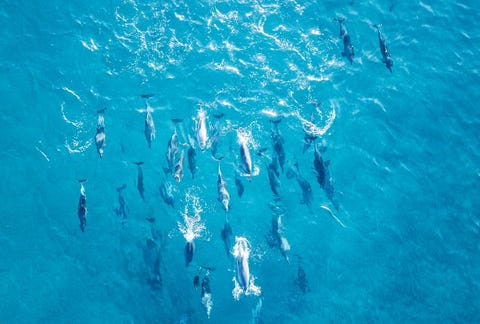 VICKI SMITHGETTY IMAGES
 This image shows a dolphin shelling in Shark Bay in Western Australia.Although shelling appears quite rare, both the number of shelling events and the number of individual “shellers” is likely to be an underestimate, according to the study, as the shell-shaking only lasts a few seconds, and is therefore hard to observe.”Some dolphins use shells quite regularly during foraging, while others have only ever been seen with a shell once,” said Wild.”So, while there may be other explanations, it’s possible that some dolphins have mastered the skill more than others.”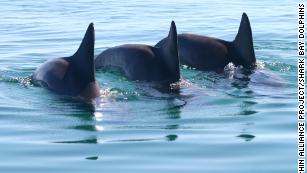
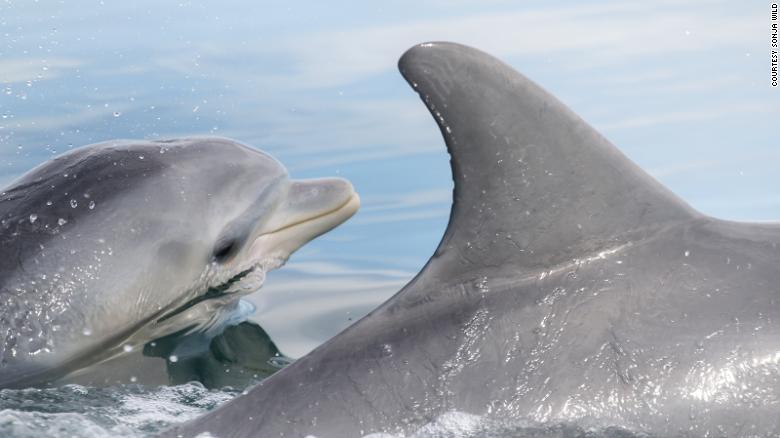 A mother and calf swimming together in Shark Bay, Australia.”Our results show that dolphins are definitely capable, and in the case of shelling, also motivated to learn new foraging tactics outside the mother-calf bond,” Wild said.”Learning from others allows for a rapid spread of novel behaviors across populations, and it has been suggested that species with the capacity for learning from others in this way may be better able to survive,” she said.
 Paid Content4/5


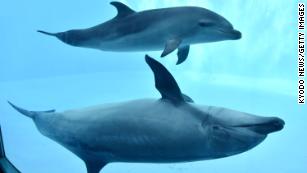
 (Dolphin hunt off Taiji pictured in 2010.)


 Exposing the Big Game