Tradition versus technology: Northerners debate use of drones in caribou hunting

BY THE CANADIAN PRESS

https://www.citynews1130.com/2019/07/07/tradition-versus-technology-northerners-debate-use-of-drones-in-caribou-hunting/

Posted Jul 7, 2019 7:00 am PDT


Wild caribou roam the tundra near the Meadowbank Gold Mine in Nunavut on Wednesday, March 25, 2009. Tradition and technology are clashing on the tundra, where Indigenous groups are debating the use of drones to help hunt caribou. THE CANADIAN PRESS/Nathan Denette

YELLOWKNIFE — Tradition and technology are clashing on the tundra where Indigenous groups are debating the use of drones to hunt caribou.

The issue arose during public consultations on new wildlife regulations in the Northwest Territories, where First Nations and Metis depend on caribou for food.

Drones are not widely used to hunt, but the N.W.T. government says they have been utilized to find caribou and sometimes to herd them to a hunter. That’s caused fears of increased pressure on populations that are already struggling.

The Bathurst herd, nearly half a million strong in the 1980s, has dwindled to 8,500. The Bluenose-East herd has declined almost 50 per cent in the last three years to about 19,000 animals.

“We heard significant concern about the use of drones for hunting and broad support for a ban on their use,” Joslyn Oosenbrug, an Environment Department spokeswoman, said in an email.

“A ban on drones will help address conservation concerns for some species and help prevent new conservation concerns for others.”

The territory has proposed banning drones for hunting except for Indigenous harvesters.

Some Indigenous groups argue the ban should go further. The board that co-manages wildlife between Great Slave and Great Bear lakes wants a ban on drones to apply universally.

“The Wek’èezhìi Renewable Resources Board would prefer that drones not be used for harvesting purposes,” said board biologist Aimee Guile in an email.

The Northwest Territory Metis Association also wants to see drones banned for everyone.

Others argue that banning drones for Aboriginals would violate treaty rights.

An N.W.T. report into consultations on the proposed ban says both the Inuvialuit Game Council and the Wildlife Management Advisory Council stated that rights holders should be exempt from the proposed ban, “because of the potential infringement to Aboriginal harvesters exercising their rights.”

The Tli Cho government, which has jurisdiction in communities west of Great Slave Lake, also wants Indigenous harvesters exempted.

“It’s a matter of leaving it with us,” said spokesman Michael Birlea. “We want to be able to make our own decisions rather than somebody else.”

Tli Cho residents are uneasy with the technology.

“(Tli Cho leaders) also acknowledged the discomfort heard from many of their citizens,” the consultation report said. “Many citizens expressed that all harvesters should be prohibited from using drones.”

Members of the Fort Chipewyan Metis local in Alberta hunt in the N.W.T. and are concerned about the impact drones could have on the health of caribou herds and on Metis culture.

“Drones could undermine the transmission of traditional knowledge to younger hunters about how to hunt and what to look for,” the local said in its submission.

It suggested that restrictions on drones should come from Indigenous governments, not the territory.

Others have made similar points.

Summarizing what the government heard during consultations, Oosenbrug said: “Using drones is bad because it is another loss of the Indigenous culture of NWT people as it does not represent a traditional way of hunting.

“(It) shows a lack of respect for Indigenous culture and the wildlife, and it should be considered cheating.”

The N.W.T.’s new wildlife regulations came into effect July 1, but the territory chose to defer a decision on drones until there are further talks.

More discussion is planned for the fall, said Oosenbrug.

“(The wildlife council) looks forward to continued discussions with the (territory) on the potential conservation issues for wildlife and implications to harvesters with Indigenous rights,” said council resource co-ordinator Jodie Maring in an email.

Indigenous hunters have already accepted restrictions on the number of animals they can take. In some areas, no hunting is allowed at all.
New Mexico Taking Aim at Drone Use in Hunting

 http://abcnews.go.com/Technology/wireStory/mexico-taking-aim-drone-hunting-23569819

Alaska, Colorado and Montana already have outlawed the use of drones in hunting, but some sportsmen groups and animal advocates are pushing to see that regulations are passed in every state to protect the concept of fair chase.

They argue the art of hunting should be based on skills and traditions that have been honed and passed down over generations, not technological advancements such as drones.

“Hunting an animal with your physical senses, with your eyes and your ears and even to a lesser extent your sense of smell, that puts you on fairly even ground with these animals that can see far better, hear far better and smell far better than we can,” said Joel Gay, a spokesman for the New Mexico Wildlife Federation.

Drones would simply take the challenge out of hunting and could lead to the sport becoming more exclusive, Gay and others said.

There’s only anecdotal evidence of drones being used for hunting, but the national group Backcountry Hunters and Anglers and the Humane Society of the United States both say they want to get ahead of the issue before it becomes a problem.

In New Mexico, the state Game Commission is set to vote this month on a proposal that would make it illegal to use drones to signal an animal’s location, to harass a game animal or to hunt a protected species observed from a drone within 48 hours.

All of that is already illegal if done from an aircraft. The proposal calls for redefining aircraft to include unmanned, remote-controlled drones.

Vermont is also considering changes to its hunting rules, while Idaho and Wisconsin have included prohibitions on the use of aircraft to hunt wildlife in existing regulations.

But there are some groups that don’t see the need to act quickly to regulate drone-assisted hunting.

Blake Henning, vice president of lands and conservation with the Rocky Mountain Elk Foundation, said he has yet to hear from the group’s more than 200,000 members about drone concerns.

“We’ve got all kinds of other things we’re trying to address,” he said.

Like helicopters and airplanes, Henning said drone-assisted hunting will undoubtedly have to be regulated at some point, but he noted that wildlife research could benefit from the technology.

From Nepal to South Africa, scientists are already using drones to monitor endangered species and to track poachers.

In the U.S., federal aviation regulators do not yet allow for the commercial use of drones, but the government is working on operational guidelines and has said that as many as 7,500 small commercial drones could be flying within five years of getting widespread access to U.S. skies.

Colorado-man-offering-drone-hunting-lessons-in-Deer-Trail

Boone and Crockett Club: Drone hunts ineligible for records

http://missoulian.com/news/local/boone-and-crockett-club-drone-hunts-ineligible-for-records/article_a263a49c-b86b-11e3-b4f4-0019bb2963f4.html

Heading out for the big hunt? Leave your drone at home.

The Missoula-based Boone and Crockett Club, North America’s oldest hunting and conservation organization, has announced that any game scouted or taken with the help of drones or other unmanned aerial vehicles is ineligible for entry into its records program.

“Boone and Crockett likes to, as much as possible, set the standard for fair chase,” said Richard Hale, the chairman of the club’s big game records committee.

The club defines fair chase as the ethical, sportsmanlike and lawful pursuit and taking of any free-ranging wild, native North American big game animal in a manner that does not give the hunter an improper advantage over such animals.

“These drones, like all technology, have advanced rapidly. We need to be responsive to the way technology is changing things,” Hale said Sunday, adding that several states, including Colorado and Alaska, have already moved to ban the use of drone-aided hunting.

Curbing the use of technology is not new for the Boone and Crockett Club.

In the 1960s, the group declared that trophies taken with the use or assistance of aircraft, including spotting or herding game, would be ineligible for its prestigious records.

“We already don’t allow things like trail cameras that could send an image to, say, your phone, or pursuing game in a vehicle,” Hale said.

He said if Boone and Crockett or even state wildlife agencies take a wait-and-see approach on new technology, companies and other groups can develop an entrenched interest in seeing such technology stay legal, and lobby against any moves to limit them later on.

The Boone and Crockett Club was founded by Theodore Roosevelt in 1887 to promote the proper management of wildlife and encourage hunting sportsmanship. Its international headquarters is in Missoula.

Colorado-man-offering-drone-hunting-lessons-in-Deer-Trail

Drone-Assisted Hunting Banned in Alaska

http://www.smithsonianmag.com/smart-news/drone-assisted-hunting-banned-alaska-180950251/?no-ist

by Rose Eveleth smithsonianmag.com

Alaska takes big game hunting seriously, and, in a recent meeting of the Alaska Board of Game, the state officially banned the use of unmanned aerial vehicles to help hunters track prey.

Alaska Wildlife Troopers told the board that, while drone-assisted hunting was still rare, they worried that, as the technology got cheaper, more hunters would start using it, Casey Grove at Anchorage Daily News reports. In 2012, a hunter took down a moose using a drone, and troopers couldn’t do anything about it because the practice wasn’t technically illegal. “Under hunting regulations, unless it specifically says that it’s illegal, you’re allowed to do it,” Wildlife Trooper Captain Bernard Chastain told Grove.

To get ahead of potential problems, the board decided to make spotting and shooting game with a drone illegal. This is similar to the law that bans hunters from using aircraft to follow and shoot animals. With aircraft, it’s legal to shoot the animal if you take it down a day or more after spotting it with the plane but, with drones, any kind of tracking and killing will not be allowed. According to Grove, these laws stem from a “principle of fairness”—not to the animals, but to the other hunters. “Other people don’t have a fair opportunity to take game if somebody else is able to do that,” Chastain says.

According to Valentina Palladino at the Verge, this isn’t the first use of drones banned by hunting communities. Colorado will vote on a rule that would require permits to use drones while hunting. And in Illinois, PETA’s drones, which were tracking hunters, were made illegal. And not only can you not hunt animals, but delivering beer by drone is apparently also a no-go. Spoil sports.

Colorado-man-offering-drone-hunting-lessons-in-Deer-Trail

Drone Hunting Anyone?

Here’s two articles that must go together…

Drones: A New Tool For Hunting The Wild Pigs Terrorizing America

Snip> “…an outfit called Louisiana Hog Control that hunts pigs at night using a remote controlled plane outfitted with an infrared camera. Hunters on the ground, informed by the bright white blobs of porcine body heat illuminated on their video feeds, can then sneak up on the clever and twitchy critters and dispatch them to hog heaven. On a successful hunt the body count of wild hogs can reach into the dozens. By the looks of the pics and video posted by Louisiana Hog Control on its Facebook page, the pig-shooting weapon of choice is the AR-15 and its variants.”

Read more: http://www.forbes.com/sites/christopherhelman/2013/12/03/drones-a-new-tool-for-hunting-the-wild-pigs-terrorizing-america/

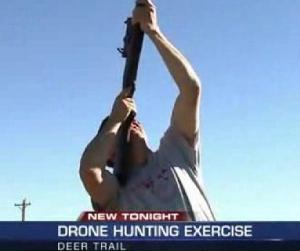
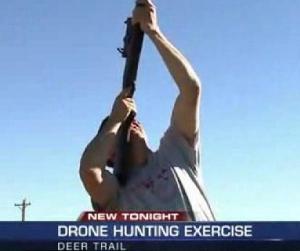
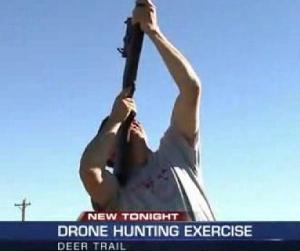
And in answer that?: Colorado man offering drone hunting lessons in Deer Trail

“The issue of whether Deer Trail should sell licenses to hunt drones first went beforeColorado-man-offering-drone-hunting-lessons-in-Deer-Trail the town board in August. It specifically lays out limitations like restricting shooting to daylight hours and only allowing the shooting of unmanned aerial vehicles flying lower than 1,000 feet over private property.”

Read more:  http://www.upi.com/Odd_News/Blog/2013/12/02/Colorado-man-offering-drone-hunting-lessons-in-Deer-Trail/8261385993846/#ixzz2mRXgWuyQ