Tackling the Tusk Trade

Michael Markarian: Animals & Politics

In a welcome break from partisan gridlock, Republicans and Democrats are joining together to protect elephants and rhinos from illegal poaching. This month, New Jersey and New York became the first two states to ban the trade in elephant ivory and rhino horns, with bills signed by Governors Chris Christie, R-N.J., and Andrew Cuomo, D-N.Y.  The new policies will help to crack down on international wildlife traffickers and dry up the demand for illegal wildlife products in the northeast, which is the largest U.S. market for ivory and a main entry point for smuggled wildlife products.

Elephants and rhinos are threatened by a global poaching crisis. Only 28,000 rhinos of five different species remain in the wild, with more than 1,000 of them poached last year for their horns. In 2012, about 35,000 African elephants were killed for their tusks, and if the current poaching rate continues, African elephants could be extinct in a few decades. In Central Africa, populations of forest elephants have declined by 65 percent during the last decade. Asian elephants are critically endangered with fewer than 50,000 left in the wild.
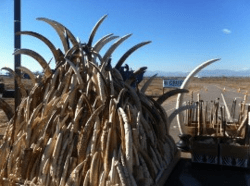
Seized Ivory Crush

Seized U.S. ivory stockpile bound for crushing. Credit: The HSUS/Iris Ho
Much of the killing is associated with criminal networks and Africa-based terrorist groups like al-Shabaab, the Lord’s Resistance Army, and others, which use the proceeds from ivory sales to fund their nefarious activities. As House Foreign Affairs Committee Chairman Ed Royce, R-Calif., noted, “While this growing problem is a grave threat to wildlife, with some animals facing extinction, it is also a threat to U.S. national security interests. As long as illegal wildlife trafficking continues, terrorists and rebel groups will have yet another way to fund their deadly objectives.”
Policymakers need to do more to address this problem. Fortunately, President Obama has announced a national strategy to crack down on elephant poaching and the ivory trade, and the U.S. Fish and Wildlife Service plans to issue new regulations that would prohibit the commercial import all African elephant ivory, including antiques, with a few exemptions for non-commercial purposes. This near-total ban on U.S. commerce in African elephant ivory, with the exception of a narrow class of antiques and certain ivory items that are exempt from regulation under the Endangered Species Act, will build on the efforts of the states to stem the tide of the poaching epidemic.
Shockingly, some members of Congress are trying to retain the status quo on the illegal slaughter of elephants, and at the request of the trophy hunting and gun lobbies and the music and antique industries, are fighting the Administration’s proposal. Sen. Lamar Alexander, R-Tenn.—whom Chattanoogan columnist Roy Exum said is “morphing into America’s newest champion of animal abuse”—and Rep. Steve Daines, R-Mont., have introduced the so-called “Lawful Ivory Protection Act,” which would handcuff the Fish and Wildlife Service and prevent the administration from taking any new action to protect elephants from the ivory trade.
These short-sighted politicians are lamenting the ability of someone to resell a gun or a guitar with a little bit of ivory on it, without regard for the fate of the largest land mammal in the world or our national security. Congress should follow the lead of New Jersey and New York, and support the global effort to stop the slaughter of elephants and rhinos—not provide aid and comfort to the organized criminal network of poachers and traffickers.

KWS Rangers kill poacher next to the 45-year-old elephant he had killed in Tsavo

Sunday, July 27, 2014 – 00:00 — BY RAPHAEL MWADIME

The suspected poacher killed in Tsavo West on Friday night lying with the elephant carcass they had killed.Photo/Raphael Mwadime

The suspected poacher killed in Tsavo West on Friday night lying with the elephant carcass they had killed.Photo/Raphael Mwadime

Kenya Wildlife Service rangers have killed one suspected poacher and recovered four elephant tusks  in Tsavo West National Park.

Five other poachers fled leaving behind an M16 rifle, two AK47 magazines, an axe, three saucepans and six five litre water jerry cans.

The poachers had already killed a 45-year-old elephant near the water pan and were in the process of removing its tusks.

Senior KWS Warden in charge of Tsavo West, Josephat Erupe, said KWS rangers on Friday traced foot prints of the group of poachers before getting them removing ivory from a bull elephant they had killed.

“On Friday our rangers spotted the strange foot prints that they traced to Marwa dam where the suspects had killed an elephant. At about 8pm our officers caught up with the suspects where they spotted spot lights and when they came closer, they saw the group removing tusks from the elephant. They opened fire and gunned down one suspect,” he said.

Erupe said that the rangers took ambush until Saturday morning where they realised that they had gunned down one suspect and recovered four elephant tusks and the firearm.

“We have launched an air ground operation to track the runaway suspects. It a matter of time before our security personnel catch up with them,” he told the Star at the scene of incident.

Erupe said that the poachers have devised a habit of waiting for elephant at the watering pans where they kill them.

“We have observed that the poachers wait for elephants when they come to drink water at the watering pans where they shoot them. We have enhanced security surveillance in the park in a bid to fight poaching,” he said adding that the male Jumbo aged about 45 years was killed some 50 metres from the water pan.

– See more at: http://www.the-star.co.ke/news/article-180101/kws-rangers-kill-poacher-next-45-year-old-elephant-he-had-killed-tsavo#sthash.EvqIopTK.dpuf

Ex Guns N’ Roses star Matt Sorum blasts Ted Nugent over hunting photo post

http://www.torontosun.com/2014/07/15/ex-guns-n-roses-star-matt-sorum-blasts-ted-nugent-over-hunting-photo-post

Former Guns N’ Roses star Matt Sorum has taken aim at fellow rocker Ted Nugent for68439_10151399495155861_1116657731_n his pro-hunting remarks.

Animal lover Sorum took offence to a photo he spotted of smiling Nugent standing next to a pre-teen boy who had just killed a groundhog, and took to Twitter.com to lash out at the Cat Scratch Fever hitmaker over the weekend.

The drummer wrote, “Hey @tednugent u are a sick individual, u are smiling too much for killing this animal. Something wrong w u (with you), poor kid.”

Nugent has made a name for himself protecting the rights of hunters, insisting they are vital to manage wildlife.

In an interview earlier this year, he attacked animal-rights activists opposed to hunting and killing, calling them “numb-nuts”.

Sorum is currently spearheading the International Fund For Animal Welfare’s campaign for elephant conservation, and last month wrote an open letter to his fellow musicians urging them to support a new U.S. strategy for minimizing America’s role in global elephant poaching.

Please come to fill the courtroom with elephant advocates

Please come to fill the courtroom with elephant advocates

Friends of Woodland Park Zoo Elephants has filed numerous public disclosure requests to the Zoo. The Zoo has been frequently unresponsive claiming it isn’t subject to Washington State’s Public Records Act.  In order to hold the Zoo accountable and to learn more about the elephants’ plight, we filed a lawsuit on March 12th, 2014: Fortgang v. Woodland Park Zoo.  The request for summary judgment will be heard this Friday, July 25th at 1:30pm.

We need you there to show the judge WE ARE WATCHING
History could be made!  Please there!

What:    Request for summary judgment for Fortgang v. Woodland Park Zoo
When:   Friday, July 25th, 2014 at 1:30pm
Where:  King County Superior Court. 516 Third Avenue, Seattle, WA 98104
Honorable Judge Jean Rietschel’s courtroom.

What is the zoo hiding?
The Zoo has taken over $108 million dollars from tax payers since 2002.  The Zoo has use of city parkland and city buildings RENT FREE.  The Zoo acquired their “product”, the animals, from the city for FREE.  Yet the Zoo has refused to answer the most basic financial information and details about the welfare of Bamboo, Chai and Watoto, the three elephants confined in the Zoo.  When it did respond, some information was not accurate—such as how many times Chai was artificially inseminated or where the water sources are located in the yard.

   Photo credit: The Seattle Times

More recently, the Zoo has refused to provide records on the imminent transfer of Watoto to another Zoo.  Despite acknowledging that the Zoo is communicating with other zoos, it says it has no records.

It’s time for secrecy to end.  Taxpayers deserve to know what’s going on inside the walls of Woodland Park Zoo.  Please come and show your support against the Zoo’s arrogance.

We will all wear an orange tag that says in big letters:  TRANSPARENCY

Thanks so much,
Nancy Pennington and Alyne Fortgang

Copyright © 2014 Friends of Woodland Park Zoo Elephants, All rights reserved.
You are receiving this because you have opted in.

Our mailing address is:

Friends of Woodland Park Zoo Elephants

10011 Vinton Ct NW

Seattle, WA 98177

America’s Earliest Elmers Overhunted Elephants

Early Americans dined on four-tusked elephant relative, say scientists

Archaeologists have unearthed 13,400-year-old weapons crafted by the Clovis people mixed in with bones from an extinct elephant relative.

By Becky Oskin,

LiveScience Senior Writer July 15, 2014

  • A gomphothere jawbone as it was found in place, upside down, at the El Fin del Mundo site in Mexico. Vance Holliday/University of Arizona


There’s a new mega-mammal on the menu of America‘s first hunters.

On a ranch in northwestern Sonora, Mexico, archaeologists have discovered 13,400-year-old weapons mingled with bones from an extinct elephant relative called the gomphothere. The animal was smaller than mastodons and mammoths, but most had four sharp tusks for defense.

The new evidence puts the gomphothere in North America at the same time as a prehistoric group of paleo-Indians known as the Clovis culture, whose beautifully crafted projectile points helped bring down giant Ice Age mammals, including mammoths. This is the first time gomphothere fossils have been discovered with Clovis artifacts.

Recommended: Are you scientifically literate? Take our quiz

“The Clovis stereotypically went out and hunted mammoth, and now there’s another elephant on the menu,” said Vance Holliday, a co-author on the new study, published today (July 14) in the Proceedings of the National Academy of Sciences.

More: http://www.csmonitor.com/Science/2014/0715/Early-Americans-dined-on-four-tusked-elephant-relative-say-scientists

Wildlife Products May Finance Terrorism

[Finally they have a good reason…]

The U.S. government is stepping up its crackdown on the illegal trafficking of wild animal products across the nation’s borders, saying some may be linked to terrorists, federal officials said Monday.

“Poaching in Africa is funding terrorist groups,” U.S. Trade Representative Michael Froman told a news conference at Kennedy International Airport.

He said such illegal trade is a threat to global security because it’s driven by criminal elements, including terrorists using profits from items such as rhinoceros horns and elephant tusks to finance their activities.

Paul Chapelle, the agent in charge of New York for the U.S. Fish and Wildlife Service, said one horn case resulted in 16 arrests, including that of a mobster from Ireland now serving 13 months behind bars.

A dead elephant is worth about $18,000 — mostly from the tusk.

Kennedy handles the largest cargo volume of any U.S. airport, about $100 billion a year, said Patrick Foye, executive director of the Port Authority of New York and New Jersey, which runs the airport.

And the wildlife element plays an especially powerful role in national security, said Froman, the chief U.S. trade negotiator and adviser to President Barack Obama.

More than 20,000 elephants were killed last year along with about 1,000 rhinos, meeting a rising world demand resulting in declining populations across Africa, according to officials with the Convention on International Trade in Endangered Species of Wild Fauna and Flora.

This treaty was signed by more than 170 countries to protect animals that end up as contraband including live pets, hunting trophies, fashion accessories, cultural artifacts and medicinal ingredients.

U.S. trade officials believe that groups benefiting from the poaching include the militant Lord’s Resistance Army in Uganda and South Sudan, the Janjaweed comprised of Sudanese Arab tribes, and al-Shabab, a jihadist group based in Somalia.

In February, Obama approved a new strategy for fighting trafficking through enforcement, as well as partnerships with other countries, communities and private industry. For the first time, U.S. officials are asking trading partners to agree to conservation measures for wildlife and the environment in return for signing agreements.

Kennedy customs officials are reaching out to local businesses, plus auction houses like Christie’s and Sotheby’s and even Carnegie Hall to alert them to illegally traded valuables that may come their way.

1924891_10152211828561061_1647642544_n

Why Would Anyone Hunt Elephants? GQ Tries To Defend Those That Do

By Jenny Kutner

In a recent piece for GQ, writer Wells Tower attempts to answer10304338_10204008161985492_2584105410340479966_n a simple question with a story that’s as long as it is powerful: “Who wants to shoot an elephant?” As it were, that’s not actually the question Tower ends up asking; it’s pretty easy to find the people who want to shoot elephants, as the journalist did in order to write his story. What Tower really gets at is why anyone would want to shoot an elephant, or how people think they can justify it. Try as they might, they can’t.

And oh, do they try. Robyn Waldrip and her husband, Will, allowed Tower to accompany them on an eight-day safari last summer, during which time they explained to the writer why they feel that hunts like theirs can be justified. Waldrip’s trip was arranged solely so she could kill an elephant and bring parts of its broken-down body back to her home in Texas, where she’ll keep them as a trophy. But that’s okay, she and her husband explained, because it actually does good for the environment, and even for the elephants themselves:

Perhaps out of a kind of kindred impulse, Will and Robyn Waldrip are quick to point out the violences elephants have inflicted on the local landscape. … While he has no reservations about Robyn shooting the elephant, [Will] is doing, I think, some version of the hunt-justifying psych-up going on in my own head. He wants to feel like it’s a good deed his wife is doing out here, a Lorax-ly hit in the name of the trees. …

[And] counterintuitively, even in the presence of an active bullet-tourism industry, Botswana’s elephant population has multiplied twentyfold, from a low point of 8,000 in 1960 to more than 154,000 today. These healthy numbers … mirror elephant populations in other African countries where hunting is allowed. … Kenya, on the other hand, banned elephant hunting in 1973 and has seen its elephant population decimated, from 167,000 to 27,000 or so in 2013. Some experts predict that elephants will be extinct in Kenya within a decade.

There is a confused correlation going on here, which Tower himself points out: legalized hunting incentivizes tourism, and that tourism brings money and jobs into the communities near elephant habitats. “When locals’ livelihoods are bound to the survival of the elephants,” Tower writes, “they’re less likely to tolerate poachers, or to summarily shoot animals that wander into their crop fields.” But it doesn’t have to be hunting that monetizes the elephants for local residents: other, non-lethal forms of ecotourism could bring in solid cash-flow as well.

Those with vested interests in legalized hunting — like the Waldrips’ guide, Jeff Rann — would argue that poachers can and will circumvent photo-safaris and other ecotourism concessions, as they have in Kenya. But poaching is not an inevitability; all it takes is “some combination of public policy, private money, and anti-ivory market pressures” to “render hunting obsolete as a conservation instrument,” Tower points out.

It’s easier said than done, certainly — but if we know that making elephants valuable to communities is necessary, and we know how to monetize them in a non-lethal way, then there is no excuse for trophy hunting. Alternative tourism ventures, such as Thailand’s Elephant Nature Park, have proven hugely successful at protecting elephant populations without killing relying on blood money. It’s not a form of conservation. It’s a cop-out that allows those wealthy and willing enough to participate to pay for the right to poach.

Trophy hunting advocates tout the activity as a key form of conservation — but in reality, it merely contributes to the gradual decimation of endangered species around the world. Join us in pledging never to support big game hunting of any form, and to stand with governments that ban the sale of imported animal “trophies.”

supporters have signed this petition. Let’s get to 1,000