Friday, October 4, 2019 – Washington Department of Fish and Wildlife (WDFW) officials announced today that they killed a female member of the Grouse Flats wolf pack on September 25. She was believed to be the mom.
On September 24, in accordance with the agency’s controversial Wolf Plan and 2017 wolf-livestock interaction protocol, Director Kelly Susewind authorized the incremental “removal” of wolves following livestock depredations in Grouse Flats territory on both private lands and state wildlife areas in southeast Washington.
The announcement of the killing comes after Governor Jay Inslee expressed concern over the state’s Wolf Plan:
“We must find new methods to better support co-existence between Washington’s livestock industry and gray wolves in our state. The status quo of annual lethal removal is simply unacceptable.”
Since 2012, WDFW has killed an estimated thirty one endangered wolves and pups, has obliterated entire wolf families (including the Old Profanity Territory pack in August), and has caused countless packs to fragment as a result of targeting individual wolves.
Moreover, peer-reviewed research demonstrates that employing lethal action to deter depredation on cows can even result in increased attacks.
Enough is enough.
Please contact WDFW Director Kelly Susewind and respectfully ask him to stop the assault on Washington’s wolves.
MOSCOW, September 24 (RAPSI) – A bill to toughen punishment for illegal capture and sale of especially valuable wild animals and marine biological resources belonging to species listed in the Red Book has passed its third and final reading in the State Duma.
Amendments, according to a statement of the lower house of parliament, would be introduced into the Criminal Code of the Russian Federation.
Under them, such crimes against rare animals would be recognized as medium and grave.
Thus, illegal catching, keeping, purchase, transportation or sale of red-listed animals and marine biological resources would be punishable by community service or imprisonment for up 4 years instead of current 3 years. If the crime is committed with the use of job position or is publicly demonstrated on the Internet or in media, it would be punished with prison terms of up to 6 years instead of current 5 years.
The bill also toughens punishment for illegal buying rare animals online. Currently, it is punished with community service or imprisonment for up to 4 years. Under the draft law, such actions would result in jail terms of up to 5 years. Those purchasing rare species through the Internet with the use of official position would face up to 7 years behind bars instead of currently stipulated 6 years.
Punishment for crimes of this type committed by a group of people in conspiracy and with the use of job position would be also tightened by 1 year, from current maximum 7 to 8 years in custody.
According to the State Duma Chairman Vyacheslav Volodin, both poachers and their assistants would not have a chance to avoid sanctions as the bill introduces a separate provision on penalties for non-officials using job position to commit the crime, namely employees of national parks and special nature reserves. Previously, responsibility was not set for them.
Young J54, covered in rake marks from the attempt to keep him alive, is held afloat between his sister, J46 (left) and a cousin in late October 2017. He probably died within hours of this photo.
Everyone in the San Juan Islands who watches the whales remembers the summer of 2016. No one wants to relive it.
That was the summer the Southern Residents lost seven members, including one of the J Pod’s elderly matriarchs, who scientists say are the acknowledged leaders of the pods and repositories of the stored knowledge essential to the whales’ survival. But it was the death of J28 and her calf that stirred people to action.
It was late summer when observers began noticing J28, a 23-year-old female known as Polaris. She had given birth to a male calf that spring, but as the summer wore on, it became clear something was wrong. One day in August was especially telling.
The scene unfolded in the waters directly off Lime Kiln Lighthouse, in Washington state’s San Juan Islands: Polaris’s 6-year-old daughter, J46, nicknamed Star, was swimming about actively in the roiling currents with her mother and her baby brother, who had been designated J54, but had not yet been named.
They were not, as is often the case at this lighthouse, merely frolicking in the nearby seas. They were pursuing the salmon that comprise most of these endangered killer whales’ diets, and there was a deadly serious intent to it.
J46 Star, left, and her mother, J28, playing in 2011, when Star was only eight months old.
A week or so before, researchers at the nearby Center for Whale Research had sounded an alarm of sorts about Polaris, who was in her reproductive prime, and by extension the dire lack of salmon for the Southern Resident killer whale population. Ken Balcomb, the center’s founder, had reported that another J Pod matriarch, J14 (Samish), was missing and presumed dead, and that several whales appeared to be struggling.
“Things are shaping up to be pretty bad,” said Balcomb. “J28 is looking super-gaunt, and I would say she is within days of her death.”
The “peanut head” condition that Balcomb had reported—a severe sunkenness in the flesh directly behind the orca’s skull, an indication of extreme malnutrition and often a harbinger of imminent death—was clearly visible in Polaris the day we observed her, about a week after the warning. However, the listlessness CWR had reported also was ameliorated somewhat: The orca mother appeared at times to be frolicking physically with her calf, and seemed to be fairly active, though at times she also was simply “logging,” laying still on the surface and drifting with the current.
The last known photo of J28 and J54 together, early October 2016.
The most striking aspect of the scene was Star’s activity. She swam constantly around her two companions, diving deep at length and doing percussive behaviors like tail-lobbing and pectoral-slapping, often pointing in her mother’s direction. At times, the three of them would go down into the deep currents and disappear for minutes at a time, evidently foraging. It appeared to my amateur eye that she was herding the salmon she could find toward her mother, helping her get the food she so desperately needed.
The scene also had a deep emotional resonance for me: Six summers before, when Star had just been a still-callow baby of eight months, I had encountered her with Polaris a little south of the lighthouse, along a cliff wall in my kayak. I had tucked into a cove, well out of their way, and began taking photos.
That too had been a deeply touching scene: The mother and little amber-toned calf had played in the still morning waters, nuzzling and wrestling about, reveling in the kind of contact that human parents and their bonded offspring know well, the joy of touching. Polaris also seemed to be feeding the calf, getting its first nascent tastes of fish as the mother dove and brought at least one healthy Chinook to the surface to show and share, as these orcas have been observed doing for years.
Six years later, the now-grown calf was doing her part, returning that love and care to her mother by helping her find and catch the salmon she clearly has not been getting. The familial bonds of killer whales are now a scientifically established fact, but they are profound things to observe, spine-chilling reminders of the deep connection that exists between humans and orcas, whom the Northwest Native Americans referred to as “the people under the sea.”
The afternoon feeding at the lighthouse was a bit of good news, at least—it appeared that Polaris was more active and feeding well. Orcas have occasionally recovered from “peanut head,” though rarely (in captivity, it has been a virtual death sentence). Still the worry remained, and was compounded by the reality that if Polaris died, it meant nearly certain death for her still-unweaned calf, too.
In some regards, the loss of J14 Samish—a 44-year-old female whose still-mysterious death can’t be attributed to malnutrition or a lack of salmon, since the last sightings of her just days before her disappearance showed her in robust apparent health—may prove even more devastating for the Puget Sound’s endangered orcas. Recent research has revealed that post-menopausal females play an essential role in orcas’ long-term survival, because they actively lead the pods in their foraging and represent long-term memory of prey-seeking routes. Without their immense brains leading the way, orcas have a harder finding the large of amounts of fish they need to eat daily to survive and thrive.
That year also saw the loss of a big, striking male once so large he was nicknamed “Doublestuff,” who died after being struck by some unknown vessel. There was also a mother who died after her developed fetus died and became necrotic. Another big male died after government scientists darted him, and the wound became infected.
The bad news regarding the two well-known orca females cast a pall over a multimillion-dollar whale-watching industry in the San Juans that had just endured the worst season (for seeing resident orcas, at least) in its history, and seemed to cast a cloud on the island’s whole community. As September drew to a close, it seemed everyone wanted to know how J28 was doing, as though the fate of the Southern Resident killer whale population seemed to hinge on the news. And in some respects it may have.
J2 Granny, playing in the kelp near Lime Kiln Lighthouse in 2012.
The orcas’ human advocates were not giving up, but the picture was becoming grim. “Right now, we don’t even have a sustaining population of Southern Residents,” said Deborah Giles. “We’ve gone backwards. There were 88 animals when they were listed in 2005. Now we are down to 82, and maybe fewer very soon.” As she said this, she looked out over the waters where we had all observed Polaris and her offspring a few days before, and a cloud crossed her face.
A month later, on Oct. 28, CWR scientists made it official at a press conference in Seattle: J-28 had disappeared and was now presumed dead. Her baby, J-54, they said, looked even more malnourished and was being supported in the water by his sister, J-46. They gave him only a few more days, if not hours, to live, and at the time of the announcement was also presumed dead.
“It’s a sad day,” said Ken Balcomb. “I’ve been to several funerals and that’s what this feels like.”
Something snapped. The agony of watching a mother orca slowly starve to death, followed by the spectacle of her unweaned baby’s path towards the same death, was like a final straw that kicked the region’s whale advocates into action.
Coordinating among several advocacy groups and the CWR, they organized a press conference at the Seattle waterfront focusing on the deaths of J28 and J54 as a tragic warning sign for the state of the endangered Southern Resident killer whale population. Even the normally reclusive Balcomb was persuaded to participate, and he delivered the message in stark terms.
“We know what we need to do—feed them!” Balcomb told the assembled reporters, and urged government officials to take immediate steps to begin removing the four Lower Snake River dams.
“Restore Chinook habitat, anywhere, anyhow,” he said. “If we don’t, we will lose our whales.”
The surge of publicity created immediate political pressure on the state’s politicians, though it eased off over the following year or so, but local lobbying efforts in Olympia, led by the Pacific Whale Watch Association and other advocacy groups, stepped up their intensity during 2017, culminating in Gov. Jay Inslee’s March 2018 announcement that he was forming an Orca Recovery Task Force to tackle the problem.
In the meantime, the bad news for the Southern Residents reached a kind of apex when, shortly after New Year’s Day 2017, Balcomb and the CWR announced a momentous death in the population: J2, aka Granny, the J Pod’s grand matriarch who was estimated to be more than 100 years old.
There was only one further death in the population in 2017: J52 Sonic, a 2-year-old male who disappeared in September. But 2017 also saw a significant change in the Residents’ behavior: Their presence in the Salish Sea waters became extremely scarce.
It may have been one of the effects of Granny’s death; matriarchs are known to be the leaders of the pods, calling the shots on where they go and when, and the change in J Pod leadership clearly affected its foraging patterns. However, the far more likely culprit in the change was the disappearance of Fraser River salmon.
The Chinook produced by the Fraser—which flows out of British Columbia just south of Vancouver—have long been the primary reason the Southern Residents have come to the Salish Sea in the summertime: Scientists estimate that 80 percent of their summer diet comprises fish from the Canadian river. And in the summer of 2017, the numbers of Chinook returning to the system, measured at the Albion Point salmon station, simply flatlined.
Canadian officials remain puzzled at how the returns simply fell off the table that year, but the trend has remained similar through 2018 and much of 2019, as well. The return of the J Pod to the San Juans this past week coincided with a marginal rise in salmon return numbers on the Fraser.
So for most of the summers of 2018 and 2019, the Southern Residents have simply been absent from the Salish Sea.
“It still feels very surreal that we’ve just had our first June on record with no Southern Resident killer whales in inland waters,” wrote Monika Wieland, executive director of the Orca Behavior Institute and the author of Endangered Orcas: The Story of the Southern Residents, at her blog. “June used to be a highlight of the year because of the abundance of sightings of all three pods on the west side of San Juan Island. Yet here we are, 58 days without any of them in the Salish Sea. The silence created by their absence is deafening.”
A humpback whale breaches in Haro Strait with the Olympic Mountains in the background.
The absence of the Residents, however, has not been the complete disaster one would expect both for land-based whale watchers and for the whale-watching operations based in the San Juans and Vancouver/Victoria area. That’s because the second population of orcas to use these waters—the mammal-eating population known as transients, or Bigg’s killer whales—have suddenly begun showing up in unusually large numbers.
The two populations—which geneticists have determined haven’t exchanged DNA in more than 300,000 years—are not friendly; when they have been observed in proximity to each other, the Residents have generally chased away the smaller pods of Bigg’s whales. So scientists have hypothesized that the Bigg’s whales may be taking advantage of the absence of the Residents to access the abundant numbers in the Salish Sea of their main prey: namely, seals and sea lions.
Additionally, humpback whales—which were absent from the Salish Sea after being hunted out near the turn of the 20th century—have begun returning as well, feeding on the large schools of herring and the semi-abundant krill that can be found here.
A pod of mammal-eating Bigg’s orcas catch and kill a Dall’s porpoise on May 25.
Certainly, passengers on the region’s whale-watching tours have had plenty to witness. On one tour I took this spring, we followed a pod of Bigg’s whales as they hunted a Dall’s porpoise at high speed, and then turned the waters around them blood-red when they finally caught and killed it. Even more common have been sightings of Bigg’s whales launching hapless harbor seals 50 feet into the air with their powerful flukes at the climax of a hunt.
A transient calf with its mother in Juan de Fuca Strait.
“The transients are fascinating animals, and it’s been great to have them here,” says Jeff Friedman, owner of Maya’s Legacy Whale Watching and president of the PWWA. “They are amazing to watch, especially when they’re hunting.”
However, the tour operators aren’t content with the new reality. “The fact is that our number one priority is the recovery of the Southern Resident killer whale population,” Friedman says. “They are the reason we are here. Even with the transients around, the picture isn’t right without the Residents.”
Friedman, like the scientists and advocates, has been heavily engaged in the Orca Recovery Task Force process. Even though his focus has necessarily been directed to warding off the would-be moratorium on whale watching, he says his primary mission remains getting enough fish in the water to return the Resident population to health.
However, many of the solutions under consideration by the task force—habitat restoration, vessel effects, toxins in the water, and dam removal among them—are all long-term solutions that do relatively little to help the orcas now. Even if the Lower Snake dams were all to be taken down within the year (not at all likely), it would be as long as another decade (though perhaps sooner, depending on which salmon scientists you talk to) before the Snake/Salmon river systems would produce numbers of fish appreciable enough to help the killer whales.
The pressing issue facing scientists is how to get enough fish in the water to feed the orcas right now.
J35 Tahlequah romps in the waters off Lime Kiln Lighthouse on Sunday, Aug. 25.
J35 Tahlequah, the mother whose mourning for her dead calf gripped the world last summer, thus sparking the wave of anger over the loss of the whales that finally drove the state’s politicians into action, was among the J Pod whales who returned to the San Juans last week. She looked plump and healthy, frequently playing with little J56, and tail-slapping and socializing.
“We have seen her foraging successfully a couple of times. She looked really healthy to me,” says Deborah Giles. “It made everyone happy.”
Both the condition and the behavior of J Pod made clear that they have, for now at least, figured out how to sustain themselves without enduring the paucity of salmon that has been their reality in the Salish Sea recently. “It’s so heartening to see these whales, and to see them together, see them playing, lifting each other up out of the water, breaches and tail slaps—it’s really amazing,” says Giles. “And it’s really, really good to see them looking as well as they do.
“But in the back of my head, I am thinking—where is K pod? Where is L pod? Are there more babies? Obviously K27 lost the baby she was pregnant with last September. She didn’t come back with a baby. K pod hasn’t had a new baby since 2011.”
While J Pod appears to have regained its health, there were nonetheless three deaths among the Southern Residents this year, including J17, a 42-year-old matriarch known as Princess Angeline. She was Tahleuqah’s mother, making J35 the matriarch of her clan at age 21.
So while Giles spends her time this month on the water collecting scat samples, she has been directing her political focus on getting more fish in the water sooner. For her, that means fisheries management.
The Northwest’s salmon harvest is carefully regulated by a treaty overseen by the Pacific Salmon Commission, an international body that includes both American and Canadian stakeholders such as commercial and sport fishermen, as well as Native American tribes. That body produces a treaty every 10 years—vigorously negotiated—in which the salmon harvest produced in Pacific waters is divvied up among those various interests.
The Southern Resident killer whales, however, do not have a place at that table. So their needs are left to whatever might be left over from the divided harvest.
“What we’ve all been screaming about is giving the whales a place as a major stakeholder in fisheries management,” says Giles. “We’re asking for an allocation of fish for the whales.”
The solution, as she sees it, is for much tighter regulation, if not an outright moratorium, on fishing for Chinook in the orcas’ home waters, which run the entire length of the Pacific Coast. “If not full on fisheries closures, we at least need to have targeted regulations for where and how we fish,” Giles says. “It’s past time we’re doing that. And a lot of that has to do with tribal rights, which is where it becomes very political.”
Recently undertaken studies aimed at identifying key orca-foraging “hotspots” in the San Juans could help provide the data needed to make such a plan a reality, Giles says. However, “the thing I am scared that if we don’t get a handle on these fisheries, there won’t be any salmon even in those hotspots.
The PSC itself has been resistant to these overtures, though its most recent news releases have indicated at least a sensitivity to the political pressure that has arisen around orca recovery.
“At the Pacific Salmon Commission, at that highest level, in the rhetoric around the most recent treaty, the dialogue was that ‘the needs of the Southern Residents would be taken into consideration,’ but if you look at the treaty itself, the words ‘whale,’ ‘killer whale,’ ‘orca whale’—none of that show up in the treaty itself,” Giles observes.
“So basically it’s just lip service. Those words ‘allocation’ and ‘Southern Resident’—they don’t want those to pass into reality. No way.”
However, an adjunct body of the Pacific Salmon Treaty, the Pacific Management Fishery Council, has proven more amenable to whale advocates’ overtures. It is holding public hearings of an ad hoc group in key cities around the Pacific Northwest, examining the impacts of mixed open fishing on Southern Resident killer whales.
“It is a start, and the more people that get involved in those hearings, and make comments leading up to the meetings” the better, Giles says, noting that the deadline for such comments is Tuesday.
Overall, Giles is mostly heartened by how the public has responded to the killer whales’ plight, and how the effort has drawn help from a variety of quarters. “There are a lot of people working in a lot of different arenas to help these whales in different capacities—like the Toxic-Free Future people, who are doing a lot of important work to remove toxins from our system, and to try to push legislation that reduces the use of chemicals as much as possible. I think that’s good, I think we need to keep pushing each other in our own areas of expertise. “
“And we need to be engaging with our political appointees, the people that we elect, and pushing them into continuing to address the issues and continuing to cut to solutions,” she adds.
At times, particularly back in 2016, Giles would confess that she feared she was doomed simply to document the demise of a once-great population of killer whales. These days, she is more hopeful—not to mention determined.
“We may well be witnesses to the complete loss of the Southern Residents,” she says. “But we know what can be done. It may get depressing at times, but none of us will ever stop fighting for them.”
Raw video: Wildlife officials share video of disabled panthers dealing with a severe nerve disorder which hinders leg mobility.
An inexplicable crippling disorder appears to be affecting some Florida panthers, puzzling wildlife officials who are working to determine what is ailing the endangered animals.
The Florida Wildlife and Conservation Commission (FWC) this week announced some of the state’s big cats — namely kittens — have “exhibited some degree of walking abnormally or difficulty coordinating their back legs.”
So far, FWC officials said they have confirmed neurological damage in one panther and one bobcat, but noted at least eight other panthers and one adult bobcat are also “displaying varying degrees of this condition.”
Trail footage from three counties — Collier, Lee, and Sarasota — shows some cats exhibiting the disorder. In one clip, a kitten loses its balance; its hind legs seem to simply give out. It manages to get up, albeit slowly, before trotting off after its mother.
Officials said the disorder, as of now, seems to be limited to those counties.
While officials have ruled out a number of diseases and possible causes, an exact cause for the cats’ “abnormal gait” has not yet been discovered, Michelle Kerr, a spokeswoman for the state agency, told Fox News.
That said, there are suspicions, which include “a variety of toxins and infectious disease,” she said.
“One of these potential causes is bromethalin, a rat pesticide, commonly used in the United States to control rats,” Kerr added, noting the FWC “does not currently have information on any poisoning efforts.”
Florida panthers, the state’s official animal, are a subspecies of pumas, which once had the “largest range of any land mammal in the Americas,” the wildlife agency says. The Florida panther is the only puma subspecies that exists east of the Mississippi River.
There are just 120 to 230 adult Florida panthers — one of the two wild cats found, the other being the bobcat — in the state, according to the FWC, which makes the condition currently affecting some of the cats more of a concern.
Conservation efforts beginning in the 1970s and 1980s helped save the cats from extinction. At that time, there were an estimated 20 to 30 panthers in the state, the U.S. Fish and Wildlife Service says.
Today, Florida panthers are primarily threatened by habitat loss and cars and highways, among other challenges, according to officials.
Officials with the Department of Fisheries and Oceans inspect the carcass of killer whale J34 near Sechelt, B.C., on Dec. 21, 2016. (Graham Moore)
41
comments
The final report into the death of a southern resident killer whale over two and a half years ago confirms that it died from blunt force trauma, likely inflicted in a ship strike.
J34, an 18-year-old male nicknamed Doublestuff, was found dead near Sechelt on Dec. 20, 2016.
At the time of his discovery, Fisheries and Oceans Canada said initial examinations of the seven metre orca indicted that it was alive when struck and died sometime later.
J34’s necropsy report was last updated on May, 23, 2017, however, according to a DFO spokesperson, the report wasn’t made public and is only available upon request, as per policy.
“There were no requests for this information at the time the report was finalized. There had been significant media coverage at the time, reporting the cause of death was blunt force trauma, consistent with a ship or boat strike. The final report came to the same conclusion, ” said DFO’s Dan Bate.
The final necropsy report for J34 confirmed the original evaluation of researchers that the whale was killed by a ship strike. (Fisheries and Oceans Canada)
Shari Tarantino of Orca Conservancy, a Washington state non-profit, said there is a lack of transparency around the DFO’s reporting on J34.
According to Tarantino, her group and Washington state orca researcher Scott Veirs had been asking DFO for the final J34 necropsy report for months. Tarantino received a copy of the report late last week, but only after petitioning the office of Fisheries and Oceans Minister Jonathan Wilkinson directly.
“It should not have taken two and a half years to release a report,” said Tarantino.
“There’s nothing new in this report. It’s basically what we had already been told. But it’s hard not to wonder if it was withheld because Kinder Morgan or because of Roberts Bank Terminal 2 (the proposed container terminal in Delta, B.C.) was waiting on comments.”
Fisheries and Oceans Canada media advisor Lara Sloan said the delays in sending the report were due to administrative problems and miscommunication within DFO.
“There was no intention not to provide that report,” said Sloan.
The precarious state of the 76 remaining southern resident killer whales is a major concern in the Trans Mountain expansion project which will increase tanker traffic through the animals’ territorial waters once completed.
A report released this year by the National Energy Board backed up those concerns, suggesting the project would have “significant adverse effects” on the whales.
The federal government approved the Trans Mountain expansion project last month.
How many wolves are on the landscape in Idaho? That’s an often-asked question that Idaho Fish and Game is aiming to answer using game cameras during a new statewide population monitoring program.
In recent months, Fish and Game staff have deployed over 800 game cameras in a high-density grid throughout the state, which will take millions of pictures. When Fish and Game staff collect the cameras at the end of September, researchers will download and analyze the photos and apply statistical modeling to estimate the population.
Sifting through millions of photos will be labor intensive, but Fish and Game Wildlife Research Manager Mark Hurley is aiming to early next year have the most robust and accurate count of wolves ever in Idaho, and the first scientific population estimate since 2015.
Wolf monitoring evolves with changing wolf populations
Wolves were federally reintroduced into Idaho, Wyoming and Montana in 1995 and 1996. Between 1996 and 2005, Idaho’s wolf population was estimated using a “total count” technique to generate an estimate of the statewide population, which was appropriate when the total population was small and many wolves wore radio collars. Biologists could track individual animals back to their packs, get an estimate of pack sizes and then estimate the statewide population.
From 2006 to 2016, Fish and Game’s wolf monitoring program remained under federal oversight. Until May 2016, the department was required to maintain enough radio collared wolves to be able to demonstrate that there were more than 15 breeding pairs of wolves in that state and more than 150 total wolves. .
“This kind of monitoring was really targeted at federal Endangered Species Act recovery goals — that’s why we were doing that. That sort of effort works with very small populations,” Hurley said.
During this period, biologists counted the number of wolves within each pack from aircraft, or on the ground, during early winter, and used that information to calculate an average pack size. While they continued to count the actual number of wolves they spotted during surveys, wildlife managers also began using a new technique to estimate the statewide wolf population that was better suited to larger and more dispersed populations. They applied the average pack size in areas known to have packs, but where individual wolves were not necessarily seen and counted by a person.
As Idaho’s wolf population continued to grow, however, it became increasingly difficult to monitor the population. After wolves were removed from the endangered species list, Idaho took full management of them and hunters and trappers began harvesting wolves, it made keeping radio collars on wolves more difficult and costly.
“That monitoring used to cost about $750,000 per year, a large portion of which came from federal funding,” said Toby Boudreau, Fish and Game’s Wildlife Bureau Chief. “That funding tapered off from the time wolves were delisted in 2011 until it was eliminated in 2016.”
Idaho’s wildlife managers knew they would need to monitor wolf populations using a more cost-effective and efficient model than one based on radio collars, and the focus of their monitoring shifted to “occupancy” — or estimating the number of wolf packs in the state, rather than establishing a total wolf population estimate.
Expanding the use of game cameras
Beginning in 2016, researchers started using a grid of about 200 game cameras to detect whether or not wolf packs were present in predetermined areas scattered across the Idaho, which biologists call “occupancy cells.”
By determining what percentage of Idaho is occupied by wolf packs and monitoring changes over time, while also monitoring wolves’ impact on elk and deer populations, wildlife managers observed large-scale trends in the statewide wolf population, and managed wolves based on population trends, i.e. whether the overall population was stable, growing or shrinking.
“If the wolf population contracts, occupancies should contract, in the same way that they increase,” Hurley said. “You can also estimate the number of packs. That is what we can do with patch occupancy, because your occupancy cells are the size of a whole pack territory.”
Biologists also used DNA analysis from scat surveys and harvested wolves, allowing them to estimate pack counts, reproduction, and the number of wolves in small areas during the summer months. Using these methods alone, however, it was difficult to get an overall, statewide wolf population estimate.
That situation changed recently after researchers developed population-estimate techniques by using game cameras, similar to how biologists are already using cameras to count and monitor elk and deer populations in Idaho.
For the new method to work, wildlife managers needed to dramatically increase the number of cameras in the field devoted to wolf monitoring, which is why Fish and Game staff deployed hundreds of additional cameras this summer.
“What we’ve done is split these occupancy cells up again, and added additional cameras within them,” Hurley said. “That will give us enough cameras to generate an abundance estimate, which we can’t get with just the occupancy cameras.”
JACKSON COUNTY, Colo. (CBS4) — A recent sighting of a possibly Gray Wolf in Jackson County has stirred up an old debate about reintroducing wolves to Colorado. Members of The Rocky Mountain Wolf Action Fund are currently gathering signatures to get a measure on the 2020 ballot to do that.
(credit: Colorado Parks and Wildlife)
“We believe that the right thing to do is give the people of Colorado a voice in restoring the balance,” said Rob Edward, President of the Rocky Mountain Wolf Action Fund.
Rob Edward (credit: CBS)
Edward says Colorado has the largest elk population in North America and one of the largest deer populations. He adds that without wolves, the two go unchecked and can cause destruction in places like Rocky Mountain National Park.
“The elk have stripped the river corridors bare. They’re putting fences around large swaths of the park in order to help the Aspen and willow regenerate. Wolves would change that dynamic over the course of a decade,” Edward told CBS4’s Dominic Garcia.
(credit: CBS)
But not everyone is excited about the recent wolf sighting. Phillip Anderson is a rancher in Jackson County, where the possible wolf was spotted. He worries about his livestock.
“We’re small ranchers and our livelihood depends on keeping the calf and lamb from the point in time it’s born to the time we market it, keeping it alive. We don’t want wolves here,” he told CBS4.
(credit: CBS)
Edward says he understands the concerns, and that’s why reimbursement to ranchers who lose livestock to wolves is in their ballot measure. But he adds that the overall threat is blown out of proportion.
“The fact is that wolves don’t pose a significant threat to livestock, and they don’t pose any threat to our burgeoning elk and deer population. In fact they pose the best answer to helping get things back in balance again.”
by MICHAEL LUKAS FacebookTwitterRedditEmail
On July 15, the U.S. Fish & Wildlife Service will close comments on its proposed rule to delist wolves from the endangered and threatened species lists. While this rule may seem to be just one of many attempts in a decade-long battle over grey wolf listing to eliminate protections for wolves and turn management over to states in places where wolves have returned, such as the Northern Rockies and Upper Midwest, this rule goes far beyond any previous USFWS delisting proposal by eliminating protections for all wolves in the lower 48 states, essentially declaring 85% of the grey wolf’s historical range insignificant to wolf recovery, ending federal protections and oversight. Given recent state management, it is difficult to see how this delisting will not result in isolated populations of wolves heavily and lethally “managed” through hunting, trapping, culling, and poaching in their current range, and a free-for-all slaughter of wolves that migrate outside those zones, keeping wolves from re-establishing their populations in places like Colorado (which has habitat for an estimated 1000 wolves)[1], where they are already returning.
While I am not a biologist, as are many of the hundred signatories to a recent open letter[2] to the USFWS opposing the proposed wolf delisting rule due to the Service’s lack of attention to “the best available science” (a mandate of the Endangered Species Act), as a researcher who has studied the discourse and human dimensions of wolf management for the last decade and recently completed a doctoral dissertation that focuses on the politics and rhetoric of wolf management, particularly in the U.S., it’s nonetheless incumbent upon me to emphasize the likely implications of wolf delisting in this current moment. This is because, as many of these scientists recognize, the proposed wolf delisting rule is not a decision prompted by science, but is, rather, a socio-political decision grounded in accepting the social intolerance of wolves. This delisting, I argue, will inevitably lead to the needless deaths of wolves, as migrating grey wolves (a native species) are prevented from re-establishing themselves in states that have wolf habitat but where lobbyists for agribusiness, privatization of public lands, and trophy hunting outfitters, are pushing state legislatures to keep wolves out (such as Colorado, Utah, and North Carolina) or further reduce populations (like the Upper Midwest and Northern Rockies) to satisfy and maximize their own private economic interests over those of the public and intent of the Endangered Species Act.
When canis lupus was listed as a species on the ESA in 1978, the entire species “grey wolf” was listed as endangered throughout the coterminous states, aside from Minnesota, where it was listed as threatened. Recovery of the species, as Judge Beryl Howell re-confirmed in a 2014 decision rejecting another delisting attempt by FWS, would thus amount to a return of the grey wolf to a “significant portion of its historical range.” Howell’s decision exposed the FWS rule as an attempt to circumvent the original listing of the entire species by designating the ‘Eastern wolf’ a subspecies that was now extinct, thereby eliminating the entire eastern half of the country outside the Upper Midwest as historical grey wolf range and possible future grey wolf habitat. While that sub-speciation effort to delist and contract historic wolf range failed, FWS has nonetheless proclaimed that the range this purported wolf occupied is now no longer “a significant portion” of the listed species canis lupus’ “historical range.” Indeed, while grey wolf populations have increased in 15% of the historical range, much of that range (including the Central Rockies, the Northeast, Lower Midwest, Central Appalachia and the Pacific Northwest) remains unoccupied by wolves. However, it is almost a certainty that wolves will migrate to, and establish populations in, available habitat in this historical range in the near future. Without adequate protections, these wolves are sure to face lethal control and persecution in states where the agribusiness lobby, big game hunting industry, and privatization advocates hold immense sway, such as presently seen in Utah, Colorado, and Eastern Washington and Oregon.
Indeed, the very contraction of grey wolf range proposed in the current delisting proposal ultimately is not based upon available habitat, historical range, or the best available science. Instead, it is based on an agricultural model of wildlife management that “ranches” wolves, allowing wolves on the land so long as they are contained (ranched) and lethally controlled (slaughtered) where they exist. Given their often close ties with the agricultural industry and extractive land users, it should perhaps not be surprising that wildlife managers defer to this agricultural model and its perception that social intolerance should be a determinative factor in designating suitable wolf habitat—a designation that is wholly at odds with the scientific definition of habitat[3], which is any place that provides for the needs of a species. Indeed, it could be said that a perceived lack of social tolerance amongst even a minority of the population in places such as Utah, Colorado, and North Carolina is considered determinative of the suitability of that habitat. However, as Justice Howell notes in the 2014 decision:
While the FWS and the defendant-intervenors may have practical policy reasons for
attempting to remove the gray wolf in the western Great Lakes from the List of Endangered and Threatened Wildlife, those policy reasons cannot overcome the strictures imposed by the ESA. The ESA offers the broadest possible protections for endangered species by design. This law reflects the commitment by the United States to act as a responsible steward of the Earth’s wildlife, even when such stewardship is inconvenient or difficult for the localities where an endangered or threatened species resides.
As Howell recognizes, protections for endangered species may often be “inconvenient or difficult” where co-existence occurs, but this alone should not be determinative of endangered status or protections more generally. Indeed, basing species protections on a lack of social tolerance would be no different than withholding protections of the Civil Rights Act for vulnerable minorities in localities where people lack social tolerance of such minorities—something we’re seeing the consequences of with voting restrictions in states now exempted from the Voting Rights Act of 1965.
So, while the grey wolf has come back from extirpation in a small portion of its range in the coterminous U.S., the listed entity canis lupus, whose range was originally designated as the near entirety of the lower-48, has not recovered in a way that would allow for delisting of the species throughout the United States. As Carlos Carrol–one of the biologists selected by the FWS to review the proposed delisting rule–emphasizes, FWS’ restrictive definition of wolf “range” to their current range is not only temporally arbitrary, but produces “perverse incentives” to eliminate wolves (or any species whose range is treated as such) to prevent their recovery by killing them before they become established. Indeed, Carrol notes that Utah’s Senate bill 36 explicitly proposes to “manage wolves to prevent the establishment of a viable pack” where they are not already protected[4]. Thus, the likely result of delisting wolves from the entirety of their range is that wolves will be heavily hunted, culled, and trapped where they exist, and unprotected and extirpated everywhere else, should they escape from such “management” in the habitat they currently occupy.
If anything, the American public should be suspicious of any delisting of canis lupus in a climate where lobbying efforts are dominated by minority interests like agribusiness and anti-regulation entrepreneurs—such as Americans for Prosperity, who promote exaggerated fears and effects of wolves[5]. As Carol and other researchers have noted, while it’s become increasingly evident from recent wolf range expansion in the Great Lakes and Europe that wolves “can persist in semi-developed landscapes if anthropogenic mortality is kept relatively low,”[6] doing so will require rejecting social intolerance as a determining factor in wolf recovery. Rather than putting resources into delisting wolves due to such pressure, FWS should instead work with wolf researchers, social scientists, human dimensions researchers, and environmental educators to develop programs to increase social tolerance, both in the range where wolves are and where they are soon to re-inhabit.
You can express your opposition to USFWS’ proposed rule by commenting on the federal website by July 15th:
The U.S. Fish and Wildlife Service wants to strip federal Endangered Species Act protection from wolves in almost all of the lower 48 states — including Washington. This could be a devastating blow, returning us to the days when wolves were shot on sight, killed in traps and relentlessly persecuted.
To make matters worse: Washington’s wildlife agency has sent a letter to the Trump administration supporting this plan and claiming that it will protect the state’s wolves if they lose federal protections.
We know that’s not true.
The agency has a long history of gunning down wolves within state borders anywhere federal protections don’t apply. If wolves lose these protections in the rest of the state, the agency will expand its atrocious wolf-killing program.
But there’s something we can do.
The proposal to delist wolves has been slammed as fundamentally flawed by a panel of scientists, who found that it contains misleading statements and erroneous scientific interpretations.
Washington’s Governor Jay Inslee has made science a hallmark of his administration and in the bills he’s championed to protect Washington’s environment. We can call on Gov. Inslee to stand up for scientific integrity and rein in his rogue wildlife agency.
Urge Gov. Inslee to officially tell the Service that he opposes removing federal wolf protections.
For the greatest impact, add a few sentences of your own at the start of our form letter.
Berlin — Scientists in Europe said Tuesday they’ve successfully transferred a test tube rhino embryo back into a female whose eggs were fertilized in vitro, as part of an effort to save another nearly extinct subspecies of the giant horned mammal. The procedure was performed last month on a southern white rhino at Chorzow zoo in Poland, said Thomas Hildebrandt of the Leibniz Institute for Zoo and Wildlife Research in Berlin.
Hildebrandt is part of BioRescue, an international team of scientists and conservationists trying to use IVF to save the rare northern white rhino.
Only two northern white rhinos — both females — are left. The last male northern white rhino, named Sudan, died in March 2018. Scientists had preserved frozen sperm samples from several males that they now hope to use to revive the species.
Scientists chose to test the IVF transfer on southern white rhinos, a closely related sub-species whose numbers have stabilized in the wild.
“This is the first positive proof that the entire procedure we’ve developed in theory can be successful,” Hildebrandt told reporters in Berlin.
But time is running out.
The BioRescue team is waiting for permission from the Kenyan government to harvest eggs from the last two surviving female northern white rhinos, a mother and daughter called Najin and Fatu.
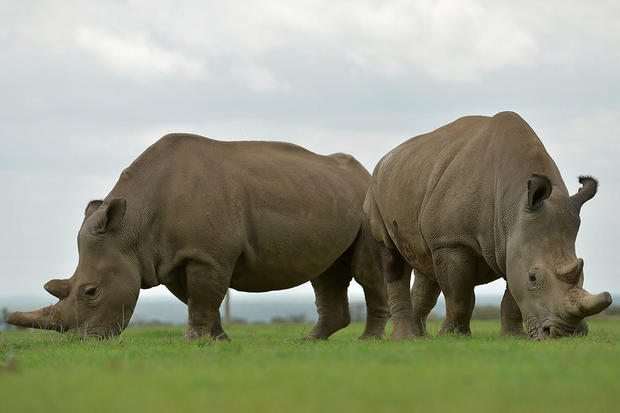
Najin and Fatu, the only two remaining female northern white rhinos, graze together on March 20, 2018 at the ol-Pejeta conservancy in Nanyuki, Kenya.TONY KARUMBA / AFP/GETTY
They are unable to bear offspring themselves, so once the embryos are fertilized in the lab they would be implanted in a southern white rhino surrogate mother.
Kenya’s ambassador in Germany, Joseph Magutt, said his country supports the effort, but didn’t say how long it would take to clear the paperwork.
Hildebrandt cautioned that while ultrasound tests show the embryo transferred at Chorzow zoo has grown, it’s smaller than expected and it remains to be seen whether it will implant in the mother’s uterine lining and result in a pregnancy.
The German government announced Tuesday that it is supporting the project with $4.6 million in funding.
In the meantime, others in the BioRescue team are working on ways to turn preserved skin cells from deceased rhinos into eggs or sperm, a procedure that’s so far only been performed with mice.
Rhinos have long been under pressure from poachers because of their horns, and several sub-species are at risk of extinction. Conservationists say rhinos are important for the survival of many other species because of the role they play in landscaping their native habitat.
Earlier this week, five eastern black rhinos were transported from European zoos to Rwanda’s Akagera National Park to help increase the genetic diversity of the rhino population there.
More broadly, a recent United Nations report warned that a million species are at risk of extinction in the coming decades, largely because of human activity.



 Exposing the Big Game