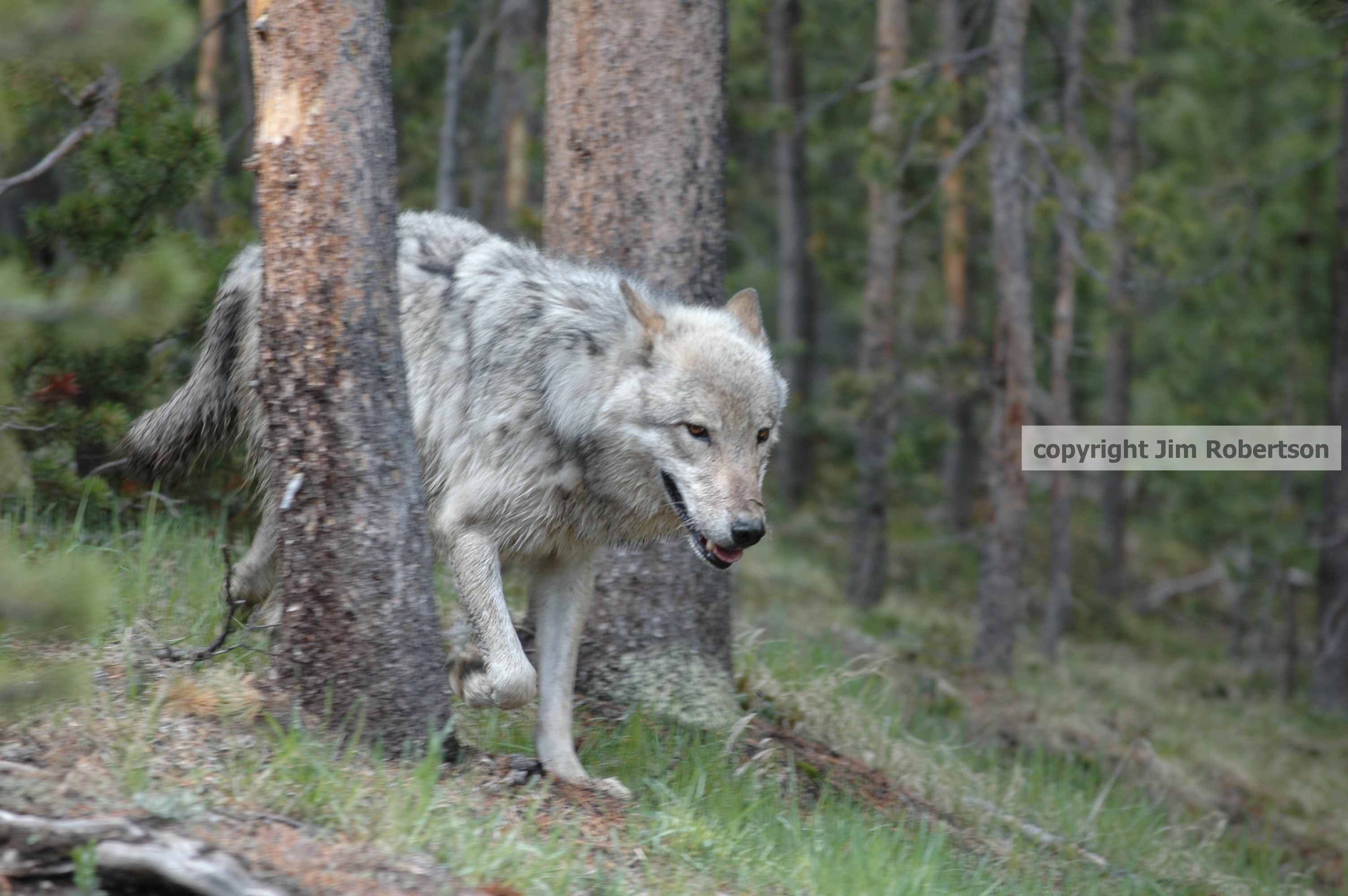
Feds Cutting Out the Pro-Wlf States From the Hearings!!!!

copyrighted wolf in water

Feds Decide To Halt Western Wolf Hearings
Colorado, Pacific Northwest public sessions terminated.

A decision by the U.S. Fish and Wildlife Service to halt public wolf hearings in Colorado, Oregon and Montana has met with criticism from environmental advocates such as the Defenders of Wildlife.

“We are very disappointed to see the Obama Administration and the Fish and Wildlife Service ignoring wolf supporters in some of the nation’s best remaining, unoccupied wolf habitat,” says Jamie Rappaport Clark, Defenders president.

The federal government is turning its back on Americans who want to see thriving wolf populations restored, adds Clark. “Those who oppose the Service’s premature and short-sighted delisting proposal deserve a chance to voice their concerns. By excluding their voices, the Fish and Wildlife Service is effectively cutting off public debate about the future of wolves in Colorado and the Pacific Northwest,” he argues.
Read more: http://farmprogress.com/story-feds-decide-halt-western-wolf-hearings-9-102378

Dances With Wild Wolves: Rally on National Mall

by Brenda Peterson

At the national rally on Sept. 7 to protest the federal delisting of wild wolves and the Western states’ slaughter of over 1,800 of them so far — I remember another gathering when I was eye-to-eye with a wild wolf. It was the 1997 Wolf Summit here in Washington State where ranchers, conservationists, and federal representatives met to discuss wolf reintroduction in the Pacific Northwest.

The young male wolf, Merlin, was a two-year-old ambassador from the Colorado haven Mission Wolf. He was here on an educational tour to teach us the real story of wolves. Before Merlin bounded into our midst, Mission Wolf Director Kent Weber schooled us in proper wolf etiquette. “Wolves, like humans, engage in a lot of eye contact to figure out if an expression says ‘threat’ or ‘play,'” he explained. “So when you meet the eyes of a wild wolf, keep an open attitude.”

Merlin explored the semi-circle of humans — a sniff to the face here, a sniff of an open hand there. The wolf was careful and curious. With his huge paws, his imperial and direct stare, we knew we were in the presence of a powerful peer. Merlin allowed no “good dog” pat on the head, interpreting that as a sign of dominance. Instead he responded only to an open palm, like a show of goodwill, an offering.

All eyes turned to follow the long-legged wolf as he moved toward the contingent of ranchers who were at the Wolf Summit to strongly lobby against any wolf restoration to our state. There was a tension in the crowd that the Mission Wolf director tried to defuse in a quiet voice.

“Most of what we believe about wolves is a myth and has nothing to do with the real animal,” Kurt said. “There is no such thing as the Big Bad Wolf,” he said softly. “Never was.”

Education, he said, not fear, was the key to restoring the ancient co-existence that our species once shared with the wild wolf — and now with their domesticated cousins, our companionable dogs. As Merlin stood before the group of ranchers, the room was very still. After all, for generations ranchers had poisoned, trapped, shot on sight this country’s wolf population until they were extinct in the Lower 48. Now a wild wolf had ranchers in his sights. Not a single hand reached out to Merlin. In fact, there was a kind of stoic stalemate: arms across chests, shifting, some eyes averted, others staring with open aggression. Surely Merlin sensed the anger and defensiveness

“Meet the wolf’s eyes,” Kurt advised one of the ranchers, a big man with a strong, sun-blasted face, “not as an aggressor, but as an equal.”

The rancher steadied his gaze and Merlin faced him, those wild eyes assessing. And then with a slow grace, the wolf took the man’s entire face in with his strong tongue. Grinning ear-to-ear, the rancher rocked back on his knees and whispered, “I feel as great as the first time a girl said, ‘yes’ when I invited her to dance.” He paused. “I guess this is a dance.”

Then Merlin moved on to a ranch woman who did not hold out her hand. Her fear and distrust were palpable; even I could almost smell its stringent scent. Merlin sniffed the air and kept a respectful distance. What he did next surprised us all. Suddenly stretching and arching his back, Merlin sat down next to the ranch woman’s outstretched legs. There was nothing domesticated about him as Merlin yawned to reveal startlingly white fangs. Then his huge jaw clamped shut, he shook his massive black head, and with great poise lay on his side only inches away from the ranch woman’s boot. The wolf and the woman remained like that in a motionless dance of opposites.

Merlin closed his great eyes, sighed. Stretching, he let out a soft growl, and then turned over on his back to look directly upside down at the ranch woman. Lying so near her, Merlin was no threat, and the ranch woman at last met the wolf’s eyes without any fear. “He’s… he’s really something,” she said slowly. “He does have a way of getting right up into your heart, doesn’t he.”

Wolves have not only gotten into our hearts, they are helping us restore our homelands. Scientists have documented that wild wolves are “keystone predators” whose reintroduction to their native habitat has restored grasslands, watersheds, and even songbirds. “If an ecosystem can support wolves,” Kent Weber said, “it will sustain all other life forms. Wolves restored as top predators are a sign of a healthy ecosystem.”

“We’re have an opportunity to correct a historic mistake,” Washington State Representative Norm Dicks had concluded that Wolf Summit. He told us that the total cost to taxpayers of all previous wolf reintroduction had only been a nickel per person, a small price to pay for helping to rebuild an entire ecosystem.

Wolves have helped balance every ecosystem in which they’ve been restored. We’ve paid little for this balance; even the ranchers who are reimbursed at market prices for every livestock loss by such programs as Defenders of Wildlife, have paid little. But the wolves are now paying with their lives. Only 1 out of 3 Americans in a recent poll support the very unpopular federal plan to drop Endangered Species protections for wolves across most of the U.S. and let Western states continue their lethal harvest, not sustainable management, of wild wolves.

At the Washington, D.C. rally, I keep this memory of that other Wolf Summit in my mind: A ranch woman at last reaching out her tentative, open palm to Merlin. Only then did the wolf leap up with unexpected energy and sniff her hand and, as she bowed her head, her hair. But he didn’t lick her. Instead, the wolf looked directly into her eyes, inches away from her face. Then he simply leaned his black, soft forehead against hers. It was the briefest of touches, before Merlin bounded away. But it seemed like those two minds, once opposites, rested together a long time — longer than our history, our generations of fear, our prejudice. This is the future we must hold out for, howl out for — because when we protect the wild wolf, we are also protecting ourselves~

http://www.huffingtonpost.com/brenda-peterson/dances-with-wild-wolves_b_3882170.html


NYT: Wolves Under Review

http://www.nytimes.com/2013/08/16/opinion/wolves-under-review.html?_r=0

By 
Published: August 15, 2013

In June, the Fish and Wildlife Service prematurely proposed to end federal protection for gray wolves in the lower 48 states in the belief that wolves had fully recovered from near eradication in the early 20th century. This was politics masquerading as science. The Fish and Wildlife Service would love to shed the responsibility of protecting large carnivores, like the wolf and the grizzly bear, and hunters and ranchers throughout the Rocky Mountains would love to see wolves eradicated all over again.

By law, a decision like this one — to remove an animal from the endangered species list — requires a peer review: an impartial examination of wolf numbers, population dynamics and the consequences of proposed actions. But science and politics have gotten tangled up again. The private contractor, a consulting firm called AMEC, which was hired to run the review, removed three scientists from the review panel. Each of the scientists had signed a May 21 letter to Sally Jewell, the interior secretary, criticizing the plan to turn wolf management over to the states.

In the peer-review process, there is only the illusion of independence, for the simple reason that the Fish and Wildlife Service controls the appointment of panelists. The agency would like to pretend that these panelists were removed for their lack of impartiality. In fact, they failed to measure up to the agency’s anti-wolf bias. The Fish and Wildlife Service is now busy covering its tracks. It postponed evaluation of the delisting plan because, it says, the identities of the panelists, which were supposed to be hidden from agency officials, had been discovered.

If wolves can’t get a fair hearing at the federal level, what chance do they have at the state level? The answer is, very little. Scientists have already noted a 7 percent decline in Rocky Mountain wolves since they were delisted, and hunts authorized, in Idaho, Montana and Wyoming.

Wolves arouse passions that seem to preclude any effort to treat them the way they should be treated: as part of a natural, healthy ecosystem. That is how the Clinton administration understood wolves when it reintroduced them to the region in the mid-1990s, and it’s how they should be understood now.

copyrighted wolf in water

Heed the call of the wild: don’t cull the wolf

copyrighted Hayden wolf in lodgepoles

There are better ways to control North America’s wolf populations than removing wildlife protections and permitting hunting

http://www.theguardian.com/commentisfree/2013/aug/14/wolf-cull-hunting

by  www.theguardian.com,

Wednesday 14 August 2013

They encroach on natural habitats, kill wildlife and destroy native landscapes.

While this is, in many ways, the modus operendi of human populations, it is the excuse now being given by the US Fish and Wildlife Services (FWS) in its call on the federal government to remove the gray wolf from endangered species lists. All for the purpose of using human “ingenuity” (read: guns) to help reduce the population to a more “manageable” level.

Activists are beginning to take to the social media networks in calling for the government to not slaughter wolves. One petition, began last week, has already garnered several thousand signatures en route to its 10,000 goal.

With thousands of wolves across the country struggling to survive after decades of reintroduction since humans slaughtered nearly the entire population, it seems odd that calls have grown stronger to remove them from the Endangered Species Act (ESA). According to the FWS, in the Great Lakes region, there are roughly 4,000 wolves; in the Northern Rocky Mountains around 1,700; Washington State has nine total; the southwest about 60 wolves. In Alaska, where wolves are not protected by the ESA, there live about 10,000.

So, why have the calls for “culling” wolves increased so dramatically over the past five years, in a plan to reduce the populations which the FWS terms “control”?

The modern wolf story largely begins in 1995, in Idaho (my home state), when the state reintroduced a number of gray wolves into the state as part of the “experimental, non-essential” clause of the ESA. From there, the animals developed and grew in numbers across the state as wildlife biologists helped support the small ecosystems that were developed for the animals’ use. And in the United States Pacific northwest, the Nez Perce Native American tribe also started their own project, which enabled a pack of wolves to live and create familial ties in a large fenced area.

Not everyone was pleased that hills covered in snow and jagged mountains – the difficult terrain of Idaho’s mountains – are now home to wolves: some government officials and ordinary citizens claim the species has now overpopulated the wilderness areas and is a threat to “human activity”.

As one family friend, a hunter, told me recently, the wolves are “killing livestock, attacking people in the natural parks and without action could overrun our landscape”. Although he is right that wolves do attack livestock (and wild prey), there is little evidence that people are being attacked. Wolves rarely are aggressive toward humans unless threatened.

The problem is rather with the continued development on what had, historically, been remote areas; there, wolves are simply attempting to survive. With calls for removing wolves from the protection of the ESA, however, it could soon be open season for hunters – in what officials argue are “conservation” efforts to ensure the wolves’ survival.

I spoke with an Idaho biologist who has worked with both the FWS and the wolf reintroduction program. He argues that human populations continue to “overuse” hunting in the name of sport and this has reduced deer and elk populations, not just in Idaho, but in the Great Lakes and Alaska. The result?

Wolves have been forced to look elsewhere for food and sustenance. This results in cattle being attacked because the regular food chain has been disrupted. Hunting wolves won’t stop this problem unless all the wolves are killed.

He also pointed out that during such culls – which we have seen in Idaho and other areas – it is the adult wolves that are killed, often leaving cubs unprotected and unable to fend for themselves. “It is sad that this sort of thing continues,” he added.

Activists have called for a blanket ban on wolf-killing, but there is a need to work with the FWS and those who feel threatened by wolves. We must understand that the issue of wolves is a nuanced controversy in which those directly affected by the encroaching wolf populations must be heard. There needs to be compromise that does not threaten the whole wolf population and finds sustainable solutions in the specific environments where the reintroduction process has occurred.

At the same time, we can’t afford to reverse the good work of reintroduction programs and go back to the days when wolves were seen as a deadly menace to humans and their livestock – and had to be exterminated because of that perception.

No Wolf Proponents Allowed

Three wolf researchers were removed from a review panel based on their public criticism of a federal plan to turn management of the wolf over to states.

Federal officials apparently ordered a purge of an independent science panel tasked with reviewing whether gray wolves should come off the Endangered Species List, a move the federal government supports.

Three prominent independent wolf researchers — Roland Kays, John Vucetich and Robert Wayne — were removed from the review team based on their public criticism of the federal plan. They specialize in different areas of wildlife research, but they have one thing in common: In a May 21 letter to Interior Secretary Sally Jewell, they questioned the scientific basis for a plan to turn wolf management over to states.

Related: Majority of Minnesotans mad over state allowing wolf hunting

Shortly after being picked for the review team, the private contractor amec, which is running the review project, told the scientists they were off the panel because they had signed the letter, along with 13 other scientists.

In an email sent to the men on Wednesday, amec scientist Melissa Greulich wrote: “I understand how frustrating it must be, but we have to go with what the service wants,” a reference to the U.S. Fish and Wildlife Service’s concern about potential conflict-of-interest issues associated with the scientists who signed the critical letter.

Fish and Wildlife expertscharged withadministering the review said the fact that the scientists took a position on the plan was inconsistent with the agency’s scientific integrity policies.

The head of a government watchdog group said the last-minute removal of the three scientists confirms that Fish and Wildlife did exercise veto power over the review panel, despite the agency’s claims that it left the choice to the contractor.

“To avoid dealing with the serious scientific concerns … the Fish & Wildlife Service is packing the review panel for its own proposal,” Jeff Ruch, director of Public Employees for Environmental Responsibility, said in a statement.

“Selecting your own reviewers defeats the purpose of independent peer review,” Ruch said.

Related: Wolf howl identification developed by British scientists

One of the purged scientists said he thinks the process is politically driven.

“What I understand happened is, the U.S. Fish and Wildlife Service told the contractor you can’t pick anybody that’s on that list,” said Vucetich, a professor at Michigan Technical University who has spent his career studying wolves. He was referring to the letter signed by the scientists who disagree with turning gray wolf management over to states.

The federal wolf proposal doesn’t reflect the best available science and fails to measure up to the requirements of the Endangered Species Act, Vucetich said.

“The Service did not request that any particular scientists be excluded from participation as peer reviewers for the agency’s gray wolf proposals,” Fish and Wildlife spokesman Gavin Shire told MSN via email. Shire said the agency doesn’t know who the panelists are in advance of the final selection.

Gray wolves were wiped out in the Lower 48 states by the middle of the 20th century. Today they live in Alaska, Idaho, Montana, Wyoming, Michigan, Minnesota and Wisconsin, with a small population just taking hold in the Pacific Northwest. Currently, all those populations are protected under the Endangered Species Act. The Fish and Wildlife Service estimates that about 1,600 wolves in the northern Rockies and 4,400 in the western Great Lakes region.

Make Sure FWS Gets the Message: Americans Want Wolves to Stay Protected!

Make Sure FWS Gets the Message: Americans Want Wolves to Stay Protected!

July 28, marked the halfway point of the 90-day comment period on the proposed delisting of nearly all gray wolves in the lower 48 states, and we’re making a racket they can’t ignore.

The premature delisting of gray wolves flies in the face of sound science and is an invitation to a recovery disaster.

Please send an urgent message to the U.S. Fish and Wildlife Service – demand that they withdraw their delisting proposal.

Take Action by going Here: https://secure.defenders.org/site/Advocacy?cmd=display&page=UserAction&id=2621

Plan would expand range in Arizona for gray wolves

The Associated Press

Posted: 08/04/2013 01:40:11 PM MDT

FLAGSTAFF, Ariz.—The federal government is floating a plan that would let endangered Mexican gray wolves roam north toward Flagstaff and across Arizona for the first time in generations.
The Arizona Daily Sun reports (http://bit.ly/1bZONIg ) that the government’s wolf reintroduction program has limited the animals to a recovery area that straddles the Arizona-New Mexico state line, where they have struggled to gain a foothold. Currently, any wolf leaving the recovery area is captured and returned.

U.S. Fish and Wildlife Service released a draft of proposed changes last month that, if put into effect, would let wolves roam from western Arizona to eastern New Mexico between Interstates 40 and 10.

The draft includes potential wolf reintroduction sites in northern Arizona on the Tonto National Forest, throughout the Sitgreaves National Forest and other public lands, as well as private lands where there’s a participating landowner. The Apache tribe has an agreement with the Fish and Wildlife Service that has allowed wolves to roam on their lands in eastern Arizona.

The Mexican wolf was added to the federal endangered species list in 1976. The 15-year effort to reintroduce them in New Mexico and Arizona has stumbled due to legal battles, illegal shootings, politics and other problems.

The federal proposal calls for expanding the area where the wolves could roam to include parts of the Cibola National Forest in central New Mexico. In all, there would be a tenfold increase in the area where biologists are working to rebuild the population.
Environmentalists welcomed the prospect of expansion, but they voiced concerns about provisions that could create loopholes that would expand circumstances in which wolves could be killed for attacking livestock or for other reasons.

Wolves have been spotted in the past as close to Flagstaff as Mormon Lake and Holbrook along Interstate 40, as the animals are capable of traveling vast distances in search of food and mates.

Emily Nelson of the Grand Canyon Wolf Recovery Project in Flagstaff said in an interview with the Daily Sun that conservation groups were unhappy with the initial federal proposal because it doesn’t include some of the “last, best area for wolves.”

Scientists have identified the Grand Canyon as prime wolf territory.

While the current population has never gotten close to the goal of 100 wolves, scientists say as many as 200 wolves could be supported in the Grand Canyon region alone.

Judy Prosser, whose family operates a ranch south of Mormon Lake and owns some 2,000 head of livestock, would see her grazing lands put inside the expanded wolf recovery area.

Prosser said that her ranching friends in the current recovery area have struggled and not been happy with the way things were managed. Losing livestock has affected their pocketbooks.

“The program has not been successful. I don’t think anyone has been happy with the outcome,” she said.

———

Information from: Arizona Daily Sun, http://www.azdailysun.com/

Protections still needed for wolves

http://www.utsandiego.com/news/2013/jul/27/protections-still-needed-for-wolves/

By Patrick C. Valentino July 27, 2013

In June, the U.S. Fish and Wildlife Service proposed to remove gray wolves from the endangered species list despite wolves occupying only about 5 percent of their historic range. The service reminds us that the Endangered Species Act was not intended to provide indefinite life support. This is certainly true, and there might have been a compelling case for delisting today had the science supported it and had wolves reached a fuller stage of recovery.

But that hasn’t happened. In fact, three states in our Northern Rockies, already charged with wolf management, have unleashed an intense and partisan desire to reduce wolf numbers to the barest minimum allowable. Montana, Idaho, and Wyoming now have recreational hunting and trapping seasons, and in the past two years nearly 1,200 wolves have been killed. Well-known and well-loved wolves from Yellowstone National Park were killed, including the cherished Lamar Canyon pack’s alpha female. This degree of backlash questions whether our society has advanced past treating predators as a disposable commodity, a mindset that nearly wiped out wolves by the early 1900s.

There is an alternative path: one that recognizes that the majority of Americans support wolves as part of our wilderness and heritage, looks beyond managing wolves on the basis of population numbers along, recognizes the inherent value of wolves to exist in the wild as nature intended, and focuses on solutions to conflicts with livestock, such as nonlethal predator deterrents.

California is currently developing a wolf management plan and reviewing whether to protect wolves under state law in preparation for a future wolf population. Californians have a chance to lead the way and demonstrate how to afford the wolf the value it deserves, work together to reduce conflicts, and hopefully one day celebrate the recovery of wolves in our state.

The mission is far from accomplished. Delisting now is a political decision defying the majority’s desire for a more complete, science-based recovery of gray wolves. We owe it to ourselves and future generations to protect gray wolves and maintain their rightful place on our wild landscape.

Valentino is director of California Wolf Recovery.

copyrighted Hayden wolf in lodgepoles

Montana increases bag limit for next wolf hunt

The bastards!!

http://www.seattlepi.com/news/article/Montana-increases-bag-limit-for-next-wolf-hunt-4657694.php          

 By MATT VOLZ, Associated Press Wednesday, July 10, 2013

HELENA, Mont. (AP) — Montana Fish and Wildlife commissioners on Wednesday increased the bag limit from one to five wolves per person and extended the state’s next hunting season, but they also set new restrictions in areas adjacent to Yellowstone National Park.

The commission voted to loosen hunting regulations during its meeting in Helena in an attempt to further decrease the state’s wolf population. They amended their plans and set new quotas around Yellowstone after park administrators expressed concern over the effects on the wolf population there.

Hunting and trapping wolves next to Yellowstone, which is a no-hunt zone, flared as an issue after several Yellowstone wolves wearing radio tracking collars were shot last year by hunters in Montana, Idaho and Wyoming.

Commission Chairman Dan Vermillion said the limits are the result of an attempt to reach a middle ground.

“It’s not going to cause a long-term threat to the wolf population there,” Vermillion said.

There is no statewide quota limiting the total number of wolves that can be killed during the season, but in two special wolf-management units north of Yellowstone, the commission limited the total number of wolves that can be killed to seven.

Hunters and trappers will only be allowed to take one wolf each in those areas.

To the west of Glacier National Park, a quota of two wolves has been set in that management unit, the same as last year.

The rifle season for wolves will run from Sept. 15 to March 15, giving hunters a six-month season this year. The trapping season, the state’s second, will again run from Dec. 15 through Feb. 28.

Archery season will be from Sept. 7 through Sept. 14.

Opponents of the new regulations wanted an even lower quota around Yellowstone, saying the combined effects of Montana’s and Wyoming’s hunts would likely hurt the park’s wolf population. They also objected to lengthening the rifle season beyond February, saying that is the time when female wolves are pregnant.

“Yellowstone’s wolf packs are the foundation for the ecosystem’s wolf population and must be provided special considerations,” said Bart Melton of the National Parks Conservation Association. “It’s imperative that we protect this iconic species adjacent to the park as well as the vibrant wolf-related tourism that benefits our local economy.”

Wolf opponents argued the animals’ burgeoning population hurts other big-game animals and results in more livestock being killed. Blake Henning of the Rocky Mountain Elk Foundation said the National Park Service’s lack of wildlife management creates problems for hunters and ranchers outside the park.

“We don’t believe the park needs special protections or designations for its wolves,” Henning said.

In all, nearly 25,000 people submitted comments on the plans to loosen regulations for the upcoming hunt since the commission first announced the proposal in May.

A total of 225 wolves were killed by hunters and trappers last season. Montana Fish and Wildlife estimated the state’s wolf population at 625 at the end of 2012, a decline of about 4 percent from 2011.

Congress lifted federal protections of wolves in Montana and Idaho in 2011, handing management over to those states and allowing them to hold hunts. Wyoming held its first hunt last year.

Montana’s management plan calls for a population of at least 150 wolves and 15 breeding pairs within its borders.

copyrighted-wolf-argument-settled

The War on Wolves: Who Are the Real Predators?

Michael Markarian, of the HSUS Legislation Fund, wrote the following on their “Animals and Politics” page:


The Chicago Tribune weighed in with an editorial this weekend on the Obama Administration’s latest in a series of proposals to strip recovering gray wolves of their federal protections—leaving the fate of wolves to the blood lust of hostile state politicians and trophy hunting and ranching interests. More than 1,000 wolves have been killed with painful steel-jawed leghold traps, hound hunting, and other methods since Wisconsin, Minnesota, Idaho, Montana, and Wyoming legalized hunting seasons—including storied Yellowstone National Park wolves whose packs had been studied for decades, but were gunned down in their GPS collars over the park border.

WolvesAs if that wasn’t bad enough, Montana officials now propose lengthening the wolf hunting season and increasing the bag limit. It’s alarming to Yellowstone administrators who say it places more of the park’s wolves in jeopardy when they step over the border into Montana—putting the Department of the Interior in the awkward position of handing wolf management to the states and then watching from the sidelines as they kill the very descendants of the wolves reintroduced to the park 17 years ago. And just last month, Wisconsin raised its quota to 275 wolves which, when combined with other forms of human-caused wolf mortality, likely will result in 50 percent of the entire wolf population in the state being killed—despite the fact that Wisconsin voters oppose wolf hunting by a more than eight-to-one margin.

You’d think the pogrom for wolves in the Northern Rockies and Great Lakes regions would cause the Obama Administration to pause before adding to the carnage. But the U.S. Fish and Wildlife Service has announced its plans to drop endangered species protections for the gray wolf population in virtually all of the lower 48 states, with the exception of about 75 wild Mexican wolves in Arizona and New Mexico.

Some states have set up sound, capable management plans for wolves—such as Washington, which this year passed legislation to create a state gray wolf conflict account to be used for mitigation, assessment, and payments for injury or loss of livestock caused by wolves. But many others have taken a regressive, dangerous approach. The Utah legislature even handed out hundreds of thousands of taxpayer dollars to a private group to advocate for killing wolves. Instead of hoping for the best from a patchwork of state authorities subject to varying degrees of political power exerted by ranching and hunting interests, the federal government should be overseeing and working with the states and driving the nation toward full recovery of wolves.

The Tribune is urging concerned citizens to submit comments to the U.S. Fish and Wildlife Service by visiting this web site before the September 11 deadline, and urging the agency to keep protections intact for one of America’s most ecologically valuable creatures.

Meanwhile, in Michigan, state politicians are so dead-set on killing wolves that they pulled a fast one on voters who gathered more than 250,000 signatures to place the question of wolf hunting on the ballot. Michigan lawmakers passed a second bill, signed into law by Gov. Rick Snyder, to subvert a vote of the people and allow wolf hunting, after their first bill was the subject of a citizen referendum. They want to take the power to decide wildlife issues away from the state’s voters, and put it in the hands of seven unelected bureaucrats—paving the way to kill wolves and other protected species.

But Michigan citizens are fighting back against this undemocratic power grab, and have launched a second referendum campaign to stop the trophy hunting and trapping of wolves and restore the right of Michigan voters to weigh in on critical wildlife issues. With the bodies of wolves piling up around the country, Michigan citizens are taking a stand for these rare and majestic treasures. You can join them by visiting the Keep Michigan Wolves Protected campaign.