Lone Wolf OR7

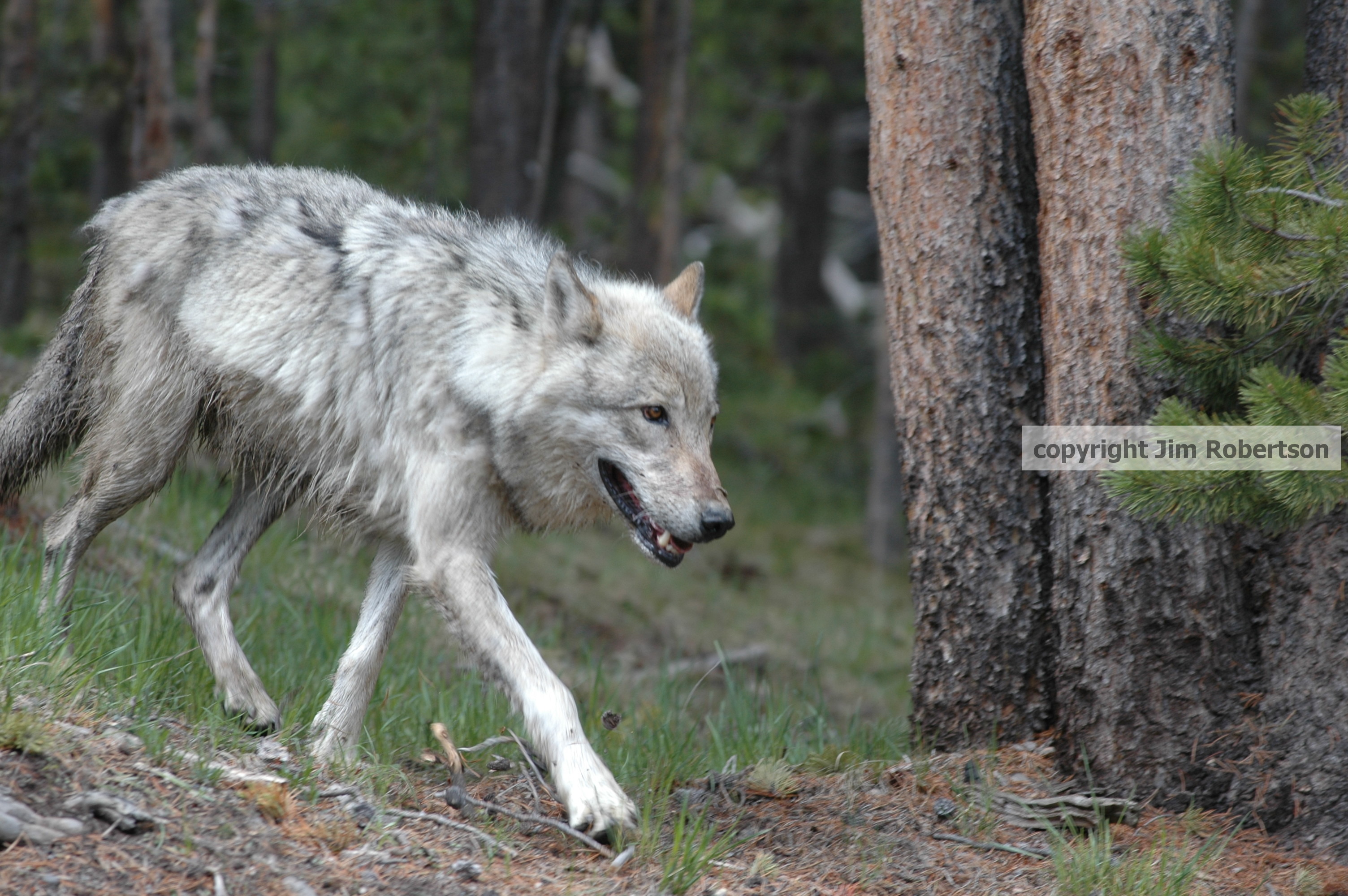
copyrighted Hayden wolf walking

http://www.orionmagazine.org/index.php/articles/article/7690

Lone Wolf

A forsaken predator reappears

By Joe Donnelly

Published in the September/October 2013 issue of Orion magazine

Here’s an excerpt from the article…

Except for a few stubborn holdouts, the era of man seems just about done in Plumas County. It’s an eerie, forgotten landscape, and there’s a certain poetic justice in OR7’s arrival. Bounty hunters killed OR7’s last remaining California cousin near here in 1924, back when wolves were considered to be an enemy of manifest destiny. OR7, though, doesn’t seem to have revenge in mind. He has yet to take sheep or cow from the descendants of those who shot, trapped, poisoned, and burned his kind to extinction in the West.

But this hasn’t stopped some locals from greeting his arrival as if the devil himself were paying a visit. As soon as his epic trek signaled a wolf with Golden State aspirations, the hysteria began. To calm local fears of pending doom, the California Department of Fish and Wildlife conducted public meetings featuring wildlife officials, celebrity wolf experts, government resources managers, and a highly agitated public—all awaiting the imminent arrival of a solitary, thirty-month-old Canis lupus.

After one meeting, Marcia Armstrong, a supervisor for Siskiyou County, where OR7 dallied briefly before moving on, told the Los Angeles Times that she would like to see all encroaching wolves “shot on sight.” Adding to the tinder were ranchers warning that a wolf repopulation would be “catastrophic.” Other folks spread rumors of conspiratorial wolf smuggling by federal agencies, and of a government out to trample rights and make it harder to log, mine, and dam the rural West.

State’s first hunt didn’t reduce tensions over wolves

The following article proves that when Yellowstone biologist, Doug Smith, stated, “To get support for wolves, you can’t have people angry about them all the time, and so hunting is going to be part of the future of wolves in the West. We’ve got to have it if we’re going to have wolves,” he was dead wrong; and when wolf hunter Randy Newberg told NPR News, “Having these hunting seasons has provided a level ofcopyrighted Hayden wolf walking tolerance again” he was totally full of shit…

State’s first hunt didn’t reduce tensions over wolves

Last year’s first managed wolf hunt in Wisconsin history did not increase tolerance toward the animals among people who live in wolf country, a new survey by University of Wisconsin-Madison researchers shows.

With a growing wolf population, state wildlife managers and legislators who rewrote state hunting laws had hoped a hunting season would lower wolf numbers and reduce tensions over the animals.

But the survey shows this didn’t happen.

The last time the researchers surveyed public’s perception of wolves in 2009, 51% of wolf country residents said they would be more tolerant of wolves if the public could hunt them.

But in this year’s survey when asked the same question, residents in wolf country were much less accepting. The level of acceptance dropped to 36%.

When measuring the public’s attitudes in all parts of the state, 37% of the respondents said they would be more tolerant toward wolves with a public hunt. There was not a statewide comparison in 2009.

The wolf range is generally described as northern Wisconsin and the state’s central forests.

The hunt took place Oct. 15 to Dec. 23. Hunters and trappers killed 117 wolves, according to the Department of Natural Resources. The agency had set a harvest goal of 116 among non-tribal hunters and trappers.

“If one of the goals of the wolf hunt was to increase tolerance for the species, the first season did not accomplish this objective,” said Jamie Hogberg, a graduate student at the Nelson Institute for Environmental Studies.

Team led study

Hogberg was part of a team that examined public attitudes toward wolves. Others on the team were Adrian Treves, an associate professor of environmental studies; Bret Shaw, an associate professor of the Department of Life Sciences Communication; and Lisa Naughton, a professor of geography.

One possible explanation for the lack of change in public opinion is that despite the hunt, the state’s wolf population has changed little.

In April, the DNR estimated the wolf population from over-winter counts at between 809 and 831 animals in 216 packs. The previous winter’s estimate was 815 to 880 wolves in 213 packs.

The survey was sent to 1,311 people. There were 772 responses, or 59%. The vast majority — 538 — of people who responded reside in areas where wolves are present.

In January 2012, the federal government removed wolves from the list of protected animals under the Endangered Species Act in the Great Lakes states. That allowed states to manage the wolf population through hunting and trapping seasons.

The Legislature approved a wolf hunt in April 2012.

Dogs caught in wolf traps set on Forest Service land

http://methowvalleynews.com/2013/08/07/dogs-caught-in-wolf-traps-set-on-forest-service-land/

By Ann McCreary

Two dogs in the Poorman Creek area were inadvertently caught last week in leg hold traps set for wolves, until the owner of one of the dogs found them and set them free.

The traps were located on U.S. Forest Service land near Second Mile Road at the end of Poorman Creek Road west of Twisp. They were set by Washington Department of Fish and Wildlife (WDFW) officials in an ongoing effort to capture and place radio collars on Lookout Pack wolves, said Scott Becker, WDFW wolf biologist.

Becker said this week the traps have been removed from that area and wildlife officials are “re-evaluating some of the trapping protocols right now. We don’t want another incident like this to happen in the future.”

Wildlife officials have confirmed that at least three pups were born this spring to a pair of wolves that have been monitored for more than a year in the Lookout Pack territory, Becker said. Efforts to collar at least one of the adults will continue, he said.

The incident involving the dogs occurred last Thursday (Aug. 1). Andy Floyd, who lives on Second Mile Road, said his dog and a neighbor’s dog followed his wife on a morning run on nearby Forest Service land, but did not return to the house with her. Concerned, Floyd began looking around the neighborhood for his dog.

Floyd said a neighbor heard a dog “barking and yipping just over his fence on the Forest Service land not 100-300 feet away.” Floyd investigated and found the neighbor’s dog with a front paw caught in a trap by the side of a Forest Service road.

“I tried getting the trap off but could not do it by myself. I ended up getting my neighbor to … use most of our strength to get the trap off,” Floyd said. In the process, Floyd said, the dog nipped his wrist. He returned the dog to its owners, Carolyn and Glenn Schmekel, who took the dog to a veterinarian.

Residents’ concerns

Floyd later found his dog caught in another trap further along the road. He said the dog had been missing for about two hours. With the help of someone camping nearby, he was able to open the trap and release his dog, which bit Floyd’s hand and slightly broke the skin. Floyd said his dog has been limping, but is recovering.

Carolyn Schmekel said she was upset that the traps were placed near the Second Mile homes without notifying area residents, and called Becker last week at WDFW to express her concerns. Fish and Wildlife officials had placed a sign on a tree in the vicinity of the traps warning about bringing dogs in the area, but did not speak to residents bordering the Forest Service land.

“This is an extension of our back yard,” Schmekel said in an interview this week. “If you’re going to have traps this close to people’s homes that have dogs and kids, we need to be informed of it.”

Floyd expressed similar concerns. “The lack of communication really frustrated me. I understand it’s good to tag the wolves because of potential problems … but what really bugged me is the traps were so close to the houses and they didn’t tell us.” He said he did not notice the sign about traps until after the dogs had gotten caught.

Schmekel said her dog was probably trapped for about 30 minutes. It had a bruised front leg but was otherwise unhurt, although the incident resulted in a $66 vet bill.

Signs posted

news-wolf-trap-post2Becker said wildlife officials sometimes talk personally with people living in the vicinity of traps, but didn’t realize that residents in the Second Mile Road area had “free ranging” dogs when they set several traps along the nearby Forest Service road. “We ended up pulling those traps out of there,” he said.

“Most traps are located away from any residences at this point,” Becker said. “No matter where we trap, because we trap on public land, there is potential” for dogs to inadvertently get caught. “Wherever we put traps we put signs at the beginning or end of the road to warn people there are traps for wildlife. We try to do everything we can with signs.”

Traps are often placed along roads on public lands because “wolves are just like people – they use roads and trails to do most of their traveling,” Becker said. Signs placed in the vicinity of traps warn about bringing dogs into the area, describe how to open the trap, and advise covering the dog’s head with a jacket or something similar to avoid being bitten while releasing the animal.

Becker said the leg hold traps are baited with scent to attract wolves, and are outfitted with a transmitter to alert wildlife officials when they are tripped.The traps are located in places that allow the trapped animal to move into the shade, and have offset jaws covered with rubber to minimize injury to the animal.

A WDFW biologist checks the traps every morning, and during the evening as well during warm weather, Becker said. The biologist was making the rounds of a dozen traps in the Lookout pack territory last Thursday morning when the dogs got trapped, and arrived while Floyd was still looking for his dog.

When a wolf is captured, wildlife officials tranquilize it, attach a radio collar and ear tags, and take measurements, Becker said.

Public review begins for expansion of Mexican wolf habitat

http://www.latimes.com/news/science/sciencenow/la-sci-sn-mexican-wolf-habitat-20130806,0,2399491.story

By Julie Cart
August 6, 2013, 2:39 p.m.

The Interior Department this week opened to public comment and review its proposal to expand the range of federally protected Mexican wolves.

The U.S. Fish and Wildlife Service has been attempting to reintroduce wolves into parts of Arizona and New Mexico with little success. A small population of about 75 wolves is restricted to a recovery area, and when an animal roams beyond those borders, it must be recaptured and returned.

Allowing wolves more room will increase their numbers and genetic diversity, biologists say. Livestock growers and others oppose any expansion of wolf territory.

Federal officials earlier this year proposed delisting gray wolves in the Northern Rockies and Great Lakes but preserved the endangered species status of Mexican wolves.

The agency is considering five alternatives, and the public has until Sept. 19 to comment.

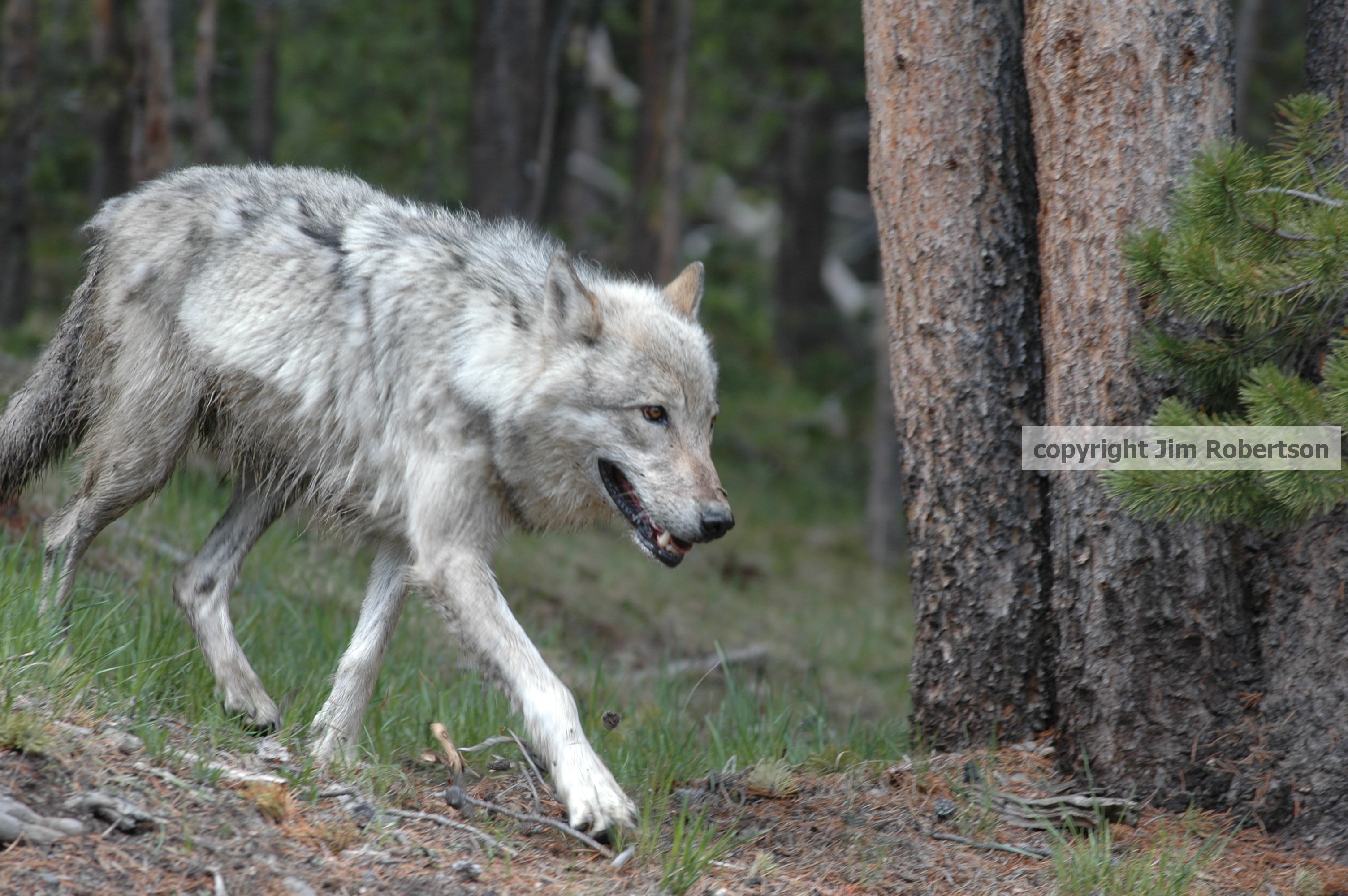
copyrighted Hayden wolf walking

Mohave County board opposes bigger wolves area

Tuesday, August 6, 2013

KINGMAN, Ariz. (AP) — Mohave County is on record as saying Mexican gray wolves aren’t welcome in the northwestern Arizona county.

The Kingman Daily Miner (http://bit.ly/1epSnXT ) reports that a resolution approved unanimously Monday by the Board of Supervisors says the wolves aren’t welcome unless they’ve been vaccinated, have a dog license and have been spayed or neutered.

The U.S. Fish and Wildlife Service is studying the possibility of expanding the range that Mexican gray wolves could roam in Arizona and New Mexico.

Some livestock owners and hunting guides oppose any expansion, saying the wolves would endanger their livelihoods by killing cattle and wild game.

U.S. Fish and Wildlife Mexican Wolf Recovery Coordinator Sherry Barrett says spaying or neutering the animals would defeat the project’s purpose. She says wolves are vaccinated before being released.

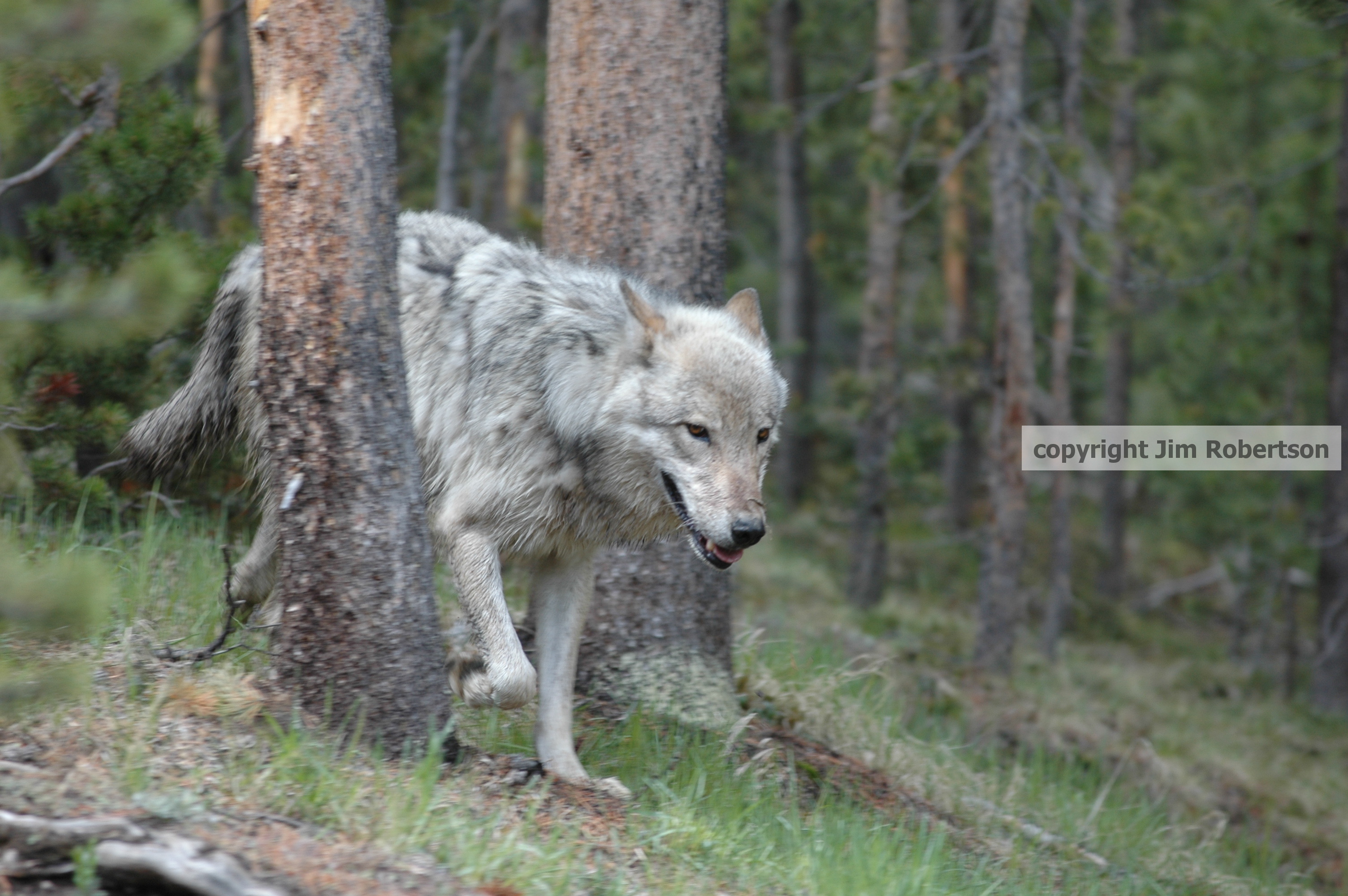
copyrighted Hayden wolf in lodgepoles

The World I Long For

On the wall of my weight room is a poster-sized print of the painting below, depicting North America’s wildlife at the site of California’s La Brea Tar Pits, 20,000 years ago: It’s a heartening image, reminiscent of the kind of biodiversity found only on the plains of Africa.

Familiar species still around today included peccary, deer, elk, coyote, bobcat, cougar, wolf and brown bear (the last two surviving species were hunted and trapped to extinction in California during the nineteenth and twentieth centuries), golden eagle, ravens and heron.

But the list of species once common, now extinct, on this continent is much longer. It includes American camels, horses, the California tapir, American mastodon and Columbian mammoth (two former representatives of the elephant family sorely missed on this continent today); also, a couple of now nonexistent bison (the giant and the ancient bison), three species of ground sloths: the Harlan’s, Jefferson’s and the Shasta (the latter, a mere daisy of a ground sloth compared to the 3,500 pound “giant” ground sloth).

They, as well as the stilt-legged llama and the dwarf pronghorn, the American lion, cheetah and saber-toothed cats, the dire wolf and the short-faced bear all disappeared shortly after the arrival of our species—the one blessedly absent from the scene at La Brea.

To me, the most beautiful thing about the painting is that the human species hadn’t yet shown up and started doing the damage they’re infamous for. Just pencil in a few stick figures and well over half the other species disappear. Sure, the genus Homo did less damage with stone-tipped spears than they could have with drones or AK-47s, but to the non-humans of the world, we were mighty dangerous and destructive nonetheless.

While many people nowadays harken back to a time before the emergence of modern technology and prior to the dawn of civilization—convinced that a harmonious era must have existed somewhere in human pre-history—when I pine for the good old days, this is the world I think of…

00-intro

Wildlife Recovery Just a Big Game for “Game” Departments

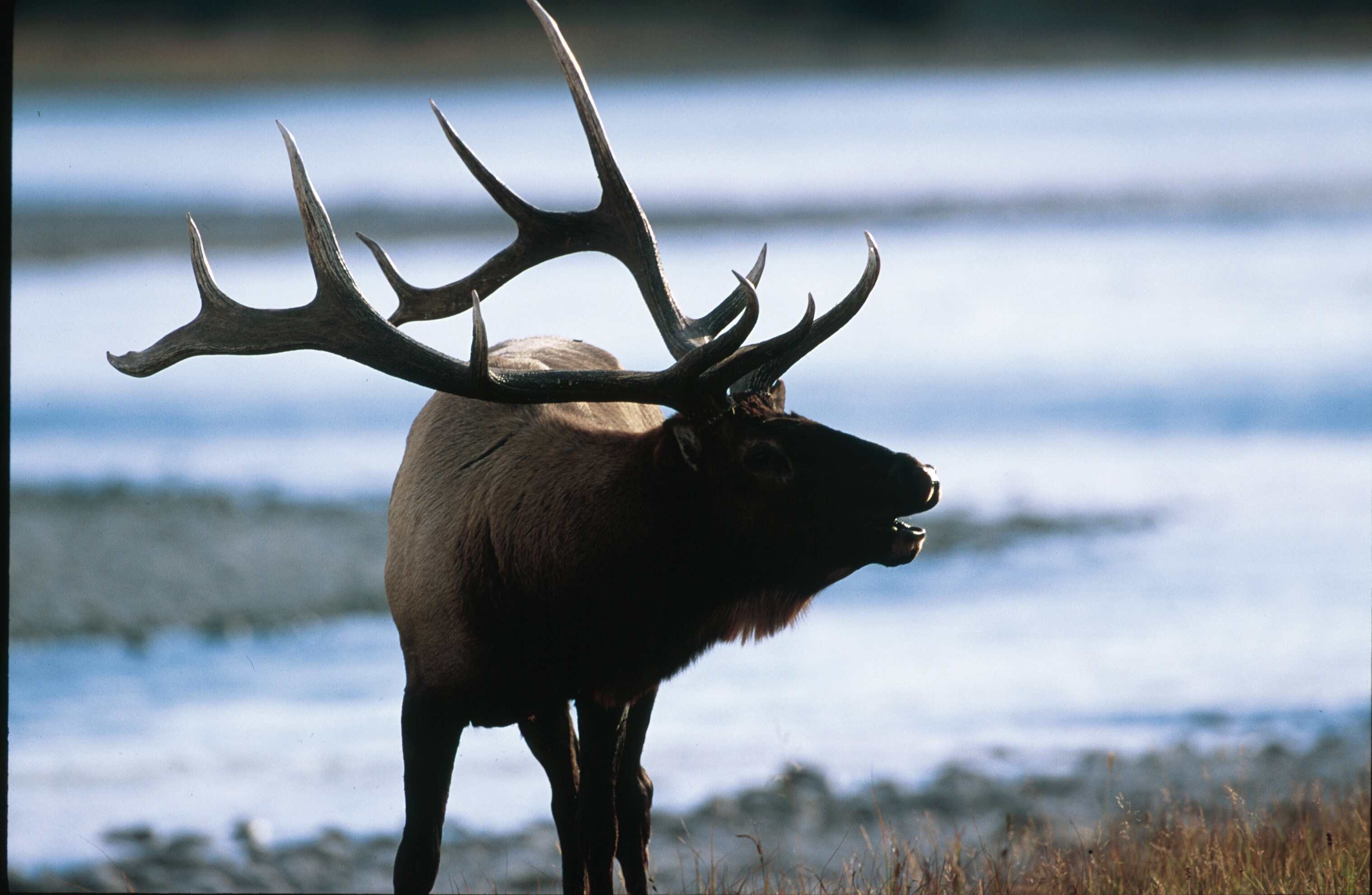
More proof that reintroduction and recovery is all just a big game for state wildlife department managers: Missouri recently reintroduced a mere 100 elk over the past two years, and already they’re talking about implementing a hunting season on them soon.

It seems hunting groups and their “game” department lackeys live by a time-tested formula:

1) Wipe out a species through over-hunting and/or trapping
2) Allow it to recover
3) Open a season and sell tags to kill the animals off again

Lately we’ve seen this formula in action with wolves in the intermountain West and Great Lakes states. In addition to their full-scale assault on wolves, Montana recently started up a hunting season on bison, and they’re already talking about one for grizzly bears the minute they lose federal protection.

Now the recovering elk in Missouri may soon be under fire, as a local paper tells us in the following article entitled,

Elk hunting in Missouri now predicted to start in 2016

Tuesday, July 9, 2013 Supervising editor, Jake Kreinberg

COLUMBIA — The Missouri Department of Conservation now estimates that an elk hunting season in the state will begin in 2016.

The department slowly reintroduced elk from 2010 until earlier this year, trapping about 50 annually in Kentucky and then bringing them to the Peck Ranch Conservation Area in southeast Missouri for observation. The program has since moved to its operational phase, in which the herd will grow only via reproduction.

Elk were common in Missouri before European settlement but had been eradicated from the state by the end of the Civil War. Resource scientist Lonnie Hansen says “about 100” elk are now in the herd following several dying off during relocation and last year’s drought.

“I’d be pleased if we had 125 animals in the herd” by the end of this year, Hansen said.

The department wants at least 200 elk in the herd before it will give any consideration to allowing elk hunting, which might not happen for another three years, Hansen predicted. He previously expected hunting to start in 2015, according to previous Missourian reporting. Whenever hunting begins, it won’t be easy to get a license, as there may be only 30 to 40 available.

“We’d like to see them become part of the natural landscape,” Hansen said about the animals.

Reintroducing elk to the state could be beneficial not only to the ecosystem of Missouri, but also the economy. Joe Jerek, the department’s news services coordinator, said the conservation areas could “expect to see a lot of people” hoping to catch a glimpse of the new herd.

“There are lots of people that just want to see them,” he said. “It brings another large native species back to Missouri.”

According to the department’s website, residents’ interest in reintroducing elk led to a restoration feasibility study in 2000, but that was suspended a year later because of fears of Chronic Wasting Disease the elk could introduce to local livestock.

A method for testing for the disease and continued interest in having elk revived the reintroduction effort in 2010.

[Just who is interested in “having elk,” and for what purpose, the paper didn’t say.]

Wildlife Photography ©Jim Robertson, 2013. All Rights Reserved

Wildlife Photography ©Jim Robertson, 2013. All Rights Reserved

.00¢=the Value of Non-Endangered Non-Human Life

Some people who read yesterday’s blog post, The Fate of Human Decency is on Your Plate, may have thought, “What the heck, doesn’t this guy know there’s a big difference between the value of human, versus non-human life?”

That’s a good question; maybe I don’t. What is the value of a non-human animal’s life in this obsessively anthropocentric world?

It seems unless one’s species has been hunted to the edge of extinction, or is the property of some human being (the self-appointed masters of the Earth, and soon the Universe), the answer is .00¢—a big fat goose egg. And if they compete with any human endeavor, less than zero.

Meanwhile, if a human accidently dies because of someone else’s actions or behavior (hunting excluded) a person (hunters exempt) can be sued for millions of dollars. Now, I’m certainly not trying to diminish the monetary value of human life in any way, but maybe could share the wealth with our fellow Earthlings just a little bit.

 Text and Wildlife Photography ©Jim Robertson, 2013. All Rights Reserved


Text and Wildlife Photography ©Jim Robertson, 2013. All Rights Reserved


Elephant Kills His Poacher and People Aren’t Exactly Sad

Speaking of karma…

Elephant Kills His Poacher and People Aren’t Exactly Sad

Since the African elephant population has been devastated in recent years, it’s pretty hard to see things from the poacher’s point of view.

http://www.takepart.com/article/2013/05/15/african-elephant-poacher-killed-zimbabwe?cmpid=tp-ad-outbrain-general

May 15, 2013, by

Noluck Tafuruka may not sound like a lucky man, but he’s lucky to be alive. His “business partner,” Solomon Monjoro, was recently discovered, a crushed corpse in blood-stained bushes. How did it happen? And what was the motive? One really mad elephant that didn’t want to become a poaching statistic.

It all happened last month in Zimbabwe’s magnificent Charara National Park. The two alleged poachers entered the park with firearms, but apparently were not able to immediately kill their target elephant, which took karma into its own hands, or shall we say tusks, and charged, trampling one of the men to death.

The other man, Tafuruka, was arrested shortly thereafter along with one other in the capital city of Harare.

Elephant poaching has soared in recent years thanks to a growing demand for ivory sculptures and trinkets among China’s emerging middle class, who view the items as status symbols. A recent report by the Wildlife Conservation Society estimated that about 62 percent of forest elephants in Africa have been poached over the past ten years. Just this spring, poachers on horseback, armed with AK47s, gunned down almost 90 elephants in Chad in just one week, including 33 pregnant females.

Ivory currently fetches about $1,300 per kilo in China.

This level of destruction would be tragic for any species, but it is especially sickening in this case, because elephants are extremely intelligent creatures with tightly knit family communities, sophisticated communication systems, and, some researchers believe, highly developed emotions.

In recent years there have been increasing reports from throughout Africa that elephants are changing their behavior because of the enormous emotional stress caused by poaching.

“Elephants in areas that have been heavily poached, display an understandable fear of humans,” said Catherine Doyle, Director of Science, Research, and Advocacy at PAWS. “They often display aggressive behavior when approached.”

Joyce Poole of Elephant Voices recounted how a Masai friend in Kenya was noticing a difference too. “When the elephants come down on that old trail, as they do every year, they no longer come down during the day trumpeting their arrival; they now slip down quietly at night, and when we look at the tracks of these animals, we only see small footprints.”

It’s hard to imagine a world without elephants, but it’s almost equally disturbing to imagine a world where majestic elephants have to cower in the bushes like scared rabbits in order to survive.

elephant-range-map