World on track for catastrophic 3 degrees Celsius warming, UN warns

Current plans and policies will lead to global temperatures rising between 2.6C and 3.1C this century, a new report finds.Share

Reports Indicate 2016 Was Hottest Year On Record
The world is already 1.3C hotter than before the Industrial Revolution. | Lukas Schulze/Getty Images

October 24, 2024 4:01 pm CET

By Zia Weise and Lucia Mackenzie

BRUSSELS — Intensify efforts to fight global warming or start planning a funeral for the Paris Agreement, the United Nations is telling governments ahead of this year’s international climate summit. 

Current plans and policies will lead to 2.6 to 3.1 degrees Celsius of global warming this century, with zero chance of limiting the temperature increase to the totemic 1.5C target agreed in Paris in 2015, according to a new report out Thursday. 

In fact, existing measures are falling so far short of what’s needed that the world even risks blowing past 2C, the Paris accord’s upper limit, the U.N. warned. 

Advertisement

Advertisement

The severity and frequency of dangerous heat waves, destructive storms and other disasters rises with every fraction of warming. At 3C, scientists say, the world could pass several points of no return that would dramatically alter the planet’s climate and increase sea levels, such as due to the collapse of polar ice caps. 

“If nations do not implement current commitments then show a massive increase in ambition in the new pledges, followed by rapid delivery, the Paris Agreement target of holding global warming to 1.5C will be dead within a few years and 2C will take its place in the intensive care unit,” said Inger Andersen, the U.N. environment chief. 

This year’s iteration of the U.N.’s so-called emissions gap report — assessing the yawning chasm between the policies required to avert climate catastrophe and what countries are actually doing — comes just weeks before world leaders gather in the Azerbaijani capital of Baku for the start of the COP29 climate summit. 

There, countries face the task of hammering out a deal on how to finance climate action in the developing world. But the Baku summit is also widely seen as a stepping stone toward COP30 in Brazil next year, the deadline for governments to submit fresh plans on how they plan to meet their Paris Agreement obligations. 

In light of the findings published Thursday, Andersen called for “dramatically stronger” plans, known as nationally determined contributions (NDCs); more funding for measures to curb climate change; and leadership from the largest emitters. 

Wrong direction 

The world is already 1.3C hotter than before the Industrial Revolution, and planet-warming greenhouse gas emissions are continuing to rise, increasing by 1.3 percent last year compared with 2022. 

Advertisement

Advertisement

As a result, limiting warming to the relative safety of the Paris targets has become more difficult, requiring even steeper annual emissions cuts of 7.5 percent or 4 percent by 2030 for 1.5C or 2C, respectively. 

With the policies currently in place across the globe, the world is heading for 3.1C of warming by the end of the century, the report says. Measures outlined in current NDCs, which haven’t been fully implemented, would bring that down to between 2.6C and 2.8C. 

Even the best-case scenario of 2.6C, however, represents “catastrophic” warming with “debilitating impacts to people, planet and economies,” the U.N. warns. 

Under all three scenarios, the world’s chances of limiting warming to 1.5C are “virtually zero,” the authors write, with global temperatures “well above” that level by 2050 and a “one-in-three chance that warming already exceeds 2C by then.” 

To get on track toward 1.5C, global emissions ought to fall 42 percent by 2030, or 28 percent for a pathway to 2C — a message also included in last year’s report, aptly titled “Broken Record.” 

The new NDCs — due in February 2025 — are meant to include measures and targets up to 2035. By then, global emissions should fall 57 percent for 1.5C and 37 percent for 2C, according to this year’s report, dubbed “No More Hot Air … Please!” 

Advertisement

Advertisement

symbol

00:00

03:12

Read More

Mo’ money, fewer problems 

Andersen said that worldwide, measures to reduce emissions will require a “minimum six-fold increase” in investment, “backed by reform of the global financial architecture and strong private sector action.” 

Developing countries excluding China require a massive surge in investment, the report says, as “these regions are already struggling with public health, human capital, food and energy security, rising debt and political tensions, all of which are exacerbated by climate change.” 

Whether current NDCs limit the rise in global temperatures to 2.6C or 2.8C depends on funding. The lower figure would be reached under so-called conditional NDCs, meaning plans contingent on additional financial aid. Twelve percent of all NDCs are fully conditional, according to the report, with another 21 percent featuring conditional elements. 

How to fund climate action in developing countries will dominate discussions in Baku. By the end of COP29, countries are meant to agree on a new long-term financial goal to replace the current $100 billion-a-year target, which was agreed in 2009 and only reached in 2022. 

Countries classified as industrialized in the 1990s provide the funding. But given the enormous funding needs — some developing countries would like to see an annual target of more than $1 trillion — as well as dramatic changes in countries’ comparative wealth and emissions since then, rich countries would like emerging economies such as China to chip in. 

G20 gotta take the lead

Case in point: The U.N. report shows that Beijing has drawn level with the European Union in terms of historical responsibility — both the bloc of 27 and China are responsible for 12 percent of all carbon dioxide emitted between 1850 and 2022. (The United States remains far ahead of both, accounting for 20 percent of historical emissions.) 

Advertisement

Advertisement

In general, the G20 — which comprises industrialized countries such as the EU and U.S. as well as Brazil, China, India, Indonesia and Saudi Arabia — were responsible for 77 percent of global greenhouse gas emissions in 2023. 

In stark contrast, all 55 African Union countries accounted for just 6 percent. 

“The largest-emitting members” of the G20 “will need to dramatically increase action and ambition now and in the new pledges,” the U.N. writes. 

After all, while the entire G20 accounted for 77 percent of last year’s global emissions, the largest six polluters among them were responsible for more than 60 percent. The U.N. report doesn’t name and shame, but authors are referring to China (30 percent), the United States (11 percent), India (8 percent), the EU (6 percent), Russia (5 percent) and Brazil (2 percent).

Progress among the G20 is a mixed bag: China’s emissions grew 5.2 percent in 2023, while the EU’s fell 7.5 percent; and while China is much more populous, its per-capita emissions in 2023 were 11 tons to the EU’s 7.3 tons. 

U.S. emissions fell by 1.4 percent, but American per-capita emissions remain the second-highest at 18 tons after Russia’s 19 tons. India’s are just 2.9 tons — even though its emissions rose by 6 percent last year. 

Advertisement

Advertisement

And while the EU, for example, is assessed as on track to reach its climate targets, many other G20 countries are not. 

Show don’t tell

Most importantly, the U.N. says, world leaders need to deliver on their promises. 

While current measures and NDCs all see the planet blowing past 1.5C, there is one path that gets closer to the goal: If countries deliver on all the promises they made on top of official NDCs in recent years, warming would be limited to 1.9C this century — making good on the Paris Agreement’s “below 2C” pledge, at least. 

It’s also the only path among the four that would see warming plateau around 2100; under the other three scenarios, temperatures would continue to rise in the next century. 

U.N. environment chief Andersen called on countries to turn rhetoric into action. Governments should enshrine their most ambitious pledges — and, ideally, more — in their upcoming NDCs, she said. 

“I urge every nation: no more hot air, please,” she said, echoing the report’s title. “Use COP29 in Baku, Azerbaijan to increase action now, set the stage for dramatically stronger NDCs, and then go all-out to get on the 1.5C pathway by 2030.” 

Júlia Vadler and Giovanna Coi contributed to this report.

Massive bear shot in the Poconos in 2010 caused controversy. See why

Mike Kuhns

Pocono Record

0:56

3:06

Editor’s Note: This story was written by the Pocono Record in 2010 about a controversial bear killed in Bushkill during hunting season.

For David Price, killing a record-setting black bear was supposed to be the event of a lifetime.

Instead, it has been a time of anger and bewilderment.

On Monday, Price, three brothers, a cousin and a friend killed a 17-year-old bruin that tipped the scales at an estimated live weight of 875 pounds, the largest ever on record in Pennsylvania.

Since then, many online forums have questioned the kill, accusing the hunting party of killing a beloved bear known as “Bozo” that was befriended by a Bushkill local, Leroy Lewis, who essentially raised it.

Bow hunter David Price bagged a 17-year-old black bear weighing 879 pounds the largest bear ever recorded in Pennsylvania near Fernwood Resort on Monday.

Bozo’s death sparked an uproar among animal lovers, locals and others who decried what they said amounted to the slaying of a wild-animal-turned-domesticated-pet.

“With all the bad publicity, I’m not feeling very good about myself,” said Price of Cresco, a 1986 Pocono Mountain High School graduate. “This may be the peak of my hunting career, and it’s tainted, it really is.”

On Monday, Price got a phone call at work from his younger brother and cousin who said they saw a large bear and wanted help hunting it on the Delaware Water Gap National Recreation Area land just north of Fernwood Resort.

“The end result was the bear came out and I shot it,” Price said. The bear was shot six times total, but Price’s arrow — he was hunting with a crossbow — killed the bear.

Price and his brothers had known of this large bear in the area for years, but had never seen it during hunting season. It was last tagged in New Jersey by game officers over the summer, but hadn’t been seen by either state’s officers since.

The Pennsylvania Game Commission believed the bear had traveled back and forth across the Delaware River but were not sure of its whereabouts because it had never been tagged in Pennsylvania.

Get the Daily Briefing newsletter in your inbox.

Start your day with the morning’s top news

Delivery: DailyYour Email

“When you go in the woods you don’t expect to see a Volkswagen bus coming through,” Price said. “I had to rub my eyes to believe what I was seeing.”

By 3:30 p.m. Monday, the bear was dead and the group of hunters was celebrating their kill. They had contacted the game commission, which sent out an officer to record the bear’s death.

Officer Mark Kropa took a scale from a check station and went to weigh the bear, Northeast Regional Director Steve Schweitzer said. Schweitzer said two different teams were at the site where the bear was killed, determining what happened during the course of the hunt.

“It was harvested legally, in our opinion,” Schweitzer said.

But PoconoRecord.com reader comments weren’t so forgiving.

This bear was well known for getting into garbage bins near Fernwood. It was also known by the game commission and many in the community that Lewis, 71, befriended the bear years ago, feeding it often. Lewis was given a written warning in October for feeding the bear, Schweitzer said.

Many posts on the Web accused Price of shooting a “tame bear.” The reaction sent Price and his hunting partners reeling.

“I’m definitely a little angry,” Price said. “I’m a little disappointed in everybody’s attitude. I enjoy hunting more than anything, and now this is tainted by it.”

Collapsing wildlife populations near ‘points of no return’, report warns

As average population falls reach 95% in some regions, experts call for urgent action but insist ‘nature can recover’

The age of extinction is supported by

theguardian.org

About this content

Patrick GreenfieldThu 10 Oct 2024 02.26 EDTShare

Global wildlife populations have plunged by an average of 73% in 50 years, a new scientific assessment has found, as humans continue to push ecosystems to the brink of collapse.

Latin America and the Caribbean recorded the steepest average declines in recorded wildlife populations, with a 95% fall, according to the WWF and the Zoological Society of London’s (ZSL) biennial Living Planet report. They were followed by Africa with 76%, and Asia and the Pacific at 60%. Europe and North America recorded comparatively lower falls of 35% and 39% respectively since 1970.

Scientists said this was explained by much larger declines in wildlife populations in Europe and North America before 1970 that were now being replicated in other parts of the world. They warned that the loss could quicken in future years as global heating accelerates, triggered by tipping points in the Amazon rainforest, Arctic and marine ecosystems, which could have catastrophic consequences for nature and human society.

symbol

00:00

03:12

Read More

Matthew Gould, ZSL’s chief executive, said the report’s message was clear: “We are dangerously close to tipping points for nature loss and climate change. But we know nature can recover, given the opportunity, and that we still have the chance to act.”https://interactive.guim.co.uk/uploader/embed/2024/10/archive-zip/giv-4559jCCOm61dRRFw/

The figures, known as the Living Planet Index, are made up of almost 35,000 population trends from 5,495 mammals, birds, fish, amphibians and reptiles species around the world, and have become one of the leading indicators of the global state of wildlife populations. In recent years, the metric has faced criticism for potentially overestimating wildlife declines.

The index is weighted in favour of data from Africa and Latin America, which have suffered larger declines but have far less reliable information about populations. This has had the effect of driving a dramatic top line of global collapse despite information from Europe and North America showing less dramatic falls.

Hannah Wauchope, an ecology lecturer at Edinburgh University, said: “The weighting of the Living Planet Index is imperfect, but until we have systematic sampling of biodiversity worldwide, some form of weighting will be necessary. What we do know is that as habitat destruction and other threats to biodiversity continue, there will continue to be declines.”

Critics question the mathematical soundness of the index’s approach, but acknowledge that other indicators also show major declines in the state of many wildlife populations around the world.

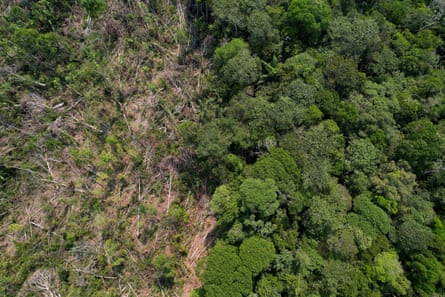
Aerial shot of he border of rainforest and clearcut land
Brazilian rainforest in Humaitá. The report identifies land-use change driven by agriculture as the most important cause of the fall in wildlife populations. Photograph: Adriano Machado/Reuters

In a critique of the index published by Springer Nature in June, scientists said it “suffers from several mathematical and statistical issues, leading to a bias towards an apparent decrease even for balanced populations”.

They continued: “This does not mean that in reality there is no overall decrease in vertebrate populations [but the] current phase of the Anthropocene [epoch] is characterised by more complex changes than … simple disappearance.”

The IUCN’s Red List, which has assessed the health of more than 160,000 plant and animal species, has found that almost a third are at risk of extinction. Of those assessed, 41% of amphibians, 26% of mammals and 34% of conifer trees are at risk of disappearing.

The index has been published days ahead of the Cop16 biodiversity summit in Cali, Colombia, where countries will meet for the first time since agreeing on a set of international targets to halt the freefall of life on Earth. Governments have never met a single biodiversity target in the history of UN agreements and scientists are urging world leaders to make sure this decade is different.

Susana Muhamad, Cop16 president and Colombia’s environment minister, said: “We must listen to science and take action to avoid collapse.

“Globally, we are reaching points of no return and irreversibly affecting the planet’s life-support systems. We are seeing the effects of deforestation and the transformation of natural ecosystems, intensive land use and climate change.

“The world is witnessing the mass bleaching of coral reefs, the loss of tropical forests, the collapse of polar ice caps and serious changes to the water cycle, the foundation of life on our planet,” she said.

Susana Muhamad Rozo 001 in Bogota, Colombia, June 2022

Land-use change was the most important driver of the fall in wildlife populations as agricultural frontiers expanded, often at the expense of ecosystems such as tropical rainforests. Mike Barrett, director of science and conservation at WWF-UK, said countries such as the UK were driving the destruction by continuing to import food and livestock feed grown on previously wild ecosystems.

“The data that we’ve got shows that the loss was driven by a fragmentation of natural habitats. What we are seeing through the figures is an indicator of a more profound change that is going on in our natural ecosystems … they are losing their resilience to external shocks and change. We are now superimposing climate change on these already degraded habitats,” said Barrett.

“I have been involved in writing these reports for 10 years and, in writing this one, it was difficult. I was shocked,” he said.

Carbon removal no solution if world overshoots warming target, scientists say

https://www.msn.com/en-us/weather/topstories/carbon-removal-no-solution-if-world-overshoots-warming-target-scientists-say/ar-AA1rYeSN?ocid=msedgdhp&pc=ENTPSP&cvid=da65ea348fb448f7bf11af0668db399f&ei=21

Reuters

Follow

898.4K Followers

Story by David Stanway

 • 35m • 2 min read

FILE PHOTO: Smog is seen in this general view of the Upper Silesian Industrial Region from Bedzin, near Katowice, Poland, December 5, 2018. REUTERS/Kacper Pempel/File Photo

FILE PHOTO: Smog is seen in this general view of the Upper Silesian Industrial Region from Bedzin, near Katowice, Poland, December 5, 2018. REUTERS/Kacper Pempel/File Photo© Thomson Reuters

By David Stanway

SINGAPORE (Reuters) – Even greater efforts to strip carbon dioxide from the atmosphere will fail to avert climate change catastrophe as rising global temperatures threaten to cross a key threshold of 1.5 degrees Celsius (2.7 degrees Fahrenheit), scientists said on Wednesday.Kizik Women's Athens - Lilac 5.5 / Standard | Kizik Hands-Free Shoes | Step In Shoes | Slip On Shoes

Kizik StoreKizik Women’s Athens – Lilac 5.5 / Standard | Kizik Hands-Free Shoes | Step In Shoes | Slip On Shoes

Ad

The Intergovernmental Panel on Climate Change (IPCC) has said carbon dioxide removal (CDR) could help slow warming by reducing greenhouse gas already accumulated in the atmosphere, and even temperatures, especially if 1.5 C is exceeded.

However, even if removing carbon dioxide works, it can do nothing to mitigate other aspects of climate change, from sea level rises to changes in ocean circulation, scientists said in research published in the journal Nature on Wednesday.

“Even if you’ve brought temperatures back down again, the world we will be looking at will not be the same,” said Carl-Friedrich Schleussner of Austria’s International Institute of Applied Systems Analysis, one of the paper’s authors.

The research showed cutting temperatures from their peak could also prove harder than anticipated even if CDR is scaled up, particularly as melting permafrost and shrinking peatlands release methane and drive further warming.Related video: The world’s first farm of mechanical CO2 absorbing trees (Innovative Techs)

about:blank

Loaded: 3.99%Play

Current Time 0:00

/

Duration 5:00Quality SettingsCaptionsFullscreen

Innovative Techs

The world’s first farm of mechanical CO2 absorbing treesUnmute

0

View on Watch

CDR refers to a range of techniques that extract and store away CO2 already in the atmosphere, including natural solutions such as forests and ocean algae, as well as new technologies that filter carbon dioxide from the air.

Existing CDR capacity takes about 2 billion metric tons of CO2 out of the atmosphere every year, but that figure must rise to about 7 billion to 9 billion tons to meet the world’s climate goals, a separate research report said in June.

Yet there are limits to how much new forest can be planted and how much CO2 can be permanently sequestered, while current technologies are expensive, said Joeri Rogelj of Imperial College London, another co-author of the paper in Nature.

“If we are starting to use land exclusively for carbon management, this can strongly conflict with the other important roles of land, be it biodiversity (or) food production,” he told a briefing.The Hyundai Palisade SUV Costs Next To Nothing (Take A Look)

VyagerThe Hyundai Palisade SUV Costs Next To Nothing (Take A Look)

Ad

Even the most optimistic emissions reduction scenario in the IPCC’s latest assessment report, published last year, factored in the possibility of a small overshoot of 0.1 C.

Reversing that would require the removal of about 220 billion tons of CO2, while an overshoot of 0.5 C – also consistent with the IPCC’s best-case scenario – would need more than a trillion tons removed, Rogelj said.

“The risks the world exposes itself to (from) an overshoot are much larger than acknowledged,” he said.

“Only through ambitious emissions reductions in the near term can we effectively reduce the risks from climate change.”

Reuters

Follow

898.4K Followers

Indigenous voters worry a Harris presidency means endangering sacred lands

The minerals beneath tribal lands are crucial to the clean-energy transition.

Kamala Harris walking on to a stage at a political rally, with spectators cheering behind her
Andrew Harnik / Getty Images

Taylar Dawn StagnerIndigenous Affairs FellowPublishedOct 07, 2024TopicClimate + Indigenous AffairsShare/RepublishCopy LinkRepublish

At an August rally in Glendale, Arizona, the rowdiness of the crowd suggested a rockstar was about to take the stage. Instead, a booming voice welcomed the spectators with a full-throated endorsement of Democratic presidential candidate Kamala Harris: “She is the right person at the right time to be our country’s 47th president!” The voice belonged to Governor of the Gila River Indian Community Stephen Roe Lewis, a tribal leader who helped resolve long overdue water rights in the state for the tribe last year. “Skoden!” 

Later on, after a warm-up speech from running mate Tim Walz, Vice President Harris took the stage, saying she would “always honor tribal sovereignty and respect tribal self-determination,” (The 22 federally recognized tribes in Arizona make an Indigenous voting block that proved essential to President Joe Biden’s win in the swing state in 2020.) On her campaign website, she maintains that she will work to secure America’s industrial future by investing in clean energy — but clean-energy development often negatively impacts sites on federal lands that are sacred to Indigenous peoples. 

Grist Weekly | The best of Grist’s essential climate reporting, delivered straight to your inbox every Saturday.Sign up now

The Biden-Harris administration has been one of the most supportive of Native peoples, investing millions of dollars of federal funding for climate resilience and green energy initiatives. Still, the Indigenous vote for Harris in 2024 is far from assured. While the U.S. has big goals on its path to a clean-energy future, those plans have to compete against the preservation of tribal lands — an issue Harris has stumbled over in her political career, dating back to her time as California’s attorney general. 

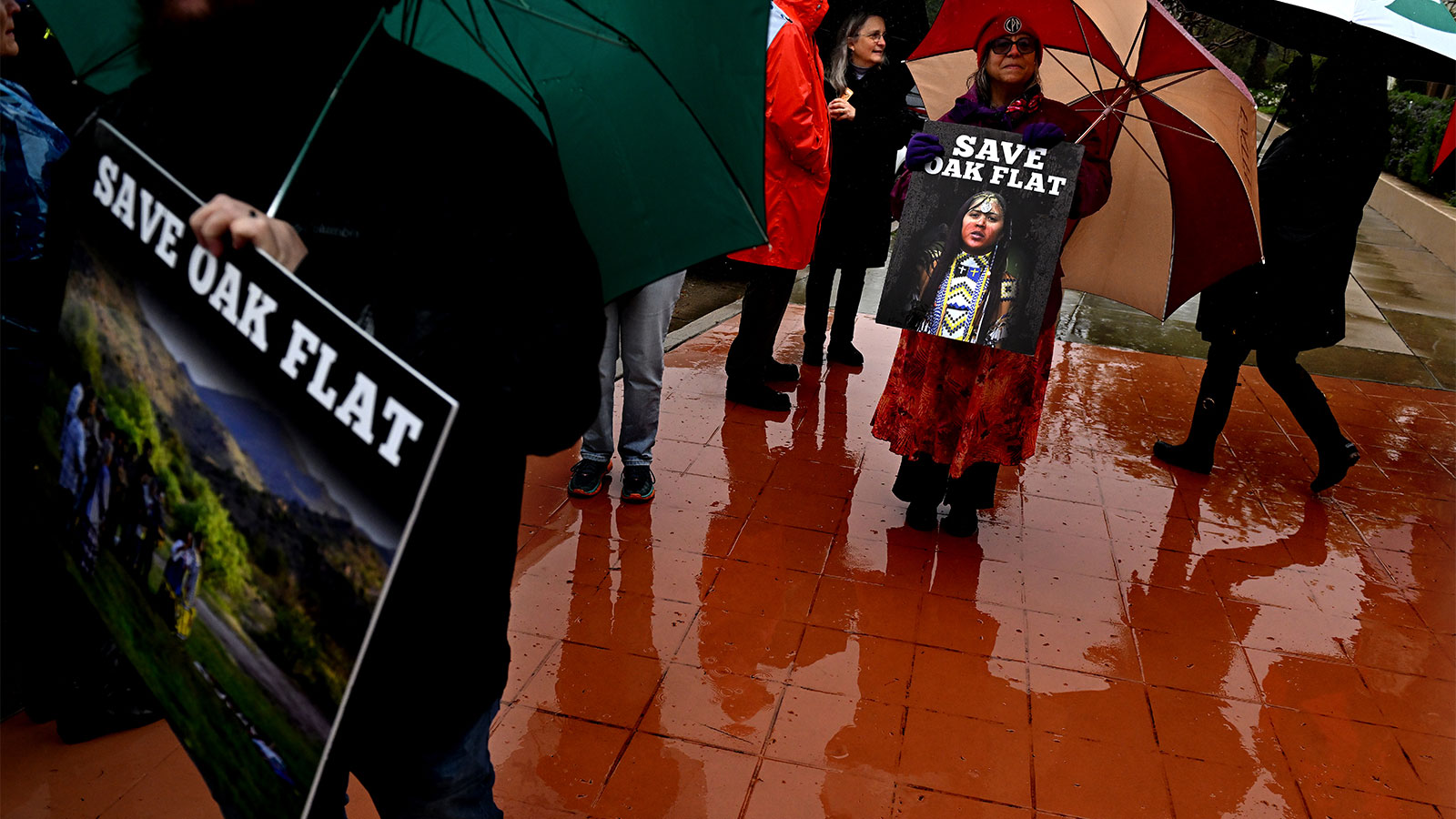
Almost 80 miles east of the Arizona rally, a sacred site is in danger. Oak Flat, a swath of national forest land in the high desert, has been an important spiritual site for tribes like the San Carlos Apache for centuries, and is used for ceremonies and gathering medicines like sage, bear root, and greasewood. Yet the area is under threat — Rio Tinto, an international mining company, has been fighting to put a copper mine there for more than a decade. Oak Flat is home to one of the planet’s largest undeveloped copper reserves, and the metal is critical to making the electric batteries necessary for the shift to cleaner energy sources. 

Grist thanks its sponsors. Become one.

Oak Flat and other sacred sites have not been given enough federal protections, activists say, despite intense advocacy from the tribal nations affected. Much of the U.S. has already been built and powered at the expense of tribal lands and peoples. To reach its goal of 80 percent renewable energy generation by 2030, and carbon-free electricity five years after that, the U.S. needs big investments and robust policy support. While Harris says she is the candidate in the best position to achieve those goals, there is a concern among Indigenous communities that doing so will continue to exploit tribal homelands — most of the minerals needed for the energy transition are located within 35 miles of away from tribal communities, on lands originally stolen from them. Read Next

The massive copper mine that could test the limits of religious freedom

Taylar Dawn Stagner

“They definitely are hard to do at the same time. That’s the conflict,” said Dov Kroff-Korn, an attorney at Lakota People’s Law and Sacred Defense Fund, of the balance between extracting the minerals critical to the energy transition and protecting tribal lands where many such minerals are located. He mentioned that Harris has few environmental policies of her own to critique, and that, policy-wise, the broader Biden-Harris administration has been a mixed bag. “There’s been a lot of positive signs that should be recognized and applauded. But it’s also been a continuation of a lot of the same old extractive policies that have powered America for pretty much its entire history.”

In a bid to protect some places from industry, President Biden flexed his ability to make national monuments out of sacred sites, such as the Ancestral Footprints of the Grand Canyon National Monument — or Baaj Nwaavjo I’tah Kukveni — as well as to fully restore the boundaries of the Bears Ears monument in Utah from a Trump-era rollback. Biden also appointed the first-ever Native American to his Cabinet — Deb Haaland, Pueblo of Laguna — as the head of the Department of Interior. In her role, Haaland has instructed federal agencies to incorporate traditional knowledge in order to better protect Indigenous sacred sites on public land.

During her tenure as vice president, Harris has been party to the administration’s push to produce more oil and gas than ever, despite promises to halve greenhouse gas emissions by 2030. Last year, the Biden administration also gave the green light to the Willow project, an $8 billion dollar drilling operation on Alaska’s North Slope that some, but not all, tribes were against. Throughout her presidential campaign, and in a reversal of her previous stance, Harris has showed support for fracking, a controversial drilling method that extracts oil and natural gas from deep within the ground. 

Crystal Cavalier-Keck, a member of the Occoneechee Band of the Saponi Nation in South Carolina, is the co-founder of 7 Directions of Service, an Indigenous-led environmental justice organization. She’s concerned that the Mountain Valley Pipeline, currently a 303-mile system that runs through West Virginia and Virginia, will permanently damage the sacred Haw River where she has many memories with her family. Over the years, the beleaguered river has been polluted by chemicals and is now threatened by the pipeline, which began operations in June. 

In 2020, Cavalier-Keck campaigned for Biden in South Carolina but didn’t see movement on the environmental protections she wanted after he got elected. She said she will still vote for Harris in November but feels like her concerns are not being talked about. “There’s not much at all on her environmental policies,” she said. “They’re saying the right buzzwords, like ‘clean, renewable, forward.’ But where’s the meat of it?” Read Next

Demonstrators against the Keystone XL pipeline march in Lincoln, Nebraska in this Aug. 6, 2017, file photo.

What a second Trump presidency could mean for Indigenous peoples

Anita Hofschneider

She lives about a two-hour drive from where Hurricane Helene has claimed more than 100 lives in North Carolina, and she worries that the next big climate disaster will reach her community. Cavalier-Keck said that her tribe has had issues accessing the roughly $120 million in federal funding to help tribes build climate resilience. 

During Harris’ time as attorney general of California, she argued against tribes putting land into trust, a process that can protect land as well as allow economic development like casinos where gambling might be banned, claiming the situation only applies if a tribe was “under federal jurisdiction” when the Indian Reorganization Act was passed in the 1930s. The Ninth Circuit Court of Appeals ruled against Harris and the state, but had she won the case, about 100 tribes in California would not have been allowed to benefit from trust lands. 

Still, Lael Echo Hawk, who is Pawnee and an expert in tribal law, says Harris’ decisions as attorney general aren’t reflective of what she might be capable of as president. She pointed out that as attorney general, Harris helped pass a red flag law in California to take away firearms from people deemed dangerous. Plus, she called on the U.S. Congress to reauthorize the Violence Against Women Act — an issue important in Native communities, where women go missing and are the survivors of violence at a rate higher than the national average. Echo Hawk also knows of tribes concerned with border issues and immigration that are endorsing Harris. “These are important issues that I think better demonstrate her commitment to advancing and protecting tribal sovereignty,” Echo Hawk said. 

But for Nick Estes, a member of the Lower Brule Sioux Tribe and a professor at the University of Minnesota, Harris might just be a continuation of the Biden administration, which he maintains has taken advantage of tribal lands. As it stands today, 1.6 million surface and subsurface acres of land within 83 reservations have non-Natives benefiting from oil, gas, and mining operations, among other extractive industries.

“You can’t just have a vibes-based environmental policy. It actually needs to be concrete,” said Estes. “What we’ve seen is just service to industry at the expense of Native lands and livelihoods.”

Arunachal’s East Siang DC warns firearm license owners against lending guns to hunters

Arunachal Pradesh’s East Siang District cracks down on firearm misuse, targeting gun owners aiding hunters. Efforts align with wildlife conservation and anti-drug initiatives.

Advertisement

Arunachal's East Siang DC warns firearm license owners against lending guns to hunters

Maksam Tayeng

  • Oct 06, 2024,
  • Updated Oct 06, 2024, 9:07 PM IST

Arunachal Pradesh’s East Siang District Deputy Commissioner, Tayi Taggu, has alerted the public, especially firearm license owners in Seram and other villages that anyone who lends their guns to hunters will be treated as a hunter and will face the same penalties, including imprisonment.

Taggu stated this during a programme which was held as part of the National Wildlife Week at Seram village under Mebo Sub-Division on October 5. 
 
The DC was the chief guest at the event which was organised by the Eco-Development Committee-cum-Community Surveillance & Monitoring Team (EDC/CSMT) of D. Ering Wildlife Sanctuary in collaboration with D. Ering Wildlife Sanctuary and Aaranyak, a reputed NGO based in Guwahati. 

The program on the prevention of wildlife crimes and anti-drugs was held during the Wildlife Week celebration, featuring East Siang District Deputy Commissioner Tayi Taggu, Superintendent of Police Dr. Sachin Kumar Singhal, Additional Deputy Commissioner Mebo Sibo Passing, Divisional Forest Officer D. Ering WLS Smty Kempi Ete, Nodal Officer of the Government Rehabilitation Centre Pasighat Dr. Oson Borang, and East Siang District Anti-Drug Warrior Chairman Gumin Mize as guests and resource persons.

A plantation programme was also held before the commencement of the awareness programme where the DC, SP and other guests planted some tree saplings provided by the RO Mebo Range under Pasighat FD, Domek Koyu.
 
Welcoming the attendees at the celebration, Amit Modi, President of the EDC/CSMT of Borguli WL Range fringe villages, expressed his gratitude on behalf of the EDC/CSMT. He expressed hope that the messages delivered by the district and sub-division heads, along with the management of D. Ering WLS and resource persons on anti-drug efforts, will be heeded and followed by the villagers in their commitment to wildlife conservation and in combating the growing drug menace.

Range Officer Sibiyamukh/Namsing Range of D. Ering WLS, Oyem Mize said that the hunting incidents in the sanctuary from fringe villages are reducing gradually, further appealing to the village elders and GBs to support the sanctuary management in restricting hunting of wildlife in and around the sanctuary. 

DFO, D. Ering WLS, Kempi Ete said that the wildlife week is celebrated by organising several events of awareness programmes, essay competitions, among others for the students in the school.

She also informed that the process of relocating and translocating rhinos in the sanctuary is underway, the completion of which will make the sanctuary a noted tourist destination. 

Meanwhile, EDC/CSMT Chairman, Maksam Tayeng said that the D. Ering WLS is rapidly regaining its lost glory owing to hard and dedicated efforts made in the last 5-6 years to secure the sanctuary from hunting by taking drastic actions against the habitual and notorious hunters. 

“Due to improved protection and the gradual increase in wildlife populations, which creates a conducive environment for new initiatives in the sanctuary, the reintroduction process for Rhinos and Tigers is underway with the active support of 39th Mebo MLA Oken Tayeng and Chief Minister Pema Khandu. Once completed, this initiative will economically benefit the fringe villages through eco-tourism. I also urge the government to accommodate unemployed youth from the fringe villages of the sanctuary by providing them with employment opportunities that will arise following the reintroduction of Rhinos and Tigers,” added EDC/CSMT Chairman Tayeng.
 
Anti-drug Chairman, Gumin Mize and Nodal Officer of Government, Rehab Centre, Dr. Oson Borang as resource persons together emphasised that the youth should be adequately made aware from getting spoiled by the drug addiction. 

Meanwhile, Tayi Taggu referenced his recent executive order banning the misuse of guns that were issued to various individuals in the villages for self-defense and other purposes, adding, “Any gun owner who lends or gives their guns to hunters or their relatives involved in hunting activities will also be treated as a hunter and will face the same penalties, including the permanent seizure of their firearms,” he warned.

Furthermore, he noted that most of the hunters arrested from D. Ering WLS for hunting were using guns belonging to others, including retired government servants and politicians. He criticised the greed of some individuals in the community who are felling large trees that are essential for maintaining moisture and ecological balance and advised the villagers to be vigilant against such wrongdoings and to assist the government in preserving and protecting forests and wildlife.

California enacts unprecedented restrictions on rat poisons in bid to protect wildlife

A mountain lion with mange.

The famed and late mountain lion known as P-22 likely developed mange as a result of rat poisoning. A new California law bans the use of anticoagulant rat poisons, with some limited exceptions.

(National Park Service)

By Lila Seidman

Staff WriterFollow

Oct. 1, 2024 3 AM PT

  • A 2023 California Department of Fish and Wildlife report found that roughly 88% of raptors and 90% of pumas tested were exposed to the poisons.
  • The law allows the poisons to be used in agricultural settings and public health emergencies.

California has become the first state in the nation to restrict use of all blood-thinning rat poisons due to their unintended effect on mountain lions, birds of prey and other animals.

Gov. Gavin Newsom recently signed a bill that expands an existing moratorium to all anticoagulant rodenticides, with only limited exceptions. The poisons prevent an animal’s blood from clotting and cause it to die from internal bleeding. When an unsuspecting mountain lion or owl gobbles a dead or sick rat — or another animal that ate a tainted rat — the toxic substance can be passed on.

Wildlife advocates hailed the new law — set to go into effect Jan. 1 — as an important step toward protecting non-target animals. However, agricultural and pest-control groups derided the measure as a potential public health issue that sidestepped the state’s regulatory process.

Climate & Environment

Newsom signs bill to ban octopus farming in California

Sept. 29, 2024

“I’m so proud that California is leading the way in protecting wildlife from these harmful and unnecessary poisons,” said J.P. Rose, urban wildlands policy director at the Center for Biological Diversity, which sponsored AB 2552. “I think we can all agree that unintentionally poisoning native wildlife is wrong.”

Advertisement

A 2023 California Department of Fish and Wildlife report found that roughly 88% of raptors and 90% of pumas tested had been exposed to the poisons. Birds of prey — and American kestrels in particular — have been significantly harmed by chlorophacinone, one of two poisons targeted in the law, according to Lisa Owens Viani, director of Raptors Are the Solution, a co-sponsor of the bill.

Megan J. Provost, president of Responsible Industry for a Sound Environment, a trade association for the specialty pesticide and fertilizer industry, which opposed the bill, pointed to its potential harm to humans.

“Effective rodenticide products are necessary for protecting the health and safety of people, structures and businesses — including those responsible for food safety — from the diseases and property damage caused by rats and other harmful rodents,” Provost said in a statement. The new law “unfortunately removes products from the pest control toolbox that are important for managing rodent infestations, leaving fewer products for effective immediate and long-term control and for managing resistance in rodents.”

She said California’s Department of Pesticide Regulation has wide latitude to evaluate pesticides for safety “so pesticide-specific legislation … that supersedes this process was unnecessary.”

The law allows the poisons to be used in agricultural settings and public health emergencies.

Owens Viani said legislation and other efforts were necessary because state pesticide regulators were unwilling to act on their own.

Advertisement

“We’re ahead of the rest of the country with these regulations, but it hasn’t been because DPR has been a willing partner,” Owens Viani said. “We’ve had to force them every step of the way.”

A spokesperson for the agency said it “has been actively evaluating risks” related to the rodenticides since 2014.

“Evaluation has included both monitoring for impacts through a partnership with the California Department of Fish and Wildlife and initiating formal reevaluation to inform future actions to mitigate risks to wildlife,” the spokesperson said in a statement.

Owens Viani said her organization has worked for about a decade on passing legislation, including two previous laws that banned other blood-thinning rat poisons. A suit her nonprofit filed against the state agency is ongoing.

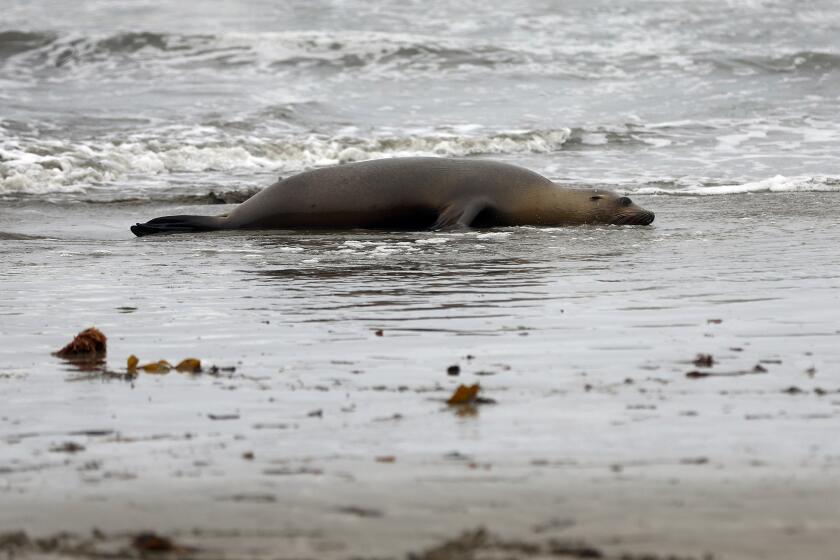
CAYUCOS, CALIFORNIA - AUGUST 05: A sick California sea lion lays on the water at Cayucos State Beach on August 05, 2024 in Cayucos, California. The Marine Mammal Center is seeing a surge of sick California sea lions washing up on Central California beaches in the past month exhibiting symptoms consistent with domoic acid poisoning, which leaves the mammals lethargic and suffering from seizures. The Marine Mammal Center, the world’s largest marine mammal hospital, typically respond to 60-80 sea lions per year impacted by the neurotoxin. Since July, 19th, they have responded to 70 calls for seal lions in distress. (Photo by Justin Sullivan/Getty Images)

Climate & Environment

Outbreak of neurotoxin killing unprecedented number of sea lions along California coast

Aug. 11, 2024

The early seeds of Owens Viani’s work on the issue began around 2011, when a neighbor ran over to tell her that Cooper’s hawk fledglings had drowned in his kiddie pool. At the time, she was studying raptors at the Golden Gate Raptor Observatory and had a hunch rat poison was involved. Tests confirmed it.

“It kept happening in my neighborhood, like people kept finding more dead hawks,” she said. They weren’t eating the bait; they were eating rats. “I knew that if people were using poison in my eco-friendly neighborhood in Berkeley, it was probably a problem everywhere. And so that’s when I decided to found my nonprofit and try to educate more people about the problem.”

Advertisement

The latest legislation, authored by Assemblymember Laura Friedman (D-Glendale), tightly restricts the use of chlorophacinone and warfarin, which are known as first-generation anticoagulant rodenticides. A law signed in 2020 put a moratorium on second-generation anticoagulant rodenticides. And last year the only other first-generation poison was added through a separate law.

The older first-generation version is slower-acting, requiring the rat to feed on the poison several times before it dies. The second-generation version is more potent, earning the moniker “one-feeding kills.”

Other states are working on similar efforts, but Owens Viani said only California has enacted a moratorium. British Columbia has placed a permanent moratorium on second-generation poisons, and the U.S. Environmental Protection Agency removed those types of poison from consumer shelves, she said.

The ban will remain in place until the state Department of Pesticide Regulation reevaluates the poisons and comes up with restrictions that meet certain criteria to protect wildlife.

The law also creates civil penalties. Anyone who sells or uses the poisons in violation of the law is subject to a fine of up to $25,000 per day for each violation.

Any money collected from violations will go to the Department of Pesticide Regulation to cover its costs in administering and enforcing the rules, and potentially other activities.

Advertisement

The department estimated the law would create a one-time cost of $258,000 and an ongoing annual cost of $193,000 to support a position “to handle anticipated increases in follow-ups and complaints associated with investigating sales and restricted materials,” according to a government analysis of the bill.

Approximately 170 Endangered southern mountain yellow-legged frogs (Rana muscosa) were released into their native habitat in the San Gabriel Mountains on Aug. 29 and 30, 2023. Animal care staff from the Los Angeles Zoo joined conservationists from the U.S. Geological Survey (USGS) to an undisclosed site to conduct the release.

Climate & Environment

Endangered frogs threatened by California wildfires once again. A rescue could be in order

Sept. 15, 2024

The analysis anticipates revenue loss of an unknown amount to the department, as well as to the California Department of Food and Agriculture’s Vertebrate Pest Control Research Advisory Committee.

The agency said it is committed to “a timely completion of its reevaluations.” Another bill signed into law this year requires that the agency share a timeline and status of all reevaluation and mitigation by the end of the year.

“The reevaluations underway include an assessment of cumulative impacts of anticoagulant rodenticides,” including first-generation varieties, the agency said in a statement, adding that it “will continue its ongoing work to address unintended wildlife exposure from first-generation and second-generation rodenticides while still retaining tools to protect public health, agriculture, critical infrastructure and the environment.”

Wildlife advocates said they compromised on certain elements of the bill as it wound through the Legislature and encountered opposition.

For example, a previous version of the bill allowed members of the public to sue bad actors for breaching the law.

Advertisement

An L.A. Times editorial from earlier this year pitched this as a powerful element of the legislation, which “could help curb the use of banned rodenticides by empowering all Californians to become enforcers.”

However, the California Chamber of Commerce called it “an expansive new private right of action that threatened businesses and created incentives for frivolous lawsuits,” and removed its opposition once the provision went away.

Owens Viani said proponents had also hoped to create buffer zones around agricultural areas, where birds of prey forage and which are part of habitat ranges for mountain lions, coyotes and other animals.

But there were other wins. Rose pointed out what he described as “exciting language … around the sentience of animals.”

The law text notes that animals “are able to subjectively feel and perceive the world around them” and that the “Legislature has an interest in ensuring that human activities are conducted in a manner that minimizes pain, stress, fear and suffering for animals and reflects their intrinsic value.”

Female Leopard Tries to Free Captured Cub; Forest Department Warns Residents

Shortly after the cub’s capture, a female leopard tried to free it by repeatedly ramming the cage, prompting Forest Department to issue safety alert.

Female Leopard Tries to Free Captured Cub; Forest Department Warns Residents

Shivraj Sanas

Published on: 

29 Aug 2024, 3:33 pm IST

Pune: In a rare occurrence, four leopards have been captured in a span of just 18 days in the Bighevasti-Katwanvasti area in Ambegaon taluka. The latest capture took place early on Thursday (August 29), when a one-and-a-half-year-old leopard cub was trapped in a cage set by the Forest Department.

Shortly after the cub’s capture, a female leopard tried to free it by repeatedly ramming the cage, prompting the Forest Department to issue a safety alert to residents.

Female Leopard Tries to Free Captured Cub; Forest Department Warns Residents

Leopard Numbers Soar to 500 in Ambegaon, Junnar, Shirur, Khed Talukas

The first leopard was captured on August 12, followed by a second, a one-year-old male, on August 18, and a third on August 25. The latest capture is the fourth in this series.

The frequency of these incidents has caused alarm among local residents, who are now worried about the continuing presence of leopards in the area.

Farmers in the area, led by Maruti Karbhari Bhor, had requested the Forest Department to set additional traps due to frequent leopard sightings.

Following the recent capture, Bhor reported witnessing a female leopard growling and hitting the cage in an attempt to rescue the trapped cub. The rescue team from the Forest Department, along with local villagers and officials, managed to take the leopard cub into custody.

Female Leopard Tries to Free Captured Cub; Forest Department Warns Residents

Panic at RIT College as Leopard Roams Campus; Search Teams Mobilized

The situation has heightened concerns among locals after a leopard killed two sheep belonging to a farmer, Santosh Patilbuwa Lokhande, late Sunday night. This incident further indicates that leopards remain active in the vicinity, leading to growing fears among residents.

Safety Alert for Residents

The Forest Department has advised residents of Bighevasti-Katwanvasti to exercise caution, especially after a female leopard showed aggressive behavior by ramming into the cage where the cub was trapped.

Given the possibility of further aggression, authorities are considering setting up more traps and have requested residents to remain alert.

Waterfowl hunter shoots and kills wolf near St. Germain

A man shot and killed a gray wolf Saturday morning while he and two others were waterfowl hunting near St. Germain. Two wolves reportedly approached as close as five yards to their blind.

Paul A. Smith

Milwaukee Journal Sentinel

0:50

0:50

The Department of Natural Resources is investigating an incident in which a man shot and killed a gray wolf Saturday as he and two others were waterfowl hunting on public land near St. Germain.

Chase Melton, 19, of Sugar Camp, said about 6:15 a.m. Saturday two wolves approached the hunters’ blind.

Melton was accompanied by hunters aged 14 and 13. Saturday was opening day of the 2024 Wisconsin duck hunting season in the north zone.

He initially attempted to scare the wolves off, Melton said in an interview with WJFW in Rhinelander.

“I tried making some noise, I was clapping, stomping, breaking some sticks, whatever,” Melton said.

One of the wolves got as close as 5 yards to the hunters, Melton said. “I probably could have touched it with my hand, that was extremely scary,” Melton said. “So now, we’re really panicking. We’re like alright, we’re surrounded and we have a wolf charging us right now.”

Melton said he picked up his shotgun and when one of the wolves kept coming he shot it in the head; he estimated the animal was 8 to 10 yards away.

The wolf died nearby.

Melton said it was not what he wanted but the hunters “felt harmed” so he pulled the trigger.

He called the DNR to report the incident.

An updated population estimate for gray wolves in Wisconsin is expected sometime this fall.

Randy Johnson, DNR large carnivore specialist, said Wednesday an investigation of the incident remains open so he could not provide many details.

Johnson said a DNR conservation warden and wildlife biologist traveled to the scene to investigate. They confirmed the animal was a wolf.

The gray wolf is under protections of the Endangered Species Act in Wisconsin and most other states. As a result of its status, lethal force can be used against a wolf only in defense of human life.

Get the First Nations newsletter in your inbox.

Covering the 12 Indigenous nations in Wisconsin and other tribal news.

Delivery: WedYour Email

The investigation will use information from interviews with the hunters and others in the area to try to determine if the shooting was justified.

No wolf attack on a human has been documented in Wisconsin in the modern era, according to the DNR.

However, wolves have caused reports of threats to human safety in the state.

A 2017 incident on public land in Adams County, in which a man fired a handgun at and reportedly hit a wolf that approached him, did not qualify as a wolf attack, the DNR concluded.

An investigation was not able to find the wolf; the man was not cited.

A December 2023 incident in which an Ashland County man shot and killed a wolf in his yard remains under investigation. The man reportedly claimed the wolf threatened his safety.

There have been two verified complaints of wolf threats to human safety in Wisconsin this year, according to the DNR. The incidents were reported April 30 in Washburn County and May 30 in Price County. No wolf was shot in either instance.

In another hunting-related case, a ruffed grouse hunter in October 2012 in Minnesota shot and killed a wolf that approached him and his dog. The wolf was 8 yards away when the hunter shot. He was not cited.

The most common form of wolf conflict reported in Wisconsin is with livestock producers. As of last week, 73 confirmed or probable wolf depredations were recorded this year in the state, most on livestock. Other animals killed by wolves include bear hounds and family pets.

The number of wolf depredations this year already has surpassed the annual totals in 2023 (69 confirmed or probable) and 2022 (49).

Johnson said wolf depredations are likely higher this year for multiple reasons, including a mild winter in 2023-24 that made it harder for wolves to catch their primary prey, white-tailed deer. When wolves come into spring and summer in poorer condition they are more likely to attempt to kill livestock.

In addition, lethal controls have been unavailable to wildlife staff since the February 2022 ruling that put the wolf under protections of the Endangered Species Act. Johnson said non-lethal abatement methods such as visual and auditory deterrents lose their effectiveness over time.

In April 2023, Wisconsin had 1,007 wolves in 283 packs, according to the most recent population estimate from the DNR.

An updated population estimate is expected sometime this fall.

Waterfowl hunting safety tips

The south zone duck hunting season opens Saturday in Wisconsin. Waterfowl hunters should follow best boating safety practices as they hit the water this season, according to the DNR.

The top safety tips include wearing a life jacket, avoiding overloading boats, safely transporting firearms, making sure boat lights are working, and sharing your hunting plan with someone on land, including your expected return time and location.

For 2024 waterfowl hunting regulations, visit dnr.wi.gov and search for the 2024 Wisconsin Hunting Regulations booklet.

How a shocking environmental disaster was uncovered off the California coast after 70 years

https://www.cbsnews.com/news/california-environmental-disaster-ocean-ddt-sea-lions/

BY JEFF BERARDELLI

APRIL 12, 2021 / 6:48 AM / CBS NEWShttps://www.cbsnews.com/embed/video/?v=27c2db22c86bece439a19414820ef4a4#vVZtb9s2EP4rgj4OoSVKol4MDEOyFGixLgua9FM0GBR5stlQoiBKjr0i%2F31HWXZeVqBA1xaBEYm61%2BfunuNnn4%2BD6TTf%2B8uhH%2BHM3yoJxl9%2B9tUAjfWXd5%2F9Yd%2BBv%2FS3RvpnvpL4SEGKgtU1ARCUJCwDUnCWkrCGKoqKGtJUoGzT7T5A%2Fc5pMBHG2T%2FnSU7freI0f7t%2F08dZy837qwjeR1d7lLZ6XKPkYHZKEDk2ncUQyEMP%2FF61a7LhWyOIaUnHhapRxAjgLQFh7N5OsZ75gxq0C%2FXy8tY7WvAmC9ab9D3Teg3vVQueVjWgioR7VMCHetT6qH%2FrYnhlAWN4snF9iMH7y8XgvYhB8Na0SnB9%2Bx2MDaoBO%2FCm85c0pXnIWBSmYRhi3GPPB2VafxmzZ6%2FveQUanYZsyUI0oA%2FvLSaHtWv4GqwrrnU12QxDZ5dlUAaisi082GiBDwr9DUoshGnKYDNWZaDKoC%2BDKIxoGYRJGdCwDJKCpTGjIUmBxSQBlpBc0oyEsgrzIi%2ByFNIyGDZjU7Vc6TJIk3AXp6hZ84rzMKrDKs3iKEkTzKhKZRixKBdM1odoSD1aTId8czeQk2%2BS5kUSZWSOYPGpWyMwmy8iQH8gAjTKw10WoapgWZVIRkFUdcQhpXEUAuciLvAnaPZTIHg887setgoePvb6BRa200rAgjd6vVCmDHiH%2BW8j%2FDluKIOvzXIZzIbLwD8RyjP7XW%2FkAtlk%2BrKYkT%2BgPb%2BgK8R7o%2B1r0GmexznNWFxkMcOmcmmx1STYcEy6XzTxmB%2B9Rj%2FdbW36hg%2FolncOxGkky2BHmg7WHz%2B8R4nxFdgPDw8vY5lB%2FuaqT6Ar%2B67pjIvMX9ZcWyR2pHklJmJ3nZ%2FVFJm6SkjMIiCUQkxyATkJk0xmFWVVEcETJ2OA2EzKksb0rYvC8mHsJXe0vVHQ815scIPcOUHPCXqzoOPDV0feSfdv7EDeQzvcutCueOPY8veLG%2B%2FWif95snDycLE%2FCN19SermZBY7GzpljURRijkAt44nfeoSgnWDHg8fxg4b1doTRFzrcyHw5EIbcX9iTfvRQn8zVlb0qgJ5Eredaa3pj3Ib2J1fQs1H7RogPMM%2Ffzq9eDqNi7OEnbHCUXvPhauoKwkW3grTw%2FSMXRuHIQvzFMFLDpBcze3h8Ezx6BfnEl9au7LDau2Acx10OOHdirt8r8rg%2FCQjnPutoPR0YodXth8RuGbcXfemg37Y%2FwFYUj9KMpC422OaScqSIiloFMc8Tv1HrF8DA5%2F2CWYzwHrvnvFsY%2BRhBqCVk9m5j2pwRQJJhFtX4O4T8%2BUC%2FSOarjJPWxwfkXrw4TQUuw3OpzBagzhM1kkN98or22Xwm7IrbdZrkCvV%2Fho6xnsOurJvWl5pV9DD1Yf3yPoazkeMv3e3ljs%2FimTMw5wRARledCIQBAcjwXGjSSHDWIo8cn38QvXYpJ%2Bgrr3K9a4ErdUzuelKVCVohGWc1CzJSUJzSSoaoW0Zi1pSnM7CFWtWuR6rS0zLVQSpCecUh9aj0ZKyJX0mdrx0bMyDxz27MVO6HrRb1ZvWtT7XnlR2Yi3vgVtvbIXZAgLnGQx32ICHdxdVu7ninjAo6PHaCWehtwfe22fOjrVrBzS8mk%2BnS9UWN8j8WYK9R%2FKZWOkSti4D303%2B%2BijgOnflrptuPvH%2FW%2BVo6863QkErwOHmjm8ORUeF44fD%2BWwFJ9nNo9riFQsqfya8CekM5wnvGpRUES0I9jCQquYFqTNa5HVUVIyxo8JMQ08utGoUTkpyyvrGjL2AAyt689RVPW%2FlteaDWwCTz5nTVy7C1RME7nV2MUs4x4CIj41rSlxStdLPPjsFFMEC4plbYa6NT3fM16v7P9vksNaeKkpedAI5dsK8RaQcCNIl0YjzYZE0IBW%2FNhgFHs1Ia%2BByruAP9%2B%2BczHj9f2MTi3w15O%2BwgB8f%2FwU%3D

Just 10 miles off the coast of Los Angeles lurks an environmental disaster over 70 years in the making, which few have ever heard about. That is, until now, thanks to the research of a University of California marine scientist named David Valentine. 

Working with little more than rumors and a hunch, curiosity guided him 3,000 feet below the ocean’s surface. A few hours of research time and an autonomous robotic submersible unearthed what had been hidden since the 1940s: countless barrels of toxic waste, laced with DDT, littering the ocean floor in between Long Beach and Catalina Island. 

barrel-valentine.jpg
DR. DAVID VALENTINE

The fact that his underwater camera spotted dozens of decaying barrels immediately in what is otherwise a barren, desert-like sea floor, Valentine says, is evidence that the number of barrels is likely immense. Although the exact number is still unknown, a historical account estimates it may be as many as a half a million.https://www.cbsnews.com/newsletters/widget/e879?v=27c2db22c86bece439a19414820ef4a4&view=compact#vVPLbtswEPwVgmczFmkJetxSpEB7KQKkPdVFQJGrmI1ECiQlwQj87106cuL0WqA3cXb2NbN6oW6MxtlAmxcKymmgDYWqrOmGzgYWfCk3jFJFBEYXTCIjeBsCRPLJ6SM9bWj0Uj0b%2B5SKmPDZyrYHTZvoJ9hQ6aNRPdxO8eD8V4R%2FUiH0TmZVwRSUnOUCFKsF5AwUz2ud7bSqBP31V%2Bo3OUBK%2Fg1dR1rw0mvoe3PFS8Vpm2ORopSsK%2FKK5bzSrOUCa%2Bud6jQXoq05fUu5n9o7GdPSIhOcZTnjnHDR8KLhV7TvJvaJdHALkSQc3HldAnY23tkBbJQ90SbIEMGTRQYyWeVm8KCJw3HjAYiSvemct0YS5ZBIZJfIZUaOIH24anYc4ay7jVj4cUUxrmE26hLWEJ6jGxE24Q7mtEGySD5dCBaW8GgiDAijb%2FDFgE%2F6BWXAKki6JfgB1OrpJfCKr1U8hBHPw8xAFmgxhj2NOitd7rKs3KFqreA1y%2BscWNvJmnUlr6tO1G1RFJeEV%2FOuWkwB%2FNpCWmy%2Fob0ZTKRN%2FqbDg5u8OivRBpK2QVLrpdX3vYyo5HCeAoPnTdPMj%2B%2BipOfadGWkUQA9mIZ0pqN3nemvwikBKWgpYhjV6bBVms2gcz98n%2ByPcQzNfrvfLstysybe4A%2By36av%2FfbdY%2FbhNtjlNphTIC3TOrIAkvXp19tvV%2BP%2BS5NVlH8tdjr9AQ%3D%3D

After 70-plus years of inaction, Valentine’s research has finally helped initiate a huge research effort to reveal the extent of the contamination.

But this offshore dump site is only a part of the story of environmental damage from years of DDT discharge along the coast of Southern California — a story which likely won’t be closed for decades to come because of its ongoing impact, including a recently discovered alarming and unprecedented rate of cancer in the state’s sea lion population, with 1 in every 4 adult sea lions plagued with the disease.

The history of DDT dumping

The chemical DDT was invented in 1939 and used during World War II as a pesticide helping to protect troops from insect-borne diseases like Malaria. After the war, production of the chemical ramped up and it became routinely used in the spraying of crops, and even over crowded beaches, to eliminate pests like mosquitos.

ddt-plane-2.jpg
CBS NEWS

But in the 1960s, DDT was discovered to be toxic. Over time, eating food laced with DDT builds up inside the tissues of animals and even humans, resulting in harmful side effects. The EPA now calls it a “probable human carcinogen.” In 1972, when the U.S. government started taking environmental pollution seriously with legislation like the Clean Air Act, DDT was banned in the United States.  

Trending News

The largest DDT manufacturer in the U.S., Montrose Chemical Corporation, was located along the Southern California coast in the city of Torrance. From 1947 through 1982, Montrose manufactured and distributed DDT worldwide. In doing so, a byproduct mix of toxic sludge made up of petrochemicals, DDT and PCBs was produced.

For decades, that hazardous waste was disposed of in two ways. Some of the toxic pollution was dumped into storm drains and the sewer system, which was then pumped out to sea through outflow pipes, 2 miles offshore of the city of Rancho Palos Verdes.

The rest of the waste was disposed of in barrels which were loaded onto barges and floated 10 to 15 miles offshore to waste dumping sites off Catalina Island and then jettisoned into the ocean.

montrose-sign.jpg
CBS NEWS

While it may seem hard to believe, at least part of the dumping was legally permitted. Back then, Valentine says, the prevailing thought was the ocean’s were so huge that they could never be compromised. The mantra was “dilution is the solution to pollution” — in hindsight a naïve notion.

But while the designated dumping site was very deep — in 3,000 feet of water — Valentine says shortcuts were taken, with barrels being dumped much closer to shore. And, in an effort to get the barrels to sink, there is evidence that many were slashed, allowing poison to leak, as they were dropped into the ocean. 

For decades, the existence of these toxic barrels was surmised only by a very small group of scientists and regulators. That’s despite a startling report produced in the 1980s by a California Regional Water Quality Control Board scientist named Allan Chartrand, which asserted there may be as many as 500,000 barrels laced with DDT sitting on the ocean floor.

The report was largely ignored. But after nearly 30 years, Valentine dusted it off as he began his quest to see if these barrels existed. 

The inshore toxic waste site

Unlike the deep water dumping sites, the shallower toxic site — called the Palos Verdes Shelf — 2 miles off the beaches of Rancho Palos Verdes was well-known and documented. In 1996, this zone was declared a Superfund clean-up site by the EPA, now comprising a 34-square-mile area. Montrose was sued and after a protracted legal battle ending in late 2000 the companies involved, including Montrose, settled for $140 million.

rancho-palos-verdes.jpg
CBS NEWS

Over the past two decades, most of the money has been used by a program called the Montrose Settlements Restoration Program (MSRP) to try to restore the contaminated sites. Half of the funds were allocated to the EPA and National Oceanic and Atmospheric Administration (NOAA) to rehabilitate ecosystems impacted by the poison.

DDT gets into the food chain when it is consumed from the contaminated ocean bottom by tiny marine creatures, which are then eaten by small fish, which are then consumed by larger fish and marine mammals, like sea lions. Over time DDT builds up in the tissues and blubber of marine animals, a process called bioaccumulation. To this day, signs all along the Southern California coast warn fishermen not to eat certain fish. Despite this, you cannot get DDT contamination from swimming in the water.

Scientists say the contamination at this shallower water site is the most likely food chain route which leads to DDT building up in sea lion blubber. That’s because there is a much greater amount of marine life living in shallower water. But that does not rule out contamination from the much deeper site as well. 

To try to remedy these pollution problems, NOAA has used its share of the funds to manage almost 20 restoration projects off the LA coast, like restoring kelp forest habitat, helping migratory seabirds and restoring 500 acres of critical coastal marsh habitat in Huntington Beach.

The last project of the effort — just completed — was the commissioning of an artificial reef just off the beaches of Rancho Palos Verdes. To accomplish this, NOAA hired a team of scientists from the Southern California Marine Science Institute and Vantuna Research Group at Occidental College to design and deploy the reef. 

The reef building effort was led by Jonathan Williams, a marine biologist from Occidental College. The project involved strategically placing more than 70,000 tons of quarry rock on the ocean bottom just off the beach. Williams says that the reef was an immediate success, with thousands of fish flocking to the rocks.

fish.jpg
NOAA FISHERIES

This reef site is much closer to shore than the contamination site, which is 2 miles from land. That’s by design. Williams says the idea is to construct new habitat for fish and kelp in uncontaminated areas to build up healthy populations of fish. This helps limit the amount of toxins, like DDT, which enters the food chain.

As predators at the top of the food chain, DDT in fish is also a danger to people. Williams says this is especially true of underserved communities who are mostly likely to subsistence fish, eating what they catch. In this way, NOAA’s project addresses environmental justice by attempting to make fish more safe to eat. 

Two miles offshore, Williams says that after years of measuring high levels of DDT on the Palos Verdes Shelf, levels have started to drop precipitously, a sign that some of the DDT may finally be starting to break down. 

Discovering the barrels

Despite the fact that the toxic barrels were dumped in the 1940s, 50s and 60s, their existence just became common knowledge this past fall when the Los Angeles Times published a feature on Valentine’s work. But his discovery dates all the way back to 2011 when he first decided to see if the rumors of the barrels were true. In 2013 he made another short trip to the site. But his research was not published until March of 2019. https://c55fadcb7585363c5692a38ab3e59214.safeframe.googlesyndication.com/safeframe/1-0-38/html/container.html

In all, his time-limited work yielded visuals of 60 barrels. Besides bringing back video of the leaking barrels, his team was also able to collect samples from the ocean floor. One of them registered a contamination 40 times greater than the highest contamination at the Superfund site, indicating that the toxins down deep are still very concentrated.

Armed with this compelling evidence, Valentine said that he “beat the drum” for years, speaking to various government agencies, trying to get some interest, but to no avail. However, when the LA Times story came out, interest finally followed as public outcry grew.https://platform.twitter.com/embed/Tweet.html?creatorScreenName=https%3A%2F%2Ftwitter.com%2Fweatherprof&dnt=true&embedId=twitter-widget-0&features=eyJ0ZndfZXhwZXJpbWVudHNfY29va2llX2V4cGlyYXRpb24iOnsiYnVja2V0IjoxMjA5NjAwLCJ2ZXJzaW9uIjpudWxsfSwidGZ3X2hvcml6b25fdHdlZXRfZW1iZWRfOTU1NSI6eyJidWNrZXQiOiJodGUiLCJ2ZXJzaW9uIjpudWxsfX0%3D&frame=false&hideCard=false&hideThread=false&id=1369755436077957125&lang=en&origin=https%3A%2F%2Fwww.cbsnews.com%2Fnews%2Fcalifornia-environmental-disaster-ocean-ddt-sea-lions%2F&sessionId=4ed6173f3a53dcdaaada320f06d67e614d13bae2&siteScreenName=CBSNews&theme=light&widgetsVersion=1ead0c7%3A1617660954974&width=550px

But before his discovery in 2011, Valentine placed part of the blame for the lack of knowledge about the barrels on the lack of technology to find it. It’s only in the past couple of decades that the technology became available to make this deep water research feasible.

Coincidentally, on the very day CBS News went to visit Valentine in Southern California, Scripps Institution of Oceanography began a two-week mission to survey almost 50,000 feet of the deep ocean seafloor. 

scripps-ship.jpg
SCRIPPS

Employing a large research vessel called the Sally Ride, 31 scientists and crew members, and two high-tech autonomous robots they call Roombas, the team used sophisticated sonar to map the ocean bottom and assess how many barrels there are.  

siocomm-a-sallyride-remus-bluefin-auv-2021-4553.jpg
Scripps Researchers aboard the Research Vessel Sally Ride using the REMUS 600 and Bluefin automated underwater vehicles (AUVs) to survey the seafloor for discarded DDT barrels in March 2021.SCRIPPS

As of our last conversation with Eric Terrill, the team leader, the final number had still not been tallied. But even as early as a week into the research mission, Terrill described detecting tens of thousands of targets and said the number of barrels seemed “overwhelming.”

The two-week mission is now complete, but the team is still putting together the pieces. They expect to have a final report published at the end of April.

Sea lions in trouble

Located right near the Golden Gate Bridge, the mission of the Marine Mammal Center in Sausalito, California is to rescue marine mammals in distress. Since 1975, the organization says they have rescued 24,000.

In December, the team published a 30-year study on sea lions, finding an alarming statistic: 25% of adult sea lions have cancer.

CBS News interviewed the lead veterinarian Dr. Cara Field. She called the number of sea lions with cancer both “extremely alarming” and “unprecedented in wildlife.” Last year the Marine Mammal Center had to euthanize 29 sea lions because of cancer.

sea-lions-underwater.jpg
NOAA FISHERIES

In the report, the research team pointed to a combination of herpesvirus and contaminants like DDT and PCBs as the cause of cancer. In all cases of cancer, sea lions had elevated levels of DDT and PCBs in their blubber. The theory goes that the contaminants weaken the body’s immune system, making the virus more effective.

Because sea lions travel up and down the California coast yearly, scientists believe they may pick up the contaminants when they are near their breeding site on the Channel Islands off the coast of Southern California.

And while it seems logical that the sea lion contamination is coming from polluted sites in shallow water, scientists do not yet know how much of the DDT from barrels in deeper water may be entering the food chain. This, they say, will require more research.

While there are still many unanswered questions, one lesson from this story of DDT contamination is clear: When humans callously pollute the environment it can have consequences for generations to come. One current example is human-caused climate change. The question is, how much of a burden will our children and grandchildren have to bear as result of our choices?