‘Kayactivists’ protest as Arctic drill rig moors off Seattle

http://www.komonews.com/news/local/Kayakers-protest-as-Arctic-drill-rig-moors-off-Seattle-303891431.html

'Kayactivists' protest as Arctic drill rig moors off Seattle»Play Video
A small flotilla of kayakers and other protest boats follow as the oil drilling rig Polar Pioneer is towed toward a dock Thursday, May 14, 2015, in Elliott Bay in Seattle.(AP Photo/Elaine Thompson)
SEATTLE (AP) – As a massive oil drill rig moved into Seattle, about two dozen activists in kayaks paddled to the middle of Elliott Bay, linked boats and unfurled a banner to make a stand against Royal Dutch Shell’s plan to open a new frontier of fossil fuel exploration in the Arctic Ocean.

The 400-foot-long rig rising nearly 300 feet above the water dwarfed the flotilla of tiny boats on Thursday, as it passed the city’s Space Needle and downtown skyline and docked at Terminal 5.

The watery protest marked a pivotal moment for an environmental movement increasingly mobilized around climate change, but the scene also suggested how outmatched Shell’s opponents have been as they try to keep the petroleum giant from continuing its $6 billion effort to open new oil and gas reserves in one of the world’s most dangerous maritime environments.

“The environmental issues are big and this is an opportunity to present a David versus Goliath position – the people and the planet versus Shell – and create a national debate about drilling in the Arctic,” said Paul Adler, 52, of Shoreline, who paddled a single white kayak to “unwelcome” the Polar Pioneer.

Environmental groups in the Pacific Northwest are sensing a shift in the politics that surround energy production and have mobilized against a series of projects that would transform the region into a gateway for crude oil and coal exports to Asia.

“These proposals have woken a sleeping giant in the Northwest,” said Eric de Place, policy director for Sightline Institute, a liberal Seattle think tank. “It has unleashed this very robust opposition movement.”

Added Seattle City Councilmember Mike O’Brien, who joined the so-called kayaktivists on the water Thursday: “Shell’s attempt to use Seattle as a home base for Arctic drilling may be the last battle on the front of Arctic drilling, and the energy I have seen and felt from people in the region is really powerful and it gives me hope that we can stop Arctic drilling.”

hell still needs other permits from state and federal agencies, including one to actually drill offshore in the Arctic and another to dispose of wastewater. But it’s moving ahead meanwhile, using the Port of Seattle to load drilling rigs and a fleet of support vessels with supplies and personnel before spending the brief Arctic summer in the Chukchi Sea, which stretches north from the Bering Strait between Alaska and Russia.

Hurricane-force winds and 50-foot seas can quickly threaten even the sturdiest ships in the seas off Alaska. But Shell cleared a major bureaucratic hurdle Monday when the federal Bureau of Ocean Energy Management, after taking public comments and reviewing voluminous reports, approved the multiyear exploration plan.

If exploratory drilling goes well, Shell plans to invest billions more in infrastructure to open this new frontier, building pipelines under the ocean and onto the tundra of Alaska’s North Slope, along with roads, air strips and other facilities.

Shell’s last effort to do exploratory drilling in the Arctic Ocean also left from Seattle and ended badly. The Noble Discoverer and the Kulluk – a rig Shell had spent hundreds of millions of dollars to customize – were stranded by equipment failures in terrible weather, and the Coast Guard barely rescued the Kulluk’s crew. Federal investigations resulted in guilty pleas and fines for rig owner Noble Drilling.

The Kulluk ended up on a scrap heap in China. Shell is leasing the Polar Pioneer in its stead, again backed by the Noble Discoverer. But Shell says it has gained vital experience and can safely drill on its leases in the Chukchi Sea, as well as the Beaufort Sea, an even more remote stretch north of the Alaska National Wildlife Refuge.

Shell spokesman Curtis Smith called Monday’s approval an important milestone that “signals the confidence regulators have in our plan.”

Officials in Alaska have welcomed the drilling, even flying to Seattle this week to lobby for Shell’s plan. Labor groups representing port workers noted that Foss Maritime is employing more than 400 people already to service the Shell fleet.

Seattle Mayor Ed Murray, for his part, is strongly against hosting Shell’s fleet, warning that the port could face daily fines because it lacks the proper permit.

Those fines would amount to no more than $500 a day for the port – a tiny drop in a very large barrel if Shell, one of the world’s largest companies, manages to recover billions of gallons of oil from the Arctic Ocean.

Seattle’s environmentalists, however, have a sense that their time is now.

“Unless people get out there and put themselves on the front lines and say enough is enough, then nothing will ever change,” said Jordan Van Voast, 55. “I’m hopeful that people are waking up.”

When the Kulluk was being prepared in 2012 for Shell’s last Arctic venture, “it wasn’t this big civic moment,” recalled KC Golden, a senior policy adviser for Climate Solutions, an organization advocating for renewable energy.

But “now it is,” Golden said. “That’s a measure of how the awareness has grown. I think it’s a moment for Seattle.”

Blissful, Willful Ignorance

Ignorant people are lucky. It must be nice to skate through life choosing to be clueless of the unfairness and injustice going on around you; that you are a part of; that you’re causing; that you benefit from. But then again, you’d have to go through your life harboring a lot of hatred for the messenger; for the competition; for the things you can’t control, no matter how hard you try.

No, maybe willful ignorance wouldn’t be so blissful after all. How can a person be ready when the shit inevitably comes down, or make peace with their part in it? Are they going to stand around scratching their heads, asking themselves, “Wha’ happened?” Or, “Where did all this human evil come from?”

The world may seem like a relatively nice, peaceful place right now, but that’s only because non-human nature has been taking the brunt of human avarice.  While some of us carry the weight of the world on our shoulders, most people just float through life. And though there’s no doubt about their willful ignorance, the blissful part may be getting ever more elusive.

10540558_375401285918411_2665274623410467579_n


The Limits to Human Carrying-Capacity

Harvard archeologist Steven Le Blanc writes in “War or Peace for the Future,” the final chapter of his book, Constant Battles; Why We Fight (pg. 224), “…let’s examine the myths of a peaceful past and of humans living in ecological balance and contrast them with a careful assessment of reality that turns the more traditional view on its head. These myths assume that for long periods of time the earliest humans were simple foragers [hunter-gatherers] who lived in harmony with nature, had few wants, and were able to control their populations. When agriculture was developed, populations grew, but farmers managed to remain inherent environmentalist and continued to avoid the environment. Then finally, but not until the rise of complex societies, we humans lost our ability to live in ecological balance. At that point, the appealing story of millions of years of peaceful coexistence with nature turns ugly, and violent, environmentally threatened societies—in particular Western European society—command a starring role. As Western societies spread or affected much of the planet, the myth continues, warfare and environmental degradation spread like an infectious disease, engulfing most of the world—except where vestigial remains of this peaceful, ecologically balanced existence survived among such groups as the !Kung [bushmen], Australian aborigines, Eskimos, Siriono, and the like. In other words, noble Cro-Magnon humans were replaced by warlike, modern imperialists.

“Reality paints a different picture, one with many opportunities for peace and ecological harmony, but it is a portrait of opportunities lost. Looking back through history, several radical changes in human societies occurred, and each change provided, in theory, an opportunity to improve the population-ecological balance and usher in a new era of peace. Each time one of these dramatic changes took place, peace and ecological balance remained elusive.

“The first of these transformations was becoming human. As proto-humans became fully human beings and gained superior intelligence, language, and cultural norms, these initial human foragers were hardly peaceful. Greater intelligence did not result in greater peacefulness. Although some ecologically benign behaviors did develop, they were never effective enough to regulate population growth and to establish a peaceful, stable system. Except in the harshest environments, forager populations grew, reaching the carrying-capacity limit, and then competed for resources. For more than a million years, humans lived in a precarious balance between population growth and the limitations and variability of the environment. Periodic population increases that could not be sustained by an ever-changing resource base lead to chronic starvation, infanticide, and warfare. These early people modified the environment by such means as fire and were no more ‘environmentalists’ than their short-term goals dictated. Since their numbers, by necessity, low, and their technology limited, the impact of the first foragers was relatively minor.

“Beginning around ten thousand to twelve thousand years ago, people began to farm in the Middle East, China, and later in Africa and Central and South America. This new situation might have resulted in a peaceful world. Farmers were able to get far more food from an acre of land than had ever before been possible, and there was potential for plenty for all—but the balance was not maintained. Farmers could reproduce at rates far beyond those of foragers, and they spread quickly over much of Earth. In spite of its potential, farming itself solved no problems. The benefits of every new plant domesticated, every new animal tamed, and every new technology invented were quickly consumed by the growing number of people such advances could additionally support. Horticulture and domestic animals caused environmental degradation that went way beyond the effects of just the higher population numbers. More people translated into more degradation. In any given region, in spite of efforts to control growth or to develop new foods and technologies, the population soon grew to stress the resources once again. Malnutrition, if not starvation, and even more intense and chronic warfare were common among the early farmers.

“Once again, a major social transformation occurred. Complex societies developed. The leadership in these societies had the mechanisms and potential ability to control population growth and to force people to be more ecologically sensitive. Along with more complex societies came complex technologies. The chiefdoms and early states had developed enough technology to harm the world’s environment at levels and rates not seen before. The result was even more degradation of the environment. Although some efforts were made to control population growth, such mechanisms were always far from fully successful, and resource stress was as common as ever.”      etc…

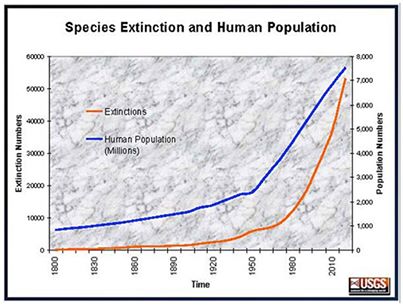
graph

Shell lost control of an Arctic offshore drilling rig


Ted Danson with Oceana via Change.org

Oil giant Shell’s efforts to drill in the Arctic Ocean have been plagued by mistakes and near disasters. The company even lost control of an offshore drilling rig – allowing it to run aground in Alaska. You saw the destruction that the BP Deepwater Horizon oil spill caused to the Gulf in 2010. Imagine that same devastation brought to the Arctic – one of the most unique and important places left on earth. 

Now, after years of failing to find safe ways to drill in the Arctic, Shell is asking the federal government to extend its leases by five years.

I’m calling on the Bureau of Safety and Environmental Enforcement (BSEE) to deny Shell’s request for five more years to explore for offshore oil drilling in the Arctic. Please click here to join me.

I remember walking down the beach in Santa Monica over twenty years ago with my young daughters. At the time I was starring on the show “Cheers,” and during our walk we came to a sign that read: “Water polluted, no swimming.” I didn’t know how to explain to them that we allowed pollution into our oceans and beaches – and I don’t want any parent to have to explain to their children how Shell destroyed the Arctic.

Shell is the only company still actively pushing to drill in the U.S. Arctic Ocean, as other companies have walked away from the unpredictable Arctic environment or put plans on hold. Chevron recently pulled its plans to drill in the Canadian Beaufort Sea after finding the process too risky and expensive. If BSEE denies Shell’s request, the company will suffer a major blow to its dangerous efforts.

The oil industry does not have proven means to contain or clean a spill in the Arctic Ocean. A single accident could lead to serious environmental degradation, threatening iconic marine wildlife and impacting the region’s coastal communities. If Shell is given five more years, the Arctic’s polar bears, ice seals, belugas and many other inhabitants will be pushed further into harm’s way.

We have an incredible opportunity to protect the Arctic from offshore drilling. In the mid-1980s, I helped lead a successful campaign to stop Occidental Petroleum from drilling 60 oil wells in the waters beside Santa Monica. Now, along with Oceana, I desperately need your support to protect the Arctic.

Please sign our petition calling on BSEE to deny Shell’s request for five more years to drill for oil in the U.S. Arctic Ocean.

Thank you,

Ted Danson with Oceana

…and the Grasshoppers Inherit the Earth

1451324_650954518277931_1616731734_n

Those who are still harboring fantasies about a time of peace and harmony, sustainability, or inherent respect for nature in human kind’s pre-Columbian past should read, Constant Battles, by Steven A. LeBlanc, which explodes the myths about the peaceful, noble savage and the notion of early conservation ethics.

Here’s an excerpt from that book’s chapter, “Enter Conflict:”

“What sets humans apart from almost all other animals is their ability to take resources from other groups, by group action. A large male bear can chase other bears from the best fishing spot along the river, and a male lion can defend its pride’s territory from other lions, but humans developed this process much further. They can cooperatively take over the territory or resources of another group—either by killing them off or driving them from the resources. Such aggression is not without risk, but it is achievable. The ability to engage in social cooperation sets up a dynamic among population growth, carrying capacity, and the potential for conflict.

“Not only are human societies never alone, but regardless of how well they control their own population or act ecologically, they cannot control their neighbors’ behavior. Each society must confront the real possibility that its neighbors will not live in ecological balance but will grow its numbers and attempt to take the resources from nearby groups. Not only have societies always lived in a changing environment, but they always have neighbors. The best way to survive in such a milieu is not to live in ecological balance with slow growth, but to grow rapidly and be able to fend off competitors as well as to take resources from others.

“To see how this most human dynamic works, imagine an extremely simple world with only two societies and no unoccupied land. Under normal conditions, neither group would have much motivation to take resources from the other. People may be somewhat hungry, but not hungry enough to risk getting killed to eat a little better. A few members of either group may die indirectly from food shortages—via disease or infant mortality for example—but from an individual’s perspective, he or she is much more likely to be killed trying to take food from the neighbors than from the usual provisioning shortfalls. Such a constant world would never last for long. Populations would grow and human activity would degrade the land or resources, reducing their abundance. Even if, by sheer luck, all things remained equal, it must be remembered that the climate would never be constant: times of food stress occur because of changes in the weather, especially over the course of several generations. When a very bad year or series of years occurs, the willingness to risk a fight increases because the likelihood of starving goes up.      …

“Now comes the most important part of this overly simplified story: The group with the larger population always has the advantage in any competition over resources, whatever those resources may be. Over the course of human history, one side has rarely had better weapons or tactics for any length of time, and most such warfare between smaller societies is attritional. With equal skills and weapons, each side would be expected to kill an equal number of its opponents. Over time, the larger group will finally overwhelm the smaller one. This advantage of size is well recognized by humans all over the world, and they go to great lengths to keep their numbers comparable to their potential enemies. This is observed anthropologically by the universal desire to have many allies, and the common tactic of smaller groups inviting other societies to join them, even in times of food stress.

“Assume for a moment that by some miracle one of our two groups is full of farsighted, ecological geniuses. They are able to keep their population in check and, moreover, keep it far enough below the carrying capacity that minor changes in the weather, or even longer term changes in the climate, do not resort in food stress. If they need to consume only half of what is available each year, even if there is a terrible year, this group will probably come through the hardship just fine. More important, when a few good years come along, these masterfully ecological people will not grow rapidly, because to do so would mean that they would have trouble when the good times end. Think of them as the ecological equivalent of the industrious ants.

“The second group, on the other hand, is just the opposite—it consists of ecological dimwits. They have no wonderful process available to control their population. They are forever on the edge of carrying capacity, they reproduce with abandon, and they frequently suffer food shortages and the inevitable consequences. Think of this bunch as the ecological equivalent of the care-free grasshoppers. When the good years come, they have more children and grow their population rapidly. Twenty years later, they have doubled their numbers and quickly run out of food at the first minor change in the weather. Of course, had this been a group of “noble savages” who eschewed warfare, they would have starved to death and only a much smaller and more sustainable group survived. This is not a bunch of noble savages; these are ecological dimwits and they attack their good neighbors in order to save their own skins. Since they now outnumber their good neighbors two to one, the dimwits prevail after heavy attrition on both sides. The “good” ants turn out to be dead ants, and the “bad” grasshoppers inherit the earth.

“The moral of this fable is that if any group can get itself into ecological balance and stabilize its population even in the face of environmental change, it will be tremendously disadvantaged against societies that do not behave that way.” The long-term successful society, in a world with many different societies, will be the one that grows when it can and fights when it runs out of resources. It is useless to live an ecologically sustainable existence in the “Garden of Eden” unless the neighbors do so as well.”

Serial Killing for Shopping Malls

The Earth is being raped, strangled and left for dead by people who care only about themselves and what they can get in the short term. The suffering of others is inconsequential. Indeed, they pride themselves in their ability to disregard the cries and struggles of their targets, whom they objectify while denying their very sentience. Like psychopathic serial killers, they ignore the rights and welfare of their victims, intentional or incidental.

Text and Wildlife Photography ©Jim Robertson

Text and Wildlife Photography ©Jim Robertson

Florida isn’t the only state trying to shut down discussion of climate change

 http://www.vox.com/2015/3/10/8182513/florida-ban-climate-change

In a growing number of states, conservatives have been taking a rather novel approach to climate change — simply prevent people from talking about it.

Florida state employees say they were barred from using the term “climate change”

There’s a big uproar in Florida this week after an investigation alleged that the state has an unwritten policy barring environmental officials from using the terms “climate change” or “global warming” in their work. On Monday, Republican Governor Rick Scott denied any such policy was in place. But state employees and outside scientists insist there’s heavy pressure not to talk about the topic, despite the fact that Florida faces a serious threat from future sea-level rise.

If so, that wouldn’t be the first time state officials — Republicans, usually — have taken steps to prevent people from discussing global warming or climate science.

In 2012, North Carolina’s GOP-controlled state legislature passed a law to prevent the state from considering the most up-to-date climate science in formulating predictions of rising seas. In Pennsylvania in 2014, back when Republican Tom Corbett was governor, one former state employee alleged that she was ordered to remove references to “climate change” from the conservation agency’s website.

In a somewhat different vein, states like Tennessee and Louisiana have been passing laws making it easier to teachers in the classroom to present alternative theories to climate change — even though there’s a broad and firm consensus among climate scientists that human activity is responsible for the rise in global temperatures over the last 50 years.

More: http://www.vox.com/2015/3/10/8182513/florida-ban-climate-change

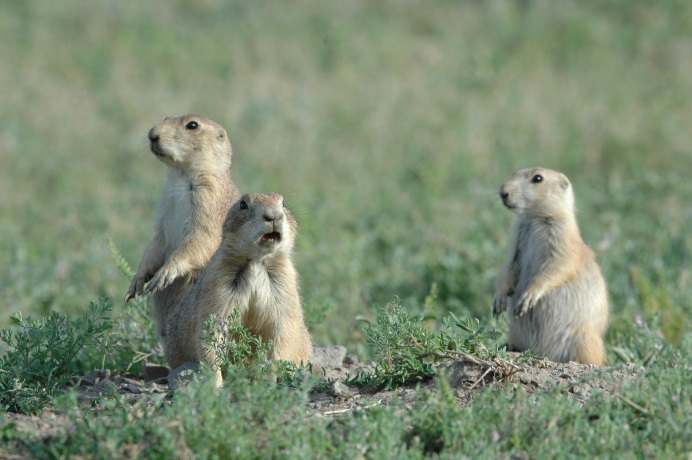
Activists continue fight for prairie dogs

Wildlife Photography ©Jim Robertson

Wildlife Photography ©Jim Robertson

by Mike DiFerdinando  3/2/15

Group explores options to protect wildlife from future development

As protesters stood at Founders Parkway and Factory Shops Boulevard — waving signs and shouting at drivers to help save the prairie dogs — a few hundred yards behind them exterminators were already laying traps.

The grass-roots campaign, called Save the Castle Rock Prairie Dogs, wants to push back the construction of the Promenade at Castle Rock, at the north end of town between I-25 and U.S. Highway 85, near the Outlets at Castle Rock, until June.

That’s when the animals, many of them pregnant, could be moved. The prairie dogs are being trapped with baited cages. It is unknown how or if they are being killed at this time.

“Of course I was at the protest,” said Castle Rock resident Keith Lattimore-Walsh, one of about 40 protesters at the Feb. 24 rally. “My heart won’t allow me to do anything less than to fight for those who cannot speak.”

The controversy is part of the town’s continued conversation about growth and began when more than 20 residents spoke out against the Promenade at the Feb. 17 council meeting.

Activists said they hope snowy conditions and the slow pace of capture will give them time to find available land for relocation of the colony — about 1,000 prairie dogs.

“It’s slow, they aren’t capturing many at a time,” said Brian Ertz, board president of the activist organization the Wildlands Defense.

Alberta Development Partners, the developer behind the Promenade, could not be reached for comment about the removal of the prairie dogs, despite repeated attempts by the News-Press.

Town officials reiterated their stance that the situation is a matter of a private developer building on private land, therefore they have no jurisdiction to stop or delay construction.

This would be different if the prairie dogs were protected by state law, which they aren’t, because they are not an endangered species. [Not officially, buy they should be on the list–I challenge anyone who says prairie dogs are still common throughout the state.]

More: http://castlerocknewspress.net/stories/Activists-continue-fight-for-prairie-dogs,182035