An Elmer’s Code of Ethics

Fudd

If an animal lives,

kill it.

If it gets away,

hunt it down and kill it.

If it learns to adapt to humans,

hate it and kill it year ‘round.

If it becomes endangered,

kill its mother and put it in a zoo.


If an animal proves intelligent,

respect it then kill it.

If you think it dumb,

kill it and eat it.

If it simply is,

kill it because it’s there.

If anyone’s watching,

Just call it “conservation.”

A Field Guide to the North American Hunter

People tend to paint all wildlife-killers with a single brush stroke, referring to them all simply as “hunters.” Yet close scientific observation reveals that there are at least five different categories, or sub-species, of the mutation of Homo sapiens known as the North American hunter (Homo hunter horribilis). Oddly, members of some sub-species don’t like to be associated with others. They can’t all be bad apples, can they? Read on…

1) Sport Hunter

This category can actually be applied to all the other sub-species, including theimagesD5ZT7PC1 universally maligned trophy hunter, as well as the so-called subsistence hunter, since nearly no one in this day and age really has to kill wild animals to survive anymore. Lately we’ve been hearing from a lot of hunter apologists quick to make a distinction between sport and subsistence hunters. Truth is there’s not all that much difference between the two. Sport hunters and subsistence hunters are often so closely related, they’re practically kissin’ cousins. Rare is the hunter who doesn’t justify his sport by boasting about “using the meat.” By the same token, you hardly ever find one who openly admits to being just a sport hunter.

But, being by far the largest sub-class, there are obviously plenty of adherents. For reasons known only to them, they like to refer to themselves as “sportsmen” (or “sportswomen”). When not out killing, they are often seen petitioning Congress to enshrine their perceived right to kill animals (meanwhile mocking the very notion that non-human animals have rights).

Tracks: On the rare occasion that these good ol’ boy traditional sport hunters get out of their vehicles (usually a pickup truck with a bench seat, so they can sit on their camo-clad asses three abreast), you’ll find their tell-tale boot tracks weaving along the roadway—a sure sign the Schmidt-swilling hunter has spotted a deer, or needs to take a pee.

Other spoor to watch for: spent shotgun shells and cigarette butts in parking lots, or 16 ounce beer cans and empty fried pork rind bags ejected out the truck window, along forest roadways.


2) Subsistence Hunters

10478663_666186560097028_1055574252307234730_nThis category includes the holier than hemp types who use words like “foodie,” and all those others who claim to hunt mainly for food. Subsistence types conveniently ignore the fact that there are 7 billion human meat-eaters on the planet today, and if they all followed their model for “living off the land,” there would be no wildlife left on Earth.

Like sport hunters, subsistence hunters do what they do because they want to; they enjoy the “outdoor lifestyle.” But not many self-proclaimed “subsistence” hunters are willing to give up modern conveniences—their warm house, their car, cable TV or the ever-present and attendant “reality” film crew—and live completely off the land like a Neanderthal…at least not indefinitely.

While everyone has a right to feed themselves and their family, what gives them the right to exploit the wildlife is unclear. Sure, all people need some form of protein, yet millions have found a satisfying and healthful way to eat that doesn’t involve preying on others. And they don’t seem to understand that dead is dead and it doesn’t matter to the victim whether their killer eats every part of them or just sticks their head on a wall.

Call: Often overheard uttering feeble catch-words like “management,” “sustainability,” “population control” or “invasive species.” Unfortunately, they never think to apply those same concepts to the species, Homo sapiens.


3) Trophy Hunters   

This group can be confused with other “sportsmen,” but though both types are clearly in1383480_10151726970777825_1974489269_n it for the fun, trophy hunters are obsessed with every aspect of the so-called sport. These are the kind of people who hold “contest hunts” on anything seen as competition, yet ironically are intent on recruiting more hunters, including women and young people, encouraging them to take up the “sport.” Although their professed enemies are predators like wolves and mountain lions, their most dreaded foe are the anti-hunters.

The trophy hunters’ fixation with horn curl or antler spread is in fact causing a reversal of evolution in the species whose heads they covet.

Breeding plumage: Camouflage from head to tail; flashy orange vest. Mates primarily with themselves.


4) Sadists  

1384140_564330240283396_857016214_nThis category includes bow-hunters, trappers and wolf hunters. Often seen on reality T.V.  shows or in homemade snuff-film videos on U-Tube. Hunters who consider themselves in one of the other categories would do well to self-police their kind, lest normal people (non-hunters) think all hunters are sadists who enjoy the act of killing and are turned on by watching animals suffer and struggle under their power.

Habitat: Disgusting personal websites or Facebook pages where they parade around in camo, showing off their evil deeds for anyone who’ll give them the time of day.


5) “Ethical” Hunters

This is the category that virtually all hunters want to be included in. Unfortunately, the phrase “ethical hunter” is an oxymoron, like “humane slaughter,” “virgin mother,” “fair chase,” “free-range poultry” or “friendly neighborhood serial killer.” As withSmalfut UFOs, Bigfoot and the Loch Ness monster, no one has ever been able to locate one of these mythical phantoms.

Spoor: This make-believe subspecies leaves no tracks or scat because, well, they’re fictitious. The only impression they make is in the minds of the easily influenced. There’s simply no way an animal-killer can be considered ethical, unless of course he gives up hunting.

Boone and Crockett Club: Drone hunts ineligible for records

http://missoulian.com/news/local/boone-and-crockett-club-drone-hunts-ineligible-for-records/article_a263a49c-b86b-11e3-b4f4-0019bb2963f4.html

Heading out for the big hunt? Leave your drone at home.

The Missoula-based Boone and Crockett Club, North America’s oldest hunting and conservation organization, has announced that any game scouted or taken with the help of drones or other unmanned aerial vehicles is ineligible for entry into its records program.

“Boone and Crockett likes to, as much as possible, set the standard for fair chase,” said Richard Hale, the chairman of the club’s big game records committee.

The club defines fair chase as the ethical, sportsmanlike and lawful pursuit and taking of any free-ranging wild, native North American big game animal in a manner that does not give the hunter an improper advantage over such animals.

“These drones, like all technology, have advanced rapidly. We need to be responsive to the way technology is changing things,” Hale said Sunday, adding that several states, including Colorado and Alaska, have already moved to ban the use of drone-aided hunting.

Curbing the use of technology is not new for the Boone and Crockett Club.

In the 1960s, the group declared that trophies taken with the use or assistance of aircraft, including spotting or herding game, would be ineligible for its prestigious records.

“We already don’t allow things like trail cameras that could send an image to, say, your phone, or pursuing game in a vehicle,” Hale said.

He said if Boone and Crockett or even state wildlife agencies take a wait-and-see approach on new technology, companies and other groups can develop an entrenched interest in seeing such technology stay legal, and lobby against any moves to limit them later on.

The Boone and Crockett Club was founded by Theodore Roosevelt in 1887 to promote the proper management of wildlife and encourage hunting sportsmanship. Its international headquarters is in Missoula.

Colorado-man-offering-drone-hunting-lessons-in-Deer-Trail

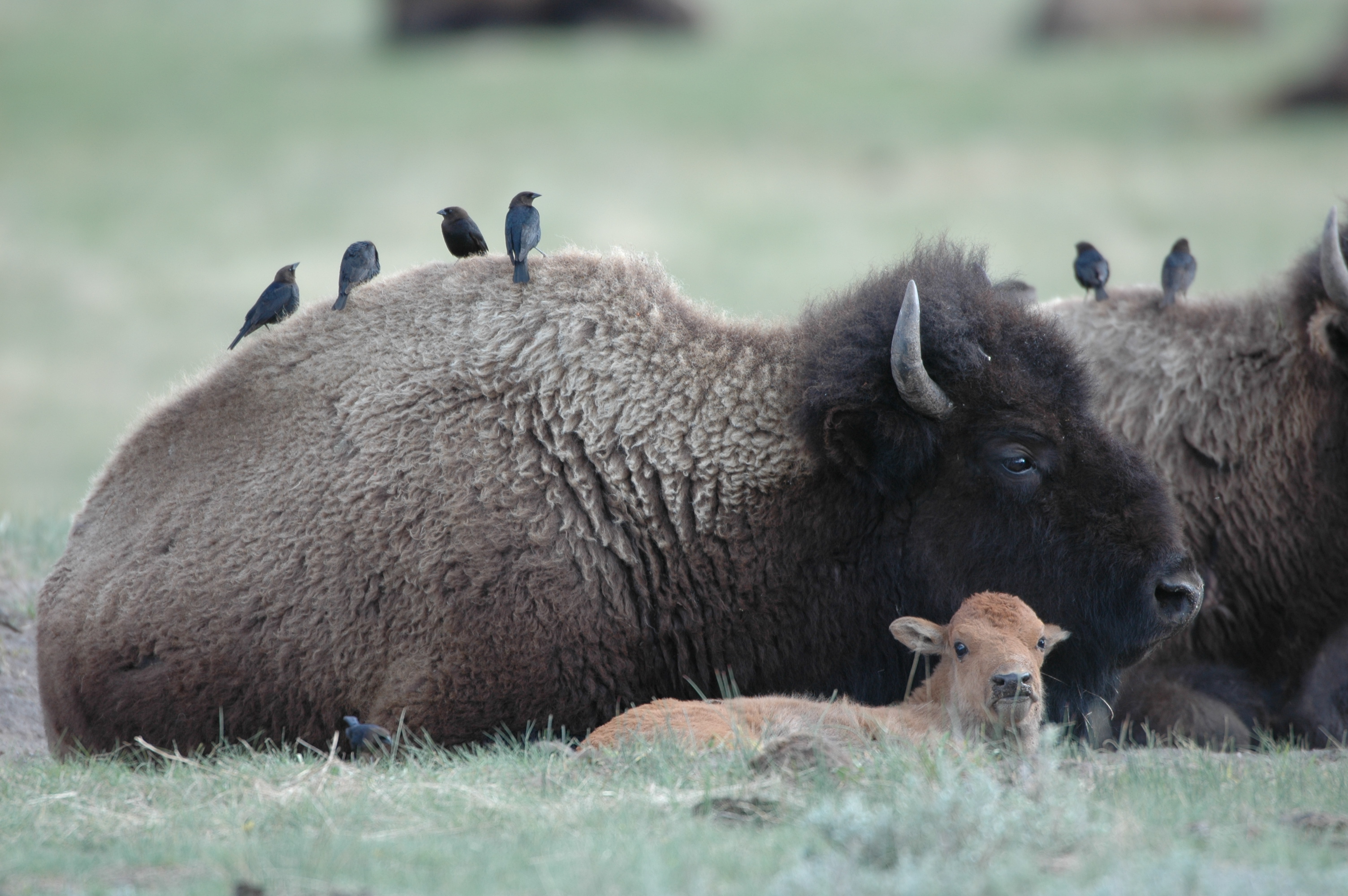
Tension Escalates Over Hunting of Pregnant Bison Outside Yellowstone

Photo Copyright Jim Robertson

Photo Copyright Jim Robertson

http://www.reuters.com/article/2014/03/07/us-usa-yellowstone-bison-idUSBREA261U520140307

By Laura Zuckerman SALMON, Idaho Fri Mar 7, 2014

(Reuters) – Angered by the killing of pregnant bison outside Yellowstone National Park, a Native American tribal member tried to deliver a bloody bison heart to Montana’s governor this week, the latest skirmish over the management of the iconic animal.

James St. Goddard, a member of the Blackfeet Nation in Montana and former member of the tribe’s governing council, said he found the heart where hunters from another tribe discarded it after gutting a bison killed when many females are well along in their pregnancies. At another location, he said, he found several fully formed fetuses cut out of bison cows.

“These are atrocities. Why are they killing these babies? Are we all ignorant of our own Indian culture?” said St. Goddard, who was prevented by authorities from presenting the bison heart to Montana Governor Steve Bullock at his office in Helena.

St. Goddard’s protest, which was not sanctioned by the Blackfeet Nation, highlighted controversy over practices – which have divided some tribal members – in which bison that stray out of Yellowstone have been killed in extended tribal hunting seasons.

The protest against the actions of other tribes came amid broader tensions about the management of the nation’s last band of wild, purebred bison, or buffalo, over concerns by Montana ranchers that the animals could transmit the cattle disease brucellosis to cows that graze near Yellowstone.

The buffalo at Yellowstone, which cuts through parts of Wyoming, Montana and Idaho, are all that remain of the herds that roamed vast grasslands west of the Mississippi until systematic hunting drove them to the edge of extinction in the 19th century. There are more than 4,000 bison at the park, Yellowstone figures show.

Yellowstone’s bison are prized by visitors as a symbol of the American West and by tribes whose religious, cultural and dietary traditions are centered on the animals.

Tribes have asserted hunting rights granted in 19th century treaties for animals that migrate to traditional hunting grounds, and they largely set their own rules on the timing of their seasons. Some tribal hunting seasons extend into March, ahead of a birthing season that can begin in April.

Yet within the tribes, some members have taken issue with the hunts.

The Nez Perce Tribe in Idaho defended its late season hunting as an ancient custom halted over a century ago by the U.S. government amid Western settlement, near-elimination of the herds and forced relocation of tribes to reservations.

Nez Perce Chairman Silas Whitman faulted St. Goddard, whose own tribal government has not opposed the hunts, for criticizing the exercise of off-reservation hunting rights gained by treaty.

“He’s creating controversy where there is no cause. He’s talking as an old enemy, and we’re not going to bend to the will of our enemies,” he said.

Ervin Carlson, the Blackfeet’s buffalo project manager and a member of a federal, state and tribal team that oversees Yellowstone bison, said St. Goddard’s sentiment did not represent the tribe.

“Those tribes have their treaty hunting rights. We wouldn’t step into their concerns,” he said.

FEARS OF CATTLE DISEASE

Licensed hunting of bison that leave Yellowstone’s snow-covered high country to seek food in lower Montana elevations was sanctioned in 1985, then banned after public outcry as hunters lined up outside the park to shoot bison.

Regulated hunts were reinstituted with “fair chase” provisions in 2005 to help keep a burgeoning buffalo population in check. Four tribes have since asserted their own independent hunting rights spelled out in historic treaties.

Montana currently offers limited licenses, decided by lottery, in a season that ends in mid-February, partly to protect heavily pregnant bison, said Pat Flowers, a regional supervisor at Montana Fish, Wildlife and Parks.

The hunts and a program that sends wandering buffalo to slaughter are in part a response to worries by Montana ranchers that bison will infect nearby cattle with brucellosis, which can cause stillbirths in cows.

About half of Yellowstone’s bison have been exposed to brucellosis, and roughly 300 animals that strayed from the park this winter were sent to slaughterhouses or to the U.S. Department of Agriculture for reproductive experiments. An additional 263 animals have been killed by hunters, most of them tribal hunters, in Montana.

Conflicts over the way bison are managed escalated further on Thursday with the arrest of a man who protested their killing by blocking a road to a park facility where wayward bison are penned, Yellowstone spokesman Al Nash said.

The protest by a man who anchored himself to a 55-gallon drum was celebrated by Buffalo Field Campaign, which opposes the hunts and slaughter, and sends members into Yellowstone to monitor the wintering herd.

In a sign that not all tribal members agree with their governments, James Holt, a Nez Perce member who sits on the Buffalo Field Campaign board, said it was disheartening to see tribes support the activities.

“Buffalo were made wild and free and should remain so. It is painful to watch these tribal entities take such an approach to what should be the strongest advocacy and voice of protection,” Holt said in a statement.

Among tribes with hunting rights, the Confederated Salish and Kootenai Tribes of Montana restricts its season to the end of January to avoid killing pregnant bison cows, which calve in spring, Tom McDonald, the tribes’ wildlife agency manager, said.

“Our regulation is based on the votes of the people, who don’t want big-game animals harvested past the end of January because they’re pregnant. But we don’t point fingers at other tribes for their regulations,” he said.

Carl Scheeler, wildlife program manager for the Confederated Tribes of the Umatilla Indian Reservation in Oregon, said the reality of gutting a two-ton animal means fetuses may be discarded from pregnant bison killed in a tribal hunting season that stretches to mid-March.

“There’s a certain level of public sensitivity to viewing large and persistent gut piles, and hunters are directed to move them out of view to the extent that’s possible,” he said.

(Editing by Cynthia Johnston and Douglas Royalty)

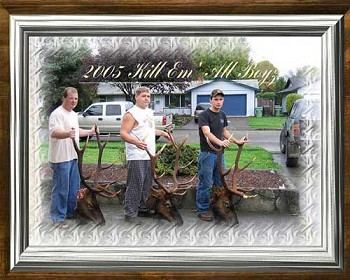
“Kill ‘Em All Boyz” Are “Ethical Hunters” Once Again

Ever since a friend sent me an article from back in 2006 about the poaching ring4cbfbced5cc75_image who gave themselves the narcissistic name the “Kill ‘Em All Boyz,” I’ve been wondering when they would be back in the Washington state “game” department’s good graces and be allowed to hunt again.

I found the answer in an October 20, 2008 article by the Daily Astorian entitled “Tip alerted WDFW officials to poaching gang” which reported that Micky Ray Gordon, ringleader of the “Kill ‘Em All Boyz” (who pleaded guilty to pleaded guilty to charges of first-degree animal cruelty, illegal hunting with hounds, second-degree criminal trespass and third-degree malicious mischief and was sentenced in ‘08 to 13 months in prison, following a seven-month undercover investigation by the Washington Department of Fish and Wildlife) would be eligible to purchase a hunting license again after only five years of suspension.

The other poachers were given even more lenient sentences, with even shorter
suspensions before they could hunt again. According to the article, “Brian Hall, 20, pleaded guilty to second-degree criminal trespass, third-degree malicious mischief and second-degree hunting with dogs. He was sentenced to 30 days in jail and $1,500 in fines, and will not be eligible to purchase a hunting license for two years. Adam Lee, 21, pleaded guilty to hunting with a suspended license and was sentenced to 30 days in jail and $1,850 in fines. And Joseph Dills, 23, pleaded guilty to a variety of charges, ranging from second-degree big-game hunting to using bait to hunt for bear. His total penalties amounted to 65 days in jail and $2,050 in fines.” At their press time, “Dills [was] pending trial in Lewis County on charges of committing other hunting violations.”

The article also states that this “case has provoked outrage among the hunting community in Southwest Washington and Northwest Oregon, in part because of the nature of the crimes but also because Gordon and his gang were initially referred to as “hunters” and not “poachers.” That sentiment was echoed by a comment I received earlier today from a hunter who piously stated, “Please remember. These are poachers, not to be confused with legal, ethical, ‘pay for conservation’ hunters.”

Well, they can go out and buy a hunting license now, just as legally as anyone. Does that make them different people? Are they “ethical” hunters again now that they’re
1800308_664612120267816_1839536551_nallowed to re-up their annual hunting licenses and bear, elk, deer, cougar,
bobcat, etc., etc. tags? How do these former poachers’ mindsets differ from the
average hunters? Is it just a matter of how many they killed at one time; or
the fact that they were not playing fair by the law-abiding hunters?

Poachers or not, it’s all ends the same for the animals they killed.

________________________
Anyone who witnesses a wildlife violation call WDFW’s toll-free Poaching Hotline at (877) 933-9847

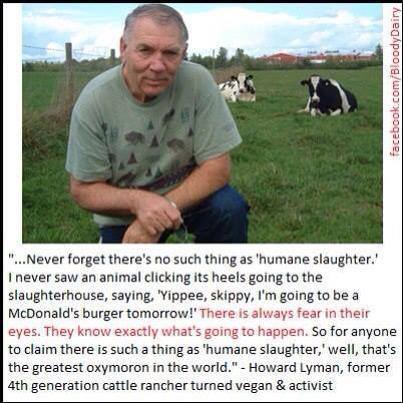
“Humane Slaughter,” “Ethical Hunting” Both Oxymoronic

1625753_10152050799636696_1513233750_n

After forty-some years in the business, fourth generation Montana cattle rancher Howard Lyman finally saw the light. Now, the author of the bestselling books, Mad Cowboy: Plain Truth from the Cattle Rancher Who Won’t Eat Meat and No More Bull: The Mad Cowboy Targets America’s Worst Enemy: Our Diet, spends his days promoting veganism.

For the sake of our health and humaneness, for the planet and for the wolves, adopting a cruelty-free vegan lifestyle is a challenge we all must face together. As Mr. Lyman tells us: ”The question we must ask ourselves as a culture is whether we want to embrace the change that must come, or resist it. Are we so attached to the dietary fallacies with which we were raised, so afraid to counter the arbitrary laws of eating taught to us in childhood by our misinformed parents, that we cannot alter the course they set us on, even if it leads to our own ruin? Does the prospect of standing apart or encountering ridicule scare us even from saving ourselves?”

Read More here: https://exposingthebiggame.wordpress.com/2013/02/18/fourth-generation-montana-cattle-rancher-now-promotes-veganism/