Exposing the Big Game

Forget Hunters' Feeble Rationalizations and Trust Your Gut Feelings: Making Sport of Killing Is Not Healthy Human Behavior

Exposing the Big Game

VEGAN MEAT IS ABOUT TO BE WAY CHEAPER THAN ANIMAL MEAT

Vegan Meat Is About to Be Way Cheaper Than Animal Meat

Liz Specht Ph.D. — a senior scientist at the Good Food Institute (GFI) — says vegan meat products are about to come down in price.

Vegan Meat Is About to Be Way Cheaper Than Animal Meat
Vegan meat products are set to come down in price | Lightlife Foods
Senior Editor, UK | Contactable via charlotte@livekindly.com
 

The vegan meat market is booming. As consumer attitudes change, supermarkets, fast-food chains, pubs, restaurants, and even fish and chip shops are jumping on the vegan wagon. But there seems to be a catch that comes with eating vegan meat products — especially if you buy them straight from the store — in many instances, they’re more expensive.

It’s a fact that cannot (and should not) be ignored, but is it one that is going to change anytime soon? Many think it is. According to Liz Specht Ph.D., a senior scientist at the Good Food Institute (GFI), price parity with vegan meat and its animal-based counterpart is just around the corner.

“Industrial animal agriculture has been operating and optimizing at a global scale for decades,” she explained in a post on GFI’s website. “Yet it is still inherently more efficient to make meat directly from plants rather than feeding our crops to animals and then eating a part of the animal.” She added, “It’s all but inevitable that the plant-based meat industry will eventually be cost-competitive with conventional meat.”

Why Is Vegan Meat Currently More Expensive?

GFI’s Liz Specht says Beyond Meat need to charge more so it can meet demand | Beyond Meat

According to Specht, vegan meat is currently more expensive for a number of reasons. It’s partly due to the fact that brands are operating in a “free market.” They must maximize their profit, and this means charging consumers more.

“Companies like Beyond Meat and Impossible Foods are currently producing as much as they can and are still unable to meet demand,” writes Specht. “There is no reason for them to charge less than consumers will pay at this time — moving down the supply/demand curve would not allow them to sell more products.”

She continues, “Lowering prices would just lower their revenue, which would, in turn, hurt their ability to scale and meet demand.”

Another reason is that while the vegan meat market is growing at a rapid rate, currently, it remains small. This means that brands have a harder time negotiating prices for their ingredients — such as soybeans or peas. The market is also currently at a place where it lacks the same infrastructure as animal agriculture. “The current scale of plant-based meat companies also limits their manufacturing facility design, equipment, and other technologies,” notes Specht.

“Even the largest plant-based meat production facilities look like boutique operations compared to the scale of manufacturing facilities for conventional meat products and other common food products,” she adds.

When vegan meat brands have a bigger share of the overall meat market, production methods will evolve, explains Specht, increasing efficiency and inevitably reducing cost.

One of the other factors to consider when looking at the price of vegan meat products is the cost of research and development. UK veggie and vegan meat brand Quorn, for example, recently invested £7 million into researching and developing its own “bleeding” plant-based burger.

As smaller brands find their feet and “secure their market position,” less money will be poured into this research and development, says Specht.

How Long Until Vegan Meat Falls In Price?

Impossible Foods partnered with Burger King earlier this year | Impossible Foods

Vegan meat could fall in price pretty soon.

The market is consistently growing. It’s currently worth around $1 billion, but this is expected to increase by 4,000 percent in the next decade, potentially reaching a worth of more than $40 billion.

The growth could be partly due to Beyond Meat’s recent IPO. The California-based brand — responsible for the “bleeding” Beyond Burger — went public in May. It was the first-ever company of its kind to do so. Initially, the IPO was priced at $25 a share, but this rose to $65 at the end of the first day. Stocks are now valued at around $99.

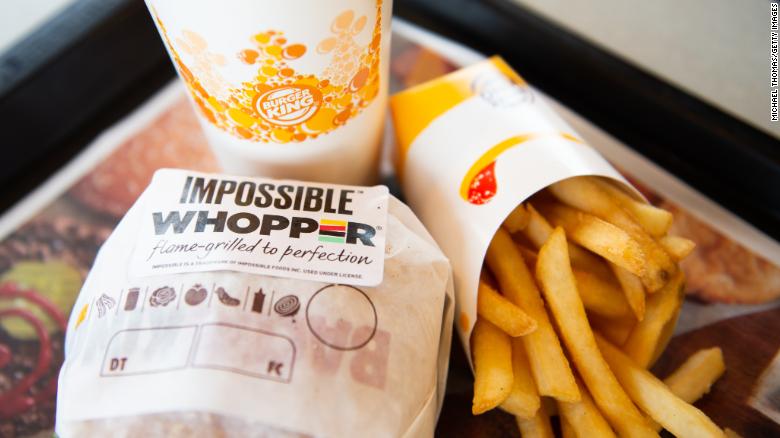
Primary competitor Impossible Foods has also seen huge success in recent months. It partnered with fast-food giant Burger King to launch the Impossible Whopper — a vegan meat version of the chain’s signature beef-filled Whopper sandwich. The vegan trial — conducted in 59 locations in Missouri — went “exceedingly well,” and the burger is now being rolled out across the U.S.

“[The] tipping point may hit relatively soon,” notes Specht. “Given the recent flurry of activity reflecting new production capacity among the existing plant-based meat companies and the involvement of new entrants with massive resources.”

The market is growing so quickly that existing major companies want in, like meat giant Tyson Foods and multinational corporation Nestlé. The latter has already rolled out the plant-based Incredible Burger across Europe, which features on McDonald’s menus in Germany and Israel. It also intends to roll out the similar Awesome Burger in the U.S. in the fall, under its Sweet Earth brand.

Tyson Foods — the world’s second largest processor and marketer of chicken, beef, and pork — announced earlier this year it will be joining the vegan meat market this summer.

Specht adds, “once plant-based achieves sufficient market penetration to tap into these emerging opportunities to optimize raw materials and make production more efficient, the industry will enter a bright new era of accessibility and affordability that will benefit both consumers and producers.”

Could Anything Stifle The Growth Of The Vegan Meat Market?

Upton’s Natural is suing Mississippi over the “meat label” ban | Upton’s Natural

Some have criticized the vegan meat market. In Mississipi, plant-based foods that emulate meat cannot be labeled as meat or a meat-based product on the packaging. So, brands cannot market soy or pea protein-based products, for example, as “meatless meatballs” or “vegetarian bacon.” The reason for the law is that some members of the meat industry believe that consumers will be misled by this use of terminology.

But many vegan organizations and brands — such as the Plant Based Foods Association (PBFA) and Upton’s Naturals, which are suing the state of Mississipi over the law — maintain that using this sort of language helps consumers understand what the product will taste like.

“People are not confused by terms like ‘veggie burger’ or ‘vegan hot dog,’” said Justin Pearson, a managing attorney at the Institute of Justice, in a statement. The institute is backing the PBFA and Upton’s Naturals lawsuit. He continued, “To the contrary, those terms tell consumers that they are buying exactly what they want: a plant-based alternative to animal meat.”

Daniel Staackmaan — the founder of Upton’s Naturals — added, “Mississippi’s law is not about clearing up consumer confusion, it’s about stifling competition and putting plant-based companies at a disadvantage in the marketplace.”

The Future Is Innovation

Beyond Meat and Impossible Foods were awarded “Champion of the Earth” by the United Nations | Beyond Meat

Despite challenges from the meat industry, it’s unlikely the vegan meat market will slow down anytime soon. The food industry is innovating, just like the tech industry has and continues to do, says GFI on its website.

“Unlike at any other moment in history, we now have the ability to blend imagination with design to improve the world around us,” notes the organization. “An array of inventions has improved lives for billions of people across the globe. Smartphones allow farmers and textile workers in the developing world to start small businesses and move out of desperate poverty.”

“Modern air travel and the internet have made travel and information more accessible than previous generations could have even imagined,”
 it continues. “Now, that same spirit of innovation is coming to our dinner plates. Just as modern automobiles replaced the horse and buggy, better alternatives will replace conventional animal agriculture.”

As it stands, animal agriculture brings with it a wealth of environmental problems. Last year, the United Nations labeled tackling meat consumption as one of the world’s biggest problems. It also jointly honored Beyond Meat and Impossible Foods with the Champion of the Earth award.

“Our use of animals as a food-production technology has brought us to the verge of catastrophe,” said the UN Environment in a press release at the time. “The destructive impact of animal agriculture on our environment far exceeds that of any other technology on Earth.”

“The global community can eliminate the need for animals in the food system by shifting the protein at the center of the plate to plant-based meat,” it continued. “For their pioneering work towards reducing our dependence on animal-based foods, Ethan Brown [CEO of Beyond Meat] and O’Reilly Brown [CEO of Impossible Foods] have been selected 2018 Champions of the Earth in the category or science and innovation.”


There’s a new meatless Beyond Burger. It tastes even more like meat.

https://www.vox.com/2019/6/11/18659900/beyond-meat-burger-bynd-new

Beyond Meat’s latest alternative meat product hits grocery stores this week.

Courtesy of Beyond Burger

There’s a new Beyond Burger hitting supermarket shelves — one that the company promises is “even meatier.”

It’s the latest product offering from Beyond Meat, the fast-growing producer of plant-based meat products that are meant to taste just like meat and provide consumers with a more sustainable, more animal-friendly alternative.

The new burgers arrive in grocery stores starting this week, and will be available nationwide by the end of June. There are three major changes between the current burgers, which first came out in 2016, and the updated Beyond Burger. First, the new burger starts out red and changes colors (to brown) as it cooks, thanks to an extract from apples. This doesn’t affect the flavor much, but presentation still makes a big difference to consumers.

Secondly, Beyond Meat has changed up the ingredients to make the burger a more complete protein source — the new recipe uses a “blend of pea, mung bean and rice proteins,” a company spokesperson told me in an email. The mung bean and rice proteins are a new addition, aimed at giving the product more fiber and making its protein content more similar to that of a beef burger.

Third — and most notable from the package — Beyond Meat has added “marbling,” or those pockets of fat that are often credited for meat’s juiciness and flavor.

I tried out the improved burger and — while I’m very much not a burger connoisseur — it’s tasty and flavorful. I’m a vegetarian, so I recruited a meat-eating friend to the taste test for an opinion as well. He approved, too. One of my biggest complaints about past Beyond Burgers was that they were a little dry and bland, and the marbling seems to help with that.

The result is a burger that Beyond Meat hopes will compete both with conventional meat products and with fast-growing competitor Impossible Foods, which has landed coveted distribution deals with Qdoba and Burger King, and which, like Beyond Meat, aims to convince consumers that meat products can be just as tasty if no animals are involved.

It’s been a good few years for Beyond Meat. National chains including Del Taco, Carl’s Jr., and T.G.I. Friday’s have started carrying their products. They’ve also found their way onto grocery store shelves at Whole Foods, Kroger, and Target. In total, Beyond Meat says its products are available in more than 35,000 outlets, from hotels and college campuses to grocery stores and sports stadiums. Sales have been growing fast — last year the company reported revenues of $87.9 million, up from $32.6 million in 2017.

When Beyond Meat went public at the beginning of May, its stock soared — from an IPO price of $25 to a current price of $167, or a 670 percent increase. Beyond Meat means to use the money it raised in its IPO to expand its supply chain and meet the increasing demand for its products, chairman Seth Goldman told me at the time.

But another priority for the company has been improving the taste and nutrition profile of its burgers. There’s a lot of demand for a product that tastes just like meat, and a lot less demand for one that tastes kinda like meat. And by the accounts of many food reviewers, Impossible Foods was ahead of Beyond Meat on this front, with burgers that tasted just a tiny bit meatier. (Other reviewers have favored Beyond.) The new Beyond Burger is the latest turn in this meatless competition.

Plant-based meat alternatives are getting big

There’s a lot wrong with our food system. Producing meat by raising animals on factory farms produces tons of greenhouse gases, and many analysts think we can’t tackle climate change without tackling the enormous emissions that go into agriculture. Animals in close quarters are fed low-dose antibiotics constantly so they don’t make one another sick, which contributes to antibiotic resistance, a huge threat on the horizon for public health. And animals on factory farms are routinely subjected to intense cruelty and conditions that disgust the average American consumer.

That’s what inspired people to start working on meat alternatives — and it may be what’s inspiring the consumer enthusiasm that has buoyed them in recent years. Products like veggie burgers, fake chicken, and soy and almond milk are growing in popularity and market share — and even better, they’re getting tastier and harder to distinguish from animal products.

New breakthroughs in food science have made it easier to imitate the flavor and texture of real meat. While early veggie burgers were almost exclusively purchased by vegetarians, Brown says that 93 percent of Beyond Meat customers buy regular meat too — suggesting the company has succeeded at making something that appeals to meat eaters.

Beyond Meat was among the pioneers of this new generation of plant-based meat, which aimed to replace bean-based veggie burgers marketed mostly to vegans. The company’s commitment to refining its products and improving the taste have been crucial on that front — consumers who also eat meat are fairly picky about the flavor of plant-based products.

The rest of the plant-based meat industry has been thriving too. Burger King has been expanding their Impossible Whoppers to stores across the countryQdoba announced last month that it would be serving Beyond Meat competitor Impossible Foods. Industry giants Tyson and Purdue are pursuing their own plant-based product lines. A few years ago, the Impossible Burger was available in a handful of restaurants — now it can be found in more than 5,000.

“There’s a sense that there’s a movement going on that’s much bigger than any one company,” Brown told Vox last month.

The interesting thing about that movement is that plant-based meats don’t have to displace all animal meats in order to make a big difference. Every burger replaced with a Beyond Burger has an impact on CO2 emissions, demand for factory farming, and demand for antibiotics. The more the plant-based meat industry grows, the more those impacts will be visible — and that might, in turn, itself fuel more interest in plant-based meats.

Beyond Burger’s team doesn’t just believe they’ve found a niche — they say they’ve figured out the “Future of Protein.” The new burger certainly seems to represent one more step towards that future.

Fake meat: Don’t go bacon my heart, say butchers

Sausage dummies are pictured at the international meat industry fair IFFA in Frankfurt am Main, western Germany, on May 6, 2019. — AFP pic

FRANKFURT, May 12 — Slicing through juicy cuts of pork belly alongside rarer delicacies of ox brain and sheep intestine, young butchers at a Frankfurt trade hall cast a suspicious eye towards the so-called fake meat products on display.

Puzzlingly, for the butchers, the fake meat seems to be popular.

“As a butcher, it just can’t be that we have to get into plastic!” said Paolo Desbois, an 18-year-old French butcher, referring disparagingly to the synthetic burgers, sausages and nuggets at the IFFA meat industry convention.

The concept that animals are meat—and plants are not—never used to challenged.

But increasingly plant-based protein products are trying to muscle in on the meat market.

Derived from sources like soy, peas or beans, the synthetic products are being manufactured without using animals.

And Desbois, who placed second in a young butchers competition at the convention, feels they undermine “the essence of the profession”.

“It’s just not possible to work with synthetic meat,” he said.

Another budding elite butcher from Switzerland, 20-year-old Selina Niederberger, agreed.

“As a butcher, I’m for real meat. I think a lot of people would see it the same way,” she declared.

Non “real” meat products have been making headlines lately, backed by investors with an appetite for supplying plant-based burgers and sausages to the trendy diet-conscious masses.

The celebrity-backed vegan burger start-up Beyond Meat, for example, made a sizzling Wall Street debut on May 3 when it more than doubled its share price.

Backed by Hollywood star Leonardo DiCaprio and Microsoft founder Bill Gates, the firm and its competitors aim to turn plant-based foods mainstream and capture a huge potential market.

Ethical concerns

Whether meat substitutes will ever be able to 100 percent replicate the taste, colour, smell and texture of a freshly chopped up slaughtered animal is debatable.

But some young butchers suspect their growing popularity will inevitably have a transformative effect on their trade.

“It’s just shifting with the world and working with it rather than against it,” said 19-year-old British butcher Lennon Callister.

Trade skills are “what sets butchers apart from supermarkets,” he argued, but accepted consumers are starting to look at food differently.

Josja Haagsma from the Netherlands, who won the young butchers competition, agreed that synthetic meats were changing opinions.

“It makes you think about how you can use meat and how you can change it, how you can use more vegetables,” she said.

“Maybe the next generation” will be the ones pressed to apply their knives and creativity to the task, Haagsma said.

Vegetables used to be considered a side dish, at best, for carnivore connoisseurs.

But in increasingly health conscious societies, where governments warn about the dangers of consuming too much red meat, plant-based products are widening in appeal.

Alongside ethical concerns over animals bred for the dinner table and green advocates urging the public to eat less meat to save the environment, the scope for more no-meat products is growing.

‘They aren’t sausages!’

“It’s very important that we think about it, that we consume less” but “good quality meat,” said Haagsma.

“You can use organic meat and homegrown cows, and not the cows from the big companies,” she said.

The growing numbers of people turning to plant-based meat alternatives include vegans, who shun all animal products, and flexitarians, who advocate moderate consumption of meat.

One sign of their expanding popularity? Silicon-valley company Impossible has linked up with Burger King to offer a plant-based version of its signature Whopper.

Nestle and Unilever are also aiming to cement their presence in the sector.

The move by big conglomerates into the sector has made young butchers note that changes are on the way.

“There’ll be less of this mass-produced stuff, which is also really, really bad for the climate,” said 23-year-old German Raphael Buschmann.

However, while recognising environment-conscious citizens are rethinking their diets, Buschmann predicted a limit to the industry changes.

Vegetarian sausages would not be added to his displays any time soon.

“They aren’t sausages,” he said. “That’s just the way it is.” — AFP

Burger King plans to roll out Impossible Whopper across the United States

New York (CNN Business)Burger King’s test of a vegetarian version of its signature Whopper was such a success, the chain is planning to roll the Impossible Whopper out nationally this year.

On April 1, Burger King started testing the vegetarian burger, using a plant-based patty from Impossible Foods. The test took place in St. Louis and “went exceedingly well,” a spokesperson for Restaurant Brands International (QSR), Burger King’s parent company, said. The spokesperson added that the sales of the Impossible Whopper are complementary to the regular Whopper.
That’s exactly what Burger King wants.
With the Impossible Whopper, Burger King is primarily targeting meat eaters who seek more balance in their diet. The new product is designed to “give somebody who wants to eat a burger every day, but doesn’t necessarily want to eat beef everyday, permission to come into the restaurants more frequently,” Chris Finazzo, president of Burger King North America, told CNN Business when discussing the initial test.
Burger King started testing out the Impossible Whopper in St. Louis.

The Impossible Whopper is supposed to taste just like Burger King’s regular Whopper. Unlike veggie burgers, Impossible burger patties are designed to mimic the look and texture of meat when cooked. The plant protein startup recently revealed a new recipe, designed to look and taste even more like meat. That version is being used in Burger King’s Impossible Whoppers.
The company plans to expand to more markets “in the very near future” before making the sandwich available nationally by the end of the year. Burger King had about 7,300 US locations at the close of last year.
There’s public interest in plant-based protein because of concerns about animal welfare and the environmental impact of factory farming, and because some consumers are interested in reducing their consumption of meat for health reasons.
And the interest appears to be growing. The global market for meat substitutes is forecast to grow from an estimated $4.6 billion in 2018 to $6.4 billion by 2023, according to research firm MarketsandMarkets.
Beyond Meat, Impossible Food’s primary competitor, thinks that the potential is bigger. In an SEC filing detailing plans for the 10-year-old company’s IPO, Beyond Meat projected that over time the plant based-meat market could reach $35 billion in the United States. Beyond Meat plans to start trading in early May.

BEYOND MEAT’S VEGAN BURGERS COULD CHANGE THE WAY WE THINK ABOUT MASCULINITY

hamburger
Reuters/Lucy Nicholson
Changing minds, one meatless patty at a time.

Beyond Meat wants to change the way we eat. That means the plant-based protein company, currently in the midst of planning an initial public offering expected to put its value at $1.2 billion, needs to ensure that its products appeal to all kinds of people—including men.

That’s a tall order, given that meat-eating has long been associatedwith masculinity. And so the Los Angeles-based company, in its mission to make meatless choices mainstream, has leaned into the manliness of a hearty, red-liquid-dripping burger (even if that liquid isn’t blood). Its marketing strategies avoid potentially off-putting words like “vegan” or “veggie burger.” As Fast Company’s Rina Raphael puts it, both Beyond Meat and its biggest meatless competitor, Impossible Foods, “entice men where they can be found—in sports, at popular burger joints, and in the BBQ meat section at stores.”

Beyond Meat’s Instagram feed features endorsements from the NBA’s Kyrie Irving and Chris Paul (both also investors), while promoting deals with fast-food joints such as Del Taco and Carl’s Jr. (You can also chow down on an Impossible Burger at White Castle and Red Robin.) And both Beyond Meat and Impossible Foods both boast that their burgers “bleed,” a choice that serves no purpose other than to more closely imitate the viscerally satisfying, caveman-like experience of biting into a juicy beef patty.

The strategy is a practical one: Rather than trying to push men to eat less meat and embrace plant-based diets, Beyond Meat and Impossible Foods want to expand the definition of what meat is. “What consumers value about meat has nothing to do with how it’s made,” Impossible Foods CEO Patrick Brown told Quartz last year. “I mean, animals have just been the technology we have used up until now to produce meat, which is a food that is defined by its flavor profile, its sensory profile, its nutrition, utility, and stuff like that.”

If Beyond Meat and Impossible Foods succeed in instilling this new idea of meat, the cultural link between meat and masculinity may well remain intact. “We can’t just eat our way out of toxic masculinity,” says Max Elder, the research director at the Institute for the Future, a nonprofit research center in Silicon Valley.

Elder, who has a background in food ethics, thinks Beyond Meat and Impossible Foods won’t necessarily challenge gender norms. He points out that because these companies emphasize how similar their products are to meat in taste and texture, they may be less likely to make people question their meat-eating habits and engage in deeper reflections about the relationship between food and gender.

“Are these plant-based meat alternatives sufficiently different that they will challenge existing ideologies?” he asks. “I’m sort of skeptical that we can both preserve everything that these companies want from meat, and get rid of everything these companies don’t want from meat at the same time.”

But there’s also a far more optimistic possibility—that the rise of meatless meat could be part and parcel of a broader cultural shift. Whether this will happen turns on a question of causality. We know that ideology shapes our behaviors. But can changing our behaviors—say, by chowing down on a meatless burger that looks and tastes just like a regular one—shift our ideology over time?

The social pressure to eat meat

The gender politics of meat-eating can be traced all the way back to the Bronze Age. One 2017 analysis of the bones of 175 people who lived in China found that both men and women ate a combination of meat and grains during the Neolithic period. But by the Bronze Age, meat was off the menu for women—a change that corresponded with a downgrade in women’s social status. Meanwhile, the Book of Leviticus details how sacrificial meat was reserved for priests and the sons of Aaron, as Carol J. Adams explains in her 1990 book The Sexual Politics of Meat.

In the modern era, women in wealthy countries have far greater access to meat. Nonetheless, eating meat continues to be seen as a particularly macho thing to do, a concept that shows up everywhere from Hungry-Man frozen dinners to macho fast-food ads and Jordan Peterson’s all-meat diet (a mode of eating so on-brand with the controversial psychologist’s vigorous defense of the patriarchal orderthat it verges on self-parody).

There are certainly plenty of men today who have no qualms about swapping out steak or pulled pork for legumes, eggs, fish, and tofu. But research shows that making vegetarian choices still carries a certain gendered stigma. One 2011 study by researchers at the University of British Columbia, published in the journal Appetite, found that people who eat vegetarian diets are perceived as both “more virtuous and less masculine” than their meat-eating peers.

“Manhood is still considered a precarious state, easily lost and requiring constant validation,” the researchers note—and because social conditioning has taught us that meat-eating is manly, ordering steak at a dinner date is a way to reaffirm one’s strength and virility.

And so, at a time when scientists and public-health experts are urging people around the world to eat less meat (pdf) because of health and environmental concerns, some men have been loathe to change their habits. One nationally representative survey (pdf) of over 1,000 Americans, published in the journal Public Health Nutrition, found that men were less likely than women to reduce their meat consumption and more likely to say that meat was part of a healthy diet and that meals were boring, incomplete, or insufficiently filling without meat.

Emma Roe, an associate professor in human geography at the University of Southampton in the UK, suggests that the key to changing this mindset is to normalize vegetarian choices for men.

“Even men who don’t like meat, men who find it upsets their digestion, or have been asked by the doctor to eat less meat, still find it hard to choose the vegetarian option in public around other men,” she writes in a blog post. “What we have discovered is that many men are interested in eating less meat, they just need social permission to do so.” She suggests that the more meatless options become widely available in everyday spaces—at fast-food restaurants and neighborhood cookouts—the less stigma men will feel about giving beef a pass.

Changing minds, one meatless patty at a time

Whatever an individual’s motivation for cutting back on meat, it’s likely to have health benefits. A 2017 article, published in the journal Gender, Place, and Culture, also suggests that when men change their meat-eating habits, they can wind up changing gender norms in their social circles.

Doing vegetarianism in interactions drives social change, contributing to the de-linking of meat from gender hegemony,” writes researcher Anne DeLessio-Parson, who conducted interviews with 23 male and female pescetarians and vegetarians in La Plata, Argentina.

In a culture where meat-heavy asados play a huge role in national identity, the men in the interviews said they’d faced some pushback after going vegetarian. But they fought back, pushing an alternative model of masculinity in the process. “Armed with moral clarity, science, and ‘rational’ arguments, they confronted meat-eaters,” DeLessio-Parson reports. “They redefined meat-eating as a behavior that communicates weakness, rather than strength, and once established, gained respect and in some cases even admiration from others.”

Moreover, she notes that on a practical level, men who become vegetarian upset the traditional gendered division of space at an asado, in which men cook meat on the grill while women prepare salads inside. “If a vegetarian man does not want to be ‘complicit’ and see meat on the grill, where should he go? Will he be accepted in the kitchen, where women traditionally prepare salads? What happens when everyone heads for the shared table?”

One needn’t rely on men giving up meat entirely in order to see how more men eating plant-based meat could spark bigger shifts in gender roles and relations. As Adams explains in a blog post, popular culture often suggests that “refusing meat raises questions about one’s masculinity and sexuality.” She cites a German ad campaign that proposed the slogan “tofu is gay meat” and a Brooklyn deli that peddled a vegetarian sandwich called the “Gayboy.” Similarly, Michael Ian Black recounts in a New York Times op-ed being called “soy boy” as a slur insulting his manhood, after he posted a thread about masculinity on Twitter.

A son who grows up watching his father tucking into a crunchy salad or a vegan sausage, however, receives at least some level of indoctrination against such stereotypes. That’s a big deal, given that boys are still growing up with a rigid model of masculinity. In a 2018 nationally representative survey (pdf) of 1,000 kids between the ages of 10 and 19, for example, conducted by Plan International USA, an overwhelming 82% of boys said that they had heard someone criticize a boy for “acting like a girl.” Parents play a big role in socializing their children’s ideas about gender, according a 2018 briefpublished in the Journal of Adolescent Health—a power that can be used for good or for ill.

Similarly, a man who feels perfectly comfortable ordering a meatless burger in front of his friends at a restaurant signals to his peers that it’s all right to deviate from strict gender norms—in eating habits, yes, but perhaps in other ways, too.

On that front, Elder says there’s reason for optimism. “Insofar as Beyond Meat is creating the permission space for eaters to interrogate their food in a new way, I’m hopeful and I’m happy,” he says. Most problems with our current food system, he notes, can be traced back to a lack of critical thinking about the alternative possibilities we might explore. The marketing around Beyond Meat, Impossible Foods, and other plant-based and “clean meat” options will play a crucial role in determining the kinds of conversations we have about meat and masculinity, Elder added.

A recent Carl’s Jr. ad for Beyond Meat burgers may offer a hint at what we can expect. For years, Carl’s Jr. was known for its highly sexualized ads featuring Paris HiltonKate Upton, and other scantily-clothed actresses and models biting into burgers—messaging that promoted the idea that “women, like chicken and steak, exist to be salivated over and consumed by men,” as Deena Shanker wrote for Quartz.

In 2017, the company announced that it was forgoing this kind of advertising—not because of any ideological awakening, but simply because sex wasn’t selling the way it used to. Its Beyond Meat spot, which debuted earlier this year, offers insight into its new direction.

In the advertisement, the camera zooms out from a closeup of a tough, grizzled cowboy to reveal that he’s in the midst of a beachside yoga class, a Carl’s Jr. Beyond Famous Star (a burger made with a Beyond Meat patty) by his side. “When the wagon of change comes, you ride along with it,” he declares, striking a warrior pose. While he’s surrounded mostly by women in the yoga class, there are at least one or two men in the mix with him.

The message is clear: The tough cowboy can eat meatless burgers and do yoga, and still be himself.

Much like Carl’s Jr., the ad isn’t perfect. It doesn’t erase the sexist history of the fast-food chain or meat in general. And guys like this cowboy—that is, men who are looking to cut back on meat—are still in the minority. But hey: It’s a start.

Plant-based eating goes mainstream as Beyond Meat targets Canadian grocery shelves

Beyond Meat’s signature burger will soon be available on Canadian grocery store shelves (Beyond Meat)

1563
comments

A California company that was overwhelmed by demand for its meatless fast food burger is hoping to capitalize on the rising trend of vegetarianism and sell directly to Canadian grocery stores starting now.

Founded a decade ago in California, Beyond Meat first captured the attention of Canadians when the company signed a deal with burger chain A&W last year for a plant-based burger — one they claim looks and tastes like traditional patties, but is made entirely from vegetable-based proteins.

A&W was flooded by so much demand for the product that most locations sold out almost instantly, and has had trouble maintaining supply ever since. But Beyond Meat is pushing ahead with more expansion, confident those supply issues have been handled.

After focusing on getting its products into some 27,000 restaurants around the world, Beyond Meat has now turned its attention to selling directly to consumers. It has struck deals with major food chains like Loblaws, Sobeys, Metro and Longo’s that will see the company’s plant-based burger patties sold in thousands of Canadian grocery stores.

“On the heels of our successful launch with A&W … retail is the natural next step for our brand,” CEO Ethan Brown said in a release announcing the move.

Billions worth of burgers

Robert Carter, a Toronto-based consumer analyst with NPD group, said Beyond Meat tapped into what was a slowly growing movement toward plant-based eating, and became a leader almost overnight.

“I had seen the underpinnings, but even I didn’t expect it to be as popular as it is,” Carter said in an interview.

Carter said burgers comprise a $20-billion piece of Canada’s fast food industry, a figure that doesn’t include the ones that Canadians buy at the grocery store to take home and cook themselves. “We’re talking about a tens of billions of dollars market opportunity in North America,” he said. “To take a share of that from meat is massive.”

Embedded video

Beyond Meat

@BeyondMeat

Canada, the wait is almost over. The is coming to the meat case!

Learn more here ➡️ https://bit.ly/2DuaEcO 

84 people are talking about this

While fast growing, Beyond Meat is far from the only company in the space.

Market research firm Mintel estimates that the market for meat alternatives has almost doubled between 2013 and today, and restaurant chains have been trying to tap into that trend.

Burger King partnered with Impossible Foods to create the Impossible Whopper, a meatless alternative to the chain’s iconic offering. So far, it is only available in select markets, but it too has seen strong sales and is expected to become a permanent offering.

And earlier this month, Canada’s Maple Leaf Foods announced plans to spend $310 million to build a huge plant-based protein food processing facility in Shelbyville, Ind., which will produce the company’s Lightlife products, a line of plant-based food items. “We own the leading brands in the North American refrigerated plant-based protein market,” CEO Michael McCain said of the venture.

All of these companies are hoping to cash in on the growing trend towards plant-based eating, which has hit something of a tipping point because of consumers millennial-aged and younger. While they may be ahead for now, Beyond Meat “needs to capture as much as they can,” Carter said, “because the big players are going to get in on this game very quickly.”

He said it’s a market opportunity because younger consumers are much more aware of the food they eat, and want to consider the environmental and social impacts — on top of the taste and price.

“These guys have got a product that is so on trend right now,” he said, referring to the company’s eponymous burger. He said partnering with a fast food chain was a savvy opening move because it gets the product into the hands of potential testers who likely wouldn’t ordinarily consider buying it uncooked on a shelf.

Even calling it “plant-based,” as opposed to the outdated term “vegetarian,” has helped Beyond Meat win over consumers who’d never consider themselves to be the latter. “The messaging has been very well done,” Carter said.

So far Beyond Meat has focused on working with restaurants to sell its products, but it will soon go direct to consumers in the grocery aisle. (Pete Evans/CBC)

Calls for Canadian food innovation

Vegetarians aren’t the company’s target market.

“Whether you’re a hardcore carnivore or a strict vegan, you should be able to have our burgers, enjoy what you’re eating and feel great afterward,” said Brown, Beyond Meat’s CEO.

Nova Scotia-based chain Sobeys is first out of the gate on the grocery side in Canada, with the burger available in every region where the company operates as of Friday. Other chains will follow next month, Beyond Meat said.

Sylvain Charlebois, a professor in food distribution and policy at Dalhousie University, said the move away from meat is very much a trend — and Beyond Meat has jumped to the head of the pack — for now.

“Rarely in Canada have we seen a supplier orchestrate such a well-coordinated, timely invasion of a market through careful management and marketing,” he said. “Now grocers are drinking the proverbial plant-based Kool-Aid, all at once.”

His only beef is that he’d like to see a Canadian-made product growing so rapidly on Canadian shelves.

“It’s an American product, fostered and propelled by American entrepreneurial spirits,” he said. “Our way of thinking regarding food innovation suppresses any chance for a company to come up with a project like this. There are glimmers of hope, however, as startups are erupting all over the place and will bring a proper dosage of innovation, in due course.”

In what is apparently not an April Fools’ joke, Impossible Foods and Burger King are launching an Impossible Whopper

Impossible Foods

The meat substitute manufacturer Impossible Foods  and fast food giantBurger King are launching an Impossible Whopper.

According to a report in The New York Times, Burger King is launching the Impossible Whopper in stores in the St. Louis area with plans for a broader rollout later — and not as part of some elaborate April Fools’ Day prank.

Burger King isn’t the first fast food chain to bring an Impossible burger to market. That’d be White Castle, which is selling Impossible sliders at stores in the Northeast.

But Burger King would certainly be the biggest slinger of ground beef to go with a meatless patty maker.

Impossible’s largest competition in the meat-substitute market, the publicly traded purveyor of purely beef-free patties, Beyond Meat,  has a similar deal with Carl’s Jr. for its own version of a beef-less burger.

The Silicon Valley-based Impossible Foods has been on a roll. They introduced a new version of their burger to much fanfare at the Consumer Electronics Show earlier this year, and have been locking in deals with higher-end fast casual restaurants and now large international fast food chains.

In the eight years since the company raised its first $7 million investment from Khosla Ventures, Impossible Foods has managed to amass more than $389 million in financing — including a convertible note last year from the Singaporean global investment powerhouse Temasek (which is backed by the Singaporean government) and the Chinese investment fund Sailing Capital (a state-owned investment fund backed by the Communist Party-owned Chinese financial services firm, Shanghai International Group).

It remains to be seen if this is a harbinger of things to come for Burger King and whether the fast food giant will embrace other alternative meat companies like the providers of fake chicken or cellular-based meat substitutes like Memphis Meats.

IVANKA TRUMP’S CHILDREN REQUEST VEGETARIAN THANKSGIVING AFTER WHITE HOUSE TURKEY PARDON

https://www.livekindly.co/ivanka-trumps-vegetarian-thanksgiving-white-house-turkey-pardon/

Ivanka Trump’s children, Joseph and Arabella, requested a vegetarian
thanksgiving after watching the president – their grandfather – pardon the
Thanksgiving turkeys this year.

Presidents and turkeys go way back, with reports of gifts of the animal
being sent to the White House dating back to 1870. However, it was in 1989
– when George H.W. Bush was the American head of state – that the White
Houses’ official turkey pardoning ceremony tradition was cemented.

According to White House History
<https://www.whitehousehistory.org/pardoning-the-thanksgiving-turkey>,
after being presented with a turkey – wary of animal rights activists
picketing nearby – Bush stated, *“Let me assure you, and this fine tom
turkey, that he will not end up on anyone’s dinner table, not this guy —
he’s granted a Presidential pardon as of right now — and allow him to live
out his days on a children’s farm not far from here.”*

This year, it was the turn of turkeys Peas and Carrots to be pardoned by
the President
<https://www.livekindly.co/irelands-former-president-mary-robinson-go-vegan-global-warming/>,
and his grandchildren were quite taken with the pair. According to Trump
<https://www.livekindly.co/vegan-pamela-anderson-reason-melania-trump-kim-kardashian-ditched-fur/>,
who posted pictures of Arabella, Joseph, and Theodore meeting the turkeys
on her Instagram account, *“After watching their Grandpa pardon Peas and
Carrots at the White House on Tuesday, Joseph and Arabella have sworn off
turkey and are insisting on a vegetarian Thanksgiving!”*

The children are not alone in asking for a turkey-free holiday. A number of
celebrities urged their fans to leave meat off the table this year,
including star of “The Big Bang Theory” Kaley Cuoco.
<https://www.livekindly.co/vegetarian-big-bang-theory-kaley-cuoco-adopt-turkeys-thanksgiving/>

In a video for the animal rescue organization Farm Sanctuary, the
vegetarian actor said, *“Each year 46 million turkeys
<https://www.livekindly.co/vegan-james-cromwell-helps-rescue-100-turkeys/> are
inhumanely raised and slaughtered for Thanksgiving. The majority of these
birds are raised on factory farms, which are linked to numerous
environmental problems hurting us and our planet.”*

Filmmaker Kevin Smith
<https://www.livekindly.co/filmmaker-kevin-smith-urges-americans-go-vegan-thanksgiving/>

who turned vegan at the beginning of this year following a heart attack –
also asked consumers to consider choosing a cruelty-free option over a
turkey ahead of this years’ Thanksgiving
<https://www.livekindly.co/this-vintage-vegan-thanksgiving-ad-with-joaquin-phoenix-is-back-from-the-90s/>.
Speaking to two of the animals – again in a video for Farm Sanctuary –
Smith, who appeared alongside his daughter Harley Quinn, said, *“You have
my solemn word ladies, I will never eat another turkey. And I will go out
of my way to see that others might not as well.”*

The new carnivores: Humans who eat only meat

raw steak on a plate
CC BY 2.0 Marius Boatca

Consuming between 2 and 4 pounds of steak daily, adherents of this new and extreme diet challenge everything that plant-based eaters believe in.

The word ‘carnivore,’ as we were taught in school, usually refers to a small group of animals, both present-day and prehistoric, that subsisted entirely on a diet of flesh. Think of carnivores, and animals like Tyrannosaurus rex, African lions, and sharks will come to mind; but now another animal has voluntarily added itself to the list, to the horror and doubt of many of its fellow species.

Enter the carnivorous human, a baffling phenomenon that is still small, yet gaining attention, both supportive and not. Proponents of carnivory claim that eating only meat, offal, and eggs — with absolutely no fruits, vegetables, nuts, grains, or dairy — offers tremendous mental and physical benefits.

Shawn Baker, an orthopaedic surgeon from Orange County, California, only eats steak, a staggering 4 pounds of it each day. He switched from a diet that included salads, spinach, dairy and nuts to pure carnivore 18 months ago, and told the Guardian that his overall wellbeing has improved drastically.

“My joint pain and tendinitis went away, my sleep became excellent, my skin improved. I no longer had any bloating, cramping or other digestive problems, my libido went back to what it was in my 20s and my blood pressure normalised.”

Others claim the all-meat diet boosts mental focus, clarity, and productivity; that it has enabled them to achieve feats of physical prowess previously unattainable; and that it has simplified their lives. Baker doesn’t have to plan meals; he only asks himself how many steaks he wants. Michael Goldstein, a “bitcoin and meat maximalist” from Texas, says,

“Grocery shopping takes all of ten minutes, most of which is standing in the checkout line. I spend little time thinking about food. I only need to eat once or twice a day (no snacking or cravings). Basically, it’s the greatest productivity hack.”

Productivity aside, it is difficult to reconcile such a diet with its impact on the planet. The scientific evidence is mounting against industrial meat production and the numerous ways in which it degrades the planet, from destruction of natural habitats and loss of biodiversity, to requiring massive amounts of water for very low returns and widespread contamination of water sources, to dangerous methane emissions from the vast quantities of poop.

Nor do the carnivorous adherents prioritize the purchase of higher-quality meat (or at least meat from animals raised in conditions considered more natural or ethical), despite the fact that it comprises their entire diet. The Guardian article cites a software engineer from New York City who “will sometimes eat four to six quarter-pounder burger patties from McDonald’s for lunch.” Goldstein references the grocery store, where most meat sold is produced in concentrated animal feeding operations (CAFOs) and says he spends $400 per month on steak. Based on my limited knowledge of grass-fed steak prices, $400 would not go far at his consumption rate of 2-2.5 pounds per day — perhaps a week at best.

Excessive red meat consumption has been linked to heart disease, inflammation in the gut, diabetes, and even cancer. But even if fears of pending illness are not sufficient to deter the new carnivores, the environmental argument should. It begs the question, what responsibility do we have to ourselves, to fellow humans, and to the planet to make dietary choices that sustain, or, better yet, regenerate our world?

Everything we do on a daily basis has an effect, and our choices add up. Animal agriculture is estimated to be on par with transportation when it comes to greenhouse gas emissions (some say it’s more), and we have a responsibility as conscientious citizens to do our best to reduce our individual footprints. Eating a carnivorous diet has no place in a world that strives to distribute food more evenly, alleviate hunger, and slow climate change.

White Castle goes highbrow? Now famous slider can come with fake beef

LINKEDIN 3COMMENTMORE

The new wave of plant-based “meat” is going mainstream — and straight into one of America’s most iconic fast-food burgers, the White Castle slider.

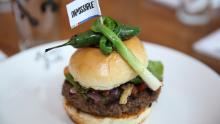
White Castle is announcing it is introducing a vegetarian fake-meat version of its famous mini-burgers. The burger uses a patty made by a California-based start-up, Impossible Foods, which is one of several scientifically engineered products made to make plant-based ingredients taste uncannily like juicy ground beef.

Called the Impossible Slider, it will be initially sold at 140 White Castle eateries in the New York, New Jersey and greater Chicago areas with the potential for a nationwide rollout.

The White Castle Impossible Slider — made with smoked cheddar cheese, pickles, onions and a bun — features a 2-ounce patty and costs $1.99. That compares to the chain’s traditional 0.9-ounce mini-cheeseburger at about 94 cents, depending on the store location.

The new choice might come as a surprise to White Castle devotees, especially since the fake-beef burgers have largely been confined to more highbrow burger chains and restaurants until now. But White Castle executives figured it was time to give fake beef a try.

“Plant-based proteins are growing. We felt it was a good opportunity to test it with our customers,” CEO Lisa Ingram said. “We think it will appeal to a broad range of customers — those that are meat eaters who want to try something different and non-meat eaters who want this.”

She also said the new sliders might bring in new customers, too.

This isn’t White Castle’s first foray into meatless. It has been selling a Veggie Slider since 2015.

The new Slider is bigger, because “the new taste comes through more fully” when that size patty is on the regular 2-inch-squared bun, according to the company.

Until now, Impossible Foods’ faux meat was served in more upscale chains, such as Fatburger, Umami and actor Mark Wahlberg’s Wahlburger restaurant.

Competitor Beyond Meat’s Beyond Burgers joined the TGI Friday’s menu in January and can be found on shelves of large stores such as Kroger and Target.

Animal-protein titan Tyson Foods, which acquired a 5% ownership stake in Bill Gates-backed Beyond Meat in 2016, increased its investment in December to an undisclosed amount. Last fall, Nestle announced plans to acquire Sweet Earth, a plant-based foods manufacturer.

The Impossible Slider represents what few in the traditional beef industry thought possible — that cowless meat would be a hit in a country known for its meat-and-potatoes diet and love of burgers.

Plant-based meat alternatives are growing at rate of about 11% a year, according to the research firm Acosta. The market isn’t just vegetarians: Some 71% of people who buy plant-based meat also eat the real thing.

The meat imitators present enough of a threat that in February, the U.S. Cattlemen’s Association filed a petition with the U.S. Department of Agriculture, asking that the terms “meat” and “beef” be applied only to food made directly from animals. Impossible Foods’ burger is made of water, wheat protein, potato protein, coconut oil and heme, an iron-heavy molecule that gives it its meaty taste.

“Interest in meat alternatives seems to be driven by consumers at large, not just those looking for vegetarian lifestyles, but looking for diversification of tastes and health benefits,” said Billy Roberts, senior food and drink analyst at the global market research firm Mintel.

More: Where’s the beef? Not in these new plant-based burgers

More: Burgers now outselling classic jambon-beurre baguette sandwiches in France

More: Lego bricks will soon be plant-based, but don’t eat them

“Our business is a growth business. There’ll be increased demands for products like the Impossible Burger,” Impossible Foods Chief Operating Officer David Lee said. “People are increasingly asking about what impact food has on the environment and our health.”

His company recently expanded its manufacturing facility in Oakland and can produce 1 million pounds of its meat alternatives a month. That’s what will enable Impossible Foods to produce all the patties White Castle needs, though the privately-held Columbus, Ohio-based 376-unit chain declined to say how many it needs to sell to say the new product is a success.