Bonobo monkeys are among the group of hominid primates Spain wishes to protect, saying they share common traits with human beingsALAMY
In 1975 the founder of a new field of biomedical ethics came up with 15 criteria by which someone’s “humanhood” could be judged.
Among the qualities defined by Dr Joseph F Fletcher, an ordained Episcopal priest in the US and a controversial professor of ethics who espoused the virtues of euthanasia, were some minimal intelligence, self-awareness, self-control, a sense of time and concern for others.
These, he said, distinguish us from our animal ancestors.
Yet today the Spanish government is citing Fletcher’s research as part of efforts to create a law to protect animals, arguing that the hominid family of primates, which includes gorillas, orangutans, bonobos and chimpanzees, is close to another family member — humans — in cognitive ability.
The objectives of the law, according to the ministry of social rights, which is drafting the legislation, are the prohibition of experimentation and research on great apes if it causes them harm.
Advertisement
It will also establish the conditions of their ownership or custody as well as ban their use for commercial purposes, including in shows, and the improvement of efforts for their conservation.
The government has taken the first step by launching a public consultation on the law that would affect the animals. The reason for the law lies in their “genetic closeness” to humans and because “they share the 15 attributes that bioethicist Joseph Fletcher once established to define the human personality”, says the ministry’s public consultation document.
The government argues that in addition to the fact that Spanish law considers animals to be sentient beings, in 1997 an international confederation decided to classify great apes in the Hominidae family, alongside humans and our extinct ancestors.
Chimpanzees are classified as part of the Hominidae family alongside humans
AFP/GETTY IMAGES
“This decision, accepted by the entire scientific community, is of great importance as it puts these beings on the same level as our ancestors, homo erectus, homo habilis, australopithecus, etc,” says the document.
The ministry adds that great apes “have cognitive abilities such as learning, communication and complex reasoning that bring them close to those of human beings”.
Advertisement
The creation of the legislation was mandated by the Animal Welfare Act, which was passed last year, where it was introduced as an additional provision during its passage through parliament.
The idea of a law on great apes is not new in Spain. In 2006 the organisation Proyecto Gran Simio promoted a non-legislative proposal but it did not prosper. “This law on great apes would be the first in the world and in this way Spain would recognise what science admits and supports, that non-human hominids are our evolutionary brothers and sisters and being within our own family, they deserve special recognition,” Pedro Pozas Terrados, head of of the project, said.
Although scientists have been investigating the evidence of biological evolution for over a century, some parts of the fossil record remain maddeningly enigmatic, and finding evidence of Earth’s earliest animals has been particularly challenging.
Unbiased. Nonpartisan. Factual.
Our daily newsletter
Hidden evolution
Information about evolutionary events hundreds of millions of years ago is mainly gleaned from fossils. Familiar fossils are shells, exoskeletons and bones that organisms make while alive. These so-called “hard parts” first appear in rocks deposited during the “Cambrian explosion,” slightly less than 540 million years ago.
The seemingly sudden appearance of diverse, complex animals, many with hard parts, implies that there was a preceding interval during which early soft-bodied animals with no hard parts evolved from simpler animals. Unfortunately, until now, possible evidence of fossil animals in the interval of “hidden” evolution has been very rare and difficult to understand, leaving the timing and nature of evolutionary events unclear.
There is indirect evidence regarding how and when animals may have appeared. Animals by definition ingest pre-existing organic matter, and their metabolisms require a certain level of ambient oxygen. It has been assumed that animals could not appear, or at least not diversify, until after a major oxygen increase in the Neoproterozoic Era, sometime between 815 and 540 million years ago, resulting from accumulation of oxygen produced by photosynthesizing cyanobacteria, also known as blue-green algae.
It is widely accepted that sponges are the most basic animal in the animal evolutionary tree and therefore probably were first to appear. Yes, sponges are animals: they use oxygen and feed by sucking water containing organic matter through their bodies. The earliest animals were probably sponge-related (the “sponge-first” hypothesis), and may have emerged hundreds of millions of years prior to the Cambrian, as suggested by a genetic method called molecular phylogeny, which analyzes genetic differences.
Based on these reasonable assumptions, sponges may have existed as much as 900 million years ago. So, why have we not found fossil evidence of sponges in rocks from those hundreds of millions of intervening years?
Under the right conditions, soft sponge tissue made from spongin fibres can create a distinctive fossil. (Elizabeth C. Turner), Author provided
Work on modern and fossil sponges has shown that these sponges can be preserved in the rock record when their soft tissue is calcified during decay. If the calcified mass hardens around spongin fibres before they too decay, a distinctive microscopic meshwork of complexly branching tubes results appears in the rock. The branching configuration is unlike that of algae, bacteria or fungi, and is well known from limestones younger than 540 million years.
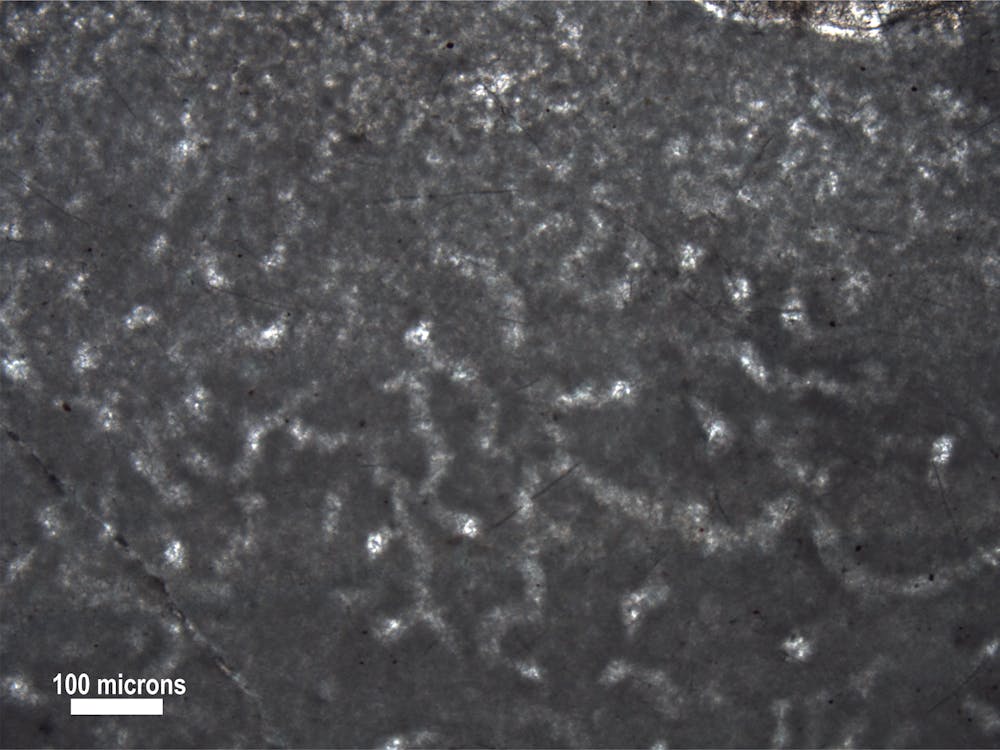
This may be an 890 million year old sponge fossil. (Elizabeth C. Turner), Author provided
Although my proposal may initially seem outrageous, it is consistent with predictions and assumptions that are common in the paleontological community: the new material seems to validate an extrapolated timeline and a predicted identity for early animals that are already widely accepted.
If these are indeed sponge fossils, animal evolution can be pushed back by several hundred million years.
The early possible sponges that I describe lived with localised cyanobacterial communities that produced oxygen oases in an otherwise low-oxygen world, prior to the Neoproterozoic oxygenation event. These early sponges may have continued living in similar environments, possibly unchanged and unchallenged by evolutionary pressure, for up to several hundred million years, before more diverse animals emerged.
The existence of 890-million-year-old animals would also indicate that biological evolution was not substantially affected by the controversial Cryogenian glacial episodes — so-called “snowball Earth” — that began around 720 million years ago.
My unusual fossil material may provide a new perspective on Darwin’s dilemma. However, radical new ideas are generally not fully accepted by the scientific community without vigorous discussion; I expect lively controversy to ensue. At some point, probably years in the future, a consensus may develop based on further work. Until then, enjoy the debate!
The last ancestor that we shared with apes had its own set of traits, and was different from both us and modern apes.By Marcia WendorfMay 10, 2021Man-Half-tube/iStockPhoto
The truth is that we don’t know where we, homo sapiens, came from. In his 1871 work, In The Descent of Man, Charles Darwin speculated that humans originated in Africa, and that we evolved from an ancestor who was different from any currently living species.
Now, a new study by an international group of paleoanthropologists, with a wide range of specialties, have backed up Darwin by concluding that it is likely that the last ancestor that we shared with apes had its own distinct set of traits that are different from those of both modern humans and modern apes.
Historically, two major approaches have been used in analyzing human ancestry:
Top-down – uses living apes, especially chimpanzees, to reconstruct our origins
Bottom-up – uses the fossil record of both humans and apes; it shows multiple possibilities both for what the LCA looked like, and where he roamed.
In reviewing the studies surrounding these diverging approaches, the authors of the paper argue that there are limitations to relying on just one or the other of these opposing approaches. This is because the top-down studies often assume that modern ape species share habitat and features of earlier groups, while bottom-up studies tend to give individual fossil apes a more important evolutionary role than may be warranted.
In an attempt to reconcile these approaches to identifying our ancient ancestor, the scientists looked at what the environment must have been like for the Pan-Homo last common ancestor, or LCA.
The Miocene epoch existed from around 23 to 5.3 million years ago, and a number of fossil ape genera from that era have been found. However, they show a combination of features common to both “orthograde” (upright) and “pronograde” (walking on all fours) body plan, which has led some scientists to exclude the Miocene apes from the human lineage, and there is no scientific consensus on the evolutionary role played by these fossil apes.
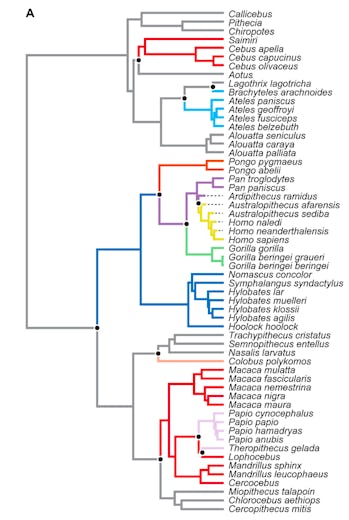
The journey from monkeys to us. Source: Almécija/AAAS
Some scientists espouse the theory that some Miocene apes dispersed out of Africa and into Eurasia, approximately 16 to 14 million years ago, before the hominins diverged from apes. Some of these apes gave rise to the line that produced orangutans, and the European “Dryopith” apes, while others returned to Africa where they evolved into modern African apes and hominins. Others interpret dryopiths as broadly ancestral to hominids or as an evolutionary dead end.
During the late Miocene period in Africa, increased habitat fragmentation may have led to the evolution of African ape knuckle-walking, and hominin bipedalism, or walking on two feet, from a common orthograde ancestor who lived in the trees. Walking on two feet might have allowed our human ancestors to adapt their diets and locomotion, and escape the “specialization trap” that kept other apes in an arboreal environment.
The study concluded that future research efforts should focus on looking for Miocene ape fossils in areas where they have yet to be found. The scientists also concluded that data-driven modeling should take precedence over trying to fit evolutionary scenarios to every fossil find.
Hominin fossils have been found in eastern and central Africa, and possibly also in Europe. Fossils of over 50 genera of ancient apes have been found in Africa and Eurasia, however, as Dr. Sergio Almécija, a researcher in the Division of Anthropology at the American Museum of Natural History told Sci-News “… there is no scientific consensus on the evolutionary role played by these fossil apes.”
Kelsey Pugh, one of the study co-authors, added that, “The unique and sometimes unexpected features and combinations of features observed among fossil apes, which often differ from those of living apes, are necessary to untangle which features hominins inherited from our ape ancestors and which are unique to our lineage.”
Miocene ape fossil locations. Source: Source: Almécija/AAAS
Where do we go from here?
The new study seems to put us back to square one as to where we came from. Every ancient religion has its own theory of how we came to be. Giorgio A. Tsoukalos, better known as “the hair guy,” who is a producer of the show “Ancient Aliens” on which he often appears, theorizes that humans arose due to visits made to Earth made by ancient aliens. Tsoukalos shares those opinions with others including Erich von Däniken, Zecharia Sitchin, and Robert K. G. Temple.
If you’ve ever wondered why rabbits and hares never evolved to be the size of horses, scientists have now got the answer.
It might sound like a flippant question, but it gets to an important part of evolutionary science: What is it that causes some animal taxonomies to have such a wide variation in size, while with others it’s very small?
For example, lagomorphs – which include rabbits and hares – don’t vary much in size, whereas the closely related rodents can go all the way from the tiny pygmy mouse to the chunky capybaras with hundreds of times as much mass.
“The largest living wild lagomorphs weigh only about 5 kg (11 lbs) on average, a tenth of the largest living rodent, the capybara,” says vertebrate paleontologist Susumu Tomiya from Kyoto University in Japan.
“But some breeds of domestic rabbits and other extinct species can weigh up to 8 kg. We were surprised by this and so began to investigate what sort of external forces keep wild lagomorphs across the world from evolving larger body sizes.”
The researchers analyzed lagomorph sizes past and present, looking at the fossil record and evolutionary history of the mammals, before turning their attention to other ecological factors. It turns out that the presence of ungulates, or hoofed animals, can be linked to lagomorph size.
Following up on the lead, the team looked at energy use across different sizes of lagomorphs and ungulates. They found that once lagomorphs reach around 6 kilograms (about 14 lbs) in mass, they’re at a competitive disadvantage to ungulates.
A return to the fossil record for North America backed up the idea that the smallest contemporaneous ungulate in an area was a big factor in determining the largest lagomorph – anything larger had a lower chance of survival with the bigger, more energy-efficient competitors around.
“We see this pattern today across numerous eco-regions, suggesting that there is an evolutionary ceiling placed on lagomorphs by their ungulate competitors,” says Tomiya.
The researchers point out that there are other factors that come into play once lagomorphs become too big to operate at optimum capacity: competition from other animals from the same clade and increased danger from predators.
However, it’s the ungulate comparison that seems to have had the most effect in this case. The research feeds into two contrasting ideas about how species evolve: the ‘red queen’ hypothesis, which ascribes most importance to species competition, and the ‘court jester’ hypothesis, which says abiotic forces like climate changes have the most impact.
According to the research, it seems that the red queen model is the one that’s most significant here, against the backdrop of abiotic forces that aren’t anything to do with animal competition.
“An ongoing debate in evolutionary biology concerns whether biological or environmental processes are more important in shaping biological diversity,” says Tomiya.
“For some time, the court jester model – ascribing diversity to abiotic forces such as the climate – has been dominant, due to the difficulty of studying biological interactions in the fossil record.”
These results serve as a reminder that we can’t ignore the effects of ignore species competition, however, as it seems to be the main reason we don’t have horse-sized rabbits and hares.
Reconstructions based on intuition can distort views of what extinct species looked like
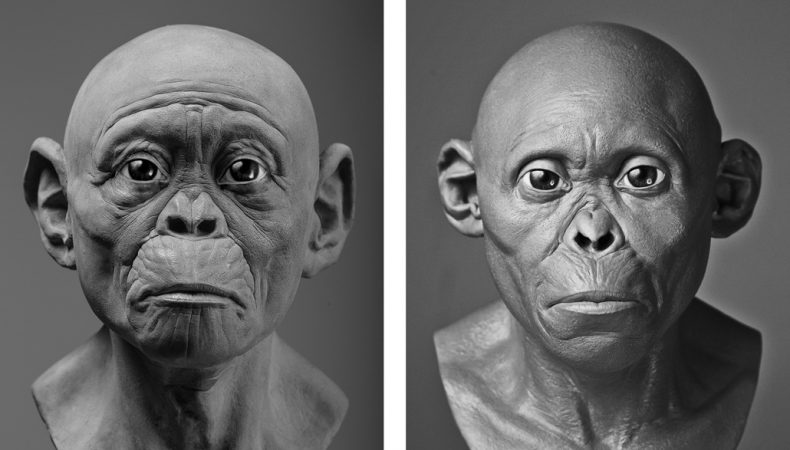
New standards for reconstructing extinct hominids could lead to more accurate representations, such as this sculpture of a 2.8-million-year-old Australopithecus africanus youngster known as the Taung child.G. VINAS, R.M. CAMPBELL, M. HENNEBERG AND R. DIOGO
Depictions of extinct human ancestors and cousins are often more art than science.
Take, for example, two reconstructions of the Taung child, a 2.8-million-year-old Australopithecus africanus skull discovered in South Africa in 1924. One version, made using a sculptor’s intuition, appears more apelike. A second version, made while working alongside a scientist, appears more humanlike.
Now, the researchers that produced the dueling images are attempting to remove some of this subjectivity by introducing standards that may give more accurate and reproducible portraits of species known only from fossilized bone. The team points out some of the flaws in facial reconstructions of ancient hominids — and the social and ethical implications misleading portraits may have — in a report published February 26 in Frontiers in Ecology and Evolution.
These two reconstructions of the Taung child depend on subjective decisions to make it appear more apelike (left) or humanlike (right).G. VINAS, R.M. CAMPBELL, M. HENNEBERG AND R. DIOGO
Getting the depictions right matters, says Rui Diogo, a biological anthropologist at Howard University in Washington, D.C. When museumgoers see artists’ renditions of Neandertals or extinct hominids, visitors often don’t realize how much bias creeps into the work. “They think it is reality,” he says. And that can skew people’s views and reinforce existing prejudices of present-day people.
For instance, reconstructions of multiple extinct hominids in the Smithsonian National Museum of Natural History in Washington, D.C., portray skin getting lighter and lighter in color as species became more and more bipedal. “But there is zero evidence to say the skin was whiter,” Diogo says. Such a depiction might give the mistaken impression that people with lighter skin are more evolved.
Sign Up For the Latest from Science News
Headlines and summaries of the latest Science News articles, delivered to your inboxE-mail*GO
Artists’ depictions can also give erroneous views of human evolution and extinct species’ intelligence and behavior, says Diogo’s coauthor Ryan Campbell, an anatomical scientist and physical anthropologist at the University of Adelaide in Australia. For instance, Neandertals are often portrayed as having matted, dirty hair. “It’s as if there is a bias toward portraying our ancestors as if they were stupid and didn’t have hygiene,” he says.
But animals of all kinds groom themselves, and there is no reason to think that Neandertals or other extinct hominids were any different. In fact, presenting reconstructions without hair might be more accurate, says Campbell. Hair is usually not preserved in fossils and DNA data from bones may hint at hair color, but don’t reveal grooming habits.
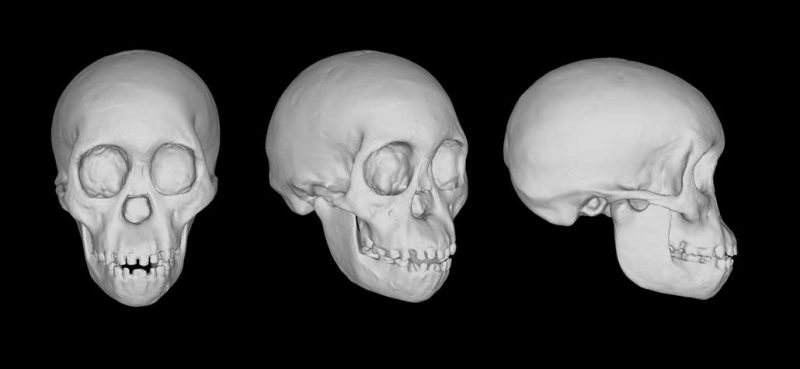
Accurate artistic depictions of extinct hominids begin with precise scans of skeletal findings, such as this digital scan of a cast made from the original Taung child skull fossil.G. VINAS, R.M. CAMPBELL, M. HENNEBERG AND R. DIOGO
“Reconstructing hair is not even informed speculation,” Campbell says. “It’s imaginary speculation.”
Scientists and artists often work together to produce reconstructions, but the choices they make may be driven more by whim than science, the researchers contend. By studying muscles in the great apes and other nonhuman primates, Diogo and colleagues have constructed reference databases that scientists might use in reconstructing faces from fossils. Even then, whether a sculptor chooses chimpanzee or human muscles as their starting point can produce very different outcomes.
“The reconstructions of the past, most of them did not have a scientific basis,” Diogo says. “Our goal is to change the methods and to change the biases” to give a more accurate view of human evolution.
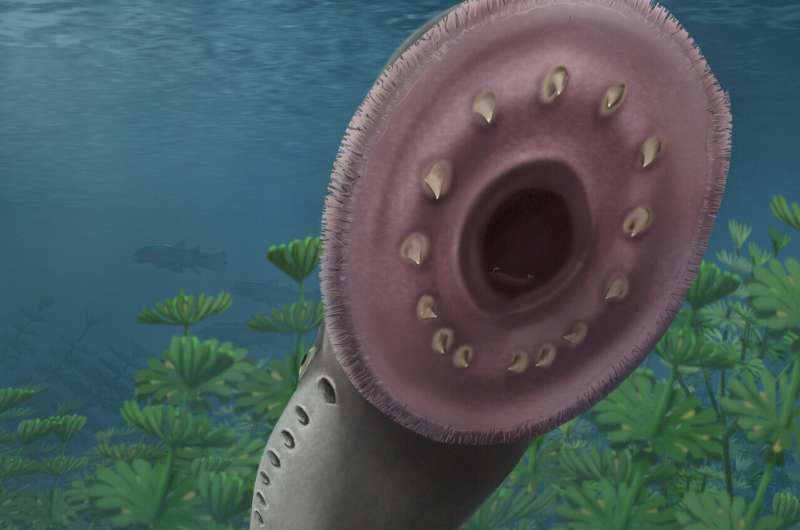
Artist’s reconstruction showing the life stages of the fossil lamprey Priscomyzon riniensis. It lived around 360 million years ago in a coastal lagoon in what is now South Africa. Clockwise from right: A tiny, yolk-sac carrying hatchling with its large eyes; a juvenile; and an adult showing its toothed sucker. Credit: Kristen Tietjen
A new study out of the University of Chicago, the Canadian Museum of Nature and the Albany Museum challenges a long-held hypothesis that the blind, filter-feeding larvae of modern lampreys are a holdover from the distant past, resembling the ancestors of all living vertebrates, including ourselves. The new fossil discoveries indicate that ancient lamprey hatchlings more closely resembled modern adult lampreys, and were completely unlike their modern larvae counterparts. The results were published on March 10 in Nature.
Lampreys—unusual jawless, eel-like, creatures—have long provided insights into vertebrate evolution, said first author Tetsuto Miyashita, Ph.D., formerly a Chicago Fellow at the University of Chicago and now a paleontologist at the Canadian Museum of Nature. “Lampreys have a preposterous life cycle,” he said. “Once hatched, the larvae bury themselves in the riverbed and filter feed before eventually metamorphosing into blood-sucking adults. They’re so different from adults that scientists originally thought they were a totally different group of fish.
“Modern lamprey larvae have been used as a model of the ancestral condition that gave rise to the vertebrate lineages,” Miyashita continued. “They seemed primitive enough, comparable to wormy invertebrates, and their qualities matched the preferred narrative of vertebrate ancestry. But we didn’t have evidence that such a rudimentary form goes all the way back to the beginning of vertebrate evolution.”
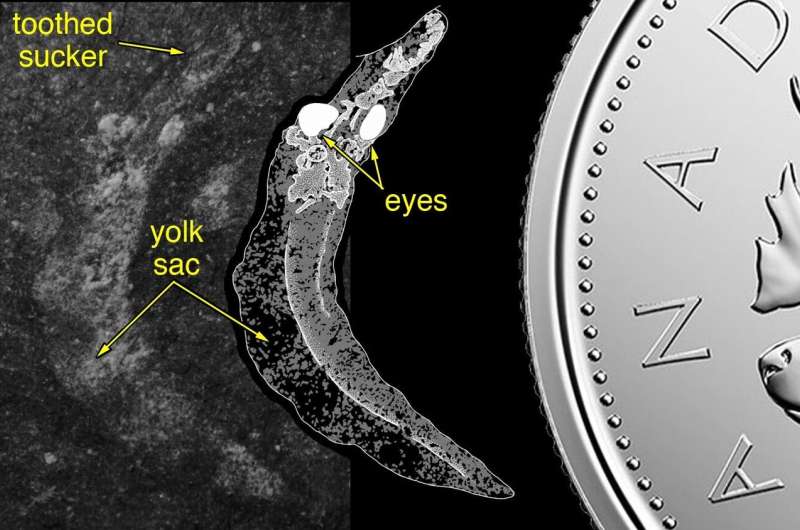
Newly discovered fossils in Illinois, South Africa and Montana are changing the story. Connecting the dots between dozens of specimens, the research team realized that different stages of the ancient lamprey lifecycle had been preserved, allowing paleontologists to track their growth from hatchling to adult. On some of the smallest specimens, about the size of a fingernail, soft tissue preservation even shows the remains of a yolk sac, indicating that fossil record had captured these lampreys shortly after hatching.
Fossil of the hatchling of Priscomyzon, from the Late Devonian around 360 million years ago. The hatchling is already equipped with large eyes and toothed sucker, which in modern lampreys only develop in adults. (The Canadian 25-cent coin offers a size comparison for the tiny fossil). Credit: Tetsuto Miyashita
Crucially, these fossilized juveniles are quite unlike their modern counterparts (known as “ammocoetes”), and instead look more like modern adult lampreys, with large eyes and toothed sucker mouths. Most excitingly, this phenotype can be seen during the larval phase in multiple different species of ancient lamprey.
The researchers say that these results challenge the 150-year-old evolutionary narrative that modern lamprey larvae offer a glimpse of deep ancestral vertebrate conditions. By demonstrating that ancient lampreys never went through the same blind, filter-feeding stage seen in modern species, the researchers have falsified this cherished ancestral model.
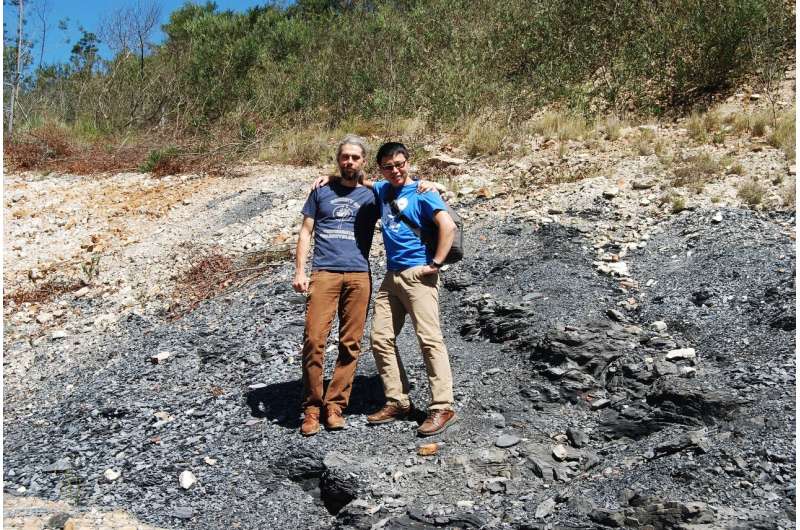
Tetsuto Miyashita (right) stands with researcher Rob Gess in 2016 atop the shale locality in Makhanda, South Africa that has yielded fossils of the 360 million-year-old Priscomyzon lamprey. Credit: Tetsuto Miyashita
“We’ve basically removed lampreys from the position of the ancestral condition of vertebrates,” said Miyashita. “So now we need an alternative.”
After looking back at the fossil record, the team now believes that extinct armored fishes known as ostracoderms might instead represent better candidates for the root of the vertebrate family tree, whereas modern lamprey larvae are a more recent innovation. The team thinks the evolution of filter-feeding larvae may have allowed lampreys to populate rivers and lakes. Fossil lampreys reported in the new study all came from marine sediments, but modern lampreys mostly live in freshwater.
The researchers say that this is the sort of discovery that can rewrite textbooks. “Lampreys are not quite the swimming time capsules that we once thought they were,” said Coates. “They remain important and essential for understanding the deep history of vertebrate diversity, but we also need to recognize that they, too, have evolved and specialized in their own right.”
TARZAN SWINGING FROM TREE TO TREE might seem like a Hollywood attempt at imagining the life of primitive men, but new findings suggest our ancient ancestors really were swingers.
WHAT’S NEW — Research published Wednesday in the journal Science Advances suggests the last common ancestor of hominids — a category of great apes that includes chimpanzees, gorillas, orangutans, and humans — climbed and swung in trees.
“Our findings support the view that humans and chimpanzees evolved from an ancestor that had similarities to modern apes in their locomotor adaptation,” lead author Thomas C. Prang, an assistant professor at Texas A&M University, tells Inverse.
SOME BACKGROUND — Most scientists recognize that the highly dextrous human hand seems to differ in shape and form from the hands primates use to swing from trees.
However, this evidence has given rise to a disputed hypothesis: Humans evolved from a quadrupedal ancestor that used all four limbs for movement on the ground, rather than a bipedal ancestor that suspends from trees.
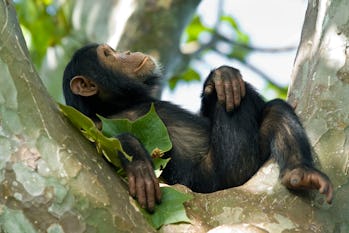
A chimpanzee in a tree. The researchers suggest the ancient ancestor of humans swung from trees like chimps. Getty
Proponents of this hypothesis believe the last common ancestor was more “monkey-like” and less similar to, say, chimpanzees or bonobos.
The researchers in this study were skeptical of this idea and wanted to test its merits.
HOW THEY DID IT — Researchers used a sample of 400-plus specimens, encompassing both living primates and ancient hominoid fossils.
First, researchers analyzed the ancient hand bones of Ardipithecus ramidus, which believers of the disputed hypothesis use to support their idea regarding a quadrupedal last common ancestor. Ardipithecus ramidus is a human ancestor that lived nearly 4.4 million years ago. Our understanding of it is predominantly linked to a partial skeleton found in 2009, nicknamed ‘Ardi.’
The initial interpretation of this hand suggested the last common ancestors of humans and chimpanzees used a form of locomotion called “above-branch clambering,” Prang explains.
The remains of Ardipithecus ramidus.Raphael GAILLARDE/Gamma-Rapho via Getty Image
He doubts this interpretation for one reason: monkeys and lemurs are the only primates that use above-branch climbing, and their much smaller bodies use external tails to help them with tree climbing — unlike the subject of their study.
“The inference of ‘above-branch’ adaptations in Ardipithecus is somewhat problematic since it’s chimpanzee-sized and lacks an external tail [like all apes and humans],” Prang says.
To test it, Prang and his colleagues reconstructed the evolution of the hominin hand and how it may have adapted in ancient environments.
A figure from the study showing the evolution of hands in various hominoids, including humans and Neanderthals.
WHAT THEY FOUND — The results showed that Ar. ramidus was most similar to chimpanzees, bonobos, and orangutans compared to “non-suspensory” monkeys. Overall, they compared the specimen across a sample of 53 anthropoid primate species.
Ar. ramidus had these suspensory traits — which enabled them to swing from tree branches — before a significant evolutionary shift occurred with the lineages of Homo (humans) and Australopithecus, an ancient ancestor of hominins, which includes humans and chimpanzees.
“The hand of Ardipithecus suggests that the last common ancestor of humans and chimpanzees was adapted to climbing tree trunks and suspending the body beneath branches,” Prang says.
The study, in turn, is framed as a debunking of the earlier hypothesis suggesting hominins evolved from an ancestor “with a generalized hand that lacked suspensory adaptations.”
According to Prang, the study also indicates an important evolutionary step related to the development of tool use.
“We show a major evolutionary jump between the hand of Ardipithecus and all later hominins that happens to coincide with the loss of tree climbing adaptations in the foot and the earliest known stone tools and stone tool-cut-marked animal fossils,” Prang says.
This finding provides support for the idea that Ar. ramidus displayed an early form of bipedalism — or the ability to walk upright on two legs — which helps us understand how human hands and feet evolved.
“Our study provides some support for the hypothesis that human hands and feet ‘co-evolved,’ which previous studies have suggested on the basis of comparisons of patterns of hand/foot trait relationships, and evolutionary simulations, among humans and chimpanzees,” Prang says.
The researchers refer to Charles Darwin, the father of evolutionary theory, in discussing the implications of their findings.Getty
DIGGING INTO THE DETAILS — The researchers’ new findings harken back to the works of more historical evolutionary scholars.
“Our analysis is much more consistent with what people like Thomas Henry Huxley and Sir Arthur Keith proposed in the late 19th and early 20th century based on anatomical comparisons between humans and apes,” Prang says.
The most notable of these historical scholars is Charles Darwin, the father of evolution. Prang connects Darwin’s work to their findings on bipedalism in the ancient specimen, which can help explain human evolution.
“The classic idea attributed to Darwin is that bipedalism ‘freed the hands’ from their primary role in quadrupedal locomotion, which enabled natural selection to push hand anatomy in a new direction [directly or indirectly] related to manual dexterity, possibly useful for the manufacture and use of stone tools,” Pran says.
WHY IT MATTERS — According to the study, these findings “resolve a long-standing debate about the role of suspension in the ancestry of humans.”
Alexandros Karakostis, a hand biomechanics expert not affiliated with the study, describes the findings to Inverse as “very intriguing.” It provides a robust answer to “a heated debate,” Karakostis says — although it’s a debate that’s likely to continue.
“In this context, this new study identifies suspensory adaptations in the 4.4 million-year-old hand remains of Ardipithecus ramidus, suggesting that human hand morphology may have emerged from an evolutionary shift between Ardipithecus and Australopithecus,” he says.
A sculptor’s rendering of the hominid Australopithecus afarensis. The researchers in this study discuss the evolution of Australopithecus. Getty
WHAT’S NEXT — In the future, the study team wants to examine the Ardipithecus hand in more detail.
Ameline Bardo, a postdoctoral research associate at the University of Kent not affiliated with the study, agrees a more detailed analysis of the hand bones would be necessary to “better understand the links between form and function of his hand.” This analysis, Bardo tells Inverse, may contribute to an understanding of the ancient creature’s movements.
Overall, Bardo views the study as “very well done” and contributes to the idea “early hominins evolved from an ancestor with a varied positional repertoire including suspension and vertical climbing.”
The study team is most excited to explore the paper’s implications for the evolution of great apes and humans
“If it is true that humans and chimpanzees evolved from an African ape-like ancestor, it implies that each African ape lineage evolved at different rates,” Prang says.
“It will be important to think about the evolutionary histories of African ape populations and how the evolutionary process might have shaped their anatomy and behavior over the last several million years.”
Abstract: The morphology and positional behavior of the last common ancestor of humans and chimpanzees are critical for understanding the evolution of bipedalism. Early 20th century anatomical research supported the view that humans evolved from a suspensory ancestor bearing some resemblance to apes. However, the hand of the 4.4-million-year-old hominin Ardipithecus ramidus purportedly provides evidence that the hominin hand was derived from a more generalized form. Here, we use morphometric and phylogenetic comparative methods to show that Ardipithecus retains suspensory adapted hand morphologies shared with chimpanzees and bonobos. We identify an evolutionary shift in hand morphology between Ardipithecus and Australopithecus that renews questions about the coevolution of hominin manipulative capabilities and obligate bipedalism initially proposed by Darwin. Overall, our results suggest that early hominins evolved from an ancestor with a varied positional repertoire including suspension and vertical climbing, directly affecting the viable range of hypotheses for the origin of our lineage.
“The mystery seems to have been made particularly abominable to him by its highly publicised use by the keeper of botany at the British Museum to argue for divine intervention in the history of life,” he says.
What is the abominable mystery?
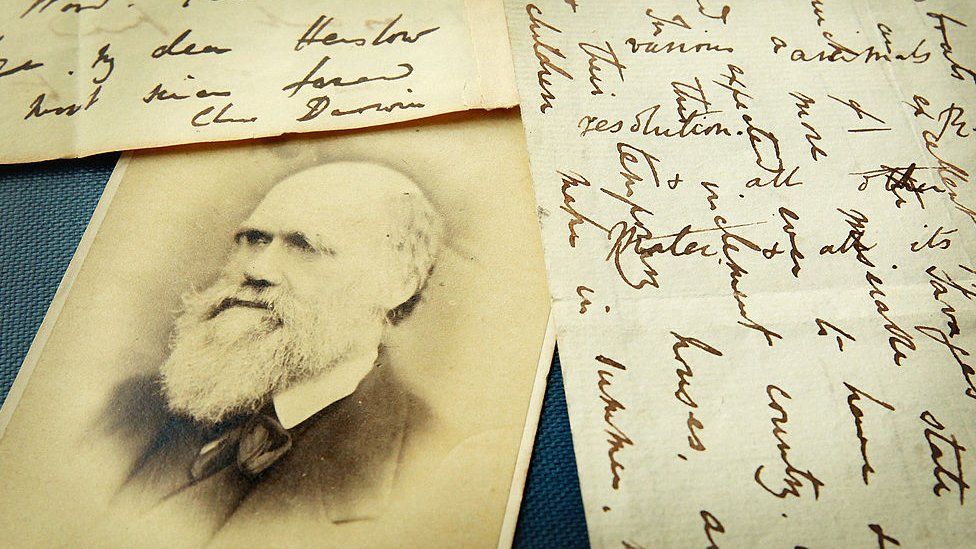
Darwin coined the phrase, abominable mystery, in 1879. In a letter to his closest friend, botanist and explorer Dr Joseph Hooker, he wrote: “The rapid development as far as we can judge of all the higher plants within recent geological times is an abominable mystery.”
image captionThere are more than 200,000 species of flowering plants
The mystery centres on the rise of the flowering plants, or angiosperms, the family of plants that produce flowers and bear their seeds in fruits.
They make up the vast majority of all known living plants, from oaks to wildflowers and water lilies.
Flowering plants appeared on Earth relatively recently on a geological timescale, then swiftly diversified in an explosion of colour, shape and form.
“In the fossil record they appear very suddenly in the Cretaceous, dated at about 100 million years ago, and there’s nothing that looks like an angiosperm before them and then they suddenly appear and in considerable diversity,” says Prof Buggs.
Questions raised by the sudden appearance of flowering plants are at the heart of Darwin’s abominable mystery, he explains.
“Why isn’t there a gradual evolution of the angiosperms? Why can’t we see intermediate forms between the gymnosperms – things like conifers – and the flowering plants? And why, when they appear, are they already so diverse?”
Why was Darwin puzzled?
Darwin was deeply bothered by how flowering plants conquered the world seemingly in the blink of an eye, while other large groups, such as the mammals, evolved gradually.
image captionTulips in bloom in Magdesburg, Germany
The advent of flowering plants suggested evolution could be both rapid and abrupt, in direct contradiction to an essential element of natural selection, natura non facit saltum – nature makes no leap.
Darwin toyed with the idea that flowering plants might have evolved on an as yet undiscovered island or continent.
In August 1881, only months before his death, he wrote to Hooker: “Nothing is more extraordinary in the history of the Vegetable Kingdom, as it seems to me, than the apparently very sudden or abrupt development of the higher plants. I have sometimes speculated whether there did not exist somewhere during long ages an extremely isolated continent perhaps near the South Pole.”
What’s the new thinking?
In the library at the Royal Botanic Gardens, Kew, Prof Buggs came across a re-print of a lecture from 1876 by the Scottish botanist William Carruthers that gives new context to Darwin’s thinking.
William Carruthers rose to become keeper of botany at the British Museum, and “a towering figure at the time in paleobotany”.
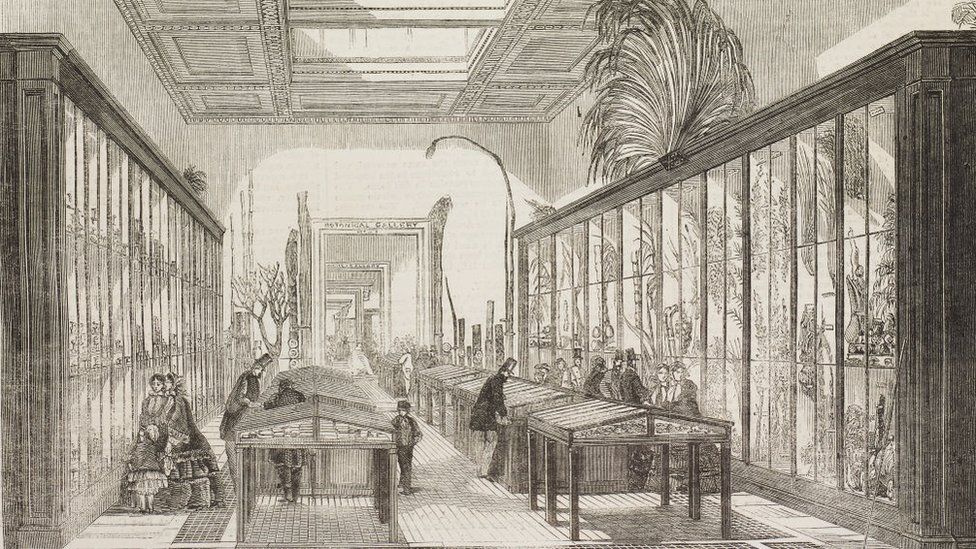
image captionBotanical room of the British Museum in 1858
In a lecture to the Geologists Association in the library of University College London, Carruthers highlighted the problems that Darwin had with the fossil record, focussing on the sudden appearance of flowering plants.
His comments were reported in The Times and the scientific press, sparking a public debate.
“Carruthers was using the abominable mystery to launch an attack on evolution itself,” says Prof Buggs. “He thought that God had created the angiosperms in the Cretaceous; they hadn’t evolved.
“To Darwin and his friends, this was anathema, basically, because [Carruthers] was trying to bring supernatural explanations into the fossil record.”
But Darwin had a problem. The points Carruthers was making about the fossil record were actually very difficult to explain in terms of evolution, says Prof Buggs.
He thinks this is what prompted Darwin to coin the phrase “an abominable mystery” and makes his case in a scientific paper, published in the American Journal of Botany.
The mystery was to Darwin what Fermat’s Last Theorem was to the 17th Century mathematician Pierre de Fermat, he adds.
“It gives an insight into what was going on in Darwin’s mind in the last few years of his life and it gives it an extra romance, almost, a bit like Fermat’s Last Theorem – Darwin’s last mystery, this problem preying on his mind in his final months.”
And is the mystery solved?
In short, no. “One hundred and forty years later, the mystery’s still unsolved,” says Prof Buggs. “Of course, we’ve made lots of progress in our understanding of evolution and in our knowledge of the fossil record, but this mystery is still there.”
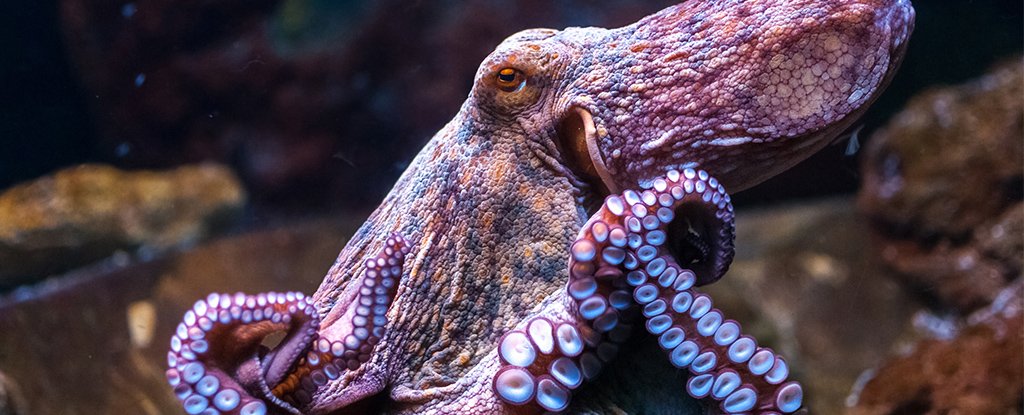
Just when we thought octopuses couldn’t be any weirder, it turns out that they and their cephalopod brethren evolve differently from nearly every other organism on the planet.
This is weird because that’s really not how adaptations usually happen in multicellular animals. When an organism changes in some fundamental way, it typically starts with a genetic mutation – a change to the DNA.
Those genetic changes are then translated into action by DNA’s molecular sidekick, RNA. You can think of DNA instructions as a recipe, while RNA is the chef that orchestrates the cooking in the kitchen of each cell, producing necessary proteins that keep the whole organism going.
But RNA doesn’t just blindly execute instructions – occasionally it improvises with some of the ingredients, changing which proteins are produced in the cell in a rare process called RNA editing.
When such an edit happens, it can change how the proteins work, allowing the organism to fine-tune its genetic information without actually undergoing any genetic mutations. But most organisms don’t really bother with this method, as it’s messy and causes problems more often that solving them.
“The consensus among folks who study such things is Mother Nature gave RNA editing a try, found it wanting, and largely abandoned it,” Anna Vlasits reported for Wired.
But it looks like cephalopods didn’t get the memo.
In 2015, researchers discovered that the common squid has edited more than 60 percent of RNA in its nervous system. Those edits essentially changed its brain physiology, presumably to adapt to various temperature conditions in the ocean.
The team returned in 2017 with an even more startling finding – at least two species of octopus and one cuttlefish do the same thing on a regular basis. To draw evolutionary comparisons, they also looked at a nautilus and a gastropod slug, and found their RNA-editing prowess to be lacking.
“This shows that high levels of RNA editing is not generally a molluscan thing; it’s an invention of the coleoid cephalopods,” said co-lead researcher, Joshua Rosenthal of the US Marine Biological Laboratory.
The researchers analysed hundreds of thousands of RNA recording sites in these animals, who belong to the coleoid subclass of cephalopods. They found that clever RNA editing was especially common in the coleoid nervous system.
So it’s certainly a compelling hypothesis that octopus smarts might come from their unconventionally high reliance on RNA edits to keep the brain going.
“There is something fundamentally different going on in these cephalopods,” said Rosenthal.
But it’s not just that these animals are adept at fixing up their RNA as needed – the team found that this ability came with a distinct evolutionary tradeoff, which sets them apart from the rest of the animal world.
In terms of run-of-the-mill genomic evolution (the one that uses genetic mutations, as mentioned above), coleoids have been evolving really, really slowly. The researchers claimed that this has been a necessary sacrifice – if you find a mechanism that helps you survive, just keep using it.
“The conclusion here is that in order to maintain this flexibility to edit RNA, the coleoids have had to give up the ability to evolve in the surrounding regions – a lot,” said Rosenthal.
As the next step, the team will be developing genetic models of cephalopods so they can trace how and when this RNA editing kicks in.
“It could be something as simple as temperature changes or as complicated as experience, a form of memory,” said Rosenthal.



 We believe in the free flow of information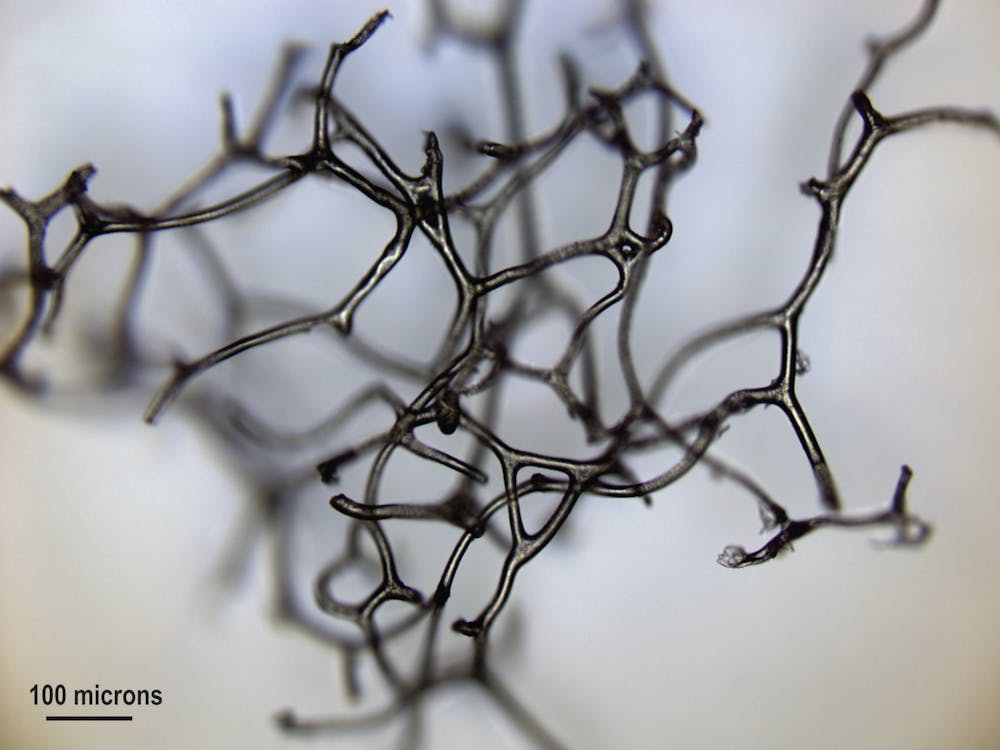

 Top Articles








 Exposing the Big Game