Chronicling the End, Part 1

The End. Everybody has one. Some are nicer than others. The end is not necessarily a bad thing, just an inevitability. What goes up must come down, but the end of one era can be a new beginning for another. Not all endings are unwelcome.

For instance, while the NRA and the Safari Club view the end of hunting as a bad thing, it would actually spell the beginning of a more agreeable era for wildlife—a time when human beings treat animals with respect and compassion, rather than objectifying and maltreating them.

Just as the end of winter brings the promise of spring, the end of the Anthropocene age will bring hope for new life to flourish.

Now, rumor has it there are those who think I’m too negative when referring to the future of humankind. But although I’m a realist when it comes to the future of our species (or rather, the lack thereof) I don’t secretly hope for the violent demise of humanity. If I hope for anything, it’s that people will learn to accept new ways of living lightly on the planet that include eschewing meat, treading softly rather than stomping out gargantuan carbon footprints everywhere, and of course, voluntarily reducing our population in a big way.

Barring that—and if Homo sapiens continues on the currently charted course—then I’m afraid to say I feel the species’ days are numbered. Call me Malthusian (as detractors call Paul Ehrlich for his theories outlined in The Population Bomb), but I’d have to say Thomas Malthus was far ahead of his time when he published the essay, Principle of Population in 1798, wherein he wrote:

“The power of population is so superior to the power of the earth to produce subsistence for man that premature death must in some shape or other visit the human race. The vices of mankind are active and able ministers of depopulation. They are the precursors in the great army of destruction, and often finish the dreadful work themselves. But should they fail in this war of extermination, sickly seasons, epidemics, pestilence, and plague advance in terrific array, and sweep off their thousands and tens of thousands. Should success be still incomplete, gigantic inevitable famine stalks in the rear, and with one mighty blow levels the population with the food of the world.”

It’s hard to believe that Malthus saw all that as far back as 1798. Even harder to believe is that his predictions have not yet come true. The only two things preventing a “Malthusian catastrophe” are technology and mechanization—neither of which I have much faith in. Now, before you go accusing me of being negative, a pessimist or worse, a misanthropist, at least give me credit for seeing the silver lining in every instance. Why, just today I spotted the following article sharing the uplifting news that “Bird flu brings windfall for businesses”…

BEIJING, April 22 (Xinhua) — A new strain of bird flu that has been spotted across China has brought vegetable dealer Xu Jialiang mixed feelings.

For Xu, who has been selling veggies for 20 years in Wuhan, capital of central China’s Hubei Province, the virus is a cause for concern, but also a commercial opportunity.

“Cabbage that was once left to rot has become a hit,” said Xu, adding that he recently sold more than 50 tonnes of cabbage in a single day, double the amount he was selling just two months ago.

“People have become more reluctant to eat poultry, so vegetables have become much more popular,” he said.

The Wuhan municipal bureau of commodity pricing said vegetable prices have surged since the end of March.

The first human H7N9 infection was reported in late March. A total of 102 cases have been reported to date, resulting in 20 deaths.

The poultry-raising industry, restaurants that sell poultry and even producers of shuttlecocks, which are made using bird feathers, have been impacted by the virus.

Figures from the China Animal Agriculture Association showed that direct economic losses for broiler chicken breeders have exceeded 3.7 billion (593 million U.S. dollars).

However, other sectors have been boosted by the virus’s arrival. In addition to vegetable vendors, sellers of traditional Chinese medicine (TCM) have also profited.

At the Zhangshu TCM Wholesale Market, a major TCM market in east China’s Jiangxi Province, the purchase price of processed isatis root surged from 13 yuan per kilo to 22 yuan after health experts claimed that the root can prevent infection.

Lei Da, head of the purchase department at Zhangshu Tianqitang TCM Co., Ltd., said processed honeysuckle, which some have claimed can prevent bird flu, sold out after the infections were reported.

Lei said the company is watching the status of the epidemic closely to decide whether it will increase its stores of the two items.

Insurance companies are also using the virus as an opportunity to boost income. Ping An Insurance, one of China’s largest insurance companies, is selling bird flu insurance that offers 20,000 yuan in compensation if an insurant is confirmed to have become infected. Other companies, such as Taikang Life and Sinosafe Insurance, are also offering bird flu insurance.

However, health experts say poultry products are still safe to eat as long as they are purchased through regulated channels and are thoroughly cooked.

Li Lanjuan, an academic with the Chinese Academy of Engineering, said the virus is sensitive to high temperatures, ultraviolet rays and several kinds of sanitizer.

She ate chicken meat in front of reporters last week to dispel public worries.

“The virus will be killed in two minutes after the temperature reaches 100 degrees Celsius or half an hour if the temperature is 60 degrees Celsius,” said Li.

If Mr. Malthus were here today I’m sure he’d agree that the act of eating Chinese chicken (even if purchased through regulated channels) is one of those “vices of mankind” and an active and able minister of depopulation. …

Consider this the first installment of a new series which will chronicle the ways in which humans are instigating their own undoing. I’m considering starting a new blog and/or book “Chronicling the End,” depending on the feedback I receive. If you like the idea, “Like” this page, or leave a comment below…
Text and Wildlife Photography ©Jim Robertson, 2013. All Rights Reserved

Text and Wildlife Photography ©Jim Robertson, 2013. All Rights Reserved

Hunting Conditions Us to Killing

The Following is an Op/Ed I sent to the New York Times in response to a recent article they featured glorifying hunting. For some reason, they didn’t print this—it must not have fit in with their agenda…


Hunting Conditions Us to Killing

I’d like to thank the New York Times for inadvertently giving us a glimpse inside the hunter’s mind, through their recent article, “Hunting your own dinner.” In my book, Exposing the Big Game: Living Targets of a Dying Sport, I spend an entire chapter probing “Inside the Hunter’s Mind” and I’m here to tell you, it’s a dark and disturbing place in there—and no one divulges that better than the hunters themselves. Here are a couple of quotes from hunters waxing poetic on the thrills they get out of killing:

“I had wondered and worried how it would feel to kill an animal, and now I know. It feels — in both the modern and archaic senses — awesome. I’m flooded, overwhelmed, seized by interlocking feelings of euphoria and contrition, pride and humility, reverence and, yes, fear. The act of killing an innocent being feels — and will always feel — neither wholly wrong nor wholly right.”

“You’re the last one there…you feel the last bit of breath leaving their body. You’re looking into their eyes and basically, a person in that situation is God! You then possess them and they shall forever be a part of you. And the grounds where you killed them become sacred to you and you will always be drawn back to them.”

Both quotes were from people who considered themselves hunters—men who stalked and killed innocent, unarmed victims. The first was taken from the aforementioned Times article written by Bill Heavey, an editor at large for the “sportsman’s” magazine, Field and Stream. The second one triumphantly reliving his conquest was none other than the infamous Ted Bundy, as he sat on death row musing over his many murders to the authors of The Only Living Witness.

It seems that, whether the perpetrator is engaged in a sport hunt or a serial kill, the approach is similar. Though their choice of victims differs, their mindset, or perhaps mental illness, is roughly the same.

Even our former cold war enemy seems to be light years ahead of the U.S. in moving beyond the barbarity of hunting. Oleg Mikheyev, MP of the center-left Fair Russia parliamentary party, told daily newspaper Izvestia just what I’ve been saying all along: “People who feel pleasure when they kill animals cannot be called normal.”

Mikheyev entered a draft law to ban most hunting in Russia and expressed his belief that hunting is unnecessary and immoral, regardless of whether one sees it as a sport, a pastime or an industry. According to the bill, forest rangers will still be allowed to hunt but must first pass a psychological test, which Mikheyev points out, “…can help us in early detection of latent madmen and murderers.”

Here in the states, Heavey went on to write, “What ran in the woods now sits on my plate… What I’ve done feels subversive, almost illicit.”

Then why do it?

Though some hunters like Heavey may put on a show of innocuousness by temporarily eschewing guns and choosing to test their skill at bowhunting—arguably the cruelest kill method in the sportsman’s quiver—the typical American hunter sets out on their expeditions in a Humvee or some equally eco-inefficient full-sized pickup truck, spending enough on gas, gear, beer and groceries to buy a year’s supply of food, or to make a down payment on a piece of land big enough to grow a killer garden.

Clearly the motive for their madness is more insidious than simply procuring a meal.

There’s been plenty of discussion about controlling weapons to stave off the next school shooting, but the media has been mute over the role hunting plays in conditioning people to killing. And the New York Times article is a shameful example of the press pandering to the 5 percent who still find pleasure in taking life. Do we really want to encourage 7 billion humans to go out and kill wildlife for food as if hunting is actually sustainable and wild animal flesh is an unlimited resource?

Overhunting has proven time and again to be the direct cause of extinction for untold species, including the passenger pigeon, the Carolina parakeet and the Eastern elk. Meanwhile, hunters out west are doing a bang-up job of driving wolves back to the brink of oblivion for the second time in as many centuries.

Heavey ended his Times article gloating, “I have stolen food. And it is good.” Like serial killers and school shooters, hunters objectify their victims; so insignificant are they to them that hunters don’t even recognize them for what they are—fellow sentient beings. Does somebody have to point out the obvious—he didn’t just steal “food,” he stole a life.

Text and Wildlife Photography ©Jim Robertson, 2013. All Rights Reserved

Text and Wildlife Photography ©Jim Robertson, 2013. All Rights Reserved

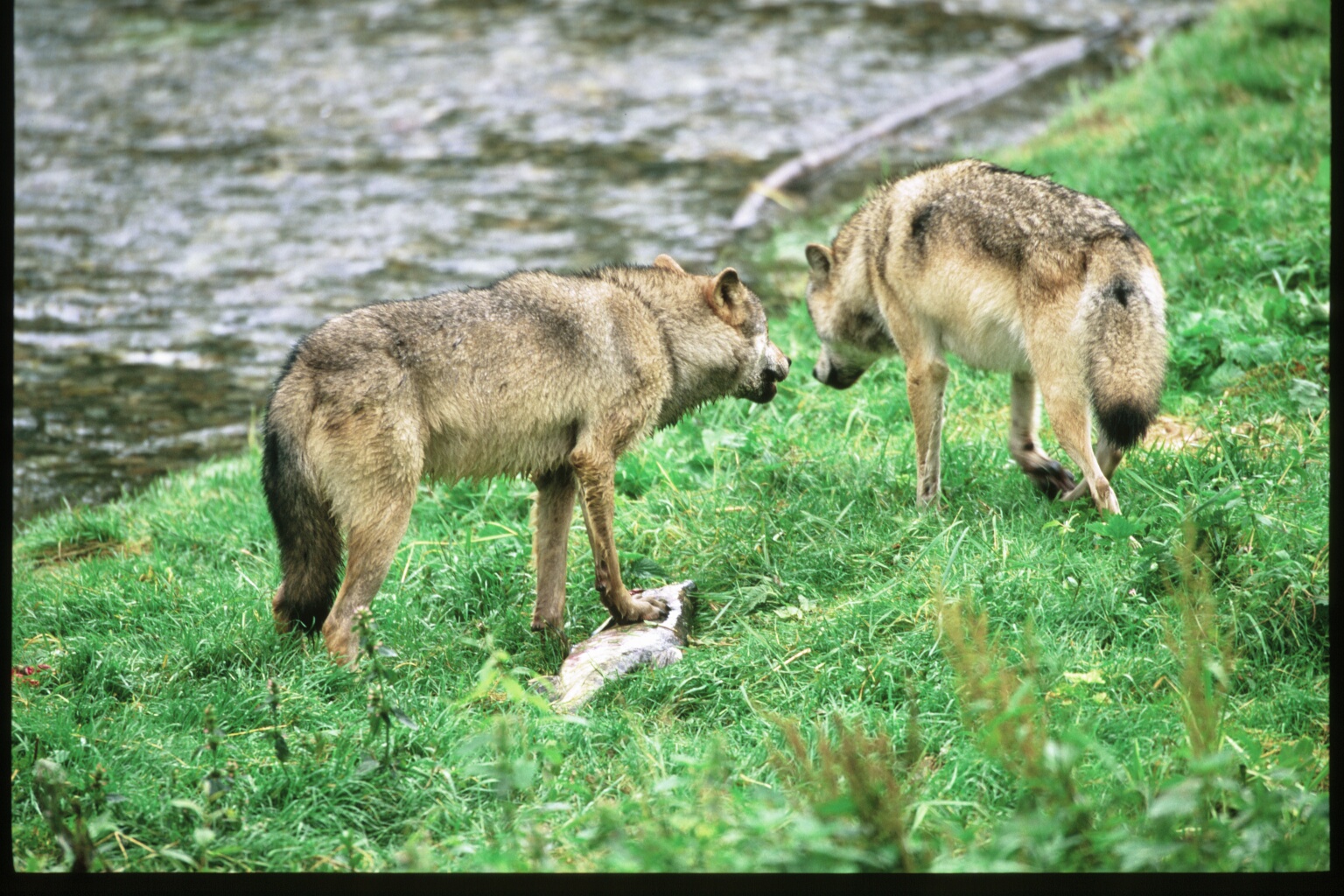
Wolves Are the Only Management “Tool” Necessary

I didn’t mean to set off a pissing match in my last blog post by quoting a group’s recent statement to the Missoulian, “We at Wolves of the Rockies understand and acknowledge the importance of hunting as a tool for managing wolves, and we stand beside the ethical hunter in doing so.” I’m sorry if I misinterpreted that statement, but I thought it made their position on wolf hunting pretty clear: they support it.

And I think it’s obvious what they’re saying with the lines, “We are not advocating the end of wolf hunting. We have only asked for a slight modification to the state wolf management plan to accommodate other legitimate values in this specific locale. Remember, Montana’s wildlife is owned by ALL the people, not just hunters.”

It sounds to me like they feel that wolf “management” through hunting and trapping is acceptable, as long as it doesn’t conflict with another “legitimate value” some other human being has placed on the canines. I would argue that wolves themselves have intrinsic value, as individuals and as a species.

While I whole-heartedly applaud this group’s part in getting a buffer zone closed to hunting and trapping implemented around Yellowstone National Park in Montana (“only for this year,” according to the Montana Wildlife Commission chair Bob Ream), I have to question whether anything is worth legitimizing wolf hunting and trapping as “management tools” like they did in their articles to the press. When the back-patting and back-pedaling are over, it’s time to bring the focus back on the real problem—the fact that wildlife are considered “property” of the states, to be “managed” as they see fit.

Commissioner Ream said they made the closure because of the “particular and unique situation” of collared Yellowstone wolves being shot. He assured hunters and ranchers that the closure will not affect the goals of the commission for the overall Montana wolf hunt and trapping season in any significant way because this is such a small area, and one with almost no winter livestock.

Still, it could have a big effect conserving Yellowstone’s small and shrinking wolf population, now down to only about 80 wolves. The park’s wolf population of 170 wolves three or four years ago began to drop when inter-pack rivalry and low surviving pup numbers took their toll. Clearly, wolves have self-regulating population control systems which kick into play before their numbers get too far out of hand (which is more than can be said for hunters and trappers).

Wolves play an important part in nature’s narrative, a role that has served both predator and prey for eons. Rightful kings returning from exile, wolves are far from new to the Yellowstone ecosystem. Their 71-year absence was the result of a heartless bounty set by the real newcomers to the fine-tuned system of checks and balances that has regulated itself since life began.

New to the scene are cowboys on four-wheelers with their monoculture crop of cows and ubiquitous barbed-wire fences. New are pack trains of hunters resentful of any competition from lowly canines, yet eager to take trophies of wolf pelts, leaving the unpalatable meat to rot. And new is the notion that humankind can replace nature’s time-tested order with so-called wildlife “management,” a regime that has never managed to prove itself worthy.

Unmatched manipulators, modern humans with their pharmacies, hospitals, churches, strip malls, sporting goods stores, burger joints and fried chicken franchises have moved so far beyond the natural order that population constraints, such as disease or starvation, are no longer a threat to the species’ survival (as long as society continues to function). Hunting is no longer motivated by hunger. Twenty-first century sport hunters are never without a full belly, even after investing tens of thousands of dollars on brand-new 4X4 pickups, motorboats, RVs and of course the latest high-tech weaponry.

But wolves can’t afford to be acquisitive; if they run low on resources, they must move on or perish. Theirs is a precarious struggle, without creature comforts or false hopes of life everlasting.

~ From the book, Exposing the Big Game: Living Targets of a Dying Sport

Text and Wildlife Photography ©Jim Robertson, 2012. All Rights Reserved

Text and Wildlife Photography ©Jim Robertson, 2012. All Rights Reserved

On the Death of Hunting

Literally, figuratively and statistically, hunting is a dying sport—it just hasn’t accepted that fact yet. Over the centuries, hunting in this country has been on a slippery, downward slope. It’s gone from being an almost universally practiced, year-round method of meat-gittin’ and “varmint” eradicatin’ (during the pioneering, God-given “Manifest Destiny” days that near-completely brought an end to the continent’s biodiversity) to the desperate, “sportsmen are the best environmentalists” perjury of present day—a laughable last-ditch attempt to stay afloat if you ever saw one.

Whether consciously aware of it or not, hunters, individually and as a well-funded whole, are in the process of grieving the impending demise of their favorite pastime. The question is, which stage of grief are they currently in, and more importantly, when will they finally give up the ghost and leave the animals alone?

If we apply the Kübler-Ross model (a hypothesis introduced by Elisabeth Kübler-Ross in her 1969 book, On Death and Dying, commonly referred to as the “five stages of grief” including denial, anger, bargaining, depression and acceptance) to the death of hunting, it would appear that hunters are somewhere between the first and the middle stage in their emotional journey toward acceptance. Kübler-Ross originally applied these stages to people suffering from terminal illness, later expanded this theoretical model to apply to any form of catastrophic personal loss, which could include job, income, freedom or some other significant life event. To a dyed-in-the-wool nimrod, the death of hunting definitely qualifies.

Known by the acronym DABDA, the five stages of the Kübler-Ross model include:

1)    Denial — “I feel fine.” “This can’t be happening, not to me.”

Denial can be a conscious or unconscious defense mechanism; a refusal to accept facts or the reality of the situation. This feeling is generally replaced with a heightened awareness of possessions that will be left behind after the death—in this case, after the death of their blood sport. For hunters, these possessions might be their beloved weapons, which they covetously cling to with Gollum-like obsession and zeal. Whenever the specter of gun control rears up after a mass school shooting, you can hear them breathlessly whispering, “My precious, my precious.” Denial is usually only a temporary defense for the individual, but some can become locked into this stage…

2) Anger — “Why me? It’s not fair!” “How can this happen to me?” ‘”Who is to blame?”

Once in the second stage, the individual recognizes that denial cannot continue. Because of anger, the person is very difficult to be around due to misplaced feelings of rage and envy. Anger can manifest itself in different ways. For hunters, it’s usually directed toward non-hunters, especially environmentalists or animal advocates, but is often also directed against species they view as competition, such as coyotes or wolves. It is important to remain detached when dealing with a person experiencing anger from grief.

3)    Bargaining — “I’ll do anything for a few more years.” “I will give my life savings if only…”

The third stage involves the hope that the individual can somehow postpone or delay death (or the death of their favorite lethal hobby). Usually, the negotiation for an extended life is made with a higher power in exchange for a reformed lifestyle. Psychologically, the individual is saying, “I understand I will die, but if I could just do something to buy more time…” In the case of hunting, this negotiation is with the non-hunting majority and includes reinventing their persona, trying to sell themselves as “the best environmentalists;” pitching hunting as an admirable part of our heritage and trying to get laws passed to enshrine it; or recruiting women and young children into the fold.

4)    Depression — “I’m so sad, why bother with anything?” “I’m going to die soon so what’s the point?” or in the case of the hunter, “If I can’t have my beloved blood sport, why go on?”

It’s natural for the hunter to feel sadness, regret, fear and uncertainty when going through this stage. It is not recommended to attempt to cheer up an individual (or a hunting organization, such as the NRA or the Safari Club) who is in this stage, as these emotions indicate their acceptance of the situation.

5)    Acceptance — “It’s going to be okay.” “I can’t fight it, I may as well prepare for it.”

In this last stage, individuals begin to come to terms with their mortality or another tragic event, such as the loss of a loved one…or, for the hunter, the long-dreaded ceasefire in the war waged against the animals.

One of the most popular arguments for hunting is, “But humans are carnivores, we’ve always been hunters.” The fact is, human predatory behavior is killing the planet. The only way any of us are going to survive is if we lay down our weapons and return to our plant-eating origins.

Sound radical? Arthur Schopenhauer spelled out his own set of stages that undeniably applies here: “All truth passes through three stages. First, it is ridiculed. Second, it is violently opposed. Third, it is accepted as being self-evident.”

DSC_0056

The Last “Traditional” Thanksgiving

In the beginning, God created turkeys…well, that’s not exactly true—turkeys evolved in North and Central America somewhere in the neighborhood of twelve million years ago, during the Miocene/early Pliocene epoch—but it makes for a good story.

Turkeys are intelligent, highly social and easily distressed when isolated or kept from their familiar surroundings. Adults can differentiate between friends and possible foe, and have been known to go into attack mode to drive off outsiders. Benjamin Franklin described the turkey as “a Bird of Courage, and would not hesitate to attack a Grenadier of the British Guards who should presume to invade his Farm Yard with a red Coat on.”

Their size, showy feathers and territorial disposition make turkeys an easy target for anyone with a weapon and an unwholesome urge to kill. Native Americans have a long history of feasting on turkeys that began well before the first Thanksgiving—the California turkey was hunted to extinction over 10,000 years ago. Meanwhile, modern human’s industrialized abuse of turkeys is nothing short of barbaric. Man has become so proficient at playing God with the turkey that nowadays the once proudly feathered bird is hardly recognizable. The vast majority of domesticated turkeys are bred to have white feathers because their pin feathers are less visible to the feaster when the carcass is “dressed” (glib jargon meaning butchered and mechanically plucked).

Any compassionate creator would be appalled by the unimaginable scale of institutionalized abuse of turkeys on factory farms or even on pseudo “free range” feel-good farms. Yet, each year turkeys are depicted—appearing at ease or even pleased with their plight—in inane commercials meant to soothe any holiday shopper who may have inadvertently stumbled onto the ugly truth about the suffering and cruelty inherent in the meat industry.

If you’re feasting on the flesh of one of the 45 million turkeys slaughtered this Thanksgiving season, please take a minute to consider the unnecessary suffering your meal caused and make this your last “traditional” Turkey-kill Day. Next year, try celebrating the life of the turkey while you feast on Tofurky or Field Roast, cranberries, candied yams, mashed potatoes, dressing, pumpkin pie and all the other tasty non-animal fixin’s. You may end up stuffed, but at least a bird won’t have to be.

Text and Wildlife Photography ©Jim Robertson, 2012. All Rights Reserved

.

Repugs From the Pit of Hell

I voted today; filled in my absentee ballot, that is. I wasn’t real keen on any particular candidate, just wanted to get it over with so I don’t have to think about politics for a while.

I’m a private person, and I respect other people’s right to their privacy. I don’t expect anyone to publicly declare how they voted if they don’t want to. I will tell you, though, no Republicans (or Repugs) got my vote.

Sure, there have been a few good Republican leaders in the past. Abe Lincoln comes to mind. And I thought Washington State’s1970’s-era GOP governor, Dan Evans, was a decent man—until I learned he was so tight with Ted Bundy that he vouched for the notorious serial killer’s character in a written testimony to a Florida court of law when Bundy was on trial for the brutal murders of numerous young women, including a 12 year-old girl.

It’s common knowledge that Ted Bundy was a staunch Republican. He campaigned for a number of prominent GOP candidates and likely would have fancied himself as a future contender for that party, had reckless behavior not gotten him arrested and prosecuted for his extracurricular activities.

Another active Republican serial killer of note, Wisconsin Congressman Paul Ryan, can’t seem to keep his mouth shut on the campaign trail about his murderous urges, as well as his intent to train his 10 year-old daughter to become a conscienceless killer like her daddy…or Ted Bundy.

The reasons the Republicans didn’t get my vote are many—they all have to do with threats facing the diversity of life on Earth. (Sorry, but concerns about the economy do not trump the continued habitability of the planet.) Now, if you don’t believe the scientific evidence for global warming, by all means vote for the Romney/Ryan ticket—they’re the anti-science candidates—as long as the things those two do believe in don’t put you off. Freedom of (or from) religion is one thing, but anthropocentric ignorance at the expense of the environment is not a God-given right.

There’s a new breed of Republican stalking the streets of D.C. these days, and they take their religion dead seriously. Ask Congressman Paul Broun (R-GA). He called evolution and the Big Bang Theory, “lies from the pit of Hell” at a “sportsman’s” banquet at the Liberty Baptist Church (be sure to check out the heads on the wall behind him here).

While just yesterday, Indiana Republican Senate candidate, Richard Mourdock, said he believes pregnancies from rape are “something that God intended to happen.” Clearly, to Mourdock, every sperm is sacred, even if it came from a violent rapist (never mind that procreation was the furthest thing on the perpetrators mind.)

For his part, vice presidential candidate Paul Ryan worked shoulder to shoulder with Missouri republican congressman Todd Aiken to try to redefine rape as either “legitimate” or some other unfortunate scenario that these two guys don’t think should warrant a woman’s right to choose whether or not to bring forth another human life into this overcrowded world. In other words, if a woman became pregnant as the result of some loveless, devious act of seduction that was slightly less violent than their idea of “legitimate” rape, she would be forced to spend the next nine months carrying around an unwanted child (Like Mia Farrow in Rosemary’s Baby, pregnant with the Devil’s spawn).

Meanwhile, Mitt Romney plans, if he becomes president, to cut funding for birth control to developing nations. None of these Republicans seem to be aware of the staggering human overpopulation problem threatening the future of all life on this planet.

And I’m sure if you told them our species was solely responsible for causing an ongoing mass-extinction on a scale not seen since the K-T extinction event that ended the age of dinosaurs 65 and a half million years ago, they’d really look befuddled. After all, wasn’t the Earth created by God for Man only 10 thousand years ago? And if Man overcrowds the Earth and destroys the atmosphere, isn’t it just “something that God intended to happen?”


A Day of Remembrance for Wolves

If I a flag to hang outside my house, it would be flying at half-mast today.

Today should be officially declared a day of mourning for wolves, in honor of Washington’s Wedge pack—brutally killed last week to appease an intolerant cattle rancher—and also a day of remembrance for all of the wolves across the country and throughout our history who were hunted to extinction in order to make room for modern humans and their chosen food species.

This whole thing brings to mind the first time I beheld the sight of wolves. Due to repeated persecution by residents of a nearby, decrepit mining-town-turned-tourist-trap on the Alaska panhandle, wolves hadn’t been seen around there for decades. Their surprise return that year was greeted with generous appreciation by an assembly of bear watchers and photographers who shared in my elation.

But the spectacle lasted only one short season; by late fall a couple of local tyrants—under the patrician delusion that it‘s all here for them—had trapped, shot and otherwise driven off every member of the pack. These days, the only sign of wolves to be found is a hand-painted plywood sign advertising “Wolf Hides for Sale” in front of a detestable trinket shop on a muddy back road of the wretched little town.

Wolves in Alaska can legally be killed by anyone, virtually anytime and by any means imaginable (former Governor Sarah Palin‘s apparent personal favorite: strafing from low-flying aircraft).

I never thought I’d see the day that Washington wolves would suffer that same fate; when wolves here would be relentlessly pursued from the air and gunned down like escaped convicts as they fled for the Canadian border; when a radio tracking device would be used not for furthering scientific understanding, but to aid in the massacre of an entire family; when wolves in one of the most progressive states would be sacrificed on the altar of the T-bone and the cheeseburger.

As in Alaska, a few local tyrants here think they can dictate whether a wild wolf pack should live or die. Clearly, bigotry against wolves is alive and well in Washington State. It’s just tragic that the wolves of the Wedge pack had to be the first to find out.           __________________________________________

A portion of this post was excerpted from the book, Exposing the Big Game: Living Targets of a Dying Sport

Text and Wildlife Photography ©Jim Robertson

Game “Managers” are Slow to Adapt

Judging by their eagerness to kill all the wolves in Washington’s Wedge pack, no matter the cost (helicopters, fuel, rifles fitted with night vision scopes and ammunition can get expensive), it appears that wildlife agencies don’t have their heart into this new-fangled idea of wolf recovery. It’s a shame that state and federal governments don’t have the same dedication and zeal for recovering endangered species that their forerunners had for their part in making our native wildlife, like wolves, endangered in the first place.

In spite of state bounties on predators throughout the 1800s and unrestrained trapping of wolves at the height of the fur trade, some wolves still miraculously survived into the twentieth century in the lower 48. It was a federal wolf poisoning program in the early 1900s, aimed at securing as much prime land as possible for cattle ranchers, which gave the species its last push over the precipice of extinction.

Since then, science has proven (many times over) the importance of wolves to biodiversity and enlightened people have called for the recovery of species essential to healthy, functioning ecosystems. But today’s game “managers” have been slow to adapt.

People who run cattle on our national forest lands should just accept the fact that there’s no guarantee their dehorned, unattended cow-calf “units” (as they so callously consider their animals) will ever be completely safe from natural predators. It’s not like ranchers really care about their cows—they’re just going to send them off to a horrible fate in a slaughterhouse sooner or later anyway.

The wolves of the Wedge pack found their way back to Washington on their own; their kind was here long before humans claimed the land for themselves. Yet game managers continue to side with their cattle rancher cronies, instead of righting a wrong and recovering a species their ham-fisted, anthropocentric predecessors were so keen to eradicate.

Text and Wildlife Photography ©Jim Robertson

For the Bragging Rights

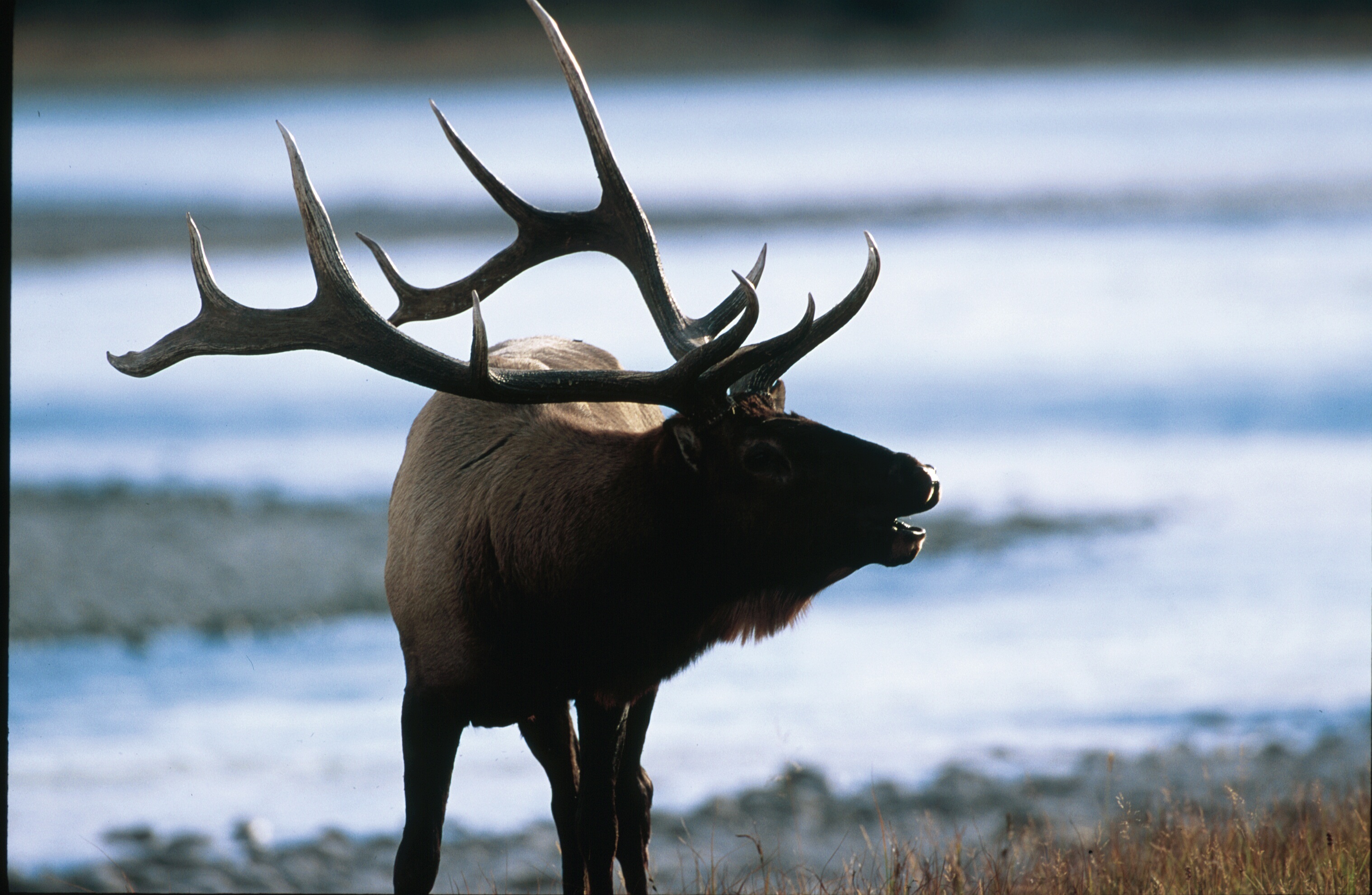
Autumn in elk country would not be complete without the stirring sound of solicitous bulls bugling-in the season of brightly colored leaves, shorter days and cooler nights. Nothing, save for the clamor of great flocks of Canada geese, trumpeter swans or sandhill cranes announcing their southward migration, is more symbolic of the time of year. And just as any pond or river along their flyway devoid of the distinctive din of wandering waterfowl seems exceedingly still and empty, any forest or field bereft of the bugling of bull elk feels sadly deserted and lifeless.

Yet there are broad expanses of the continent, once familiar with these essential sounds of autumn, where now only the blare of gunfire resounds. By the end of the nineteenth century, the great wave of humanity blowing westward with the force of a category five hurricane—leveling nearly everything in its destructive path—had cut down the vast elk herds, leaving only remnants of their population in its wake.

Nowadays, a different kind of rite rings-in the coming of autumn across much of the land. Following in the ignoble footsteps of their predecessors who hunted to extinction two subspecies, the Mirriam’s and the Eastern elk, nimrods by the thousands run rampant on the woodlands and inundate the countryside, hoping to relive the gory glory days of the 1800s.

On the way back from a trip early last evening I saw one such nimrod as I turned at the local mini-market on the final stretch home. I have no doubt in my mind that he was parked there just to show off his kill; the antlers of a once proud, now degraded and deceased bull elk were intentionally draped over the tailgate of the assassin’s truck—clearly on display.

I can’t say that I see just what the hunter was so proud of. It’s not like he personally brought down the mighty animal with his bare hands. Elk follow a pretty predictable path this time of year, and the bulls are distracted and preoccupied with escorting their harems around. Taking advantage of them during their mating season is about as loathsome as anything a human can come up with (and that’s saying a lot).

All a deceitful sportsman has to do is blow an imitation elk bugle to lure a competitive bull within range of their tree stand or wait in hiding above the herd’s traditional trail to the evening feeding grounds. When the procession passes by (right below the camouflaged killer’s perch), the most challenging thing for the sniper is deciding which individual animal to shoot or impale with an arrow.

The fact that they let groups of cows and young spike bulls pass by and wait for the largest, “trophy” bull is proof positive that they’re not hunting for food, but rather for sport—and for bragging rights.

____________________________

The first portion of this post was excerpted from the chapter, “The Fall of Autumn’s Envoy,” in the book, Exposing the Big Game: Living Targets of a Dying Sport

Text and Wildlife Photography ©Jim Robertson

Homo sapiens is No Ordinary Species

When did big game hunters first start driving other species to extinction? If you go by the Young Earth Creationist’s calendar, even before the dawn of time. In this, the third installment of our series on detrimental denial, we’re going to look at how hunting by humans has been wiping out our fellow animal species since the earliest of times.

According to Richard Leaky and Roger Lewin, authors of The Sixth Extinction: Patterns of Life and the Future of Humankind, “…In recent years it has become undeniable that the evolution of Homo sapiens was to imprint a ruinous signature on the rest of the world, perhaps from the beginning periods.”

In a chapter examining the sudden loss of North American mammals, such as elephants, mastodons, giant sloths, horses, camels and the American lions, paleoanthropologist Leaky and his co-author wrote: “Within a flicker of geological time, between 12,000 and 10,000 years ago, these animals were among some 57 similarly large mammal species to go extinct in North America while a much larger number did so in the southern continent.”  In naming the culprit, Leaky went on to say that stone-aged peoples’ “…north to south population expansion left a trail of destruction, as hunters were easily able to kill large, lumbering prey unused to a new kind of predator. The animals probably had no innate fear of humans, as is often the case in regions of the world that have evolved in the absence of humans; they would therefore have been particularly vulnerable to efficient hunters.”

In the mid-1800s, Scottish geologist Sir Charles Lyle noted of the disappearance of so many North and South American megafauna, that human hunting “is the first idea presented to the mind of almost every naturalist.” But it wasn’t until 1911 that Alfred Russel Wallace, co-developer of the theory of evolution and natural selection, decided, “I’m convinced that the rapidity of…the extinction of so many large mammalia is actually due to man’s agency.”        

Expounding on that concept, University of Arizona paleontologist Paul Martin in 1967 dubbed the over-kill hypothesis the “Pleistocene over-kill.” He noted that the megafaunal extinction phenomenon coincided exactly with the arrival of prolific human hunters armed with new technology: the Clovis spear-points, along with the spear thrower or Atlatl, which (like the “Chuck-it,” a popular kind of tennis ball thrower used in playing fetch with dogs inclined to retrieve) greatly increases throwing distance and accuracy.

Martin calculated that during their southward advance, human numbers could have grown to 600,000 within the 350 years it took them to reach the Gulf of Mexico and to many millions by the time they reached the southern tip of South America, within 1,000 years.

UCLA physiology professor and author, Jared Diamond, concurs with the Pleistocene overkill theory in his book, The Third Chimpanzee: the Evolution and Future of the Human Animal, “…the interpretation that seems most plausible to me, the outcome was a ‘blitzkrieg’ in which the beast were quickly exterminated—possible within a mere 10 years at any given site. If this view is correct, it would have been the most concentrated extinction of big animals since an asteroid collision knocked off the dinosaurs sixty-five million years ago. It would also have been the first of a series of blitzkriegs that marred our supposed Golden Age of environmental innocence and that have remained a human hallmark ever since.”

But the theory is not without its detractors, most notably those who blame climate change alone (the Earth was entering into a post-glacial period) as the driving force of that extinction event, and those who date the arrival of Paleo-Indians in the Americas much earlier.

Leaky addresses the latter with: “It is possible to imagine a series of migrations into North America when glaciation lowered sea levels sufficiently to expose the Bering land bridge that joins Alaska with Siberia. Pre-Clovis entry may have been sparse; in any case, the archaeological imprint implies that significant population growth did not result from them. Only with the coming of the Clovis people does the evidence suggest rapid population expansion, in numbers and in territory occupied. Whatever the date of the first entry, it does not detract from the overkill hypothesis linked to the end-Pleistocene expansion of the Clovis people.”

Meanwhile, Paul Martin addresses the climate issue with: “If ice age climate changes were important in determining the extinction of American large mammals, it is not obvious why earlier glaciations and interglacial warm-ups were unaccompanied by faunal losses.” But the case of the North American wooly mammoth may be the most damning of all to the climate-change-alone theory. An ice-age adapted species that disappeared from most of its range at the end of the Pleistocene epoch 10,000 years ago, isolated populations of the wooly mammoth were able to go on living on St. Paul Island, Alaska, up until just a few thousand years ago, roughly 3750 BC, and on Wrangel Island until 1650 BC—again, coinciding with the arrival of the first humans to those locations.  

Contemporary researchers, such as John Guilday, suggest that the extinctions could be a result of a combination of the deadly impact of human hunting and a changing climate. As he put it, “In any event their combined effect was devastating, and the world is much the poorer.”

Like the global warming skeptic who isn’t comfortable placing blame on human activity for changing the Earth’s climate to the detriment all, the Pleistocene overkill denier has a hard time accepting that humans are responsible for diminishing biodiversity by hunting species to extinction. And some folks might wonder, ‘what’s the point of digging up the past, unearthing the dark side of primitive cultures that we’ve grown fond of thinking of as noble and beyond reproach?’ As Richard Leaky explains, “…human colonization of pristine lands is an extreme example of an invading species and the consequences of that invasion on existing [animal] communities. Mature, species-rich communities can often resist invasion attempts by most species. But Homo sapiens is no ordinary species, and its attempts at invasion are almost always successful and almost always devastating for the existing community. If we are to assess the impact that humans are having on the world today, we need a historical perspective.”

And Paul Martin adds, “The distinction between African and American Pleistocene extinctions is seen in the difference between gradually developing [humans] evolving for millions of years with large animals on one continent, compared with the onslaught of a highly advanced hunting society at the height of its power suddenly arriving on the other. Had America rather than the Old World been the center of human origins, the late Pleistocene record of extinction might well have been reversed.”

In other words, the overkill hypothesis is not meant to just pick on the Paleo-Indians, the Paleo-palefaces were cut of the same loin cloth. Unpopular as the subject may be, the only way to get to the root of the problem of human hunting is to cast off the Rousseauean fantasy that primitive hunting was somehow acceptable or harmonious. No other natural predator launched lethal projectiles from a distance or torched the landscape to drive entire herds of animals off cliffs.