A Bit of Animal Trivia

Everyone likes a bit of trivia. Well, maybe not everyone; you may be the one person who doesn’t. Come to think of it, I don’t really enjoy trivia all that much myself. But anyway, like it or not, here’s some trivia for you…

1) What is the fastest growing bone tissue on Earth?
Answer:  Deer antlers

2) Which wild animal carries a dominant gene affecting their appearance that was acquired from their domesticated cousins?
Answer: Wolves. The wolf got their gene for black fur (found nearly exclusively in North American wolves) from dogs brought over with the earliest people to inhabit this continent.

3) What animal can detect odors up to 5 miles away; can hear both low and high frequency sounds beyond human capabilities and has 360 degree panoramic vision?
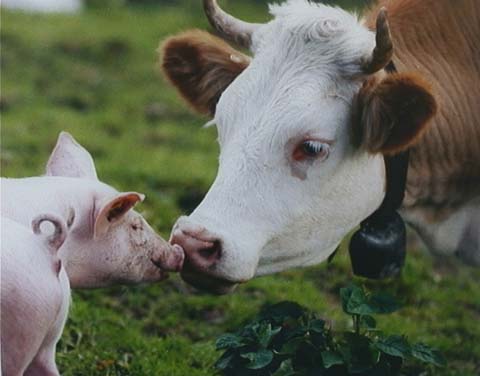
Answer: Cows. They also form friendships and are devoted mothers and will walk upwards of five miles in search of their calves.

4) A few centuries ago, this animals’ droppings were considered the best available fertilizer and therefore were protected by armed guards?
Answer: Pigeons

5) Which marine animal can live up to 100 years, uses complicated signals to establish social relationships, and sometimes travels hand in hand, the old leading the young?
Answer: Lobsters

6) When this animal gets injured or sick, his or her mate, and sometimes a comrade or two, will stay by their side until they are able to recover or pass on.
Answer: Canada goose

7) Which animal has the ability to learn the precise details of an area of over 1000 acres?
Answer: The turkey

8) Which dog breed was an American favorite in the early 20th century, featured as a child’s best friend and constant companion on TV and in movies, and can now be found in hospitals and nursing homes as a registered therapy animal?
Answer: The Pit Bull Terrier

9) What creature has some so paranoid that they’ve had protective enclosures—modeled after shark cages—built at school bus stops?
Answer: The Mexican Wolf in Catron County, New Mexico

10) Which animal species secretly communicates with one another through their flatulence?
Answer: Herring. Many species of fish have devised creative forms of communication and recent research has shown fish have a more complex nervous system than was previously accepted.

Bonus Question) While so many others dwindle, which group of animals has been steadily on the increase over  the years, now surpassing 150 billion?
Answer: Those consumed by humans each year.

turkey-factory-farming

Just Call Me a Cow Hugger

People often ask if I get a lot of uninvited remarks from anti-wolf or pro-hunting trolls. The answer is, not as many as you might think. It seems the smart hunters (again, not so many as you might suppose) know better than to waste their time writing to this blog, since any pro-kill comments go straight to the cyber-round file never to reach the light of day. I usually know right away which comments are from hunters; they’re the ones that start off with, “You people are all a bunch of tree huggers…” (Guilty as charged.)

But there are others whose comments also deserve being jettisoned off the cyber-map. I’m talking about those single-minded “wolf people” who blame the cows themselves for the persecution of wolves, as though cows enjoy their lot in life and are part of a grand conspiracy against predators, in league with the very ranchers who brand, dehorn and ultimately slaughter them. These one-note wolf folks should know that not only am I a tree-hugger and a wolf-lover, I’m also a bunny, deer and cow hugger.

In an earlier post, entitled “Animal Industry = Animal Abuse,” I wrote of hearing the cows lowing for their calves. Tonight I’m hearing it again. To me, the sounds they make are every bit as mournful as the howling of wolves, and for good reason. Not only are cows raised just to be killed and eaten by humans, theirs is a lifetime of abuse at the hands of man. Forcibly impregnated, many cows see their calves snatched away just as they start to bond with them. Unlike their wild ancestors, they’re never allowed to freely migrate to wherever conditions are more favorable for them. There are always barbed wire fences, or some bully on horseback or four-wheeler bossing them around or telling them where to go.

Taking it out on the cows (as a psychiatrist in Arizona  did when he killed seven cows in his driveway) is like wishing ill on caged elephants because you disagree with zoos or on rabbits because you hate animal experimentation. Slave auctions were repugnant because people were “treated like cattle.” Well, why should any sentient being be bought and sold like chattel? But no abolitionist ever wished harm on the slaves themselves…

The cows didn’t choose to be born in wolf habitat; they’re there because some fourth generation rancher’s forefather killed off the original wolves, claimed the land and stuck cows on it. If you want to blame someone, blame today’s ranchers for continuing the practice.

In other words, pick on someone with your own brain size. Cows know all they need to know to be a cow. A cow will never be born the next Einstein, but by the same token, no cow will ever be the next Hitler, Ted Bundy or Ted Nugent.

1379284_544626882259670_451791472_n

Relative Radicalism

All things are relative, and that includes radicalism. Do I go too far, or not far enough? That depends on who you ask. Ask a hunter, and I’m an extremist “anti”; in the eyes of the everyday meat-eater, I’m a vegan food Nazi.

But to an actual radical—one of the die-hard few who won’t be happy until every cage is empty, every cattle ranch is bankrupt, every mink is freed and every fur farm burned to the ground—well, I’m probably considered too fuckin’ nice. It’s not that I don’t want to see every hog farm abandoned, every layingcage_1 hen liberated, every trap melted back into pot metal, every trophy hunter prosecuted and every meat-eater veganized.

I guess I just don’t have that much faith in humanity.

I can’t get past the feeling that the only way all this human evil’s gonna end is when the species goes completely under, due to, say, a pandemic, major drought, storms or food shortage—the kind of things we’re likely to see as the climate keeps changing for the worse.

I’m not saying we shouldn’t try to do everything humanly possible (within reason) to stop the coming global train wreck, but meanwhile, I’m going to continue to secretly hope Mother Nature will hurry up and get her shit together to make right her biggest mistake. She’s been an overly permissive parent to the spoiled species Homo sapiens thus far, letting them get away with uncontrolled, selfish misbehavior.

It’s about time for her to rein in the over-intelligent, under-compassionate, over teched, under-ethical killer ape, even if she has to throw out the baby with the bath water.


Factory Farm Legacy: Animal Torture, Water and Air Pollution and Antibiotic-Resistant Superbugs

From: Organic Consumers Association, September 18, 2013

For related articles and more information, please visit OCA’s Factory Farming page and our Food Safety page.

The days of the small farmer raising his cattle, hogs and hens on green pastures are long gone. Today America’s farming landscape resembles a windowless, animal gulag system filled with metal sheds, wire cages, gestation crates and confinement systems.

Factory farms aren’t about feeding the hungry or harvesting healthy food. They’re about maximizing profits for a handful of the world’s largest agribusiness corporations, and the biotech and pesticide companies that fuel their factories and feed their animals.

Today, nearly 65 billion animals worldwide, including cows, chickens and pigs, are crammed into CAFOs and slaughtered annually. These animals are literally imprisoned and tortured in unhealthy, unsanitary and unconscionably cruel conditions.

Factory farms produce unhealthy animals. And unhealthy people. About 80 percent of all antibiotics used in the U.S. are used on factory farms, either to prevent disease or stimulate growth. Meanwhile, about 70,000 Americans die each year from “superbugs” that have developed a resistance to antibiotics.

Animal Torture Chambers

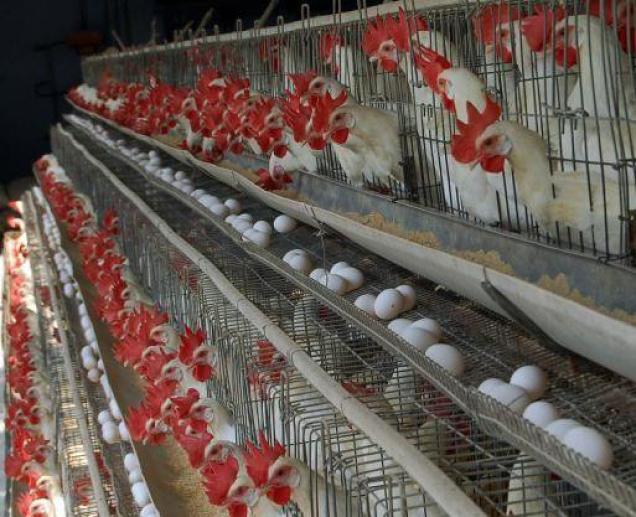
Over 300 million: The number of laying hens in the United States; of these, some 95 percent are kept in wire battery cages.

67: The average number of square inches of space allowed in each hen’s wire battery cage – less than the size of a standard sheet of paper.

72: The number of square inches of space a hen needs to be able to stand up straight.

303: The number of square inches a hen needs to be able to spread and flap her wings.

2 ft: The width of a factory farm sow cage – too small for them even to turn around or lie down comfortably.

2 ft.: The width of a factory farm cage for calves who are raised for veal.

None: The time provided to chickens and hogs raised in factory farms to spend outdoors, breathe fresh air or experience natural light.

None: The time provided to dairy and beef cattle to graze in a pasture where they could express their natural behavior (and ideal diet).

80: The percentage of antibiotics used in the United States that are given to farm animals, as a preventative measure or to stimulate growth. Growth stimulants are prohibited in Europe, but not here.

23 million: The number of pounds of antibiotics added to animal feed every year, to make the animals grow faster.

875 million: The number of U.S. animals, or 8.6%, who died lingering deaths from disease, injury, starvation, suffocation, maceration, or other atrocities of animal farming and transport.

Endangering Human Health

220 billion: The number of gallons of animal waste dumped by factory farms onto farmland and into our waterways every year.

73,000: The number of E. coli and salmonella outbreaks in 2007.

70,000: The number of Americans that die every year because of force-feeding animals antibiotics that helps breed antibiotic-resistant “superbugs.”

5,000: The number of deaths per year from food borne illnesses in the U.S.

4.5 million: The approximate number of Americans exposed to dangerously high nitrate levels in their drinking water. Agricultural Waste is the number-one form of well-water contaminants in the U.S.

14: The percentage of factory farm chickens that tested positive for
salmonella.
68: The percentage of chickens with salmonella that showed resistance to one or more antibiotics.

40: The percentage of cows in industrial dairies that are injected with genetically engineered recombinant bovine growth hormone (rBGH) to increase their milk yields.

70: The percentage of chicken producers that used the toxin roxarsone in their feed additives between 1995 and 2000.

3: The number of cases of mad cow disease identified in cattle in the U.S. — in December 2003, June 2005, and March 2006.

Over 90: The percentage the U.S. Department of Agriculture (USDA) scaled back testing for mad cow disease starting in the fall 2006, claiming that testing was expensive and detection of infected cows was rare.

Nearly 43: The percentage of large-scale dairies (over 500 head) that used rBGH on their cows in 2007, compared to 30 percent of mid-sized dairies, and nine percent of small dairies.

Sources:
Antibiotics are widely used by U.S. meat industry, Consumer Reports
Report: Bacteria in chicken too high, Consumer Reports
10 Reasons to Fear Your Food Supply, Takepart.com
Factory-Farmed Chickens: Their Difficult Lives and Deaths, Britannica Advocacy for Animals
CAFO’s Uncovered, Union of Concerned Scientists

Zack Kaldveer, Assistant Media Director for the Organic Consumers Association, compiled these statistics.

_________________

And From the UK Guardian:

Mad cow, bird flu, pink slime? The bigger threat is antibiotics in our meat

23,000 people die each year in the US from overuse of antibiotics. We should regulate antibiotic use in agriculture


  •  Wednesday 18 September 2013
                                          Beef carcasses at a wholesale meat market in Paris
Beef carcasses at a wholesale meat market. Photograph: Francois Mori/AP

Remember pink slime – that Dayglo-bright mash of ground up meat scraps and cow connective tissues larded with industrial strength ammonia that was being served up in school lunch programs in the United States last year?

More ominously, there was mad cow disease, which has killed scores of people in Britain and elsewhere. Bird-flue outbreaks originating in poultry farms  in China and Southeast Asia have also led to periodic scares. And did I mention salmonella?

But these food-related scourges pale in comparison with another threat, which was the subject of a report released Monday by the US Centers for Disease Control: the spread of antibiotic resistant bacteria. In its first estimate of the scope of the problem, the CDC says that 23,000 people – and possibly many more than that – die in the US each year from infection by microorganisms that can no longer be controlled by our current array of antibiotics.

We’ve known for a long time that our chronic overuse of antibiotics is helping to create these dangerous new strains of bacteria. Public health officials worry that doctors are routinely overprescribing powerful broad-spectrum antibiotics for everything from stomach aches to common colds. The CDC report says that 50% of all the antibiotics prescribed for people are not actually necessary.

But antibiotics are not just overused in medical care; we’re also feeding them indiscriminately to cows, pigs and chickens. Fully 80% of the antibiotics sold in the US are administered to farm animals in their water and feed. The use of these drugs in agriculture is virtually unregulated, according to Keeve Nachman, the director of the Center for a Livable Future at Johns Hopkins University.

Nachman told me that we don’t know exactly what antibiotics are being used in meat production, or how large the doses that are administered are. Even more critically, we don’t know how much of these antibiotics remains in the meat that we eat. There is no requirement to routinely test for this. Eating meat, even with low doses of antibiotics, he warns, may lead to the spread of antibiotic resistant bacteria in our own guts, if the meat is mishandled or undercooked.

There is also ample evidence that the overuse of antibiotics has created resistant bacteria in the external environment. Studies have shown them in water downstream from livestock farms, as well as in the air and soil near facilities where antibiotics are used. Nachman himself published a study yesterday in the journal JAMA Internal Medicine that shows that people living near swine production sites are more likely to be infected with the superbug MRSA (Methicillin-Resistant Staphylococcus aureus).

In light of these risks, the CDC report says pointblank:

The use of antibiotics for growth is not necessary, and the practice should be phased out.

Most antibiotics currently used on farms are not for the treatment of sick animals, or even the prevention of disease, but to promote the growth and weight of livestock. Until recently scientists didn’t know how antibiotics stimulated growth. However, a study published in the journal Nature last year helped to clear up this mystery.

New York University researchers found that antibiotics have a big impact on what is called the microbiome, the teeming ecosystem of billions of diverse bacteria that live within the gut. Not only do they kill off many valuable microorganisms, but they also apparently alter the ability of some gut bacteria to metabolize carbohydrates. With the result that mice that the scientists fed antibiotics fattened up, just as as livestock do.

So if animals typically put on weight when they take antibiotics, what about humans? A study published in the Journal of Obesity found a strong correlation between exposure to antibiotics in childhood and later obesity. But that may not be the worst of it. Evidence is also mounting that low microbial diversity in the gut is associated with a whole range of inflammatory illnesses including heart disease, type 2 diabetes and cancer.

With all of these dangers deriving from our overuse of antibiotics, Keeve Nachman argues that the time has come to get serious about regulating them. He says:

The FDA has proposed a voluntary program in which the pharmaceutical companies are asked to give up their drug approvals for purposes of growth promotion and to relist them for purposes of disease prevention.

But Nachman calls this “essentially a shell game” which will change how the drugs are labelled, but not the way they are actually used in animals.

To solve the problem, he says, we’ll have to ban antibiotics except in actual cases of illness. Farmers should be required to get a prescription from a veterinarian, much as you and I need a prescription from their physician before we can use the drugs.

There are already several European countries that have banned the indiscriminate use of antibiotics in meat production. But so far neither Congress nor regulators in the US have been willing to stand up to the livestock lobby and protect the public’s health.

In Relation to Animals, All People Are Narcissists

The protagonist in Nobel Peace Prize laureate and author Isaac Bashevis Singer’s book, The Letter Writer, stated, “In relation to animals, all people are Nazis.”

Ah, the Nazis; who can forget them? They were those goose-stepping narcissists who had the arrogant audacity to think themselves superior to all other races. Hell, “Nazi” even sounds like a derivative of the word “narcissism.” Thank God that kind of grandiosity is a thing of the past.

Or is it…

Not if you, like Isaac Singer, consider the attitudes human beings have toward their fellow animals. When you allow yourself even for a moment to ponder the plight of non-humans at the hands of man and connect the dots, you’re sure to come to the logical conclusion that: in relation to animals, all people are Narcissists.

Although Galileo and Copernicus have long since put to rest the notion of Earth as the center of the universe, so engrained is the belief that humans themselves are the center of all things that they even imagine their omnipotent creator in the image of man. (When the Good Lord was handing out personality disorders, he must have decided to make humankind the narcissists of the animal kingdom—in His image, perhaps.)

So what’s the problem with people having this perception of prowess, self-importance and excessive sense of entitlement (undeserved as they may be)? As those who study aberrant behavior have found, like the Nazis, the vast majority of serial killers have overblown narcissistic tendencies. While the serial killer objectifies his human victims, the human species is comfortable exploiting other Earthlings for their own selfish gains—no other life forms seem to matter much in the human scheme of things. The human race as a whole considers only the treatment of their own kind worthy of consideration.

Instantaneous creation and miraculous wand waving aside, how did Homo sapiens become so narcissistic as a species? It has been well established that hunters share many of the behaviors and rationalizations of serial killers. Although most people don’t live by hunting any more these days, a long, long history of proving oneself the baddest spear-throwing, fire-wielding, big game hunter on the planet doesn’t fade from the collective psyche overnight. No wonder the species has been so quick throughout history to take advantage of every other animal with such indifference to their needs or feelings. All others are just background—props on their stage.

Never before in the history of mammals have seven billion large, terrestrial, meat-eating members of one species single-handedly laid waste to so much of the Earth’s biodiversity. Human carnivorousness is killing the planet one species at a time, one ecosystem after another. Yet meat has never been so readily available worldwide. That’s because living conditions for farmed animals has taken a backseat on the bus of human hedonism. For all the recent advances made in regards to human rights, the treatment of non-humans has never been more deplorable and demonic.

Like the ordinary German civilian who chose to look the other way during the Holocaust, the everyday meat-eater chooses to remain willfully ignorant of today’s ongoing atrocities. But some who choose a vegetarian or vegan diet purely for their health can be about as narcissistic as a meat-eater.

Even the severely deformed and consequently down-trodden title character in David Lynch’s classic film, The Elephant Man, voiced his perceived human superiority when he told a gawking crowd, “I am not an animal! I’m a human being!” Of course he was an animal, and so are you, and so am I. I’m proud to be an animal. I’m sure if John Merrick, “the elephant man,” had had a chance to get to know many non-human animals, he would have realized that most animals are far more accepting and less judgmental than the average human.

Edgar Kupfer-Koberwitz, a conscientious objector and Holocaust victim who was sent to a concentration camp for “being a strong autonomously thinking personality” wrote in his Dachau Diaries, “I have suffered so much myself that I can feel other creatures’ suffering by virtue of my own…I believe as long as man tortures and kills animals, he will torture and kill humans as well—and wars will be waged—for killing must be practiced and learned on a small scale.”

Human beings are unique only in the extent of cruelty and destruction they inflict. While each and every human being does not suffer from narcissistic personality disorder, the species Homo sapiens is a lot more like a narcissist than a Galileo or Copernicus.

Isaac Bashevis Singer was one of those who was able to shed his deep-rooted human narcissism, a fact made clear by his statement in Judaism and Vegetarianism, “I am a vegetarian for health reasons – the health of the chicken.”

poultry_845904f_jp_1463316f

And We Call Ourselves Civilized?

In agreeing with President Obama’s plan to strike Syria, Representative Nancy Pelosi was quoted as saying we must respond to actions “outside the circle of civilized human behavior.” Nice to hear that the U.S. Government thinks it has the moral authority to respond to such actions. While they’re at it, I can think of a whole lot of other actions which should be considered “outside the circle of civilized human behavior” that are desperately in need of responding to.

I’m referring, of course, to the innumerable abuses of non-human animals by humans—many that go on every day right here in the U.S. of A. I’m afraid if I were to try to list all the instances of human mistreatment of other animals which should fall outside the “circle of civilized human behavior,” the pages would fill the halls of justice, spill out onto the streets and overflow the banks of Potomac River in an unending tsunami of savagery.

So here’s just a partial list…

Wolf Hunting—No sooner did grey wolves begin to make a comeback in the Lower 48 than did the feds jerk the rug out from under them by lifting their endangered species protections and casting their fate into the clutches of hostile states. Now, hunters in Wyoming have a year-round season on them while anti-wolf fanatics in Montana have quadrupled their per person yearly kill quota.

Trapping—Only the creepiest arachnid would leave a victim suffering and struggling for days until it suits them to come along for the “harvest.” Yet “law abiding trappers” routinely leave highly sentient, social animals clamped by the foot and chained to a log to endlessly await their fate.

Hound-Hunting—“Sportsmen” not content to shoot unsuspecting prey from a distance of a hundred yards or more sometimes use hounds to make their blood-sport even more outrageously one-sided.

Bowhunting—Those who want to add a bit of challenge to their unnecessary kill-fest like to try their luck at archery. Though they often go home empty-handed, they can always boast about the “ones that got away”… with arrows painfully stuck in them.

Contest Hunts—Prairie dogs, coyotes, and in Canada, wolves, are among the noble, intelligent animals that ignoble dimwits are allowed to massacre during bloody tournaments reminiscent of the bestial Roman Games.

Horse Slaughter—After all that our equine friends have done for us over the centuries, the administration sees fit to send them in cattle trucks to those nightmarish death-camps where so many other forcibly domesticated herbivores meet their tragic ends.

Factory farming—Whether cows, sheep, pigs, chickens or turkeys, the conditions animals are forced to withstand on modern day factory farms fall well outside even the narrowest circle of civilized human compassion. To call their situations overcrowded, inhumane or unnatural does not do justice to the fiendish cruelty that farmed animals endure each and every day of their lives.

Atrocious conditions are not confined to this continent. Chickens in China (the ancestral home of some new strain of bird flu just about every other week) are treated worse than inanimate objects. Bears, rhinoceros and any other animal whose body parts are said to have properties that will harden the wieners of hard-hearted humans are hunted like there’s no tomorrow. And let’s not forget the South Korean dog and cat slaughter, or Japan’s annual dolphin round up…

Far be it from me to belittle the use of chemical weapons—my Grandfather received a purple heart after the Germans dropped mustard gas on his foxhole during World War One. I just feel that if we’re considering responding to actions “outside the circle of civilized human behavior,” we might want to strike a few targets closer to home as well. Or better yet, reign in some of our own ill-behaviors so we can justifiably call ourselves “civilized.”

Text and Wildlife Photography ©Jim Robertson, 2013. All Rights Reserved

Text and Wildlife Photography ©Jim Robertson, 2013. All Rights Reserved

We’re All Individuals

[This goes for observing animals in the wild as well.]

August letter by Robert Grillo, Free from harm.org

Visiting a sanctuary is a vastly different experience than visiting a farm. Farms value animals to the extent that they produce a profitable product via their flesh, mammary gland secretions or ovulation. Visiting animals on farms does not produce any “breakthrough” in our understanding of animals. On the contrary, most people simply walk away from a farm reaffirming what they have been taught: animals don’t object to being used as resources. It’s natural and sanctified by ancient traditions. Somehow, we rationalize, animals have passively accepted their lot in life. On farms, we view meek or fearful animals from a distance or on the other side of an electrical fence, typically in herds or flocks with ear tags (numbers instead of names), and under conditions which generally repress their ability to express themselves as individuals.

Yet, each animal is a self-aware individual with a unique personality – a complex of experiences, interests, emotions, thoughts, memories, likes, dislikes, desires, joys, fears, loves, families, friends, losses and pains. How do we know this? From sanctuaries and from science.

On a sanctuary, animals are individuals who, like human beings, have intrinsic value and who have no expectations placed on them. The owners are replaced by guardians who provide a caring environment that empowers them with the confidence to more authentically express their true selves. People can walk away from sanctuaries often with a “breakthrough” understanding. They recognize that these individuals are vastly more expressive, more sophisticated than their repressed counterparts on farms. They see much of themselves in these animals. They realize that the stereotypes they’ve come to believe all of their lives are based on prejudice.

Every animal-eating culture around the world has developed, over the course of centuries, a set of oppressive beliefs and traditions to deny animals – not only their identity as individuals – but also the right to exist itself, with the exception of their abbreviated lives as a human resource. Humans treated this way are appropriately called slaves. Humans killed in the manner in which animals are slaughtered is appropriately called an atrocity.

“Many who readily condemn human victimization as “heinous” or “evil” regard moralistic language as sensational or overly emotional when it is applied to atrocities against nonhumans. They prefer to couch nonhuman exploitation and murder in culinary, recreational, or other nonmoralistic terms. That way they avoid acknowledging immorality. Among others, Nazi vivisectors used the quantitative language of experimentation for human, as well as nonhuman, vivisection. Slaveholders have used the economic language of farming for nonhuman and human enslavement.” – Joan Dunayer, from her essay entitled English and Speciesism.

Many people will never have an opportunity to visit a sanctuary in person. The virtual visit we are developing for our online community is the next best thing to being there, providing a powerful way for potentially millions of people to reconnect with animals.

524958_3325028303604_654533903_n

Condemning the USDA’s Decision to Slaughter Wild Turkeys

http://freefromharm.org/animal-cruelty-investigation/weighing-in-on-the-usdas-fish-wildlifes-decision-to-slaughter-wild-turkeys/#sthash.fWYeWk8O.dpuf
By Robert Grillo  –  August 15, 2013
Upon discovering a story entitled Feds round up wild turkeys on Staten Island for slaughter, I felt compelled to comment. Please consider leaving a comment as well:

Let’s call this practice what it is: a transparent form of speciesism. In other words, if you’re another species, and you get in our way or become a “nuisance” to us, we’re going to massacre you — not because we have to, but just because we can.

Might makes right. That’s the underlying premise for treating other species like trash, killing them off when they get in our way, destroying their habitat so we can play golf, breeding more so we can use them for target practice, taking away the babies of others so we can view them in captivity for our own amusement, breeding billions of others through artificial insemination so we can destroy their lives in their youth in a slaughterhouse, emptying our oceans of trillions of sentient life forms so we can buy a can of tuna, and then subjecting millions of others to needless pain and suffering in lab experiments intended to find cures for the diseases caused by eating them. We create all of our own conflicts with animals. We create a staged competition with other species to use as a pretext for destroying their lives, “for our own protection,” of course. I rescue and raise chickens and other birds that come from a kill shelter.

The germaphobe chicken keepers in this comment string have got things a little twisted. They blame the victim, not the perpetrator. They blame the birds for defecating. They excuse themselves for a much more egregious offense: buying and using them for their eggs and flesh directly from the hatcheries — the cruelest industries on earth — which creates the problem in the first place. Think for a moment how that victim blaming serves us. Voltaire famously wrote that “If we believe in absurdities, we shall commit atrocities.” What a prophetic statement to describe the utter selfishness and sociopathic age we live in.

turkey-factory-farming

Exposing that Other Big Game: Cannibalism

People were appropriately appalled at recent news that Syrian rebel leader, Abu Sakkar, ate part of a government soldier’s innards in a primitive display of human evil possibly unrivaled on film (aside from those clandestine videos taken in slaughterhouses to expose animal cruelty, or the footage wolf hunters themselves spread around the internet to impress their buddies and sicken wolf-advocates).

Cannibalism, an abhorrent, aberrant act practiced by carnivorous humans in one form or another the world over since the earliest of times (according to archaeological finds), has fallen out of fashion today for all but the most warped, serial killer-types.

In a new, almost apologetic article called Face-to-face with Abu Sakkar, Syria’s ‘heart-eating cannibal,’ BBC’s Paul Wood tells of his meeting with the Hannibal Lecter of the Mid-East (safely restrained in a straightjacket and hockey mask, one would hope)……

It sounded like the most far-fetched propaganda claim – a Syrian rebel commander who cut out the heart of a fallen enemy soldier, and ate it before a cheering crowd of his men. The story turned out to be true in its most important aspect – a ritual demonstration of cannibalism – though when I met the commander, Abu Sakkar, in Syria last week, he seemed hazy on the details.

“I really don’t remember,” he says, when I ask if it was the man’s heart, as reported at the time, or liver, or a piece of lung, as a doctor who saw the video said. He goes on: “I didn’t bite into it. I just held it for show.”

[A quasi-denial reminiscent of Bill Clinton’s bogus, “But I didn’t inhale” defense.]

The video says otherwise. It is one of the most gruesome to emerge from Syria’s civil war. In it, Abu Sakkar stands over an enemy corpse, slicing into the flesh.

“It looks like you’re carving him a Valentine’s heart,” says one of his men, raucously. Abu Sakkar picks up a bloody handful of something and declares: “We will eat your hearts and your livers you soldiers of Bashar the dog.”

Then he brings his hand up to his mouth and his lips close around whatever he is holding. At the time the video was released, in May, we rang him and he confirmed to us that he had indeed taken a ritual bite (of a piece of lung, he said).

Now, meeting him face-to-face, he seems a bit more circumspect, though his anger builds when I ask why he carried out this depraved act.

“I didn’t want to do this. I had to,” he tells me. “We have to terrify the enemy, humiliate them, just as they do to us…”

Before the uprising, he was working as a labourer in Baba Amr. He joined the demonstrations when they started in the spring of 2011. Then, he says, a woman and child were shot dead at a protest. His brother went to help. He, too, was shot and killed.

Abu Sakkar seems unsure how to respond to his notoriety. He is, by turns, sheepish, nervous, angry and bitter. He definitely has the look of a man who has seen too many bad things. At the end of our interview he says he is an “angel of death” coming to cash in the souls of the enemy.

It is possible that Abu Sakkar was mentally disturbed all along. Or perhaps the war made him this way. War damages men – and Syria is no different.

As the poet W H Auden wrote: “Those to whom evil is done, do evil in return.”
…………………………..       HumanWeapons_170
Where will it all end?   Eating human organs (whether heart, lung or liver) out of hatred, rage, to steal another’s life force or to terrify one’s enemies, definitely amounts to evil in my book.

With very few exceptions, most animal species don’t eat others of their own kind. (Some species of gulls will scavenge on the remains of another washed up on the beach; on the other hand, wolves may kill wolves from other packs, but will not eat them.) But cannibalism is not such a stretch for a species like Homo sapiens which eats or has eaten everything that creepeth, swimeth or otherwise moveth on the Earth—from snails to whales and everyone in between.

Indeed, if ancient humans had video cameras, Abu Sakkar’s stunt would seem like small potatoes.

As recently as the early 1800s, New Zealand’s Maori people practiced warfare-related cannibalism, such as the type Sakkar resurrected. New Zealand was blissfully human-free until only a thousand years ago. The Maori were the first settlers of the islands, arriving by canoe several centuries before Europeans. Known for practicing cannibalism in the heat of “battle rage,” the Maori made it onto the list of the Top Ten cases of human cannibalism:

In October 1809 a European convict ship was attacked by a large group of Maori warriors in revenge for the mistreatment of a chief’s son. The Maori killed most of the 66 people on board and carried dead and alive victims off the boat and back to shore to be eaten. A few lucky survivors who were able to find a hiding spot inside the mast of the boat were horrified as they watched the Maori devour their shipmates through the night until the next morning.

North of Australia, an anthropologist studying the Mianmin, a mountain-dwelling tribe in Papua New Guinea, witnessed them carrying off the dead of a neighboring tribe, the Atbalmins, after a successful lethal raid and asked them, “Why?” The Mianmins told the scientist they considered them “good meat.” The Atbalmins were outsiders, different from the Mianmins, who thought of them as “game.”
Also in New Guinea, during the 1950s and ’60s, How Stuff Works tells us: anthropologists studying the Fore people of Papua New Guinea documented an outbreak of kuru, a degenerative spongiform brain disease. The Fore contracted the disease by consuming the brain of their relatives as part of a funerary ritual. Kuru, which is the human version of mad cow disease, is highly contagious.

The only reason cows ever acquired “mad cow disease” is that “beef” producers began the capitalistic ritual of grinding up animal flesh and mixing it with their feed to produce a high protein gruel, thus creating unwitting cannibalistic cattle (possibly the only thing more bizarre than human cannibalism itself).

Ted Turner (the T.V mogul, oldies colorizer, big-time bison-flesh-peddler and former hubby to fellow activist Jane Fonda) predicted in 2008 that unless we drastically curb global warming, by 2040 “…none of the crops will grow. Most of the people will have died and the rest of us will be cannibals,”

Turner also said the population is another problem that must be handled. “We’ve got to stabilize the population,” he told PBS interviewer, Charlie Rose, “We’re too many people. That’s why we have global warming. We have global warming, because too many people are using too much stuff. If there were less people, they’d be using less stuff,” he said.

He also launched verbal offensives against the U.S. war on terror, describing war as senseless and suggesting a cutback in military budgets. “Right now the U.S. is spending $500 billion a year on the military, which is more than all [other] 190 countries in the world put together.

The timing of Turner’s prediction might be a bit off the mark as far as complete crop failure, mass starvation and rampant cannibalism, but one thing’s for certain: as long as people continue to feed their taste for the flesh of others—whether hunted venison, free-range bison, grass-fed beef or factory-farmed pig meat—the thought of moving laterally to include their fellow man in their bill of fare will be much easier to swallow.

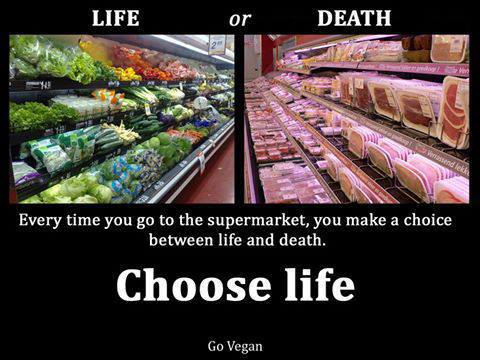
It certainly stands to reason that starving humans in future decades might eventually turn to the most numerous flesh foods available—other humans—for survival. But the vegan diet cuts out the middle man (so to speak), allowing for more plants and grains to go to feeding human beings themselves, rather than cows, pigs and chickens. The only solution to avoid a nightmarish future that includes the depravity of cannibalism and is to move beyond the evils of animal exploitation.
264431_455824994498980_1177070538_n

The Fate of Human Decency is on Your Plate

Well, I tried to hold true to my promise to swear off philosophizing, but I come across too many issues that need addressing to stay on that wagon for very long. The latest thing that got me thinking was a Facebook poster that read:

“I went to Subway today to get my favorite sandwich. The guy in front of me ordered a different sub. I was pissed because he didn’t get the same sub as me, even though it didn’t affect me in any way.
“This is what people sound like when they say gay marriage affects them.”

While I get it, and agree with the analogy in that context, I couldn’t help but think about the scenario in a literal sense. Ordering a Veggie Delite (hold the mayo and cheese) at Subway, I find myself getting pissed if the guy in front of me is ordering a Cold-Cut Combo sub. Not because it directly affects me, but because of the multitudes of sentient animals who endure miserable lives and horrible deaths to appease such hedonistic humans’ thirst for blood (and flesh and tissue and animal fat, etc.).

The sacred right to personal choice should be limited by the rights and interests of others. It’s not like I care whether someone’s food choices are unhealthy—hell they can smoke, drink or overeat to their heart’s content—as long as no one else suffers for their actions. And factory-farmed animals being served at fast-food restaurants suffer unimaginable conditions. Enslaved for life, a pig raised for bacon or sausage has no semblance of the kind of existence nature intended. The same goes for cows confined on feed lots, and chickens or turkeys de-beaked and crowded into windowless barns.

On a related note, last night I watched the Spielberg flick, Lincoln, and had a similar thought: although it’s inspiring to see how far we’ve come as a country in terms of accepting racial equality, we still have a long way to go in applying the notion of “equal under the law” to all of our fellow Earthlings. In order for society to truly stop living off the backs of the enslaved, the concepts spelled out by Thaddeus Stevens in the 13th amendment—that though all are not always equal in all things, they should be treated equally under the law—must apply to both human and non-human animals alike.

Just some food for thought next time you feel entitled to a meat-lover’s combo submarine sandwich. Every time you order from Subway, the “fate of human decency” is in your hands.

524958_3325028303604_654533903_n